4
Binomial distribution
4.1 Binomial theorem
From your knowledge of the distributive law:a(b + c)
=
ab + ac and its extension:(a + d)(b + c)
=
(a + d) b + (a + d) c = ab + bd + ac + cd we are able to multiply any number of binomial factors.(x + a)(x + b)
= x
2 + x(a + b) + ab ... (1) Note that each term in the expansion of (x + a)(x + b) is of two dimensions and is obtained by multiplying two letters, one from each of the two factors.(x + a)(x + b )(x + c)
=
x3 + x2(a + b + c) + x(ab + ac + be) + abc . . . (2) Each term in this expansion is of three dimensions and is obtained by multiplying three letters, one from each of the three factors. The term x3 is obtained by taking x out of each factor. The terms containing x2 are obtained by taking x out of any two factors and one of the letters a, b, c out of the remaining factor. The terms containing x are obtained by takingx
out of any one factor and two of the lettersa,
b,c
out of the remaining factors. The term independent of xis obtained by multiplying the three lettersa,
b,c.
Similarly it can be shown by multiplication that: (x + a)(x + b)(x + c)(x + d)
=
x4 + x3(a + b + c + d) + x2 (ab + ac + ad + be + bd + cd)+
x(abc + abd + acd + bed) + abed... (3) Each term in this expansion is of four dimensions and is obtained by multiplying four letters, one from each of the four factors. There is only one term containing x4
• Four terms containx3 because one letter can be selected from
a,
b,c,
din(1),
i.e. four, ways.Six terms contain
x
2 because two letters can be selected froma,
b,c,
din(i),
i.e. six, ways. Four terms contain x because three letters can be selected from a, b, c, din(1),
i.e. four, ways. The term independent of xis obtained by multiplying the four letters a, b, c, d.Example 1
Expand:a (x + l)(x + 2)(x + 3) b (x + l)(x + 2)(x + 3)(x + 4)
a (x + l)(x + 2)(x + 3)
=
x3 +(1 + 2 + 3)x2 + (1 . 2 + 1 . 3 + 2 . 3)x + 1 . 2 . 3=
x3 + 6x2 +llx + 6
Use the factor theorem to check this expansion. b (x + l)(x + 2)(x + 3)(x + 4)
=
x4 +(1 + 2 + 3 + 4)x3 + (1 . 2 + 1 . 3 + 1 . 4 + 2 . 3 + 2 . 4+
3 . 4)x2 +(1 . 2 . 3 + 1 . 2 . 4 + 1 . 3 . 4 + 2 . 3 . 4)x + 1 . 2 . 3 . 4=
x4 + l0x3 + 35x2 + 50x + 24Example 2
Find the coefficient of: a x3 b x2in the expansion of (x + 2)(x - 3)(x + 4)(x -5)(x + 6)
a The terms containing x3 are obtained by multiplying the x from a_ny_!!1_r�e fa�ors �nd the numerals, tw? at a time, from the remaining two factors. The�e are
G),
1:e. 10, ways of �electmg 3th� numeral.s.-2,---==---3,-4,-=-5 and-6,-�o �ta-t_1me. __ . . Coefficient of x
-l::_
3
=;!�;-}��t-�-'+l{�-���-f.
;!'-�--{
6= �
b The terms containing x2 are obtained by multiplying the x from any
two
factors and the numerals, three at a time, from the remaining three fact�ere areG),
i.e. 10, ways ��g the numerals 2, -3, 4, -5 and 6, three at a time. Coefficient of x2 = 2 . -3 . 4 + 2 . -3 . -5 + .2 . -3 . 6+
_2 .4.-5-+2.4.6+2 . -5.6+ -3.4. -5-+ -3, 4, 6
+
-3 ,_�_i_,-v6+
4., -5 :6= -
124 - -- �---- __ ,If, in (1) above, we put b
=
a
we get: (x + a)2=
x2 +(i)
xa + a2=
x2+
2xa+
a2 If, in (2), we put b= c
=
a, we get:(x + a)3
=
x3 +(i)
x2a + (�) xa2 + a3= x
3 + 3x2a + 3xa2 + a3 If, in (3), we put b=
c=
d=
a, we get:(x + a)4
=
x4 +(i)
x3a +{i)
x2a2 +{j)
xa3 + a4=
x4 + 4x3a + 6x2a2 + 4xa3 + a4In general, if n e N:
(x + a)n
=
Xn + (�) x11-1 a+ (;) xn-2a2 + ... + (;) xn-,a, + ... + 0n=
xn + nxn-la + n<;�11)xn-2a2 + .. .
n(n - 1)(n - 2) ... (n -r + 1)
+ ' . xn -r a' + . . . + an
r(r
- 1) . .. 3 . 2 . 1The expansion of (x + a)" is the product of n factors, each of which is x + a. Each term in the expansion is of n dimensions and is of the form x" -'a' where r
=
0, 1, 2, 3 ... n. The general term x" -'a' is obtained by selecting a out of any r factors and x out of the remaining n - r factors. This selection can be made in(;) ways. So the coefficient ofx" -'a' is ( ;) and by putting r = 0, 1, 2, 3 ... n in succession we obtain the coefficient of each term:
(x + a)" (�) x" +
(7)
x"-'a +G)
x"-2a2 + ... + (;) x"-'a'+ ... +
(n�
2)
x2a11-2 +(
n
�
1)
xa"-' + (�) a"f
(n)
x"-'a'r-0 r
The coefficients (�) and (�) are each equal to unity.
Some properties of the binomial expansion
(i) The expansion of (x + at contains (n + 1) terms of which ( n) x" -'a' is the (r + 1 )th term and is called a general term. r
(ii) If we write -a in place of a, we get:
(x - a)"
=
x" -(7)
x" -1a + (;) x" -2a2 - • • • + (;) x" -'( - a)' + ... + ( - a)"The terms are alternately positive and negative.
(iii) Putting x
=
1 and a=
x in the expansion of (x + a)" we get:(iv) (1 - x)" = 1 -
(7)
x + (;) x2- (;)
x3 + ... + (;) ( - x)' - ... + ( -x)"It can be shown by actual multiplication that: n = 0, (1 + x)0 = 1
n = 1, (1 + x)1 = 1 + x
n = 2, (1 + x) 2 = 1 + 2x + x2
n = 3, (] + x)3 = 1 + 3x + 3x2 + x3
n = 4, (1 + x)4 = 1 + 4x + 6x2 + 4x3 + x4
n = 5, (1 + x) 5 = 1 + 5x + 10x2 + 10x3 + 5x4 + x5
n = 6, (] + x)6 = 1 + 6x + 15x2 + 20x3 + 15x4 + 6x5 + x6
BINOMIAL DISTRIBUTION 115
The coefficients of the successive powers of I + x can be arranged in a triangular pattern, called Pascal's triangle.
(I + x)o (I + x)1 (I + x)2 (I + x)3 (I + x)4 (I + x)5
(I + x)6 6
2
3 3
4
' '
6 4 5'
�'
10@
@)
15Figure 4-1
5 6
Pascal's triangle has the following interesting properties: (i) The first and last number in each row is I.
(ii) Every other number is the sum of the two numbers to its left and right in the row above it, e.g.
10=4+6 15 = 5 + 10 20 = IO+ IO
These properties enable us now to write the expansion of (I + x) n for n
=
7, 8, 9, ... n = 7, (I + x) 7 = I + 7x + 2lx2 + 35x3 + 35x4 + 21x5 + 7x6 + x 7n = 8, (I + x)8 = I + 8x + 28x2 + 56x3 + 70x4 + 56x5 + 28x6 + 8x7 + x8
Let us rewrite the three bottom rows of Pascal's triangle using (;) notation. (I + x)4
(6)
(1)
(1)
(j)
(!)
(I + x)s
(�)
(I + x)6 (�)Example 3
Write the expansion of: a (a + 3b)4
b (x2 + 2y)3 C (2x -y)s
(�)
(D G) (D
(�)
(�)
_(�)
(�)
G)
a (a + 3b)4 = a4 +
(1)
a3(3b) +(1)
a2(3b)2 +(!)
a(3b)3 + (3b)4 = a4 + 12a3b + 54a2b2 + 108ab3 + 81b4b (x2 + 2y)3
=
(x2)3 +(i)
(x2)2(2y) +G)
x2(2y)2 + (2y)3 = x6 + 6x4y + 12x2y2 + 8y3
c (2x -y)s = (2.x-)5 -
(i)
(2x)4y +
G)
{2x)3y2 -(D
{2x)2y3 +(�) (2x)y4 -ys
=
32x5- 80x4y + 80x3y2 - 40x2y
3 + 10x y4 -y
5
.(�)
Example 4
Write the binomial expansion of:
a
(¾
+¼)
5
b(½
+½)
8
a
(¾
+¼)
5
=
(¾)
5
+(D (¾)
4
(¼)
+G) (¾)
3
(¼Y
+G)
(¾)
2
(¼)
3
+G)
(¾) (¼)
4
+(¼)
5
243 405 270 90 15 1
= 1024 + 1024 + 1024 + 1024 + 1024 + 1024 Note that the fractions in the expansion sum to 1. Why?
b
G
+½)
8
=
(½)
8
+(D Gr
(½)
+ (�)Gt GY
+ .. . +(½)
8
1 8 28 56 70 56 28 8 1
= 256 + 256 + 256 + 256 + 256 + 256 + 256 + 256 + 256
Example 5
Find the coefficient of x3y 3 in the expansion of (3x -2y)6
(4 = (�) (3x)3( -2y)3
Coefficient of x3y3
= �:;:
i.
33• (-2)3 = - 4320Exercises 4a
1 Expand:
a (x - l)(x + 2)(x + 3)(x - 4) b (x + 2a)(x - b)(x + 3c)
2 What is the coefficient of x3 in the product:
(x - 4)(x + l)(x + 3)(x -5)(x - 8)?
(:t
Find the coefficient of x3y2 in the product:, (x - y)(x + 2y)(x -3y)(x + 5y)(x -8y).
4 Find the coefficient of a2
b in the product:
5
(a -2b + c)(2a -2b + c)(a - 3b -2c). J;xpand:
ia .(x2
+ a)4 \
d (x2 -3y)6
b (2x -3y)5 ; 1 e - - -_,, 3 (a 3b )4
C (a+ ¾)4
f (2y + 3;)4
g (x2 _
�)
5 h (� + 3brii-o
•· J(f! _
b a!!)
sj
(½
+½)
5
k (0.6 + 0.4)4 ' I6 Find the following and simplify: G}the 4th term of (; - 3n) 8
;---\ 5
i c �he 3rd term of (a - 2b) \__/
7 Find the coefficient of:
b the 5th term of
(2; -
ix)
6d the 4th term of (x +
i)
n
(�)x17 in (2x2 - 3x>12 d a9 in (2a -
¾)
1
3
C �)
Find the constant-term, i.e. the term independent ofx, in the expansion of:
a ( 2x -
�ir
b(3f
+tr
(9 iFind the middle term (or terms) in the expansion of:
a (x2 -
1x)
1°
b (3a + �)9/10 ,1Simplify (-./3 + 1)6 + (-./3 - 1)6•
!i I
l
\i11 Jn the expansion of (2 + 3x)
n the coefficients of x3 and x4 are in the ratio 8:15.
'. 1'.Find n.
\1:z
/in the expansion of (x + a)3(x + b)5, the coefficients of x7 and x6 are 9 and 12 · respectively. Find the values of a and b.4.2 Binomial probability distribution
In the study of probability, we meet some situations in which the same trial is repeated several times and there are two possible outcomes in each trial, either one of which must occur.
Games of chance
If a fair die is tossed three times (or three dice are tossed) there is a probability, p
=
i•
of a six turning up in'each trial and a probability, q=
i,
that a six does not turn up in each trial. So the two possible outcomes in each trial are the occurrence of a six or its non occurrence - resulting in the name 'binomial' trials. The three trials are independent, i.e. the outcome of one trial has absolutely no influence on the outcome of any other similar trial, and the probability of a six in each of the three trials is the same,(¼) .
We are concerned, then, with calculating the probability of 0, 1, 2 or 3 sixes.
tt\_
Target shooting
A targetshooter who keeps a record of performances finds that a bull's-eye is scored on an average four times out of five. The probability that a bull's-eye will be scored in any one trial is therefore p = �. and the probability of failure in each trial is q =
½·
The shooter fires, say, eight rounds at a target. Assuming that the eight trials are independent and that the chance of a bull's-eye remains the same in each trial, we can calculate the probability of 0, 1, 2, ... 8 bull's-eyes.Sampling lots of manufactured articles
A manufacturer finds that in the long run, 10 per cent of the factory's manufactured articles are defective. If a sample of 20 articles is randomly selected, each article has a probability,
p = /0, of being defective and a probability, q = ;0, of not being defective. We can
calculate the probability of 0, I, 2, ... 20 defectives in the sample.
Clinical trials
It is found that, in the long run, 80 per cent of patients suffering from complaint X are cured by drug Y. Ten patients, not specially selected, suffering from this complaint are treated with the drug. Each has a probability, p =
l
of being cured and a probability, q =½,
of not being cured, and each case is independent of the others. The properties common to each of the examples above are: a there are n independent trials
b each trial has two possible outcomes, which we will call a 'success' or a 'failure', e.g. the occurrence of a six, a head, a bull's-eye, a defective article and a cure with drug Y could each be called a 'success'.
c the probability of a success is the same in each of then trials.
Example 6
A fair die is tossed three times. What is the probability of 0, 1, 2 or 3 sixes turning up?
Probability of a six in a single trial
=
¼=
p.Probability of not a six in a single trial =
i
=
q.First toss Second toss
<
s<
sF 6
<
s F F 6 Figure 4-2 Third toss 1-= �
sF
6
1
-=
·==
s5 F
6 1
s
-== � 5 F
6
-=
�
s§. F
Outcomes Probability
sss cU=P3
SSF d>2(¾) =p2q
SFS d>2c¾>=P2q SFF (i) (¾)2=pq2
FSS c½l'c¾>=p2q FSF (i) (i)2=pq2
FFS (i) (¾)2=p
q2
FFF (¾)"= q"
Call the occurrence of a six a 'success' (S) and its non-occurrence a 'failure' (F). The eight possible outcomes and their corresponding probabilities can be
The table below lists the possible outcomes of the three independent trials with their respective probabilities.
If Xis used to denote the number of successes in the three trials, Xis a random variable which can assume the values x
=
0, 1, 2 and 3. We may consider the sample space as consisting of 2 3, i.e. eight, sample points, but they are not equally weighted.The table below shows the probability distribution of the number of sixes turning up in three tosses of a fair die.
Number of Possible sixes outcomes
0 FFF
r
FF
1 FSF
FFS
r SF
2 SFS
FSS
3
sss
Probability
(�)3 = q3 (�)2
. (t)
} = 3q'p
(�)2
,(t) (�)2
,(t)
Iii. Iii'}
(�) . (t)2 = 3qp2
(�). (tl2
(t)3 =
p3
Pr(X = 0) = Pr(a six in none of the three trials)
=
(�
6)
3= q3
125
=
216Pr(X
=
1)=
Pr(a six in any one of the three trials and not a six in the other two)=
(D (iY
(¼) =(D
q2p75
= 216
Pr(X = 2)
=
Pr(a six in any two of the three trials and not a six in the other two)=
G)
(i)
(¼Y
=
G)
qp215 216
Pr(X
=
3)=
Pr(a six in all of the three trials)From this example, the pattern of binomial trials emerges. Since the above table lists all possible outcomes of the three trials, all of which are mutually exclusive and one of which is certain to happen, the sum of their probabilities is unity.
That is:
q3
+
(Dq2p+
(Dqp2 + p3=
l ... (1). 125 75 15 1 216
But the left-hand side of (1) is the binomial expansion of (q + p)3• That is:
(q + p)3
=
q3 + (Dq2p + (Dqp2 + p3
=
Pr(0 sixes) + Pr(l six) + Pr(2 sixes) + Pr(3 sixes)Example 7
A Gallup Poll establishes that 60 per cent of people interviewed are in favour of a certain proposal. What is the probability that, if five people are selected at random:
a exactly three will be ii) favour? b at least four will be in favour?
c only the second person will be against the proposal?
Pr of any one person being in favour
=
¾=
p.Pr of any one person
not
in favour= � =
q.If X denotes the number in favour, Xis a binomial variable which can assume the values 0, 1, 2, 3, 4 and
5
.a Pr(X
=
3)=
Pr(any three in favour and the other two against)=
(�Ji (¾)
!
(�)�
21 6
=
625b The statement 'at least four will be in favour' means four in favour or five in favour. These events are mutually exclusive.
Pr(X;;., 4)
=
Pr(X=
4)+
Pr(X=
5
)= (�)
(¾)
4
(�)
+
GY
810 243
=
3125
+ 3125
10
5
3=
3125
c If we are concerned with the second person only being against the proposal, the pattern of successes and failures is SFSSS with probability¾ . � .
¾ . ¾ . ¾,
i.e. }16f
5
. Note the absense of the coefficient(i)
or (�). Why?Example&
The probability that a person, currently 20 years old, will reach the age of 50 years is approximately 0.9. Out of a group of six persons aged 20 years, what is the probability that: a none will reach the age of 50?
b more than one will reach the age of
5
0?p
=
0.9,q=
0.1,n=
6a Pr(X
=
0)=
(0.1)6= 0.000001, i.e. 1 in a million.
This is an event of extremely small probability. If there were actually no survivors, what would we conclude? How many survivors would we expect?
b Pr(X> 1)
=
Pr(X=
2)+
Pr(X=
3)+ ... +
Pr(X=
6) However, it is certain that there will be 0, 1, 2, . . . 6 survivors and so:Pr(X> 1)
=
1 - [Pr(X=
0) + Pr(X=
1)) = 1 - [(0.1)6 + (\0)(0.9)(0.1)5]=
1 - [0.000001+
0.00009)= 0.99991, i.e. almost certain. From these examples, we can generalise for
n
independent trials.(q
+
p)n=
qn+
(�)qn-1p
+ (;)
qn-2p2+ ... +
(:)qn-xpx+ ... +
pn=
Pr(X=
0)+
Pr(X= 1)+
Pr(X=
2)+ ... +
Pr(X=
x)+ ... +
Pr(X=
n)If X denotes the number of successes in n independent trials in which p is the probability
of a 'success' in a single trial, and q is the probability of a 'failure' in a single trial, the probability that there will be exactly x successes and (n -x) failures is given by the
(x + l)th term in the expansion of (q + pt. That is:
Pr(X
=
x)=
(:)q'!:::-xpx, wherex=
0, l, 2, . . . n(:) (1 -p)n-xpx since q
+
p=
1Example 9
In packets _of flower seeds, 400Jo of the seeds produce pink flowers and the remainder produce yellow flowers.
If 2000 rows, each of five plants, are planted, how many rows would be expected to have 0, 1, 2, 3, 4 and 5 pink flowers?
I •
Let X denote the number of pink flowers per row. Then Xis a binomial variable withp = 0.4, q = 0.6 and n = 5.
The number of rows in which we would expect
x
pink flowers per row is given by: 2000 Pr(X=
x), x=
0, l, 2, . . . 52000 Pr(X
=
0)=
2000(0.6)5=
1562000Pr(X
=
1)=
20oo(i)<o.6)4(0.4)=
518 . 2000 Pr(X=
2)=
woo(D<0.6)3(0.4)2=
6912000 Pr(X
=
3)=
20oo(D (0.6)2(0.4)3=
4612000 Pr(X
=
4)=
2000 (�) (0.6)(0.4)4=
1542000 Pr(X
=
5)=
2000(0.4)5=
20Sampling with replacement from a small population
Example 10
An ordinary pack of 52 playing cards consists of 13 hearts, 13 diamonds, 13 spades and 13 clubs. A card is drawn from the pack, exa:mined and placed back in the pack. Another draw is made, the card is examined and placed back in the pack. This process is continued four times, the cards being well shuffled each time. What is the probability that:
a at least one heart is drawn?
b not more than two hearts are drawn?
Since each card is replaced after selection and inspection, the probability, p, of a
success (namely the drawing of a heart) remains the same,
¼,
for each of the four trials. So the binomial probability applies in this case. The binomial variable X can assume the values0
, 1, 2, 3 or 4.1 3
P = 4' q = 4' n = 4.
a Pr(X � 1) = Pr(X = 1)
+
Pr(X = 2)+
Pr(X = 3)+
Pr(X = 4)= 1 - Pr(X = 0)
= 1 -
(¾)
4
175 256
b Pr(X::,; 2) = Pr(X = 0)
+ Pr(X = 1) + Pr(X = 2)
=
(¾)
4
+(1) (¾)
3
(¼)
+(1) (¾)
2
(¼)
2
81 10
8 54= 256 + 256 + 256
243
= 256
Sampling without replacement from a large population
In Example 1
0
we considered sampling from a small population of 52 cards. If the sampling were done without replacement, the probability that the first card drawn was a heart would be ;�- The probability that the second card drawn was a heart would be ;i,
giventhat the first card was a heart, and so on. The probability, p,of a heart has altered significantly in which case we are dealing with ahypergeometric variable, to be discussed in the next chapter.
If, however, we take a sample without replacement from a large population of mass produced articles, say 1
000
, of which 20
per cent are defective, then the probability that the first article selected is defective is ?0
°
0
°
0
. The probability that the second article selected is defective, given that the first is defective, is then ��� which isI
Example 11
A manufacturer finds that, in the long run, 10 per cent of the manufactured articles are defective. If a sample of 10 articles is randomly selected, calculate the probability that: a the sample contains exactly two defectives
b the first two articles inspected are defective and the remainder are not defective
c the sample contains more than one defective.
The binomial approximation can be used with p = 0.1, q = 0. 9 and n = 10. The binomial variable X can assume values 0, 1,
2
, 3, ... 10.a Pr(X
=
2
)=
(11)
(0.9)8(0.1)2=
0.1 9 36b In a above the coefficient
(11)
indicates that any two of the 10 articles may be defective. If, however, the two defectives are the first two articles inspected, the pattern of 'successes' and 'failures' is SSFFFFFFFF with probability(0. 1)2(0.9)8, i.e. 0.0043 without the coefficient
(1
2
°).
c Pr(X> 1) =Pr(X = 2)
+
Pr(X = 3)+ . . . +
Pr(X = 10)= 1 - [Pr(X = 0) + Pr(X = l)]
= 1 - [ (0.9) 10 + (\0) (0.9)9(0.1)]
r
=
1 - [0.3487 +. o:3874]=
0.2
63 9 DExercises 4b
e,,\/
{(Assume that coins and dice are fair, unless otherwise stated.)
1 In three throws of a die, what is the probability of exactly two sixes turning up?
2 For a certain species of bird, there is a chance of three in five that a fledgling will survive
the first month after birth. From a brood of 10 chicks, what is the probability that:
a none will survive?
b more than one will survive?
3 A coin is tossed four times. What is the probability of:
a two heads? b at least one head? c no more than two heads?
4 A coin is biassed so that the probability of a head in a single toss isl The coin is tossed
three times. What is the probability of:
a no heads?
b two heads?
c no more than one head? d at least one head?
5 In the long run, two out of every three patients suffering from a particular disease are cured by a certain drug. If five such patients, not specially selected, are treated with the drug, find the probability of:
a exactly four cures
b at most three cures
6 A targetshooter keeps a record of performances and finds that, in the long run, bulls eyes are scored on three out of four occasions. Five rounds are fired at a target. Assuming that each trial is independent of any other similar trial, find the probability of:
a exactly three bull's-eyes
b at least four bull's-eyes
c a bull's-eye in the second round only.
7 A box contains five black and 10 white cubes. Find the probability that three balls, drawn at random, include at least one of each colour, if the cubes are put back in the box after each draw.
8 A gardener pfants 10 seeds. The probability that a seed will germinate is 0.8. What is the probability that at least eight of the seeds will germinate?
9 The probability of a girl child being born is 0.49. Find the probability that a family of five children will have at least one child of each sex, assuming the probability of a girl child being born remains the same.
10 A dental inspector finds that, in a particular area, three children in every 20 have tooth decay. Five children from the area are randomly selected. What is the probability that: a exactly four will have tooth decay?
b the first three examined will have tooth decay, but not the other two? c fewer than two will have tooth decay?
11 An X-ray photograph has a probability of¾ of detecting a flaw in a weld.
If an X-ray photo is taken of a particular weld by four different photographers, what is the probability that:
a all four will detect a flaw?
b two particular photographers will detect a flaw and the other two will not?
c at least one photographer will detect a flaw?
12 A die is tossed five times. What is the probability that a number less than 5 appears uppermost:
a on exactly three occasions?
b at least twice? c not more than once?
-'\ 13 What is the probability of obtaining:
a at least one six in four tosses of a die?
. b at least one double-six in 24 tosses of two dice?
(This problem is known as de Mere's paradox. Chevalier de Mere, a gambler, argued that the two probabilities should be equal.)
14 Hospital records show that, of patients suffering from a certain complaint, 75 per cent � recover. What is the probability that, of five randomly selected patients, all will recover?
15 A targetshooter finds that, on the average the target is hit four times out of five. Four
shots are fired. What is the probability of: a more than three hits?
b at least two misses?
16 What proportion of families with exactly five children should be expected to have at k��o��?
17 A manufacturer of metal pistons finds that on average 10 per cent of the pistons are rejected because they are either oversized or undersized. What is the probability that a batch of six pistons will contain:
a no more than one reject?
b at least one reject?
18 a If three coins are tossed what is the probability of 0, 1, 2 and 3 heads?
b Three coins are tossed 400 times. On how many occasions would we expect 0, 1, 2
and Jheads?
19 Martina estimates that the probability of winning any one game of tennis against a
particular opponent is½· How many games should they play so that the probability that Martina wins at_least_?�e-gameis greater than 0.9? ',a-"' -;:::,
20 A die is loaded, �such�hat in 10 independent trials the probability that.ail even number
appears five times is twice the probability that an even number appears· four times. What is the probability that an even number will appear in a single trial?
21 A targetshooter finds that, on average, the target is hit eight times out of every 10 and a bull's-eye is scored, on average, once every four rounds. Five rounds are fired. What is the probability that:
a the target is hit each time?
b at least two bull's-eyes are scored?
22 If ten coins are tossed 50 times, on how many occasions would we expect the number
of heads to exceed the number of tails?
� A factory has seven machines - four of model A, which are in use, on average, 80
per cent of the time, and three of model B which are in use, on average, 60 per cent
of the time. If the supervisor walks into the factory at a randomly selected time, what is the probability that two machines of model A and one of model B will be in use?
24 A Gallup Poll establishes that 60 per cent of people interviewed a�e in favour of a
certain proposal. What is the probability that, if five people are selected at random, a majority of them will be against the proposal?
25 If, over a certain period of the year, rain falls at random and, on average, on four days in every 10, find the probability that:
a the first three days of a given week will be fine and the remainder wet b rain will fall on just three days of a given week
c at least three days in a given week will be fine.
26 On average, a typist has to correct one word in 500 words. Assuming a page contains
200 words, find the probability of more than one correction per page.
27 In order to form an estimate of the quality of mass-produced articles, a customer adopts the following double sampling scheme. A random sample of lOis inspected; if no defectives are found, all 10 are accepted; if four or more defectives are found, all ten are. rejected; but if one, two or three defectives are found, a second sample of 10 is taken and, if the total of defectives in the two samples is four or more, all twenty are rejected, but otherwise all twenty are accepted. Calculate the probability that a sample which is known to be 10 per cent defective is accepted. . \
28 How many times must we to·ss:
a a fair coin, so that the probability of at least one head exceeds 0.8? b a fair die so that the probability of exactly one six exceeds 0.4?
29 A manufacturer finds that, in the long run, x per cent of the articles produced are
defective. If a sample of five articles is randomly selected, calculate the probability that the sample contains:
a no defectives
b exactly two defectives c more than one defective.
30 Find the most likely number of successes in each of the following:
a number of heads in 20 tosses of a fair coin
b number of defective articles in a sample of 25 articles drawn from a population which is 10 per cent defective
c number of people in favour of a certain candidate in a sample of 30 voters taken from a population which is 60 per cent in favour of the candidate.
31 a What is the probability of getting a total of 3, 4 or 5 when two dice are tossed?
b If two dice are tossed four times, what is the probability of a total of 3, 4 or 5: (i) twice?
(ii) at least twice? (iii) not more than twice?
... , 32 A manufacturer of razor blades finds, that on the average, one blade in every 20 is faulty. The razor blades are marketed in packets of five. Out of a batch of 20 packets, how many would be expected to have 0, 1, 2, 3, 4 �nd 5 faulty blades?
33 A targetshooter finds that on average, the target is hit nine times out of every 10 and a bull's-eye is scored, on average, once every five rounds. Four rounds are fired. What is the probability that:
a the target is hit each time?
b at least two bull's-eyes are scored?
...., c at least two bull's-eyes are scored and the target is hit on each of the four rounds?
34 A quiz has five multiple-choice questions, each with four alternatives, only one of which is correct. What.is the probability of guessing correct answers to:
a none of the five questions? b all of the five questions?
c at least three of the five questions?
35 Assuming that the chance of death by accident is 3
b
o
•
estimate the probability that, out of a random selection of 150, there wi1l be at least one death by accident., 36 Four families have four children each. What is the probability that:
a at least one of these families has two boys and two girls? b each family has at least one boy?
37 Five missiles are fired at a ship, each missile having a probability of¾ of sinking it. What is the probability that the ship is sunk?
')
,;
)(�
4.3 Mean and variance of a discrete random variable
Before considering the mean and variance of the binomial distribution, it is necessary to define the mean or expected value and variance of a discrete random variable. The mean of a probability distribution is defined in much the same way as the mean or expected value of a frequency distribution. In your study of statistics you have seen that if a variable assumes the values X1, x2, X3 ••• Xk with corresponding frequencies! ,,f 2,f 3 ••. f k, the
mean is defined by:
- Xif1 + XV2 + ... + X1<,[k
X=
J, +h + . .. +!k- 'M.
- "i:,f
Similarly, if a discrete random variable X assumes the values x,, X2, X3 ••• Xk with
corresponding probabilities Pr(X
=
x,), Pr(X=
X2), Pr(X=
X3), . . . Pr(X=
Xk), themean or expected value is denoted byµ, or E(X) and is defined by:
=
E(X)=
X1 Pr(X=
X1) + X2 Pr(X=
X2) + ... + Xk Pr(X=
Xk)µ, Pr(X
=
x,) + Pr(X=
X2) + ... + Pr(X
=
Xk)But: Pr(X
=
X1) + Pr(X = X2) + ... + Pr(X = Xk)=
1So:
µ,
=
E(X)=
X1 Pr(X=
x,) + X2 Pr(X=
X2) + ... + Xk Pr(X=
Xk)=
"ZxPr(X=
x)The variance is denoted by a2 or Var (X) and is defined by:
... . . . (1)
a2
=
Var (X)=
"Z(x - µ,)2 Pr(X=
x)=
E(X - µ,)2 ••• • • •••••• • • •••••• • • • •••••• • • • (2)=
"Z(x2 - 2xµ, + µ, 2) Pr(X
=
x)= "Zx2 Pr(X
=
x) - 2µ,"Zx Pr(X
=
x) + µ, 2"£ Pr(X=
x)But: "Zx Pr(X
=
x)=
µ, and "£ Pr(X=
x)=
1So: a2
=
Var(X)=
"Zx2Pr(X=
x) - 2µ,2 +µ,2 = "Zx2 Pr(X = x)
-µ,2 ... (3)
=
E(X2)- [E(X)] 2 (2)and (3) provide alternative forms for Var(X).
Standard deviation is defined as the positive square root of the variance and is denoted bya.
SD (X) = -Jv ar(X) = (J
Example 12
The random variable, X, takes the values x with probabilities given in the following table.
X
Pr(X = x)
Find the mean and variance of X.
X Pr(X
=
x) x Pr(X=
x) X - p. (x - p.}2Pr(X=
x)0 0.3 0 -0.8
1 0.6 0.6 0.2
2 0.1 0.2 1.2
1.0 0.8
µ = E(X) = �xPr(X
=
x)=
0.8u2
=
Var (X)=
�(x - µ)2 Pr(X=
x)=
0.36, using (2)If the alternative form of the variance is used it is necessary to evaluate �x2 Pr(X
=
x) as well asµ, as shown below:x2 Pr(X = x)
0 1 4
Var(X)
=
�x2 Pr(X=
x) - µ2=
1.0 - 0.64=
0.36 as before0.3 0.6 0.1
Total:
x2 Pr(X = x)
0 0.6 0.4
1.0
0.192 0.024 0.144
0.360
This alternative form for the variance has the advantage that it is unnecessary to evaluate the deviations from the mean.
SD(X)
=
-../var (X)=
-J0.36=
0.6Example 13
A player tosses three coins and receives $8 if three heads turn up and $3 if two heads. or one head turn up, but pays $14 if no heads turn up. What is the player's expected gain (or loss) per game, if it costs $2 a game?
Let X denote the number of heads which turn up when a coin is tossed three times. It is a binomial variable which can assume the values 0, 1, 2 or 3.
Pr(X
=
0)=
(2
1)3=
81Pr(X
=
1)=
(i)
(½)
2
(½)
=
¾
Pr(X
=
2)=
G)
(½) (½)
2
=
¾
(_21)3 1
Pr(X
=
3)=
=
8y 8 3 3 -14
Pr(Y = y) 1 3
8 8 8 8
y Pr(Y
=
y) yPr(Y=
y)8 1 8 1
3 3 8 9 8
3 3 8 9 8
, .
-·
1 14-14 8
-8
1.5
µy= �yPr(Y=y)= 1.5
The player would expect to receive $1. 50 per game. However, since it costs $2 to play a game, the player's expected loss per game is 50 cents.
4.4 Mean and variance of a binomial distribution
Example 14
A Gallup Poll establishes that 80% of people interviewed are in favour of a certain
proposal. Five people, randomly selected, are interviewed. Calculate the mean, variance and standard deviation of X, the number of people in favour of the proposal.
Xis.a binomial variable withp
=
0.8, q=
0.2, n=
5, and X can assume the values 0, 1, 2, 3, 4 or 5.x Pr(X = x)
0 0.0003(2)
1 0.0064
2 0.0512
3 0.2048
4 0.4096
5 0.3276(8)
1.0000
xPr(X = x)
0 0.0064 0.1024 0.6144 1.6384 1.6384 4.0000
Mean: µ = �x Pr(X = x)
=4
Variance: a2
=
0.8X - /J,
-4
-3-2
-1 0 1Standard deviation: a
=
..J��-(x---,.,,-)-2-Pr(-_X_=_x_)=
-../o.8=
0.8944(x - µ)2 Pr(X
=
x)0.0051(2) 0.0576 0.2048 0.2048 0 0.3276(8) 0.8000
The mean, µ
=
4, is actually the result we would expect. If p, the probability of a success in a single trial, is 0.8, we would expect an average of eight successes out of IO trials, and four successes out of five trials. If manufactured articles are IO per cent defective, we would expect an average of IO defectives out of a sample of 100 articles; five defectives out of a sample of 50, and so on. So if p=
0.1 and n=
50, the mean, or expected value, µ, is given by:µ
=
np=
50 X 0.1=
5In Example 14, the standard deviation was -Jo.s. This actually is '\/flpq. If p = 0.8, q
=
0.2, n=
5, then:a = -Jnpq
=
-J5 x 0.8 x 0.2=
-Jo.sOne of the characteristic features of standard deviation is that, for a variety of distributions, a value of the variable will lie within two standard deviations of the mean, with a probability of about 0.95.
i.e. Pr(µ - 2a::;; X::;; µ + 2a)""' 0.95
Example 15
For the binomial distribution with p = ¾ and n = 12, find approximately Pr(µ - 2a ::;; X::;; µ + 2a).
p
=
l, 4 n=
12µ = np = 9 and a = -J npq = � 12 x ¾ x � = 1 ½ µ
±
2a = 9±
3=
6 to 12Pr(6 ::;; X::;; 12) = Pr(X = 6) + Pr(X = 7) + ... + Pr(X = 12)
=
(1;)
(¼)
6
(¾)
6
+(\
2
)
(¼)
5
(¾)
7
+ ... +(¾)
12
""'0.98Exercises 4c
1 The variable X takes the values
x
with the probabilities given below.X 1 2 3
4
5Pr(X = x) 0.2 0.1 0.3 0.3 0.1
Find the mean value and the variance of X.
2 The probability distribution of of a discrete random variable, X, is as follows.
X 0 1 2 3 4 5
Pr(X = x) 1 5 5 5 -5 -1
32 32 16 16 32 32
3 The random variable X takes the values
x
with probabilities given in the following table.X 0 1 2 3
Pr(X
=
x) 0.1 0.4 0.3 0.2Find:
a E(X) b SD(X)
4 The number, X, of video sets sold per week by a salesperson is a random variable with
the following probability distribution:
X 10 11 12 13 14
Pr(X
=
x) 0.2 0.1 0.3 0.3 0.1a Find the mean value of X.
b The weekly wage of the salesperson is a random variable Y defined by
y = 150 + 40x dollars. Find the mean value of Y.
c Is E(Y) = 150 + 40 E(X)?
5 The number, X, of occupants of cars crossing a toll bridge has the following probability
distribution:
Number of occupants 1 2 3 4 5
Probability 0.60 0.30 0.03 0.05 0.02
a Find the mean and variance of X.
b If the toll is $1 per_ car plus 20 cents per occupant, find the mean toll charge a driver
pays.
6 A player tosses three coins and wins $5 if three heads occur, $3 if two heads occur and
$1 if one head occurs, but loses $9 if no heads occur. What is the player's expected gain (or loss) per game?
, 7 A player tosses three coins and wins $8 if three heads occur, $3 if two heads occur and $1 if one head occurs. How much should the player lose if no heads occur and the player
is expected to win or lose nothing per game?
8 The discrete random variable X may take the values 1, 2 or 3. The probability
distribution of X is defined by Pr(X
=
x)=
kx (4 -'x), x=
1, 2 or 3. Find:a the numerical value of
k
b the mean and variance of X.
9 The variable X takes the values
x
with the following probabilities:a Calculate:
(i) E(X)
(iii) E(X2)
- [E(X)] 2
'
Pr(X=
x)b Show that E(2X - 1) = 2E(X) - 1.
0
0.20
.
1 2 3
0.15 0.25 0.40
(ii) E(X2)
(iv) E(2X - 1)
10 Two independently operated machines, A and B, produce varying numbers of parts per hour. The probabilities of varying numbers produced per hour are as shown in the following table:
Number of parts 3 4 5 6
Probabilities A B 0.4 0.3 0.2 0.1 0.1 0.2 0.3 0.4
a Calculate the mean number of parts per hour produced by each of the two machines.
b If X parts per h�r _iDbe__��ined production of both mac�j_�, find the
probabilities for all possible valu-es taken by X and find E(X), the mean of X.
�-11 A journey of 240 km is to be made using one of two available vehicles, A and B. Vehicle
A averages 80 km/h, while vehicle B averages 60 km/h. The probability that vehicle
A is used for the journey is½, and the probability that Bis used is
l
Find the mean an:d standard deviation of the time taken for the journey.12 If Xis a binomial variable with mean 6 and variance 2, find Pr(X = 6).
13 Xis the number of heads in four tosses of a biassed coin. If the distribution of X has a mean of 1, find the probability distribution of X, i.e. Pr(X = x), x
=
0, 1, 2, 3 or 4. 14 Two dice are rolled three times and X denotes the number of times the sum of the twonumbers uppermost is an odd number. Find: a the probability distribution of X
b the mean and variance of X.
15 A fair coin is tossed 16 times.
a Find the mean and standard deviation of the number of heads appearing.
b Show that the probability of the number of heads lying within two standard deviations of the mean is approximately 0.95.
16 The probability that any one of 10 telephone lines in a city office is engaged at any instant is 0.2.
a What is the probability that four of the lines are engaged?
b How many lines would be expected to be engaged at any one time and what is the probability of that number?
17 A die has two faces numbered 2, another two faces numbered 4 and another two faces numbered 6.
a The die is rolled and, if Xis the number uppermost, find the mean and variance of
X.
[:l
4.5 Cain tossing
Toss a coin eight times. The number of heads which turns up is a binomial variable,
X, which can assume values x = 0, 1, 2, ... 8, with probabilities given by the
successive terms of the binomial expansion of
(½
+½)
8 as shown in the following table:X 0 1 2 3 4 5 6 7
Pr(X = x)
- -- --
1 8 28 56- -
70 56-
28--
8256 256 256 256 256 256 256 256
Note the symmetry.
This means that, if the experiment of tossing a coin eight times is repeated 256 times, we would expect 0, 1, 2, ... 8 heads to occur with frequencies:
1, 8,28,5�70,5�28,8, 1
0\
1 \._
-
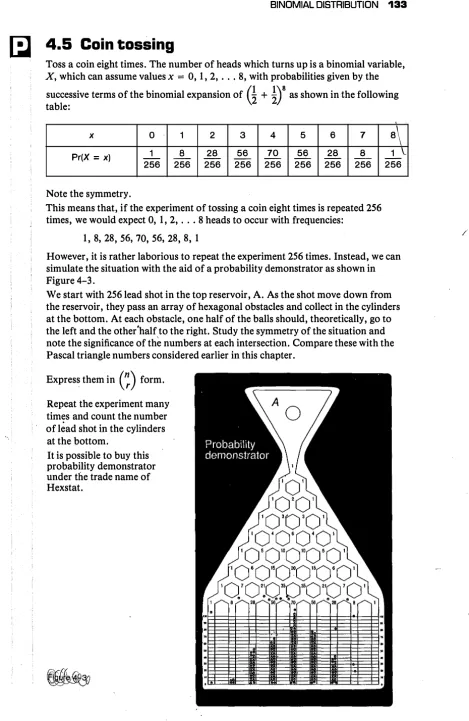
256However, it is rather laborious to repeat the experiment 256 times. Instead, we can simulate the situation with the aid of a probability demonstrator as shown in Figure 4-3.
We start with 256 lead shot in the top reservoir, A. As the shot move down from the reservoir, they pass an array of hexagonal obstacles and collect in the cylinders at the bottom. At each obstacle, one half of the balls should, theoretically, go to the left and the other'half to the right. Study the symmetry of the situation and note the significance of the numbers at each intersection. Compare these with the Pascal triangle numbers considered earlier in this chapter.
Express them in (�) form. Repeat the experiment many times and count the number of lead shot in the cylinders at the bottom.
It is possible to buy this probability demonstrator under the trade name of Hexstat.
(
4.6 Computer simulation of binomial
experiments
Coin tossing
The program below simulates the tossing of a coin. N defines the number of tosses
BIAS defines bias in coin (to two decimal places) BIAS = 0 will generate all heads.
BIAS = l will generate all tails.
BIAS = 0.49 represents a slightly biased coin. BIAS = 0.50 represents a fair coin.
The output contains data for two simulations of 100 tosses, one with a fair coin and the other with a biassed coin.
1 0 REM C oin Tossing (Binomial experiments) 20 LPRINT "Program to simulate tosses of a coin" 30 LPRINT "--- " 40 PRINT " Enter number of tosses-N ": INPUT N
50 PRINT " Enter bias factor 0- 1; to 2 dee place": INPUT BIAS 60 IF BIAS>1 THEN 50
70 IF BIAS <O THEN 50 80 RA NDO MIZE
90 FO R I = 1 TO N
100 IF (I - 1) / 40< > INT((I - 1) / 40) THEN 130 110 LPRINT
120 LPRINT
130 C = INT(RND*100)
+
1 140 IF C< = 1 OO* BIAS THEN 180 150 THROW$ = "H"1 60 HTOT = HTOT + 1 170 GOTO 200 180 THROW$ = "T" 1 90 TTOT = TTOT + 1 200 LPRINT THROW$;" "; 210 N EXT I
220 LPRINT
230 LPRINT "HEADS="; HTOT; "TA ILS=" ; TTOT; "TOSSES="; N 240 END
Sample output [fair coin]: BIAS = 0.50
Program to simulate tosses of a coin
HHTHTHHTHTTHTTHTHHHTHTTTTTTHTTTHHHT TTHTHHTHHHHHTHHHHTHTTHTHTHTHHHTTHH THTHHTTTHHTTTTTHHTTHHTTHTTTHTHT
HEADS= 49 TAILS= 51 TOSSES= 100
/ ,
Sample output (biassed coin]: BIAS = 0.40
Program to simulate tosses of a coin
HHTHHHHTHTTHTTHTHHHTHHHHHTTHTTHHHH
THHHTTHHHHHHHTHHHHTHHHHHHTHTHHHHHHH
THTHHHHTHHHTTTTHHHHHHHTHTHTHTHT
HEADS= 69 TAILS= 31 TOSSES= 100
Perform some simulations with BIAS = 0.5, 0.49, 0.51. Can you tell whether the resulting distributions are different?
Continue to alter the BIAS. When does it begin to seem that the output is generated from a biassed coin? When could you be sure?
To obtain printout on a terminal rather than a printer, the print statements in lines 20, 30, 110, 120, 200, 220 and 230 need to be amended from LPRINT to PRINT. Note:
This program models binomial distributions in general - not just coin tossing.