Volume 2006, Article ID 12378, Pages1–15 DOI 10.1155/ASP/2006/12378
Kalman Filters for Time Delay of Arrival-Based
Source Localization
Ulrich Klee, Tobias Gehrig, and John McDonough
Institut f¨ur Theoretische Informatik, Universit¨at Karlsruhe, Am Fasanengarten 5, 76131 Karlsruhe, Germany
Received 9 February 2005; Revised 13 October 2005; Accepted 17 October 2005
In this work, we propose an algorithm for acoustic source localization based on time delay of arrival (TDOA) estimation. In earlier work by other authors, an initial closed-form approximation was first used to estimate the true position of the speaker followed by a Kalman filtering stage to smooth the time series of estimates. In the proposed algorithm, this closed-form approximation is eliminated by employing a Kalman filter to directly update the speaker’s position estimate based on the observed TDOAs. In particular, the TDOAs comprise the observation associated with an extended Kalman filter whose state corresponds to the speaker’s position. We tested our algorithm on a data set consisting of seminars held by actual speakers. Our experiments revealed that the proposed algorithm provides source localization accuracy superior to the standard spherical and linear intersection techniques. Moreover, the proposed algorithm, although relying on an iterative optimization scheme, proved efficient enough for real-time operation.
Copyright © 2006 Hindawi Publishing Corporation. All rights reserved.
1. INTRODUCTION
Most practical acoustic source localization schemes are based ontime delay of arrival estimation(TDOA) for the following reasons: such systems are conceptually simple. They are rea-sonably effective in moderately reverberant environments. Moreover, their low computational complexity makes them well-suited to real-time implementation with several sensors. Time delay of arrival-based source localization is based on a two-step procedure.
(1) The TDOA between all pairs of microphones is esti-mated, typically by finding the peak in a cross-correla-tion orgeneralized cross-correlationfunction [1]. (2) For a given source location, the squared error is
calcu-lated between the estimated TDOAs and those deter-mined from the source location. The estimated source location then corresponds to that position which min-imizes this squared error.
If the TDOA estimates are assumed to have a Gaussian-distributed error term, it can be shown that the least-squares metric used in Step (2) provides the maximum likelihood (ML) estimate of the speaker location [2]. Unfortunately, this least-squares criterion results in a nonlinear optimiza-tion problem that can have several local minima. Several au-thors have proposed solving this optimization problem with standard gradient-based iterative techniques. While such
techniques typically yield accurate location estimates, they are typically computationally intensive and thus ill-suited for real-time implementation [3,4].
For any pair of microphones, the surface on which the TDOA is constant is a hyperboloid of two sheets. A sec-ond class of algorithms seeks to exploit this fact by group-ing all microphones into pairs, estimatgroup-ing the TDOA of each pair, then finding the point where all associated hyperboloids most nearly intersect. Several closed-form position estimates based on this approach have appeared in the literature; see Chan and Ho [5] and the literature review found there. Un-fortunately, the point of intersection of two hyperboloids can change significantly based on a slight change in the eccen-tricity of one of the hyperboloids. Hence, a third class of al-gorithms was developed wherein the position estimate is ob-tained from the intersection of several spheres. The first al-gorithm in this class was proposed by Schau and Robinson [6], and later came to be known asspherical intersection. Per-haps the best-known algorithm from this class is thespherical
interpolationmethod of Smith and Abel [7]. Both methods
provide closed-form estimates suitable for real-time imple-mentation.
source location. The final position estimate is obtained from a weighted average of these potential source locations.
In the algorithm proposed here, the closed-form approx-imation used in prior approaches is eliminated by employ-ing an extended Kalman filter to directly update the speaker’s position estimate based on the observed TDOAs. In partic-ular, the TDOAs comprise the observation associated with an extended Kalman filter whose state corresponds to the speaker’s position. Hence, the new position estimate comes directly from the update formulae of the Kalman filter. It is worth noting that similar approaches have been proposed by Dvorkind and Gannot [8] for an acoustic source localizer, as well as by Duraiswami et al. [9] for a combined audio-video source localization algorithm based on a particle filter.
We are indebted to a reviewer who called our attention to other recent works in which particle filters were applied to the acoustic source localization problem [10,11]. As ex-plained in the tutorial by Arulampalam et al. [12], particle filters represent a generalization of Kalman filters that can handle nonlinear and non-Gaussian state estimation prob-lems. This is certainly a desirable characteristic, and makes particle filters of interest for future study. It remains to be seen, however, whether particle filters will prove better-suited for acoustic source localization than the extended Kalman fil-ters considered here. To wit, Arulampalam et al. [12] discuss several problems that can arise with the use of particle fil-ters, namely, degeneracyandsample impoverishment. While solutions for circumventing these problems have appeared in the literature, the application of a particle filter to a track-ing problem clearly requires a certain amount of engineer-ing to obtain a workengineer-ing system, much as with our approach based on the Kalman filter. Moreover, it is not clear that the assumptions inherent in the Kalman filter, namely, linearity and Gaussianity, make it unsuitable for the speaker track-ing problem: Hahn and Tretter [13] show that the observa-tion noise encountered in time delay of arrival estimaobserva-tion is in fact Gaussian, as required by a Kalman filter. More-over, as shown here, the nonlinearity seen in the acoustic source localization problem is relatively mild and can be ad-equately handled by performing several local iterations for each time step as explained in [14]. Such theoretical consid-erations, notwithstanding, the question of whether Kalman or particle filters are better suited for speaker tracking, will only be answered by empirical studies. We believe that such studies should be conducted on real, rather than simulated, data such as we have used for the experiments discussed in
Section 5, as only results obtained on real data will be truly compelling. We hope to make such empirical comparisons the topic of a future publication.
The balance of this work is organized as follows. In
Section 2, we review the process of source localization based on time delay of arrival estimation. In particular, we for-mulate source localization as a problem in nonlinear least-squares estimation, then develop an appropriate linearized model. Section 3 summarizes the standard and extended Kalman filters. It also presents a less well-known variant known as the iterated extended Kalman filter.Section 4first discusses two possible models for speaker motion, then
discusses how the preceding development can be combined to develop an acoustic localization algorithm capable of tracking a moving speaker.Section 5presents the results of our initial experiments comparing the proposed algorithm to the standard techniques.Section 6 presents our conclu-sions and plans for future work. The appendix presents a nu-merically stable implementation of the Kalman filtering algo-rithms discussed in this work that is based on the Cholesky decomposition.
2. SOURCE LOCALIZATION
Consider a sensor array consisting of several pairs of micro-phones. Letmi1 andmi2, respectively, denote the positions of the first and second microphones in theith pair, and let x ∈ R3 denote the position of the speaker. Then the time
delay of arrival(TDOA) between the microphones can be
ex-pressed as
Tmi1,mi2,x
= x−mi1−x−mi2
s , (1)
wheresis the speed of sound. Denoting
x= ⎡ ⎢ ⎢ ⎢ ⎣ x y z ⎤ ⎥ ⎥ ⎥
⎦, mi j= ⎡ ⎢ ⎢ ⎢ ⎣
mi j,x mi j,y mi j,z ⎤ ⎥ ⎥ ⎥
⎦ (2)
allows (1) to be rewritten as
Ti(x)=T
mi1,mi2,x
=1 s
di1−di2
, (3)
where
di j=
x−mi j,x 2
+y−mi j,y 2
+z−mi j,z 2
=x−mi j
(4)
is the distance from the source to microphonemi j. Source localization based on a maximum likelihood (ML) criterion [2] proceeds by minimizing the error function
(x)= N−1
i=0 1 σi2
τi−Ti(x) 2
, (5)
whereτiis the observed TDOA for theith microphone pair andσi2is the error covariance associated with this observa-tion. The TDOAs can be estimated with a variety of well-known techniques [1,15]. Perhaps the most popular method involves thephase transform(PHAT), a variant of the gener-alized cross-correlation (GCC), which can be expressed as
R12(τ)= 1 2π
π
−π
X1ejωτX∗ 2
ejωτ X1
ejωτX∗ 2
ejωτe
For reasons of computational efficiency,R12(τ) is typically calculated with an inverse FFT. Thereafter, an interpolation is performed to overcome the granularity in the estimate cor-responding to the sampling interval [1].
Solving for thatx minimizing (5) would be eminently straightforward were it not for the fact that (3) is nonlinear in x=(x,y,z). In the coming development, we will find it use-ful to have a linear approximation. Hence, we take a partial derivative with respect toxon both sides of (3) and write
∂Ti(x) ∂x =
1 s ·
x−mi1,x di1 −
x−mi2,x di2
. (7)
Taking partial derivatives with respect to yandz similarly, we find
∇xTi(x)=1 s ·
x−mi1
di1 − x−mi2
di2
. (8)
Although (5) implies we should find thatxwhich minimizes the instantaneous error criterion, we would be better advised to attempt to minimize such an error criterion over a se-riesof time instants. In so doing, we exploit the fact that the speaker’s position cannot change instantaneoulsy, thus, both the present τi(t) and past TDOA estimates {τi(n)}tn−=10 are potentially useful in estimating a speaker’s current position x(t). Hence, let us approximateTi(x) with a first-order Tay-lor series expansion about the last position estimatex(t−1) by writing
Ti(x)≈Ti
x(t−1)+cTi(t)x−x(t−1), (9) where we have defined the row vector
cT i(t)=
∇xTi(x)
T x=x(t−1)
=1 s ·
x−mi1
di1 − x−mi2
di2 T
x=x(t−1).
(10)
Substituting the linearization (9) into (5) provides
(x;t)≈ N−1
i=0 1 σi2
τi(t)−Ti
x(t−1)−cTi(t)x−x(t−1)2
= N−1
i=0 1 σ2
i
¯
τi(t)−cTi(t)x 2
,
(11)
where
¯
τi(t)=τi(t)−Ti
x(t−1)+ciT(t)x(t−1), (12) fori=0,. . .,N−1. Let us define
¯ τ(t)=
⎡ ⎢ ⎢ ⎢ ⎢ ⎣ ¯ τ0(t)
¯ τ1(t)
.. . ¯ τN−1(t)
⎤ ⎥ ⎥ ⎥ ⎥
⎦, τ(t)= ⎡ ⎢ ⎢ ⎢ ⎢ ⎣ τ0(t) τ1(t)
.. . τN−1(t)
⎤ ⎥ ⎥ ⎥ ⎥ ⎦,
Tx(t)= ⎡ ⎢ ⎢ ⎢ ⎢ ⎣
T0x(t) T1x(t)
.. . TN−1
x(t)
⎤ ⎥ ⎥ ⎥ ⎥
⎦, C(t)= ⎡ ⎢ ⎢ ⎢ ⎢ ⎣
cT0(t) cT1(t)
.. . cTN−1(t)
⎤ ⎥ ⎥ ⎥ ⎥ ⎦ (13)
so that (12) can be expressed in matrix form as
¯
τ(t)=τ( t)−Tx(t−1)−C(t)x(t−1). (14)
Similarly, defining Σ= ⎡ ⎢ ⎢ ⎢ ⎢ ⎣ σ2 0 σ2 1 . .. σ2
N−1 ⎤ ⎥ ⎥ ⎥ ⎥ ⎦ (15)
enables (11) to be expressed as
(x;t)=τ(¯ t)−C(t)xTΣ−1τ(¯ t)−C(t)x. (16)
In past work, the criterion in (5) was minimized for each time instantt, typically with a closed-form approximation [4–7,16]. Thereafter, some authors have proposed using a Kalman filter to smooth the position estimates over time [17]. In this work, we propose to incorporate the smooth-ing stage directly into the estimation. This is accomplished as follows: first we note that (16) represents anonlinear least-squares estimation problem that has been appropriately lin-earized; we can associate τ(t) with the observation vector appearing in a Kalman filter such as we will encounter in
Section 3. Moreover, we can define a model for the motion of the speaker, in the form typically seen in theprocess equa-tionof a Kalman filter. Thereafter, we can apply the standard Kalman filter update formulae directly to the given recur-sive estimation problem without ever having recourse to a closed-form approximation for the speaker’s position. It is worth noting that similar approaches have been proposed by Dvorkind and Gannot [8] for an acoustic source localizer, as well as by Duraiswami et al. [9] for a combined audio-video source localization algorithm based on a particle filter.
To see more clearly how this approach can be imple-mented, we review the Kalman filter and several variations thereof inSection 3.
3. KALMAN FILTERING
To set the stage for the development to follow, this section summarizes the Kalman filter based on the Riccati equation, as well as the extended Kalman filter.
3.1. Riccati-based Kalman filter
Our purpose here is to present, without proof, the principal quantities and equations required to implement a Kalman fil-ter based on the Riccati equation. Letx(t) denote the current state of a Kalman filter andy(t) the current observation. Nor-mally,x(t) cannot be observed directly and thus must be in-ferred from the times series{y(t)}t; this is the primary func-tion of the Kalman filter. The operafunc-tion of the Kalman filter is governed by astate space modelconsisting of aprocessand anobservationequation, respectively,
x(t+ 1)=F(t+ 1,t)x(t) +ν1(t), (17)
whereF(t+ 1,t) andC(t) are the knowntransitionand obser-vationmatrices. By definition, the transition matrix satisfies
F(t+ 1,t)F(t,t+ 1)=F(t,t+ 1)F(t+ 1,t)=I. (19)
In (17)–(18), theprocessandobservation noiseterms are de-noted byν1(t) andν2(t), respectively. These noise terms are by assumption zero mean, white Gaussian random vector processes with covariance matrices defined by
Eνi(t)νTi(k)
= ⎧ ⎨ ⎩
Qi(t) fort=k,
0 otherwise, (20)
fori=1, 2. Moreover,ν1(t) andν2(k) are statistically inde-pendent such thatE{ν1(t)ν2T(k)} =0for alltandk.
In the sequel, it will prove useful to define two estimates of the current statex(t): letx(t| Yt−1) denote thepredicted
state estimateofx(t) obtained from all observationsYt−1 = {y(i)}t−1
i=0up to timet−1. Thefiltered state estimatex( t|Yt), on the other hand, is based on all observationsYt= {y(i)}ti=0 up to timet. Thepredicted observationis then given by
yt|Yt−1
=C(t)xt|Yt−1
(21)
as can be readily derived from (17). By definition, the inno-vationis the difference
α(t)=y(t)−C(t)xt|Yt−1
(22)
between actual and predicted observations. Exploiting the statistical independence of ν1(t) and ν2(t), the correlation matrix of the innovations sequence can be expressed as
R(t)=Eα(t)αT(t)
=C(t)K(t,t−1)CT(t) +Q2(t),
(23)
where
K(t,t−1)=E(t,t−1)T(t,t−1) (24) is the correlation matrix of thepredicted state error,
(t,t−1)=x(t)−xt|Yt−1
. (25)
TheKalman gainis defined as
G(t)=Ex(t+ 1)αT(t)R−1(t). (26) This definition can be readily shown to be equivalent to
G(t)=F(t+ 1,t)K(t,t−1)CT(t)R−1(t). (27) To calculateG(t), we must knowK(t,t−1) in advance. The latter is available from the Riccati equation, which can be stated as
K(t+ 1,t)=F(t+ 1,t)K(t)FT(t+ 1,t) +Q1(t), (28) K(t)=I−F(t,t+ 1)G(t)C(t)K(t,t−1), (29)
where
K(t)=E(t)T(t) (30)
Table1: Calculations for Kalman filter based on the Riccati equa-tion.
Input vector process:y(1),y(2),. . .,y(t). Known parameters:
(i) state transition matrix:F(t+ 1,t), (ii) measurement matrix:C(t),
(iii) covariance matrix of process noise:Q1(t), (iv) covariance matrix of measurement noise:Q2(t), (v) initial diagonal loading:σ2
D. Initial conditions:
x1|Y0
=x0,
K(1, 0)= 1 σ2
DI.
(36)
Computation:t=1, 2, 3,. . .,
R(t)=C(t)K(t,t−1)CT(t) +Q 2(t), G(t)=F(t+ 1,t)K(t,t−1)CT(t)R−1(t),
α(t)=y(t)−C(t)xt|Yt−1
,
xt+ 1|Yt=F(t+ 1,t)xt|Yt−1
+G(t)α(t), K(t)=I−F(t,t+ 1)G(t)C(t)K(t,t−1),
K(t+ 1,t)=F(t+ 1,t)K(t)FT(t+ 1,t) +Q1(t).
(37)
is the correlation matrix of thefiltered state error,
(t)=x(t)−xt|Yt
. (31)
Finally, the filtered state estimate can be updated based on the Kalman gainG(t) and innovationα(t) according to
xt+ 1|Yt
=F(t+ 1,t)xt|Yt−1
+G(t)α(t). (32)
These relations are summarized inTable 1.
We have now formulated theone-step predictionform of the Kalman filter, which returns the predicted state estimate
x(t+ 1|Yt). InSection 3.2, we will require the filtered state estimatex(t|Yt), which can be obtained as follows. Taking an expectation conditioned onYton both sides of (17), we can write
xt+ 1|Yt
=F(t+ 1,t)xt|Yt
+ν1
t|Yt
. (33)
As the process noise is zero mean, we haveν1(t|Yt)=0, so that (33) becomes
xt+ 1|Yt
=F(t+ 1,t)xt|Yt
. (34)
To obtain the desired filtered estimate, we multiply both sides of (34) byF(t|t+ 1) and invoke (19) and write
xt|Yt
=F(t,t+ 1)xt+ 1|Yt
. (35)
3.2. Extended Kalman filter (EKF)
To begin, let us split the filtered state estimate update for-mula (35) into two steps. Firstly, we make a one-step predicti-ton to updatex(t−1|Yt−1) tox(t|Yt−1), which is achieved by (34). Secondly, we updatex(t|Yt−1) tox(t|Yt), which is achieved by substituting (32) into (35) and using (19) to simplify
xt|Yt
=xt|Yt−1
+GF(t)α(t), (38)
where thefiltered Kalman gainGF(t) is defined as
GF(t)=F(t,t+ 1)G(t). (39)
The complete filtering algorithm is then
R(t)=C(t)K(t,t−1)CT(t) +Q2(t), (40)
GF(t)=K(t,t−1)CT(t)R−1(t), (41)
α(t)=y(t)−C(t)xt|Yt−1
, (42)
xt|Yt
=xt|Yt−1
+GF(t)α(t), (43)
K(t)=I−GF(t)C(t)K(t,t−1), (44)
K(t+ 1,t)=F(t+ 1,t)K(t)FT(t+ 1,t) +Q1(t), (45)
xt+ 1|Yt
=F(t+ 1,t)xt|Yt
. (46)
To formulate the extended Kalman filter, we first posit a less restrictive state-space model, namely,
x(t+ 1)=F(t+ 1,t)x(t) +ν1(t), y(t)=Ct,x(t)+ν2(t),
(47)
where the observation functional1 C(t,x(t)) is, in general, nonlinear and time varying. The main idea behind the EKF is then to linearize this functional about the most recent state estimatex(t|Yt−1). The corresponding linearization can be written as
C(t)=∂C(t,x) ∂x
x
=x(t|Yt−1)
. (48)
In the above, entry (i,j) ofC(t,x) is the partial derivative of theith component ofC(t,x) with respect to thejth compo-nent ofx.
Based on (48), we can express the first-order Taylor series ofC(t,x(t)) as
Ct,x(t)≈Ct,xt|Yt−1
+C(t)x(t)−xt|Yt−1
. (49)
1Most authors formulate the extended Kalman filter with a nonlinear process functionalF(t,x(t)) in addition to the observation functional C(t,x(t)); see, for example, Haykin [18, Section 10.10]. This more gen-eral formulation is not required here.
Table2: Calculations for extended Kalman filter.
Input vector process:y(1),y(2),. . .,y(t). Known parameters:
(i) state transition matrix:F(t+ 1,t),
(ii) nonlinear measurement functional:C(t,x(t)), (iii) covariance matrix of process noise:Q1(t), (iv) covariance matrix of measurement noise:Q2(t), (v) initial diagonal loading:σ2
D. Initial conditions:
x1|Y0=x0,
K(1, 0)= 1 σ2 D
I. (53)
Computation:t=1, 2, 3,. . .,
R(t)=C(t)K(t,t−1)CT(t) +Q2(t), (54)
GF(t)=K(t,t−1)CT(t)R−1(t), (55)
α(t)=y(t)−Ct,xt|Yt−1
, (56)
xt|Yt
=xt|Yt−1
+GF(t)α(t), (57)
K(t)=I−GF(t)C(t)
K(t,t−1), (58)
K(t+ 1,t)=F(t+ 1,t)K(t)FT(t+ 1,t) +Q
1(t), (59)
xt+ 1|Yt
=F(t+ 1,t)xt|Yt
. (60)
Note: the linearized matrixC(t) is computed from the nonlinear functionalC(t,x(t)) as in (48).
Using this linearization, the nonlinear state-space equations (47) can be written as
x(t+ 1)=F(t+ 1,t)x(t) +ν1(t),
¯
y(t)≈C(t)x(t) +ν2(t),
(50)
where we have defined
¯
y(t)=y(t)−Ct,xt|Yt−1
−C(t)xt|Yt−1
. (51)
As everything on the right-hand side of (51) is known at time t, ¯y(t) can be regarded as an observation.
The extended Kalman filter is obtained by applying the computations in (40)–(46) to the linearized model in (50), whereupon we find
xt+ 1|Yt
=F(t+ 1,t)xt|Yt
,
xt|Yt
=xt|Yt−1
+GF(t)α(t),
α(t)=y(¯ t)−C(t)xt|Yt−1
=y(t)−Ct,xt|Yt−1
.
(52)
3.3. Iterated extended Kalman filter (IEKF)
We now consider a further refinement of the extended Kalman filter. Repeating (54)–(57) ofTable 2, we can write
Rt,xt|Yt−1
=C(t)K(t,t−1)CT(t) +Q2(t), (61)
GF
t,xt|Yt−1
=K(t,t−1)CTt,xt|Yt−1
×R−1t,xt|Y t−1
, (62)
αt,xt|Yt−1
=y(t)−Ct,xt|Yt−1
, (63)
xt|Yt
=xt|Yt−1
+GF
t,xt|Yt−1
×αt,xt|Yt−1
, (64)
where we have explicity indicated the dependence of the rel-evant quantities onx(t | Yt−1). Jazwinski [14, Section 8.3] describes aniterated extended Kalman filter(IEKF), in which (61)–(64) are replaced with thelocal iteration,
Rt,ηi=CηiK(t,t−1)CTηi+Q2(t),
GF
t,ηi=K(t,t−1)CTηiR−1t,ηi, αt,ηi=y(t)−Ct,ηi, ζt,ηi=αt,ηi−Cηixt|Yt−1
−ηi, ηi+1=x
t|Yt−1
+GF
t,ηiζt,ηi,
(65)
whereC(ηi) is the linearization ofC(t,ηi) aboutηi. The local iteration is initialized by setting
η1=x
t|Yt−1
. (66) Note thatη2=x(t|Y) as defined in (64). Hence, if the local iteration is run only once, the IEKF reduces to the EKF. Nor-mally (65) are repeated, however, until there are no substan-tial changes betweenηiandηi+1. BothGF(t,ηi) andC(ηi) are updated for each local iteration. After the last iteration, we set
xt|Yt
=ηf (67)
and this value is used to updateK(t) andK(t+1,t). Jazwinski [14, Section 8.3] reports that the IEKF provides faster conver-gence in the presence of significant nonlinearities in the ob-servation equation, especially when the initial state estimate η1 =x(t|Yt−1) is far from the optimal value. The calcula-tions for the iterated extended Kalman filter are summarized inTable 3.
3.4. Numerical stability
All variants of the Kalman filter discussed in Sections3.1–3.3
are based on the Riccati equation (28)–(29). Unfortunately, the Riccati equation possesses poor numerical stability prop-erties [18, Section 11] as can be seen from the following: substituting (29) into (28) and making use of (19) provide
K(t+ 1,t)=F(t+ 1,t)K(t,t−1)FT(t+ 1,t) −G(t)C(t)K(t,t−1)FT(t+ 1,t) +Q
1(t). (79)
Table3: Calculations for the iterated extended Kalman filter.
Input vector process:y(1),y(2),. . .,y(t). Known parameters:
(i) state transition matrix:F(t+ 1,t),
(ii) nonlinear measurement functional:C(t,x(t)), (iii) covariance matrix of process noise:Q1(t), (iv) covariance matrix of measurement noise:Q2(t), (v) initial diagonal loading:σ2
D. Initial conditions:
x1|Y0=x0,
K(1, 0)= 1 σ2 D
I. (68)
Computation:t=1, 2, 3,. . .,
η1=x
t|Yt−1
. (69)
Iterate:i=1, 2, 3,. . .,f−1,
Rt,ηi=CηiK(t,t−1)CTηi+Q2(t), (70)
GF
t,ηi=K(t,t−1)CTη i
R−1t,η i
, (71)
αt,ηi=y(t)−Ct,ηi, (72)
ζt,ηi=αt,ηi−Cηixt|Yt−1
−ηi, (73)
ηi+1=x
t|Yt−1
+GF
t,ηiζt,ηi. (74)
Calculate:
xt|Yt=ηf, (75)
K(t)=I−GFt,xt|YtCxt|YtK(t,t−1), (76)
K(t+ 1,t)=F(t+ 1,t)K(t)FT(t+ 1,t) +Q
1(t), (77)
xt+ 1|Yt
=F(t+ 1,t)xt|Yt
. (78)
Note: the local iteration overicontinues until there is no significant difference betweenηiandηi+1.
Manipulating (27), we can write
R(t)GT(t)=C(t)K(t,t−1)FT(t+ 1,t). (80)
Then, upon substituting (80) for the matrix product C(t)K(t,t−1)FT(t+ 1,t) appearing in (79), we find
K(t+ 1,t)=F(t+ 1,t)K(t,t−1)FT(t+ 1,t) −G(t)R(t)GT(t) +Q1(t).
(81)
matrixG(t)R(t)GT(t). Due to finite precision errors, the re-sulting matrixK(t+ 1,t) can become indefinite after a suffi -cient number of iterations, at which point the Kalman filter exhibits a behavior known asexplosive divergence[18, Section 11].
As discussed in the appendix, a more stable implemen-tation of the Kalman filter can be developed based on the
Cholesky decompositionorsquare rootofK(t+ 1,t), which is by definition that unique lower triangular matrixK1/2(t+1,t) achieving
K(t+ 1,t)K1/2(t+ 1,t)KT/2(t+ 1,t). (82)
The Cholesky decomposition of a matrix exists if and only
if the matrix is symmetric and positive definite [19, Sec-tion 4.2.3]. The basic idea behind the square-root imple-mentation of the Kalman filter is to update K1/2(t+ 1,t) instead of K(t+ 1,t) directly. By updating or propagating
K1/2(t+ 1,t) forward in time, it can be assured thatK(t+ 1,t) remains positive definite. Thereby, a numerically stable al-gorithm is obtained regardlessof the precision of the ma-chine on which it runs. The appendix presents a procedure wherebyK1/2(t+ 1,t) can be efficiently propagated in time using a series ofGivens rotations[19, Section 5.1.8].
In the acoustic source localization experiments con-ducted thus far, the numerical stability has proven adequate even using the Kalman filter based directly on the Riccati equation. Instabilities can arise, however, when the audio fea-tures are supplemented with video information as in Gehrig et al. [20]. Hence, we have included the appendix for the sake of completeness.
4. SPEAKER TRACKING WITH THE KALMAN FILTER
In this section, we discuss the specifics of how the linearized least-squares position estimation criterion (16) can be re-cursively minimized with the iterated extended Kalman filter presented in Section 3.3. We begin by associating the “lin-earized” TDOA estimate ¯τ(t) in (14) with the modified ob-servation ¯y(t) appearing in (51). Moreover, we recognize that the linearized observation functional C(t) in (48) required for the Kalman filter is given by (10) and (13) for our acoustic localization problem. Furthermore, we can equate the TDOA error covariance matrixΣin (15) with the observation noise covarianceQ2(t). Hence, we have all relations needed on the observation side of the Kalman filter. We need only supple-ment these with an appropriate model of the speaker dy-namics to develop an algorithm capable of tracking a moving speaker, as opposed to merely finding his position at a single time instant. This is our next task.
4.1. Dynamic model
Consider the simplest model of speaker dynamics, wherein the speaker is “stationary” inasmuch as he moves only under the influence of the process noiseν1(t). Assuming the pro-cess noise components in the three directions are statistically
independent, we can write
Q1(t)=σP2T2 ⎡ ⎢ ⎣
1 0 0 0 1 0 0 0 1 ⎤ ⎥
⎦, (83)
whereTis the time elapsed since the last update of the state estimate, andσP2is the process noise power. TypicallyσP2is set based on a set of empirical trials to achieve the best localiza-tion results.
4.2. Position updates
Before performing an update, it is first necessary to deter-mine the timeT that has elapsed since an observation was last received. This factor appears as a parameter of the pro-cess noise covariance matrix Q1(t) in (83). Although we assume the audio sampling is synchronous for all sensors, it cannot be assumed that the speaker constantly speaks, nor that all microphones receive the direct signal from the speaker’s mouth, that is, the speaker sometimes turns so that he is no longer facing the microphone array. As only the di-rect signal is useful for localization [21], the TDOA estimates returned by those sensors receiving only the indirect signal reflected from the walls should not be used for position up-dates. This is most easily assured by setting a threshold on the PHAT (6), and using for source localization only those microphone pairs returning a peak in the PHAT above the threshold [21]. This implies that no update at all is made if the speaker is silent.
Given the dynamic model inSection 4.1, we now have everything required for an acoustic speaker tracking sys-tem. The position update equations are given inTable 3. The nonlinear functionalC(t,x(t)) appearing there corresponds to the TDOA model
Tt,x(t)= ⎡ ⎢ ⎢ ⎢ ⎢ ⎣
T0x(t) T1x(t)
.. . TN−1
x(t)
⎤ ⎥ ⎥ ⎥ ⎥
⎦, (84)
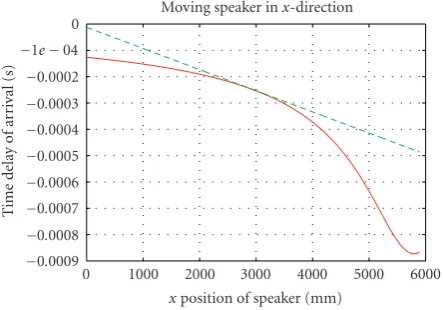
where the individual componentsTi(x(t)) are given by (3)– (4). The linearized functionalC(t)=C(x(t)) is given by (10) and (13). To gain an appreciation for the severity of the non-linearity in this particular Kalman filtering application, we plotted the actual value ofTi(x(t)) against the linearized ver-sion. These plots are shown in Figures1and2, respectively, for deviations in the x- and y-directions from the point about whichTi(x(t)) was linearized. For these plots, theD -array inFigure 5was used and the operating point was taken as (x,y,z) = (2.950, 4.080, 1.700) m in room coordinates, which is approximately in the middle of the room. As is clear from the plots, for deviations of±1 m from the nominal, the linearized TDOA is within 2.33% of the true value for move-ment in thex-direction, and within 1.38% for movement in they-direction.
−0.0009 −0.0008 −0.0007 −0.0006 −0.0005 −0.0004 −0.0003 −0.0002 −1e−04 0
T
im
e
d
el
ay
o
f
arri
va
l
(s
)
0 1000 2000 3000 4000 5000 6000
xposition of speaker (mm) Moving speaker inx-direction
Figure1: Actual versus linearizedTi(x(t)) for movement in thex -direction.
processor with a clock speed of 3.0 GHz. This is so because during normal operation very few local iterations are re-quired before the estimate converges, typically five or fewer. The local iteration compensates for the difference between the original nonlinear least-squares estimation criterion (5) and the linearized criterion (11). The difference between the two is only significant during startup and when a significant amount of time has passed since the last update, as in such cases the initial position estimate is far from the true speaker location. Once the speaker’s position has been acquired to a reasonable accuracy, the linearized model (11) matches the original (5) quite well. The use of such a linearized model can be equated with theGauss-Newton method, wherein higher order terms in the series expansion (9) are neglected. The connection between the Kalman filter and the Gauss-Newton method is well-known, as is the fact that the convergence rate of the latter is superlinear if the errorτi−Ti(x) is small near the optimal solutionx=x∗. Further details can be found in Bertsekas [22, Section 1.5].
5. EXPERIMENTS
The test set used to evaluate the algorithms proposed here contains approximately three hours of audio and video data recorded during a series of seminars by students and fac-ulty at the Universit¨at Karlsruhe in Karlsruhe, Germany. The seminar room is approximatly 6×7 m with a calibrated camera in each corner. An initial set of seven seminars was recorded in the fall of 2003. At that time, the seminar room was equipped with a single linear 16-channel microphone array with an intersensor spacing of 4.1 cm, as shown in
Figure 3. The linear array was used for both beamforming and source localization experiments. In 2004, the audio sen-sors in the seminar room were enhanced to the configuration shown inFigure 5. The 16-channel linear array was replaced with a 64-channel Mark III microphone array developed at the US National Institute of Standards (NIST). This large array is intended primarily for beamforming, and was not used for the source localization experiments reported here.
−0.0015 −0.001 −0.0005 0 0.0005 0.001 0.0015 0.0002
T
im
e
d
el
ay
o
f
arri
va
l
(s
)
0 1000 2000 3000 4000 5000 6000 7000 8000
yposition of speaker (mm) Moving speaker iny-direction
Figure2: Actual versus linearizedTi(x(t)) for movement in they -direction.
FourT-shaped arrays were mounted on the walls of semi-nar room. The intersensor spacing of theT-arrays was cho-sen as either 20 or 30 cm in order to permit more accurate source localization. TheT-shape was chosen to permit three-dimensional localization, which was impossible with the ini-tial linear configuration. In the balance of this section, we report experimental results on both sensor configurations.
Prior to the start of the seminars, the four video cam-eras in the corners of the room had been calibrated with the technique of Zhang [23]. The location of the centroid of the speaker’s head in the images from the four calibrated video cameras was manually marked every 0.7 second. Using these hand-marked labels, the true position of the speaker’s head in three dimensions was calculated using the technique de-scribed in [24]. These “ground truth” speaker’s positions are accurate to within 10 cm.
As the seminars took place in an open lab area used both by seminar participants as well as students and staffengaged in other activities, the recordings are optimally suited for evaluating acoustic source localization and other technolo-gies in a realistic, natural setting. In addition to speech from the seminar speaker, the far field recordings contain noise from fans, computers, and doors, in addition to cross-talk from other people present in the room.
5.1. Experiments with linear microphone array
The simple dynamic model presented inSection 4.1was used for all source localization experiments based on the IEKF reported in this section and inSection 5.2.Table 4presents the results of a set of experiments comparing the new IEKF algorithm proposed in this work to the spherical intersec-tion (SX) method of Schau and Robinson [6], the spherical interpolation (SI) method of [25] as well as the linear inter-section (LI) technique of Brandstein et al. [4].
(0, 0, 0)
White board
Cam 2 Cam 4
Cam 1 Cam 3
16 channel mic array D-array Speaker area
Table
W E
S N
5.9 m
7.1 m •Room height=3 m
•Camera height∼2.7 m z y
x
ISL seminar 2003 room setup
All coordinates (x,y,z) (mm) are relative to the north-west corner
of the room. Floor is atz=0.
Figure3: The room setup for the seminar recordings 2003 at Universit¨at Karlsruhe.
Table4: Experimental results of source localization and tracking algorithms.
Algorithm RMS error
x(cm) y(cm) Azimuth (deg) Depth (cm)
SX 144.6 166.6 24.6 148
SX + Kalman filter 138.1 153.5 20.4 145
SI 121.4 132.0 16.5 133
SI + Kalman filter 121.2 131.7 16.4 132
LI 225.0 130.5 17.6 234
LI + Kalman filter 196.1 111.5 13.3 207
IEKF 91.7 119.7 12.9 100
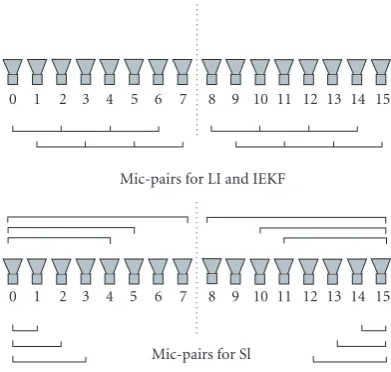
extends the ideas of the SX and enables the use of more than four microphones to take advantage of the redundancy. The array was divided into two subarrays and all microphones of these subarrays were used to estimate two positions. The fi-nal position estimate was the average of the two initial es-timates. The LI and IEKF techniques, on the other hand, made use of the same set of 12 microphone pairs. These pairs were formed out of the microphone array by dividing the ar-ray into two eight-channel subarar-rays and taking each pos-sible pair of microphones with an interelement distance of 8.14 cm. In all cases studied here, the TDOAs were estimated using the PHAT (6).Figure 4shows the configuration of the array and definition of the microphone pairs in detail.
0 1 2 3 4 5 6 7 8 9 10 11 12 13 14 15
0 1 2 3 4 5 6 7 8 9 10 11 12 13 14 15 Mic-pairs for LI and IEKF
Mic-pairs for Sl
Figure4: Use of microphone pairs for the different methods.
Without any smoothing, the source localization estimates returned by both the LI and SX methods are very inaccurate. The LI method provides particularly poor estimates in depth. Kalman filtering improved the position estimates provided by both the SX and LI methods, yet the average RMS distance from the true source location remained large. The SI method shows significantly better performance than the SX and LI methods both in total precision as well as in stability of the position estimations, as the results did not show the big vari-ance of the first two methods. On the other hand, this im-proved stability reduces the improvement given by Kalman filtering, hence the filtered results do not show the big im-provements noticeable for the SX and LI methods. The new IEKF approach outperformed all methods for both azimuth and depth. We attribute this superior performance largely to the elimination of the initial closed-form estimate associated with the LI, SI, and SX methods, and its inherent inaccuracy. The performance of the IEKF could be further improved by implementing an adaptive threshold on the PHAT as pro-posed in [21]. The total gain is about 46% relative in terms of azimuth and about 47% in depth as shown inTable 5.
5.2. Experiments withT-shaped microphone arrays
Here we report the results of a set of experiments conducted with the T-shaped arrays whose location is indicated in
Figure 5. For the new sensor configuration, we report results only in Cartesian coordinates, as azimuth and depth are no longer meaningful. Shown inTable 6are source localization results obtained with the IEKF on two data sets: the
develop-ment setconsisting of three 15-minute segments, on which
the parameters of the Kalman filter were tuned, and the
eval-uation setconsisting of ten 15-minute segments chosen from
five seminars. These results were obtained with a fixed PHAT threshold. Only TDOAs for pairs of microphones from the
sameT-array were estimated, as the distances between theT -arrays were too great to allow for reliable cross-correlation. The TDOAs from all microphone pairs for which the PHAT was above the fixed threshold were concatenated into asingle
observation vector, which was then used to update the posi-tion estimate. As can be seen upon comparing the results in
Table 6 with those inTable 4, theT-shaped arrays provide for significantly more accurate speaker localization. More-over, theT-shape enables three-dimensional estimation. In the column ofTable 6labeled “3D,” we report the total RMS error for all dimensions; in the column labeled “2D,” the height orz-dimension is ignored.
Given that the position estimate can only be updated when the speaker is actually speaking, we also investigated the application of speech activity detection (SAD) to the source localization problem. We trained a neural net-based speech activity detector on the data from the close-talking microphone worn by the speaker, and only updated for time segments declared to be speech by the detector. We still re-tained the threshold criterion on the PHAT of each micro-phone pair, to ensure the update was based the signal received directly from the speaker’s mouth. As shown inTable 6, the use of an explicit SAD module provided a marginal improve-ment in the performance of the source localizer. We suspect that this is so because the threshold on the PHAT already pro-vides an effective means of speech activity detection.
We also tested the LI method on theT-shaped arrays; the SI and SX methods require the calculation of all time delays with respect to a reference microphone and, as noted pre-viously, the distances between theT-arrays are too great to estimate TDOAs reliably. In this case, we calculated a single bearing line for each microphone array, then calculated the point of nearest intersection for each unique pair of bearing lines. The final position estimate was given by the average of the points of nearest intersection, as specified in Brandstein et al. [4]. The LI results are shown inTable 7for the evalua-tion set.
Comparing the results of Tables 6 and 7, we see that the IEKF still clearly outperforms LI. The accuracy of the LI method improves in thex-direction when the fourT-arrays are used instead of the single linear array. The accuracy in they-direction, however, degrades due to the fact that fewer microphone pairs are available to resolve the location of the source along this dimension.
In a final set of studies, we investigated the effect of speaker movement on the number of local iterations required by the IEKF. InFigure 6, we plotted the number of local iter-ations versus the time since the last update.Figure 7shows the number of local iterations plotted against the distance the speaker has moved since the last update. Finally,Figure 8
Table5: IEKF with and without adaptive threshold.
Algorithm RMS error
x(cm) y(cm) Azimuth (deg) Depth (cm)
IEKF 91.7 119.7 12.9 100
IEKF with adaptive threshold 52.2 61.9 6.97 52.9
(0, 0, 0)
White board
Cam 2 Cam 4
Cam 1 Cam 3
64 channel Mark III array D-array A-array
B-ar
ra
y
Checkerboard
Speaker area
Tabletop mics C-ar
ra
y
Sennheiser omnimic
W E
S N
5.9 m
7.1 m
z y
x
All coordinates (x,y,z) (mm) are relative to the north-west corner of the room. Floor is atz=0.
1 3 2
4 300 mm 200 mm 200 mm
A/B/C/D-array layout
x y z
ISL seminar 2004 room setup (update)
Checkerboard 2004 11 Checkerboard 2004 06/07/08 Mark III ArrayA1 ArrayB1 ArrayC1 ArrayD1
2130 3260 732 2000 3110 730 5665 2900 1710
105 3060 2370 2150 105 2290 2700 6210 2190 5795 4280 2400
•Mark III=64 channel, 20 mm mic distance •Checkerboard square size=105 mm.
Position of the first inner crossing is given. •Checkerboard for internal calibration=42 mm
square size •Room height=3 m •Camera height∼2.7 m
Figure5: Current sensor configuration in the seminar room at Universit¨at Karlsruhe.
Shown in Figure 9 are several images from a seminar recording. The light square marks the true speaker’s posi-tion obtained from the hand-labeled images. The dark square is the three-dimensional position estimate after back projec-tion to the two-dimensional image plane.
6. CONCLUSIONS
Table6: IEKF source localization results with theT-shaped arrays, both without and with explicit speech activity detection (SAD) on the close-talking microphone (CTM).
Experiment RMS error (cm)
x y z 2D 3D
dev. set 39.0 40.4 9.9 56.3 57.1
eval. set 35.3 34.9 10.3 51.8 53.0
dev. set with SAD on CTM 36.0 35.6 9.4 50.7 51.6
eval. set with SAD on CTM 34.5 32.8 9.9 49.2 50.3
Table7: Source localization results for theT-shaped arrays based on linear intersection.
Experiment RMS error (cm)
x y z 2D 3D
LI 114.2 177.2 45.7 211.5 216.6
LI + Kalman filter 109.9 175.4 45.4 207.6 212.8
0 1 2 3 4
It
er
ations
0 1 2 3 4 5 6 7 8
Time since last update (s)
Figure6: Number of local iterations versus time since last update.
0 1 2 3 4
It
er
ations
0 100 200 300 400 500 600 700 800 Distance since last update (mm)
Figure7: Number of local iterations versus distance moved since last update.
approximation was first used to estimate the true position of the speaker followed by a Kalman filtering stage to smooth the time series of position estimates. In our proposed algo-rithm, the closed-form approximation is eliminated by em-ploying a Kalman filter to directly update the speaker’s po-sition estimate based on the observed TDOAs. To be more
0 1 2 3 4
It
er
ations
0 5 10 15 20 25 30 35 40 ×103
Speed of speaker movement (mm/s)
Figure8: Number of local iterations versus speaker velocity.
precise, the TDOAs comprise the observation associated with an extended Kalman filter whose state corresponds to the speaker’s position. We tested our algorithm on a data set con-sisting of seminars held by actual speakers, and recorded si-multaneously with one or more microphone arrays, as well as four calibrated video cameras. From the video images, the true position of the speaker was extracted and used as “ground truth” for the automatic localization experiments. Our experiments revealed that the proposed algorithm pro-vided source localization superior to the standard spherical and linear intersection techniques. We found that further improvements in localization accuracy could be obtained by adaptively setting a threshold on the PHAT function. More-over, our algorithm ran in less than real time on an Intel Xeon processor with a 3.0 GHz clock speed.
Figure9: Images from four calibrated video cameras taken during a seminar recording at Universit¨at Karlsruhe.
coordinates to two-dimensional image coordinates serves as the innovation vector. Hence, it is never necessary to triangu-late the speaker’s position from several video images as was done in [17]. We need only follow the approach adopted in this work and perform the standard update for a Kalman fil-ter. Such anincrementalupdate procedure was investigated by Welch and Bishop [26] for a different set of sensors. Welch [27] also analyzed this incremental scheme in terms of the observability criterion typically encountered in state-space control theory. He found that although the state of the system (i.e., the speaker’s position) isnotobservable based on the in-formation from any single sensor, the state becomes observ-able when the information from all sensors is combined. To achieve a stable update, it is only necessary to ensure that all sensors are sampled frequently enough.
APPENDIX
IMPLEMENTATION BASED ON THE CHOLESKY DECOMPOSITION
Using manipulations similar to those leading to (81), it is possible to combine (76)–(77) as
K(t+ 1,t)=FK(t,t−1)FT
−FK(t,t−1)CTηiR−1t,ηi
×CηiK(t,t−1)FT+Q1(t),
(A.1)
whereF = F(t+ 1,t) is the constant transition matrix and ηiis the current local iterate. Equation (A.1) is a statement of theRiccati equationfor this particular formulation of the Kalman filter. The Riccati equation specifies how the state er-ror correlation matrixK(t+ 1,t) can be recursively updated orpropagatedin time. As is well documented in the literature, however, this equation has poor numerical stability prop-erties [18, Section 13.3]. In this section, we present a rem-edy, the square-root implementation [28], for the explosive
divergence phenomenon seen in Kalman filters based on the Riccati equation. Our discussion follows that in Haykin [18, Section 11].
TheCholesky decomposition[19, Section 4.2] or square-rootK1/2(t+ 1,t) of the state estimation error covariance ma-trixK(t+1,t) is the unique lower triangular matrix achieving
K1/2(t+ 1,t)KT/2(t+ 1,t)K(t+ 1,t). (A.2)
Square-root implementations of RLS estimators and Kalman filters propagateK1/2(t+1,t). The advantage of this approach is that the Cholesky decomposition exists only for positive definite matrices [19]. Thus, in propagatingK1/2(t+ 1,t) in-stead ofK(t+ 1,t), we ensure that the latter remains positive definite. The square-root implementation is derived from the following well-known lemma [28].
Lemma 1(matrix factorization). Given any twoN×M ma-tricesAandBwith dimensionsN≤M,
AAT=BBT (A.3)
if, and only if, there exists a unitary matrixθsuch that
Aθ=B. (A.4)
To develop an update strategy based on the Cholesky de-composition, we setQ2(t)=Σ,Q1(t)=Q(t), and write
A= ⎡ ⎢ ⎢ ⎣Σ
1/2 ... Cη i
K1/2(t,t−1) ... 0 . . . .
0 ... FK1/2(t,t−1) ... Q1/2( t)
⎤ ⎥ ⎥
⎦. (A.5)
We seek a unitary transformθ that achievesAθ = B, such that
AAT= ⎡ ⎢ ⎢ ⎣Σ
1/2 ... Cη i
K1/2(t,t−1) ... 0 . . . .
0 ... FK1/2(t,t−1) ... Q1/2(t) ⎤ ⎥ ⎥ ⎦
· ⎡ ⎢ ⎢ ⎢ ⎢ ⎢ ⎢ ⎣
ΣT/2 ... 0 . . . . KT/2(t,t−1)CTη
i ..
. KT/2(t,t−1)FT . . . .
0 ... QT/2(t) ⎤ ⎥ ⎥ ⎥ ⎥ ⎥ ⎥ ⎦
= ⎡ ⎢ ⎢ ⎣B11
..
. 0 ... 0 . . . . B21 ... B22 ... 0 ⎤ ⎥ ⎥ ⎦ ⎡ ⎢ ⎢ ⎢ ⎢ ⎢ ⎢ ⎣
BT11 ... BT21 . . . . 0 ... BT22 . . . . 0 ... 0
⎤ ⎥ ⎥ ⎥ ⎥ ⎥ ⎥ ⎦
=BBT,
(A.6)
where bothB11andB22are lower triangular. Performing the required multiplications on the block components, we find
B11BT11=Σ+C
ηiK(t,t−1)CTηi, (A.7)
B21BT11=FK(t,t−1)CT
ηi, (A.8)
From (A.7), clearly,
B11BT11=R
t,ηi. (A.10) Hence, asB11is lower triangular,
B11=R1/2
t,ηi. (A.11) Based on (71),
GF
t,ηiRt,ηi=K(t,t−1)CTηi. (A.12)
Substituting forK(t,t−1)CT(ηi) in (A.8), we find B21BT11=FGF
t,ηiRt,ηi=FGF
t,ηiB11BT11, (A.13)
where the last equality follows from (A.10). Hence,
B21=FGF
t,ηiR1/2t,ηi. (A.14) Finally, substituting (55) into (A.14), we can rewrite (A.9) as
B22BT22=FK(t,t−1)FT−B21BT21+Q(t) =FK(t,t−1)FT−FK(t,t−1)CTη
i
R−1t,η i
×CηiKT(t,t−1)FT+Q(t).
(A.15)
The last equation, together with (A.1), implies
B22BT22=K(t+ 1,t) (A.16) or, asB22is lower triangular,
B22=K1/2(t+ 1,t). (A.17) In light of (A.11)–(A.17), we have
Aθ= ⎡ ⎢ ⎢ ⎣Σ
1/2 ... Cη i
K1/2(t,t−1) ... 0 . . . .
0 ... FK1/2(t,t−1) ... Q1/2(t) ⎤ ⎥ ⎥ ⎦θ
= ⎡ ⎢ ⎢
⎣ R
1/2t,η i
..
. 0 ... 0 . . . . FGF
t,ηiR1/2t,η i
..
. K1/2(t+ 1,t) ... 0 ⎤ ⎥ ⎥ ⎦=B.
(A.18)
Although a new estimate of the predicted state error covari-ance matrix is generated with each local iteration, only the final resultK1/2(t+ 1,t) is saved for use on the succeeding time step.
The final position update is achieved as follows: through forward substitution we can find thatζ(t,ηi) achieving
ζt,ηi=R1/2t,ηiζt,ηi, (A.19)
where ζ(t,ηi) is defined in (73). The development in
Section 4.1 shows that F is upper triangular for station-ary source model of interest here. Hence, we can find that ζ
(t,ηi) achieving Fζ
t,ηi=B21ζ
t,ηi (A.20)
through back substitution onF. Finally, as in (74), we update ηiaccording to
ηi+1=x
t|Yt−1
+ζt,ηi, (A.21)
whereη1=x(t|Yt−1). The new state estimatex(t+ 1|Yt) is taken as the final iterateηf.
A unitary transformθthat imposes the desired zeros on Acan be readily constructed from a set of Givens rotations; details are given in [29].
ACKNOWLEDGMENT
This work was sponsored by the European Union under the integrated project CHIL,Computers in the Human Interaction Loop, Contract No. 506909.
REFERENCES
[1] M. Omologo and P. Svaizer, “Acoustic event localization using a crosspower-spectrum phase based technique,” inProceedings of IEEE International Conference on Acoustics, Speech, and Sig-nal Processing (ICASSP ’94), vol. 2, pp. 273–276, Adelaide, SA, Australia, April 1994.
[2] S. M. Kay,Fundamentals of Statistical Signal Processing: Estima-tion Theory, Prentice-Hall, Englewood Cliffs, NJ, USA, 1993. [3] M. S. Brandstein,A framework for speech source localization
us-ing sensor arrays, Ph.D. thesis, Brown University, Providence, RI, USA, 1995.
[4] M. S. Brandstein, J. E. Adcock, and H. F. Silverman, “A closed-form location estimator for use with room environment mi-crophone arrays,”IEEE Transactions on Speech and Audio Pro-cessing, vol. 5, no. 1, pp. 45–50, 1997.
[5] Y. T. Chan and K. C. Ho, “A simple and efficient estimator for hyperbolic location,”IEEE Transactions on Signal Processing, vol. 42, no. 8, pp. 1905–1915, 1994.
[6] H. C. Schau and A. Z. Robinson, “Passive source localization employing intersecting spherical surfaces from time-of-arrival differences,”IEEE Transactions on Acoustics, Speech, and Signal Processing, vol. 35, no. 8, pp. 1223–1225, 1987.
[7] J. O. Smith and J. S. Abel, “Closed-form least-squares source location estimation from range-difference measurements,” IEEE Transactions on Acoustics, Speech, and Signal Processing, vol. 35, no. 12, pp. 1661–1669, 1987.
[8] T. G. Dvorkind and S. Gannot, “Speaker localization exploit-ing spatial-temporal information,” inProceedings of the IEEE International Workshop on Acoustic Echo and Noise Control (IWAENC ’03), pp. 295–298, Kyoto, Japan, September 2003. [9] R. Duraiswami, D. Zotkin, and L. S. Davis, “Multimodal
3-D tracking and event detection via the particle filter,” in Pro-ceedings of IEEE Workshop on Detection and Recognition of Events in Video in Association with IEEE International Confer-ence on Computer Vision, pp. 20–27, Vancouver, BC, Canada, July 2001.
[10] D. B. Ward, E. A. Lehmann, and R. C. Williamson, “Particle filtering algorithms for tracking an acoustic source in a rever-berant environment,”IEEE Transactions on Speech and Audio Processing, vol. 11, no. 6, pp. 826–836, 2003.