Volume 2006, Article ID 52919, Pages1–12 DOI 10.1155/ASP/2006/52919
FPGA Implementation of an MUD Based on
Cascade Filters for a WCDMA System
Quoc-Thai Ho, Daniel Massicotte, and Adel-Omar Dahmane
Laboratory of Signal and System Integration (LSSI), Department of Electrical and Computer Engineering, Universit´e du Qu´ebec `a Trois-Rivi`eres, 3351 Boulevard des Forges, C.P. 500, Trois-Rivi`eres, QC,
Canada G9A 5H7
Received 2 October 2004; Revised 30 June 2005; Accepted 12 July 2005
The VLSI architecture targeted on FPGAs of a multiuser detector based on a cascade of adaptive filters for asynchronous WCDMA systems is presented. The algorithm is briefly described. This paper focuses mainly on real-time implementation. Also, it fo-cuses on a design methodology exploiting the modern technology of programmable logic and overcoming the limitations of commercial tools. The dedicated architecture based on a regular structure of processors and a special structure of memory ex-ploiting FPGA architecture maximizes the processing rate. The proposed architecture was validated using synthesized data in UMTS communication scenarios. The performance goal is to maximize the number of users of different WCDMA data traffics. This dedicated architecture can be used as an intellectual property (IP) core processing an MUD function in the system-on-programmable-chip (SOPC) of UMTS systems. The targeted FPGA components are Virtex-II and Virtex-II Pro families of Xil-inx.
Copyright © 2006 Hindawi Publishing Corporation. All rights reserved.
1. INTRODUCTION
The third generation (3G) of mobile wireless communica-tion is adopted for high-throughput services and the eff ect-ive utilization of spectral resources. This work focuses on Universal Mobile Universal Telecommunications systems (UMTS). In UMTS Systems, the wideband code-division multiple-access (WCDMA) scheme is adopted. The desired data throughputs for 3G UMTS systems are 144 kbps for vehicular, 384 kbps for pedestrian, and 2 Mbps for indoor environments [1,2]. The receivers in 3G systems must take into account not only intersymbol interferences (ISI), but also more importantly multiple-access interferences (MAIs) which increase radically in the number of users and data rates. Multiuser detectors (MUDs) are applied to eliminate the MAI and become essential for an efficient 3G wireless network systems deployment [3]. The algorithmic aspect of MUD has become an important research issue over the last decade (e.g., [3–6]). Moreover, the real-time implementa-tion aspect of MUDs is also well documented (e.g., [6–9]). The rapid prototyping targeted on field-programmable gate arrays (FPGAs) is also proposed [10–12]. These works dem-onstrate several limitations in practical systems in terms of timing and algorithm and hardware constraints (e.g., arith-metic complexity, memory access requirements, data flow) [5–7]. Moreover, no work was done to maximize the number
of users on a chip (or a device in case of FPGAs). Maximizing the number of users makes it possible to increase the capacity of a cell and multiantenna processing.
Because minimum-mean-square-error (MMSE)-based receivers allow for a significant gain in performance, the adaptive two-stage linear cascade filter MUD (CF-MUD) based on MMSE receivers proposed in [13] offers a good tradeoff between performance and complexity. This algo-rithm presents a low-complexity and suitable regularity as-pects for FPGA implementation. The CF-MUD is based on two blocks, signature and detection, which will be briefly de-scribed inSection 2. Each block acts as a filter in order to can-cel the ISI and MAI. In previous works [14,15], FPGA im-plementations of the signature block were presented. Based on the CF-MUD algorithm, this paper describes a plete design architecture targeted on the recent FPGA com-ponents—the Virtex-II and Virtex-II Pro of Xilinx includ-ing signature and detection blocks.
The rest of the paper is organized as follows.Section 2
presents a brief description of the system model and the adaptive MUD algorithm considered in this paper.Section 3
introduces the VLSI architecture of the present MUD tar-geted on the Virtex-II and Virtex-II Pro components.Section 4describes the implementation methodology andSection 5
Channel baseband model
Signature 1
SignatureK . . .
Signature block Detection block Detection .
.
. ...
˜
r
rtrain btrain
y1
yK
b1
bK
Figure1: Principle of cascade filter MUD (CF-MUD).
2. BACKGROUND
2.1. DS-CDMA baseband model
In a direct-sequence CDMA (DS-CDMA) baseband system model, we consider K mobile users transmitting symbols from the alphabetΞ= {−1, 1}. Each user’s symbol is spread by a pseudonoise (PN) sequence of lengthNccalled the spe-cific signature code.Tdenotes the symbol period andTc de-notes the chip period, whereNc=T/Tcis an integer. Userk’s
nth transmitted symbol isb(kn).
The base transceiver station (BTS) received signal in baseband can then be written as follows:
r(t)=
Nb−1
n=0
K
k=1
Akb(n)
k Lk
l=1
h(n)
k,ls(kn)
t−nT−τk,l
+η(t),
(1)
wheretdenotes the time;Lk is the number of propagation
paths;h(kn,l)andτk,lare, respectively, the complex gain and the
propagation delay of the pathlfor userk;Nbrepresents the number of the transmitted symbols, Ak is the transmitted amplitude of userk;s(kn) is the specific signature of userk; andη(t) is the additive white Gaussian noise (AWGN) with varianceσ2
η.
To increase the performance and capacity of communica-tion systems, the ISI and MAI must be minimized. It is there-fore essential to design MUD processing able to cancel these interferences. The following gives a brief description of the CF-MUD [13].
2.2. Cascade filter multiuser detector
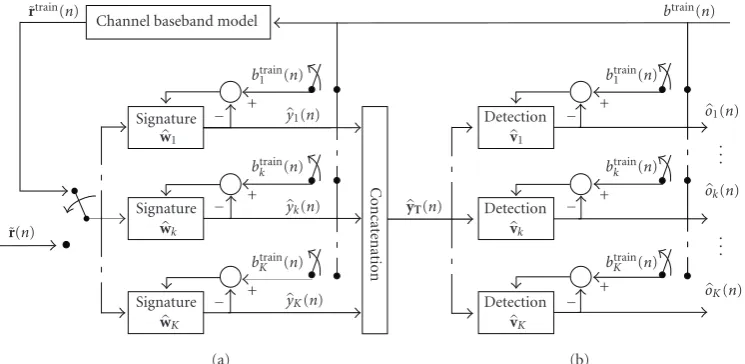
The block diagram of the multiuser detector CF-MUD to be implemented on an FPGA is shown inFigure 1[13].We can distinguish two blocks: signature and detection. Each block acts as an adaptive filter for canceling the ISI and MAI. The proposed linear adaptive MUD is based on the least-mean-square (LMS) adaptation method. This filter, however, needs data training sequences to adapt the filter coefficients. Compared to time-division multiple-access (TDMA) used in Global Systems for Mobile communications (GSM) systems, UMTS systems do not give access to preknown data with the
exception of pilot bits—in order to adjust the filter coeffi -cients. It is important to note that to assure the convergence, both block filters need more than the pilot bits available in fast-fading context. Preknown data training sequencesrtrain are internally generated based on channels parameters (am-plitudes and delays) obtained from the channel-estimation technique.
The principle of CF-MUD is briefly described inFigure 2. The switch models the training phase and detection phase. The first block of the CF-MUD, the signature block, adapts the signatures of the users without prior knowledge of their PN codes. In the first step, we synchronized the received sig-nalr(n) based on the estimated propagation delays for each user.
In the training phase, we used the following set of equa-tions for userk(k=1, 2,. . .,K):
yk(n)= wk(n)Hrtrain(n), wk(0)=0, (2)
αk(n)=btraink (n)−yk(n), (3)
wk(n+ 1)=wk(n) +μrtrain(n)αk(n)∗, (4)
withwk(n)=[wk ,0(n),wk,1(n),. . .,wk ,Nc−1(n)]T, and
r(n)=r(nT),rnT−Tc,
rnT−2Tc,. . .,rnT−Nc−1TcT, (5)
where dim(wk)=dim(rtrain)=Nc×1,(•) defines the real
part of complex value, (•)Hdefines the Hermitian operation and∗the conjugate.
The following notations are used:xis the estimated value ofx;yk(n) is the adaptation output of userk;wk(n) is the vector of filter coefficients of userk;btraink (n) is the synthetic transmitted training data sequence;rtrain(n) is the synthetic received training data vector generated from the btrain
k (n)
transmitted through estimated channel parameters;αk(n) is the adaptation error of the signature; andμis the adaptation step of adaptive filters in the signature block.
The detection block aims to suppress the residual MAI and ISI based on the data of all users estimated using the out-put signal of the signature block. From all users, we formed a vectoryT(n) at the output of the signature block as follows:
yT(n)=
y1
n−1,. . .,yKn−1,
y1(n),. . .,yK(n),y1(n+ 1),. . .,yK(n+ 1)T.
(6)
In the training phase, we used the following set of equa-tions for userk(fork=1, 2,. . .,K):
ok(n)=vTk(n)HyT(n), vTk(0)=0, βk(n)=btrain
k (n)−ok(n),
vTk(n+ 1)=vTk(n) +νyT(n)βk(n)∗,
(7)
wherevTk(n)=[v1,k(n),v2,k(n),. . .,v3K,k(n)]T, dim(vTk(n))=
dim(yT(n))=3K×1,ok(n) is the adaptation output of user kcorresponding to the output of the respective adaptive fil-ter,vTk(n) is the filter coefficient vector of userk,βk(n) is
Channel baseband model ˜
rtrain(n) btrain(n)
˜
r(n)
Signature
w1
Signature
wk
Signature
wK −
−
− + + +
btrain 1 (n)
btrain
k (n)
btrain
K (n)
y1(n)
yk(n)
yK(n)
C
o
ncat
enation
yT(n)
Detection
v1
Detection
vk
Detection
vK −
−
− + + +
btrain 1 (n)
btrain
k (n)
btrain
K (n)
o1(n)
. . .
ok(n) . . .
oK(n)
(a) (b)
Figure2: Principle of (a) signature block and (b) detection block for thekth user.
In the detection phase, the transmitted data of mobile us-ers are estimated by the signature block from following equa-tion:
yk(n)= wk(n)Hr(n), fork=1, 2,. . .,K. (8)
Regarding the detection block, the transmitted data of users are estimated by the following equation:
ok(n)=vTk(n)HyT(n), fork=1, 2,. . .,K. (9)
Finally, the estimated bitsbk(n) are found by simply
tak-ing the sign function ofok(n),
bk(n)=signok(n). (10)
When the adaptation process was completed, we applied (8), (9), and (10) to propagate the signalr(n) through the CF-MUD.
2.3. Performance evaluation of CF-MUD
Figure 3 depicts algorithmic performance in terms of the block error rate (BLER) of CF-MUD algorithm compared with the RAKE receiver and soft multistage parallel interfer-ence canceler (Soft-MPIC) in a WCDMA platform [3]. Sim-ulation results were done for one antenna, in perfect chan-nel estimation, Vehicular A chanchan-nel defined by International Telecommunication Union (ITU) [16] 3 km/h mobile speed, 64 kbps data rate, and 15 users. We observed a gain of 1.9 dB to target a BLER of 10% for CF-MUD compared with Soft-MPIC and the RAKE receiver cannot reach the BLER of 10%. No decision feedback has been considered for CF-MUD and Soft-MPIC. Although MUD with decision feedback is con-sidered superior than without the decision feedback creates a serious data dependency to parallelize the implementation on many devices.
Based on CF-MUD equations (2)–(10), the proposed FPGA-targeted architecture can be described as inSection 3.
0 2 4 6 8 10 12
10−3 10−2 10−1 100
SNR Rake
Soft-MPIC CF-MUD
BLER
Figure 3: A performance evaluation of MUD methods in the WCDMA conditions with vehicular A channel at mobile speed 3 km/h, data rate 64 kbps (OVSF =16), and 15 users in terms of BLER.
3. VLSI ARCHITECTURE TARGETED ON FPGA
Ext
er
n
al
memor
y
(SDRAM)
Ser
ial2P
ar
allel
F
IFO
InputB
u
ff
er
Ar
ra
y
o
f
P
E
(sig
natur
e
stage)
In
te
rB
u
ff
er
Ar
ra
y
o
f
P
E
(det
ection
stage)
OutputB
u
ff
er
P
ar
allel2Ser
ial
F
IFO
Ext
er
n
al
memor
y
(SDRAM)
Global control
External memory control
CF-MUD mapping Address generator
Figure 5
Figure4: Simplified HW architecture of CF-MUD.
The main algorithmic constraints, with respect to MUD performance, consist of the number of adaptation iterations in the signature filter and detection filter, adaptation stepsμ andν, quantification scales to respect the arithmetic preci-sion in fixed point.
The main hardware constraints take into account the lim-itations of targeted FPGAs in term of number of dedicated multipliers, number of block RAMs (BRAMs), and memory size of each BRAM [17].
These constraints were also used in our method of re-source estimation before synthesis. The architecture must be able to respect real-time constraints bounded by time frame to detect all data frames, and by adaptation time to adapt all coefficients (wandv) depending on the mobile speed.
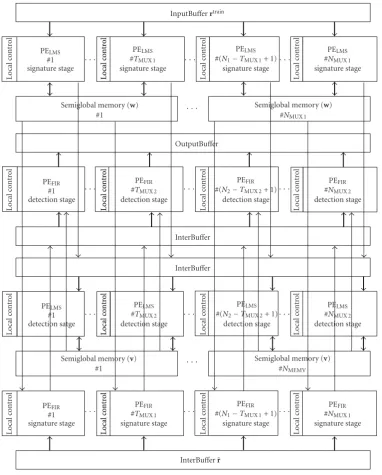
The block diagram of the pipelined architecture is based on two stages of the modular array structure of processing elements (PEs) shown in Figure 4. Figure 5 illustrates the mapping of CF-MUD algorithm on array of PEs and internal memories (inside the FPGA). These PEs consist of optimized cores performing adaptive filtering defined by (2)–(4) which we called PELMSincluding straightforward filtering defined by (2) which we called PEFIR. The regularity of the CF-MUD makes it possible to time multiplex a number of users, that is, we used only one PE to process a number of users by time multiplexing selection. The time multiplexing, that is, num-ber of users per PE, in the signature and detection blocks is defined byTMUX 1 andTMUX 2, respectively. Thus, the num-ber of PELMS and PEFIR inside each block is the same, and is represented by NMUX 1 andNMUX 2 for the signature and detection blocks, respectively. All PEs consider normalized-fixed complex-value signals and use the same time multi-plexing.
The data and address paths are independent to permit maximum simultaneous direct access to data and address. Two different external memories SDRAM and two different memory buffers (InputBufferandOutputBuffer) are used to
allow independent access to input/output, and thus to maxi-mize the multiple path access to external input/output. These memory buffers are implemented by the LUT (lookup-table) -based distributed memory of FPGAs. The memory buffers
InputBufferandOutputBuffer are multiport. The buffer In-ternalBuffer is used to memorize intermediate results from the signature filter and input to the detection filter. It is im-plemented by LUT-based distributed memories. The first-in first-out (FIFO) buffersSerial2ParallelandParallel2Serial
are used to minimize the utilization of input-output (IO) pins of FPGA and also to minimize the number of exter-nal memories. These buffers are implemented by LUT-based distributed memory of FPGAs as well. The PE of the ar-chitecture uses the semiglobal internal BRAM-based mem-ories, that is, a certain number of PEs have access to the same memory. This number is defined by the possible time multiplexing determined from the architectural specification step.
Lo cal con tr ol Lo cal con tr ol Lo cal con tr ol Lo cal con tr ol Lo cal con tr ol Lo cal con tr ol Lo cal con tr ol Lo cal con tr ol Lo cal con tr ol Lo cal con tr ol Lo cal con tr ol Lo cal con tr ol Lo cal con tr ol Lo cal con tr ol Lo cal con tr ol Lo cal con tr ol Lo cal con tr ol Lo cal con tr ol Lo cal con tr ol Lo cal con tr ol PELMS #1 signature stage PELMS
#TMUX 1
signature stage
PELMS
#(N1−TMUX 1+ 1)
signature stage
PELMS
#NMUX 1
signature stage InputBufferrtrain
Semiglobal memory (w) #1
Semiglobal memory (w) #NMUX 1
PEFIR
#1 detection stage
PEFIR
#TMUX 2
detection stage
PEFIR
#(N2−TMUX 2+ 1)
detection stage
PEFIR
#NMUX 2
detection stage OutputBuffer
InterBuffer
InterBuffer
PELMS
#1 detection satge
PELMS
#TMUX 2
detection stage
PELMS
#(N2−TMUX 2+ 1)
detection stage
PELMS
#NMUX 2
detection stage
Semiglobal memory (v) #1
Semiglobal memory (v) #NMEMV
PEFIR
#1 signature stage
PEFIR
#TMUX 1
signature stage
PEFIR
#(N1−TMUX 1+ 1)
signature stage
PEFIR
#NMUX 1
signature stage
InterBuffer ˜r
· · · · · · · · · · · · · · · · · · · · · · · · · · · · · · · · · · · · · · · · · ·
Figure5: Mapping the CF-MUD on processing elements and internal memories.
The fine-grain pipeline of PEs, shown inFigure 6(a), uses dedicated 2-level pipelined multipliers available on the sili-con die of Xilinx FPGA devices. To understand the PE func-tionality, consider the complex-number multiplication de-scribed by (2) as follows. The summation is up toNT, which isNCfor signature filters and 3Kfor detection filters:
Rre=
NT−1
i=0
rtrain
k,i
wk,i
− rtrain
k,i
wk,i
,
Rim=
NT−1
i=0
rtrain
k,i
wk,i+rktrain,i
wk ,i.
(11)
And to update the coefficients of (3) in (4),
wk,i(n+ 1)=wk,i(n)+μbktrain,i (n)−Rre
rk,i(n), wk,i(n+ 1)=wk,i(n)+μbktrain,i (n)−Rim
rk,i(n),
(12)
where(x) and(x) define the real and imaginary parts of
x, andRre andRim represent the accumulation registers for real and imaginary parts.
R
0 R1
A1 A2
R0 R1
M1 M2
A3 e
Rre μe
Rim A1
A1
R 0
R0 M1
M1 M2
M2
A2
A2
R0 R1
R1
R 1
PEFIR Tclk ri
wi
wr
btrain rr
Register
(a)
Reg. Reg. Reg. Reg.
btrain Reg. Mem rr Mem wr Mem wi ri Mem
1 0 1 0
0 1
M1 M2
R0 R1
1 0 0 1
1 0 0 1 1 0 0 1
A1 A2
A3
R 0 R0
o
Rre Rim
o R
1
R2
yr Wr yi Wi
(b)
the adder and the multiplier units. UnitA1 is an adder-sub-tracter that is used for addition or subtraction in the real part of (2). UnitA3 is subtracter operation that is used to calcu-late the error adaptation in (3). Saturation is used at the out-put of these operational units to maintain the length of the data bus. In this figure, the subscripts “r” and “i” represent the real and the imaginary parts of the variables, respectively. RegistersRre (Rim) andR0 (R1) correspond to(wk,i(n))
((wk,i(n))) and(wk,i(n+ 1))((wk,i(n+ 1))), respectively. RegistersR0(R1) are used as pipelined registers allowing for two concurrent additions in multiplier-accumulator (MAC) and complex multiplications in (2), (4). Two registers are added before inputs of addersAxto pipeline without haz-ard. The IO of PE can be registered or not. The fact that IO can be registered or not helps the processor to interface with other components of the system. The shift-to-right opera-tion is represented by. This shift operation allows to im-plement the hardware-free multiplication by adaptation step
μandνwhose value are of 2−n.
The execution time of an adder is one clock cycle (Tclk) and that of a multiplier is 2 cycles. RegardingNcomplex taps filters, the throughput in terms of clock cycles of adaptation process is (2N+ 5) and of detection process is (2N+ 4). Thus, the throughput for the PELMS(including adaptation process and detection process) and PEFIR(including detection pro-cess only) of are, respectively, (3N+ 9) and (2N+ 5). As a re-sult, the throughputs of signature block and detection block are, respectively, (3NC+ 9), (2NC+ 5) and (9K+ 9), (6K+ 5).
The coarse-grain pipeline data-flow strategy in the sys-tem level of the architecture is detailed in Figures 7and8
for the adaptation and detection processes, respectively. The strategy depends on the processing time between signature block, detection block, and the adaptation and detection pro-cesses.
4. IMPLEMENTATION METHODOLOGY
This paper focuses on the hardware (HW) design flow of the MUD based on a library of the hard optimized IP cores; for example, complex-taps FIR filters used as PE for the adap-tive MUD. It is necessary to estimate the timing performance and HW resources required by architectures from the archi-tectural specifications satisfying these constraints. To reach the maximum number of users (K) for two family devices of Xilinx, a program based on nonlinear integer-programming model was developed. This nonlinear integer-programming is resolved by the branch-and-bound method [19]. The non-linear integer-programming model makes it possible to es-timate the performance requirements and the limitations of FPGA HW resources. This tool is used to maximize the time multiplexing (number of users in one PE) and timing performance (number of clock cycles) of the system, while respecting algorithmic constraints and HW resource limita-tions (number of multipliers and RAM block). It is also nec-essary to minimize the clock rate for power consumption. The program is helpful for choosing a type of suitable ar-chitecture in terms of pipeline strategy for the algorithmic specification of MUD. This tool can also be conversely used
to estimate the necessary HW resources and timing perfor-mance.
For the specific developed architecture of the CF-MUD algorithm targeted on these FPGA devices (Virtex-II Pro and Virtex-II), the objective functions are to maximize the num-ber of usersKMAXdescribed by the nonlinear inequalities as follows:
K≤ft,NMEM,TMUX 1,TMUX 2, OVSF,Nchip,Nm,NA2,Ncycle
.
(13)
Respecting the following constraints,
TMUX 1≤g
t,NMEM, OVSF,Nchip,NA1,Ncycle
(14)
andTMUX 2is an integer satisfying the pipeline strategy of the HW architecture.
WhereNMEM is the number of data by BRAM,Nchip is the number of chip,Nm is the maximum number of dedi-cated multipliers available on silicon die of these FGPA com-ponents [17],Ncycle is the number of cycle (throughput) to solve the CF-MUD on FPGA (Section 3), andNA1andNA2 are the number of adaptation iterations in the signature and detection block, respectively. We consider that the variables
NA1,NA2, OVSF, andtare constraints. These above
inequal-ities defined by straightforward functions f(•) and g(•), from (13) and (14), are built by taking constraints stated on
Section 3and the dedicated FPGA architecture.
Since verification is critical in the design flow, dynamic verification by simulations is used throughout. The results of fixed-point simulations high-level language (Matlab) pro-vide a static functional reference for the HW verification of the architecture. The synthesized data are used for the verifi-cation in Matlab as well as in FPGA devices implementation.
5. RESULTS
HW architecture is targeted on the Virtex-II and Virtex-II Pro components of Xilinx to satisfy different algorithmic and WCDMA specifications in real time.
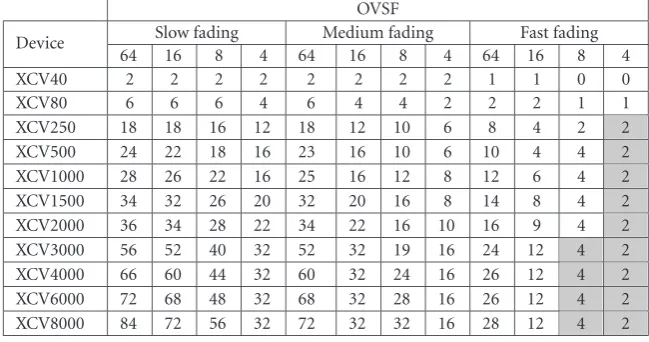
Tables1and2summarize the maximum number of si-multaneous users (KMAX) that can be processed in monorate on different devices of the Virtex-II and Virtex-II Pro families in different data based on the UMTS 3G standard. The data throughputs are fixed by the OVSF parameter such as 64, 16, 8, and 4 corresponding, respectively, to 12.2 kbps (voice rate), 64 kbps, 144 kbps, and 384 kbps (the last three throughputs are for data) [2]. We assumed three mobile speeds: slow fad-ing (TA = 40 milliseconds), medium fading (TA =10 mil-liseconds), and fast fading (TA =2 milliseconds), whereTA represents the allowed adaptation time of CF-MUD coeffi -cients (wandv) [20]. Considering the short code of 256 chips, the number of adaptation iterations is 100(256/OVSF) for each userkof the signature and detection block. We used the same number of adaptation iterations for hardware esti-mation.
Filtering Adaptation Block
signature
Block detection
n−1 PELMS
Filtering Adaptation
n
PELMS
Filtering Adaptation
n+ 1 PELMS
Idle Filtering Adapt. Idle Filtering Adapt. Idle Filtering Adapt. Idle
tA
· · ·
· · ·
(a)
Filtering Adaptation Block
signature
Block detection
n−1 PELMS
Filtering Adaptation
n
PELMS
Filtering Adaptation
n+ 1 PELMS
Idle
Filtering Adapt. Idle Filtering Adapt. Idle Filtering Adapt. Idle
t tA
· · ·
· · ·
(b)
Figure7: Pipeline strategy of adaptation process in case that the processing time of signature block is (a) superior and (b) inferior to the processing time of detection block.
Block signature
Block detection
n−1 PEFIR
n
PEFIR
n+ 1 PEFIR
Idle PEFIR Idle PEFIR Idle PEFIR Idle
tD
· · ·
· · ·
(a)
Block signature
Block detection
n−1 PEFIR Idle
n
PEFIR Idle
n+ 1 PEFIR Idle
Idle PEFIR PEFIR PEFIR
tD
t
· · ·
· · ·
(b)
Table1: Maximum number of simultaneous users (KMAX) detected and which can be integrated on different devices of Virtex-II Pro family.
OVSF
Device Slow fading Medium fading Fast fading
64 16 8 4 64 16 8 4 64 16 8 4
XC2VP2 10 10 8 6 10 6 6 4 4 2 2 1
XC2VP4 22 20 16 14 20 14 10 6 10 4 2 2
XC2VP7 30 28 24 18 28 18 14 8 12 6 4 2
XC2VP20 52 48 36 28 48 28 16 16 22 12 4 2 XC2VP30 68 68 44 32 68 32 26 16 26 12 4 2 XC2VP40 84 82 64 38 82 38 32 16 32 12 4 2 XC2VP50 98 90 68 46 90 46 32 16 38 12 4 2 XC2VP70 112 108 68 64 108 64 32 16 54 12 4 2 XC2VP100 148 136 88 68 136 68 32 16 54 12 4 2 XC2VP125 170 136 110 68 136 68 32 16 54 12 4 2
Table2: Maximum number of simultaneous users (KMAX) detected and which can be integrated on different devices of Virtex-II family.
OVSF
Device Slow fading Medium fading Fast fading
64 16 8 4 64 16 8 4 64 16 8 4
XCV40 2 2 2 2 2 2 2 2 1 1 0 0
XCV80 6 6 6 4 6 4 4 2 2 2 1 1
XCV250 18 18 16 12 18 12 10 6 8 4 2 2
XCV500 24 22 18 16 23 16 10 6 10 4 4 2
XCV1000 28 26 22 16 25 16 12 8 12 6 4 2
XCV1500 34 32 26 20 32 20 16 8 14 8 4 2
XCV2000 36 34 28 22 34 22 16 10 16 9 4 2
XCV3000 56 52 40 32 52 32 19 16 24 12 4 2 XCV4000 66 60 44 32 60 32 24 16 26 12 4 2 XCV6000 72 68 48 32 68 32 28 16 26 12 4 2 XCV8000 84 72 56 32 72 32 32 16 28 12 4 2
of 38400 chips in UTMS systems. To estimate the maximum number of users KMAX, we assumed a 100 MHz clock fre-quency for all devices.
Tables3and4summarize the utilization ratio of resour-ces on targeted deviresour-ces corresponding to the estimated maxi-mum number of users given in Tables1and2, respectively. We observed that the utilization ratio of resources in case of fast-fading scenario is low (indicated in gray zones). This is because the adaptation time decreases an impose to fix
TMUX 1 andTMUX 2 to equal 1. Thus, we are limited by few resources. But we can easily increase the number of users by only duplicating the same architecture on the device. Hence, we can easily increaseKMAXin fast-moving conditions.
Note that in these results, the users transmit simultane-ously in the same sector. Normally, we should consider the number of user lower than the value of the OVSF. Thus, the number of user higher than the value of the OVSF should be distributed on the other sectors of the BTS. Under these conditions, the number of users by BTS (3 sectors) should be higher than the data indicated in Tables1and2.
According to the pipeline strategy of developed architec-tures, the total time needed to process a data frame is re-stricted by the maximum execution time in the signature and
detection blocks. In the signature block, the performance in terms of adaptation time (tA1) and detection time (tD1) is,
respectively, defined by
tA1=
3NC+ 9NA1 256 OVSF
TMUX 1Tclk,
tD1=
2NC+ 5 38400 OVSF
TMUX 1Tclk.
(15)
In the detection block, we have
tA2=(9K+ 9)NA2TMUX 2Tclk,
tD2=(6K+ 5) 38400 OVSF
TMUX 2Tclk.
(16)
With the pipeline strategy of architecture, the time process-ing in each cascade filter is, respectively, max(tA1,tD1) and max(tA2,tD2), and it needs to be inferior toTAfor adaptation
depending on slow-, medium-, and fast-fading communica-tion situacommunica-tions.
Table3: Utilization ratio of hardware (%) forKMAXofTable 1on different devices of Virtex-II Pro family.
OVSF
Device Slow fading Medium fading Fast fading
64 16 8 4 64 16 8 4 64 16 8 4
XC2VP2 93 97 98 88 97 88 100 89 79 83 83 39 XC2VP4 100 100 95 100 100 100 95 100 100 71 57 36 XC2VP7 96 95 98 95 95 95 95 97 98 95 68 23 XC2VP20 98 98 98 99 98 99 97 97 100 82 34 11 XC2VP30 90 100 88 97 100 97 99 94 76 70 22 7 XC2VP40 89 100 100 99 100 99 92 67 100 50 16 5.2 XC2VP50 100 92 98 99 92 99 85 55 98 41 13 4.3 XC2VP70 92 100 83 99 100 99 80 39 99 29 9.1 3.0 XC2VP100 100 92 99 92 92 92 59 29 97 22 6.7 2.2 XC2VP125 92 98 100 98 98 98 47 23 78 17 5.3 1.7
Table4: Utilization ratio of hardware (%) forKMAXofTable 2on different devices of Virtex-II family.
OVSF
Device Slow fading Medium fading Fast fading
64 16 8 4 64 16 8 4 64 16 8 4
XCV40 78 80 84 93 79 93 85 90 54 67 0 0
XCV80 95 98 91 85 98 85 100 88 86 75 58 58
XCV250 98 96 100 90 96 90 97 97 89 83 67 42
XCV500 96 98 99 100 98 100 83 88 87 94 100 31
XCV1000 99 98 92 99 98 99 98 100 90 90 75 25
XCV1500 99 100 98 97 100 97 100 100 97 100 62 21
XCV2000 95 98 100 92 98 92 95 98 95 96 54 18
XCV3000 97 99 100 100 99 100 99 100 100 100 31 10 XCV4000 99 100 100 92 100 92 100 80 87 80 25 8.3
XCV6000 100 94 100 92 94 92 97 89 72 7 21 6.9
XCV8000 100 100 100 79 100 78 98 76 100 57 18 6.0
Table5: Postplacing and routing results using Xilinx physical tools (ISE Foundation) targed on Xilinx Virtex-II Pro XC2VP30 device for a system ofK=16 users for slow- and medium-fading conditions.
OVSF TMUX Slices BRAM Multipliers Clock rate(MHz) Clock skew(ns) (ms)tA (ms)tD
TMUX 1 TMUX 2
Slo
w
fading
64 4 4 6149/13696
(44%)
36/136
(32%) 32/136 (23%) 71 0.273 4.53 4.50
16 4 4 4508/13696
(32%)
36/136
(32%) 32/136 (23%) 72 0.271 8.49 13.45
8 3 2 6168/13696
(45%)
56/136
(41%) 52/136 (38%) 74 0.28 4.28 13.10
4 2 2 7474/13696
(54%)
68/136
(50%) 64/136 (47%) 73 0.281 4.192 26.56
M
edium
fading
64 4 4 6155/13696
(44%)
36/136
(32%) 32/136 (23%) 75 0.279 4.34 4.31
16 2 2 8466/13696
(61%)
68/136
(30%) 64/136 (47%) 83 0.281 3.68 5.82
8 4 1 8493/13696
(61%)
84
(61%) 80 (58%) 49 0.708 8.62 9.89
4 1 1 11940/13696
(87%)
132/136
limitation of the present architecture in terms of maximum numbers. Again, we can find a slight difference in terms of hardware resources (number of slices) between the results after synthesis inTable 5and the results before synthesis by our resource-estimator tool inTable 1. This was explained in
Section 4by the absence of database for FPGA components. We consider only the number of multipliers and BRAMs in our integer nonlinear programming model. Moreover, even with knowledge of the database, the resource estimation be-fore synthesis is still difficult [21]. Nevertheless, for the main resources, the number of multipliers and BRAMs are exactly the same as inTable 1.
6. CONCLUSIONS
The HW architectures of a multiuser detector based on a cascade of adaptive filters (CF-MUD) for WCDMA systems were developed. The CF-MUD based on FIR using an LMS adaptation process presented a good choice for targeting FPGA devices. We have exploited the implementation advan-tages of the algorithm and the particular features of Xilinx devices. The regularity and recursiveness of the CF-MUD al-gorithm offer the opportunity to maximize the utilization ra-tio in the resource of the FPGA device. Using real-time im-plementation and taking into account all UMTS constraints, we demonstrated a utilization ratio in the resource near to 100% to maximize the parallelism of the CF-MUD algo-rithm. These dedicated architectures can be used later as op-timized IP cores performing MUD functions. The current HW architectures are purely glue logic. Future work will con-sist of exploiting software processing in the multirate CF-MUD as a whole respecting the constraint specifications of the 3G wireless communications.
ACKNOWLEDGMENTS
The authors are grateful for the financial support of the Nat-ural Sciences and Engineering Research Council of Canada (NSERC). We also wish to thank Axiocom Inc. for its techni-cal and financial assistance.
REFERENCES
[1] P. Chaudhury, W. Mohr, and S. Onoe, “The 3GPP proposal for IMT-2000,”IEEE Communications Magazine, vol. 37, no. 12, pp. 72–81, 1999.
[2] 3rd Generation Partnership Project (3GPP), “Spreading and modulation (FDD),” Tech. Rep. TS 25.213 v4.1.0 (2001-06), 3GPP, Valbonne, France, 2001.
[3] S. Verd ´u,Multiuser Detection, Cambridge University Press, New York, NY, USA, 1998.
[4] A. O. Dahmane and D. Massicotte, “DS-CDMA receivers in Rayleigh fading multipath channels: direct vs. indirect meth-ods,” in Proceedings of IASTED International Conference on Communications, Internet and Information Technology (CIIT ’02), St. Thomas, Virgin Islands, USA, November 2002. [5] A. O. Dahmane and D. Massicotte, “Wideband CDMA
receiv-ers for 3G wireless communications: algorithm and imple-mentation study,” in Proceedings of IASTED International
Conference on Wireless and Optical Communications (WOC ’02), Banff, Alberta, Canada, July 2002.
[6] S. Moshavi, “Multi-user detection for DS-CDMA communi-cations,”IEEE Communications Magazine, vol. 34, no. 10, pp. 124–136, 1996.
[7] S. Rajagopal, S. Bhashyam, J. R. Cavallaro, and B. Aazhang, “Real-time algorithms and architectures for multiuser channel estimation and detection in wireless base-station receivers,”
IEEE Transaction on Wireless Communications, vol. 1, no. 3,
pp. 468–479, 2002.
[8] O. Leung, C.-Y. Tsui, and R. S. Cheng, “VLSI implementation of rake receiver for IS-95 CDMA testbed using FPGA,” in Pro-ceedings of IEEE Asia and South Pacific on Design Automation
Conference (ASP-DAC ’00), pp. 3–4, Yokohama, Japan, January
2000.
[9] G. Xu, S. Rajagopal, J. R. Cavallaro, and B. Aazhang, “VLSI implementation of the multistage detector for next generation wideband CDMA receivers,”The Journal of VLSI Signal
Pro-cessing, vol. 30, no. 1-3, pp. 21–33, 2002.
[10] Y. Guo, G. Xu, D. McCain, and J. R. Cavallaro, “Rapid schedul-ing of efficient VLSI architectures for next-generation HSDPA wireless system using Precision C synthesizer,” inProceedings of 14th IEEE International Workshop on Rapid Systems
Proto-typing (RSP ’03), pp. 179–185, San Diego, Calif, USA, June
2003.
[11] W. Schlecker, A. Engelhart, W. G. Teich, and H.-J. Pfleiderer, “FPGA hardware implementation of an iterative multiuser detection scheme,” inProceedings of 10th Aachen Symposium
on Signal Theory (ASST ’01), pp. 293–298, Aachen,Germany,
September 2001.
[12] B. A. Jones and J. R. Cavallaro, “A rapid prototyping en-vironment for wireless communication embedded systems,”
EURASIP Journal on Applied Signal Processing, vol. 2003, no. 6,
pp. 603–614, 2003, Special issue on rapid prototyping of DSP systems.
[13] D. Massicotte and A. O. Dahmane, “Cascade filter receiver for DS-CDMA communication systems,” International Applica-tion Published Under the Patent CooperaApplica-tion Treaty (PCT), May 2004, WO2004/040789.
[14] Q.-T. Ho and D. Massicotte, “FPGA implementation of adap-tive multiuser detector for DS-CDMA systems,” in Proceed-ings of 14th International Conference on Field Programmable
Logic and Application (FPL ’04), pp. 959–964, Leuven,
Bel-gium, August–September 2004.
[15] Q.-T. Ho and D. Massicotte, “A low complexity adaptive mul-tiuser detector and FPGA implementation for wireless DS-WCDMA communication systems,” inProceedings of Global
Signal Processing Expo and Conference (GSPx ’04), Santa Clara,
Calif, USA, September 2004.
[16] The International Telecommunication Union (ITU), Geneva, Switzerland, available at:http://www.itu.org.
[17] Xilinx, San Jose, Calif, USA, available at:http://www.xilinx. com.
[18] G. De Micheli,Synthesis and Optimization of Digital Circuits, McGraw-Hill, New York, NY, USA, 1994.
[19] S. G. Nash and A. Sofer,Linear and Nonlinear Programming, McGraw-Hill, New York, NY, USA, 1996.
[20] S. Rajagopal, S. Rixner, and J. R. Cavallaro, “A programmable baseband processor design for software defined radios,” in Pro-ceedings of 45th IEEE Midwest Symposium on Circuits and
Sys-tems (MWSCAS ’02), vol. 3, pp. 413–416, Tulsa, Okla, USA,
[21] C. Shi, J. Hwang, S. McMillan, A. Root, and V. Singh, “A system level resource estimation tool for FPGAs,” inProceedings of 14th International Conference on Field Programmable Logic and
Application (FPL ’04), pp. 424–433, Leuven, Belgium, August–
September 2004.
Quoc-Thai Ho received a B.S. degree in electrical and electronics engineering from the Ho Chi Minh City University of Tech-nology, an M.S. degree in design of digi-tal and analog integrated systems from the Institut National Polytechnique de Greno-ble, and an M.S. degree in microelectron-ics from the ´Ecole Doctorale de Grenoble in September 2000, October 2001, and June 2002, respectively. He is currently pursuing
his Ph.D. in electrical engineering at the Universit´e du Qu´ebec `a Trois-Rivi`eres where he joined the Laboratory of Signal and Sys-tem Integration. His Ph.D. work consists of VLSI architectures of multiuser detectors for DS-WCDMA wireless communication sys-tems of third generation. His actual research interests include VLSI implementation, design methodologies, FPGA-based rapid proto-typing with applications to CDMA communication systems.
Daniel Massicottereceived the B.S.A. and M.S.A. degrees in electrical engineering and industrial electronics in 1987 and 1990, re-spectively, from the Universit´e du Qu´ebec `a Trois-Rivi`eres (UQTR), QC, Canada. He obtained the Ph.D. degree in electrical en-gineering in 1995 at the ´Ecole Polytech-nique de Montr´eal, QC, Canada. In 1994, he joined the Department of Electrical and Computer Engineering, Universit´e du
Qu´ebec `a Trois-Rivi`eres, where he is currently a Professor. He is currently the Head of the Laboratory of Signal and Systems Inte-gration and Chief Technology Officer of Axiocom Inc. He received the Douglas R. Colton Medal for Research Excellence awarded by the Canadian Microelectronics Corporation, the PMC-Sierra High Speed Networking and Communication Award, and the Second place at the Year 2000 Complex Multimedia/Telecom IP Design Contest from Europractice in 1997, 1999, and 2000, respectively. His research interests include VLSI implementation and digital sig-nal processing for the communications and measurement prob-lems such as nonlinear equalization, multiuser detection, channel estimation, and signal reconstruction. He is the author and the coauthor of more than 60 technical papers. He is also Member of the Ordre des Ing´enieurs du Qu´ebec, Groupe de Recherche en ´Electronique Industrielle (GREI), and Microsystems Strategic Al-liance of Qu´ebec (ReSMiQ).
Adel-Omar Dahmanereceived the B.S. de-gree in electrical engineering from the Uni-versit´e des Sciences et de la Technologie Houary Boum´edienne (USTHB), Algiers, Algeria, in 1997, the M.S. and Ph.D. de-grees with honours in electrical engineering from Universit´e du Qu´ebec `a Trois-Rivi`eres, Trois-Rivi`eres (UQTR), QC, Canada, in 2000 and 2004, respectively. He was two times the Laureate of the Governor General
of Canada’s Academic Medal (gold medal—graduate level) and a Fellow of the Natural Sciences and Engineering Research Council of