A S tu d y of
C hem istry, D ynam ics and D u st
in N ova O utflow s
M atthew P ontefract
Thesis su b m itted for th e degree of D octor of Philosophy
of th e U niversity of London.
UCL
D epartm ent of Physics & Astronomy Un i v e r s i t y Co l l e g e Lo n d o n
London W C lE 6BT
ProQuest Number: U642247
All rights reserved
INFORMATION TO ALL USERS
The quality of this reproduction is dependent upon the quality of the copy submitted. In the unlikely event that the author did not send a complete manuscript and there are missing pages, these will be noted. Also, if material had to be removed,
a note will indicate the deletion.
uest.
ProQuest U642247
Published by ProQuest LLC(2015). Copyright of the Dissertation is held by the Author. All rights reserved.
This work is protected against unauthorized copying under Title 17, United States Code. Microform Edition © ProQuest LLC.
ProQuest LLC
789 East Eisenhower Parkway P.O. Box 1346
A b stra ct
Since the celebrated outburst of nova DQ Herculis (1936), observations of which suggested th a t dust grains were being formed with high efficiency, research into the chemical pro cesses leading to dust nucléation has flourished. Observations show th a t dust formation is not only highly efficient but a common occurrence in nova outbursts, yet the chemical pathways leading to dust are poorly understood.
A study of chemical processes within outflowing ejectum m aterial through closely linked, quasi self-consistent chemical models from ju st a few days post-outburst until the formation of dust nucléation sites is presented. Chemical modelling, incorporating new and updated chemistry within a realistic radiation field, is followed by a study of dynamics with a new fluid dynamic model incorporating chemistry explicitly within the conservation equations.
In contrast to previous studies, we find th a t a rich chemistry of small molecules develops within a few days after outburst. This leads to the formation of a large abundance of nucléation sites from many model configurations. We find also th a t CO does not satu rate within these chemical scenarios; this negates previous assumptions and helps to explain observations not only in novae, but also in objects such as planetary nebulae. C onstraints are placed on physical conditions within the ejecta.
A ck n ow led gem ents
I would like to thank Jonathan Rawlings above all for providing the inspiration for this work and maintaining his cool in the face of one who would insist on writing code in the devil’s own tongue: C. Having rather directly ascertained w hether he drank or not, Jo n ath an took responsibility for a student who trembled a t the very thought of ‘doing chem istry’. Four years later the fear is gone and I am left in no doubt as to the correct answer to th a t first, testing question!
C hapter 5 would not have been possible w ithout the superb code of Andrew Lim. His patience when answering my many questions, and assistance with the elimination of gremlins, was invaluable at a time when to sta rt a novel project was to take a considerable risk. I hope he is pleased with the product of his baby.
From the time I started this work four years ago, my friend, confidente and one-time flat-m ate, Serena Viti, has always been close to help me find the door when things go black and swooney. A more understanding, generous and humorous friend one could not hope to find, and to her I offer tanti bacil
To Tony Lynas-Gray I also extend my heart-felt gratitude for his regular encourage ment, liquid refreshment and good humour. His critical assessment of this m anuscript and moral support have, w ithout doubt, made this a better work.
As for the myriad buddies, friends and family who have played such an im portant rôle in my life of the past few years, I thank you for all the fun and, of late, the floor space. In particular I feel th a t my appreciation of both fine gin and tonic and deep penetration would not be w hat it is today w ithout your encouragement. My appreciation of new and talented female vocalists clearly owes nothing to any of you, however!
C on ten ts
A b stra c t 3
A ck n o w le d g e m en ts 5
T able o f C o n te n ts 9
List o f F igu res 13
List o f T ables 17
1 N ovae: P h y sic s, C h e m istry and th e M aking o f D u st 19
1.1 In tro d u c tio n ... 19
1.2 The Physics of a Nova E ru p tio n ...21
1.3 The Spectral Evolution of a N o v a ... 24
1.3.1 The Pre-Nova S t a g e ... 25
1.3.2 The Rise to Visual M a x im u m ...26
1.3.3 Early D e c lin e ... 28
1.3.4 Final D e c lin e ... 29
1.4 The Ejecta: Properties, Structure and E v o l u t i o n ... 29
1.4.1 Physical P ro p e rtie s ... 29
1.4.2 Ionisation S t r u c t u r e ... 31
1.5 C h e m is tr y ...33
1.5.1 Pre-D ust F o r m a t io n ... 40
1.5.2 D ust and G e o m e t r y ... 40
1.6 Recent O b s e rv a tio n s ... 43
1.6.1 Molecules in N o v a e ... 43
10 CO NTENTS
2 M o d ellin g T ech n iq u es 51
2.1 In tro d u c tio n ... 51
2.1.1 Previous W o r k ... 52
2.2 Basic Reaction D a t a ...52
2.3 P ho torate Coefficients: Realistic Radiation F ie ld s ... 54
2.3.1 Photoreactions where no cross-section d ata are a v a ila b le ... 60
2.4 Representing Chemistry in C o d e ... 61
2.4.1 A Schematic Model ... 63
2.4.2 Jo : Generating Di f f u n and Ja c o b i a n... 65
2.5 The C h e m is tr y ... 68
2.6 The Model ... 70
2.7 L i m it a ti o n s ... 73
3 E arly C h em ica l E v o lu tio n 75 3.1 In tro d u c tio n ... 75
3.2 C h e m is try ... 76
3.2.1 Additions and modifications to R a te 9 5 ... 78
3.2.2 Excited Hydrogen: Hn= 2... 86
3.3 A Complete M o d e l... 89
3.4 Model R e s u lts ... 91
3.4.1 An O v e r v ie w ... 91
3.4.2 Reaction Networks in Practice ... 99
3.5 Concluding R e m a r k s ...109
4 L ate C h em ica l E v o lu tio n 113 4.1 In tro d u c tio n ... 113
4.2 A Hydrocarbon S o lu tio n ... 115
4.2.1 C h e m is try ... 115
4.2.2 L im ita tio n s ... 118
4.2.3 Results ... 118
4.2.4 S u m m a r y ... 130
4.3 The PAH Reaction S c h e m e ...131
4.3.1 A note on the com putation of r a t e s ...134
C O N TEN TS 11
4.3.3 Transfer to the Nova E n v ir o n m e n t...137
4.3.4 A Working Model ... 138
4.3.5 C o n clu sio n s...148
5 A F lu id D y n a m ic M o d el 151 5.1 In tro d u c tio n ...151
5.2 The Lim CFD C o d e ... 151
5.3 Including C h e m is tr y ... 155
5.4 L i m it a ti o n s ...157
5.4.1 P h o to ch e m istry ... 158
5.5 Working Models ... 158
5.6 R e s u lts ...162
5.6.1 Different Physical Scenarios: A ‘Di f f u s e En h a n c e d’ Wind . . . . 170
5.7 C o n c lu sio n s ...177
5.7.1 Modelling in 7%-Dimensions ... 178
6 C o n c lu sio n s and F u tu re P r o je c ts 181 A E a rly -T im e M o d el P lo ts 185 B R ea ctio n s o f th e E arly C h e m istry 203 C P h o to r e a c tio n R a te C oefficien ts 241 D G ib b s C o efficien ts for th e P A H R ea ctio n S ch em e 245 E O n lin e R eso u r ces 249 E .l O btaining J o ... 249
E.2 O ther Online R e s o u r c e s ...249
List o f Figures
1.1 Profile of a typical nova light curve, W arner (1989)... 27 1.2 Potential energy curves and characteristic cross sections for (a) direct pho
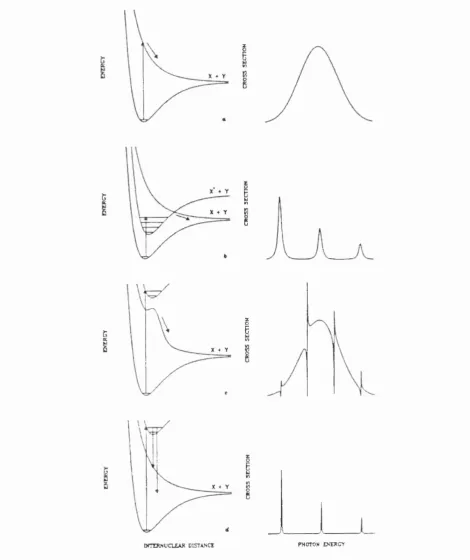
todissociation; (b) predissociation; (c) coupled states photodissociation; (d) spontaneous radiative dissociation, van Dishoeck (1988)... 38 1.3 Nova Cas 1993: K and L-band spectra obtained 1994 January 11 (day 26.5),
Evans et al. (1993)... 45 1.4 Nova Cas 1993: K and L-band spectra obtained 1994 January 30 (day 46),
Evans et al. (1993)... 46
2.1 Synthetic spectra reproduced from Beck et al. (1995). Spectra correspond ing to four different photospheric tem peratures as given. Enhanced CNO abundances were used (factor 10^ above solar) as are implied by TN R mod elling. The corresponding black body continuum flux is also shown as a dashed line... 60 2.2 Forming an ODE with J o ... 67 2.3 Differentiating to form the Jacobian m atrix with J o ...69
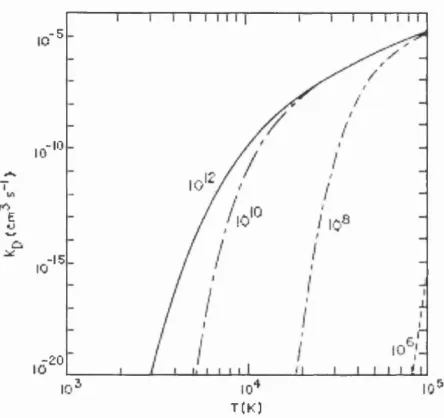
3.1 The rate coefficient for collision-induced dissociation of carbon monoxide in a gas of atomic hydrogen. The curves are labelled by the density of atomic hydrogen in cm “ ^. From Roberge and Dalgarno (1982)... 80 3.2 Time dependent plot of selected species evolving within a DQ Her-type
nova. Here, n{C) < n{0). Time in units of days... 92 3.3 Time dependent plot of selected species evolving within a DQ Her-type
nova. Here, n[C) > n{0). Time in units of days... 92 3.4 CO abundance in relation to N”*" and O'*" abundance. The solid line is for
14 LIST OF FIGURES
3.5 CO and N'*' in a moderately fast nova with thy = 0.06 The solid line is for a model with n{C) > n{0) whilst the dashed line is for n{C) < n{0). . . 3.6 M ajor formation and destruction channels for CO (see text for details). . 3.7 M ajor formation and destruction channels for CN (see te x t for details). . 3.8 M ajor formation and destruction channels for H2 (see text for details). . .
3.9 The column density of Carbon a t t =50 days; results for a grid of models 3.10 The column density of H2 a t t =50 days; results for a grid of models . . .
3.11 The column density of CO at t =50 days; results for a grid of models . . . 3.12 Species in a model of QU Vul...
98 99 102
104 106 106 106 109
4.1 Hydrocarbon model output (a) Ng and Tg are the startin g number density and tem perature (at 30 days) respectively; X (0 ) is the startin g oxygen
relative abundance... 123
4.2 Hydrocarbon model ou tput (b)... 124
4.3 Hydrocarbon model ou tput (c)... 125
4.4 Hydrocarbon model output (d)... 126
4.5 Hydrocarbon model output (e)... 127
4.6 Sensitivity of the PAH model to oxygen fraction...146
4.7 Sensitivity of species to density in the PAH reaction network. Models started a t 30 days post-outburst with density of n = lOd^ cm“ ^ (solid line); n = 10^ cm~^ (dashed line); n = 10^ cm“ ^ (dotted line)... 147
5.1 Initial state of a simple, single shell, CFD ejecta model. The upper axis shows the real space dimensions of the grid with the left hand edge being at a radius of lOd^ cm from the white dw arf... 161
5.2 Tem perature and density profile through a CFD ejecta m o d e l ... 163
5.3 Greyscale representations of the spatial and tem poral evolution of species within an isolated shell. Abundances are represented by colour from black (low) to white (high)... 164
5.4 Snapshots of the CO abundance profile... 165
5.5 Snapshots of the H2 abundance profile... 166
5.6 Evolution of CO column density with time in a hydrodynamic model. . . . 167
LIST OF FIGURES 15
5.8 Tem perature and density profiles at 1.6 (top) and 20.2 (bottom ) days in a colliding wind model. The ‘Diffuse Enhanced’ component is seen approach ing from the left in the upper plot whilst in the lower plot it has merged
with the principal ejectum ... 171
5.9 Greyscale images of CO and H2 evolution in a colliding wind model.172 5.10 CO abundance profiles in a colliding wind model... 173
5.11 H] abundance profiles in a colliding wind model...174
5.12 CO column density as a function of time for a colliding wind model..176
A .l ihy = 0.02, z ( C ) = l.l X 10-2, z (0 )= 5 .3 X 1 0 - 2 ... ... 186
A.2 my = 0.02, a ;(C )= l.l X 10-2, a;(0)=5.3 X 1 0 - 2 ... ... 187
A.3 ihy = 0.02, a;(C )= l.l X 10-2, æ (0)=5.3 X 1 0 - 2 ... ... 188
A.4 ihy = 0.02, a :(C )= l.l X 10-2, æ (0)=5.3 X 1 0 - 2 ... ... 189
A.5 ihy = 0.06, a ;(C )= l.l X 10-2, x (0 )= 5 .3 X 1 0 - 2 ... ...190
A .6 ihy = 0.06, a ;(C )= l.l X 10-2, x (0 )= 5 .3 X 1 0 - 2 ... ...191
A .l
ihy = 0.06, z ( C ) = l.l X 10-2, æ (0)=5.3 X 1 0 - 2 ... ... 192A.8 ihy 0.06, a ;(C )= l.l X 10-2, z (0 )= 5 .3 X 1 0 - 2 ... ... 193
A.9 ihy = 0.02, x(C )=5.3 X 10⁻², x ( 0 ) = l . l X 1 0 - 2 ... ...194
A .10ihy — 0.02, æ(C)=5.3 X 10⁻², x ( 0 ) = l . l X 1 0 - 2 ... ... 195
A .11ihy = 0.02, æ(C)=5.3 X 10⁻², a ; ( 0 ) = l . l X 1 0 - 2 ... ... 196
A.12 ihy = 0.02, x(C )= 5.3 X 10⁻², æ ( 0 ) = l . l X 1 0 - 2 ... ...197
A.13 lily = 0.06, x(C)=5.3 X 10⁻², z ( 0 ) = l . l X 1 0 - 2 ... ... 198
A .14ihy = 0.06, x(C )=5.3 X 10⁻², æ ( 0 ) = l . l X 1 0 - 2 ... ... 199
A. 15 lily = 0.06, æ(C)=5.3 X 10⁻², æ ( 0 ) = l . l X 1 0 - 2 ... ... 200
List o f Tables
1.1 Classification of nova light c u r v e s ... 25
2.1 Generic reaction types and units of A;... 53
2.2 Comparison of selected photorate coefficients computed using black body {kbb) and synthetic {kgyn) spectra with a photospheric tem perature of 10^A'. 59 3.1 Nitrogen bearing species selected for nova modelling... 85
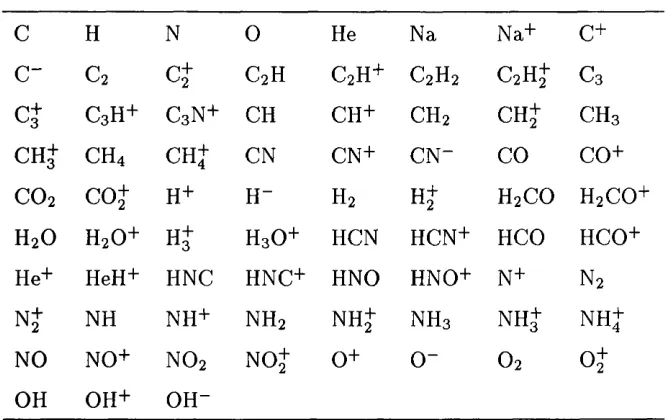
3.2 Complete species list for early-time chemistry... 86
3.3 Calculating the efficiency of H„ = 2 associative ionisation. Figures in paren theses are the exponential quotient... 88
3.4 Estim ated elemental abundances within the DQ Her outflow 3 days post outburst with Xi the fractional abundance cm“ ^... 90
3.5 Initial param eters for early-time nova m o d e l s ...90
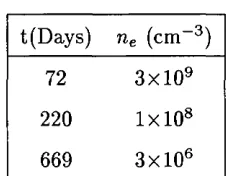
3.6 n{CO)/n{CN) ratio at ~ 50 days for a grid of models. In each tem perature band, the top row is an oxygen rich nova and the bottom a carbon rich nova. 96 3.7 Electron abundance as inferred from observation within the DQ Her nebula. 107 4.1 Species list for a hydrocarbon c h e m is tr y ... 116
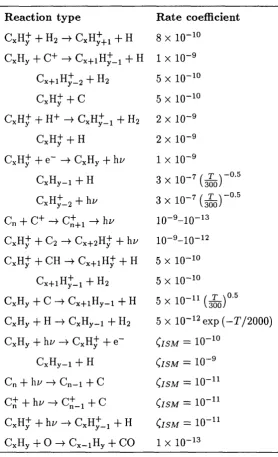
4.2 Basic reaction types in the hydrocarbon chemistry (prim ary d a ta source Rawlings and Williams (1989))... 119
4.3 Species list for a PAH formation chemistry ... 132
4.4 Species of the mixed H ydrocarbon/PA H chemistry... 140
C hap ter 1
Novae: P h ysics, C h em istry and
th e M aking o f D u st
1.1
Introduction
20 CHAPTER 1. NOVAE: PHYSICS, CHEMISTRY AND THE MAKING OF DUST
vast numbers of possible isomers and an equally vast catalogue of pathways through which they might be synthesised. A thorough understanding of the chemical kinetics behind such processes would be difficult if not impossible to achieve with current modelling and com putational resources. In this thesis we explore a little of this domain in order to find routes to the formation of intermediaries between chemical and microscopic worlds within the laboratory of a nova wind. Although apparently hostile, molecular chem istry appears to be very efficient within such an environment with the harsh tem peratures, densities and radiation fields both assisting and complicating the chemistry. On the one hand, the intense UV radiation field inhibits the formation of large molecules in rapidly dissociating them whilst a t the same time this very action reduces the possible routes to grain nucléation; the chemistry must proceed via small molecule reactions. Above all, however, novae provide us with a unique opportunity to observe the formation of dusts in a time-dependent manner, inferring directly from observation information regarding the development of precursor molecules and the kinetics of grain formation. It is well known th a t many cool stars, carbon stars (Cherchneff and Barker (1992); Cherchneff et al. (1992)), AGB stars (Gail, H. -P. and Sedlmayr (1999)) and Wolf-Ray et winds (Cherchneff (1997)) all produce dust but they do not do so in the singular manner of a nova; the identification of discrete stages in the chain of events leading to dust formation is the key advantage of novae.
Novae are not the only objects to form dust in episodic outbursts however: Wolf-Rayet (Filippenko et al. (1995)) and R Coronae Borealis (RCrBr) (Feast et al. (1997)) stars also resemble novae in some ways. For example, CN is commonly detected in the la tter (e.g. Benson et al. (1994)) and this is one of the very few species directly observed in novae, however the underlying reasons for this are different. Both RCrBr and Wolf- Rayet stars produce dust with a hydrogen-deficient chemistry and in the latter, form ation usually occurs in the shock-induced condensation of colliding winds. The underlying source of the former is a cool F or G type supergiant having an effective tem perature of 5 - 7000 K aa opposed to greater than 10,000 K for a nova. Moreover, neither class of object shares the relative simplicity of the nova geometry nor the singular nature of a classical nova. Although the d a ta suggest th a t RCrBr stars conform to a random ‘dust-puff ’ model (Feast et al. (1997)), this mechanism is undoubtably far removed from the nova ejection mechanism!
1.2. THE PHYSICS OF A NOVA ERUPTION 21
of which is the presence of an intense UV radiation field coupled with extremely high tem peratures of the order 10^ K and densities of the order cm“ ^. W ithin such an energetic environment not only are the myriad reactions of standard interstellar chemistry (the kind of chemistry developed for interstellar clouds: refer to Duley and Williams (1984), and Millar et al. (1991)) inappropriate, many elemental and molecular species will be in highly excited electronic, vibrational and rotational states for which little or no chemical kinetic d a ta are available. In such cases rate coefficients have to be extrapolated or inferred from apparently ‘similar’ reactions. The photophysics of species in excited states is also very different to those of ground state species so we may be less able to trea t these accurately. Even ground state photoreactions give cause for concern in particular for photodissociation reactions where the appropriate cross-sections are highly uncertain even for small species. These are critical uncertainties in an environment dom inated by photochemistry.
W hilst we must accept th a t research into the chemistry of nova winds is still in its infancy and fraught with difficulties both observational and theoretical, novae give us a unique environment in which to develop and test new ideas and theories th a t might one day lead us to a b etter understanding of the process of astrophysical dust form ation.
1.2
T he P hysics o f a N ova E ruption
Novae, so named because the spectacular ejection of m atter in a nova explosion may cause a naked-eye sta r to appear where none had been before, are a class of cataclysmic variable (hereafter, CV). CYs loosely comprise a diverse group of stars th a t erupt, irrespective of the cause of the outburst, and include supernovae, nova-like stars, flare stars, some X-ray sources and other erupting objects^. A nova may fall into one of three categories:
22 CH APTER 1. NOVAE: PHYSICS, CHEMISTRY AND THE MAKING OF DUST
to instability in the accretion disc.
C lassical: The most dram atic and prolific producers of dust, classical novae have, by definition, not previously been observed to erupt. Whilst also having a rapid rise tim e of approxim ately 1-3 days, the decline is very much longer than for dw arf novae, usually lasting months or years. The amplitude of such an outburst exceeds nine m agnitudes (by definition) and its spectral development is in stages characteristic of classical novae. The ejecta velocity is in the range 100-5000 k m s“ ^.
R ecu rren t: In principle a recurrent nova is the same as a classical nova except th a t more than one outburst has been recorded. They accrete at a much faster rate than classical novae and hence become unstable earlier and with greater frequency.
By virtue of their apparently singular nature, ‘cleaner’ geometry and prolific dust produc ing characteristics, it is solely with classical novae th a t this thesis concerns itself.
As with most CVs, all classical novae (and indeed dwarf and recurrent novae too) are believed to originate in binary systems. Observational evidence shows th a t novae are found in semi-detached systems^ in which a white dwarf primary of approximately 1M@ accretes hydrogen enriched material from a late-type (red star) secondary by Roche lobe overflow through the inner Lagrangian point via an accretion disc. The first direct evidence for an accretion disc in a cataclysmic variable was provided by K raft (1959) from observations of the variability in the He ll emission line at 4686Â. Direct accretion onto the relatively small white dw arf is not possible due to the angular momentum of the accreted material; viscous forces within the disc act to cause m atter slowly to spiral in towards the surface of the white dw arf whilst angular momentum is transferred outwards.
The accretion of hydrogen rich material on to a degenerate object is potentially highly explosive and as the accreted layer slowly thickens, the bottom gradually increases in tem perature. Eventually, when the tem perature is sufficient to initiate hydrogen burning by proton-proton chain reactions, a huge thermonuclear runaway (hereafter TNR) explosion heralds the s ta rt of an eruption. The result is a series of shells ejected at high velocity into the ISM, the most massive of which is the ‘principal ejectum ’. W ith the luminosity of the nova so close to, or exceeding, the Eddington luminosity (in particular for fast novae), this outflow is driven primarily by super-Eddington continuum radiation pressure a t this
1.2. THE PHYSICS OF A NOVA ERUPTION 23
stage; only in the case of high CNO enhancements and large envelope mass may a shock develop also to accelerate the envelope. The principal ejectum carries the bulk of the m aterial at speeds of 300-1300 k m s“ ^. Radiation pressure may also drive th e secondary, less massive, ‘diffuse enhanced’ wind seen to move a t speeds approxim ately twice those of the principal ejectum.
TN R models have been successful in predicting both observed expansion velocities and the light curve produced by the expanding material. It has been shown th a t a maiss loss rate of ju st 10“ ^^ year"^ is sufficient to initiate a TNR; indeed for a 1M@ white dwarf, the maximum accretion rate th a t will still result in mass ejection is of the order 10“ ^° M© year“ ^ with metal abundances enhanced over solar values by a factor of 10-100. The required conditions for mass ejection are rather stringent: were the accreted shell not degenerate (as would be the case for large accretion rates) and the white dw arf too luminous, a runaway but no ejection may occur. It is required th a t the shell be degenerate so th a t the expansion of the envelope does not halt the TN R too early in the evolution. The specific requirements for mass ejection imposed by the TN R model account, perhaps, for the general similarities between all classical novae.
The TN R model also neatly explains a key feature, th a t the bolometric luminosity of a nova remains remarkably constant as the visual light curve declines and beyond; indeed this lasts for many tens or hundreds of days. Only 10% to 50% of the accreted m aterial is ejected in the initial outburst; much material remains on the surface of the white dwarf whilst the remainder forms a rem nant envelope the outer surface of which coincides approxim ately with the photosphere. The decline in visual m agnitude is attrib u ted to a shift in the peak energy to the UV as this rem nant shrinks and its effective tem perature rises.
TN R models have their failings however; unfortunately models predict very long evo lution time-scales for the rem nant, longer than observations indicate. The time-scale of a typical o utburst is some 1-2 years, yet the time-scale to burn all of the m aterial remaining in the envelope, r„, may be of the order several hundred years as given by
=
( ï o ^ ) ( 2 7 ^ )
24 C H APTER L NOVAE: PHYSICS, CHEMISTRY AND THE MAKING OF DUST
establish itself. Once this has been achieved, the nova system begins its long evolution to another ou tb urst some 10^-10^ years later (Ford (1978)); this is a statistical figure derived from observation th a t reflects the time required for the white dwarf to accrete a critical mass of m aterial from its companion. Two possible mechanisms to explain the rapid evolution of the envelope are:
1. Stellar-wind (i.e. radiation driven) type mass loss driving mass loss rates up to 10“ ^ Mq for luminous remnants, or more if there are enhanced CNO abundances in the rem nant.
2. If the radius of the white dwarf plus nuclear burning rem nant exceed the radius of the binary system during the early stages of outburst, dynamical friction caused by the secondary orbiting within the rem nant could then drive mass loss. Once the rem nant radius shrinks to within the Roche lobe of the white dwarf, tidal forces from the secondary could still act to drive some additional mass loss
The specifics of this phase of evolution will determine the time-scale to the next o u tb u rst since this depends on the am ount of material remaining on the white dwarf.
1.3
T he Spectral E volution o f a Nova
It is estim ated th a t there are approximately 100 Galactic novae per year (Allen (1954); Kukarkin (1954)), however this may be considered slightly high when compared with M31 in which the rate is ju st 21±4 per year (Arp (1956). In any case, only 5-15 Galactic novae are observed per year, on average, and in the four years of the work leading up to this thesis, not a single, bright and well positioned classical nova has erupted. This is a cruel but fine example of one m ajor drawback with using such objects as stellar laboratories: novae are by their very nature targets of opportunity and this combined with extremely rapid evolution to maximum light and the short time-scales of early chemical and physical evolution in the ejectum means th a t much needed d ata relating to the first few days of evolution is somewhat sparse.
1.3. THE SPEC TRAL EVOLUTION OF A NOVA 25
Speed class t2 (days) Speed (m agday ^)
Very fast <10 >0.20
Fast 11-25 0.18-0.08
M oderately fast 26-80 0.07-0.025
Slow 81-150 0.024-0.013
Very slow 151-250 0.013-0.008
Table 1,1: Classification of nova light curves
1.1 lists these speed classes as a function of (2, the time taken for the nova to diminish by
2 m agnitudes below visual maximum. The profile of a typical nova light curve is depicted in figure 1.1 (from W arner (1989)). We now consider each stage in the evolution of the nova.
1 .3 .1 T h e P r e - N o v a S ta g e
By definition, a classical nova is one th a t has not yet been observed to erupt and since no previously studied star has yet blossomed into a classical nova we are left with nothing but the plates of general sky surveys to study. Observations of novae long after outburst suggest th a t the accretion disc is re-established some ten years after the outburst. These novae may be considered to have returned to the quiescent phase. For certain novae, pre ou tburst m agnitudes may be obtained but for others the progenitor magnitude is fainter than the plate limit. None the less it is sometimes possible to gather enough evidence in this m anner to build up an idea of some behaviour prior to outburst.
The precursor object may appear as a low amplitude variable star exhibiting a fea tureless blue continuum possibly indicative of accretion. Models of close binary systems fit the observed light curves and provide one of the very few pieces of evidence to suggest a binary system. One notable exception is nova VI500 Cyg whose faint precursor could be indicative of a white dwarf accreting directly from the interstellar medium. Only in 1954 was it discovered th a t DQ Her (1934) is an eclipsing binary with a period of 4^39"^ (Walker (1954)). Subsequently it has been shown th a t virtually all novae originate in short period, close binary systems (Kraft (1964)).
26 CH APTER 1. NOVAE: PHYSICS, CHEMISTRY AND THE MAKING OF DUST
thought sometimes to have its origins at the accretion hot-spot, the point on the accretion disc where m aterial from the companion joins the disc. This is uncertain and it may also be due to irregular mass-flow into the disc. Instability in the accretion disc may give rise to further brightness variations occurring on time-scales of approximately one hundred days.
The old nova DQ Her exhibits a periodic variability of 71 seconds with variable am plitude. Observations with the Hubble Space Telescope Faint Object Spectrograph (HST FOS) made by Margon et al. (1994) detected pulsed continuum and line UV variability for the first time. The first detection of a 71 second variability in the visual light curve was by Walker (1956) whilst U, B, V and R band photom etry by Zhang et al. (1995) provides improved ephemerides for the periodicity th a t are used to calculate, am ongst other pa ram eters, the current mass transfer rate which is deemed to be < 3.4 x 10“ ® M© y r“ F DQ Her has also been found to have a strong magnetic field (see review by P atterson (1994)); Zhang et al. quote the magnetic moment to be 2.7 X 10^^ G cm“ ^. It is proposed th a t gas transfers from the accretion disc to the white dwarf along magnetic field lines where it makes contact at one or both magnetic poles. The sudden release of kinetic energy creates hot spots a t these sites which are highly luminous and irradiate the accretion disc. The m agnetic pole is not aligned with the spin-axis thus beams of radiation form a pattern of light and dark spokes th a t sweep around the accretion disc. Zhang et al. believe their observations show there to be two illuminating spots resulting in a 71 second periodicity in the light curve due to a 142 second rotation period of the white dwarf.
1.3.2
T h e R ise to V isual M axim um
Again, being targets of opportunity and with no way of predicting where and when a nova is about to explode, the initial rise is rarely caught. It is thought, due in part to this very paucity of d a ta and also based on a unique d a ta set covering most of the initial rise of V1500 Cyg (Alksne and Samus (1975); Samus (1975); Filler et al. (1975)), th a t this phase takes 2-3 days for most novae (McLaughlin (I960)); V1500 Cyg took less than a day. This initial rapid escalation in brightness is frequently arrested some two magnitudes below maximum. This ‘pre-maximum h alt’ may last anything from a few hours in fast novae, to a few days in slow novae. There is then a final rise to maximum of a day or two for fast novae, a few weeks for the very slow, to reach visual maximum.
1.3. THE SPECTRAL EVOLUTION OF A NOVA 27
a
I N I T I A L 9 M AGS
mmn
3,5 MAG S
k
:
6 MA G S
\ F
t r a n s i t i o n , FINA DECLINE
POST NOVA
F ig u re 1.1: Profile of a typical nova light curve, W a r n e r (1989).
(he light c u rv e e n t e r s in to decline. By th is p o in t th e nova has reach ed a b o lo m e tric o u t p u t
t h a t r e m a in s a p p r o x i m a t e l y c o n s t a n t t h r o u g h o u t t h e following p h a s e of e v o lu tio n ; th e
decline in th e visual light c u rv e is as a result of a r e - d is trib u tio n of t h e e n e rg y t o s h o r t e r
w a v e le n g th s, from th e visual to th e UV a n d IR to visual. Visual m a x i m u m r e p r e s e n ts th e
tim e at which t h e p h o to s p h e ric radius, RpUot, is a t its g r e a t e s t ; Fphot. is defined w h ere
t h e o p a c ity r = 2 / 3 (refer to e q u a tio n (2.7). T h is a s s u m e s a c o n s t a n t m a s s loss ra te .
A f te r visual m a x i m u m , th e p h o to s p h e r e recedes w hilst its effective t e m p e r a t u r e increases
in c o m p e n s a t i o n . T h e result is a r a d ia tio n field t h a t progressively h a r d e n s t o w a r d s th e
UV.
T h e initial e x p a n sio n of th e envelope begins only once t h e o u t b u r s t h a s re a c h e d its
jjeak o f e n e rg y g e n e r a tio n . T h e c h a n g e from h y d r o s ta tic eq u ilib riu m to h y d r o d y n a m i c
ex p a n s io n m ay be p re c ip ita te d in fast novae by a su rface lu m in o sity ex ceed in g t h e Ed-
d in g to n lum inosity. As th e shell e x p a n d s , it cools a n d once t h e t e m p e r a t u r e has reached
so m e 7 - 9 x 1 0 ^ K t h e lum inous, e x p a n d in g g as reaches a. m a x im u m ra d iu s of a p p r o x i m a t e l y
lO^^-K)^^ cm , t h e m o m e n t a t which p e a k visual lu m in o sity is o b se rv e d . A t th is t e m p e r
a t u r e , h y d ro g e n reco m b in es a n d t h e o p a c ity d r o p s rap id ly allow ing t h e o b s e rv e r t o ‘se e ’
d e e p e r in to t h e nova; th e p h o to s p h e r e recedes.
T h e p r e - m a x im u m s p e c t r u m is d o m i n a t e d by blue-shifted b ro a d a b s o r p t i o n lines c h a r
a c te ris tic of s p e c tr a l ty p e s in t h e ra n g e B 5 - F 0 . T h e s p e c t r a of slower novae m a y be
a s s o c ia te d w ith l a t e r - t y p e s p e c t r a . R a d ial velocities o f t h e a b s o r p t i o n lines a re m e a s u re d
up to -1300 k m s “ ^ for very f a s t novae, b u t as little as - 7 2 k m s ~ ^ for t h e slow est. T h e
28 CHAPTER 1. NOVAE: PHYSICS, CHEMISTRY AND THE MAKING OF DUST
At maximum light the spectrum becomes much more complex and is named the Pr i n
c i p a l Sp e c t r u m. The absorption line components strengthen and the whole spectrum becomes characteristic of an A or F supergiant. Again, slower novae resemble later spec tral types. The velocity of the principal spectrum is greater than th a t of the pre-maximum a t typically 500-1000 kms~^ for fast novae and 150-300 k m s“ ^ for the slower.
Structure within absorption lines shows great complexity with multiple lines at differing velocities. The absorption lines develop a P Cygni profile characteristic of strong stellar winds.
The strongest lines are those of H I, Ca ll, Na I and Fe ll followed a few days after maximum by [O l], [N li] and [0 ill].
1.3.3
E arly D eclin e
Soon after maximum a new, distinctive spectrum develops with very broad absorption lines blue shifted to approximately twice th a t of the principal spectrum . Also containing P Cygni profiles, as this spectrum evolves the broad absorption features fade and split into multiple sharp sub-components. This spectrum is named the Di f f u s e En h a n c e d.
Already a mixture of both the principal and diffuse enhanced spectra, when the nova has declined some 1-2 magnitudes below maximum a new and complicated spectrum termed the O r i o n S p e c t r u m ^ appears. Initially this spectrum exhibits a blue shift at least as great c l s the diffuse enhanced system which becomes greater until, as th e Orion
spectrum is fading, the velocities may be as much as -4200 km s~^ as in V1500 Cyg (Rosino (1977)), a very fast nova. This spectrum is characterised (i) by the lines remaining diffuse throughout and (ii) the increase in excitation and ionisation with time.
W hilst initially absorption lines due to He I, 0 II, N II, N ill and C II are prominent, often om itting H, certain species become particularly prominent in the late stages of the Orion spectrum . Payne-Gaposchkin (1957b) made particular note of N iii and N v ab sorption lines for their strength and persistence into later phases of spectral development. He I of exceptional strength may also be seen. O ther species may also become prominent with short-lived flashes: the most common is nitrogen ‘flaring’ and oxygen flashes. Pro posed mechanisms include Lyman P trapping (S trittm atter et al. (1977)) and resonance fluorescence (Gallagher (1978)). The high ratio of O I A8446 to other O i lines suggests
1.4. THE EJECTA: PROPERTIES, STRU CTU RE AND EVOLUTION 29
the former mechanism is responsible in this case.
It is believed th a t, as with the diffuse enhanced wind, the Orion spectrum is associated with wind m aterial dispersed after the principal spectrum . Much less dense th an the prim ary ejected material, they may be ‘absorbed’ by the principal ejectum and their final disappearance may be linked to the cessation of the wind.
1 .3 .4
Final D eclin e
The spectra observed thus far all relate to the ‘pseudo-stellar’ phase of the nova’s spectral evolution, where features are comparable with those of stars. As the light curve passes through the period known as Tr a n s i t i o n (refer to figure 1.1) the visual light curve may
enter into a deep minimum provided large scale dust formation occurs (and assuming th a t dust is indeed responsible for the transition phase), prior to recovering as either the d u st shell thins or breaks into clumps. W ith ever increasing ionisation, the gas th a t once formed the principal ejectum now takes on the spectral appearance of a nebular with many emission lines of H I, He I , I I , N I I ,ill and forbidden lines. These are all of the same
width as lines in the principal spectrum , thus supporting the view th a t they originate in the same material, and the spectrum evolves towards th a t of a planetary nebula as the ionisation further increases and the gas cools. This is known, unsurprisingly, as the Ne b u l a r Sp e c t r u m.
1.4
T he Ejecta: P rop erties, Structure and E volution
1.4.1
P h ysical P ro p erties
Deducing the density and tem perature of the ejecta from observation is fraught with difficulty as observations sample regions of different tem perature and density along the line of sight. Density can be estim ated by calculating th a t required for an optical depth of 2 /3 a t the photosphere, neglecting variations in density, opacity and making assumptions about the source of opacity.
In later stages, nebular emission line fluxes may be used: O II I line ratios give the
30 CH APTER L NOVAÉ: PHYSICS, CHEMISTRY AND THE MAKING OF DUST
Neither method either accounts for or provides an insight to any possible physical structure within the wind. This spatial structure not only makes estim ating the ejecta mass and tem perature difficult, but it imposes constraints on the ionisation stru ctu re of the ejecta and the chemistry. For example, for a nova to produce a very deep minimum during transition requires th a t dust becomes optically thick across the whole nova sky yet achieving this task with, say, an ejecta configuration th a t includes a dense equatorial outflow and a tenuous polar flow will almost certainly involve different chemistry in each region. From a modelling point of view, this is difficult to understand and make consistent with observations.
D irect observation of confirmed structure within the expanding shell has so far been impossible to obtain. It is, however, possible to image old nova rem nant shells with modern detectors and deep exposures. Slavin et al. (1995) present the results of ju st such a survey of 13 classical nova shells in which previously unobserved features are revealed. Rem ark ably, the d a ta imply a possible correlation between nova speed class and the ellipticity of the rem nant: faster novae tend to result in randomly distributed clumps superimposed upon spherically symmetric, diffuse background material whilst slower novae exhibit more structured, ellipsoidal rem nants with one or more rings. The latter may generally be de scribed as having ‘polar blobs/equatorial ring morphologies’ according to Slavin et al.. The DQ Her rem nant, for example, is composed of a main ellipsoidal shell constricted by three rings and surrounded by a faint halo; tails of emission extending from bright knots in the halo suggest the passage of a high velocity wind through the fractured principal shell. The main shell is far from homogeneous; in each wave-band image, lumpy structu re may be observed.
The morphology of old nova shells must inevitably be related to the underlying phys ical processes of the nova outburst. Deducing the events th a t result in particular shell morphologies from imaging is a difficult task but survey work with new detectors is pro viding a mass of new data. W ith these new images it is possible to explore hypotheses involving:
• R otation of the white dwarf
1,4. THE EJECTA: PROPERTIES, STRU CTU RE AND EVOLUTION 31
thus imposing a limit on the strength of the field.
• Interaction with the pre-outburst accretion disc or other circum-binary m aterial
W hilst the most simple ejecta configuration th a t can be imagined for the purpose of modelling might be a spherically symmetric one, such a morphology is quite unlikely due to the presence of circum-binary material close to the white dwarf. The very likelihood of an encounter between the ejecta and circum-binary material makes it almost surprising th a t some novae, such as DN Gem, show no discontinuous spatial structure a t all. A t the very least the expanding shell will plough into the interstellar medium. Such interaction will decelerate the wind and, by virtue of a shock wave sent traveling back into the ejectum, heat and ionise the ejectum. In cases where a strong magnetic field is present, the shock will become closely coupled to it thus forming an MHD shock. The rôle of magnetic fields in novae is little understood: whilst it has been said th a t a magnetic field would alter and perhaps inhibit the TNR, it is clear from surveys th a t many CVs including novae do indeed have strong magnetic fields (Zhang et al. (1995); Patterson (1994)).
The likelihood and inferred existence of spatial and shock structure casts considerable uncertainty upon any measurements of basic physical param eters for the ejecta which, as a result, remain as relatively unconstrained param eters within the models presented in this thesis.
1.4.2
Ion isation S tructure
W hilst the tem perature and density structure of the ejecta are unclear, general conclusions can be drawn from the ionisation structure. Hydrodynamic simulations indicate th a t the ejectum is extended with a wide range of tem peratures and densities along the line of sight. Observations corroborate this model with evidence for the simultaneous presence of many ionisation states of individual elements.
32 C H APTER 1, NOVAE: PHYSICS, CHEMISTRY AND THE MAKING OF DUST
I: H i, C I, Fe ii, Mg ii, . . .
II: H I, C II , N I, 0 I, . . .
Ill: H II , C II, N II, 0 II, Fe iii. Mg iii, . . .
Early simple ionisation models (Mitchell and Evans (1984); Rawlings (1988)) for the ide alised case of a uniform, spherically symmetric ejecta distribution illuminated by a black body having tem perature Tphot suggest th a t the ejecta may be completely ionised car bon within 10 days or less for most novae, with complete hydrogen ionisation (zone III) taking up to 100 days or more. Model atmospheres for spherically expanding, non-LTE, line-blanketed nova photospheres have since been developed by Hauschildt et al, (1992). W hilst still idealised, these models offer considerable improvement over the black body assumption. Hauschildt et al. find th a t for cool photospheres consistent with slow novae, the F e ll absorption forest forms a quasi-continuum in the UV, depressing the flux by several orders of magnitude to much less than the black body model. In subsequent work. Beck et al. (1990, 1995), developed models of the ionisation and tem perature structure of nova ejecta and find th a t for slow novae (those most likely to form dust, see section 1.5.2), the ionising radiation is completely absorbed in a thin layer. This perm its a neu tral carbon region (zone I) to exist almost until the time of dust condensation for many novae; complete carbon ionisation and conversion to zone II does not occur until at least 50 days post-outburst. Complete hydrogen ionisation is similarly delayed with respect to simpler models; a t 1 0 0 days less than 2% of the ejecta may be ionised hydrogen even for
m oderately fast novae. The consequences for the chemistry are significant, as is described in chapter 3.
Observations of CO (see section 1.6.1) complicate the picture with CO excitation
tem peratures often considerably larger than models suggests. The rapid decline of these emission features suggests a possible cooling of the ejectum with CO itself proposed as a coolant (Evans et al. (1996)). In this mechanism, collisional excitation of CO results in IR emission th a t carries away therm al energy from the gas. Scoville et al. (1981) com pute a cooling rate around maximum light of Aco 4.9 x 1 0“ ^ erg c m s “ ^ if the CO
1.5. CHEMISTRY 33
1.5
C hem istry
W hilst bearing little resemblance to molecular clouds and the interstellar medium, our understanding of the gas phase chemistry in a nova is based upon interstellar chemistry. This work concerns itself entirely with gas phase chemistry and thus stops short of studying the chemistry once dust grains have formed. By the time dust grains begin to nucleate, the chemistry will not necessarily occur solely in the gas phase; as nucléation sites are formed, the surface of grains provide a new site for reactions providing the tem perature is low enough. Such surface chemistry may take place once grains have formed and play a rôle in determining the properties of the grains in a given region.
The conditions in the nova ejecta differ from a classic interstellar cloud in the following key ways:
• Ejecta density ~ 10^-10® times greater than a cloud
• Tem perature several thousand Kelvin as opposed to 10-200 Kelvin • Intense UV radiation field
The chemistry will thus progress on very different time-scales in a nova as com pared with the interstellar case; certain classes of reaction will assume greater im portance, such as photochemistry, whilst others will only be found to be im portant in the nova, such as many three-body reactions. The main reaction types of key relevance to the nova are:
• Photodissociation / Ionisation
• Collisional dissociation • Direct radiative association
• Negative ion reactions
• Three-body reactions
• N eutral-N eutral reactions
34 CHAPTER 1. NOVAE: PHYSICS, CHEMISTRY AND THE MAKING OF DUST
The region surrounding a cataclysmic variable is a classic example of an extreme photon dominated region. The U ltra Violet flux is vast, as much as ~ times th a t of the cold and quiescent environment of a dark cloud for which the UMIST rate files, a m ajor database of interstellar chemistry (Millar et al. (1991)), were conceived. For this reason all photoreactions are treated specially as described in section 2.3.
We now consider each of these generic reaction types along with typical examples.
• C ollision al D isso cia tio n
CO + H - ^ C + O + H k ~ lQ-'2 for T = 10“K, hh =
This particular reaction is further discussed in section 3.2.1. Dissociation in this case occurs as successive collisions of CO with H atoms progressively excite the molecule to higher vibrational states. These states will decay via a process of radiative sta bilisation unless the inter-collision time is less than the life time of the state thus perm itting further collisions to keep exciting the molecule into progressively higher vibrational states. If this condition holds, the molecule will be knocked up the vi brational energy ladder until it translates from a bound to a repulsive state where upon it dissociates. For this reason such reactions are extremely sensitive to both density and tem perature (higher kinetic energies will im part more energy on each collision) as is made clear in figure 3.1. Although presented as a two-body reaction, this is effectively a many-hody reaction involving, as it does, a number of H atom s in order to complete the dissociation. It follows th a t this class of reaction is most likely in the very young, hot and dense outflow,
• D irect R a d ia tiv e A sso cia tio n
C -f H —>• CH + \iu k = 1.0 X 10“ ^^cm^ s“ ^
Simply put, this reaction occurs if the two particles approach along a potential en ergy curve th a t leads to an excited molecular state upon collision. Provided the system can radiate a photon of sufficient energy, where hu > Ecoiu and sufficiently quickly (before the two atoms fly apart), the system will fall into a lower energy bound state and the two particles will be unable to separate to infinity. The rate coefficient for this type of reaction with neutrals is generally of the order 1.0x1 0“ ^^
1.5. CHEMISTRY 35
density, but when the tem perature is high and the individual particles have a high kinetic energy it becomes progressively more difficult to stabilise the new molecule by emission of a photon, due to the ever larger energies th a t must be radiated within ever shorter periods of time, thus leading to rapid dissociation. Such reactions are thus less effective in the nova environment, in particular in the early outflow. How ever, collisional stabilisation with a third body, as opposed to radiative stabilisation, results in a similar type of reaction (see below).
• N e g a tiv e Io n R e a c tio n s In a medium having a high density of free electrons, negative ion reactions become im portant. Although ISM chemistry is driven by ion-molecule reactions, the low density of electrons mean the negative ion reactions don’t feature highly. Negative ions form by the process of radiative attachm ent:
X -|- e —y X -\-hu
and are then destroyed by either photodetachm ent:
X“ -b hi/ ^ X -f e~
or they may take part in a neutral-ion reactions such as associative detachm ent:
X - + Y ^ XY -b e"
where the electron carries away the energy th a t perm its the new molecule to stabilise. Photodetachm ent is efficient in the nova medium where IR photons are plentiful and the low interaction energy between the electron and neutral is low thus allowing the process to occur over a wide wavelength range. Detailed calculations for H“ show this to be true in the interstellar radiation field so it is bound to be highly efficient in a nova. Indeed, unsurprisingly, it is found th a t both photodetachm ent (W ishart (1979)) and associative detachm ent are the main routes by which H“ is destroyed in our models.
• T h r e e - B o d y R e a c tio n s
H - b H - b H - > H2 + H k = 5.0 X IQ-^^
36 C H APTER L NOVAE: PHYSICS, CHEMISTRY AND THE MAKING OF DUST
extremely dense. Such conditions are found within ejecta during the first few days of expansion.
• N e u tr a l—N eu tr a l R ea ctio n s
N + C N - > N2 + C k = 1.0 X 10“ ^°cm^s"^
M any n eutral-neutral reactions have activation barriers th a t prevent them assuming any significance in interstellar chemistry. In the nova environment where much higher tem peratures provide the kinetic energy to overcome such barriers, neutral-n eutral reactions become possible and are highly significant.
• Io n —M o lecu le R ea ctio n s
0 + + H2 ^ 0 H + + H k = 1.70 X lO'® c m ^ s " ‘
N+ + C O ^ C O + + N k = 3 . 9 6 x
These reactions form the bulk of standard interstellar chemistry. Many ion-molecule reactions have been studied in the laboratory and for the m ajority of, but not all exothermic reactions the rate coefficient has a value th a t is independent of the tem perature over the measured range, usually of 300-1000 K, and is of the order 10"^ cm ” ^ s “ ^. W hilst such experiments remain below the characteristic tem perature range of the early nova wind (a few thousand Kelvin), the apparent uniformity in the characteristics of these reactions make it relatively easy to estim ate unknown rate coefficients based on closely related reactions. Outside of the laboratory, these rate coefficients may sometimes be calculated quantum mechanically ab initio.
•
C harge T ransfer R ea ctio n sH+ -h H -> H2 + H+ k = 6.4 X 10-^° cm^ s"^
This is a good example of a class of reactions th a t are very sensitive to the physical conditions and whose rate coefficients are, as a result, likely to be very different to ISM values and, more over, are likely to vary considerably throughout the nova wind. The region in which charge transfer is likely may be defined as:
1.5. CHEMISTRY 37
where a is the distance over which charge transfer is possible, v is the speed of im pact A E is the energy defect (the difference between the ionisation potentials of the reagents), and h is Planck’s constant. The process is only im portant for im pact velocities approximately equivalent to th a t determined by equation (1.2). Unlike the nova wind case, interstellar velocities are small hence \AE\ too m ust be small. Furtherm ore, the Franck-Condon principle states th a t during the electronic transi tion, the nuclei m ust not move ‘appreciably’; more precisely, the overlap integral of the wave functions describing the nuclear motion should be large. W here both these requirements are met the reaction should occur so th a t, in the interstellar case where the range of tem peratures is limited, there need be no tem perature dependence. For these reactions to be well modelled in the nova case, however, a considerable am ount of theoretical work is needed to calculate cross-sections across a range of physical conditions in order th a t we might param eterise the tem perature dependence. Until such a time as this d a ta are available, ISM rates must be used in the nova context but, whilst this class of reactions is expected to be im portant, the rates are likely to be significantly in error.
• P h o to re a c tio n s assume considerable im portance in the highly irradiated environ ment of a nova and provide the dom inant destruction mechanism. Photo reactions fall into three categories as listed here along with the approxim ate rate coefficient and operational wavelength range for each:
C/5M (s“ ^) A range
photodissociation AB A B ~ 10“ ^^ — 10“ ^^ 1000Â -2000Â photoionisation A hi^ A"*" -|- e“ ~ 1 0~^ — 1 0“ ^° 912Â -1500Â
photodetachm ent A~ 4- /iz/ —>• A -j- e” ~ 10~^ 912 Â -2/im
where CiSM is the unshielded interstellar rate coefficient. Naturally, in a region dom inated by high energy UV photons, these interstellar rate coefficients are quite useless so for this work the photorate coefficients are calculated specificaly for the environm ent as described in section 2.3.
38 CHAPTER I. NOVAE: PHYSICS, CHEMISTRY AND THE MAKING OF DUST
§
:
S
i
K c
g
6
PHOTOH ENTRCY
F ig u r e 1.2: P o t e n t i a l e n e rg y cu rv es an d c h a ra c te r is tic cross sectio n s for (a) d ire c t plio-
to d is s o c ia tio n ; (b) p red isso ciatio n ; (c) coupled s t a t e s p h o to d is s o c ia tio n ; (d) s p o n t a n e o u s
1.5. CHEMISTRY 39
commonly found in astrophysical contexts. An incident photon provides the energy for a molecule to make the transition from the vibrational level of a bound sta te to a repulsive state. This latter has an energy in excess of the separated atom state and the molecule dissociates. The cross-section for direct photodissociation is a continuous function of wavelength with a maximum close to the vertical excitation energy.
Indirect photodissociation is also possible; the incident photon is absorbed into a bound discrete excited state. This is known as Pr e- Di s s o c i a t i o n. Subsequent in teraction with the continuum of a final dissociation state completes the process. The cross-section for this procès consists of a series of discrete peaks. The dissociation of CO occurs in this way. H2, the most abundant interstellar molecule, dissociates by
Sp o n t a n e o u s Ra d i a t i v e Di s s o c i a t i o n in which an excited bound state decays
by spontaneous emission into a lower-level continuum state. For most molecules this process is of little significance. The cross-section consists of discrete lines.
Photodissociation is thus a combination of both continuum and line processes. The distinction between the two is im portant; line dissociation can, for example, result in self-shielding if the abundance of the dissociating molecule is sufficient to satu rate the line and thus shield the population a t greater radii from the irradiating source. By contrast, photoionisation and photodetachm ent, are both continuum processes where the absorption of a photon with an energy greater than the lowest ionisation threshold may result in either (or even dissociation). The wavelength range over which ionisation occurs is bounded by the ionisation potential of the species a t the low frequency end and the spectral cut-off at the high end, normally the Lyman limit at 912 Â. In the same way photodetachm ent is bounded a t the high end by the Lyman limit, but the extremely low detachm ent potential of the order of 1 eV ensures th a t the low end reaches far into the infra-red.
40 C H APTER L NOVAE: PHYSICS, CHEMISTRY AND THE MAKING OF DUST
and three-body reactions, the characteristic time-scale, r , is obtained by:
f i x — ^ T = ^ S
f i a — kf l aTi f , T — S ria = —kriaTibnc => r = s
1.5.1
P r e -D u st Form ation
The chem istry of the nova ejecta is dominated by photoreactions which inhibit the form a tion of larger species through photodissociation and photoionisation. The nova radiation field is not well determined, partly because of inadequate d a ta coverage of novae a t rel evant wavelengths and partly because radiation transp ort in novae is both complex and ill-defined.
In a neutral carbon region, the carbon continuum, which extends up to a wavelength of A ~ 1100Â, shields several molecular species against the dissociative UV flux. W ithin this zone, both H2 and CO are well shielded against photodissociation. The situation is
complicated by the presence of vibrationally excited states. In this neutral carbon zone, chemistry may flourish and small molecules may be stable against the radiation field. As discussed previously, the ejecta are likely to become completely carbon ionised after approxim ately 50 days post-outburst thus much of the early chemistry is likely to take place in a neutral carbon zone whilst the formation of nucléation sites may take place partially or completely within an ionised carbon region.
1.5.2
D u st and G eo m etry
1.5. CHEMISTRY 41
all produced dusts composed of two or more of carbon, hydrocarbon and silicate dusts. In the classical model, an ejecta having an abundance of oxygen enhanced over carbon would result in all the carbon being locked in the stable molecule CO, leaving the remaining oxygen free to form silicates. Conversely, where carbon was more abundant than oxygen, the la tte r would be completely depleted into CO leaving a surplus of carbon to form dust. Thus, according to this model, it should not be possible to form both silicate and carbon based dust in the same wind. The location of the region in which dust is formed now seemed much more difficult to pin-point. Perhaps the carbon and silicate spectral features originated in different parts of the wind (possibly with different C :0 ratios in each) or perhaps the silicate emission arose from the material of a previous eruption excited by the radiation from the current outburst. The first hypothesis accepts also th a t the ejecta are not necessarily simple spherically symmetric shells but th a t they may possibly be bi- modal, having cone-like polar ejection and a ‘blobby’ equatorial ejection. Such stru ctu re is inferred from observation of old nova shells and could help explain some spectral features during an outburst. Generally however, it is the faster dust-producing novae th a t show the molecular lines of SiC, SiO and other silicate features. (Gehrz et al. (1984)) tentatively ascribe features in the spectrum of nova Aquilae 1982 to SiC forming in the ejecta. A review of mid-infrared spectroscopy of galactic novae by Smith et al, (1995) considers ten novae in six of which dust formed in the ejecta. In all six, silicate features were also observed leading to their conclusion, adm ittedly with limited statistics, th a t the formation of both silicate and carbon grains within nova ejecta is a common occurrence despite the nova progenitor being carbon rich in general.
In short, we are left with a very complicated range of scenarios in which to place the dust formation event. Chemically there are many possible ways in which th e dust might nucleate and equally numerous structures for the grains themselves. It is not possible to address all of these issues simultaneously so th a t in this work we m ust assume th a t the d ust is homogeneous: it has a uniform composition composed of one monomer type, Mixed-molecule and core-mantle grain types are not considered although nucléation sites are likely to form as the result of heterogeneous chemistry.