THE INFLUENCE OF PRICE REDUCTIONS ON SHOPPER’S REFERENCE
PRICE AND RESERVATION PRICE WHEN UPGRADING TO PREMIUM
BRANDS
Mario J. Miranda1
Abstract
In order to encourage consumers to upgrade to a more expensive brand of a particular product category price reduction on premium brands was provided as a stimulus. An interactive dynamic instrument was used to record the consumer’s instantaneous response to changing price cues and their levels of reference price and reservation price for their preferred premium brand were established. The contextual variables influencing these price levels are considered and discussed. From the research results it is evident that retailers while encouraging existing shoppers to switch to more expensive brands, would require to discount them differently depending on the contextual factors and shopper groups being targeted.
Keywords: Price Specials, Reference price, Reservation price, premium brand
1
Mario J. Miranda B.Tech., MMS, Ph.D, CPM, FAMI
Victoria University, School of Applied Economics, Footscray Park Campus, PO Box 14428, MMC, Victoria 3000, Australia
Ph: 61 3 96885004, Fax: 61 3 96884888
E-mail: [email protected]
Introduction
A regular feature of retailers’ promotional objectives is to get shoppers to upgrade their purchase to more expensive brands because premium merchandise invariably includes bigger profit margins. Often retailers temporarily discount premium brands so that shoppers may be motivated to purchase them. The price of an item is a key variable in communicating to the customer the value of the product (1). The level of price also determines the extent of income and profitability the firm can generate from the activity associated with the product. Using price as a base for promoting a product is a strategy that is often used by retailers and marketers to facilitate purchase. Literature makes it clear that the shoppers’ perceptions of price are central to influencing their purchase behaviour.
Background
Marketing literature has identified several causal factors including shopper characteristics and their shopping patterns, that influence price response behavior, among them being:
• Accuracy of recall of price paid for existing brand (2)
• Extent of consumers’ involvement and knowledge of products (3)
• Shoppers' shopping pattern, for instance:
- store and brand loyalty of shopper (4) - shopper’s frequency of purchase (5) - shopper buying from prepared lists (6) - shopping in company of others (7) - shopper’s deal proneness (8, 9)
• Shopper characteristics e.g. income, education, employment status, household size and social
group membership (10)
Research Problem
While the literature discusses price response behaviour for different shopper categories and shopping contexts, it is not explicit what contextual factors affect reference price and reservation price and to what extent, when premium brands are discounted to motivate shoppers to upgrade from their less expensive brands.
Research Method
without explicitly suggesting the price change.
Critical to this research investigation was the employment of a computer program to record shopper responses to changing levels of price cuts to a more expensive brand of a product category that the respondent shopper had selected and was currently using. The intention of the computer program was to establish the reference prices and the reservation prices at which the shoppers were willing to switch from the less expensive brands they were currently using.
The sample consisted of university third year and postgraduate students from across three campuses, all in the western suburbs of Melbourne. These students did regular grocery shopping either for themselves or for their families. The sample was made up of 22 male respondents and 151 female respondents and represented a mix of ethnic extractions representing Anglo-Celtic, Asian, Middle Eastern and European.
Thirteen grocery categories which are commonly bought and included a variety of brands/sizes which belong to clearly demarcated price segments, were investigated. They included tomato sauce, laundry detergent, dish washing liquid, coffee, baked beans, facial tissues, frozen peas, paracetamol, bread, meat pies, two minute noodles, tuna and tooth-paste.
The research investigation checked each respondent for 28 variables which included 3 responses in relation to the changing prices of the controlled item, 12 shopping pattern characteristics (including two characteristics namely, purchase frequency and deal proneness for the item that the respondent selected or controlled item) and 13 shopper characteristics (demographic and life style). These variables have been identified in the literature review as having a bearing on consumer response to price.
Shoppers’ Response related to control items
1. Estimated price 2. Attractive or Reference Price
3. Buy or Reservation Price
Respondents' Shopping Patterns
1. Frequent purchasers of an item 2. The consumer who buys an item
on special
3. Whether respondent goes shopping from home or work 4. Respondent buys from usual store 5. Time taken for shopping
6. Respondent visits other shops before going to this store
7. Respondent visits other shops after going to this store
8. Shopping more frequently 9. Consumers who shop on the same
day
10. Consumers who shop at the same time
11. Respondents who shop in the company of others.
12. Respondents who prepare a shopping list
Shoppers' Demographic Characteristics
1. The number of Adults in the household.
2. The number of children in respondent's home.
3. Language spoken at home. 4. Respondents who were born in
Australia (or country in which they were born and continue to live).
5. Fully Occupied or Employed shoppers
6. The extent of education of the shopper
7. Age of shopper
8. The place of residence of the shopper
9. The location of where respondent works
10. Sex of the respondent
11. Respondents who got The Age newspaper (local broad sheet) at home
12. Respondent who got The Herald Sun newspaper (local tabloid) at home
13. Respondents who got The Australian newspaper (national broad sheet) at home
This study estimated two models that defined the behaviour of reference price (Model 1) and reservation price (Model 2) when the shopper is being propositioned to upgrade to a more expensive brand through the inducement of a price special.
Weber-Fechner’s law (11), R = K log S + a, implies that a buyer has lower and upper price thresholds, which form the limits of their acceptable price range, where, R: is the magnitude of response, S: is the magnitude of the stimulus, a and K: are constants.
The Weber-Fechner law suggests the existence of a price range bounded by a reference price and a reservation price. Based on the Weber-Fechner law, the following models were assumed to broadly reflect how the level of the shopper’s reference price and reservation price could be influenced by the causal factors when the premium brand was discounted in order to upgrade consumers.
Representing Model 1 (reference price) in equation form we have: p - Δp1 = f (p) + f (p1) + f (XSP) + f (XSC) + B1 where:
p: actual original price of the premium brand or magnitude of the stimulus (Weber-Fechner’s law) p1: perceived original price (estimated price) of current brand
Δp1: extent of price drop below which the shopper will not find the price cut attractive
p - Δp1: reference price or the magnitude of response as per Weber-Fechner’s law for the shopper
to find the discounted premium brand attractive XSP: shopping pattern of the shopper
XSC: shopper characteristic
Similarly the model representing the effect of the causal variables on reservation price (Model 2) depicted in equation form, is as follows:
p - Δp2 = f (p ) +f (p - Δp1) + f (XSP) + f (XSC) + B2 where:
Δp2 :extent of price drop below which the shopper will not give a 'will buy' response.
p - Δp2: reservation price or magnitude of response as per Weber-Fechner’s law for the shopper to
purchase the discounted premium brand BB2 :constant of integration
The two null hypotheses are as follows:
H0: there is no correlation between reference price (p - Δp1) and the perceived original price ‘p1’
of the current brand and other causal variables, XSP and XSC.
H0': there is no correlation between reservation price (p - Δp2) and reference price
(p - Δp1) and other causal variables, XSP and XSC.
The actual original price of the premium brand (p) was not considered in the hypothesis because it would appear as part of the constant term in the estimated equation and not as a qualifying variable. The alternative hypotheses are as follows:
H: there is a correlation between reference price (p - Δp1) and the perceived original price ‘p1’ of
the current brand and other causal variables, XSP and XSC.
H': there is a correlation between reservation price (p - Δp2) and reference price
(p - Δp1) and other causal variables, XSP and XSC.
Data Analysis and Results of the Influence on Reference Price
The multiple regression methods of forward selection, backward elimination and stepwise selection
significant were identified. These variables were then analysed to explain their influence in the equation on the dependent variable.
Using the F test, all the three multi-regression models identified the same six significant variables with p-values < 0.05 1 from the list of 28 variables. Emerging from the multi-regression techniques were the following statistically significant variables and their attached coefficients together with the interceptor which defined the following estimated equation (Model 1).
1. Estimated price (variable Relestpr), indicating shopper's recall of price paid for their current brand, i.e. 'p'- the perceived original price of the current brand
2. Dspecial (dummy variable) suggesting that respondents last purchased this product on a price special and when present (i.e.=1) is indicative of a shopper being "deal prone". This variable is a ‘shopping pattern’ and belongs to the set of Xsp.
3. Dnormsup (dummy variable) suggesting that respondents last purchased the product from a store where they normally did their shopping. It is, when present (i.e.=1), indicative of a store loyal shopper. This variable is a ‘shopping pattern’ and belongs to the set of Xsp.
4. Dfreqpa (dummy variable) suggesting respondents who frequently purchased this product. This variable when present (i.e. =1), is indicative of a shopper who frequently purchased the item two or more times a week. This variable also reflects a ‘shopping pattern’ and belongs to the set of Xsp.
5. Adults - indicating the number of adult members in the respondent's household. This is a continuous variable and belongs to the set of ‘shopper's characteristics’ i.e. Xsc.
6. Dasian (dummy variable) suggesting if present (i.e.=1), that the respondent's household speaks an Asian language. This is a ‘shopper characteristic’ and belongs to the set of Xsc.
1
The multiple regression techniques used to select the influencing variables for the equation are known to keep multicollinearity to the minimum and hence multicollinearity between the independent variables is not expected to affect the quality of the model.
Table-1: Descriptive statistics of dependent variable-Reference Price (RELATTPR) Method of estimation = Ordinary Least Squares
Dependent variable: RELATTPR Current sample: 1 to 145
Number of observations: 145 Mean of dep. var. = 1.03417 Std. dev. of dep. var. = .427998 Sum of squared residuals = 6.03946 Variance of residuals = .043764 Std. error of regression = .209199 R-squared = .771044
Adjusted R-squared = .761089
Ramsey's RESET2 = 47.7549 ** [.000] Ramsey's RESET3 = 23.8451 ** [.000] F (zero slopes) = 77.4560 ** [.000]
Variable Coefficient Error t-statistic p-value
Constant .214772 .075871 2.83074 .005 Relative
Estimated Price (RELESTPR)
.725303 .034788 20.8491 .000
Deal Prone Customer (DSPECIAL)
-.0797421 .038760 -2.05730 .042
Store Loyal Customer (DNORMSUP)
.1279351 .047832 2.67469 .008
Frequent Purchaser (DFREQPA)
.111776 .037713 2.96384 .004
No. of adults in household (ADULTS)
-.026177 .013458 -1.94510 .054
Asian background customer (DASIAN)
Model 1:
REFERENCE PRICE = 0.215 + 0.725 Relative Estimated Price - 0.07974 Deal Prone Customer +0.128 Shop Loyal Customer + 0.112 Frequent Purchaser - 0.02618 Number of Adults in Household + 0.118 Asian Background Customer
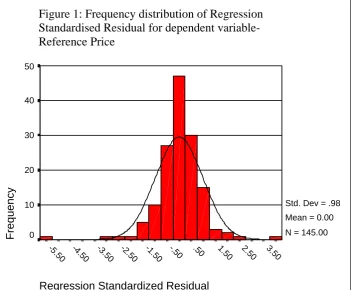
All tests of significance results were an outcome of two tailed 't' test. The 22 for Model 1 is 0.761, which was high enough to suggest that there was a reasonably good fit between the estimated results and the observed data. Because of the high value of 22, the movement of reference price was well explained by the six independent variables. Thus the alternative hypothesis was supported, namely,
H: there is a correlation between reference price (p - Δp1) and the perceived original price ‘p1’ of
the current brand and other causal variables XSP and XSC.
The Ramsey Reset tests applied to Model 1 indicated test statistic values that are significant (p-values are zero). These tests confirmed that there was no omission of a major influencing variable in the estimated model. The test also established that the model was correctly specified and that the overall fit of the estimated equation was significant. The null hypotheses was therefore rejected. Taking reliance on the high F statistic (F = 77.4560) with p-value = 0 for Model 1 and the significant 't' scores for each of the variables included in the equation (Table 1), we could conclude that rejecting the null hypothesis overall was valid.
Regression Standardized Residual 3. 50 2.50 1.50 .50 -.50 -1. 50 -2.50 -3.50 -4. 50 -5.50
Histogram
Dependent Variable: RELATTPR
Frequency 50 40 30 20 10 0
Std. Dev = .98 Mean = 0.00 N = 145.00 Figure 1: Frequency distribution of Regression
Standardised Residual for dependent variable-Reference Price
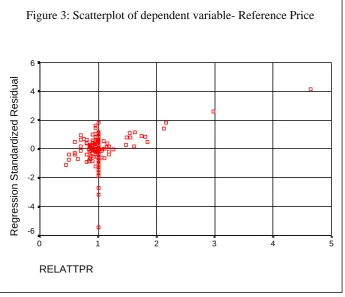
Scatterplot
Dependent Variable: RELATTPR
Regression Standardized Predicted Value
8 6 4 2 0 -2
Regression Standardized Residual
6 4 2 0 -2 -4 -6
Scatterplot
Dependent Variable: RELATTPR
RELATTPR
5 4
3 2
1 0
Regression Standardized Residual
6
4
2
0
-2
-4
-6
Figure 3: Scatterplot of dependent variable- Reference Price
Discussion of the Influence on Reference Price (Model 1)
The reference price was influenced by each of the variables included in Model 1. The subdued level of the shopper's reference price comes as a revelation, because the shopper is presumably aware that the propositioned brand is more expensive than their current brand. This outcome suggests that the shopper does not ascribe any superior quality to the higher priced brands. Therefore perception of greater quality for more expensive brands cannot be presumed among grocery shoppers buying less expensive brands.
Model 1 identified store loyalty and frequency of purchase as variables that transpire to bring the shopper’s reference price closer to the original price of the premium brand. The reason in moving the reference price higher, one suspects is because the store loyal and/or the frequent purchaser (particularly if they are not mutually exclusive), saw the store as rewarding them with a special purchase opportunity.
While Model 1 suggests that store loyal and frequent purchasers positively moved their reference price in the direction of the regular price of the premium brand (by virtue of their positive coefficients), these variables demonstrated different results when each of them were controlled on separately. The characteristics of store loyal and frequent purchase now indicated the reference prices to be lower than the reference price of non-store loyal customers and non- frequent purchasers. Most shoppers are trained to expect price promotions to offer the item significantly below their regular price. There is no reason to believe that store loyal shoppers and frequent purchasers have any different expectations. If at all, their familiarity with the store and brand promotions should only drive them to consider a fair price as low as their reference price regardless of whether the brand on offer is premium. This group is therefore implicitly indifferent to quality. According to Model 1, it would seem that store loyal customers are more willing to take the risk in a familiar environment of adapting a brand they had not used before. If they did not, it could mean that they do not ascribe additional quality or benefits to the premium brand.
continued patronage of the brand can only be achieved through sustained offer of competitive inducements.
One more factor influencing the reference price formation is the characteristic of coming from an Asian background. This group being relatively new to the country is relatively less informed and less resourced to do comparative shopping. Their credulity when considering an upgrade, to a large extent contributes to pushing up their reference price closer to the premium brand's original price.
Data Analysis and Results of the Influence on Reservation Price
To identify the relevant significant variables which influence the reservation price i.e. the price at which the respondent indicates a willingness to buy, the cross sectional data was treated in a similar way as was for reference price.
The multiple regression methods of forward selection, backward elimination and stepwise selection
were again used to identify the predictor variables attaching themselves to reservation price:
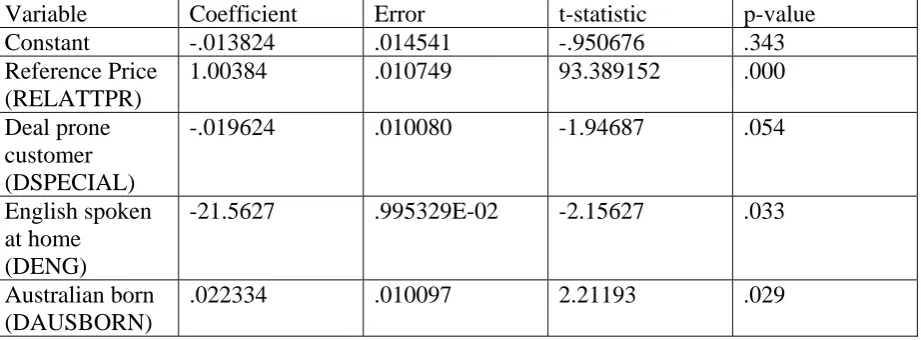
Each of these 3 model selection methods identified exactly the same variables that have an influence on the dependant variables namely, reservation price. The following variables were found to be statistically significant together with their attached coefficients and interceptor in the estimated equation (Model 2) that defined the relationship between reservation price and the causal variables.
1. Reference price (variable Relattpr)
2. Dspecial (dummy variable), if present (i.e.=1) suggests that the shopper is deal prone. This variable reflects a shopping pattern and belongs to the set Xsp.
4. Deng (dummy variable), if present (i.e.=1) suggests that the shopper comes from a home where English is their first language. This variable also reflects the shopper's characteristic and belongs to the set of Xsc.
Since the multiple regression techniques used to select the influencing variables for the equation are known to keep multicollinearity to the minimum, multicollinearity between the independent variables in Model 2 are not expected to affect the estimation quality of the model.
Table 2: Descriptive statistics for dependent variable-Reservation Price (RELBUYPR) Method of estimation = Ordinary Least Squares
Dependent variable: RELBUYPR Current sample: 1 to 145
Number of observations: 145 Mean of dep. var. = 1.02150 Std. dev. of dep. var. = .434053 Sum of squared residuals = .411335 Variance of residuals = .293811E-02 Std. error of regression = .054204 R-squared = .984838
Adjusted R-squared = .984405 F (zero slopes) = 2273.45 ** [.000]
Variable Coefficient Error t-statistic p-value
Constant -.013824 .014541 -.950676 .343 Reference Price
(RELATTPR)
1.00384 .010749 93.389152 .000
Deal prone customer (DSPECIAL)
-.019624 .010080 -1.94687 .054
English spoken at home
(DENG)
-21.5627 .995329E-02 -2.15627 .033
Australian born (DAUSBORN)
Model 2:
Reservation Price = -0.01382 +1.004 Reference Price – 0.01962 Deal Prone Customer – 0.02146 English Spoken at Home + 0.02233 Australian Born
22
for the equation (Model 2) was around 0.984 (Table 2) , which suggests that there is a good fit between the estimated values and the observed values. Because of the high value of 22, the movement of reservation price was well explained by the four independent variables. Thus the alternative hypotheses was supported namely,
H': there is a correlation between reservation price (p - Δp2) and reference price
(p - Δp1) and other causal variables XSP and XSC.
Taking reliance on the high F statistic (F =2273.45) with p-value = 0 for Model 2 and the significant 't' scores for each of the variables included in the equation (Table 2), we can conclude that rejecting the null hypothesis overall was valid.
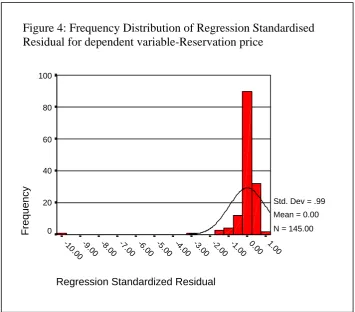
Regression Standardized Residual 1. 00 0.0 0 -1 .00 -2 .0 0 -3 .0 0 -4 .0 0 -5 .0 0 -6 .0 0 -7 .00 -8 .00 -9 .00 -1 0.0 0
Histogram
Dependent Variable: RELBUYPR
Frequency 100 80 60 40 20 0
Std. Dev = .99
Mean = 0.00
N = 145.00
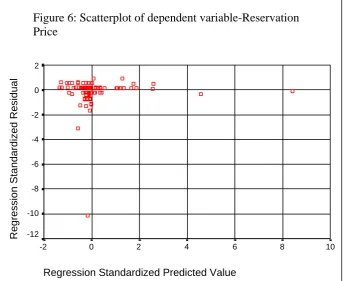
Figure 4: Frequency Distribution of Regression Standardised Residual for dependent variable-Reservation price
Scatterplot
Dependent Variable: RELBUYPR
RELBUYPR 5 4 3 2 1 0
Regression Standardized Residual
2 0 -2 -4 -6 -8 -10 -12
Figure 5: Scatterplot of dependent variable- Reservation Price
Scatterplot
Dependent Variable: RELBUYPR
Regression Standardized Predicted Value
10 8
6 4
2 0
-2
Regression Standardized Residual
2
0
-2
-4
-6
-8
-10
-12
Figure 6: Scatterplot of dependent variable-Reservation Price
Discussion of the Influence on Reservation Price (Model 2)
The reservation price moves away from the premium brand's regular price and searches for the lowest possible level. Deal proneness affected the reservation price in the same way albeit with a different intensity, as it affected the reference price, by pushing the reservation price down. The effect of deal proneness on reservation price was similar in the Model 2 as when this factor was controlled on individually in Model 1.
seem to matter to the Australian born shopper when perceiving fair value. Brand reputation therefore seemed to be disregarded by this group.
English spoken at home subscribed to a downward push to the level of reservation price. Even when this factor was controlled on, a similar indication was evidenced. This group appeared to be more price sensitive and no immediate reason can be ascribed for this characteristic. Literature in this area is also conspicuously absent. This research investigation was carried out in a university campus where significant number of respondents are of recent ethnic extraction. Among these were a proportion who claimed English as their first language. It can only be conjectured that this group, because of their felicity with English, had greater exposure at a cognitive level to price promotion advertisements and therefore had greater expectations of the price offer. It is possible that English speaking household shoppers do not equate the premium brand with quality and are not happy to go any distance beyond the price of their current brand to adopt the premium brand on offer.
Limitations of Study
this type of shopper to a more premium brand will succeed only if the price drop brings the price of the higher strata brand to the same level as their regular purchase. This investigation however did not separate respondents who shopped for themselves and for their households and cannot ascribe conclusively that because of the high salience of this type of respondent in the sample the reference price in combination with other variables is about equal to the estimated price. This type of student shopper would also, in their concern for the lowest price they can afford, be likely to have a reference price and reservation price that are close.
Conclusion
References
(1) Dickson PR, Sawyer SG. The price knowledge and search of supermarket shoppers. Journal of Marketing 1990; 54: 42-53.
(2) Gabor A, Granger CWJ. On the price consciousness of consumers. Applied Statistics 1961; 10: 170-188.
(3) Rao AR, Sieben WA. The effect of prior knowledge on price acceptability and type of information examined. Journal of Consumer Research 1992; 19: 265-270.
(4) Kalyanaram G, Little J. An empirical analysis of latitude of price acceptance in consumer package goods. Journal of Consumer Research 1994; 21: 408-18.
(5) Monroe KB. The influence of price differences and brand familiarity on brand preferences. Journal of Consumer Research 1976; 3: 42-49.
(6) Hoch SJ, Lowenstien GF. Time-inconsistent preferences and consumer self-control. Journal of Consumer Research 1991; 17: 429-507.
(7) Woodside AG, Sims JT. Retail sales transactions and customer 'purchase pal' effects on buying behaviour. Journal of Retailing 1976; 52 (1): 57-64.
(8) Lichtenstein DR, Burton S, Karson E. The effect of semantic cues on consumer perceptions of reference price ads. Journal of Consumer Research 1991; 18: 380-91.
(10) Zeithaml VA, Berry L. The time consciousness of supermarket shoppers. Working Paper Texas A & M University 1987; (Copyright Journal of Applied Business Research 1993).
(11) Webb E. Weber’s Law and Consumer Prices. American Psychologist 1961; 16: 450.