IJEDR1603099
International Journal of Engineering Development and Research (www.ijedr.org)603
Stabilization of Black Cotton Soil for Pavement
Using Fly Ash and Lime
1Shubham Maheshwari, 2 S.S.Goliya 1M.E. Student, 2 Asst.Professor 1,2Department of Civil Engineering
1,2Samrat Ashok Technological Institute(Engineering college) Vidisha (MP) 464001
________________________________________________________________________________________________________
Abstract - The term soil stabilization means improvement of the stability or bearing power of the soil by the use of controlled proportioning, compaction and the addition of suitable admixture or stabilizers. Soil stabilization deals with physical, physio-chemical and chemical methods to ensure that the stabilized soil services its intended purpose as pavement component material. In this paper we deal the stabilization of soil with the help of fly ash and lime. These admixtures are mixed in different proportions with the soil sample and tests are performed for the results.
Index Terms - Soil stabilization, Fly ash, Lime, Black cotton soil, Pavement.
________________________________________________________________________________________________________
I. INTRODUCTION
The basic principles of soil stabilization include evaluating the properties of given soil and assessing the deficient property due to which the soil is considered weak. It also decides the appropriate method of supplementing the deficient property by the economical and effective methods of stabilization. Due to lack of availability of suitable soil for the construction purposes, the soil available is stabilized by different methods such as mechanical and chemical stabilization. In this study we made an attempt to improve the different properties of bc soil such as bearing capacity, cbr ratio, atterberg limits by carrying laboratory investigations with the mixing of fly ash and lime in different proportions. The test performed in this study are carried out in a proportion of mix of soil with 25% fly ash and some proportions of lime.
II. OBJECTIVES
To determine the optimum content of fly ash and lime by conducting liquid limit test, plastic limit test and plasticity index. To determine the optimum moisture content and maximum dry density by conducting the proctor compaction test. To determine the CBR value of BC soil mixed with different percentages of lime and fly ash.
III. ENGINEERING PROPERTIES OF SOIL
1. Permeability: It is defined as the property of the soil which allows the passage or seepage of water through its interconnecting voids.
2. Plasticity: It is defined as the property of soil which allows it to deform rapidly without any volume change and without elastic rebound.
3. Compaction: It is a artificial process by which soil particles are rearranged and packed together into a closer state of contact by mechanical means to increase its dry density and decrease its porosity.
4. Compressibility: The property of the soil to reduce in volume under pressure is called compressibility. 5. Shear Resistance: It is the resistance to deformation by continuous shear displacement of soil particles.
IV. EXPERIMENTAL INVESTIGATIONS:
1. Grain size distribution: The sample of soil is taken and oven dried. A set of sieve of sizes 4.75mm, 2.36mm, 1mm, 600, 425, 300, 212, 150, 75 is taken. The sample is sieved through this set and the results are obtained. 2. Determination of specific gravity of soil: With the help of instrument known as pycnometer the test is performed
and the results are obtained.
3. Determination of specific gravity of fly ash: Pycnometer ; which is used to perform test for specific gravity is used and the results are calculated.
IJEDR1603099
International Journal of Engineering Development and Research (www.ijedr.org)604
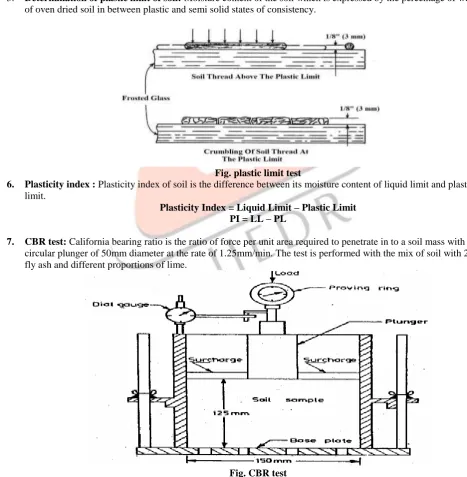
Fig. Liquid limit test5. Determination of plastic limit of soil: Moisture content of the soil which is expressed by the percentage of weight of oven dried soil in between plastic and semi solid states of consistency.
Fig. plastic limit test
6. Plasticity index : Plasticity index of soil is the difference between its moisture content of liquid limit and plastic limit.
Plasticity Index = Liquid Limit – Plastic Limit PI = LL – PL
7. CBR test: California bearing ratio is the ratio of force per unit area required to penetrate in to a soil mass with a circular plunger of 50mm diameter at the rate of 1.25mm/min. The test is performed with the mix of soil with 25% fly ash and different proportions of lime.
Fig. CBR test V. RESULTS:
IJEDR1603099
International Journal of Engineering Development and Research (www.ijedr.org)605
Percentage of gravel = 1.576%Percentage of sand = 10. 766% Percentage of silt and clay = 87.6%.
2. Specific gravity of soil:
Sl.
No Particulars
Wt. in gm
01 Mass of pycnometer (M1) gm 652
02 Mass of pycnometer + soil (M2)gm 908
03 Mass of pycnometer + soil + water (M3)gm 1630
04 Mass of pycnometer + water (M4)gm 1470
05 Specific gravity G 2.67
3. Specific gravity of fly ash:
Sl.
N o
Particulars Wt in
gm
01 Mass of pycnometer (M1) gm 26
02 Mass of pycnometer + flyash (M2)gm 38
03 Mass of pycnometer + flyash+ kerosene (M3)gm 76
04 Mass of pyconmeter + kerosene (M4)gm 68
05 Specific gravity G 0.807
06 Specific gravity of flyash 2.42
4. Liquid limit, Plastic limit, Plasticity index of soil:
Sample Liquid limit Plastic limit Plasticity index
Plain soil 77.5 40.86 36.64
Soil + 25% flyash 67.5 48.92 18.58
Soil + 25% + 2% (flyash + lime)
66 46.63 19.37
Soil + 25% + 3% (flyash + lime)
62.28 48.54 13.74
Soil + 25% + 4% (flyash + lime)
60 49.07 10.93
5. CBR test:
Particulars CBR value
Plain soil 0.86
Soil + 25% flyash 1.02
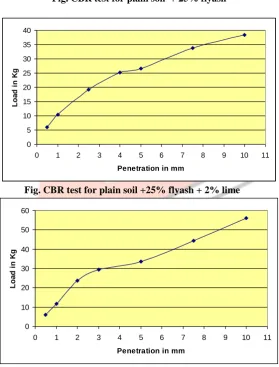
Soil + 25% flyash + 2 % lime 1.405
Soil + 25 % flyash + 3 % lime 1.75
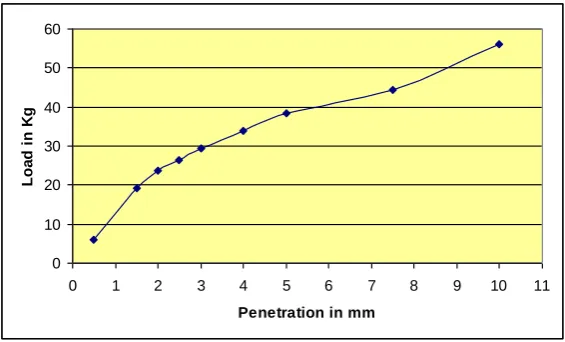
Soil + 25 % flyash + 4 % lime 1.93
0 5 10 15 20 25 30
0 1 2 3 4 5 6 7 8 9 10 11
Penetration in mm
L
o
a
d
i
n
K
IJEDR1603099
International Journal of Engineering Development and Research (www.ijedr.org)606
Fig. CBR test for plain soilFig. CBR test for plain soil + 25% flyash
Fig. CBR test for plain soil +25% flyash + 2% lime
Fig. CBR test for plain soil +25% flyash + 3% lime 0
5 10 15 20 25 30 35 40
0 1 2 3 4 5 6 7 8 9 10 11 12 13 14
Penetration in mm
L
o
a
d
i
n
K
g
0 5 10 15 20 25 30 35 40
0 1 2 3 4 5 6 7 8 9 10 11
Penetration in mm
L
o
a
d
i
n
K
g
0 10 20 30 40 50 60
0 1 2 3 4 5 6 7 8 9 10 11
Penetration in mm
L
o
a
d
i
n
K
IJEDR1603099
International Journal of Engineering Development and Research (www.ijedr.org)607
Fig. CBR test for plain soil +25% flyash + 4% limeVI. CONCLUSION
Liquid limit, plastic limit and plasticity index for plain soil are 77.5%, 40.8% and 36.7% respectively with addition of 25% fly ash of BC soil. The above values are 67.5% the above values are 67.5%, 48.92% and 18.56% respectively. This clearly indicates that the addition of fly ash reduces the plasticity characteristics of BC soil and makes the soil non plastic.
It reveals that by addition of 25% fly ash with 2% of lime the liquid limit and plasticity index reduced by 14.83% and 47.22% respectively whereas increase in plastic limit by 14.28%.
By addition of 25% fly ash with 3% lime the liquid limit and plasticity index reduced by 19.63% and 62.56% where as increase in plastic limit by 18.97%.
By addition of 25% of fly ash with 4% lime the liquid limit and plasticity index reduced by 22.58% and 70.21% where as increase in plastic limit by 20.26%.
There is increase in CBR value with normal 4 days soaking is 55.44% more than the plain soil
Reference
[1] S. Bhuvaneshwari, R. G. Robinson, S. R. Gandhi(2009), “Stabilization of expansive soils using Flyash” ijser, vol. 15, issue 6, pp. 478-482.
[2] Erdal Cokca(2012), “Quality Assessment for Stabilization of Black by Using Fly Ash Cotton Soil” asce journal, vol. 212, issue 4, pp.125-129.
[3] Pandian Kunal, R.Raul,(2010), “Effect of lime and fly ash on Engineering Properties of Black Cotton soil” ijsrd, vol 10, issue 3, pp. 56-62
[4] Phanikumar and Sharma (2004), “Study of Black Cotton Soil Stabilization” journal of engg., vol. 12, issue 5, pp. 31-328. [5] Shailendra Singh, Hemant B. Vasaikar(2013), “Stabilization of Black Cotton Soil using Lime” ijsr, ISSN (Online):
2319-7064.
[6] Bose, B. (2012), “Geo-engineering Properties of Expansive Soil Stabilized with Fly Ash”, Electronic Journal of Geotechnical Engineering, Vol. 17, pp. 1339-1353.
[7] Khanna, S.K., And Justo, C.E.G., (2011), “Highway Engineering”, New Chand And Bros, 9th Edition, New Delhi 0
10 20 30 40 50 60
0 1 2 3 4 5 6 7 8 9 10 11
Penetration in mm
L
o
a
d
i
n
K