Teaching English as a Foreign Language in Oman:
An Exploration of
English Language Teaching Pedagogy
in Tertiary Education
Husna Suleiman Al-Jadidi
Dip.TEFL, B.Ed., M.A.
School of Education
Faculty of Arts
Victoria University
Melbourne, Australia
Submitted in fulfillment of the requirements of the degree of
Doctor of Philosophy
Teaching English as a Foreign Language
in Oman:
An Exploration of English Language Teaching Pedagogy
in Tertiary Education
Abstract
This thesis reports on research conducted between 2004 and 2007 into the teaching of English as a Foreign Language (EFL) in tertiary education institutions in Oman. The research was an exploration of English language teaching pedagogy with a particular focus on bilingual (English and Arabic) versus monolingual (English only) teaching and the role of first language (Arabic) usage in the classroom.
The research was prompted on the one hand, by the need of the Omani government to train skilled teachers of English to support educational development and
modernisation. On the other hand, I was aware of anecdotal evidence (including my own observations) that many students seemed to prefer learning with bilingual rather than monolingual teachers. I wanted to find out whether this was the case in Omani secondary institutions overall, and if so, why? What are the benefits and drawbacks of L1 usage in the classroom? What are the benefits and drawbacks of L2 only as a teaching medium? What are the language pedagogies that bilingual (Arabic and English speaking) teachers and monolingual (English only speaking) teachers typically practice?
The study was carried out in six different higher education colleges in or near Muscat, the capital of Oman. Ten classroom observations were carried out (including bilingual and monolingual teachers) and eleven teachers were interviewed. Fifteen students from the same colleges as those teachers were interviewed.
what purposes do I draw on English and Arabic in my teaching? How could I improve my own pedagogical practice?
I observed that bilingual teachers as a group and monolingual teachers as a group each had characteristic pedagogical styles and approaches. The bilingual teachers were more teacher-centered, relied more heavily on the use of textbooks, focused more on the teaching of grammar and used less varied techniques of instruction and
engagement than did the monolingual teachers. On the other hand, the monolingual teachers, while they were more learner-centered and incorporated more
communicative, interactive lessons and activities, seemed to be less successful in classroom management and focus less on accuracy, grammar and lexis than their Arabic-speaking counterparts.
The outcomes of the student interviews broadly reflect the outcomes of the teacher interviews and classroom observations. Students seemed to be evenly divided in whether they preferred monolingual or bilingual teachers at the tertiary level. However, both students and teachers thought that bilingual teaching was essential at beginning levels of education and that the ability to speak both English and Arabic was beneficial for teachers. Many students, however, thought that as they advanced, interaction in the classroom should be conducted in English only. Together, the perspectives of EFL teachers and students and of the researcher herself as an EFL teacher point to a significant, but limited, role for Arabic usage in EFL tertiary college classrooms.
The teacher interviews in general reinforced the conclusions that I drew from the classroom observations and yielded insights into how teachers teach EFL in either English or Arabic and how expatriate teachers who speak English only, compensate for their lack of Arabic.
Through reflection on the interviews, the observational and self-reflective data, and my review of the contemporary literature about ESL/EFL methodology, an analysis emerges of the strengths and drawbacks of the typical bilingual and monolingual styles of teaching. The two pedagogical styles reflect differences between the cultural and educational traditions, teacher training programs and stages of social and
style has inherent pedagogical advantages and disadvantages that have the potential to be developed through especially planned and targeted professional development programs.
Abbreviations and Acronyms
A/S - Advisors & Supervisors
AAMEP - Australian Adult Migrant Education BT1 - Bilingual Teacher Interview 1
BTCO1 - Bilingual Teacher Classroom Observation 1 CLL - Communicative Language Learning
EFL - English as a foreign Language EGP - English for General Purposes
ELCD - English Language Curriculum Department ELT - English Language Teaching
ESP - English for Specific purposes FL - Foreign language
KG - Kindergarten L1 - First Language
LSCT - Lower secondary Course for Teachers MT1 - Monolingual Teacher Interview 1
MTCO1 - Monolingual Teacher Classroom Observation 1 NESTS & NS - Native English Speaking Teachers
NL - Native language
NNEST &NNS - Non-native English speaking Teachers NPL - National Policy on Languages
PRIT - Primary In-service Training RTT - Regional Teacher Trainer S1 - Student 1
SET - Senior English Teacher
SETC - Senior English Teacher Course
SETIM - Senior English Teacher Inspector Meetings SL - Second Language
SLA - Second Language Acquisition SQU - Sultan Qaboos University
TEFL - Teaching English as a Foreign Language
Acknowledgements
I wish to thank His Excellency Dr. Yahya Bin Mahfoodh Al-Manthari, the former Minister of Higher Education in Oman, the Chief of the State Council at present, for his inspiration and encouragement. I also would like to thank the staff at the
Department of Higher Studies at the Ministry of Higher Education for their assistance throughout my PhD journey.
I am also grateful to the people at the Australian Agency for Education and Training Center in Muscat, Oman for their effort to facilitate my enrolment and education at Victoria University.
My gratitude goes to the staff and students of the six colleges where I have been allowed to observe and interview a number of teachers and students. I appreciate the teachers’ generosity for giving me the time to share their professional expertise. I am also thankful to students who shared their concerns and were quite open to talk to me about learning English. All teachers and students have been protected by pseudonyms throughout the thesis.
I am grateful to my colleagues at The College of Law, notably the instructors at the English Unit who assisted me with regards to the required materials and references. Sayed Mohammed Omar and Associate Professor Dr.Ali Al-Issa have always inspired and motivated me to perform better. Majida Al-Hinai has always been there to help me whenever I faced any technical problems with my computer.
Special thanks goes to my husband, who devoted his time to take care of our children while giving me time to travel and focus on my work. He has been always there for me as the most supportive and encouraging figure.
In Australia, my first special thanks; gratitude and dedication are due to my supervisor Dr. Jill Sanguinetti who has been my main source of inspiration in writing my thesis and fulfilling the candidature requirements. I would not have made such achievement without her continued support and advice. Her broad knowledge of the field of adult education has given me some insights into how to synthesize, refine and complete the study. My thanks also go to her partner Dr. David Legge with whom I was fortunate to discuss my work and who gave me fruitful feedback on different occasions.
I also wish to thank the staff of the School of Education at Victoria University who have offered me every support and assistance. The cohort of local and international research students, especially Ludmilla, Denise, Flossie, Suharjo and Siva whose friendship, help and support throughout the journey have been deeply appreciated. I have enjoyed being part of such a lively and enthusiastic group. It has been a lifetime learning experience that I will always think about and remember.
My gratitude also goes to the staff members at the International Student Office who provided me with assistance from the very first day of my enrolment at Victoria University, especially Esther Newcastle and Kerry Wright. Their assistance was not only while I was in Australia but was also extended during the period when I was an offshore student since the last quarter of the year 2006.
I am thankful to the staff at the library of Victoria University who made their effort in directing me to the appropriate academic materials and the educational sources in order to accomplish my research study.
Last but not least, I am thankful to the many Australian people whom I got to know during my stay in Melbourne, and who always made me feel welcome. Dr. Mary Weaven and her family were especially generous in providing me with
The choice I made to travel all the way from Oman to Australia to do my PhD was the right choice, and the long hours of travel back and forth have been well worth the effort. Staying in Australia has enabled me to explore the other side of the globe and to see a diversity of cultures interacting harmoniously with each other in this
Table of Contents
Chapter One: Origins of the Research ... 11
1.1 Sultan Qaboos and the New Oman ... 11
1.2 From Student to Teacher ... 12
1.3 Questioning Monolingual and Bilingual English Teaching ... 14
1.4. Muslim Beliefs and Constructivist Epistemology ... 15
1.5 Outline of Chapters ... 18
Chapter Two: Teaching English as a Foreign Language in Oman ... 20
2.1 English Language Teaching, Culture and Globalization ... 20
2.2 The Development of English Teaching in Oman ... 21
2.3 English Teaching as a Strategic Policy Imperative ... 22
2.4 Basic Education System Schools ... 24
2.5 English Language Teaching in the Public Higher Education Institutes ... 27
2.6 English Language Teaching in Private Schools and Colleges ... 29
2.7 English Language Teaching in Private Higher Institutions ... 29
2.8 English Teacher and Training ... 31
2.9 Conclusion ... 34
Chapter Three: Theoretical Context ... 36
3.1 Introduction ... 36
3.2 Theories about Second Language Teaching and Learning ... 37
3.3 Theories of Bilingual Teaching and L1 Inclusion ... 44
3.4 Communicative Language Teaching (CLT) ... 54
3.5 Brown’s Principles of EFL Pedagogy ... 57
3.5 Constructivist Pedagogies in Language Education ... 63
3.6 Western Culture and the Teaching of English in Oman ... 66
3.7 Native and Non-native English Speaking Teachers ... 68
3.8 Conclusion ... 73
Chapter Four: Methodology and Method ... 76
4.1 Introduction ... 76
4.2 Qualitative Research in Language Acquisition and Learning ... 78
4.3 The Research Questions ... 79
4.4 Terminology of ‘Bilingual’ and ‘Monolingual’ ... 80
4.5 A Case Study of EFL teaching ... 80
4.6 Methods of Data Collection ... 81
4.7 Interviews ... 86
4.8 Researching My Own Practice through Self-Reflection ... 88
4.9 Data Analysis ... 89
4.10 Ethical Considerations... 91
4.11 How Generalisable is this Research? ... 92
Chapter Five: EFL Teachers in their Classrooms ... 94
5.1 Introduction ... 94
5.2. The Participants ... 94
5.3 Data gathering, analysis and presentation ... 95
5.4 The Bilingual Teachers ... 97
5.6 The Monolingual Teachers... 107
5.7 Summary of Monolingual Teacher Observations ... 116
5.8 A Brief Comparison ... 116
Chapter Six: Experiences and Perceptions of Students ... 119
6.1 Introduction ... 119
6.2 Who the Students were ... 119
6.3 Who their Teachers were... 120
6.4 Students’ Preferences for Bilingual or Monolingual EFL Teachers ... 121
6.5 How Teachers should Use Arabic when Teaching English ... 124
6.6 Preferred Styles of Language Teaching ... 126
6.7 Culture and the Clash of Cultures ... 128
6.8 Conclusion ... 130
Chapter Seven: Teachers’ Perceptions of Bilingual and Monolingual teaching 133 7.1 Introduction ... 133
7.2 Recruitment of participants ... 134
7.3 L1 Usage in the Classroom ... 135
7.4 Teacher-Centred and Student-Centred Approaches ... 138
7.5 Classroom Management ... 142
7.6 Summary ... 144
Chapter Eight: Reflection on my own Teaching ... 146
8.1 Introduction ... 146
8.2 About the Textbook ... 147
8.3 Overview of Teaching Strategies: What Works ... 147
8.4 English classes lessons from 10-14 March / 07 ... 150
8.5 How I use Arabic in the classroom ... 158
8.6 How I Deal with ‘Culture Conflicts’ ... 160
8.7 How I Deal with Slow Students ... 161
8.8 What I Learned from the Bilingual Teachers ... 162
8.9 What I Learned from Monolingual Teachers ... 163
8.10 What I Learned from the Student Interviews ... 163
8.11 Teacher-Centred versus Student-Centred Approaches ... 164
8.12 Summary ... 165
Chapter Nine: Learning from the Case Study ... 167
9.1 Introduction ... 167
9.2 The benefits of L1 (Arabic) usage in EFL teaching ... 167
9.3 The Benefits of Monolingual EFL Teaching ... 173
9.4 Revisiting Brown’s 12 Principles ... 175
9.5 Delineating Typical Language Pedagogies of Bilingual and Monolingual Teachers ... 180
9.6 Bilingual Teaching Styles ... 182
9.7 Monolingual Teaching Styles... 185
9.8 ‘Native’ and ‘Non-Native’ English Speaking Teachers ... 188
9.9 EFL and the Clash of Cultures ... 189
9.10 Revisiting the Research Aims ... 191
9.10 Conclusion ... 192
Chapter Ten: Re-energising EFL Teaching in Oman... 194
10.1 Professional development to make a difference ... 194
10.2 Where to from here? ... 197
Chapter One: Origins of the Research
1.1 Sultan Qaboos and the New Oman
I was among the generation born just before the Omani renaissance in 1970, when his Majesty Sultan Qaboos Bin Saeed took power in Oman. Under his leadership Oman rapidly modernized from almost nothing: until the 70s there were almost no schools, hospitals or streets and so the challenge was huge for the newly constituted
government. Sultan Qaboos framed a new structure for the government that was to plan for Oman’s development. All this new development was funded by the proceeds of oil, which was discovered in large quantities in 1963, a few years before I was born.
I was one of those who began their general education in the early1970s, participating in the new Oman from its beginning.
In 1970, His Majesty the Sultan promised to change the old face of Oman and to develop all fields of society and the economy. The priorities would be education, health care and basic services such as electricity and water. Since we had no proper school buildings at that time, His Majesty decreed that we would teach the new generation under the shelter of trees, until schools could be built. He said:
From the moment that we assumed our responsibilities in this land, education was one of our constant preoccupations; in fact, one could say it was our main concern. As we said at the time, we will educate our young people even if it has to be under the shade of the trees. Many of you will not remember that period when many of the schools were temporary structures or tents. We established the Ministry of Education and we directed them to speed up the building of schools by all necessary means. This was done, beginning with the primary level and then the preparatory and secondary levels. This urgent need to spread education was based on our knowledge that learning is enlightenment and light is the opposite of darkness. We should all remember the saying of the Almighty, “Are those who know equal to those who know not”? 1His Majesty’s Speech on the occasion of the Royal Visit to
Sultan Qaboos University May 02/05/2000.
Up until the 70s, women did not have a place; there was no education at all for women. There was a single boys’ school where boys could learn up to grade six, and then the option for them was to go abroad to study or work.
1 His Majesty’s speech was quoted from his visit to Sultan Qaboos University in May 2000.
Women before 1970 lived simply indoors and for domestic and child- bearing purposes only. However, after his Majesty took power, women’s lives changed. Soon there were schools for girls and I still remember the first day all girls of different ages started school for the first time in the history of Oman. The first school in
Muscat, was called A’ Zahraa Girls’ School. The school is still there and it is an icon for female students in Oman. I was amazed and excited by the speed of development in all fields, and in education in particular. As the time passed there were more girls’ schools, not only in Muscat (the capital city of Oman) but also in the rest of the country.
Day after day, Oman developed rapidly. I watched the Sultan on TV with the first group of male students who were about to study abroad. Even though I was still in elementary school, I was inspired by his words. From that moment I decided to study hard to go abroad to study too. I remember exactly what his Majesty said to them. He said, “You are the first group of students who is leaving the country to study outside. My advice to you is to work hard and take good deeds from the new culture while holding onto your own culture”. These words stayed with me and this was the beginning of my journey to achieve my own dream about my own education.
The study described in this thesis can therefore in one way be seen as a product of thirty- six years of educational development in Oman. While school education is now well established, Oman now needs to quickly develop its capacity for tertiary
education of an international standard. Effective teaching of English as a foreign language in colleges and universities is therefore a key strategy in Oman’s continuing development. Omani universities also need to establish a research base into how this can best be done.
1.2 From Student to Teacher
The Teacher Training Institute offered courses in different majors of specialty, such as Arabic, Islamic, Social Science Studies, and English Language.
The program lasted for three years and there was an opportunity to pursue further studies abroad for students who did well.
I was one of the few female students who specialized in English language studies. My interest in English came about because my Iraqi English teacher inspired me when I was in Grade Seven at the preparatory level. English as a foreign language was first introduced for Grade Four students by the Curriculum Department in the Ministry of Education in (1977), the year I was in Grade Four2.
By specializing in the English language, I would fulfill my dream to become a teacher of English and to learn about English and Western culture.
After I finished at the Teacher Training Institute, I went to the United Kingdom to get my first degree in Education (EFL/ESL) with a four- year scholarship from the Ministry of Education. I spent the first six months in an English Language Improvement course then I did my Diploma in Teaching English as a Second / Foreign Language in Morey House College of Education in Edinburgh (Scotland). After I successfully completed this course of study I returned to Oman for a year of teaching experience. After that I enrolled in the University of Bristol (England) to pursue my Bachelor degree in Education in ESL/EFL.
I taught for three years at two different secondary schools in Muscat after I came back from England in 1990.
In 1993 I was nominated to go to the United States of America to undertake a Master of Arts in Education at Ohio State University in Columbus Ohio. After 16 months I graduated with an MA.
On my return I was appointed as an Inspector of English Language for all school levels, for around six months. I had a number of schools to visit in the region and was
2 Grade One to Grade Four is now called ‘Basic Education’, modeled on primary education in England.
responsible for conducting professional development seminars and workshops for English language teachers.
I was then transferred to the Ministry of Higher Education to work as an assistant instructor at the College of Education for Girls in Rustaq; this town is about 100 KM from where I live. For two years I taught English as a subject at this college. Teaching alongside me there were native speakers of English and one male Arabic-speaking teacher of English who was the head of the English department.
1.3 Questioning Monolingual and Bilingual English Teaching
While I was teaching at the College of Education for Girls at Rustaq, a number of students requested to leave the classes of the native English speakers and join my class. My classes became over-crowded and my co-teachers were quite concerned that their students started to move from them to join me.
As a result, I decided to conduct an informal oral survey to find out why the students wanted to withdraw from the classes of native speakers of English to my classes.
The reasons they gave were:
• They felt insecure with (monolingual) native teachers of English
• They felt comfortable with Omani teachers
• Students complained about communication breakdown with monolingual teachers with no Arabic provision
• English language was clearer with Omani teachers and more understandable.
• Native speakers spoke too fast and the students had difficulty listening and understanding monolingual teachers in general.
I spent around two and a half years at this college before I was transferred to the College of Law where I am still employed. The College of Law is relatively new and has smaller classroom size in comparison with other Omani colleges.
Once again, some students withdrew from the American teacher’s classroom,
switching to Arabic-speaking teachers classrooms. On the other hand, a few students moved from the bilingual teachers’ classes to the American teacher’s class.
This teaching experience left me thinking of conducting a more detailed research project to explore the reasons for the preference of many students for bilingual, Arabic-speaking English teachers, and of some students’ preference for monolingual English-speaking teachers. I wanted to understand in depth the students’ various preferences and to compare the kind of teaching and learning that took place in bilingual and monolingual classes respectively.
I had so many questions in my mind that needed answers:
• Why did those students prefer me to the American teacher?
• Why did they seem to prefer Arabic- speaking teachers to monolingual teachers?
• Why do some students prefer monolingual English-speaking teachers?
• To what extent do bilingual teachers speak in Arabic in the EFL classroom?
• How can students’ attitudes towards learning the English language be improved (with all teachers)?
• Are there particular drawbacks or benefits for students in learning English with native speakers?
• Are there particular benefits or drawbacks for students in learning English with bilingual teachers?
• How do native speakers survive in EFL classes with no Arabic supplement?
• How do the students survive when the teacher has no recourse to Arabic? I kept all the questions and concerns to myself and when I got a scholarship from the Ministry of Higher Education to do my PhD, I decided to challenge myself and try to get answers to those questions.
1.4. Muslim Beliefs and Constructivist Epistemology
The research journey that I write about in this thesis was also an exploration of what constitutes knowledge and what it means to be an academic researcher and a
practising Muslim.
knowledge: “Those who go in search of kowledge, are on the path of God until they return”. “Seeking knowledge is better than worship” (Mohammed, peace be upon Him (cited in Frager, 2002, p.29).
As a teacher and as an academic researcher, I am fulfilling my religious duty to seek knowledge.
God propounds parables to humanity, as God [alone] has full knowledge of all things (Qura’n 24 p.35, quoted by Frager, 2002, p.50).
However, during my PhD studies, I have been challenged by the notion of epistemology and the fact that people have different understandings of where knowledge comes from and how it is constructed. I now believe that religious truths do not constitute a singular, universal ‘truth’ in the worldly sense, and that there is no over-riding ‘true’ truth underpinning social, spiritual and human endeavor. My personal religious truths are a different form of truth than scientific truths that are universally accepted by people in different cultural and religious contexts.
Instead, I understand truth in the academic context within a constructivist paradigm. Crotty (1998) is one of many social researchers who use a constructivist paradigm in his discussion of issues of ontology, epistemology and methodology (see also, Patton 1990 and Neuman 2003). The constructivist paradigm is very useful as it enables me to work within and across Islamic and Western paradigms of knowledge. My basic understanding of constructivism is that knowledge is not fixed or given, but is historically and socially constructed, so that what is ‘true’ for one group (e.g., Muslim, Christians or atheists) cannot be said to be universally true.
Reflective thinking is a source of knowledge because it allows one to search, improve, and reflect on prior knowledge in order to better assimilate knowledge. As a
researcher, I am trying to produce new knowledge by collecting from the informants, data that I then reflect upon, analyze and formalize as knowledge. My research would not only deepen and build my objective knowledge but also would make me better understand processes of teaching and specifically, my own teaching. I can share this practical knowledge with students, teachers and colleagues. I am therefore, on a journey of exploring, interpreting and constructing practical and theoretical knowledge, drawing on my personal experience as a teacher, the literature and the data at hand.
Muslims believe that the nature of existence is in the sole control of Allah (God), while many Westerners or non-Muslims believe that the world works independently of God or Allah. One’s perceptions and interpretations of the nature of reality are bound by one’s belief system, prior knowledge, learning experiences and cultural legacy that we inherited from the past generations.
On one hand, as a Muslim, I believe that Allah is the only one who has the absolute ‘truth’ and no one else. On the other hand, from my point of view as a constructivist researcher, in response to the question, ‘what is there that can be known?’ I would assert that in our daily lives there are multiple social realities that we construct to make sense of the world we live in. Every one of us tries to contemplate and to question so as to find answers to real life questions. How does this world work? We need to deeply understand other people’s views and interpretations of the world around them in order to make sense of the world we live in.
Differences among individuals, societies and cultures do not mean that either one is wrong or right but rather they perceive the world differently. They use their
commonsense that is underpinned by their belief system, and act accordingly.
We as human beings necessarily have limited knowledge and personal knowledge is always limited. The knowledge I have gained through teaching, through study and as a researcher is incomplete and bounded by language, tradition and context. In
qualitative research. The knowledge that is produced in this thesis will be judged by the quality of the research that has produced it and eventually, its usefulness in EFL teaching practice in Oman and other Arabic bilingual language teaching contexts.
I am involved in exploring a social phenomenon: the teaching of English in Oman by bilingual teachers and monolingual teachers teach English. The knowledge that this piece of research is striving for can only be partially achieved (or constructed). This research study aim has not been to prove a theory but to get useful insights and ideas and find out what pedagogical values, understandings and strategies teachers enact in classrooms. Hopefully this thesis is to be offering useful ideas and insights, but not absolute knowledge about the teaching of English to young adults in tertiary
institutions in non-English- speaking contexts and how they can best be supported to learn.
1.5 Outline of Chapters
A brief synopsis of the ten chapters of the thesis follows:
Chapter One is the Introduction and gives a general introduction to my educational background and the teaching and profession experiences that led me to undertake this study, as well as my reflections, as a practising Muslim, on the epistemological foundations of the research.
Chapter Two presents a historical review of the development of English as a Foreign Language (EFL) in Oman, and the current situation of EFL teaching in school and tertiary education. A numerical breakdown of EFL teachers who are of Arabic background and those who are native English speakers is presented.
Chapter Three reviews the literature pertinent to the issues of teaching and learning of English and first language usage in the EFL teaching context. This chapter gives the theoretical context for the study and surveys the current research into the role of first language usage in second language teaching in various contexts, as well as key themes in the literature about foreign language acquisition and learning.
Chapter Five presents a description and analysis of ten classroom observations. The observations were of five bilingual teachers and five monolingual teachers.
Chapter Six presents the findings of the students’ interviews and explores their English learning experiences, highlighting their perceptions and experiences of bilingual and monolingual teaching styles.
Chapter Seven presents an analysis of the teachers’ interviews. These focused on the classroom teaching-learning practices, textbook usage and teaching methods and approaches. Styles of bilingual and monolingual teaching are delineated.
Chapter Eight is a report and reflection on my own teaching. I give a detailed description of three days of my own teaching practice and reflect on my own classroom interaction with the students and how I teach, as a bilingual English teacher.
Chapter Nine is the discussion of the findings and their significance in relation to current debates about EFL pedagogy in relation to bilingual and monolingual teaching. In the main, the research supports the view that a ‘judicious’ use of Arabic in bilingual classrooms is beneficial to learning, reflecting views expressed in the current research literature for example, Wigglesworth (2003). However, the issue of L1 usage was found to be only one ingredient in a complex mix of pedagogical factors that contribute to effective EFL teaching and learning.
Chapter Two: Teaching English as a Foreign Language in
Oman
2.1 English Language Teaching, Culture and Globalization
Oman is one of many rapidly developing countries whose economies require
increasing numbers of English speakers in the light of the global spread of English in recent decades.
According to Hasman (2000, p.2), over 1.4 billion people live in countries where English has official status. Over 70% of the world’s scientists read English, over 85% of the world’s mail is written in English and 90% of information in the world’s electronic retrieval system is stored in English. Hasman suggests that by 2010, speakers of English as a second or foreign language (SL/FL) will exceed the number of native speakers. English has become a key factor in the development of the nations globally. The information technology revolution has shortened the distance between nations, and its services ignore geographical borders. Information technology has penetrated not only the industrial borders but also the Third and Developed worlds, thanks to telecommunications and English language. Computers and the Internet have both served nations and have become mediators for human communication in which English language is the main medium.
Crystal (1997, p.53) maintains that in ‘inner-circle’ countries (Kachru, 1999, 2008) where English is spoken as a native language, there are approximately 320-380 million native speakers of English. He explains that in outer circle countries, where English has an official role, as in India and Singapore for example, there are roughly 150-300 million second language (L2) speakers of English. In ‘expanding circle’ countries (Kachru, ibid), where English is used as a foreign language, there are as many as 100-1000 million learners of English (Crystal, 1997, p.61). There are
communication. A more recent IATEFL publication suggests that communication in English between non-native speakers now represents 80% of global English use (Finster, in Pulverness, 2004, p.9).
2.2 The Development of English Teaching in Oman
Oman was never a British colony and “…had no foundations for English…there were no English- medium schools in Oman…there was no British inspired education” Al-Busaidi (1995, p.90). However, from 1970 onwards it has readily embraced English as an officially taught foreign language in its institutions.
Along with other Arabic speaking countries, Oman realized the need to communicate with non-Arabic speaking countries in order to expand their bilateral relations. There was an urgent need for expatriate foreign expertise to strengthen such relationships especially after the discovery of oil in the Gulf States. After 1970, Oman developed powerful trade links with various non-English speaking countries in the globe such as Turkey, Sweden, Germany, Cyprus, France, Italy, Greece, Belgium, Austria, Portugal, and Russia. English has been used as a lingua franca in communicating with these and other non-English speaking countries.
English language is not just for trading purposes, but is also the means of communication within the country, the only tool or medium of communication between Omanis and foreigners/expatriates from all over the world who are working there. Increasingly there seems to be a need for a single language to enable people with different linguistic backgrounds to interact in a variety of settings, especially with the revolution of information technologies. In Oman, as all over the world, English has evolved as that language and is being taught and learned with increasing intensity (See also Hu, 2002, p.93).
Non English-speaking countries are adopting policies that promote the teaching and learning of English and their countless educational institutions now require their students to pass in English 3 as a condition for graduation. In Oman, as in other
Arabic-speaking countries, graduate students with an outstanding command of written and spoken English are highly valued and accepted in the private sector, in oil
companies in particular, where English is the only means of communication in that
workplace. However, the fact that Arabic learners have linguistic and cultural backgrounds that are completely distinct from English creates a barrier to the easy learning of that language.
Unless they are planning to migrate, Arabic speaking students learn English for practical, rather than cultural purposes, so that the teaching context is quite different from, for example, teaching English as a second language to migrants and refugees in Australia. Omani students learn English not necessarily for it to become part of an English-speaking community or for English to become a language of social identity. However, to some degree, it is impossible to separate completely the practical and cultural aspects of language learning and, in Oman as elsewhere in the Muslim world, there are tensions around the cultural messages inherent in English language text books, especially those produced for the international market in the UK or USA and imported to Oman by the Ministry of Education.
The English Language Teaching Department Unit at the Ministry of Education is authorized to supply school textbooks throughout the country. However, the Ministry of Education does not always take account of the cultural connotations (such as allusions to dating and alcohol) that might be incompatible with Muslim culture. However, there are Muslim authors such as Sharifian (1999, p.2) who writes about “a conflict between the students’ value system and those of the mainstream ELT
tradition”.
In summary, the teaching of EFL in Oman has been adopted as a major policy imperative and developing rapidly in schools, colleges and universities despite cultural tensions surrounding the teaching of a Western language in a Muslim country.
2.3 English Teaching as a Strategic Policy Imperative
EFL teaching in Oman, as in many parts of the world, receives political, economic and legislative support from the government. English is considered as “a resource for national development and as the means for wider communication within the
international community” 4(NELP p.2).
4 (NELP) refers to the Ministry of Education’s document known as National English Language
The Omani government recognizes the importance of English language as the language of modernization in the world today. The Reform and Development of General Education (Ministry of Education, 1995 p. A5 -1) states that:
The government recognizes that facility in English is important in the new global economy. English is the most common language for international sectors such as banking and aviation. The global language of science and technology is also English as are the rapidly expanding international computerized databases and telecommunications networks, which are becoming an increasingly important part of academic and business life.
Clearly, the government is aware of the interrelationship of its national economy with the global economy.
A Ministry of Education document entitled Philosophy and Guidelines for the Omani English Language School Curriculum (Nunan et al, 1987)was written by three
authors led by David Nunan, a leading Australian scholar in second language teaching and learning.This document outlines policy for the future development of English Language Teaching (ELT) in Oman.
The authors visited and stayed in Oman in 1987. They reported that English
was the means for wider communications with the international community. It would be a resource for the country’s continual development and for various key areas such as science and technology. English would be the tool that facilitates the acquisition of science and technology which, in turn, would contribute to narrowing the
technological gap between the developed and the developing worlds; the bridge towards national development. . It was already widely used in sectors such as tourism, banking, hospitals and other medical and clinical premises, automotive showrooms, restaurants, factories, insurance agencies and other domains of the private sector.
In the year 2003 in the country’s second census, the approximate number of expatriates was 20% of the population of 2.3 million. Expatriate skilled labourers largely dominate the private sector who mainly come from countries such as India, Pakistan, Bangladesh and the Philippines and use English as the lingua franca.
English has now become the fundamental medium for ‘Omanization’ - the
government scheme for gradually replacing the expatriate skilled labor force with Omani citizens. In the last few years, English language competence has therefore become a pre-requisite for undergraduate education and recruitment. Many graduates fail to get jobs particularly in the private sector if they do not have a good command of written and spoken English.
2.4 Basic Education System Schools
English is taught in public and private schools, colleges, universities and institutes. In the public sector, English is taught from Grade One in the Basic Education System (primary) schools as part of the school curriculum. English is taught as a subject that is textbook-based and teacher-centered. There are large classrooms with an average number of 30-35 students of mixed ability.
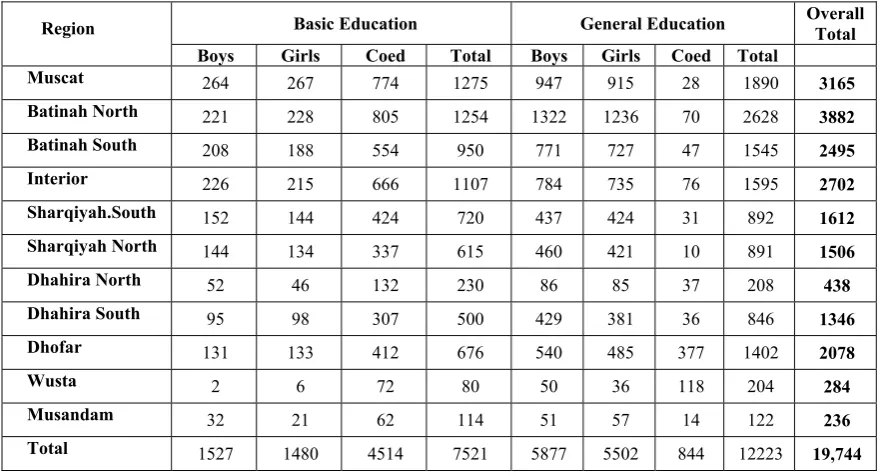
Table (1) Distribution of public school classes by type of education, gender & educational regions 2005-2006
Region Basic Education General Education Overall Total Boys Girls Coed Total Boys Girls Coed Total
The table above shows the eleven educational regions with the distribution of the 19,744 classes in the public schools in Oman (including boys’, girls’ and co-ed
schools) in the academic year 2005/2006. English is now being taught in all schools at all levels and there is a corresponding unmet demand for school teachers who can teach English, especially in the outlying regions.
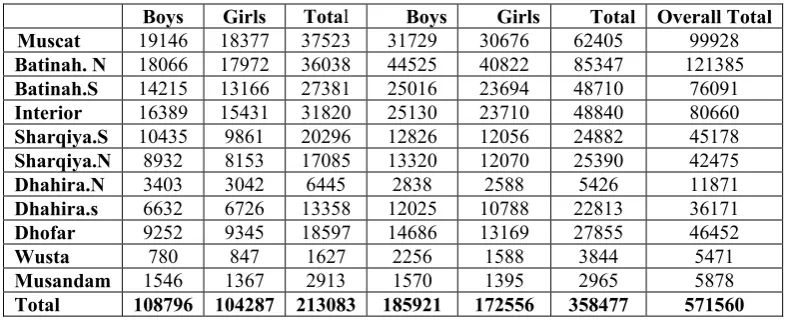
Table 2. Distribution of public school students by type of education, gender & educational regions 2005/2006
Boys Girls Total Boys Girls Total Overall Total
Muscat 19146 18377 37523 31729 30676 62405 99928
Batinah. N 18066 17972 36038 44525 40822 85347 121385
Batinah.S 14215 13166 27381 25016 23694 48710 76091
Interior 16389 15431 31820 25130 23710 48840 80660
Sharqiya.S 10435 9861 20296 12826 12056 24882 45178
Sharqiya.N 8932 8153 17085 13320 12070 25390 42475
Dhahira.N 3403 3042 6445 2838 2588 5426 11871
Dhahira.s 6632 6726 13358 12025 10788 22813 36171
Dhofar 9252 9345 18597 14686 13169 27855 46452
Wusta 780 847 1627 2256 1588 3844 5471
Musandam 1546 1367 2913 1570 1395 2965 5878
Total 108796 104287 213083 185921 172556 358477 571560
Table 2 above shows the number and distribution of the 571,560 students in public schools in Basic Education System and General Education of the academic year 2005-2006. It includes boys and girls in both types of education across the educational regions in Oman.
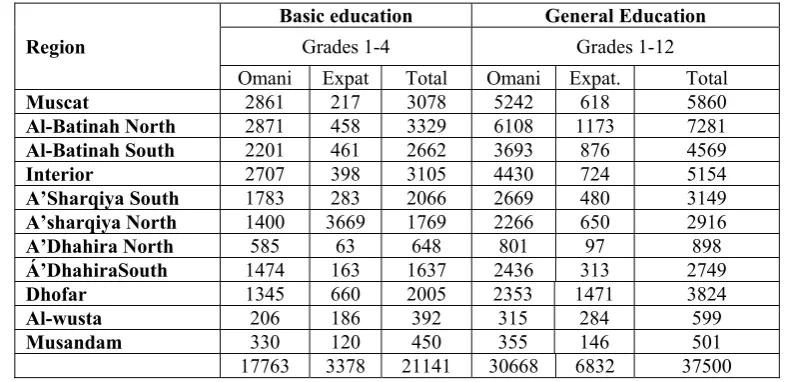
Table (3) Distribution of Public Schools’ Teachers of all subjects including English by Type of Education by Nationality across Educational Regions (2005/2006)
Region
Basic education General Education
Grades 1-4 Grades 1-12
Omani Expat Total Omani Expat. Total
Muscat 2861 217 3078 5242 618 5860
Al-Batinah North 2871 458 3329 6108 1173 7281
Al-Batinah South 2201 461 2662 3693 876 4569
Interior 2707 398 3105 4430 724 5154
A’Sharqiya South 1783 283 2066 2669 480 3149
A’sharqiya North 1400 3669 1769 2266 650 2916
A’Dhahira North 585 63 648 801 97 898
Á’DhahiraSouth 1474 163 1637 2436 313 2749
Dhofar 1345 660 2005 2353 1471 3824
Al-wusta 206 186 392 315 284 599
Musandam 330 120 450 355 146 501
17763 3378 21141 30668 6832 37500
Table 3 shows the proportion of Omani teachers to expatriate teachers currently teaching in the Omani public school system. Of the expatriate teachers, possibly half come from other Arabic speaking countries (and therefore teach bilingually) and half from the Indian sub-continent. Of a total of 37,500 teachers in Basic and General Education, over 10,000 (about one third) are expatriates from Arab countries or the Indian sub-continent. There is a severe shortage of Omani teachers who are qualified to teach English to meet the needs of those students in all parts of the country. There are only a few native English-speakers (from Western countries) teaching in schools.
While Table 3 shows the total number of teachers of all subjects in the educational regions, Table 4 below gives a breakdown of the total number of the local Omani teachers and the expatriate teachers of English. It includes teachers of English teaching at the Basic Education System schools and the General Education schools across the country, and shows that overall, Omani English teachers in the General Education years are fewer than expatriate teachers (836 to 1439).5
5 The number of expatriate teachers in these statistics includes expatriates from other Arabic-speaking
Table (4) Teachers of English in basic and general education (Ministry of Education. Education: 2005-2006)
Teachers of English in Basic Education (Grade 1 to Grade 4)
Teachers of English in General Education (Grade 5 to Grade 12)
Omani Expatriate Total Omani Expatriate Total
1579 1187 2766 836 1439 2275
In summary, Table 4 shows that the number of expatriate teachers of English in Oman Basic (primary) education approximately equals the number of Omani teachers. In General Education, Grades 5 and 6, expatriates outnumber local teachers of English by about two- thirds. An unknown proportion of these expatriate teachers are Arabic speakers from other countries, and a further large proportion of these are from the Indian Subcontinent, where English is widely spoken but not always as a first language.
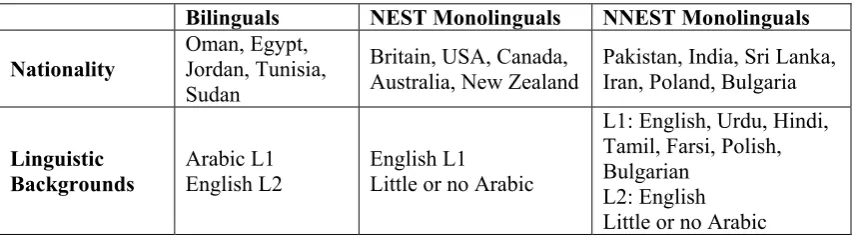
The diversity of national, ethnic and linguistic backgrounds of English teachers in Oman adds a level of complexity to the current study. Bilingual teachers are Omani or non-Omani Arabs with a diversity of training backgrounds and regional accents; ‘monolingual’ teachers maybe bilingual in English and one or two other languages (but not Arabic) or are native speakers of English (who constitute a minority of English teachers overall).
The issue of the diversity of linguistic and national backgrounds of the teachers in this study, and the implications of this diversity, is further explored in Chapter Five.
2.5 English Language Teaching in the Public Higher Education Institutes
English is taught for general and specific purposes (ESP) in institutes such as the Institute of Health Sciences, Higher Colleges of Technology, the College of Banking and Financial Studies, the College of Law, the Colleges of Education, Sultan Qaboos University and the Royal Air Force of Oman Academy. English is the medium of instruction in all the science majors in public institutions. English is also taught for academic purposes (EAP) at the Institutes of Health Sciences and at Sultan Qaboos University (SQU) to equip the students with the necessary skills to produce
Some of these institutions recruit a significant number of native English-speaking Teachers (NESTs) along with significant numbers of non-native English-speaking teachers (NNESTs). The table below shows the breakdown of the bilingual teachers, NESTs and NNESTs in the public higher education system.
Table 5. Bilingual and monolingual (NEST and NNESTS) English teachers in the public higher education institutions. Source: Ministry of Higher Education (2005-2006)
Total Number of Teachers
Total number of bilingual and non-native English speaking (monolingual) Teachers (NNESTS)
Total of NESTS
656 434 222
Table 5, above, is somewhat confusing as the figures for bilingual (Arabic speaking) and monolingual (NNEST) have been combined. However, in my experience, the number of non-native English speaking teachers is at least equal to the number of bilinguals. The table therefore may indicate that bilingual (Arabic speaking teachers would not be more than a third of the whole population of university English teachers. The table therefore gives a further indication of the shortage of local teachers teaching English in tertiary education.
2.6 English Language Teaching in Private Schools and Colleges
This research into the differing teaching styles or monolingual and bilingual teachers has been in part instigated by the current situation in which there is a shortage of Omani teachers of EFL, and the reliance by Omani institutions, as a result, on the importation of non-Arabic speaking teachers (both NEST and NNEST). The tables below indicate the extent of the shortage of Omani English teachers with respect to private schools and colleges. Unfortunately the same figures are not available for public schools and universities, but in my experience, the situation is very similar.
Besides public education, there are private schools, colleges and universities. While public education is free in the Sultanate, private education is relatively expensive, but available for those who can afford it. The 143 private schools teach English from Kindergarten One (KG1).
All the schools use imported materials mainly from UK and the USA. The teaching materials usually come in full packages that include textbook, workbook, teacher’s guide, charts, audio and videotapes and compact disks. These teaching materials are rich with cultural representations such as family life, recreation and social issues.
At present there are five bilingual private schools which teach all science-based subjects in English. These schools tend to recruit NESTs rather than NNESTs. Anecdotally, native English speaker teachers are paid more than their counterparts from non- English speaking countries, although I do not have hard evidence for this. The Table below indicates the countries of origin of NEST teachers in private schools.
Table 6. Native English speaking teachers (NESTs) by nationality in the private Schools: Source: Ministry of Education: Education. (2005-2006)
Total Number of English Teachers
Total of
NESTS USA Britain Canada Australia Ireland New Zealand
220 33 6 16 3 5 2 1
2.7 English Language Teaching in Private Higher Institutions
Diploma programs in various majors. Programs offered include accounting, business administration, education, management information sciences, computer science, banking, safety technology, fire fighting management, architectural technology, graphic design, construction management, engineering (fire fighting, electronic, civil, mechanical and computing), and catering and medicine. English is taught in general, specific and academic streams. The medium of instruction in these institutions is exclusively English for the science- based subjects. These colleges and universities recruit large numbers of NESTs. However, in order to obtain the Ministry of Higher Education’s accreditation, these local institutions are required to either affiliate, or sign a memorandum of cooperation with a university in an English-speaking country. For example Nizwa University is affiliated with University of Melbourne, Australia.
Table 7. Total Number of English teachers and NESTS in the private higher education institutions, Source: Ministry of Higher Education (Education 2005 – 2006)
Total Number of
English Teachers Bilingual and Non-Native (Monolingual) Teachers Total NESTS
199 108 91
Table 7 above combines the numbers of bilingual and non-native English-speaking teachers (NNESTs) in private higher education institutions and shows that native English-speaking teachers (NESTs) constitute almost half of that combined total. The table indicates the significance of the distinction between native and non-native English speaking teachers to officers in the Ministry of Education. Whilst the numbers of Arabic-speaking and non-Arabic-speaking, non-native English-speaking teachers are combined, it is known that these institutions recruit mainly Asian teachers. The Asian and Arabic-speaking teachers are less expensive employees and are not highly paid, unlike their native teachers counterparts, who as already
mentioned, are provided with extra privileges. However, there are no official documents outlining salary scales which are the responsibility of individual institutions.
intensify efforts to educate and qualify Omani nationals to gradually replace
expatriate teachers in higher educational institutions. There is also a need to upgrade the skills of Omani bilingual teachers in order to decrease reliance on the more expensive NEST teachers.
Table 8. NESTS by nationality in the higher institutions, Ministry of Higher Education: Education (2005-2006)
NESTS Countries of Origin Total NESTS
Britain 48
USA 17
Australia
6 Canada 11 Ireland 3
New Zealand
6 91
Table 8, above, is a breakdown table that shows the countries of origin of native English-speaking teachers6 at the higher education institutions by nationality. Most of these private universities and colleges were established in the last decade. Each institution runs its own foundation and specialization programs, which are supervised and monitored by the Directorate General of Private Universities and Colleges at the Ministry of Higher Education.
In summary, the main objective of the Omani government is to increase and promote the number of colleges and institutions to meet the continuous demand for qualified citizens to take part in the country’s on-going development. While the government has been working towards providing education for all, it pays special attention to
producing English-speaking graduates and meeting the shortage of local qualified Omani teachers of English. However, the shortage of properly qualified English language teachers remains a problem.
2.8 English Teacher and Training
2.8.1 Pre-service Teacher Education Programs
Pre-service training that integrates academic subject studies with pedagogical studies and teaching practice is considered one of the most successful aspects of foreign language education in several countries. Study and work abroad programs also
contribute to the language proficiency of foreign language teachers (Pufahl, Rhodes & Christian, 2000). I was one of the students who had pre-service experience studying
6 A native English speaking teacher is regarded as one who comes from a predominantly
abroad, where I was involved in micro teaching practices and school visits in addition to the academic studies. Both theoretical and practical studies have been of vital importance in my career today. These years of study in English-speaking countries (England and the USA) provided me with a sound basis in language teaching and professional knowledge.
Increasingly, pre-service teaching is provided in Oman, diminishing the number of aspiring teachers who study abroad. Sultan Qaboos University offers a 4-year degree in English language studies in the Faculty of Education. Recently a few private universities have started to offer a 2-year pre-service Diploma in teaching English as a foreign language and additional two years bachelor degrees with separate tuition fees.
2.8.2 In- service Teacher Developmen
In addition to recruiting high-quality teachers and principals, educational institutions are responsible for on-going training and the provision of funding for professional development to improve learning and teaching outcomes (Poftak 2003, p.24).
Nunan et al. (1987) believed that the Omani teachers entering the ELT force would have a considerable impact on the system and show more commitment to their teaching than their expatriate counterparts. However, they also stressed that in-service training, or professional development, would help Omani teachers to pursue their continuing expertise, and be able to reflect on all aspects of their work in the light of international best practice. In-service training is one kind of professional incentive that the Ministry of Education has emphasized in its educational reform. Another kind of professional incentive is rewarding the more capable teachers with opportunities for postgraduate studies in TESOL and Applied Linguistics.
The Ministry of Education signed a multi-million US dollar agreement with the University of Leeds (UK) in 1996 to run an in-service teacher training program in the Sultanate to help upgrade the level of 1060 English language teachers, over a period of eight years (2000-2008), to a Bachelor of Arts level. These teachers hold a Diploma from the Intermediate Teacher Training College - two years of teacher training after completing secondary education. The BA (TESOL) program is designed and taught by academic staff from the University of Leeds. This project is the biggest one of its kind so far.
There are other in-service teacher training activities organized by the English
Language Curriculum Department at the Ministry of Education7 designed for primary teachers. Workshops and seminars are held in each educational region across the Sultanate, Primary Teachers’ methodology Course Cycle One (1-4) of the Reform [PRIT]. It is a re-training course for teachers who teach English to children in their first four years of schooling as part of the Ministry’s reform program. The course has a minimum of 100 contact hours.
• In-service Teachers’ Methodology Course for Cycle two (5-7) of the Reform lower Secondary Course for teachers (LSCT). This course aims to equip teachers with the skills and strategies to understand and implement the new English Curriculum. The course has a minimum of 100 contact hours.
• In-service induction workshop for Grades 8-9 for Cycle Two of the Reform. This is a brief induction course for teachers who are already familiar with Cycle 2 Grades 5-7 who will be teaching Grades 8-9 for the first time. The workshop aims to familiarize teachers with key aspects of the Grade 8-9 English for Me course materials.
• Language improvement course. This course is designed to raise the level of language competence of teachers in the classroom. It is oriented towards a pre-intermediate level of English. It is 100 hours long.
• Senior English Teachers’ Course [SET]. This course is intended as a brief introduction to the role of Senior English teacher (SET) in Basic Education schools. Supervisors, RTTAs and SETS, run it. It is for a minimum of 25 hours.
• Senior English Teacher and Inspector Meetings [SETIM].
Senior English teachers and supervisors in Basic Education meet periodically throughout the year with the trainer to discuss issues pertaining to their role in supporting teaching and learning in their schools’ curriculum support seminars and
workshops, as well as orientation seminars that are delivered in the regions under the direction of the Senior English Supervisor.
Re-training is an integral part of the training program or teachers entering Basic Education schools.Once teachers have commenced teaching in the Basic Education schools they are given on-going practical support and training. It takes the form of discussions, joint observations, team teaching, workshops and meetings to solve problems. This is carried out by the regional teacher trainers/advisors in co-operation with the English Supervisors and Senior Teachers. Observations made by Senior Teacher, teachers supervisors and RTT/AS are fed back into the training programs and the curriculum department of ELCD.
The British Council is another educational organization that plays a significant role in English language and professional development in Oman. It organizes workshops on a regular basis, which focus on various educational issues and new ways of teaching and the adoption of innovative and effective methods and approaches. The British Council also organizes TESOL Arabia, which is an annual event that takes place in the United Arab Emirates (Dubai). It discusses various educational concerns with participants from around the world. This event brings many issues into the spotlight and a number of Omani faculty members from the ELT departments at the Ministry of Education, Sultan Qaboos University and other public and private higher educational institutions are invited to take part.
Sultan Qaboos University has always organised symposiums on education in general and on English Language Teaching in particular. The University hosts an annual English Language Teaching Conference for professionals working in ELT across the country. Many experts from all over the world are often invited to the conference to discuss issues of mutual concern in education.
2.9 Conclusion
many teachers, including expatriate teachers both native English speaking and non native English speaking.
While Oman has focused on producing strong policies to guide English language teaching and teacher development programs, I know from my own experience that many teachers (both ‘bilinguals’ and imported ‘monolinguals’) are still not well trained in current methods and pedagogies of ELT. Teaching directly from text-books and learning by rote is the norm, especially in schools. Students are often bored and as a result lack enthusiasm for and commitment to learning and acquiring English, despite the fact that English is the key to future career advancement and security. I am not sure why this is the case, other than that is a result of the comparatively recent appearance of school and university education in Oman, and the concomitant educational under-development, as discussed in Chapter One.
For me, learning English as a young school and tertiary student was a daily pleasure as well as a challenge and it saddens me that so many Omani young people miss this experience through indifferent teaching. I agree however with Pufahl, et al. (2000, p.4) who writes that language and education policies at the national, regional, and local levels can facilitate or inhibit strong language education.
My review of the development of English language teaching in Oman has highlighted that the current problems are probably inevitable, given the comparatively low level of development and the fact that just forty years ago was no English teacher training at all. The research reported in this thesis is an attempt to examine some of the gaps and problems in English language teaching practices more closely, and on this basis, to make suggestions about how the skills base of ELT teachers could be strengthened.
Chapter Three: Theoretical Context
3.1 Introduction
In this chapter I review the theoretical and research literature relating to L1 and its usage in the foreign language classroom, and I give an overview of some key pedagogical theories in relation to bilingual or monolingual EFL teaching.
Through the course of my research I became increasingly aware that effective
language teaching encompasses far more than the amount or purpose of L1 spoken in the EFL classroom. In the light of my underlying aim, which is to make
recommendations to the Ministry of Education in Oman about how EFL teaching can be improved, the focus of my study shifted to a focus on EFL pedagogy, and in particular, aspects of EFL pedagogy of relevance to teaching in Oman. I have
therefore undertaken a broader review than originally planned, encompassing theories of language teaching and learning, theories of language and culture in the EFL
classroom, native and non native speaking teachers of English, English as an International Language as these issues emerged from the data.
As it is not possible to review the literature of all of these areas in any depth, I have limited my review to an overview of material that is relevant to the issues of pedagogy that have arisen in the context of my study and my particular aims. My review of the literature is therefore structured in the following way:
3.2. Theories about Second Language Teaching and Learning
3.3 Theories about L1 and L2 usage in EFL teaching
3.4 Communicative Language Teaching
3.5. Brown’s Principles of EFL Pedagogy
3.6 Constructivist Pedagogies in Language Education
3.7 Western Culture and the Teaching of English in Oman
3.2 Theories about Second Language Teaching and Learning
Theories about how second languages are learned and acquired have proliferated over the last four decades. For the purposes of this study I have focused on Krashen’s (1982) Monitor Theory and Schumann’s (1978) theories of language acquisition and acculturation, as well as theories of Communicative Language Teaching (CLT) Nunan (1991, 2004) and Brown’s (2001) Principles of EFL Pedagogy. These four sets of theories are the most influential in terms of current pedagogical thinking and are foundational to the field of EFL teaching methodology.
I addition I have reviewed some of the more recent theories based in constructivist epistemology, as these theories are such as Reyes and Vallone (2008) as these theories have important implications for EFL classroom practice also.
3.2.1 Krashen’s Theories of Language Acquisition and Learning
In the early eighties, Krashen (1982, p.9) published his five hypotheses about second language acquisition: ‘The acquisition – learning distinction’, ‘the natural order hypothesis’, ‘the monitor hypothesis’, ‘the input hypothesis’ and ‘the affective filter hypothesis’.
The acquisition-learning distinction is the best known of his all hypotheses. It states that adults have two distinct and independent ways of developing competence in a second language. The first way is language acquisition, a process similar to the way children develop ability in their first language. Language acquisition is a
subconscious process; language acquisition develops naturally in the context of social communication. The second way to develop competence in a second language is by language learning. Learning refers to conscious knowledge of a second language and being aware of language rules (Krashen, 1982, p. 10).
The acquisition-learning hypothesis claims that adults acquire language just as children do. This hypothesis claims that the ability to ‘pick-up’ languages does not disappear at puberty; however, this does not mean that adults will always be able to achieve native-like levels in a second language, as most children can do.
suggests that maximum immersion in L2 would be advantageous. His input
hypothesis has also been foundational in theorizing about the teaching of foreign or second languages. ‘Input’ refers to language which is understandable by the acquirer. The input hypothesis claims that in order to move from stage (i.e., what is already and easily understood) to i + 1 (i.e., language which is a little beyond the current level of competence), the acquirer needs to hear and understand input that contains i + 1. For the acquirer to understand is to use his/ her linguistic competence, the context, knowledge of the world and extra linguistic information to understand language directed to him/her. The situations where acquisition occurs are when the input is comprehensible (Krashen, 1982, p.21).
In order to help second language acquirers, teachers use ‘modified input’, sometimes called ‘foreigner-talk’, ‘teacher talk’ or ‘inter-language talk’. Modifications made in ‘foreigner-talk’ and ‘teacher-talk’ are usually used for the purpose of communication and to help L2 acquirers understand what is being said. ‘Foreigner-and teacher-talk’ are roughly tuned input to the level of the acquirer, see Krashen (1980, 1982, p. 25).
The input hypothesis predicts that these modified codes will be useful for L2 acquirers. The hypothesis also predicts that natural, communicative, roughly tuned and comprehensible input have some real advantages over finely tuned input that directly attempts to teach the structure of the day”, not every utterance contains the target structure. For example, if the lesson’s focus is the progressive tense marker, other tenses will be used as well in both classroom input and in the readings (Krashen, 1982, p.69).
Krashen said that language acquisition does not require extensive use of conscious grammatical rules. Real language acquisition develops slowly and speaking skills emerge later than listening skills. In fact, there is a ‘silent period’ in which the child or adult L1 learner builds up competence in the L2 by listening. The learner may say little during several months of exposure to L2 in a natural, informal, linguistic
environment. Silent periods allow learners to learn chunks of language/expressions and phrases before they start talking (Krashen, 1982, pp.6-7).
before they have acquired enough syntactic competence to express their ideas. According to a hypothesis first proposed by Newmark (1966, cited in Krashen, 1982, p.27), performers who are asked to produce before they are “ready” will fall back on L1 rules. They will use L1 syntactic rules while speaking the L2.
The best methods, according to Krashen, are those that supply ‘comprehensible input’ in low anxiety situations containing messages of real language. These methods do not force early production in L2; improvement comes from supplying communicative and comprehensible input, and not from forcing and correcting production (Krashen, 1982, p. 7). ‘Comprehensible input’ implies graded or simplified L2 input with some translation and instruction in L1.
Krashen’s theories have been applied comprehensively in second language teaching methodology. For the purposes of this study, his theory of acquisition versus learning (and the relationship between them) is significant in that it implies pedagogies of L2 immersion to maximize acquisition. On the other hand, Krashen’s concept of
comprehensible input theory does not discount the need for explicit, comprehensible instruction (which could be in either language) as a necessary basis for learning of ‘the rules’ (especially for adult learners). Moreover, such input could be provided equally by either bilingual (in this case Arabic speaking) or monolingual (English speaking) teachers, depending on the skill of the teacher.
For those who cannot easily access an informal environment for L2 input, such as students in Oman, the classroom is the only place where rich sources of input can be provided. Krashen’s theories imply that lessons should be conducted primarily in English, should be communication rich environments and provide comprehensible input in order to enhance acquisition. Input is given by means of meaningful and communicative activities supplied by the teacher; and plenty of opportunities for linguistic interaction in the target language. This is the most direct way that teachers can promote language acquisition in the classroom.
3.2.2. Schumann’s Theories of Acquisition and Acculturation