
M E T H O D O L O G Y
Topography-Guided Refractive Astigmatism
Outcomes: Predictions Comparing Three Different
Programming Methods
This article was published in the following Dove Press journal: Clinical Ophthalmology
R Doyle Stulting 1
Daniel S Durrie 2
Richard J Potvin 3
Steve H Linn 4
Ronald R Krueger 5
Mark C Lobanoff 6
Majid Moshirfar 4,7
Manoj V Motwani 8
Timothy P Lindquist 2
Karl G Stonecipher 9
1Woolfson Eye Institute, Atlanta, GA,
USA;2DurrieVision, Kansas City, KS, USA;3Science in Vision, Akron, NY, USA; 4Hoopes, Durrie, Rivera Research,
Draper, UT, USA;5Cleveland Clinic, Cleveland, OH, USA;6North Suburban Eye Specialists, Minneapolis, MN, USA; 7John A. Moran Eye Center, University of
Utah, Salt Lake City, UT, USA;8Motwani LASIK Institute, San Diego, CA, USA; 9TLC Laser Centers, Greensboro,
NC, USA
Purpose: To identify the laser programming strategy that will achieve optimal refractive outcomes of LASIK with a topography-guided laser for eyes with a disparity between cylinder measured by manifest refraction and cylinder measured by topography.
Setting:Six surgeons at 5 clinical sites in the USA.
Design: Retrospective data review.
Methods: Preoperative, treatment, and postoperative data on 52 eyes that underwent
topography-guided LASIK with the WaveLight EX500 Contoura®Vision excimer laser ablation profile in which the
vectors representing the preoperative refractive cylinder and the cylinder measured by the WaveLight®
Topolyzer™VARIO Diagnostic Device (Vario cylinder) differed by >/= 0.50D and/or >/= 10 degrees of
orientation were analyzed retrospectively. Data were contributed by six surgeons using the laser at 5 different clinical sites. Vector analysis of postoperative cylindrical refractive error and the actual laser programming strategy was used to calculate the cylindrical correction that would, theoretically, have completely eliminated postoperative refractive cylinder. This was compared to expected results using the preoperative manifest cylinder, the topographic cylinder, and the Phorcides Analytic Engine (Phorcides
LLC, North Oaks MN; Phorcides). For analysis, subjects were stratified on the basis of the vector
difference between Manifest and Topo cylinder (High, >0.75 D; and Low,≤0.75 D).
Results: The poorest calculated theoretical outcomes were obtained with the manifest refraction
(centroid:−0.43, 0.22; mean calculated error vector: 0.56 ± 0.42 D; p=ns). Better outcomes were obtained
with the topographically measured refraction (centroid: 0.37, 0.02; mean calculated error vector: 0.47 ±
0.33 D; p=ns). The best outcomes were obtained with Phorcides (centroid:−0.15, 0.06; mean calculated
error vector: 0.39 ± 0.28 D; p=ns). The mean error vector magnitude in the Phorcides Low group was
significantly lower than for the Manifest and Topo Low groups (0.26 D vs 0.48 D and 0.33 D; p<0.01).
The mean error magnitude in the Phorcides High group was nearly 0.25 D lower than for the Manifest High group (0.48 D vs 0.70 D; p<0.01), but was the same as for the Topo High group (0.48 D vs 0.48 D).
Conclusion: Our study suggests that using the topographically measured cylinder or the cylinder selected by Phorcides will produce more desirable refractive outcomes than entry of the preoperative refractive cylinder as the basis for correction of myopia and myopic astigmatism with the WaveLight Contoura Vision excimer laser.
Keywords:LASIK, topography, excimer, laser, PRK, astigmatism
Plain Language Summary
Laser refractive surgery is one of the most common elective eye surgical procedures in the world. Many individuals wishing to reduce their need for glasses decide to have it. Modern technology has made the procedure very safe and effective.
Correspondence: R Doyle Stulting 224 Konawa LN, Loudon, TN 37774, USA Tel +1 770-804-1684
Email [email protected]
Clinical Ophthalmology
Dove
press
open access to scientific and medical research Open Access Full Text Article
Clinical Ophthalmology downloaded from https://www.dovepress.com/ by 118.70.13.36 on 24-Aug-2020
Most of the time, the surgery is based only on the prescription
for glasses, usually determined in the office by asking patients to
choose the lens that gives them the best vision (refraction). While this may be a good starting point, adjustments in the treatment to remove any irregularities in the curvature of the front surface of the eye (the cornea) may make the vision even better. Sophisticated instruments can measure the shape of the cornea in great detail. These devices produce a map of the corneal shape, called a topo-graphic map, that resembles a contour map in geography that shows the peaks and valleys on the surface of the earth.
The FDA recently approved an excimer laser refractive treatment based on both the refraction and the corneal topography. Reported results were excellent. There are several possible methods to design the treatment, but only one was studied in the FDA clinical trial. This study was based on theoretical outcomes that might result if some alternative methods were used to design the treatment. While all results were good, the best results were found with a new software program that helps surgeons with their surgical planning.
Introduction
Most currently used refractive lasers employ wavefront-guided treatment profiles. Topography-guided treatment has traditionally been reserved for complex cases with irregular astigmatism.1 One topography-guided LASIK procedure (Contoura® Vision, Alcon, Fort Worth, Texas, USA) has been shown to provide excellent visual out-comes in normal eyes without irregular astigmatism, with
93% of eyes achieving 20/20 or better UDVA and 34% achieving 20/12.5 or better UDVA at 12 months.2
Because corneal topography does not provide any infor-mation about the refractive status of the eye, the user must enter low-order aberrations (sphero-cylindrical refraction), which are combined with high-order aberrations measured by a Placido topographer, to create a shotfile designed to eliminate the refractive error of the eye by changing the corneal curvature. On the Treatment Plan page of the laser notebook, three sphero-cylindrical refractions are shown: Clinical, Measured, and Modified (Figure 1).
The Clinical refraction is the preoperative subjective manifest refraction. The cylinder from this entry is termed the Manifest cylinder in this report. The Measured refraction is the sphero-cylindrical correction that is necessary to neu-tralize regular, low-order corneal astigmatism after removal of high-order aberrations on the cornea. It is termed the Topo cylinder in this report (to distinguish it from the cylinder measured by refraction). The Topo cylinder is derived from Placido topography obtained by the WaveLight® Topolyzer™ VARIO Diagnostic Device (Vario; Alcon, Ft. Worth, TX). The Modified refraction, which is entered by the user, is then combined with high-order aberrations to create the refractive ablation that is intended to correct vision. This entry is termed the Treatment refraction in this report. The
Figure 1Treatment planning page for the WaveLight Contoura® Vision laser.
Clinical Ophthalmology downloaded from https://www.dovepress.com/ by 118.70.13.36 on 24-Aug-2020
WaveLight laser provides the user with the opportunity to select the Modified refraction based on the desired clinical outcome, the Manifest cylinder, the Topo cylinder, or any other factor(s).
Optimally, the Manifest and Topo cylinder will be the same or similar, but in some cases, they differ by more than a trivial amount. Possible explanations for this difference include the presence of significant high-order corneal aberrations3–6 posterior corneal astigmatism, and lenticular astigmatism. Manifest and Topo cylinders tend to differ in eyes with high-order aberrations because the subject may choose a sphero-cylindrical refraction in an attempt to correct high-order aberrations. For example, a subjective refraction may result in cylinder that is selected by the subject in an effort to reduce the blur circle created by coma.4,5If visually sig-nificant coma is treated by topography-guided LASIK, there is no longer a need for correction with low-order refractive cylinder when it is induced by the high-order aberrations.4,5 High-order aberrations may also produce a different subjective refractive cylinder that depends in magnitude and/or angle on the size and location of the pupil, as the pupillary opening restricts light striking the retina to portions of the cornea that may have different high-order aberrations.7
During the FDA clinical trial of the Contoura, the clin-ical protocol required that investigators enter the Manifest refraction as the Treatment refraction during treatment plan-ning. This requirement was based on the early report of Tan et al that good outcomes could be obtained by programming the laser with the cylinder obtained by refraction, rather than that measured by topography.8 Throughout the FDA study, there was good agreement between Manifest and Topo cylinder because subjects with significant corneal high-order aberrations were specifically excluded from the trial, as required by the FDA.2
After approval, when the laser became widely used in clinical settings, it was used to treat eyes with more irregular topographies and greater disparity between Manifest and Topo cylinder than was encountered in the FDA clinical trial. Clinical experience after FDA approval of the laser led some to hypothesize that programming with the Manifest cylinder might not produce optimal results in eyes with significant HOA.
In 2016, Motwani reported 78% of eyes with 20/15 vision 3 months after initial treatment with the Contoura laser using the LYRA (Layer Yolked Reduction of Astigmatism) Protocol, which is based on the Topo cylinder with spherical adjustment to maintain the spherical equivalent of the man-ifest refraction4,9,10 This protocol also produced excellent
Refractive Status and Vision Profile subjective patient survey outcomes.11
Also in 2016, Kanellopoulos used the Topo cylinder modified to preserve the spherical equivalent of the man-ifest refraction to obtain 20/16 or better in 50% of eyes, compared to 22% of eyes in which manifest refraction was used to program the laser.12
In a more recent study, Wallerstein et al programmed the laser with the magnitude of the manifest cylinder and the Topo axis. They compared results to those obtained by pro-gramming the laser with the manifest cylinder and the man-ifest cylinder axis. They found that the outcomes using the Topo axis were inferior to those obtained with the cylinder axis measured by the manifest refraction.6
These published findings and the unpublished experi-ences of others, including the authors of this paper, have led to further discussions about whether the method of programming the laser that was used during the FDA clinical trial produces optimal outcomes.
The purpose of this study was to analyze retrospectively the sphero-cylindrical refractive outcome when there was a dis-parity between the Manifest cylinder measured preoperatively and the Topo cylinder measured by topography (>/= 0.50 D and/or >/= 10 degrees). Known outcomes with actual program-ming strategies were used to simulate outcomes that would have been obtained by back-calculation using three different refractive inputs for treatment planning: Manifest cylinder (based on the clinical refraction), Topo cylinder (based on Placido topography obtained with the Vario topographer), and Phorcides cylinder (calculated using the Phorcides Analytic Engine, Phorcides LLC, North Oaks MN).
Methods
This study was determined to be exempt from IRB review according to 45 CFR 46.101(b)(4) by Salus IRB.
Refractive and treatment data from cases in which the preoperative manifest cylinder and topographic cylinder
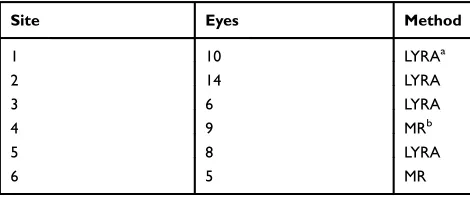
Table 1Treatment Method Actually Used at Each Site
Site Eyes Method
1 10 LYRAa
2 14 LYRA
3 6 LYRA
4 9 MRb
5 8 LYRA
6 5 MR
Notes:aLayered Yolked Reduction of Astigmatism.4bManifest refraction.
Clinical Ophthalmology downloaded from https://www.dovepress.com/ by 118.70.13.36 on 24-Aug-2020
differed by 0.50D or more in magnitude and/or 10 degrees or more in orientation were contributed retrospectively by 6 users of the Contoura®Vision at 5 sites. Three-month postoperative examinations (range, 75–197 days) were completed before January 31, 2018. There was variability in the way investigators chose the cylindrical correction to be entered as the Treatment refraction, as this decision was left up to the discretion of the investigator (Table 1).
Subjects were stratified on the basis of the vector difference between Manifest and Topo cylinder with a cutoff of 0.75 D, as that yielded approximately half the data points in each group. They are referred to as the High (>0.75D difference; 33 eyes) and Low (≤0.75D difference; 19 eyes) groups in subsequent analyses.
Overall Difference from
“
Best
”
The “Best” correction is the correction that produced, or would theoretically have produced, a zero cylinder postopera-tive outcome. It is the vector sum of the actual Treatment cylinder entered by the surgeon into the Modified blanks on the Treatment Design screen (Figure 1) and the refractive cylinder measured 3 months postoperatively.
Calculation of Theoretical Results
The theoretical sphero-cylindrical refractive error that would have resulted if Manifest, Topo, or Phorcides cylin-der had been entered as the Treatment cylincylin-der was calcu-lated by vector subtraction of the three theoretical cylinder entries from the Best correction. In some cases, the Treatment cylinder was the same as the Manifest or Topo cylinder. Results are presented with descriptive analysis and double-angle vector plots. Statistical significance was determined by analysis of variance (ANOVA).
Results
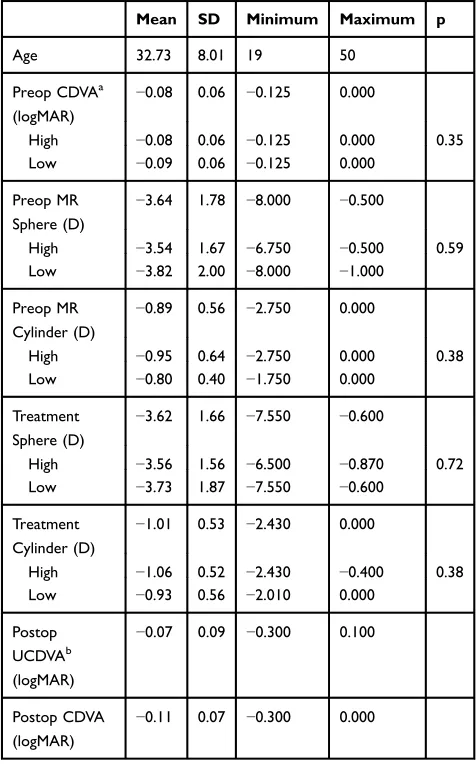
Table 2shows refractive details of the eyes included in this investigation. There was no statistically significant difference between the High and Low groups with regard to any of the preoperative variables.Table 3shows the breakdown of the difference in astigmatism magnitude and orientation between the preoperative manifest and the topography-based values. As can be seen, half the eyes (26/52) differed by less than 20 degrees in orientation and 1.0D in magnitude.
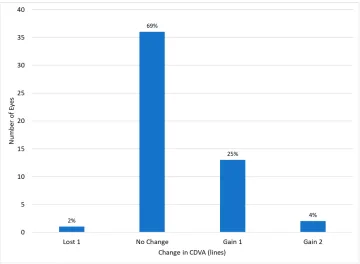
Figure 2shows uncorrected visual acuities at 3 months, and Figure 3shows the change in visual acuity from the preopera-tive examination to 3 months postoperapreopera-tively. No complica-tions or adverse events were observed in any of the eyes included in this study.
Manifest
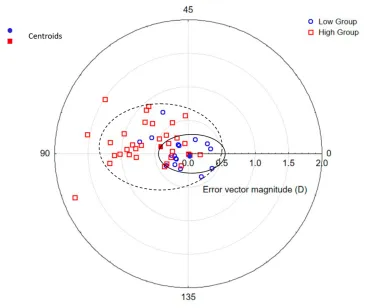
Figure 4 shows a double-angle plot of the calculated error vectors that would theoretically have been obtained if the Manifest cylinder had been entered as the Treatment refraction. The error vectors tend to be with the rule (centroid:−0.43,
Table 2Refractive Data Summary
Mean SD Minimum Maximum p
Age 32.73 8.01 19 50
Preop CDVAa (logMAR)
−0.08 0.06 −0.125 0.000
High −0.08 0.06 −0.125 0.000 0.35
Low −0.09 0.06 −0.125 0.000
Preop MR Sphere (D)
−3.64 1.78 −8.000 −0.500
High −3.54 1.67 −6.750 −0.500 0.59
Low −3.82 2.00 −8.000 −1.000
Preop MR Cylinder (D)
−0.89 0.56 −2.750 0.000
High −0.95 0.64 −2.750 0.000 0.38
Low −0.80 0.40 −1.750 0.000
Treatment Sphere (D)
−3.62 1.66 −7.550 −0.600
High −3.56 1.56 −6.500 −0.870 0.72
Low −3.73 1.87 −7.550 −0.600
Treatment Cylinder (D)
−1.01 0.53 −2.430 0.000
High −1.06 0.52 −2.430 −0.400 0.38
Low −0.93 0.56 −2.010 0.000
Postop UCDVAb (logMAR)
−0.07 0.09 −0.300 0.100
Postop CDVA (logMAR)
−0.11 0.07 −0.300 0.000
Notes:aCorrected distance visual acuity.bUncorrected distance visual acuity.
Table 3 Difference in Refractive and Topographic Astigmatism Angle and Magnitude
Difference in Magnitude (D)
Difference in Orientation (Degrees)
≤10 11 to 20 21 to 40 41 to 60 61 to 80 Total
≤0.50 1a 5 4 3 1 14
0.51 < and≤1.00 15 5 7 1 1 29
1.01 < and≤1.50 6 1 7
1.51 < and≤2.00 1 1 2
Note:a
Number of eyes.
Clinical Ophthalmology downloaded from https://www.dovepress.com/ by 118.70.13.36 on 24-Aug-2020
0.11). Summary data are shown inTables 4and5. The mean calculated magnitude of the error vector was 0.56 ± 0.42 D (mean ± SD;Table 4). It was significantly greater in the High
group (0.70 D) compared to the Low group (0.33 D; p = 0.002). In 15% of cases (8/52), the Manifest error vector was greater than 1.0D, and all of these were in the High group (Table 5). Figure 2Cumulative uncorrected visual acuities at 3 months.
Figure 3Change in corrected distance visual acuity from preoperative exam to the 3-month postoperative exam.
Clinical Ophthalmology downloaded from https://www.dovepress.com/ by 118.70.13.36 on 24-Aug-2020
Topo
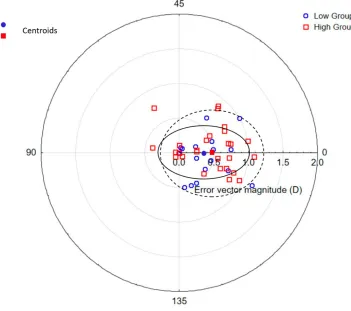
Figure 5shows a double-angle plot of the calculated error vectors that would have been obtained if the Topo cylinder had been entered as the Treatment refraction. The error vectors tend to be against the rule (centroid: 0.37, 0.02). Summary data are shown in Tables 4 and 5. The mean calculated error vector was 0.47 ± 0.33 D (mean ± SD; Table 4). There was no significant difference between the magnitude in the High (0.47 D) and Low (0.48 D) groups.
The magnitude of the error vector was greater than 1.0 D in 4% (2/52) of cases–one in the High group and one in the Low group (Table 5).
Phorcides
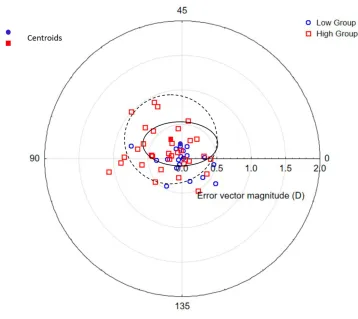
Figure 6 shows a double-angle plot of the calculated error vectors that would have been obtained if the cylinder derived from the Phorcides software had been entered as the Treatment refraction. The error vectors tend to be with the rule, but the
Table 4Centroids and Error Magnitude for Expected or Actual Cylinder Error by Method
Method Group X Coordinate Y Coordinate Magnitude (D) Mean Error (D)
Manifest High −0.48 [0.47]a 0.15 [0.28] 0.51 0.70 [0.46]
Low −0.17 [0.25] −0.07 [0.15] 0.18 0.33 [0.23]
All −0.43 [0.47] 0.11 [0.28] 0.44 0.56 [0.42]
Topo High 0.49 [0.37] 0.03 [0.31] 0.49 0.47 [0.35]
Low 0.36 [0.33] −0.08 [0.20] 0.37 0.48 [0.31]
All 0.37 [0.36] 0.02 [0.28] 0.37 0.47 [0.33]
Phorcides High −0.17 [0.34] 0.10 [0.33] 0.19 0.48 [0.28]
Low −0.01 [0.28] −0.08 [0.17] 0.08 0.26 [0.20]
All −0.15 [0.36] 0.06 [0.28] 0.16 0.39 [0.28]
Note:aValue[SD].
Figure 4Error vectors: difference between calculated Manifest and Best outcomes. Ellipses are the centroid ± SD for the low (———) and high (- - -) groups.
Clinical Ophthalmology downloaded from https://www.dovepress.com/ by 118.70.13.36 on 24-Aug-2020
deviation from the origin is minimal (centroid:−0.15, 0.06). Summary data are shown inTables 4and5. The mean calcu-lated error vector was 0.39 ± 0.28 D (mean ± SD;Table 4). The mean error vector magnitude in the Phorcides Low group was significantly lower than for the Manifest and Topo Low groups (0.26 D vs 0.48 D and 0.33 D; p < 0.01). The mean error magnitude in the Phorcides High group is nearly 0.25 D lower than for the Manifest High group (0.48 D vs 0.70 D; p< 0.01; Table 4), and the same as for the Topo High group. There were two cases of Phorcides error being greater than 1.0 D, both occurring when the vector difference between Manifest and Topo was >0.75 D (Table 5).
Discussion
Topography-guided corneal refractive surgery has histori-cally been used as a“repair procedure”for the treatment of eyes with naturally-occurring corneal irregular astigmatism,1,12–14 complications of corneal refractive surgery,1,15-22corneal transplants,16,18,20,23,24and other cor-neal conditions.1,16,18 Topography-guided PRK has also been used for the treatment of corneal ectatic disorders in conjunction with corneal crosslinking with riboflavin and ultraviolet light25–27 and to prevent hyperopic regression following hyperopic LASIK.28 Topography-guided LASIK also produces excellent outcomes for the treatment of refractive errors in otherwise normal eyes.2,8 In one comparative study, topography-guided LASIK was found to produce lower high-order aberrations than wavefront-guided treatment.29
Requests for inclusion of eyes with naturally occurring, surgically induced, or pathological irregular astigmatism in FDA clinical trials were denied by the FDA. As a result, the FDA study does not provide prospective clinical trial out-comes for the treatment of eyes with even minimal corneal topographic abnormalities.2In eyes such as this, which are
Table 5 Magnitude of Actual and Calculated Error Vectors by Method
Method Magnitude of Error Vectors (D)
≤0.25 ≤0.50 ≤0.75 ≤1.00 >1.00
Manifest 16a 29 36 44 8
Topo 17 30 43 50 2
Phorcides 19 36 45 50 2
Notes:a
Number of eyes.
Figure 5Error vectors: difference between Topo and Best outcomes. Ellipses are the centroid ± SD for the low (———) and high (- - -) groups.
Clinical Ophthalmology downloaded from https://www.dovepress.com/ by 118.70.13.36 on 24-Aug-2020
frequently encountered in clinical practice, a disparity between astigmatism that is measured by refraction (Manifest) and that measured by topography (Topo) is more likely to occur.2 This creates a dilemma for the refractive surgeon using the WaveLight Contoura® Vision laser, because the surgeon must choose the sphero-cylind-rical refraction to be entered in the treatment plan without reliable guidance from carefully conducted clinical trials.
Although some recent studies have achieved results similar to those obtained in the FDA trial,30,31 some of the authors of this report (MCL, TPL), as well as several other investigators,32–34 have been unable to obtain the excellent postoperative visual acuities obtained during the FDA trial when the same treatment protocol was applied to eyes encountered in routine clinical practice. Various alternative strategies have been proposed, there-fore, to determine the appropriate laser entry for the Treatment sphero-cylindrical refraction.4,6,9,10,12
The current study was designed to address the question of how to program the WaveLight Contoura®Vision laser to produce optimal refractive outcomes for eyes in which there is a disparity between Manifest and Topo refractions.
The most appropriate outcome measures for this determi-nation would be uncorrected visual acuity and visual symptoms. Unfortunately, is it not possible to simulate the visual acuity and visual symptoms that would have been obtained if a refraction other than the one that was used to treat the patient had been applied.
One published study does examine retrospectively the planning strategy used among eyes gaining a line of best-corrected vision, but the variability and complexity of the strategy make it difficult to plan prospectively.35We chose the actual and calculated sphero-cylindrical refractive out-come as our primary outout-come measure for this analysis. Although imperfect, this provides a method to compare the actual outcome obtained with the surgeon’s selected treat-ment strategy and the theoretical, calculated outcome that might have been obtained with alternative methods.
Overall, the visual outcomes in the subjects we studied were excellent (Figure 2), with a tendency for increased uncorrected distance visual acuity (UCDVA;Figure 3) and no complications; however, a small, measurable residual refractive error remained in many of them. None of the 3 treatment strategies we tested would have completely Figure 6Error vectors: difference between Phorcides and Best outcomes. Ellipses are the centroid ± SD for the low (———) and high (- - -) groups.
Clinical Ophthalmology downloaded from https://www.dovepress.com/ by 118.70.13.36 on 24-Aug-2020
eliminated postoperative refractive error for all patients. However, the results strongly suggest that the other strategies that we tested will produce outcomes that are superior to those obtained when the Manifest refraction is entered as the Treatment refraction, as was done in the FDA clinical trial. It is possible that consideration of posterior corneal and lenticular astigmatism that is inherent to Phorcides may pro-vide an advantage of this method over alternatives, but this advantage seems to be less apparent with higher corrections, as was seen in the Topo High and Phorcides High groups.
Our results were obtained from theoretical calculations of outcomes in a small series of eyes, rather than actual results from a head-to-head comparison of laser program-ming strategies. Our conclusions were also based on cal-culated cylindrical outcomes, rather than UCDVA. A larger, prospective, multi-center clinical trial that includes UCDVA as a primary outcome variable should lead to further refinement of the appropriate strategy for determin-ing the Treatment refraction for use with the Contoura laser for topography-guided LASIK in clinical, post-approval use for eyes routinely encountered in a commer-cial LASIK practice. In addition, a greater number of eyes might allow for more detailed sub-analyses, such as those necessary to determine whether the orientation of preo-perative manifest or topographic astigmatism might have an effect on the optimal laser programming strategy. Finally, it is yet unknown whether correcting posterior astigmatism on the anterior cornea will lead to a longer-term compensatory effect by the epithelium affecting the clinical outcome. All of these factors must be investigated in well-designed, prospective clinical trials.
Funding
This study was conducted with funding for an investigator-initiated clinical trial from Alcon.
Disclosure
Drs Durrie, Potvin, Stonecipher, Stulting, and Krueger are consultants to Alcon. Science in Vision (Potvin) received funding for data analysis and manuscript preparation. Dr Lobanoff was the developer of the Phorcides Analytic Engine and has a financial interest in Phorcides, LLC. He is also a paid consultant for Alcon and has a patent pending on the technology behind the Phorcides software. Drs Stulting, Potvin, Krueger, and Stonecipher report grants from Alcon. Dr Daniel S Durrie helped organize the study for Alcon and is a consultant for J&J that has
competitive equipment to the Alcon equipment used in the study. Dr Motwani reports grants from Alcon, Inc, outside the submitted work. In addition, Dr Motwani has a patent relating to the use of topographic guided ablation/ Contoura for the creation of uniform corneas. The authors report no other conflicts of interest in this work.
References
1. Holland S, Lin DT, Tan JC. Topography-guided laser refractive surgery.Curr Opin Ophthalmol.2013;24(4):302–309. doi:10.1097/ ICU.0b013e3283622a59
2. Stulting RD, Fant BS, Group TCS, et al. Results of topography-guided laser in situ keratomileusis custom ablation treatment with a refractive excimer laser.J Cataract Refract Surg.2016;42(1):11–18. doi:10.
1016/j.jcrs.2015.08.016
3. Choi SK, Chang JW. Higher order aberration and astigmatism in children with hyperopic amblyopia.Korean J Ophthalmol.2016;30 (1):53–59. doi:10.3341/kjo.2016.30.1.53
4. Motwani M. The use of WaveLight(R) Contoura to create a uniform cornea: the LYRA protocol. Part 1: the effect of higher-order corneal aberrations on refractive astigmatism. Clin Ophthalmol.
2017;11:897–905. doi:10.2147/OPTH.S133839
5. Zhou W, Stojanovic A, Utheim TP. Assessment of refractive astig-matism and simulated therapeutic refractive surgery strategies in coma-like-aberrations-dominant corneal optics. Eye Vis (Lond).
2016;3:13. doi:10.1186/s40662-016-0044-8
6. Wallerstein A, Gauvin M, Qi SR, Bashour M, Cohen M. Primary topography-guided LASIK: treating manifest refractive astigma-tism versus topography-measured anterior corneal astigmaastigma-tism.J Refract Surg.2019;35(1):15–23. doi:10.3928/1081597X-20181113-01
7. Wang Y, Zhao K, Jin Y, Niu Y, Zuo T. Changes of higher order aberration with various pupil sizes in the myopic eye.J Refract Surg.
2003;19(2 Suppl):S270–S274.
8. Tan J, Simon D, Mrochen M, Por YM. Clinical results of topography-based customized ablations for myopia and myopic astigmatism.J Refract Surg. 2012;28(11 Suppl):S829–S836. doi:10.3928/108159 7X-20121005-04
9. Motwani M. The use of WaveLight(R) Contoura to create a uniform cornea: the LYRA protocol. Part 2: the consequences of treating astigmatism on an incorrect axis via excimer laser. Clin Ophthalmol.2017;11:907–913. doi:10.2147/OPTH.S133840 10. Motwani M. The use of WaveLight(R) Contoura to create a uniform
cornea: the LYRA protocol. Part 3: the results of 50 treated eyes.Clin Ophthalmol.2017;11:915–921. doi:10.2147/OPTH.S133841 11. Motwani M, Pei R. The use of WaveLight Contoura to create a
uniform cornea: 6-month results with subjective patient surveys.
Clin Ophthalmol. 2018;12:1559–1566. doi:10.2147/OPTH.S175 661
12. Kanellopoulos AJ. Topography-modified refraction (TMR): adjust-ment of treated cylinder amount and axis to the topography versus standard clinical refraction in myopic topography-guided LASIK.
Clin Ophthalmol. 2016;10:2213–2221. doi:10.2147/OPTH.S122 345
13. Lin DT, Holland S, Tan JC, Moloney G. Clinical results of topogra-phy-based customized ablations in highly aberrated eyes and kerato-conus/ectasia with cross-linking.J Refract Surg.2012;28(11 Suppl): S841–S848. doi:10.3928/1081597X-20121005-06
14. Pasquali T, Krueger R. Topography-guided laser refractive surgery.
Curr Opin Ophthalmol. 2012;23(4):264–268. doi:10.1097/ICU.0b 013e328354adf0
Clinical Ophthalmology downloaded from https://www.dovepress.com/ by 118.70.13.36 on 24-Aug-2020
15. Alio JL, Belda JI, Osman AA, Shalaby AM. Topography-guided laser in situ keratomileusis (TOPOLINK) to correct irregular astigmatism after previous refractive surgery.J Refract Surg.2003;19(5):516–527. 16. Ghoreishi M, Naderi Beni A, Naderi Beni Z. Visual outcomes of topography-guided excimer laser surgery for treatment of patients with irregular astigmatism.Lasers Med Sci.2013.
17. Hafezi F, Mrochen M, Seiler T. Two-step procedure to enlarge small optical zones after photorefractive keratectomy for high myopia. J Cataract Refract Surg.2005;31(12):2254–2256. doi:10.1016/j.jcrs.20 05.04.026
18. Jankov MR 2nd, Panagopoulou SI, Tsiklis NS, Hajitanasis GC, Aslanides lM, Pallikaris lG. Topography-guided treatment of irregu-lar astigmatism with the wavelight excimer laser.J Refract Surg.
2006;22(4):335–344. doi:10.3928/1081-597X-20060401-07 19. Kanellopoulos AJ. Topography-guided custom retreatments in 27
symptomatic eyes.J Refract Surg.2005;21(5):S513–S518. doi:10.39
28/1081-597X-20050901-19
20. Knorz MC, Jendritza B. Topographically-guided laser in situ kerato-mileusis to treat corneal irregularities. Ophthalmology. 2000;107 (6):1138–1143. doi:10.1016/S0161-6420(00)00094-4
21. Lin DT, Holland SR, Rocha KM, Krueger RR. Method for optimizing topography-guided ablation of highly aberrated eyes with the ALLEGRETTO WAVE excimer laser. J Refract Surg.2008;24(4): S439–S445. doi:10.3928/1081597X-20080401-22
22. Stojanovic A, Suput D. Strategic planning in topography-guided ablation of irregular astigmatism after laser refractive surgery. J Refract Surg. 2005;21(4):369–376. doi:10.3928/1081-597X-200507 01-12
23. Cosar CB, Acar S. Topography-guided LASIK with the wavelight laser after penetrating keratoplasty.J Refract Surg.2006;22(7):716– 719. doi:10.3928/1081-597X-20060901-15
24. Mularoni A, LaffiGL, Bassein L, Tassinari G. Two-step LASIK with topography-guided ablation to correct astigmatism after penetrating keratoplasty. J Refract Surg. 2006;22(1):67–74. doi:10.3928/1081-597X-20060101-14
25. Kanellopoulos AJ, Binder PS. Management of corneal ectasia after LASIK with combined, same-day, topography-guided partial transepithe-lial PRK and collagen cross-linking: the athens protocol.J Refract Surg.
2011;27(5):323–331. doi:10.3928/1081597X-20101105-01
26. Kaufmann C, Bochmann F, Baenninger P, Thiel MA. Central corneal regularization–optimization of uncorrected visual acuity in keratoco-nus patients.Klin Monbl Augenheilkd.2013;230(4):333–336. doi:10. 1055/s-00000031
27. Krueger RR, Kanellopoulos AJ. Stability of simultaneous topogra-phy-guided photorefractive keratectomy and riboflavin/UVA cross-linking for progressive keratoconus: case reports. J Refract Surg.
2010;26(10):S827–S832. doi:10.3928/1081597X-20100921-11 28. Kanellopoulos AJ, Kahn J. Topography-guided hyperopic LASIK
with and without high irradiance collagen cross-linking: initial com-parative clinicalfindings in a contralateral eye study of 34 consecu-tive patients.J Refract Surg.2012;28(11 Suppl):S837–S840. doi:10. 3928/1081597X-20121005-05
29. El Awady HE, Ghanem AA, Saleh SM. Wavefront-optimized abla-tion versus topography-guided customized ablaabla-tion in myopic LASIK: comparative study of higher order aberrations.Ophthalmic Surg Lasers Imaging. 2011;42(4):314–320. doi:10.3928/15428877-20110421-01
30. Kim J, Choi SH, Lim DH, Yang CM, Yoon GJ, Chung TY. Topography-guided versus wavefront-optimized laser in situ kerato-mileusis for myopia: surgical outcomes. J Cataract Refract Surg.
2019;45(7):959–965. doi:10.1016/j.jcrs.2019.01.031
31. Tiwari NN, Sachdev GS, Ramamurthy S, Dandapani R. Comparative analysis of visual outcomes and ocular aberrations following wave-front optimized and topography-guided customized femtosecond laser in situ keratomileusis for myopia and myopic astigmatism: a contralateral eye study. Indian J Ophthalmol. 2018;66(11):1558– 1561. doi:10.4103/ijo.IJO_507_18
32. Faria-Correia F, Ribeiro S, Monteiro T, Lopes BT, Salomao MQ, Ambrosio R Jr. Topography-guided custom photorefractive keratect-omy for myopia in primary eyes with the wavelight EX500 platform.
J Refract Surg. 2018;34(8):541–546. doi:10.3928/1081597X-20180 705-03
33. Hashmani S, Hashmani N, Haroon H, Visual HY. Refractive out-comes of topography-guided laser-assisted in situ keratomileusis in virgin eyes.Cureus.2018;10(1):e2131.
34. Shetty R, Shroff R, Deshpande K, Gowda R, Lahane S, Jayadev C. A prospective study to compare visual outcomes between wavefront-optimized and topography-guided ablation profiles in contralateral eyes with myopia. J Refract Surg. 2017;33(1):6–10. doi:10.3928/
1081597X-20161006-01
35. De Stefano VS, Meister C, Ehlke GL, Krueger RR. Analysis of planning strategies in primary eyes gaining a line or more of visual acuity after topography-guided laser in situ keratomileusis. J Cataract Refract Surg.2019;45(3):321–327. doi:10.1016/j.jcrs.2018. 10.040
Clinical Ophthalmology
Dove
press
Publish your work in this journal
Clinical Ophthalmology is an international, peer-reviewed journal cover-ing all subspecialties within ophthalmology. Key topics include: Optometry; Visual science; Pharmacology and drug therapy in eye dis-eases; Basic Sciences; Primary and Secondary eye care; Patient Safety and Quality of Care Improvements. This journal is indexed on PubMed
Central and CAS, and is the official journal of The Society of Clinical Ophthalmology (SCO). The manuscript management system is completely online and includes a very quick and fair peer-review system, which is all easy to use. Visit http://www.dovepress.com/ testimonials.php to read real quotes from published authors.
Submit your manuscript here:https://www.dovepress.com/clinical-ophthalmology-journal
Clinical Ophthalmology downloaded from https://www.dovepress.com/ by 118.70.13.36 on 24-Aug-2020

![Only the country of the blind will have a king. On Žižek’s non-lucid reading of Saramago’s Essay on Lucidity [Seeing]](data:image/gif;base64,R0lGODlhAQABAIAAAP///wAAACH5BAEAAAAALAAAAAABAAEAAAICRAEAOw==)