The Metamorphic and Structural
Evolution of the Alpujarride Complex
Internal Zone, Betic Cordillera
(S Spain)
Louise Marie Hollick
University College London
Supervisor: Prof. J P Platt
Submitted for the degree of PhD
ProQuest Number: 10042802
All rights reserved
INFORMATION TO ALL USERS
The quality of this reproduction is dependent upon the quality of the copy submitted. In the unlikely event that the author did not send a complete manuscript and there are missing pages, these will be noted. Also, if material had to be removed,
a note will indicate the deletion.
uest.
ProQuest 10042802
Published by ProQuest LLC(2016). Copyright of the Dissertation is held by the Author. All rights reserved.
This work is protected against unauthorized copying under Title 17, United States Code. Microform Edition © ProQuest LLC.
ProQuest LLC
789 East Eisenhower Parkway P.O. Box 1346
A
b s t r a c tThe Metamorphic and Structural Evolution of the Alpujarride Complex
-Internal Zone - Betic Cordillera (S Spain)
Metamorphosed pelitic schists within the Alpujarride Complex - a component of the
Internal Zones of the Betic Cordillera, southern Spain - have experienced a complex
metamorphic/structural evolution, most recently during an Alpine-age orogenic event.
Preservation of disequilibrium textures permits an insight into the metamorphic conditions
during the formation of structural fabrics. Metamorphic grade in the area varies from
sillimanite grade to chlorite grade.
Rocks in the area (50 km south of Granada) have been affected by at least three phases of
ductile deformation. The two most recent fabrics, Ss and St, are both crenulation cleavages;
widespread examples occur which demonstrate the superposition of St on to Sg.
Ductile/brittle normal faults developed during and after both phases of ductile deformation.
The Dt phase of deformation generates kilometre-scale folds, the inverted limbs of which
overturn the metamorphic sequence related to the Dg deformation and fault contacts that
developed during and after the Dg deformation, but prior to Dt. High grade rocks are
apparently structurally above low grade rocks in the overturned limbs of Dt folds.
Trajectories in P-T space for rocks of different metamorphic grades, constrained from
mineral relations with the regional foliations Sg and St and the application of
thermobarometric techniques to appropriate assemblages, show that the Sg and St foliations
developed during decompression, accompanied by heating. Peak metamorphic temperature
occurred after the end of the Dg deformation event, and temperatures of above 550°C
persisted to low pressure (3-4 kbar) conditions.
Results from geochrology techniques - U-Pb, Ar-Ar on muscovite and biotite, and apatite
fission track - yield ages that are within error of each other, indicating that the Alpujarride
A
c k n o w l e d g e m e n t sMany thanks to my principal supervisor, Prof. John Platt, for excellent supervision during
this thesis, both at UCL and in the field (often in the rain!). Our discussions have
contributed enormously to my understanding and enjoyment of concepts and techniques
covered in this project. I would also like to thank the other two members of my
supervisory panel - Dr Wendy Kirk and Dr Hilary Downes - for the time they have given
in providing encouragement and support.
Numerous other people at the Research School of UCL and Birkbeck College and at other
institutions have contributed to this research in a multitude of ways. Dr Andy Beard
provided technical support on the electron microprobe; advice on computer-related issues
has been gratefully received from Maz Iqbal and Steve Hirons. The preparation of thin
sections was undertaken by Sean Moulding and Arthur Beer, and my understanding of the
fission track technique has been greatly improved as a result of discussion with Dr Andy
Carter. I have benefited from discussion with Jose-Miguel Azanon and Antonio Garcia-
Casco at the University of Granada, Spain and periods in the field with Miguel Orozco and
Juan Soto. Dr Tom Argles, Dr Simon Kelley and Dr Sarah Sherlock at the Open University
have also contributed their time and expertise to discussions related to this research.
Fellow post-graduate students - including Room 11 occupants past and present - have
made my time here at UCL an enjoyable, memorable experience. A particular ‘thank-you’
to Dave ‘Spain’ Hodgson for use of the Russian Rock Carrier for transporting my samples
back from the Betics!
I would like to also thank my parents, Mark, and friends outside of UCL for providing a
background of ‘positivity’ to this study and continual encouragement: they have all learnt
C
o n t e n t sCh a p t e r
1
Th e c o n t e x t o ft h e s t u d y p a g e19
1.1 Introduction
1.1.2 Introduction to the Internal Zone
1.1.3 Introduction to the External Zone
1.2 The Internal Zones of the Betic Cordillera
1.2.1 Introduction
1.2.2 The Nevado-Filabride Complex
1.2.3 The Alpujarride Complex
1.2.4 The Malaguide Complex
1.3 The Alpujarride Complex - unravelling Internal Zone
P-T-t history
1.3.1 Introduction
1.3.2 The principal foliation in the Alpujarride Complex
- timing and metamorphic relations
1.3.3 Sub-divisions within the Alpujarride Complex
1.3.4 Ductile structures in the Alpujarride Complex of
the Central Betics
1.3.5 Late metamorphic extension in the Alpujarride
Complex
1.3.6 Disequilibrium textures in the Alpujarride Complex
1.3.7 Constraining the Alpujarride P-T-t path:
thermobarometry and geochronology
1.4 Late stage evolution of the Betic Cordillera
1.5 Competing hypotheses for the cause of extension
Ch a p t e r 2 In t r o d u c t io n t o p e t r o l o g y a n d
STRUCTURE PAGE
44
/
2.1 Introduction
2.2 Deformation events and related fabrics
2.2.1 Introduction
2.2.2 Nomenclature of ductile deformation events
2.2.3 Three dimensional description of the ductile fabrics
2.3 Rock-types
2.3.1 Introduction
2.3.2 Graphitic schist and quartzite sequence
2.3.3 Non-graphitic schist and quartzite sequence
2.3.4 Phyllite and quartzite sequence
2.3.5 Carbonate rocks
2.4 Metamorphic grades
2.4.1 Introduction
2.4.2 Kyanite-sillimanite grade
2.4.3 Kyanite-sillimanite-andalusite grade
2.4.4 Sillimanite-andalusite grade
2.4.5 Garnet and/or staurolite-andalusite grade
2.4.6 Muscovite-biotite grade rocks
2.4.7 Muscovite-chlorite grade
2.5 Types of contact
2.5.1 Introduction
2.5.2 Stratigraphie contacts
2.5.3 Pre-metamorphic tectonic contacts
2.5.4 Ductile and/or brittle contacts formed during or
CHAPTER 3
St r u c t u r e p a g e64
3.1 Introduction
3.2 Fabrics relating to the Ds deformation
3.2.1 Ds folds and the Ss foliation
3.2.2 Linear features relating to Ds
3.3 Fabrics relating to the Dt deformation
3.3.1 Dt folds and the St foliation
3.3.2 Dt fold axes (Ft) and the Lst lineation
3.3.3 Large-scale Dt folds
3.4 Stratigraphie boundaries and contacts that pre-date the Dt event
3.4.1 Introduction
3.4.2 Original stratigraphie contacts
3.4.3 Early tectonic contacts
3.4.3.1 Rio Verde Contact
3.4.3.2 El Tumbo Contact
3.4.3.3 Molvizar Contact
3.4.3.4 Las Palomas Contact
3.5 Brittle - ductile contacts formed between Ds and Dt events
3.5.1. Introduction
3.5.2 Comparison of rocks at either side of a Ds/Dt contact
3.5.3 Mineral - fabric relations indicating Ds/Dt structures
3.6 Ductile - brittle structures developed after the Dt event 3.6.1 Introduction
3.6.2 Torre Miel fault zone
3.6.3 Cerro Caleta fault zone
3.6.4 Velilla fault zone
3.6.5 Late brittle-ductile faults in the Los Guajares area
3.6.5.1 Pinos V alle fault
3.6.5.2 Guajare Alto faul
3.6.6 Cerro Escalate fault zone
3.6.6.1 Shear fabrics and lineations
3.6.6.2 The Cerro Escalate fault zone
3.6.6.3 Map relations and regional context
3.6.7 Shear fabrics in the phyllite-quartzite sequence
3.7 Deformation after the end of metamorphism
Ch a p t e r 4 Min e r a l o g y a n d Mic r o s t r u c t u r e p a g e 111
4.1 Introduction
4.2 Kyanite - sillimanite grade rocks
4.2.1 Introduction
4.2.2 Mineral assemblages prior to Dt
4.2.3 Mineral assemblages during and after Dt
4.3 Kyanite-sillimanite-andalusite grade rocks
4.3.1 Introduction
4.3.2 Mineral assemblages prior to Dt
4.3.3 Mineral assemblages during and after Dt
4.4 Sillimanite-andalusite (no kyanite) grade rocks
4.4.1 Introduction
4.4.2 Mineral assemblages prior to Dt
4.4.3 Mineral assemblages during and after Dt
4.5 Gamet/staurolite - andalusite grade rocks
4.5.1 Introduction
4.5.2 Mineral assemblages prior to Dt
4.5.3 Mineral assemblages during and after Dt
4.6 Muscovite-biotite and Muscovite-chlorite grade rocks
4.6.1 Introduction
4.6.2 Locations of Andalusite porphyroblasts
4.7 Case studies from the area
4.7.1 Variation of mineral-foliation relationships with
metamorphic grade: Lower Jete Road / Cotobro and
middle Jete Road
4.7.2 Contrasts and similarities between two areas of equal
metamorphic grade: near to Guajare Faraguit and near
Ch a p t e r
5
Co n s t r a in in g t h eP-T
p a t h-QUANTITATIVE METHODS
Pa r t
1
Th e r m o b a r o m e t r y p a g e159
5.1 Introduction and methods
5.1.1 Theoretical basis of thermobarometric techniques
5.1.2 Exchange reactions
5.1.3 Net Transfer reactions
5.1.4 General problems in the application of thermobarometers
5.1.4.1 Inaccurate thermodynamic models of solids
5.1.4.2 Errors in normalising mineral formulae
5.1.4.3 Effect of cation disorder in minerals /
synthetic phases
5.1.5 Special considerations of rocks showing disequilibrium
textures
5.1.6 Estimating / minimising errors in pressure-temperature
estimates
5.2 Manipulation of probe data
5.2.1 Introduction
5.2.2 Cation number calculation
5.2.3 Spinel number selection
5.2.4 Fe^"^ estimation - garnet and mica
5.3 Modelling the activity of garnet
5.4 Choice of calibrations for barometers and thermometers
5.4.1 Introduction
5.4.2 Gamet-Biotite - thermometer
5.4.3 Gamet-Homblende - thermometer
5.4.4 GASP (Gamet-plagioclase-Al2Si0 5-quartz) barometer 5.4.5 GRAIL (Gamet-ilmenite-rutile-Al2SiÜ5-quartz) barometer 5.5 Results from thermobarometry
5.5.1 Introduction
5.5.2.1 Garnet zoning profiles
5.5.2.2 Pressure estimates - introduction
5.5.2.3. Application of the GASP barometer
5.5.2.4 Temperature estimation - Introduction
5.5.2.5. Application of the GARB thermometer
Gamet/staurolite-andalusite assemblages
5.5.3.1 Garnet zoning profiles
5.5.3.2 Pressure estimates - Introduction
5.5.3.3 Application of the GASP barometer
5.5.3.4. Application of the GRAIL barometer
5.5.3.5. Temperature estimates - Introduction
5.5.3.Ô. Application of the GARB thermometer
5.5.3.7 Application of the Gamet-amphibole
thermometer
Summary
Pa r t 2 Da t in g t e c h n iq u e s PAGE 184
5.6 Introduction
5.7 U-Pb technique
5.7.1 Introduction to the techhnique
5.7.2 Analytical procedure
5.7.3 Description of the sample
5.7.4 Results
5.8 Ar-Ar technique
5.8.1 Introduction to the technique
5.8.2 Apparatus and sample preparation
5.8.3 Results
5.9 Apatite Fission track technique
5.9.1 Introduction to the technique
5.9.1.1 Estimating the concentration of fission tracks
5.9.1.2 Estimating the concentration of
5.9.2 Analytical procedure
5.9.3 Results from apatite fission track analysis
Ch a p t e r 6 - Co n c l u s io n s a n d Dis c u s s io n Pa g e 2 3 8
6.1 Structural evolution of the Alpujarride complex
6.2 Temperature-time constraints of deformation; thermobarometry
and geochronolgy
6.3 Metamorphic and structural evolution of the Alpujarride Complex
in the context of the Betic Cordillera
6.4 Further work
Ap p e n d ix On e Min e r a l a b b r e v ia t io n s a n d m in e r a l
ASSEMBLAGES PAGE 2 4 9
Ap p e n d ix Tw o Pr o b e d a t a Pa g e 2 5 8
Ap p e n d ix Th r e e Ge o c h r o n o l o g y d a t a Pa g e 2 6 8
Re f e r e n c e s Pa g e 2 7 5
Ba c k Po c k e t
Ma p On e Structure o f the area around Almunecar,
Salobrena and Guajare Faraguit
Cr o s s Se c t io n s Figures 3.2 Rio Miel
Figure 3.3 North of Cerro Gordo
Figure 3.4 Cantalobos
Figure 3.5 Cazulas
Figure 3.6 Jete Road
Figure 3.7 West of Itrabo
Figure 3.8 North of Salobrena
Figure 3.9 Cerrajon
Figure 3.10 Escalate
L
is t o fF
ig u r e sFigure Abbreviated caption Page
Chapter 1
1.1 Map of the Betic-Rif orogenic belt, with major tectonic boundaries 34
marked
1.2 Detailed map of the Betic Cordillera showing the location of Internal 35
Zone components
1.3 Location map of volcanic rocks in SE Spain. Source: Turner et al 36
(1999).
1.4 Summary of the Ethologies in Internal Zone Complexes. Rock type 37
and age information.
1.5 Map of the major allochthonous units (ATUs) in the central Betics. 38
Source: Azanon et al (1994)
1.6 Geological map of the Alpujarride Complex SSW of Sierra Nevada 39
showing location of Alpujarride Units and metamorphic / lithological
sequence of these Units. Source: Azanon & Crespo-Blanc (2000).
1.7 Structure in the area to the north of Salobrena and Motril. Source: 40
Simancas & Campos (1993)
1.8 Detailed tectonic map of the eastern Alpujarras, showing axial traces 41
of main recumbent folds. Source: Orozco et al (1998)
1.9 P-T path for the high grade schist in the Alboran Basin. 42
Source: Soto & Platt (1999)
1.10 Timing of the main events in the tectonic evolution of the Alboran 43
Basin. Source: Comas et al, 1999.
Chapter 2
2.1 Outcrop distribution of the Alpujarride Complex and the location of 55
the field area
2.2 Micro-photograph of the Ss foliation 56
2.3 Field relations between the Sg and St foliations in an overturned limb 57
of a Dt fold.
2.5 Map of rock types and locations of stratigraphie boundaries in the 59
field area.
2.6 Variation of St foliation intensity in schistose and quartzite layers 60
2.7 Map of metamorphic grade distribution in the field area. 61
2.8 Detailed view of the El Cerallo stratigraphic-type contact at VF 62
43500731
2.9 Cross section and map view of a pre-metamorphic contact 63
Chapter 3
3.1 Summary map of ductile and brittle structural features in the area 80
around Almunecar
3.2 Rio de la Miel Cross section - along easting 4290
3.3 North of Cerro Gordo cross-section - along easting 4320
3.4 Cantalobos cross section - along easting 4350
3.5 Cazulas cross section - along easting 4380
3.6 Jete Road cross section - along easting 4390
3.7 West of Itrabo cross section - along easting 4420
3.8 North of Salobrena cross section - along easting 4460
3.9 Cerrajon cross section - along easting 4490
3.10 Escalate cross section - along easting 4520
3.11 Field photograph showing thickening of quartzite layer in hinge of Ds 81
fold
3.12 Sketch of Ss foliation lying axial planar to a Ds fold hinge 81
3.13 Areas of north and south vergence of the Ds phase folds 82
3.14 Stereonet of fold hinges relating to the Ds phase of deformation 83
3.15 Ls lineation wrapping around Dt fold hinge 84
3.16 St foliation axial planar to Dt folds, and folding Ss 85
3.17 Ss / St foliation relationships; variation of St development with 86
amount of mica in lithological bands
3.18 St foliation surfaces form the dominant fabric in the phyllite/quartzite 87
sequence
3.19 Field sketch showing the nature of the Lst lineation 88
3.20 Stereonet plot of fold axes relating to the Ds and Dt phases of 89
deformation
3.21 Sketch to illustrate the concept of vergence for the Ss/St folations 90
3.22 Overturned stratigraphie boundary between phyllite / quartzite 91
sequence and carbonate rocks
3.23 Ss/St relationships in an overturned limb of a Dt fold, including an en 92
eschlon array of small quartz veins
3.24 Field sketches and photographs of the El Tumbo and Molvizar pre- 93
metamorphic contacts
3.25 Configuration of the Alpujarride Complex near to Almunecar after Ds, 94
prior to the development of Ds/Dt faults
3.26 Maps to show location of Ds/Dt structures near to Guajare Faraguit 95
and north of Salobrena
3.27 Field sketch from area near to Guajare Faraguit showing structural 96
relationships close to Ds/Dt fault contact
3.28 Synthesised sketch to show configuration of rock-types / 97
metamorphic grade north of Salobrena after movement along a Ds/Dt
contact
3.29 Shear fabric viewed in XZ plane in thin section of sample LH 194 98
3.30 Shear fabric viewed in YZ plane in thin section of sample LH194 99
3.31 Field data from the Torre Miel fault zone 100
3.32 Field sketch and data from the Cerro Caleta fault zone 101
3.33 Field sketches and photographs of fault-related features near to Pun ta 102
de la Mona
3.34 Field sketch and field data from the Velilla fault zone 103
3.35 Field sketches and data from the faults in the Los Guajares area 104
3.36 Map of structural data to the north of Motril 105
3.37 Shear data from fabrics in the phyllite and quartzite sequence 106
3.38 Compilation of shear data from features in the phyllite and quartzite 107
sequence
3.39 Field photographs and data from the Escalate fault zone 108
3.40 Shear fabrics in a discrete contact to the south of Velez Bemadalla 109
3.41 Map to show the locations of late-formed antiforms and synforms 110
4.1 Map of metamorphic grade distribution 127
4.2 Deformation of sillimanite by Dt folds in kyanite-sillimanite grade 128
4.3 Ss foliation included in garnet - kyanite-sillimanite grade 129
4.4 Constraint of P-T conditions during Ds in kyanite-sillimanite grade 130
rocks
4.5 Constraint of P-T conditions before Dt in kyanite-sillimanite grade 131
rocks
4.6 Ss foliation and mineral phases included in garnet - kyanite- 132
sillimanite-andalusite grade
4.7 Constraint of P-T conditions after Ds in kyanite-sillimanite-andalusite 133
grade rocks
4.8 Kyanite deformed by Dt in matrix of kyanite-sillimanite-andalusite 134
grade rock
4.9 Variation of the spacing between adjacent St foliation planes in 135
different rock types
4.10 Relic garnet porphyroblast included in plagioclase porphyroblast that 136
also includes the Ss foliation
4.11 Constraint of P-T conditions before Dt in kyanite-sillimanite- 137
andalusite grade rocks
4.12 Sillimanite in pressure solution seams parallel to the St foliation. 138
Kyanite-sillimanite-andalusite grade rocks
4.13 Textural and chemical characteristics of a garnet with two stages of 139&
growth, Kyanite-sillimanite-andalusite grade rocks 140
4.14 Staurolite porphyroblast preserving open style of Dt folds. Kyanite- 141
sillimanite-andalusite grade rocks
4.15 Staurolite and andalusite porphyroblast relationship to the St foliation. 142
Kyanite-sillimanite-andalusite grade rocks.
4.16 Andalusite porphyroblast with texture indicating growth during Dt. 143
Kyanite-sillimanite-andalusite grade rocks
4.17 Ss foliation preserved in quartz-rich lithon of micaceous rock. 144
Sillimanite-andalusite grade
4.18 Constraint of P-T conditions before Dt in sillimanite-andalusite grade 145
rocks
4.19 Constraint of P-T conditions during Dt in sillimanite-andalusite grade 146
rocks
4.20 Garnet porphyroblast extended parallel to the Ss foliation. 147
Gamet/staurolite-andalusite grade.
4.21 Garnet porphyroblast including curved trail of inclusions that pass into 148
continuity with Ss in the matrix. Gamet/staurolite-andalusite grade.
4.22 Gamet porphyroblast with chloritoid and staurolite inclusions. 149
Gamet/staurolite-andalusite grade.
4.23 Constraint of P-T conditions during Ds in gamet/staurolite-andalusite 150
grade rocks
4.24 Textures between gamet and staurolite in a gamet/stamolite-andalusite 151
grade rock
4.25 Constraint of P-T conditions after Ds in gamet/staurolite-andalusite 152
grade rocks
4.26 Textures indicative of staurolite growth during and after the Dt 153
deformation. Gamet/staurolite-andalusite grade.
4.27 Andalusite with rotated intemal foliation. Gamet/staruolite-andalusite 154
grade rocks
4.28 Map to show the location of gamet-absent assemblages that contain 155
andalusite.
4.29 Texture of andalusite porphyroblast in muscovite-biotite grade rock 156
4.30 Comparison of P-T conditions for rocks of different metamorphic 157
grades in Los Guajares area
4.31 Comparison of P-T conditions during Dt for rocks from near to 158
Salobrena and in Los Guajares
Chapter 5
5.1 Location map of samples used for thermobarometry 197
5.2 Keq lines from the GARB thermometer for a variety of calibrations 198
5.3 Summary of P-T conditions in sillimanite-bearing assemblages 199
5.4 Summary of P-T assemblages in gamet/staurolite-andalusite grade 200
rocks
5.5 Plot of X(Fe) for gamet. Source: Spear (1993) 201
5.7 Composition variation across LH 125 - kyanite-sillimanite grade 203
5.8 Composition variation across LH 28 - kyanite-sillimanite-andalusite 204
grade
5.9 GASP plot for sample LH17 - kyanite-sillimanite grade 205
5.10 GASP plot for sample LH 125 - kyanite-sillimanite grade 206
5.11 GASP plot for sample LH 134 - kyanite-sillimanite grade 207
5.12 GASP plot for sample LH 28B - kyanite-sillimanite-andalusite grade 208
5.13 Textures and composition of plagioclase inlclusions in gamet from 209
sample LH 1 3 4 - kyanite-sillimanite grade
5.14 Textures and analysis locations of biotite inclusions in gamet from 210
sample LH 104 - kyanite-sillimanite grade
5.15 Composition variation across LH 104 - kyanite-sillimanite grade 211
5.16 Plot of Fe/(Fe+Mg) ratio for biotite included in gamet, and in the 212
matrix of, sample LH104 - kyanite-sillimanite grade
5.17 GARB plot for sample LH 104 - kyanite-sillimanite grade 213
5.18a Composition variation across LH 56 - kyanite-sillimanite-andalusite 214
grade
5.18b GARB plot for sample LH56 - kyanite-sillimanite-andalusite grade 215
5.18c Fe/(Fe4-Mg) ratio in biotite from sample LH56 - kyanite-sillimanite- 215
andalusite grade
5.19 Composition variation across gamet porphyroblast from LH 255 - 216
gamet/staurolite-andalusite grade
5.20 Contours of gamet and plagioclase composition in P-T space. Source: 217
Spear (1993)
5.21 Composition variation across gamet porphyroblast from LH154 - 218
gamet/staurolite-andalusite grade
5.22a Image of gamet porphyroblast from sample LH255, with locations of 219
plagioclase inclusions marked
5.22b Composition of plagiocalse crystals from matrix of sample LH255 - 219
gamet/staruolite-andalusite grade
5.23 GASP plot for sample LH255 - gamet/staurolite-andalusite grade 220
5.24a Image of gamet porphyroblast from sample LH 3 1 1 - 221
gamet/staurolite-andalusite grade
5.24b Composition variation across gamet porphyroblast from LH311 - 221
gamet/staurolite-andalusite grade
5.25 Textures of ilmenite/rutile in gamet porphyroblast from sample 222
LH138 - gamet/staurolite-andalusite grade
5.26 Textures of ilmenite/rutile in gamet porphyroblast from sample 223
LH311- gamet/staurolite-andalusite grade
5.27a GRAIL plot for sample LH l 38 - gamet/staurolite-andalusite grade 224
5.27b GRAIL plot for sample LH 31 1 - gamet/staurolite-andalusite grade 224
5.28a GARB plot for Gamet A - sample LH61 - gamet/staurolite-andalusite 225
grade
5.28b GARB plot for Gamet B - sample LH61 - gamet/staurolite-andalusite 226
grade
5.29 GARB plot for sample LH349 - gamet/staurolite-andalusite grade 227
5.30 GARB plot of sample L H l54 - gamet/staurolite-andalusite grade 228
5.31a Composition variation across gamet porphyroblast in sample LH255 - 229
gamet/staurolite-andalusite grade
5.31b Compostion variation across amphibole porpyroblast in sample 229
LH255 - gamet/staurolite-andalusite grade
5.32 Gamet/homblende thermometer plots for core, intermediate and rim 230
positions of porphyroblasts from sample LH255 - gamet/staurolite-
andalusite grade
5.33 Summary plot of the P-T conditions prevailing in the kyanite- 231
sillimanite grade rocks after the end of gamet growth
5.34 Summary plot of the P-T conditions prevailing in the kyanite- 232
sillimanite-andalusite grade rocks after the end of gamet growth
5.35 Summary plot of the P-T conditions prevailing in gamet/staurolite- 233
andalusite grade rocks after the end of gamet growth
5.36 Location map for samples used in geochronolgy 234
5.37 Images of zircon crystals from sample PB342. Source: Platt & 235
Whitehouse (1999)
5.38 Concordia plot for results of U-Pb analysis. Source: Platt & 236
Whitehouse (1999)
Ch a pte r 6
6.1 Summary P-T plots for kyanite-sillimanite, kyanite-sillimanite- 246
andalusite, kyanite-andalusite and gamet/staurolite-andalusite grade
rocsk, showing occurrence of Ds and Dt in P-T space
6.2 Metamorphic and structural evolution of Alpujarride Complex 247
6.3 Sketch to show dynamics of structural evolution 248
L
is t o fT
a b l e sChapter 4
4.1 Summary of mineral relations with the Ss and St foliations in all 126
metamorphic grades
Chapter 5
5.1 Calculation of cation number values from percent oxide values. 164
Source: Ragland (1989)
5.2 Summary of results from the Ar-Ar technique applied to white mica 191
5.3 Summary of results from fission track analysis of apatite 195
CHAPTER 1
- T h e c o n t e x t o f t h e s t u d y
1.1
Introduction
The tightly arcuate Betic - Rif mountain chain that spans the Straits of Gibraltar is the most
western expression of Alpine tectonics in the Mediterranean region (figure 1.1). The
orogeny developed in response to pre-Miocene (Cretaceous to Paleogene) convergent plate
motion between the African and Eurasian plates, resulting in subduction and continental
collision (Bakker et al, 1989; Tubia & Gil-Ibarguchi, 1991). The area close to the boundary between these two plates has accommodated approximately 200 km of roughly
north-south convergence between the mid-Oligocene and late Miocene (Dewey et al,
1989).
Early research workers in the Betics (e.g. Egeler & Simon, 1969) established the
nomenclature for the Zones and Complexes within the Betic Cordillera that is in use today.
The complexes and palaeo-geographic terrains in this area belong to four pre-Neogene
crustal domains (figure 1.1)
( 1 ) South-Iberian passive continental palaeomargin. comprising Mesozoic and
Tertiary rocks, now incorporated into the External Zones of the Betic Cordillera
(2) Maghrebian passive continental palaeomargin. also composed of Mesozoic and
Tertiary rocks, and classified as the External Zone of the Rif Chain.
(3) Flvsch Trough Units. Nappes of early Cretaceous - early Miocene sediments
deposited in a trough over oceanic or thinned continental lithosphere.
(4) Alboran Crustal Domain. Paleozoic to Miocene rocks, within the Betic-Rif
Intemal Zones, and comprising a pre-Miocene crustal stack of three nappe units
(see section 1.2 below).
The present day configuration of the Betic-Rif orogen is broadly divided into the Intemal
and Extemal Zones. Characteristics of each of these zones are briefly outlined below.
1.1.2 Introduction to the Internal Zone
This Zone is composed of mainly metamorphic rocks which are of Tertiary age or older and
crops out on the southem margin of Spain and in the north of Morocco (figure 1.1). Three
main Complexes are defined within the Intemal Zone. In the Betic Cordillera of Spain,
sequentially from the lowest up, these are the Nevado-Filabrlde, Alpujarride, and
the Alpujarride Complex and Malaguide Complex are referred to as the Sebtide and
Ghomaride nappes, respectively (Michard et al, 1997). The Alpujarride and Malaguide Complexes are referred to as the Higher Betic Nappes by Platt et al (1983).
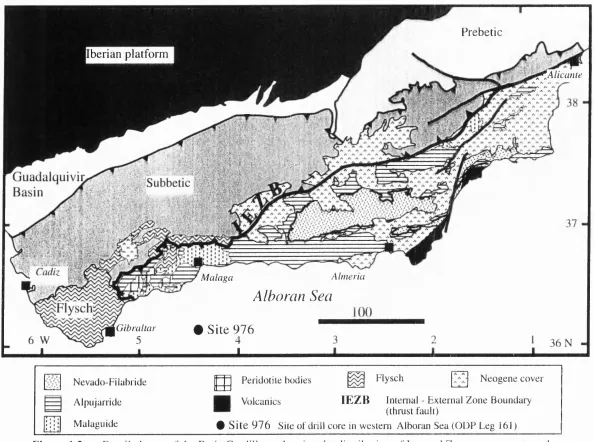
Peridotite bodies in the Betic-Rif orogen crop out near Ronda (in the west of the Betics)
(figure 1.2) and at Beni Boussera (within the Sebtide rocks of northern Morocco). Early
researchers proposed that the Ronda peridotite bodies were steep-sided diapiric intrusions
(Loomis, 1972; Darot, 1974), but subsequent studies in the region using gravity-profiling
have revealed that they have a sheet-like geometry (Tome et al, 1992). In the Betics, contact relations between the peridotite and adjacent Alpujarride rocks indicate that the
peridotite slabs were emplaced in the solid state (Argles et al, 1999). Tubia & Cuevas (1986) suggest that the emplacement of these peridotite slices into the Alpujarride Complex
occurred during the thrusting event associated with the inital crustal thickening in the
region.
A swarm of tholeitic dykes intrude the Intemal Zone to the north of Malaga, and a suite of
magmatic rocks, comprising calc-alkaline magmas, cordierite-gamet dacites and alkali
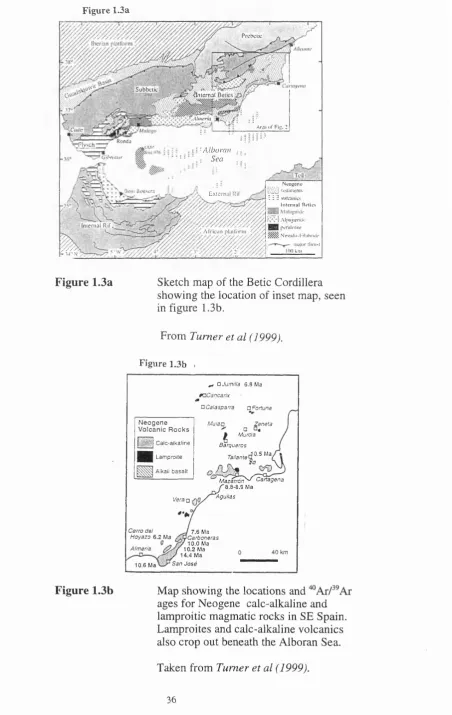
basalts are present in the Alboran Sea (figure 1.3a) and along the SE coastal margin of the
Betics (Tumer et al, 1999; figure 1.3b). Ar/Ar whole rock dating on a suite of Oligocene mafic dykes intruded in the Malaguide allochthon indicates that these dykes were intruded
between 30 Ma and 23 Ma. Sr and Nd isotope data imply that this magma was generated as
a consequence of partial melting at a shallow level in the aesthenosphere (Tumer et al,
1999). The calc-alkaline and cordierite-gamet dacite rocks in the south eastem Betics were
emplaced between 15 to 6 Ma and contain Sr and Nd isotope signatures indicative of
increasing amounts of crustal contamination in the melt; the dacites indicate very high
Moho temperatures. Alkali basalts and lamproites, emplaced sequentially between 1 0 - 7
Ma, indicate partial melting of the lower lithosphere and shallow lithospheric mantle,
respectively (Tumer et al, 1999).
1.1.3 Introduction to the External Zone
The Extemal Zone forms an extensive Neogene fold and thrust belt of unmetamorphosed
Mesozoic rocks that crop out to the north of the Intemal Zones on the Iberian peninsula,
and to the south of the Intemal Zones (Alboran nappes) in the Rif (figures 1.1 & 1.2). On
the Iberian Peninsula, the Extemal Zone is sub-divided into the Subbetic and Prebetic
Zones. The Prebetic zone is exposed in the northeast of the Betics and is composed of
shallow-water sediments deposited on the Iberian platform. The Subbetic is subdivided
into palaeogeographic regions in the north, central and southem parts of the area;
sedimentary sequences within these sub-divisions vary, but overall the Subbetic sediments
are more basinal than those of the Prebetic (Vissers et al, 1995).
In the west of the Betic Cordillera, the Flysch Units overlie the Intemal Zone complexes
(figure 1.2). The present-day exposure of the Flysch Units extends from the Straits of
Gibraltar to Kabylies in northem Africa. As mentioned above, these early Cretaceous -
early Miocene sediments were deposited in a trough formed on oceanic or very thin
continental crust (Comas et al, 1999). Balanya & Garcia-Duenas (1988) suggest that this palaeo-trough may have formed on the thinned crust between the South Iberian and
Maghrebian paleomargins.
1.2
The Internal Zones of the Betic Cordillera
1.2.1 Introduction
The rock units that make up the Intemal Zone of the Betic Cordillera are shown in Figure
1
.
2.
The Intemal-Extemal Zone Boundary (lEZB) separates the metamorphosed Intemal Zones
of the Betic Cordillera (the Alboran Cmstal Domain) from the un-metamorphosed rocks in
the Extemal Zones that belong to the South-Iberian and Maghrebian palaeogeographic
terrains (Balanya, 1991) (figure 1.2). The lEZB is dominantly a thrust contact that places
Intemal Zone rocks over the Extemal Zones. Movement along this contact began in
theearly-to-mid Miocene. Thmsting propagated in a dominantly westward direction from
the latest Oligocene to the earliest Miocene, generating the arcuate shape of the peripheral
thrust belt (the Gibraltar Arc). Variation of thrust direction occurs within the Betic-Rif
orogen. On the Iberian Peninsula, thrust directions vary from north-west (in the Betics) to
west (near to Gibraltar) (Kirker & Platt, 1998; Lonergan et al, 1994), while in the R if thrust directions towards west-southwest and west are identified (Frizon de Lamotte, 1987;
Platzman et al, 1993). Kirker & Platt (1998) propose that the large measured vertical axis rotations identified in the thrust sheets occurred by progressive addition of small
differential rotations throughout the stack. Shortening and vertical axis rotation was
contemporaneous with extension and cmstal thinning within the Alboran Crustal Domain.
The event that generated the thickening of the cmst in the Alboran Domain is generally
accepted to be of Cretaceous to Paleogene in age (e.g. Tubia & Gil-Ibarguchi, 1991). The
contentious issue. Similarities between the stratigraphy within the Nevado-Filabride,
Alpujarride and Malaguide Complexes indicate that the initial episode of crustal thickening
proceeded by nappe duplication (Bakker et al, 1989). In each Complex, a sequence of Palaeozoic graphitic schists underlies a Permo-Triassic non-graphitic quartzite and schist
sequence. The Permo-Trissic lithologies are in turn overlain by middle to upper Triassic
carbonates (Martin & Braga, 1987). The Malaguide Complex preserves a sequence of
rocks not seen in the other two Complexes (see section 1.2.4). Differentiation between the
Nevado-Filabride, Alpujarride and Malaguide complexes is principally based on variation
of metamorphic grade. The structurally highest Complex, the Malaguide Complex, shows
evidence of having experienced only very low-grade metamorphism. The underlying
Alpujarride and Nevado-Filabride Complexes contain early high-pressure/low temperature
metamorphic assemblages and subsequent assemblages indicating that lower pressure
conditions at moderate to locally high temperatures occurred later in the metamorphic
history (figure 1.4).
In both the Nevado-Filabride and Alpujarride Complexes, prolific disequilibrium
assemblages and textures are preserved (Garcia-Casco & Torres-Roldan, 1996).
Theoretically, relic mineral assemblages can be employed to help constrain the pressure-
temperature conditions that prevailed during the early metamorphic evolution of these
rocks. However, the extreme textural and chemical disequilibrium that is prevalent in the
rocks (e.g. Garcia-Casco & Torres-Roldan, 1996; section 1.3.6) generates challenges in
establishing accurate pressure and temperature estimates from the use of thermo-barometric
techniques.
1.2.2 The Nevado-Filabride Complex
The Nevado-Filabride Complex crops out an open-style antiform that is seen in the Sierra
Nevada, Sierra de los Filabres and elsewhere. This structure developed during the Miocene
(Martinez-Martinez & Azanon, 1997). The Complex is divided into three tectonic units:
from the structurally lowest to the highest these are the Veleta, Calar-Alto and Bedar-
Macael Units. The Calar-Alto and Bedar-Macael units comprise a metamorphic sequence
with basic and ultrabasic igneous rocks. The penetrative sub-horizontal schistosity which is
present throughout the Complex was formed under greenschist facies in the structurally
lower parts of the Complex, and at amphibolite facies in the upper parts of the Complex
(Platt & Behrmann, 1986; Garcia-Duenas eta l, 1988).
Basic and ultra-basic rocks in the upper part of the Nevado-Filabride Complex provide a
source of information about the pre-orogenic history of the Betic Cordillera and the early
high-pressure conditions related to crustal thickening as a consequence of continental
subduction and collision. Gomez-Pugnaire & Femandez-Soler (1987) estimate that the
equilibrium conditions in an eclogite body within the Nevado-Filabride were 550°C at 12
kbar. Attempts to date the high- pressure metamorphic assemblages in the Nevado-
Filabride complex have produced widely varying results; an age of 48 Ma from Ar-Ar
dating of barroisitic amphibole has been interpreted as defining the end of the high pressure
episode (Monie et al, 1991).
1.2.3 The Alpujarride Complex
The Alpujarride Complex overlies the Nevado-Filabride Complex, and is separated from it
by the Betic Movement Zone (BMZ). This tectonic contact is a detachment fault developed
in a heterogeneous shear regime, with indicators suggesting top-to-the-west sense of shear.
Extension along this contact began at around 23Ma and continues to the present day. The
rate of extension has varied over time: the rate of exhumation of Alpujarride rocks
decreased from 5 to 1 mm a"' between 25-19 Ma (Sosson et al, 1998); an uplift rate of 2 mm a'* is estimated for the Nevado-Filabride rocks in the period 23-12 Ma (Sosson et al,
1998). These data suggest that final movement along the Betic Movement Zone is likely to
have occurred at around 12 Ma (Jabaloy et al, 1993).
Rocks belonging to the Alpujarride Complex crop out extensively in the western and
central portions of the Betics. These rocks have characteristically experienced an early
high-pressure metamorphic event and were later affected by local high temperature
metamorphism up to granulite facies (Tubia & Gil-Ibarguchi, 1991). Thin continental crust
in the Alboran Basin, which transmits high rates of heat flow (Tome & Banda, 1992), has
been interpreted as part of the Alpujarride Complex (Platt et al, 1996; Comas et al, 1999). Samples of high-grade schist, gneiss, migmatic gneiss, marble, calc-silicate rock and
granite recovered from Site 976 in the Alboran Sea (Comas et al, 1996) have been assigned to the Blanca Group which crops out onshore in the western Betics, near to the Ronda
peridotites (Sanchez-Gomez et al, 1999).
A "^^Ar/^^Ar date of 24.8±0.4 Ma from phengite in a carpholite-chloritoid-aragonite
assemblage in the Alpujarride Complex is interpreted to date the end of the high-pressure
evolution (Monie et al, 1991). The convergence of "^Ar/^^Ar dates obtained from amphiboles, muscovite, biotite and potassium feldspars, in a range between 19-20 Ma,
Aldaya et al (1979) subdivides the Alpujarride Complex into units bound by thrust- contacts. The distinction between units was based on rock type, metamorphic grade and
the relative structural position of the unit within the Alpujarride Complex. This grouping
appears on the IGME geological sheets (e.g. Motril sheet - 19-44, 1:50,000, IGME).
Subsequent work in the Betics, including Garcia-Duenas et al (1988), Platt & Vissers (1989) and Balanya et al (1993) has led to the reinterpretation of many boundaries
previously considered to be thrusts as extensional structures. The sub-divisions established
by Aldaya et al (1979) are used by Azanon et al (1994) as the basis of a revised classification of rocks within the Alpujarride Complex (see section 1.3.3).
1.2.4 The Malaguide Complex
The Malaguide Complex overlies the Alpujarride Complex; replication of stratigraphy
between the two Complexes is evident. The current boundary between these two
Complexes, however, is an extensional contact, across which metamorphic grade increases
abruptly downwards. The time at which reactivation of the boundary occurred has been
dated, using fission-track techniques, to the Early Miocene (Lonergan & Platt, 1995).
Fabrics within the faulted contact show evidence of both brittle and ductile structures
(Lonergan & Platt, 1995).
The Malaguide Complex is the structurally highest Complex within the Intemal Zone. In
addition to the Palaeozoic, Permo-Triassic and Tertiary rocks present in the Nevado-
Filabride and Alpujarride Complexes, the Malaguide Complex contains a near-complete,
unmetamorphosed, sequence of Silurian to Miocene sedimentary rocks. A well-preserved
section of Tertiary sediments, ranging from lower Eocene to middle Miocene in age, is
present in the Tertiary Sierra Espuna Basin in the eastem Betics and have undergone
shortening and imbrication prior to the Miocene (Lonergan, 1993). Provenance studies,
stmctural analysis, petrography and heavy mineral analysis have demonstrated that the
Malaguide Complex was progressively exhumed during a period of approximately 10 Ma,
ending in the middle Miocene (Lonergan & Mange-Rajetzky, 1994).
1.3
The Alpujarride Complex - unraveling Internal Zone P-T-t
history
1.3.1 Introduction
The Alpujarride Complex is exposed across almost the entire east-west extent of the Betic
Cordillera. It enjoys particularly good exposure in the west and central parts of the
orogenic belt. The latter of these regions is the location for this study.
The stratigraphie sequence within the Alpujarride Complex is similar to that found in the
Nevado-Filabride Complex and in parts of the Malaguide Complex, as discussed above
(section 1.2.1). The pressure-temperature history of rocks within the Alpujarride Complex
of the central Bedes varies. A deformed body of heterogenous gneiss, the precursor of
which was a deformed Hercynian granite body, is present near to Torrox (50 km east of
Malaga - Garcia-Casco et al, 1993); extensive exposure of low grade phyllites are located in the eastern Alpujarras (to the north of Adra - Orozco et al, 1998). Rocks assigned to the Alpujarride Complex preserve the highest temperature assemblages found in the Betic
Cordillera. It is these assemblages which allow the metamorphic and structural evolution
of this Complex to be well constrained.
1.3.2 The principal foliation in the Alpujarride Complex - timing and
metamorphic relations
The main fabric within the quartzite and schist sequences of the Alpujarride Complex
cropping out in the central Betics is generally accepted to be a syn-metamorphic foliation
which developed during evolution from high P-T ratio metamorphic conditions to low P-T
ratio metamorphic conditions (Azanon & Crespo-Blanc, 2000; Sanchez-Gomez et al,
1999). The main foliation lies parallel to the boundaries of lithological formations and to
metamorphic isograds (Balanya et al, 1993; Azanon et al, 1994).
During the formation of the main foliation, the rocks of the Alpujarride Complex
experienced isothermal decompression as a consequence of exhumation and extreme
vertical shortening (Monie etal, 1994; Garcia-Casco et al, 1993). The metamorphic gradient in the field was condensed (i.e. the isograds were brought closer together)
throughout the Alpujarride Compex as a consequence of the attenuation of the crust. A
clearly defined example occurs near the Ronda peridotite body crops out in the western part
of the Betic Cordillera, where variation of grade from greenschist to granulite facies is seen
Betics have recorded the rapid decompression and cooling history of these rocks. ^Ar/^^Ar
and fission-track data from the Ojen and Los Reales nappes determine that the rate of
cooling in the interval between 1 9 - 1 6 Ma was at least 100°C / Ma, during which period
the rocks cooled from 500±50°C to 90±30°C (Sosson et al, 1998).
Thermobarometric techniques were applied by Azanon et al (1998) to mineral assemblages
lying within the main foliation (S2). From this study they deduced that conditions during
the formation of the main foliation in sillimanite-bearing schist from the central Betics
varied from 13 kbar to 5 kbar at an approximately constant temperature of - 580°C.
1.3.3 Sub-divisions within the Alpujarride Complex
A total of five major allochthonous tectonic units (ATUs) were defined by Azanon et al
(1994) in the central and eastern sectors of the Betic Cordillera (figure 1.5).
Classification of these units was based largely on the sub-divisions established by Aldaya et al (1979) but also incorporated additional metamorphic and structural data, including the crucial reinterpretation of thrust boundaries throughout the Internal Zones as extensional
contacts (e.g. Platt & Vissers, 1989). The allochtonous units of Azanon et al (1994) are distinguished from one another on the basis of the relict high-pressure assemblages. Rocks
in which high-pressure metamorphic assemblages are preserved are assigned to units that
are considered to have originated from structurally lower in the initial metamorphic stack
than rocks that do not contain relict high-pressure mineral assemblages (Azanon et al,
1994). From their study of relic high pressure mineral assemblages and the present-day
distribution of the ATUs, Azanon et al (1994) suggest that units which exhibit the highest pressure assemblages currently occupy the structurally highest positions in the Alpujarride
Complex (see figure 1.4).
The conclusions of Azanon et al (1994) imply that the allochthonous tectonic units in the Alpujarride Complex must have undergone significant re-organisation since the original
high-pressure event. Azanon et al (1994), Balanya et al (1997) and Azanon & Crespo- Blanc (2000) invoke a post-metamorphic episode of compression in the lower Miocene
(Aquitanian), to ‘reshuffle’ the ATUs into their present-day configuration. Km-scale north-
vergent folds and associated north-directed thrusts were generated during this event.
Azanon & Crespo-Blanc (2000) present a simplified map which summarizes the location
and relationships of the sub-divided units within the Alpujarride of the central Betics, and
the rock-types and mineralogy present in each Unit. (Figure 1.6). According to this
classification, the rocks in the area studied for this thesis lie mainly within the structurally
highest (that is, highest pressure and temperature) ATUs, including the Salobrena,
Guajares, Herradura and Adra Units, among others.
Timing of the compression event proposed by Azanon et al (1994), Balanya et al (1997) and Azanon & Crespo -Blanc (2000) is constrained by this latter set of workers to have occurred during the earliest Miocene (Aquitanian). This implies that this compressive
episode occurred after the period of extension during which the main fabric in the
Alpujarride Complex was generated (section 1.3.2) and just prior to the extensional
opening of the Alboran Sea in the lower Miocene (Platt et al, 1996). During the period of extension in the lower Miocene, the thrust contacts generated during the Aquitanian
compression were ubiquitously reactivated, destroying the sense of shear indicators of the
thrusts (Garcia-Duenas et al, 1988; Crespo-Blanc et al, 1994; Balanya et al, 1997; Azanon & Creso-Blanc, 2000).
In his discussion of Balanya et al's (1997) work, Platt (1998) challenges a number of the major assumptions which underpin the concept of dividing the Alpujarride Complex into
Allochthonous Tectonic Units (Azanon et al, 1994). Platt (1998) indicates that the early high-pressure history of the Alpujarride Units is likely to have been strongly modified by
the subsequent high-temperature history (Balanya et al 1997; Soto & Platt, 1999). During this period, extensive textural and chemical disequilibrium features were produced (Garcia-
Casco & Torres-Roldan, 1996; Garcia-Casco et al, 1993). If it is accepted that the high pressure assemblages within the Alpujarride Complex in the central Betics may have been
modified during the high-temperature part of their metamorphic history, then the use of the
high-pressure assemblages to predict the structural superposition of the ATUs prior to the
Aquitanian episode of compression (Balanya et al, 1997; Azanon & Crespo-Blanc, 2000) is evidently unsatisfactory. Platt (1998) also notes that the propensity of an individual nappe-
sheet to be characterised by a narrow range of pressure conditions has not been reported in
other orogenic settings (Heinrich, 1986). The assumption that the pre-Aquitanian structural
positions of ATUs within the Alpujarride Complex of the central Betics may be
reconstructed from their palaeo high-pressure assemblages forms the cornerstone of the
'structural correlation' achieved by Azanon et al (1994) between exposures of dismembered ATUs in the central Betics.
Results from thermobarometry and geochronology on rocks from the Alpujarride Complex
do not support an increase in pressure during the early Miocene history of the Internal
Zones (e.g. Monie et al, 1991, 1994; Soto & Platt, 1999; Platt et al, 1998). Evidence from geochronology indicates that exhumation of a thickened crustal section began around 27
Ma and proceeded rapidly (Platt & Whitehouse, 1999). Exhumation rates in the 19-18 Ma
al, 1998).
1.3.4 Ductile structures in the Alpujarride Complex of the Central Betics
Various studies of the Alpujarride Complex in the central Betics have described a phase of
km-scale folding that cause inversion of the metamorphic sequence and the configuration
of rocks existing prior to this deformation (e.g. Simancas & Campos, 1993; Orozco et al,
1998; Azanon & Crespo-Blanc, 2000). Disparities exist between the works of various
authors in the descriptions of these folds, and in the consideration of their regional
importance. For example, Simancas & Campos (1993) infer that 'late metamorphic' km-
scale folds verge to the NNW and locally invert extensive tracts of rock in the area around
Almunecar (figure 1.7). In a similar structural / metamorphic study in the same area,
Azanon & Crespo-Blanc (2000) conclude that folds equivalent to the 'late metamorphic'
folds of Simancas & Campos (1993) create only 'infrequent' inversions of the metamorphic
sequence and the pre-existing lithology. Using different nomenclatures, both studies
describe a crenulation fabric, axial planar to the km-scale folds, that cross cuts the main
(syn-metamorphic) foliation in the area.
Both Simancas & Campos (1993) and Azanon & Crespo-Blanc (2000) attribute the
generation of the km-scale folding to an episode of contraction in the late stage of the
metamorphic evolution of the Alpujarride Complex, during which the formation of
N/NNW directed thrust faults accompanied the large-scale folding.
Folds with a similar orientation and amplitude as the D3 structures of Azanon & Crespo-
Blanc (2000) and the 'late metamorphic' folds of Simancas & Campos (1993) have been
described in the eastern Betics, near to Adra, by Orozco et al (1998). In a sequence of phyllites and carbonates metamorphosed at low-grade, the axial traces of km-scale, north-
facing recumbent folds are traced for over 50 km. The hinges of the north-facing folds are
demonstrated to be closely associated with north-dipping normal faults (Orozco et al,
1998). Mineralogical techniques such as illite crystallinity and the measurement of the
basal spacing of phengite, paragonite and chlorite are used to identify the variations of
metamorphic grade. The polarity of the metamorphic sequence, and original stratigraphie
contacts are inverted in the overturned limbs of the km-scale folds (figure 1.8). Orozco et al (1998) conclude that the association of north-closing fold hinges with north-dipping normal faults is strongly suggestive that these large-scale folds formed in an extensional
regime. Folds in the Austro-Alpine nappes of the Alps are considered by Froitzheim
(1992) to have formed from the ductile folding of initially non-horizontal layers during
orogen-parallel crustal extension, as a result of gravitational spreading.
1.3.5 Late metamorphic extension in the Alpujarride Complex
Normal faults affecting the Alpujarride Complex in the central and western Betics have
been classified into two brittle, sub-perpendicular, extensional fault systems that developed
sequentially during the Miocene (Garcia-Duenas et al, 1988; Crespo-Blanc et al, 1994; Azanon et al, 1997, 1998). The Contraviesa fault system shows hanging-wall movement to the N-NW and was active during the upper Burdigalian and Langhian (Crespo-Blanc,
1995). In the Sierra de Baza region, N of Sierra Nevada, a set of normal faults showing
movement to the S-SE are considered to be antithetic to the Contraviesa faults. The
Filabres fault system shows hanging wall movement to the W-SW and relationships with
Middle Miocene deposits in the Sierra de Baza show that the Filabres fault system was
active after the upper Langhian (Martin-Perez & Viseras, 1994). Each of these fault
systems have accommodated significant amounts of extension: Beta factors of 1.5 and 1.4
are estimated for the Contraviesa and Filabres systems, respectively (Crespo-Blanc et al,
1994).
1.3.6 Disequilibrium textures in the Alpujarride Complex
Disequilibrium textures are almost ubiquitous in rocks from the Alpujarride Complex,
some of the most prominent textures in rocks from the central Betics having been described
by Garcia-Casco et al (1993) and Garcia-Casco & Torres-Roldan (1996). The three
aluminium silicate minerals, kyanite, sillimanite and andalusite commonly coexist in rocks
of the Alpujarride Complex in the central Betics (Garcia-Casco & Torres-Roldan 1993),
although textures clearly indicate disequilibrium between the phases. Chemical
disequilibrium between mineral phases in a single sample is widespread, including
examples of abnormal Fe-Mg partitioning between biotite, staurolite and garnet and wide
heterogeneities in the composition of phases within a single sample (Garcia-Casco &
Torres-Roldan, 1996). It is apparent that caution must be exercised in selecting mineral
pairs from rocks in the Alpujarride Complex for use in thermo-barometric work.
1.3.7 Constraining the Alpujarride P-T-t path: thermobarometry and
geochronology
Samples collected from the Ocean Drilling Program Site 976 in the Alboran basin (see
figure 1.1) have been assigned to the Alpujarride Complex (Platt et al, 1996). A study of
the petrology and geochronology of these samples has been carried out by Platt et al (1998) in which the P-T history of high-grade pelitic schist sample is traced along a path of
experienced cooling through 500°C at 2 kbar or less: peak temperature of the assemblages
occurred under low pressure conditions (figure 1.9). Rapid decompression is indicated by
the prolific occurrence of disequilibrium textures and overstepped metamorphic reactions
(Soto & Platt, 1999).
Other combined geochronology and pressure-temperature studies in the Alpujarride
Complex provide confirmatory evidence that rapid exhumation occurred during the early
Miocene and indicates that this exhumation proceeded as a consequence of extensional
faulting (Monie et al, 1994; Platt & Whitehouse, 1999; Sosson et al, 1998).
1.4
Late stage evolution of the Betic Cordillera
The sedimentary record in the Alboran Basin indicates that the basin was submerged from
Aquitanian-Burdigalian times: the early part of the tectonic history in the Alboran Basin is
dominated by extension (figure 1.10). Normal faults with a top-to-the-south-west direction
dominated the Miocene rifting episode, and an unconformity in the late Miocene indicates
the end of rifting. Volcanic activity in the east of the Betic and Rif chains, including the
eruption of lamproitic lavas and alkaline basalts, occurred from Langhian times onwards,
and so was partly contemporaneous with the extensional evolution of the Alboran Basin (Di
Battistini etal, 1987).
The later tectonic history of the Alboran Basin is dominated by structures that are
indicative of a contractional regime (figure 1.10). During the late Tortonian, compression
was directed northwest-southeast, subsequently changing to north-south from the late
Tortonian to the middle Pliocene and then directed along a north-northwest to south-
southeast axis later in the Pliocene and in the Pleistocene (Montenat et al, 1987; De Larouziere et al, 1988). During this period of compression, open-style east-west trending antiforms and synforms, including the east-west anticlinal component of the Sierra Nevada
- Sierra de los Filabres tectonic window, were generated (Martinez-Martinez & Azanon,
1997; Sanz de Galdeano & Vera, 1992; Comas et al, 1992). Wrench faulting has been active in the Alboran Basin since the early Pliocene (Comas et al, 1999). Strike-slip faults, including the Palomares and Carboneras strike-slip shear zones that crop out on the Iberian
peninsula, were generated as a consequence of a transtensive and transpressive regime that
is still active in the western Alboran Basin (Comas et al, 1999). Conjugate fault systems that trend approximately northeast - southwest and west-northwest - east-southeast,
generate the distributed seismic activity recorded in this region (Calvert et al, 2000).
1.5
Competing hypotheses for the cause of extension
The processes that have contributed to the evolution of the Betic-Rif arc have been debated
in various recent papers (e.g. Lonergan & White, 1997; Platt et al, 1998; Martinez-Martinez & Azanon, 1997). Recent seismic studies suggest the presence of up-welled asthenosphere
(Seber et al, 1996) and isolated bodies of lithospheric mantle in the region (Calvert et al,
2000; Blanco & Spakman, 1993).
Various mechanisms which may cause a body of lithospheric material to become separated
from the base of the lithosphere have been suggested. Proposed mechanisms include
removal of the lithospheric mantle by convection, (Platt & Vissers, 1989), slab detachment
/ de-lamination (de Jong, 1991; Zeck et al, 1992) and a combination of these two processes acting together (Seber et al, 1996). Lonergan & White (1997) suggest that the Neogene evolution of the Betic-Rif area is the consequence of a westward-retreating subduction zone
that generated rapidly extended continental crust as a consequence of its retreat.
The feasibility of geodynamic models proposed to explain the evolution of the Betic-Rif arc
have been explored using the results from thermobarometry, geochronology and studies of
mineral phase relations. Each model of the lithospheric response to the Africa-Iberian
collision will produce a characteristic pattern of thermal evolution in the overlying crustal
rocks. Platt et al (1998) produced thermal models of different tectonic scenarios by altering the values of variable parameters including thickness and thermal gradient of post-orogenic
lithosphere; depth to which lithospheric mantle was removed and rate of extension. Results
that produce pressure-temperature conditions comparable to those evidenced by
metamorphic assemblages in rocks from the ODP Site 976 are achieved when parameters
defining a significant post-contractional pause, prior to removal of the lithosphere to a
depth of 62.5 km, are defined. Delayed onset of lithosphere removal is predcted by
numerical models of the behaviour of a conductive thermal boundary layer developed in a
fluid with a non-linear vscous behavour (Molnar et al, 1998).
The evolution of mineral assemblages deduced from petrological studies of rocks taken
from the Alboran Sea core (Site 976) forms the basis of a study by Soto & Platt (1999).
These workers concluded that viable models of crustal evolution need to provide an
external source of heat (aside from that produced from radiogenic heat production) in order
to generate P-T paths similar to those suggested by the petrology of these rocks. This
constraint appears to challenge models involving trench rollback in the absence of
lithosphere removal, (e.g. Lonergan & White, 1997) as these models do not permit a
radiogenic heating was followed by the removal of the lithospheric mantle below the
orogen and rapid extension appear to most closely emulate the P-T paths recorded in the
rocks (Soto & Platt, 1999).
Turner et al (1999) present a study of the geochronology and isotopic signatures of magmatic rocks within the Betic Cordillera (section 1.1.2). The feasibility of competing
hypotheses recently proposed to account for the evolution of the Betic Cordillera are tested
according to whether they predict the goechemical signatures and geometrical distribution
of magmatic rocks discussed in this work. Models that suggest the orogen developed as the
consequence of a retreating subduction zone, detached slab of lithospheric mantle or
delamination of the lithospheric mantle are discounted; these mechanisms would be
expected to generate a progressive, systematically migrating sequence of volcanism, not
concordant with the pattern seen in the Betics (Turner et al, 1999; figure 1.3). Turner et al
(1999) propose that a model involving convective removal of the lithosphere most readily
explains the diffuse spatial distribution and temporal migration of activity directed
outwards from the Alboran Sea.
1.6
Aims of the project
As discussed in sections 1.3 - 1.5 above, numerous models have been suggested to explain
the present-day configuration of the Betic Cordillera: it is evident from the preceeding
discussions that ambiguities as to the evolution of the orogen remain.
In the broadest sense, the principal aim of this research is to provide a new set of structural
and metamorphic data, collected from the Alpujarride Complex from within the Internal
Zone of the orogen, in order to investigate the nature of the deformation that accompanied
the decompression and exhumation of the Complex and to explore the relationship
between the deformational history and the thermal evolution experienced by the rocks.
From this data, it is the intention that the hypothesis that exhumation was followed by
large-scale thrusting and regional nappe-formation (i.e. Balanya et al, 1997) may be able to
be tested. To achieve this, the zone around the towns of Almunecar, Salobrena and
LosGuajares has been elected for the following reasons:
1 Within this area, it has been recorded by previous workers that high grade
metamorphic rocks (e.g. sillimanite and kyanite bearing assemblages) located
predominately near to the coast pass structurally upwards into chlorite-bearing
assemblages over a horizontal distance of approximately 8 km. As the dip of the
main foliation in this area is recorded as being gently dipping, this indicates that the
transition from high grade to low grade rocks in this zone occurs through a reduced
vertical thickness of crust. A study of this area will enable the macro-scale
structural configuration of the area to be determined, and analysis of the
microstructures and metamorphic mineral assemblages present in these rocks should
permit the structural and metamorphic history of the rocks to be elucidated.
In the north of the area (see figure 1.6), near to the town of Los Guajares, exposures
of rocks that have experienced high temperatures crop out immediately adjacent to
rocks of considerably lower grade (IGME map of Motril (1972); Azanon et al,
1994). One common interpretation of the structure in the existing literature is that
the juxtaposition of grades in this area is the consequence of a thrust, which places
the higher grade rocks structurally above the low grade rocks (Azanon et al, 1994; Simancas & Campos, 1989). This area provides a useful ‘testing ground’ , then, for
the hypothesis that the Internal Zones of the Betic Cordillera have experienced
alternating periods of extension and compression during their evolution (i.e.
Balanya et al, 1997) or whether they have experienced continual extension (i.e. Argles et al, 1999).
Numerous well-exposed north-south trending transects through this area,
predominately within road-cuttings, provide a source of relatively fresh samples for
analysis of metamorphic minerals and microstructure, and the possibility that
structural trends will be able to be traced through the area, and perhaps correlated
between adjacent sections. It is intended that these sources of information will be
synthesised in order to generate a model that improves the understanding of the
^
G ib ra lta r ^
Alboran
\
\
%
South-Iberian
:
Flysch Trough
Alboran Dom ain
M aghrebian
Neogene
Figure 1.1 Sketch map o f the Betic-Rif arc. The locations o f the major tectonic domains are marked on an outline of
Prebetic
berian platform
i f A lic a n te
m m
A lm ena M alaga
Alboran Sea
G ibraltar
# Site 976
4 I
N e v a d o -F ila b r id e A lpujarride M a la g u id e
P erid otite b o d ies V o lca n ics
F ly sc h N e o g e n e c o v e r lE Z B Internal - E xtern al Z o n e B o u n d a i^
(thrust fau lt)
# Site 976 S ite o f drill co re in w estern A lb oran S e a (O D P L eg 16 1 )