Approach for Authentication key Exchange
Protocol in Distributed System: a Survey
Heena F.Qazi, Prof. .Vanita Babanne
Dept. of Computer Engg, RMD Sinhagad, Warje, Pune, MH, India
ABSTRACT: This paper deals the problem of key establishment for secure many-to-many communications. The problem is inspired by the proliferation of large-scale distributed file systems supporting parallel access to multiple storage devices. Our work focuses on the current Internet standard for such file systems, i.e., parallel Network File System (pNFS), which makes use of Kerberos to establish parallel session keys between clients and storage devices. Our review of the existing Kerberos-based protocol shows that it has a number of limitations: (i) a metadata server facilitating key exchange between the clients and the storage devices has heavy workload that restricts the scalability of the protocol; (ii) the protocol does not provide forward secrecy; (iii) the metadata server generates itself all the session keys that are used between the clients and storage devices, and this inherently leads to key escrow. In this paper, we propose a variety of authenticated key exchange protocols that are designed to address the above issues. We show that our protocols are capable of reducing up to approximately 54% of the workload of the metadata server and concurrently supporting forward secrecy and escrow-freeness. All this requires only a small fraction of increased computation overhead at the client.
KEYWORDS: Parallel sessions, authenticated key exchange, network file systems, forward secrecy, key escrow.
I. INTRODUCTION
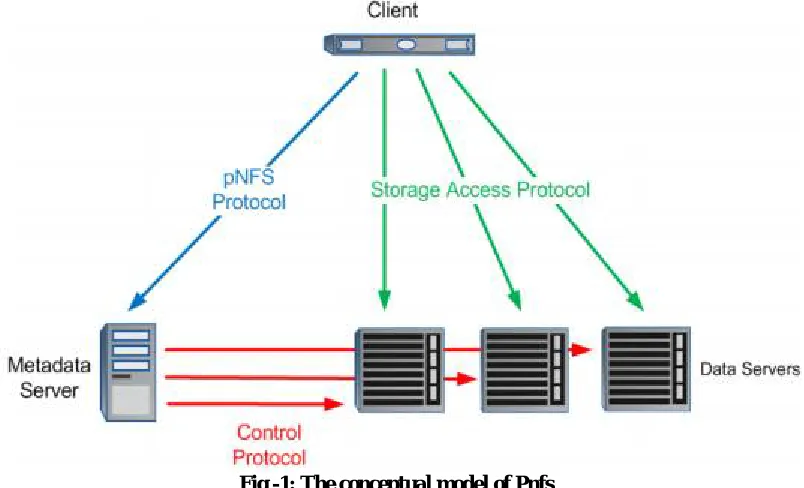
Fig -1: The conceptual model of Pnfs
More specifically, pNFS comprises a collection of three protocols: (i) the pNFS protocol that transfers file metadata, also known as a layout, between the metadata server and a client node; (ii) the storage access protocol that specifies how the client accesses data from the associated storage devices according to the corresponding metadata; and (iii) the control protocol that synchronizes the state between the metadata server and the storage devices.
II. LITERATURE SURVEY
System [1] Tele care Medical Information Systems (TMIS) provide an effective way to improve the medical process between doctors, nurses and patients. By improving the security and privacy of TMIS, it is important while challenging to improve the TMIS so that a patient and a doctor can perform synchronized authentication and session key establishment using a 3-party medical server while the secure data of the patient can be ensured. In proposed system an anonymous three-party password authenticated key exchange (3PAKE) protocol for TMIS is used. The protocol is based on the efficient elliptic curve cryptosystem. For security, we apply the pi calculus based formal verification tool ProVerif to show that our 3PAKE protocol for TMIS can provide anonymity for patient and doctor as well as achieves synchronized authentication and session key security. The advantage of proposed scheme is security and efficiency that can be used in TMIS. For this J-PAKE based protocols are used. The disadvantage of proposed scheme is of it reduced session keys.
Passwords are one of the most common causes of system crashes [3], because the low entropy of passwords makes systems vulnerable to brute force guessing attacks. Due to new technology passwords can be hacked easily. Automated Turing Tests continue to be an effective, easyto-deploy approach to identify automated malicious login attempts with reasonable cost of inconvenience to users. Hence in this proposed scheme the inadequacy of existing and proposed login protocols designed to address largescale online dictionary attacks e.g. from a botnet of hundreds of thousands of nodes. In this scheme proposed a simple scheme that strengthens password based authentication protocols and helps prevent online dictionary attacks as well as many-to-many attacks common to 3-pass SPAKA protocols.
System [4] proposed scheme Uses compositional method for proving cryptographically sound security properties of key exchange protocols, based on a symbolic logic that is interpreted over conventional runs of a protocol against a probabilistic polynomial time attacker. Since reasoning about an unbounded number of runs of a protocol involves induction-like arguments about properties preserved by each run, we formulate a specification of secure key exchange that, unlike conventional key in distinguish ability, is closed under general composition with steps that use the key. We present formal proof rules based on this game-based condition, and prove that the proof rules are sound over a computational semantics.
In [5] a public network, when a number of clusters connected to each other is increased becomes a potential threat to security applications running on the clusters. To address this problem, a Message Passing Interface (MPI) is developed to preserve security services in an unsecured network. The proposed work focuses on MPI rather than other protocols because MPI is one of the most popular communication protocols on distributed clusters. Here AES algorithm is used for encryption/decryption and interpolation polynomial algorithm is used for key management which is then integrated into Message Passing Interface Chameleon version 2 (MPICH2) with standard MPI interface that becomes ES-MPICH2. This ESMPICH2 is a new MPI that provides security and authentication for distributed clusters which is unified into cryptographic and mathematical concept. The major desire of ES-MPICH2 is supporting a large variety of computation and communication platforms. The proposed system is based on both cryptographic and mathematical concept which leads to full of error free message passing interface with enhanced security.
In [6] password Authenticated Key Exchange (PAKE) is one of the important topics in cryptography. It aims to address a practical security problem: how to establish secure communication between two parties solely based on a shared password without requiring a Public Key Infrastructure (PKI). After more than a decade of extensive research in this field, there have been several PAKE protocols available. The EKE and SPEKE schemes are perhaps the two most notable examples. Both techniques are however patented. In this paper, we review these techniques in detail and summarize various theoretical and practical weaknesses. In addition, we present a new PAKE solution called J-PAKE. Our strategy is to depend on well-established primitives such as the Zero-Knowledge Proof (ZKP). So far, almost all of the past solutions have avoided using ZKP for the concern on efficiency. We demonstrate how to effectively integrate the ZKP into the protocol design and meanwhile achieve good efficiency. Our protocol has comparable computational efficiency to the EKE and SPEKE schemes with clear advantages on security.
System [7] present a mechanized proof of the password based protocol One-Encryption Key Exchange (OEKE) using the computationally-sound protocol prover CryptoVerif. OEKE is a non-trivial protocol, and thus mechanizing its proof provides additional confidence that it is correct. This case study was also an opportunity to implement several important extensions of CryptoVerif, useful for proving many other protocols. We have indeed extended CryptoVerif to support the computational DiffieHellman assumption. We have also added support for proofs that rely on Shoup’s lemma and additional game transformations. In particular, it is now possible to insert case distinctions manually and to merge cases that no longer need to be distinguished. Eventually, some improvements have been added on the computation of the probability bounds for attacks, providing better reductions. In particular, we improve over the standard computation of probabilities when Shoup’s lemma is used, which allows us to improve the bound given in a previous manual proof of OEKE, and to show that the adversary can test at most one password per session of the protocol. In this paper, we present these extensions, with their application to the proof of OEKE. All steps of the proof, both automatic and manually guided, are verified by CryptoVerif.
this problem using an approach different from all past solutions. Our protocol, Password Authenticated Key Exchange by Juggling (JPAKE), achieves mutual authentication in two steps: first, two parties send ephemeral public keys to each other; second, they encrypt the shared password by juggling the public keys in a verifiable way. The first use of such a juggling technique was seen in solving the Dining Cryptographers problem in 2006. Here, we apply it to solve the PAKE problem, and show that the protocol is zero-knowledge as it reveals nothing except one-bit information: whether the supplied passwords at two sides are the same. With clear advantages in security, our scheme has comparable efficiency to the EKE and SPEKE protocols.
Proposed System
• In the proposed work to design and implement a system which can provide parallel processing with key authentication protocol in network file system.
• The system provide Elgamal encryption algorithm for provide the security to distributed data servers. • System also prevent SQL injection as well as data collusion attack from external requests.
• System can automatically manage the load balancing into different data nodes.
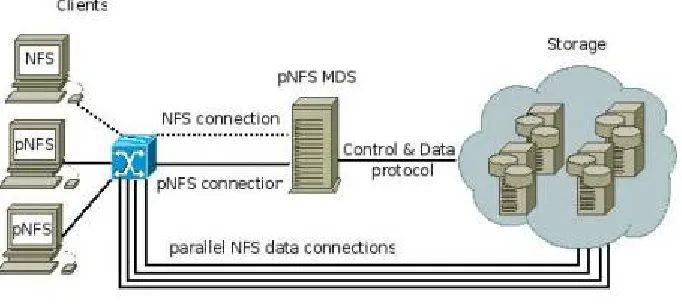
Fig 1: Proposed System Architecture
III. SYSTEM IMPLEMENTATION PROTOCOL
pNFS-AKE-I: Our first protocol can be regarded as a modified version of Kerberos that allows the client to generate its own session keys.
pNFS-AKE-II: To address key escrow while achieving forward secrecy simultaneously, we incorporate a Diffie Hellman key agreement technique into Kerberos-like pNFS-AKE-I. Particularly, the client C and the storage device Si each now chooses a secret value (that is known only to itself) and pre-computes a Diffie-Hellman key component. A session key is then generated from both the Diffie-Hellman components.
pNFS-AKE-III: Our third protocol aims to achieve full forward secrecy, that is, exposure of a long-term key affects only a current session key (with respect to t), but not all the other past session keys.
Advantages of PNF
The following are the advantages of pNFS:
Eliminates the single controller bottleneck.
Unlike traditional NFS, pNFS provides isolation of metadata and control from the data path. The metadata server
(MDS) handles all nondata traffic such as GETATTRs, SETATTRs, ACCESS, LOOKUPs, and so on. Data servers (DSs) store file data and respond directly to client read and write requests. A control protocol is used to provide synchronization between the metadata server and data server. This eliminates the single controller bottleneck to handle all the NFS operations by spreading out the metadata operations to be handled by one server, while other multiple data servers handle the read or write operations.
With pNFS, any volume that is moved to a different node within the cluster namespace for load balancing purposes
file system is served from a different cluster node after the move within the namespace; therefore, the file system does not need to be unmounted or remounted. This efficient system of load balancing helps to address highly utilized CPU, memory, and network in the clustered storage.
Improves scalability and manageability.
The pNFS client works seamlessly when the application tries to access flexible volumes hosting file systems from
nodes that are added to the cluster namespace without any disruption. No additional mounts are required from the client for the application to access these volumes as long as the application identifies that these volumes are valid for its use. Typically in a scenario where hierarchical storage management (HSM) is deployed, aging files are automatically moved to volumes created in less expensive SATA disks. And when the application might need to access these volumes sporadically, pNFS along with the benefits of cluster namespace requires no additional mounts from the client to access the new volumes. The application can access the data without any additional mounts from the different storage tiers. While additional storage nodes in the scale-out architecture provide additional CPU and memory resources, the intelligent pNFS client is updated with the new location of the file system, thus providing a direct path to the data nodes.
Coexists with traditional NFS protocol
The pNFS part of NFSv4.1 and other versions of NFS are open source and are driven by the Internet Engineering
Task Force (IETF) community. Therefore, the different varieties of NFS can coexist at the same time, as long as the clients follow the appropriate RFCs. This means that the supported NFS clients can mount the same file system over NFSv3, NFSv4, and NFSv4.1/pNFS. However, if an NFSv4.x access control list (ACL) is set on a file or directory, then the permissions are enforced on the appropriate file or directory. While an NFSv4 client can list all the access control entries (ACEs), an NFSv3 client might not see the actual ACLs set on it, as it does not support ACLs.
Provides data locality
pNFS provides a direct path to access volumes in namespace as long as a valid network path is available to reach
to the cluster node. With pNFS, the unoptimized path to access any volume in the namespace is eliminated. pNFS leverages Data ONTAP Cluster-Mode technology and provides an optimized path to the storage that essentially eliminates a cluster hop to serve the data; clients supporting pNFS always get their data served by the network addresses that are hosted on the physical controller as the storage.
IV. CONCLUSION
We proposed three authenticated key exchange protocols for parallel network file system (pNFS). Our protocols offer the advantages over the existing Kerberos-based pNFS protocol. First, the metadata server executing our protocols has much lower workload than that of the Kerberos-based approach. Second, two our protocols provide forward secrecy: one is partially forward secure (with respect to the multiple sessions within a time period), while the other is fully forward secure (with respect to a session). Third, we have designed a protocol which not only provides forward secrecy, but is also escrow-free.
REFERENCES
[1] Qi Xie1*, Bin Hu1*, Na Dong1, Duncan S. Wong2 ., “Anonymous Three-Party Password-Authenticated Key Exchange Scheme for Telecare Medical Information Systems.”
[2] Michel Abdalla, David Pointcheval., “Simple PasswordBased Encrypted Key Exchange Protocols.” [3] *A. Sai Kumar **P. Subhadra., “User Authentication to Provide Security against Online Guessing Attacks.”
[4] Anupam Datta1, Ante Derek1, John C. Mitchell1, and Bogdan Warinschi2., “Key Exchange Protocols: Security Definition, Proof Method and Applications .”
[5] R.S.RamPriya, M.A.Maffina., “A Secured and Authenticated Message Passing Interface for Distributed Clusters.” [6] Feng Hao1 and Peter Ryan2., “J-PAKE: Authenticated Key Exchange Without PKI”