A Survey for an Interactive E-learning
Environment Using Hologram Technology
Shweta Anil Korulkar
1, Prof. L.M.R.J. Lobo
2P. G Student, Department of CSE, WIT, Solapur University, Solapur, India1
Associate Professor, Department of CSE, WIT, Solapur University, Solapur, India2
ABSTRACT: Now days, there is a huge use of Hologram technology through which user can feel the virtual environment process. We aim to use this hologram technology in education sector which will be more useful to a student to understand their concept in an interactive way. User can interact with this Virtual character and get the required output. In this system, user interaction with Virtual Hologram and it is use is demonstrated.
We proposed the system will have following contribution: An Admin panel that has authority to access all data available in database and can modify data, a User access through which a user can access the required data by interacting with virtual character, one of the proposed algorithm is used for a Voice based interaction for interactive communication and a Data fetching module that fetches data which is required for a user from a database, if required data is available in database.
KEYWORDS: E-Learning Environment; Interactive Learning; Voice Processing Algorithm; Data Fetching Module; 3D Hologram Technology.
I. INTRODUCTION
Cloud Computing is used to deliver the computing resources over the internet. It is used for manipulating, referring, retrieving data which is stored on cloud. Cloud Computing means storing data on your personal PC. Example of cloud services are online file storage, social networking site, webmail, and online business application etc.
Now days, e-learning is one of the important technique which is helpful to a student to learn a concept online. Using this technique, a student can get more knowledge about a particular subject or a topic. Using an e-learning concept a student and faculty meet on a social network to get more knowledge and improve their skills [4, 10]. E-learning aims in providing lots of information to an educational community so that a student and a teacher can exploit learning and communication capabilities. E-learning can be used in many applications like e-resources, online courses, blended learning, lecture management system and other communication and collaboration tools. There are different types of video used for e-learning such as expert lecture video, screen capture
presentation, interview etc. [10] The Cloud Management System add extra layer of complexity to e-learning system from perspective of teacher and student [8]. A Virtual learning environment supports E-mail, news group, and bulletin board [3]. Virtual reality system allows a user to interact and manipulate with a computer to gain knowledge. There are different types of networked virtual environments used in e-learning such as Multi-user distributed virtual environment, Collaborative virtual environment system, Learning virtual environment, Immersive virtual environment
[1, 3]. Using a virtual reality system, it is possible to get three dimensional environments of such website equipped with 3D object viewing [1]. The effect of 3D object increases the user attention and interactivity with object in the real world. The objective of virtual reality technology is to provide a highly realistic and believable simulation of virtual Environment.
in many areas like marketing, advertising, education etc. In our proposed system a huge base of Hologram technology is used through which a user can feel the virtual environment process.
The aim to use this hologram technology in education sector will be more useful to student to understand a concept in an interactive way. Instead of giving only theoretical lectures if we use this type of technology in education sector then students are more interested and learn the concept interactively. To make the session interactive Hologram Technology is used in education technology.
We proposed the system will have the following contributions.
1] Admin Panel: Admin has authority to access all data required for our dissertation which is stored in a database. 2] User access: User can interact with Virtual Hologram through voice. If student want to see some video related to study, then he/she can tell the name of that video to Virtual Hologram. Then voice is compared with the data which is stored in database and according to that video is display.
3] Voice based interaction: CELP (Code Excited Linear Prediction) Coder like algorithm for voice processing can be used for interaction between user and Virtual Hologram.
4] Data fetching: C4.5 algorithms can be used for fetching data from a database. Using this algorithm, user request is checked and matched with our data stored in database. If match is found, then the output is displayed.
The next step in our proposed implementation is to present data through a Hologram character. In this step an output is displayed via a Hologram character. Finally, a Practical presentation of a demonstration is exhibited.
II. RELATED WORK
Hatem Abdul-Kader, [1] demonstrated the benefits of virtual reality environment using X3D in e-learning applications. These benefits are shown by two web enabled virtual environment e-learning systems. The first one is an on-line virtual chemistry lab system. In this application the student can perform all experiments in a certain crucial. The second experiment is an on-line English language education system. This application gives the students the ability to learn the language via on line interactive system. This paper gives an idea of interactive learning instead of distance learning using hologram technology for displaying lecture in a classroom.
Alexiou A., Bouras C., Giannaka E., Kapoulas V., Nani M., and Tsiatsos T., [2] used a 3D simulation of a radio-pharmacy laboratory. Here a learner is represented by 3D avatars which can perform experiment on Radio Pharmacy equipment by carrying out specific learning scenarios. They provided a sustainable, user-driven, web-based interface, which supported communication between member’s Radiopharmaceutical community. This gives an idea of 3D avatar for delivering the lecturer’s video or audio to students.
Bouras C. and Philopoulos A., [3] in their work project the communicative character would allow for students and staff to meet in social shared spaces and get extra knowledge by attending online seminar etc. They presented multiuser distributed virtual environments, which is used for education purpose. In addition to the technical issues that they have encountered, the educational issues occurred when using this application also more interesting and help us use in a more efficient way. In their work they also have distributed evaluation sheets to a teacher, and schools. Their next step in the process of developing this m-DVE (multiuser Distributed Virtual Environment) was to do the minor changes in the current environment by considering the teachers and student’s evaluation results in order to a more suitable educational environment. Here they give an idea of interactive lectures so that a student and teacher can get extra knowledge about the concept.
Bouras, Ch., et al. (1999). [4] Presented the Virtual European School (VES) that was an ongoing European project. They also developed the on-line resource for higher education schools. The technical structure of the VES system was based on Internet technologies. In this VES project they reduced instructors' hesitation towards computers which is used as the teaching assistants, in which they offer an innovative delivery system. Here one is introduced to the idea of explaining the concept in an interactive way using hologram technology.
project constituted a cost-effective solution for both schools and universities without using appropriate infrastructure and tool for distance learning and education in chemistry. Here an idea for delivering virtual practical to student via virtual hologram was introduced.
Toni Amorim, Leandro Tapparo, Norian Marranghello, Alexandre C.R. Silva, Aledir S. Pereira. [7] described a 3D virtual lab environment. By using OpenSim software this work was developed which is integrated into Moodle. They use Virtual software tool to provide pedagogical support to lab to create online texts and delivering them to the students. In this work, the courses taught in virtual lab are methodologically based on the theory of multiple intelligences. Here an idea of providing virtual practical’s procedure step by step was introduced.
Stefan Aurelius’ Rădulescu [8] identified ways to improve the learning process by using cloud computing technologies. The main focus was about the request, create, deploy, monitor and manage the virtual laboratories using Cloud Computing. The idea of introducing the concept of e-learning using cloud computing technology for getting required data from cloud storage was introduced.
Michelle Pieri, Davide Diamantini [9] focused on e-learning Web 2.0. In their work they used Think Tag Smart which is a new platform of e-learning web 2.0 to train more than 135 students of the University of Milano-Bicocca. The use of Web 2.0 in learning environments allows teachers and students to participate in the learning process. The idea of hologram technology uses instead of using think tag smart platform for e-learning was exposed.
Salih Gümüú. [10] used the rapid content production and delivery concept which could be provided by using MS PowerPoint, through instructors and using some other software. Instructor’s course lecture videos, audios, test, animations and music’s can be added to existing course contents to convert rapidly to online deliverable format. In this work, they have given an example of how to deliver an instructor’s lecture notes online. They give an idea of use of 3D hologram technology for increasing knowledge of student by providing interactive session instead of delivering the concept to student via MS PowerPoint etc.
Yuen May Chana. [11] used video instructor to support class room learning. This video allows students to learn at their own pace, own time and in their own style, as well as they can learn independently without relying on others for help. They also used YouTube for learning purpose. In this project they also created a chart of student belief and use of video instruction for learning to visualize video instruction was good from student point of view. Here an idea of providing multimedia data through virtual hologram character which would be more interesting and beneficial was introduced.
M. Tariq Bandaya, Musavir Ahmedb, Tariq R. Jan. [12] deliberated upon the applications of e-learning and learning practice in engineering education. They presented the results of a survey conducted to examine adoption of ICT and e-learning tools. The results of this project were discussed in research for suggestingrecommendations to improve e-learning implementations in engineering education.
Asanka D. Dharmawansa, Katsuko T. Nakahira, Yoshimi Fukumura [13] In their work used the method of introducing students' Eye Blinking (EB) which is used to identify the student’s status during the e-Learning sessions. An Eye Blinking Visualization System (EBVS) was constructed to establish a rich connection between the Avatar and the real user. They developed a system of EB detection in the real world was constructed where eye blinks are represented through the animations of 3D Avatar in the virtual world. Thusinteractive session using hologram technology instead of just playing the videos for student for checking the student interest could be conducted.
III. METHODOLOGY
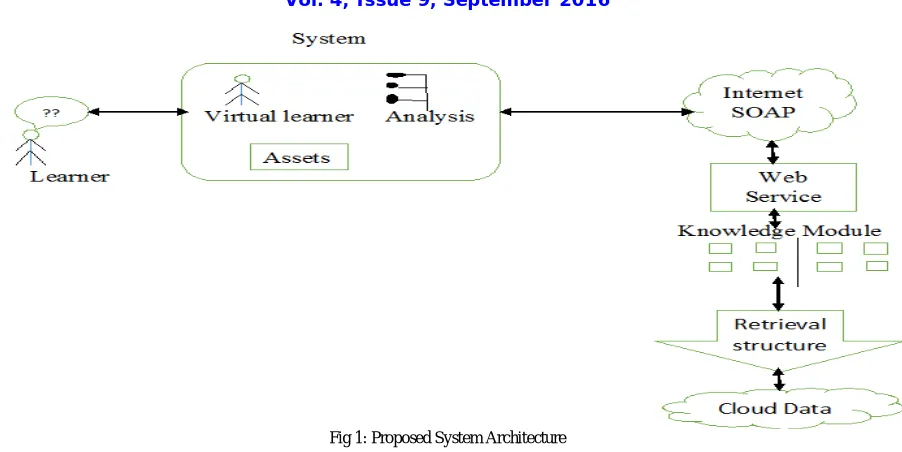
A. PROPOSED SYSTEM ARCHITECTURE
Fig 1: Proposed System Architecture
B. EXPECTED RESULT
The input of our proposed system would be learner’s requirement that may be text data, audio or video clip related to particular topic through voice command and output would be a multimedia display as per student requirement using hologram technology.
IV. CONCLUSION
In this system we have proposed the Hologram technology. We used a virtual character to which user can interact and get required output. Hologram technology is very useful and interactive technology for student or users through which a user can get more knowledge and understand a concept easily. With the help of algorithms, we performed voice and data processing. With the help of Hologram motion we explain the concept very well so that a user gets the required concept. A User interacts with virtual hologram by voice. This type of technology is very popular nowadays and concept learning becomes more interesting using technology enhancement.
REFERENCES
[1]Hatem Abdul-Kader, “e-Learning Systems in Virtual Environment” The International Arab Journal of Information Technology, Vol. 8, No. 1, January 2011
[2]Alexiou A., Bouras C., Giannaka E., Kapoulas V., Nani M., and Tsiatsos T., “Using VR Technology to Support e-Learning: The 3D Virtual Radio Pharmacy Laboratory, “in Proceedings of 6th International Workshop on Multimedia Network Systems and Applications, Japan,vol. 13 pp. 268-273, 2004.
[3]Bouras C. and Philopoulos A., “Distributed Virtual Reality Environments over Web for Distance Education,” in Proceedings of European Distance and e-Learning Network Conference, Italy, vol. 24 pp. 481-484, 1998.
[4]Bouras, Ch., et al. (1999). “Virtual European School-VES.” IEEE Multimedia Systems’99, Special Session on European Projects, Florence, Italy, vol. 99 June 7-11, 1999.
[5] Chittaro L. and Ranon R., “Web3D Technologies in Learning Education and Training: Motivations, Issues, Opportunities, “Computer Journal of ELSEVIER Computers and Education, vol. 3, no. 49, pp. 3-18, 2007.
[6]J. Georgiou, K. Dimitropoulos, and A. Manitsaris., “A Virtual Reality Laboratory for Distance Education in Chemistry, “International Journal of Social, Behavioral, Educational, Economic, Business and Industrial Engineering Vol:1, No:11, 2007
[10]Salih Gummi “Rapid content production and delivery in e-learning environments: use of Adobe Presenter, MS PowerPoint, Adobe Connect” Anadolu University, Open Education Faculty, Eskiúehir, Turkey vol. 9 pp. 805–809 2010.
[11]Yuen May Chana “Video instructions as support for beyond classroom learning “Procedia Social and Behavioral Sciences vol. 9 pp. 1313–1318, (2010).
[12]M. Tariq Bandaya, *, Musavir Ahmedb, Tariq R. Janc“Applications of e-Learning in engineering education: A case study” Procedia - Social and Behavioral Sciences vol. 123 pp. 406 – 413, ( 2014 ).