Effect of Length on Correlation of PN
Sequence and Gold Sequence
Yogyata Kumari, Dr. Raj Kumar
M.Tech Student, Department of ECE, Mata Rajkaur Institute of Engineering, Rewari, India
Director, Mata Rajkaur Institute of Engineering, Rewari, India
ABSTRACT: Spread spectrum modulation technique is different from the conventional communication system. A good correlation property and large linear period of Pseudo-random sequence is the basis of spread spectrum communication systems intern CDMA (code division multiple access communication systems). Out of several techniques to implement direct sequence spread Spectrum (DSSS), one technique PN (pseudo noise) sequence/ code which is referred as the high rate digital code is generated on MATLAB. This generated m-sequence is then converted into polar format. Finally, in this paper we examine autocorrelation of PN sequence, GOLD sequence and compares the simulated autocorrelation with theoretical measured autocorrelation function at different value of N.
KEYWORDS: Autocorrelation-sequence, MATLAB, PN sequence, Spread spectrum communication, Pseudo-noise.
I. INTRODUCTION
Spread Spectrum is a method of transmission in which the data sequence occupies a bandwidth in excess of the minimum bandwidth necessary to send it [1]. Spread spectrum techniques are used in many military communication systems to provide some combination of ranging capabilities, anti-jam protection, low probability of detection and interception, and multiple-access capability [4]. The spread spectrum communication has many advantages like strong anti-interference ability, low bit error rate, good hiding, low intercept, high confidentiality, etc [2].
Spread spectrum communication has two characteristics first one is the bandwidth of the signal transmission is much larger than the bandwidth of the original information signal and the second is that the transmission signal bandwidth is decided by the spreading codes (and the spreading codes are usually the pseudo-random code) [1]. There are several techniques by which spread spectrum can be implemented. One technique is called direct-sequence and the other technique is a PN (pseudo-noise) code which exhibits random-like properties which are necessary for providing good spectral characteristics and security [5]. A long PN code is frequently used for uplink channelization in the CDMA mobile communications [3]. Pseudo-random sequences with good correlation property, large linear complexity, and balance statistics are widely used in modern communication [6].
Figure 1. M sequence generation circuit simulation model[3]
In a Direct Sequence Spread Spectrum (DSSS) system, random binary data having bit rate of rb bits per sec is Exclusive Ored by a pseudorandom binary waveform, which is at much higher rate and it provides the frequency spreading operation. This pseudorandom binary source outputs symbols called chips at a constant chip rate rC chips per sec .Each bit in the pseudorandom binary sequence is known as a chip and the inverse of its period as chip rate. The chip rate is always higher than the bit rate, and the ratio of the chip rate to the bit rate is known as the processing gain [8]
M sequence is commonly used pseudo-random sequence, which is the longest linear sequence shift register. Such sequence has good autocorrelation characteristics. Shift register sequence is a periodic sequence, its cycle not only relate to the degree of the shift register, but also relate to the linear feedback logic and shift register initial state[1].
PN Sequence Generator generates a sequence of pseudorandom binary numbers by using shift register, as shown in Figure 2. There are r registers in the generator which update their values at each time step depending on the value of the incoming arrow to the shift register. The shift register is described by the Generator Polynomial parameter, which is a primitive binary polynomial in z, grzr+gr-1zr-1+…………+g0. The coefficient gi is 1 if there is a connection from the ith register. The leading term gr and the constant term g0of the Generator Polynomial parameter must be 1.
Figure 2. M-Sequence Generator Structure [2]
The adders perform addition modulo 2. The period of a PN sequence produced by a linear feedback shift register with m flip flops cannot exceed 2m -1.When the period is exactly 2m -1, the PN sequence is called a maximal length sequence or m-sequence. The remainder of this paper is organized as follows: Section 2 presents the material and method of the designed system for generation of m sequence and its autocorrelation in MATLAB. Section 3 gives a detailed discussion on the results obtained. The final section concludes and describes the future scope of this work.
II. MATERIAL AND METHOD
To generate PN sequence MATLAB v 7.0 is used. A PN sequence is generated by means of a feedback shift register. PN sequence generated is determined by the length m of the shift register, its initial state and the feedback logic. The procedure followed in this work is detailed below. Firstly, NRZ encoder is used to get encoding data streams.
m-sequence is generated. Then find autocorrelation of m-m-sequence by simulation. Autocorrelation also be calculated theoretically.
Method to calculated autocorrelation theoretically is Period of an m-sequence is defined by
= 2 −1
m- Length of the shift registers.
Let c (t) is the resulting waveform of the maximum length sequence. Period of the waveform c (t) is
= .
Tc is the duration assigned to symbol 1 or 0 in the maximal-length sequence. Autocorrelation function of a periodic signal c (t) of period Tb is
( ) = 1 ( ). ( − )
/
/
Where the lag τ lies in the interval (-Tb /2, Tb /2).Using this formula autocorrelation is represented as
( ) =
1− + 1| |, | |≤
−1,
This theoretically autocorrelation is then compared with simulated Autocorrelation.
III. RESULTS AND DISCUSSIONS
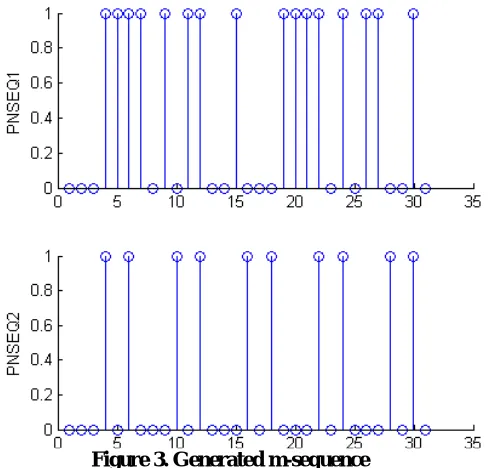
The resultant PN sequence (m-sequence) & polar format of that generated PN sequence is shown in Figure2. This figure shows that number of binary 0s are differ by number of 1s by one chip only, which is the property of m-sequence. In first part of the figure, generated m-sequence is shown with respect to chip index and second part of the figure shows when this generated m-sequence is coded in polar format. In polar format, output is shown with respect to time.
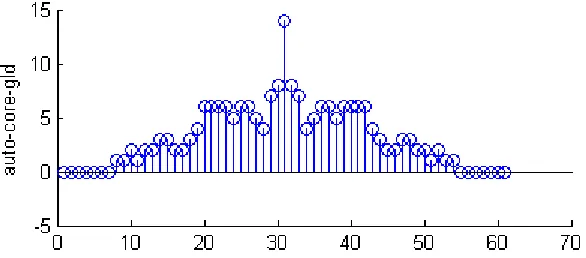
Figure 4 & 5 shows the comparison of autocorrelation function of m-sequence simulated values with measured values of autocorrelation function for different values of lag τ. These autocorrelation plots shows the number of agreements minus disagreements for the overall length of the two sequence (one is generated m-sequence and other is its time shifted sequence)
Figure 4 shows autocorrelation function when the polynomial is x5+x2+1.This figure shows that autocorrelation function increases or decreases linearly with the lag, so autocorrelation function is triangular. Figure 5 shows autocorrelation function when the polynomial is x6+x1+1. This figure shows that when the degree of polynomial increases autocorrelation function gives spike values.
Figure 4. Comparison of theoretical & simulation values of autocorrelation for N=5
Figure 5. Comparison of theoretical & simulation values of autocorrelation for N=6
Figure 6. Cross correlation of gold sequence with other gold sequences when no. of sequence is 5. IV. CONCLUSIONS AND FUTURE SCOPE
is simple and efficient, and has strong skills
REFERENCES
[1] Niu Yixia , Zhuang Ziqiang , Song Jijiang , Li Yueran , “Pseudorandom Sequence Correlation Simulation Based on MATLAB ’’,2011 IEEE International Conference on Computer Modeling and Simulation 2010 DOI 10.1109/ICCMS.2010.166 , 978-0-7695-3941- 6/10 ,pp 23-25.
[2] Niu DongWen, Zhang BaoHui, Liang Dong, Z.Q.Bo, A.Klimek, “Application of Spectrum-spread Technology in Power Line Communication ’’,
UPEC2010 31st Aug - 3rd Sept 2010 .
[3] Masaya Tanigawa ,Taka 0 Hara,Mamoru Fukui and Heiichi Yamamoto, “FAST ACQUISITION AND LOW CORRELATION
MULTI-COMPONENT CODE ’’, 0-7803-8523-3/04,2004 IEEE. , pp 2454-2457.
[4] Wei Wang, Chuncheng Wang and Yanling Hao , “A Hardware Design of Navigation ReceiverSignal Processing Platform ’’, IEEEInternational
Conference on Robotics and Biomimetics,Bangkok, Thailand, February 21 - 26, 2009,DOI 978-1-4244-2679-9/08,pp 2139-2143.
[5] James P. Stephens, Lt.Cd David M. Norman, “DIRECT SEQUENCE SPREAD SPECTRUM SYSTEM ’’, pp 462-466.
[6] Jian Ren, “Design of Long Period Pseudo-Random Sequences from the Addition of m-Sequences over Fp ’’, EURASIP Journal onWireless
Communications and Networking 2004:1, 2004 Hindawi Publishing Corporation ,pp 12-18.
[7] Li chuan & Li Chengshu, “Performance analysis of M-ary Spread Spectrum Data Transmission System Based on Phase Modulating a PN
Sequence”,DOI 0- 7803-2916- 3.pp 607-610
![Figure 2. M-Sequence Generator Structure [2]](https://thumb-us.123doks.com/thumbv2/123dok_us/1439964.1176383/2.595.64.508.373.605/figure-m-sequence-generator-structure.webp)