FACTORS AFFECTING THE PREPARATION OF THE CONSTRUCTION WORK PROGRAMME
MARDIANA BINTI MOHAMAD
A thesis submitted in fulfillment of the requirements for the award of the degree of Master of Science
(Construction Contract Management)
Faculty of Built Environment Universiti Teknologi Malaysia
iii
Dedicated to…
NUR AISHA ALIFA,
My beautiful daughter who has shared the many uncertainties, challenges and sacrifices and for her mama spending so much time away from her for working and completing on
iv
ACKNOWLEDGEMENT
In The Name of Allah, the Beneficent, the Merciful
v
ABSTRACT
vi
ABSTRAK
vii
TABLE OF CONTENTS
CHAPTER TITLE PAGE
DECLARATION ii
DEDICATION iii
ACKNOWLEDGEMENTS iv
ABSTRACT v
ABSTRAK vi
TABLE OF CONTENTS vii
LIST OF TABLES xi
LIST OF FIGURES xii
LIST OF ABBREVIATIONS xiii
LIST OF APPENDICES xiiv
LIST OF CASES xv
1 INTRODUCTION 1
1.1 1.2
Introduction
Background of Study
1 1
1.3 Research Problem 2
1.4 1.5 Research Question Objective 3 3
1.6 Scope and Limitation of The Study 4
1.7 1.8
Significance of Study Research Methodology
viii
2 WORK PROGRAMME IN CONSTRUCTION
CONTRACT 2.0 2.1 Introduction Definition 6 6
2.2 Proceeding Regularly and Diligently 7
2.3 2.4 2.5 2.6 2.7 2.8 2.9
Submission of Work Programme The Contribution of Work Programme Purpose of Having Work Programme Responsibilities of the Contracting Parties 2.6.1 Client
2.6.2 Contractor
Characteristic of Proper Work Programme 2.7.1 A Complete Schedule
2.7.2 A Full Term Schedule
2.7.3 Meets the Contractual Requirement/Milestones 2.7.4 Indicate How The Project is Suppose To Be construct
2.7.5 Activity Duration Are reasonable 2.7.6 Activity Relationship Are All Defined 2.7.7 The critical Path Makes Sense
2.7.8 It Considers Procurement and Material and Equipments Deliveries
2.7.9 It Is Resources Loaded
Factors to Be Taken in Preparation of Work Programme
Approaches for improvement in the Preparation for the Effective Work Programme
2.9.1 Explain the Project Plan
2.9.2 Defines Roles and Responsibilities 2.9.3 Hold A Kick Off Meeting
2.9.4 Develop a Scope Material 2.9.5 Develop Scope Baseline
2.9.6 Develop The Work Programme and Cost
ix 2.10 2.11 2.12 2.13 Baseline
2.9.7 Create Baseline Management Plans 2.9.8 Develop the Staffing Plan
2.9.9 Project Quality and Risks 2.9.10 Communication
Types of Work Programme 2.10.1 Gantt Chart
2.10.2 Critical Path Scheduling 2.10.3 Activity Logic
Problems With Work Programme
Requirements of Successful Construction Work Programme Conclusion 19 19 19 20 20 21 23 25 25 26 27
3 RESEARCH METHODOLOGY
3.0 3.1 3.2 3.3 3.4 3.5 3.6 3.7 Introduction Definition
Identifying the Problem Literature Review Data Collection Process 3.4.1 Pilot Survey
3.4.2 Structured Interview Data Analysis
3.5.1 Structured Interview Analysis Writing the Report
x
4 DATA ANALYSIS
4.0 4.1 4.2 4.3
Introduction
Background of The Respondent Analysis of the Interviewed Transcript Conclusion
36 37 38 54
5 CONCLUSION AND RECOMMENDATION
5.0 5.1 5.2 5.3 5.4 5.5 Introduction Conclusion Research Constraint’s Recommendation
Suggestion for Future Research Conclusion 56 56 58 58 59 60 REFERENCES 61
xi
LIST OF TABLES
TABLE NO. TITLE PAGE
4.1 Factors Affecting the Preparation of 49 The Construction Work Programme
4.2 Approaches for the Improvement in 53
xii
LIST OF FIGURES
FIGURE NO. TITLE PAGE
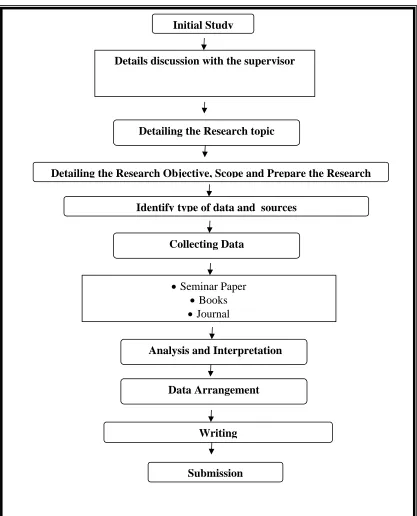
1.1 Flowchart of the Research Study 5
2.1 A Simple Gantt Chart 21
2.2 Part of A More Advance Gantt Chart 22
xiii
LIST OF ABBREVIATIONS
C.A - Contract Administrator EOT - Extension of time CPM - Critical Path Method
xiv
LI ST O F APP PE NDICE S
APPENDIX TITLE
A Pilot Survey Questions
B Interview Questions
C Raw Sample of Interview Transcript
D Project Scheduling Guidelines,
JKR Malaysia
xv
L IST O F CASE S
Balfour Beatty Construction Ltd v The Mayor and Burgess of the London 2 Borough of Lambeth (2002)
The Royal Brompton Hospital NHS Trust v Frederick Alexander Hammond 2 and others (2002)
1
CHAPTER 1
INTRODUCTION
1.1 Introduction
This chapter will discuss on the background of the study. The problem statement for the study, the research question as well as the objective for the study will also be elaborated. The scope of the study, the significance of the study, research methodology and the structure of the study will be explained in this chapter.
1.2 Background of Study
As specified in the project specification, it s required that the contractor to provide a work programme showing the execution of the work. The contractor is in the responsibilities in coordinating. By this mean, work programme are required in the construction project (Kelley, 2013).
Time of completion is crucial aspect of construction contracts as their client has their own need as well to develop specific arrangement for the completion of the project on a specific date. In assisting the client to meet their project objective, work programme provision is included in most contracts. (Hinze, 2011).
2
management tool that allows the contractor to use resources efficiently and provides an advance notice of situations that may cause the project to be delayed, and the work programme can be an important tool for evaluation and proving delay claims (Kelley, 2013).
In Balfour Beatty Construction Ltd v The Mayor and Burgess of the London Borough of Lambeth (2002), the judgement includes that the contractor should provide a valid critical path for his entitlement of EOT
In The Royal Brompton Hospital NHS Trust v Frederick Alexander Hammond and others (2002), based on the judge statement, it is definitely that a critical path analysis is so much more required. It may be so plainly clear that the delays have affected the critical path which becomes tool as evidence for the contractor claiming for extension of time.
1.3 Research Problem
A study carried out by Yusuwan and Adnan (2013) revealed that poor factual evidence and flaws in claim such as presenting a good and proper work programme are the principal facts leading to delays in EOT claims.
Furthermore, the work programme prepared by the contractor is not detailed and not properly links to show the critical path. Due to this issue, when the contractor is supposedly entitles for the EOT, he may losses the entitlement just because the contractor do not properly presenting a good work programme that relates to the delay. (Othman, 2009).
3
Several problem associated with project scheduling are the inability to fully utilize the work programme, lack of understanding of programming technology and unable to see the importance of work programme. The absence of formal guideline also contributes to this matter in preparing the work programme. (Ibrahim et al, 2006)
Based on this statement, it is important to identify what is the factors that affect the preparation of good work programme and plus, by knowing these factors, some approaches can be determined as an improvement method and eventually it will become as a guideline in preparing a good work programme.
1.4 Research Question
This study was guided by the following question:
1. How a proper work programme will alleviate the current problem in construction claims by the contractor?
2. What is the element that contributes of good and proper work programme?
3. What are the approaches should be taken for the improvement in the preparation of good and better work programme?
1.5 Objective of The Study
The research is carried out to:
4
2. To determine the approaches taken as an improvement in preparing a good work programme.
1.6 Scope and limitation of the study
The scope of this study will be look into:
a. The available construction work programme.
b. Opinion of the construction project personnel on the affecting factors in preparing a good work programme in the locality of Kuching, Sarawak.
1.7 Significance of the study
The main sources of construction project claim are delays as well as dispute over EOT and the cost which related to it. This is due to the contractor did not properly update the work programme as work progressed (Hauer, 2014).
A good and proper work programme is important because with the work programme can become a tool to prove the entitlement of construction claims such as EOT, payment and LAD. Furthermore, it is hopefully with these factors will helps to reduce the time consume in preparing a work programme itself and helping the contractors for a successful claims.
5
1.8 Research Methodology
To make sure that the objective of the study is achieved, figure 1.1 outlines the methodology of the study:
Figure 1. Flowchart of the research study Initial Study
Details discussion with the supervisor
Detailing the Research topic
Detailing the Research Objective, Scope and Prepare the Research
Identify type of data and sources
Collecting Data
Seminar Paper Books Journal
Analysis and Interpretation
Data Arrangement
Writing
61
REFERENCES
Anderson, Jonanthan. & Poole, Milicent. (2011). Assignments and Thesis Writing. John Wiley and Sons, Inc, pp. 27-29
Chua et al., 1999, D.K.H. Chua, Y.C. Kog, P.K. Loh Critical success factors for
different project objectives. Journal of Construction Engineering Management, 125 (3) (1999), pp. 142–150. Retrieve on 6.4.2016
Clark, Wallace. Polakov, Walter Nicholas & Trabold, Frank W. (2012) The Gantt Chart: A Working Tool Of Management. Nabu Press.
Creswell, John W. (2014) Research design: Qualitative, quantitative, and mixed
methods approaches. SAGE Publications. pp3-5
Devin, Kowalczyk. Purposes of Research: Exploratory, Descriptive & Explanatory
- Video ...http://study.com/academy/lesson/purposes-of-research-exploratory-descriptive-explanatory.html. Retrieve on 10.4.2016
Green, Hannah (2013). Top 10 tips for writing a dissertation methodology.(2013)
Retrieve on 11.4.2016 http://www.oxbridgeessays.com/blog/dissertation-methodology-tips/. Retrieved on 10.4.2016
Ghaleb J. Sweis. (2013) Factors Affecting Time Overruns in Public Construction Projects: The Case of Jordan. International Journal of Business and Management; Vol. 8, No. 23; 2013.
62
PROJECTS IN OMAN. Journal of Construction in Developing Countries, 2016 © Penerbit Universiti Sains Malaysia, 2016. Retrieve on 6.4.2016
Iyer, K. and Jha, K. (2006). Critical Factors Affecting Schedule Performance: Evidence from Indian Construction Projects Journal of Construction. Engineering Management. 871-881.
Harban Singh, K.S. (2004). Work Programme - A Contractual Perspective. Buletin Ingenieur Volume 21.
Heuer, Kelly M. & Zack, JR. James G. (2014). Construction Project Scheduling: Keys to Success. Practical Law Journal. Thomson Resuters
Hinze, Jimmy. (2011). Construction contract, Third Edition. McGraw Hill.pp. 214
Idris, Nor Jalilah. (2006). Effect of Work Programme in the Entitlement of EOT: Master Thesis
Johnson, Marc. (2012). What make a good schedule. http://warnercon.com/wp-content/uploads/2012/07/Article-3-What-Makes-a-Good-Schedule1.pdf
Retrieve on 1.4.2016
Kallet, RH. (2004) How to write the methods section of a research paper. - NCBI www.ncbi.nlm.nih.gov/... National Center for Biotechnology Information.
Retrieve on 11.4.2016
Kelley, Gail S. (2013). Construction law, an introduction for engineers, architects and contractors. John Wiley & Sons, Inc,pp. 127
Larson, Richard. (2012). 10 Steps To Creating a Project Plan. https://www.projecttimes.com, retrieved on 18.6.2016
63
Extension of Time. Conference on Avoiding & Resolving Disputes In Construction Contracts.
Lim Chong Fong (2011). The Malaysian PWD From of Construction Contract, first Supplement to the Second Edition. Sweet & Maxwell Asia.pp 31-32
Lim Chong Fong (2013). The Malaysian PWD From of Construction Contract, Second Edition. Sweet & Maxwell Asia.pp 16
Ling, Low, Wang & Lim. (2009) Key project management practices affecting
Singaporean firms’ project performance in China
International Journal of Project Management, Volume 27, Issue 1, January 2009, Pages 59-71. Retrieve on 1.4.2016
Mohamad Ibrahim Mohamad, Rosli Mohamad Zin and Donald Chan B. T. (2006). Guidelines for the Preparation and Submission of Work Schedule for
Construction Project. Faculty of Civil Engineering, UTM. Malaysian Journal of Civil Engineering, 20 (2). pp. 145-159.
Newell Michael W & Grashina Marina N. (2004). The Project Management Question and Answer Book. American Management Association. pp 85
Olawale, Y., and Sun M. (2010). “Cost and time control of construction projects: Inhibiting factors and mitigating measures in practice.”Construction
Management and Economics, 28 (5), 509 – 526. http://eprints.aston.ac.uk/15566/2/Cost_and_time_control_inhibiting_factors
_and_mitigating_measures.pdf. Retrieve on 8.4.2016
64
Powell, Geoff. (2012). Construction contract preparation and management from concept to completion. Palgrave Macmillan. pp 260
Rajoo, S. (1999).The Malaysian Standard Form of Building Contract (The PAM 1998 Form). Kuala Lumpur: Malayan Law Journal
Randolph, Justus J. (2009). A Guide to Writing the Dissertation Literature Review. Practical Assessment, Research & Evaluation. Volume 14, Number 13, June 2009 ISSN 1531-7714 Retrieved April 23, 2016 http://pareonline.net/pdf/v14n13.pdf.
Reynolds, Wayne D & Fisk, Edward R. (2006). Construction Project Administration, Fifth Edition. Prentice Hall. pp 333 & 334.
Rudner, Lawrence M. & William D. Schafer (1999). How to write a scholarly research report. Practical Assessment, Research & Evaluation, 6(13).
Retrieved May 23, 2016 http://pareonline.net/getvn.asp?v=6&n=13
Sundra Rajoo, Harbans Singh KS. (2012). Construction Law in Malaysia.Sweet & Maxwell Asia. pp. 252
Sundra Rajoo, (1999)The Malaysian standard Form of Building Contract, 2ndEdition. Lexis Law Pub. pp 81.
Van Teijlingen, Edwin R and Hundley , Vanora (2001) The importance of pilot studies. Retrived on 25 April 2016. http://sru.soc.surrey.ac.uk/SRU35.html
Wickwire Jon M., Jones Allen M., Wickwire Esq, Driscoll Thomas J., Hurlbut Stephen B. (2002). Construction Scheduling: Preparation, Liability, and Claims. 2nd .Edition. Aspen Publishers Online.