THE EFFECTIVENESS OF VARIOUS STRUCTURAL SYSTEMS IN REDUCING TALL BUILDING RESPONSE DUE TO WIND
ROSLIDA BT. ABD. SAMAT
A thesis submitted in fulfilment of the requirements for the award of the degree of
Doctor of Philosophy (Civil Engineering)
Faculty of Civil Engineering Universiti Teknologi Malaysia
ABSTRACT
ABSTRAK
TABLE OF CONTENTS
CHAPTER TITLE PAGE
DECLARATION ii
ABSTRACT iii
ABSTRAK iv
TABLE OF CONTENTS v
LIST OF TABLES viii
LIST OF FIGURES xii
LIST OF SYMBOLS xviii
LIST OF APPENDICES xxiv
1 INTRODUCTION 1
1.1 Introduction 1
1.2 Definition of Rigid and Flexible Building 2 1.3 Drift Index and Acceleration Limit for Structures 3
1.4 Problem Statement 7
1.5 Objective 8
1.6 Scope 8
1.7 Methodology 10
1.8 Overview of the Dissertation 11
2 BACKGROUND THEORY OF WIND ENGINEERING 12
2.1 Introduction 12
2.2 Wind Profile 13
2.3 Response of tall buildings 16
2.3.3 Torsional response of tall buildings 22
2.4 Gust Loading Factor 22
2.5 Full Scale Measurement 25
2.6 Wind Tunnel 27
2.7 Analysis of Tall Building in Resisting Wind Load 31
3 METHODOLOGY 35
3.1 Introduction 35
3.2 General procedure 35
3.3 Building Studied 38
3.4 Tall Building Systems Studied 40
3.5 Modeling of the Building 42
3.6 Output from GTSTRUDL 49
3.7 Wind Speed 51
3.8 Along Wind Response 55
3.9 Across Wind and Torsional Response 59 3.9.1 Validation of the Procedure 59 3.9.2 Calculation of the Across Wind and Torsional
Response 63
4 RESULTS AND DISCUSSION:
CORE WALL, OUTRIGGER AND BELT WALL SYSTEM 67
4.1 Introduction 67
4.2 Why some data are not available? 69
4.3 Core wall system 70
4.4 Outrigger system 79
4.4.1 One-story deep outriggers 79
4.4.2 Two-floor deep outriggers 91
4.4.3 The Effects of Outriggers to Torsional Response 101
4.5 Belt wall system 103
4.6 Tube-in-tube system 159
5 RESULTS AND DISCUSSION:
TUBE-IN-TUBE AND MEGACOLUMN SYSTEM 113
6.1 Introduction 113
6.2 Tube-in-tubesystem 114
6.3 Megacolumns 124
6 CONCLUSION 139
6.1 Introduction 139
6.2 Parameters atIssue 139
6.3 Conclusion 140
6.4 Efficiency of the Tall Building System 142 6.5 Further Study and Recommendation 144
REFERENCES 210
LIST OF TABLES
TABLE NO.
TITLE
PAGE
1.1
Serviceability problems at various deflection or drift
Indices 3
1.2 Human
perception
level
5
1.3
Acceleration limits for different perception level
5
2.1 Values
of
α
recommended in the reference
13
2.2
Roughness lengths and surface drag coefficients for various
types of terrain
15
3.1
Wide flange section used as spandrel beams
39
3.2
Size of columns of the building studied
39
3.3
Comparisons of the values of frequency of a core wall
structure modeled by various size of isoparmetric
quadratic solid elements
45
3.4
Difference of frequency and run-time for a framed
building with 12 m x 12m x 500 mm thickness core wall
having consistent mass and lumped mass definition
48
3.5
Eigenvectors of the selected joints
51
3.6
The conversions used to calculate one-hour averaging
time, 10-year return period wind speeds
54
3.7
Comparison of calculated peak and RMS along-wind
accelerations from international codes and standards with
3.8
Model cross section
60
4.1
Along-wind and across-wind responses for New York
wind environment when the outer dimension and thickness
of the core wall are altered
75
4.2
The change of moment inertia of the core wall for different
outer dimension and thickness of core wall
76
4.3
How the polar moment of inertia affects the natural
frequency in torsional direction and the torsional
acceleration of the building with core wall
78
4.4
The values of eigenvector in the across-wind direction
for a building with outriggers and 12m x 12m x 350mm
thickness core wall
85
4.5
The variation of modal mass,
M
*with different position of
outriggers of a building having an 18 x 18 size and 350
thickness of core wall
85
4.6
The variation of modal stiffness,
K
*with different position
of outriggers of a building having an 18 x 18 size and
350 thickness core wall
86
4.7
The values of displacement and stiffness for different
location of the altered section
87
4.8
The reduction of the along-wind displacement and
acceleration when the depth of outriggers at mid-height
of buiding is changed from one-story deep to two-story deep
97
4.9
The reduction of the across-wind displacements and
acceleration of the buildings when the depth of outriggers
at mid-height of buiding is changed from one-story deep
to
two-story
deep
98
4.10
The depth and moment of inertia of the two cantilever beams
studied
99
4.11
Comparison of the
K
or length to the fourth values that is
directly proportional to the torsional stiffness of the outriggers
and core wall
103
4.12
The reduction of the along-wind displacement and
acceleration of the buildings with outriggers and belt wall
compared to the values of the building with two-story
4.13
The reduction of the across-wind displacements and
acceleration of the buildings with outriggers and belt wall
compared to the values of the building with two-story
deep
outriggers
110
4.14
Comparison of the
K
or the length to the fourth values
of the core wall, outrigger and belt wall elements, and the
natural frequency in torsional mode of the building with
belt wall and no belt wall
112
5.1
Size of the exterior columns with different spacing of
the
exterior
columns
115
5.2
Reduction of the across-wind responses when the
spacing of the perimeter columns is reduced from 16 metres
to 6 metres
120
5.3
Total moment of inertia and cross sectional area of
the perimeter columns on each floor for different
spacing of the perimeter columns
121
5.4
Total moment of inertia that is contributed by the perimeter
columns for each floor level for different spacing of
the perimeter columns
123
5.5
Variation of along-wind displacement for buildings with
megacolumns, outrigger and belt wall
131
5.6
Variation of along-wind acceleration for buildings with
megacolumns, outrigger and belt wall
132
5.7
Variation of across-wind displacement for buildings
with megacolumns, outrigger and belt wall
132
5.8
Variation of across-wind acceleration for buildings with
megacolumns, outrigger and belt wall
133
5.9
Variation of torsional acceleration for buildings with
mega columns, outrigger and belt wall
135
5.10
Variation of natural frequency for buildings with
mega columns, outrigger and belt wall
138
6.1
The along-wind responses for different types of tall building
6.2
The across-wind responses for different types of tall building
system
143
LIST OF FIGURES
FIGURE NO. TITLE PAGE
1.1 Design standard on peak acceleration for 10-year return period 6 1.2 A flow chart showing the steps taken in the calculation of
the responses of the buildings due to wind 10 2.1 Ratio of probable maximum speed averaged over period t to
averaged over one hour 16
2.2 The random vibration (frequency domain) approach to
resonant dynamic response (Davnport, 1963) 17 3.1 The procedure in the analysis of buildings in this research 37
3.2 Typical plan view of the building studied 38
3.3 Typical floor for building with 24 m x 24 m core wall 40 3.4 Typical plan of core wall and mega column building studied 42 3.5 (a) Core wall system; (b) Outrigger and core wall
system; (c) Beltwall, outrigger and core wall system; (d) tube-in-tube system; (e) Mega column, outrigger and
core wall system. 43
3.6 Mode shape of the frequency considered in (a) isometric view
(b) y-z plane view. 45
3.7 (a) A cantilever beam with a point load, P at its tip; (b) Mode
Shape of the lowest frequency 46
3.8 Eigenvalue output provided by GTSTRUDL 49
3.9 Deformation shape of the structure in (a) mode 1 in isometric view; (b) mode 2 in y-z plane view (c) mode 3 in x-z plane
view 50
3.10 Sample output of the eigenvectors values from GTSTRUDL
3.11 The flowchart of the FOTRAN program to calculate the along-wind displacement and acceleration by using the
formulae provided in the ASCE7-02 57
3.12 Model building used for comparison of international standard 58
3.13 Balsa models tested 60
3.14 Comparison of torsional load spectra utilizing pneumatic
averaging and force balance techniques (Kareem, 1990) 62 3.15 The flowchart for the FOTRAN program written to calculate
the across-wind and torsional acceleration 65 3.16 The flowchart for the FOTRAN program written to calculate
The across-wind displacement 66
4.1 Deformation of building with (a) core wall; (b) outrigger; (c) belt wall and outrigger systems in the along-wind
across-wind and torsional mode. 68
4.2 Natural frequency for different thickness and outer dimension of a core wall in the (a) along-wind, (b) across-wind, (c) torsional
direction 71
4.3 Along-wind displacement that corresponds to different thickness and outer dimension of core wall for wind environment in (a) Malaysia, (b) New York, and (c) Hong Kong 72 4.4 Along-wind acceleration that corresponds to different thickness and outer dimension of core wall for wind environment in (a) Malaysia, (b) New York, and (c) Hong Kong 72 4.5 Across-wind displacement that corresponds to different thickness and outer dimension of core wall for wind environment in (a) Malaysia, (b) New York, and (c) Hong Kong 73 4.6 Across-wind acceleration that corresponds to different thickness and outer dimension of core wall for wind environment in (a) Malaysia, (b) New York, and (c) Hong Kong 74 4.7 Torsional acceleration that corresponds to different thickness and outer dimension of core wall for wind environment in (a) Malaysia, (b) New York, and (c) Hong Kong 74 4.8 The natural frequency in (a) along-wind, (b) across-wind and (c) torsional direction for different of position of 1-storey deep
outriggers 80
4.10 The along-wind acceleration for different of position of 1-storey deep outriggers that corresponds to the wind environment in (a) Malaysia (b) New York (d) Hong Kong 81 4.11 The across-wind displacement for different of position of 1-storey deep outriggers that corresponds to the wind environment in (a) Malaysia (b) New York (d) Hong Kong 82 4.12 The across-wind acceleration for different of position of
1-storey deep outriggers that corresponds to the wind environment in (a) Malaysia (b) New York (d) Hong Kong 83 4.13 The torsional acceleration for different of position of 1-storey deep outriggers that corresponds to the wind environment in (a) Malaysia (b) New York (d) Hong Kong 83 4.14 The properties of the beams for trial 1, 2, and 3. 87 4.15 M/EI diagram for the cantilever beam in Trial 2 when the
Altered section is located at (a) 25%; (b) 33%; (c) 50%; (d) 75% ;( e) 97.9% (f) M/EI diagram when there is no
altered section at all. 89
4.16 Comparison of the natural frequency between 1 storey deep outriggers with the one corresponds to the 2 storey deep
outriggers in the (a) along-wind, (b) across- wind and
(c) torsional direction 92
4.17 Comparison of the along-wind displacement between 1 storey deep outriggers with the one corresponds to the 2 storey deep outriggers in (a) Malaysia (b) New York
(d) Hong Kong wind environment 93
4.18 Comparison of the along-wind acceleration between 1 storey deep outriggers with the one corresponds to the 2 storey deep outriggers in (a) Malaysia (b) New York
(d) Hong Kong wind environment 94
4.19 Comparison of the across-wind displacement between 1 storey deep outriggers with the one corresponds to the 2 storey deep outriggers in (a) Malaysia (b) New York
(d) Hong Kong wind environment 95
4.20 Comparison of the across-wind acceleration between 1 storey deep outriggers with the one corresponds to the 2 storey deep outriggers in (a) Malaysia (b) New York
(d) Hong Kong wind environment 96
4.21 Comparison of the torsional acceleration between 1 storey Deep outriggers with the one corresponds to the 2 storey deep outriggers in (a) Malaysia (b) New York
4.22 M/EI diagram without the altered section for (a) Trial 1; (b) Trial 2. M/EI diagram when the altered section is at position 50% for the cantilever beam (c) in Trial 1 (d) in
Trial 2 100
4.23 View at the floor where outriggers are located 101 4.24 Comparison of the value of the natural frequency in the
along-wind, across-wind and torsional direction for a building with two-storey deep outriggers and a
building with both two-storey deep outriggers and belt walls 104 4.25 Comparison of the value of the along-wind displacement
for (a) Malaysia, (b) New York and, (c) Hong Kong wind environment for a building with two-storey deep outriggers and a building with both two-storey deep
outriggers and belt walls 105
4.26 Comparison of the value of the along-wind acceleration for (a) Malaysia, (b) New York and, (c) Hong Kong wind environment for a building with two-storey deep outriggers and a building with both two-storey deep
outriggers and belt walls 106
4.27 Comparison of the value of the across-wind displacement for (a) Malaysia, (b) New York and, (c) Hong Kong wind environment for a building with two-storey deep outriggers and a building with both two-storey deep
outriggers and belt walls 107
4.28 Comparison of the value of the across-wind acceleration for (a) Malaysia, (b) New York and, (c) Hong Kong wind environment for a building with two-storey deep outriggers and a building with both two-storey deep
outriggers and belt walls 108
4.29 Comparison of the value of the torsional displacement for (a) Malaysia, (b) New York and, (c) Hong Kong wind environment for a building with two-storey deep outriggers and a building with both two-storey deep
outriggers and belt walls 109
4.30 A view of a floor where the belt wall is located 111
5.1 Deformation of building with (a) tube-in-tube; (b) megacolumn systems in the along-wind, across-wind and torsional mode 114
5.2 The natural frequency in the (a) along-wind, (b) across-wind, (c) torsional direction for different
5.3 The along-wind displacement for different spacing of the perimeter columns for tube-in-tube system in
(a) Malaysia, (b) New York, (c) Hong Kong wind environment 116 5.4 The along-wind acceleration for different spacing of
the perimeter columns for tube-in-tube system in
(a) Malaysia, (b) New York, (c) Hong Kong wind environment 117
5.5 The across-wind displacement for different spacing of the perimeter columns for tube-in-tube system in
(a) Malaysia, (b) New York, (c) Hong Kong wind environment 117 5.6 The across-wind acceleration for different spacing of
the perimeter columns for tube-in-tube system in
(a) Malaysia, (b) New York, (c) Hong Kong wind environment 118 5.7 The torsional acceleration for different spacing of
the perimeter columns for tube-in-tube system in
(a) Malaysia, (b) New York, (c) Hong Kong wind environment 119 5.8 Percentage of the reduction of the along-wind
(a) displacement (b) acceleration for different spacing of the perimeter columns compared to the ones of the original
spacing of the perimeter columns 120
5.9 Natural frequencies in the along-wind, across-wind and torsional direction for different spacing of the perimeter columns when the total cross sectional
area is kept constant 122
5.10 The natural frequency in the (a) along-wind
(b) across-wind (c) torsional direction, for different combination of structural elements with the megacolumn
building 125
5.11 The along-wind displacement for different combination of structural elements with the megacolumn building in
(a) Malaysia, (b) New York (c) Hong Kong wind environment 126 5.12 The along-wind acceleration for different combination
of structural elements with the megacolumn building in
(a) Malaysia, (b) New York (c) Hong Kong wind environment 127 5.13 The across-wind displacement for different combination
of structural elements with the megacolumn building in
(a) Malaysia, (b) New York (c) Hong Kong wind environment 128 5.14 The across-wind acceleration for different combination
of structural elements with the megacolumn building in
(a) Malaysia, (b) New York (c) Hong Kong wind environment 129 5.15 The torsional acceleration for different combination
of structural elements with the megacolumn building in
5.16 Plan view of the mega columns and perimeter frame of the
LIST OF SYMBOLS
A
-
projected area of the structure loaded by the wind
a
-
length of the side of the square section
B,b -
horizontal dimension of building measured normal to wind
direction
C -
coefficient of viscous damping
c
-
damping matrix,
c
c -critical damping
C
D-
drag coefficient
f
C
-
mean along-wind force coefficient;
*
i
c
-
generalized damping in the
i
-th mode of vibration.
C
M -non-dimensional moment coefficient
d -
height of zero-plane above the ground where the velocity is zero
D
-
dynamic
matrix
E
-
modulus of elasticity
E
-
the load effect due to mean wind.
e
i-
error for each mode shape
i
f
-
cyclic frequency
( )
t
f
D-
the mean parts of the drag force
f
~
-
flexibility matrix
i
f
-
mean generalized force
( )
t
f
D′
-
the fluctuating parts of the drag force
G
f-
gust factor
G
r-
gradient velocity
τ
G
-
gust factor
τ q
G
-
gust factor (GF) for wind velocity pressure.
vz
G
-
gust velocity factor
T Y
G
-
GLF for displacement
g, g
D-
peak factor
g
B-
background peak factor
R
g
-
resonant peak factor
g
v-
peak factor for upwind velocity fluctuations
H
,
h
-
average height of structure
H
(
n
)
-
frequency response function
( )
2 1 fH
-
structural transfer function of the first mode
I
-
moment of inertia
I -
N
x
N
identity matrix and
I
h-
turbulence intensity
I
(
z
)
-
mass moment of inertia per unit height
I
H -turbulent intensity evaluated at the top of the building;
K
-
length to the power of fourth
K
,
[ ]
K
,
k
-
stiffness matrix of the structure
K -
surface drag coefficient
*
i
k
-
generalized stiffness in the
i
-th mode of vibration
k
T -torsional stiffness
L
-
horizontal dimension of a building measured parallel to the wind
direction
x u
L
,
yu
L
,
zu
L
-
integral scale
B
Mˆ
-
background base moment and base torque
R
Mˆ
-
resonant
base moment or base torque response
M
-
expected mean of the moment or torque response
'
M
-
reference moment or torque
Mˆ
-
expected extreme value of the moment or torque response
*
i
1
m
-
modal mass
m
-
mass matrix,
m
eff-
effective mass,
m
-
mass per unit length along the beam
0
n
,
n
c-
natural frequency of the structure in the across-wind direction
i
n
-
frequency in the
i
-th mode
P
-
load
( )
zPˆB -
equivalent static wind load for the background part
( )
z RPˆ
-
resonant component of the equivalent static wind loading
*
ˆ
P
-
generalized force
* 1
P
-
generalized load of the first mode;
τ
P
-
mean wind force with averaging time
τ
.
( )
zPˆT
-
peak ESWL at height
z
during observation time
T
*
i
p
-
generalized force in the
i
-th mode of vibration.
p
-
load matrix.
Q
-
non-dimensional quantities representing the normalized mean
background responses
q
1-
deflected shape
q
(
z
)
-
mean wind velocity pressure
q
i-
the
i
-th normal coordinate
.
z
q
ˆ
-
peak dynamic pressure,
R
-
resonant response factor
rˆ
-
resultant wind-induced response of interest
r
,
r
ˆ ,
Br
ˆ
R-
mean, peak beackground, and peak resonant response components
S
-
Strouhal number
S
M(
f
)
-
power spectral density of force-balance-measured fluctuating base
bending moment
*
i
p
S
-
spectral density of the generalized force
S
P(z
1,z
2;f)
-
cross spectral density of the aerodynamic load per unit height at
z
1,
z
2and frequency
f
,
qi
S
-
power spectrum of the response
S
u-
spectrum or spectral density of velocity
S
u1u2-
cross spectrum of velocity
( )
f
S
v*-
normalized wind velocity spectrum with respect to the
mean-square fluctuating wind velocity,
T
-
observation time
T
0 -average time
T
max-
maximum kinetic energy
t
-
time
U
(
z
)
-
mean wind speed at
z
height
U
H-
wind speed at the building height in the urban terrain
U
max -maximum potential energy,
U
t-
wind speed averaged over
t
seconds
U
-
mean wind speed at height
z
above the ground
crit
U
-
critical wind speed
u, v, w
-
fluctuating components of the gust in
x, y, z
*
u
-
shear velocity or friction velocity
V
des-
maximum site wind speed multiplied by the importance factor
V
n-
reduced velocity
z
ref
V
ˆ
-
3 s gust in exposure C at reference height
z
Vˆ
-
peak wind velocity at height
z
W
E-
virtual work of the external force
W
i-
virtual work of the internal force
I
W
δ
-
virtual work of the inertial forces per unit of length
X
max-
maximum along-wind displacement
max
X&&
-
maximum along-wind acceleration
x
-
mean displacement
x&&
-
mean acceleration
( )
z
Y
-
the mean deflection
( )
zYˆ&& -
peak along wind or across wind acceleration in the sway mode
Y -
deflection
( )
x
y
&&
2-
accelerations would be developed along its length
( )
z
y
ˆ
-
maximum fluctuating deflection in the direction of the mean wind
Z
-
amplitude
( )1
ˆ
Z
-
first-cycle generalized-coordinate mode shapes and
Z -
height above the surface,
ref
z
-
reference height normally taken to be 10 m
z
0-
roughness length,
z
-
reference height;
α
-
power law exponent
β
-
mode shape exponent.
βι
-
normalizing factor for iteration
i
( )
n
χ
-
aerodynamic admittance function
ε
−
error for all modes,.
Φˆ
-
complete set of
N
normalized mode shapes
Φ
−
N
modes of vibration matrix
φ
-
eigenvector matrix.
Λ , λ
-
diagonal matrix of the eigenvalues
θ
-
phase angle
ρ
-
air density
i
Bq
σ
-
non-resonating root mean square response of the
i
-th normal
coordinate
i
Dq
σ
-
resonating root mean square response of the
i
-th normal coordinate
M
σ
-
root mean square (RMS) of the fluctuating base moment or base
torque response
( )
z
x&&
σ
-
rms along-wind acceleration
( )
z yσ
-
root mean square value of the fluctuating deflection
τ
-
averaging time used to evaluate the mean wind velocity
2 1
Ω
-
first-cycle generalized-coordinate mode frequencies
ω
-
natural frequency of vibration.
ω
d-
damped natural frequency
2
i
ω
-
eigenvalues
ξ
−
damping ratio
v
-
mean up-crossing rate
ψ
-
shapes of amplitude
ξ
-
mode exponent;
i
LIST OF APPENDICES
APPENDIX TITLE PAGE
A Numerical results for model 1: core wall system 154 B Numerical results for model 2: single floor deep
deep outrigger system 158
C Numerical results for model 2: two floor deep
outrigger system 164
D Numerical results for model 3: belt wall system 167 E Numerical results for model 4: tube-in-tube system 169 F Numerical results for model 5: megacolumn system 176
G Formulas for torsional deformation 179
H An Example from the aerodynamic website to calculate
CHAPTER 1
INTRODUCTION
1.1 Introduction
New structural systems including the composite one have allowed concrete high rises to reach new heights during the last four decades. There are a wide range of structural systems available for tall concrete buildings such as shear walls, core supported structures, tube in tube and bundled tubes.
During the design process, engineers must ensure the system is not only capable of resisting all loads, but also efficient, economic and satisfy the basic serviceability requirements. The design of tall building system is primarily dominated by the effects of wind. A tall flexible structure which is subjected to lateral or torsional deflections under the action of fluctuating wind loads may have oscillatory movements that can induce a wide range of responses in the building’s occupants, ranging from mild discomfort to acute nausea. In fact, large displacements of these structures can cause improper drainage and damage of the windows and finishes of the building. Hence, the motions of the building that produce effects which is intolerable by the occupants may result in an otherwise acceptable structure becoming an undesirable or even unrentable building.
to use these data, dynamic analysis is required to allow the predicted response of the building to be compared with the threshold limits.
1.2 Definition of Rigid and Flexible Building
A rigid structure is a structure which has the first few natural frequencies relatively high. The structure will tend to follow any fluctuating wind forces without appreciable amplification or attenuation. The dynamic deflections will not be significant, and the main design parameter to be considered is the maximum loading to which the structure will be subjected during its lifetime. Such a structure is termed “static” and it may be analyzed under the action of static equivalent wind forces (Stafford and Coull, 1991).
In contrast, a flexible structure has the first few natural frequencies relatively low. If the frequencies of the fluctuating wind are below the first natural frequency, the structure will tend to follow closely the fluctuating force actions. The dynamic response will be attenuated at frequencies above the natural frequency, but will be amplified at frequencies at or near the natural frequency. Consequently the dynamic deflections may be appreciably greater than the static values. The lateral deflection of the structure then becomes an important design parameter, and the structure is classified as “dynamic.” Such structures require not only the dynamic stresses but also the acceleration induced by wind load to be determined during the design process (Stafford and Coull, 1991).
1.3 Drift Index and Acceleration Limit for Structures
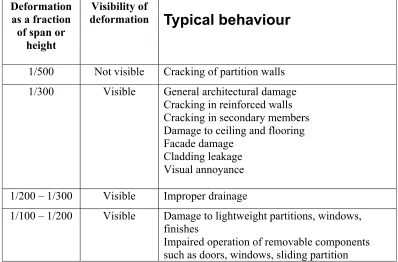
Drift index is defined as the ratio of the maximum deflection at the top of the building to the total height. In addition, the corresponding value for a single story height, the inter-story drift index, gives a measure of possible localized excessive deformation. Balendra (1993) describes the effects of excessive deflection on building component in Table 1.1.
Table 1.1: Serviceability problems at various deflection or drift indices (Balendra, 1993)
Deformation as a fraction of span or
height
Visibility of
deformation
Typical behaviour
1/500 Not visible Cracking of partition walls 1/300 Visible General architectural damage
Cracking in reinforced walls Cracking in secondary members Damage to ceiling and flooring Facade damage
Cladding leakage Visual annoyance 1/200 – 1/300 Visible Improper drainage
1/100 – 1/200 Visible Damage to lightweight partitions, windows, finishes
Impaired operation of removable components such as doors, windows, sliding partition
The National Building Code of Canada (1990) limits the drift to 1/500 of the height in order to limit the cracking of the masonary and interior finishes unless detailed analysis is made and precautions are taken to permit larger movements. Malaysian code (MS 1553:2002) also limits the total drift of wind force resisting system to 1/500 of the height, and the inter-story drift to 1/750 of the height.
Furthermore, Clause B.1 .2 in the ASCE7-02 requires the lateral deflection or drift of structures and deformation of horizontal diaphragms and bracing systems due to wind effects not to impair the serviceability of the structure. However, Clause CB.1.2 in the ASCE7-02 states that the drift limits in common usage for building design are on the order of 1/600 to 1/400 of the building or story height (ASCE Task Committee on Drift Control, 1988). These limits generally are sufficient to minimize damage to cladding and nonstructural walls and partitions. Smaller drift limits may be appropriate if the cladding is brittle. Clause CB.1.2 in the ASCE7-02 also indicates that an absolute limit on inter-story drift may also need to be imposed in light of evidence that damage to nonstructural partitions, cladding and glazing may occur if the inter-story drift exceeds about 10 mm (3/8 in) unless special detailing practices are made to tolerate movement (Freeman 1977; Cooney and King 1988). However, many components can accept deformations that are significantly larger.
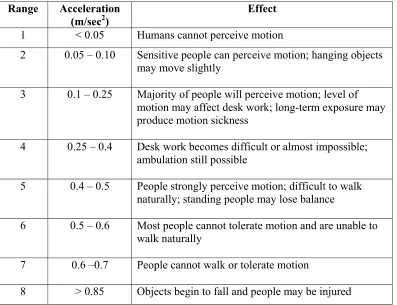
Table 1.2: Human perception level (Yamada and Goto,1975) Range Acceleration
(m/sec2)
Effect
1 < 0.05 Humans cannot perceive motion
2 0.05 – 0.10 Sensitive people can perceive motion; hanging objects may move slightly
3 0.1 – 0.25 Majority of people will perceive motion; level of motion may affect desk work; long-term exposure may produce motion sickness
4 0.25 – 0.4 Desk work becomes difficult or almost impossible; ambulation still possible
5 0.4 – 0.5 People strongly perceive motion; difficult to walk naturally; standing people may lose balance
6 0.5 – 0.6 Most people cannot tolerate motion and are unable to walk naturally
7 0.6 –0.7 People cannot walk or tolerate motion
8 > 0.85 Objects begin to fall and people may be injured
Table 1.3: Acceleration limits for different perception level (Balendra, 1993)
Perception Acceleration Limit
Imperceptible a < 0.005g
Perceptible 0.005g < a < 0.015g
Annoying 0.015g < a < 0.05g
Very annoying 0.05g < a < 0.15g
Intolerable a > 0.15g
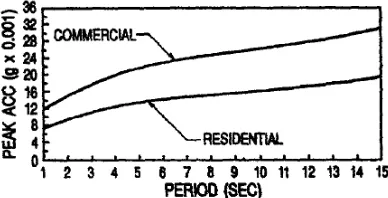
Since the tolerable acceleration levels increase with period of building, the recommended design standard for peak acceleration for 10-year wind in commercial and residential buildings is as depicted in Figure 1.1 (Griffis,1993). Lower acceleration levels are used for residential buildings for the following reasons:
1. Residential buildings are occupied for longer hours of the day and night and are therefore more likely to experience the design wind storm
2. People are less sensitive to motion when they are occupied with their work than when they relax at home.
Figure 1.1: Design standard on peak acceleration for 10-year return period (after, Griffis, 1993)
The National Building Code of Canada (1990) recommends the acceleration limit to be 1-3% of gravity (0.09 to 0.27 m/sec2) once in every 10 years, the two figures being more appropriate for apartment and office blocks respectively. Malaysian wind code , MS 1553:2002 requires the acceleration of a building due to wind-induced motion not exceed 1.0% of gravity for residential structures and 1.5% of gravity for other structures, of the acceleration due to gravity.
people engaged in quiet activities, whereas those engaged in physical activities or spectator events may tolerate steady-state acceleration in the order of 0.02g to 0.05g. Thresholds of annoyance for transient vibrations (lasting only a few seconds ) are considerable higher and depend on the amount of structural damping present (Murray, 1991). A typical finished floor will have 5% damping or more and peak transient accelerations of 0.05 g to 0.1 g may be tolerated.
1.4 Problem Statement
Despite the importance of analyzing the building responses (displacement and acceleration) as explained in Section 1.3, there are no systematic study that has been conducted on the effectiveness of the different tall building systems in
minimizing the responses of the building due to wind. There are several tall building systems available such as outriggers, belt wall, tube-in-tube, core wall and mega columns. However, no study has been performed to determine on how effective these tall building systems are in reducing the displacements and accelerations of tall buildings that are being exerted by wind forces. It is not known which tall building system is the most effective system to reduce the responses of the buildings due to wind.
1.5 Objective
The objective of this research is to study the effectiveness of five tall building structural systems: core wall, outrigger, belt wall, tube-in-tube and mega column in minimizing the building response (displacement and acceleration) to wind. There are different objectives to be accomplished for each different tall building structural studied. The objective of studying :
• the core wall is to determine whether increasing the thickness or increasing the dimensions of the core wall is more effective in reducing the responses of the building due to wind;
• the outrigger is to determine the best location to construct the outrigger so that the responses of the building due to wind can be minimized;
• the belt wall is to study the effectiveness of the belt wall in reducing the responses of the building due to wind compared to the outrigger system;
• the tube-in-tube system is to find the optimal spacing of the perimeter columns in minimizing the responses of the building due to wind;
• the megacolumn system is to study the effectiveness of this system and combination of megacolumn and other structural elements such as outriggers and belt wall in reducing the responses of the building due to wind.
Another objective of this research is to determine which tall building system among the five systems: core wall, outriggers, belt wall, tube-in-tube and mega columns studied that is the most effective system in minimizing the responses of the building due to wind.
1.6 Scope
aerodynamic data base. It is impossible to obtain the values of the across-wind and torsional responses for buildings if the ratio of height to the lateral dimension of the building is more than 1:6 as experimental data for these buildings are not available. Note that currently, no formula is available in calculating the across-wind responses and torsional responses. The formulae that are available such as from the Australian Code (AS 1170.80), Japanese code (RLB-AIJ-1993), Canadian code (NBC-1995), the aerodynamic data base of University of Notre Dame, United States of America and other literatures are empirical formulae that are based on experimental data(Simiu and Scanlan, 1996).
The lateral system of the tall building is reinforced concrete. Five types of tall building systems will be analyzed are:
• Core wall
• Outrigger
• Outrigger with belt wall
• Tube-in-tube
• Megacolumn
The manipulated variables for each system are presented in detail in Chapter 3.
The building will be exerted by wind loading for three different wind environments which are:
• Malaysia (benign wind environment)
• New York (aggressive wind environment)
• Hong Kong (one of the most aggressive wind environment in the world)
1.7 Methodology
The methodology of this project is as shown in the flowchart in Figure 1.2, and is described in detail in Chapter 3.
Figure 1.2: A flow chart showing the steps taken in the calculation of responses of the buildings due to wind.
Obtain the value of CMand σCMfrom the aerodynamic database
Calculate the along-wind responses by using the FOTRAN program written based on the method in ASCE7-02. Three wind speeds which correspond to Malaysian, New York and Hong Kong wind environment are used.
Extract the eigenvectors needed. The eigenvectors are the displacements in the across-wind direction of the joints located nearest to the longitudinal axis of the building.
Model the building by using the structural finite element software, GTSTRUDL
Analyse the building model to obtain the eigenvalues and eigenvectors in the along-wind, across-wind and torsional mode by using GTSTRUDL .
Calculate the value of fB/U where f = frequency in the across-wind or torsional mode,
B = breadth of building, U = wind speed.
Note that fB/U is calculated for the three wind speeds which correspond to Malaysian, New York and Hong Kong wind environment.
Calculate the across-wind and torsion acceleration by using the FOTRAN program written based on formula provided in the
aerodynamic database of University of Notre Dame, U.S. A.
Calculate across-wind displacement.
Choose the dimension of the structural elements, such as the size and thickness of core wall.
1.8 Overview of the Thesis
Chapter 2 is a literature review. It will discuss about the development of the research of the effects of wind to tall building. It also explains briefly about the important subjects in wind engineering such as averaging wind speed, wind profile, along-wind, across-wind and torsional response of tall buildings.
Chapter 3 will describe about the methodology used in the research in depth. Not only will it discuss on how the building is modeled in order to obtain the natural frequency and eigenvector, but it will also discuss about the problems in performing eigenvalue analysis by using the finite element methods. This chapter will also describe the procedure to determine the along-wind responses in ASCE 7-02 and across-wind and torsional responses in the University of Notre Dame aerodynamic database.
Chapter 4 will present the results obtained from the study for three tall building systems: core wall, outriggers and belt wall systems. These results are discussed in detail in this chapter.
Chapter 5 will provide results from the study for the other two building systems: tube-in-tube and megacolumns. The results are also discussed in depth in this chapter.
REFERENCE
American National Standards Institute (1982). Minimum Design Loads for Buildings and
Other Structures, New York ,American National Standard A58.1-1982
American National Standards Institute (ANSI). (1983). American National Standard Guide
to the Evaluation of Human Exposure to Vibration in Buildings. ANSI S3.29-1983,
New York.
American Society of Civil Engineers (2002). Minimum Design Loads for Buildings and
Other Structures, New York,ASCE 7-02
ASCE Task Committee on Drift Control of Steel Building Structures. (1988). Wind Drift
Design of Steel-framed Buildings: State of the Art. J. Struct. Div., ASCE
114(9):2085-2108.
Associate Committee on the National Building Code and National Research Council of
Canada. Canadian Structural Design Manual, Supplement. Ottawa, No. 4. 1975
Bailey, A., Vincent, N.D.G. (1943). Wind Pressures on Buildings Including Effects of Adjacent Buildings. Journal of Civil Engineering, 20(8):243-275.
Baker, W.F., Brown, C.D., Sinn, R.C. (1998). Belt Wall / Core Interacting System for
77-Story Plaza Rakyat Tower. Structural Engineering World Wide. T114-3.
Balendra, T. (1993). Vibration of Buildings to Wind and Earthquake Loads,
Springer-Verlag.
Bathe, K.J. (1996). Finite Element Procedures in Engineering Analysis. New Jersey:
Prentice-Hall.
Boggs, D.W. (1989). Aerodynamic Model Tests of Tall Buildings. Journal of Engineering
Mechanics, 115(3):618-635.
Boggs,D.W., Peterka,J.A., (1989). Aerodynamic Model Tests of Tall Buildings. Journal
of Engineering Mechanics ASCE 115:618-635.
Breuer, P., Chmielewski, T., Gorski,P., Konopka, E. (2002). Application of GPS Technology to Measurements of Displacements of High-rise Structures Due to Weak
Winds. Journal of Wind Engineering and Industrial Aerodynamics. 90:223-230
Brown M.W.J., Ang, C.K. (1998). Full-scale Dynamic Response of High-rise Building to Lateral Loading. Journal of Performance of Constructed Facilities. 12(1):33-40.
Buchholdt, H.A. (1997). Structural Dynamics for Engineers, London: Thomas Telford
Publications.
Campbell, S., Kwok, K.C.S., Hitchcock, P.A. (2005). Dynamic Characteristics and
Wind-Induced Response of Two High-rise Residential Building During Typhoons. Journal
Cermak, J.E. (1952). Application of Modeling Techniques to Mass Transfer and
Evaporation Studies, Paper Presentation, Centennial of Engineering, Chicago, IL:15 pp.
Cermak, J.E. (2003). Wind-tunnel Development and Trends in Application to Civil
Engineering, Journal of Wind Engineering and Industrial Aerodynamics 91:355-370
Chan, C.M. (2001). Optimal Lateral Stiffness Design of Tall Buildings of Mixed Steel and Concrete Construction. The Structural Design of Tall Buildings. 10:155-177.
Chen, X. and Kareem, A. (2005). Validity of Wind Load Distribution based on High
Frequency Force Balance Meaurements. Journal of Structural Engineers. 131(6):984-987
Chen, X., Kareem, A. (2004). Equivalent Static Wind Loads on Buildings: New
Model. Journal of Structural Engineering. 130(10):1425-1435.
Chen,X., Kareem, A. (2005). Coupled Dynamic Analysis and Equivalent Static Wind
Loads on Buildings with Three-Dimensional Modes. Journal of Structural Engineering.
131(7):1071-1082.
Cochran,L.S., Peterka,J.A., (2001). On Breached Building Envelopes and Increased
Internal Pressure. Proceedings of the International Conference on Building Envelopes
Systems and Technologies. 2001. Ottawa,Canada:83-87
Cook, R.D. (1995). Finite Element Modeling for Stress Analysis. Canada: John Wiley
& Sons.
Cooney, R.C. and King, A.B. (1988). Serviceability Criteria for Buildings. BRANZ
Report SR14, Building Research Association of NewZealand, Porirua, New Zealand
Coyle, D.C. (1931). Measuring the Behaviour of Tall Buildings. Engineering
News-Record. :310-313
Csanady, G.T. (1967). On the Resistance Law of a Turbulent Ekman Layer. J. Atmos.
Sci., 24:467-471
Davenport, A.G. (1961). The Application of Statistical Concepts to the Wind Loading of Structures. Proc. Inst. Civil Eng., 19:449-472
Davenport, A.G. (1963). The buffeting of structures by gusts. Proceedings,
International conference on Wind Effects on Buildings and Structures, Teddington U.K. 26-8 June: 3526-8-91
Davenport, A.G. (1965). The Relationship of Wind Structure to Wind Loadingl
Proceedings of the Symposium on Wind Effects on Buildings and Structures, National Physical Laboratory. Teddington, U.K. : Her Majesty’s Stationery Office. London, 53 – 102
Davenport, A.G. (1967). Gust Loading Factors. J. Struct. Div., ASCE . 93:11-34
Davenport, A.G. (1968). The Dependence of Wind Load upon Meteorological Parameters. Proc. Intl. Res. Sem. Wind Effects on Buildings and Structures, Toronto: University of Toronto Press, 19-82
Department of Standards Malaysia. (2002). Code of Practice on Wind Loading for
Building Structure. Shah Alam, MS 1553:2002.
Dryden, H.L. and Hill, G.C. (1933). Wind Pressure on a Model of the Empire State
Building. Journal of Research of the National Bureau of Standards. 10:493-523
Durst, C.S. (1960). Wind Speeds Over Shor Periods of Time. Meteorol. Mag.
89:181-186
ESDU. (1976). The Response of Flexible Structures to Atmospheric Turbulence.
London. Item 76001, Engineering Sciences Data Unit.
Freeman, S. (1977). Racking Tests of High Rise Building Partitions. J. Struct. Div.,
ASCE 103(8):1673-1685.
Greig, G.L. (1980). Toward an Estimate of Wind-Induced Dynamic Torque on
TallBuildings. University of Western Ontario: Master’s Thesis
Griffis, L.G. (1993). Serviceability Limit States Under Wind Load. Eng. J., AISC:1-16.
Gu, M., Quan, Y. (2004). Across-Wind Loads of Typical Tall Buildings. Journal of
Wind Engineering and Industrial Aerodynamics. 92:1147-1165.
Hart, G.C., DiJulio, R.M., Lew,M. (1975). Torsional Response of High Rise Buildings.
J. Struct. Div., ASCE, 101:397-416
Hellman, G. (1916). Über die Bewegung der Luft in den untersten Schichten der Atmosphäre, Meteoroll Z., 34:273
Ho,T.C.E., Lythe,G.R.,Isyumov,N., (1999). Structural Loads from the Integration of
Simultaneously Measured Pressures. Proceedings of the International Conference on Wind
Engineering. 1999. Copenhagen, Denmark.
Hoenderkamp, J.C.D. (2002b). Simplified Analysis of Asymmetric high-rise Structures with Cores. The Structural Design of Tall Buildings. 11:93-107
Holmes, J.D. (2001). Wind Loading of Structures. London: Spon Press.
Irwin, A.W. (1986). Motion in Tall Buildings. Proc. Conf. On Tall Buildlings. Second Century of the Skyscraper, Chicago: 759-778
Isyumov, N. and Poole, M. (1984). Wind-Induced Torque on Square and Rectangular
Building Shapes, Proceedings Sixth International Conference on Wind Engineering,
Amsterdam: Elsevier.
Jain, A., Srinivasan, M. and Hart, G.C. (2001). Performance Based Design Extreme Wind Loads on a Tall Building. The Structural Design of Tall Buildings. 10:9-26.
Jensen, M. (1958). The Model-law for Phenomena in Natural Wind, IngeniNren,
2(4):121-128.
Kaimal, J.C. et al. (1972). Spectral Characteristics of Surface-Layer Turbulence. J. Royal Meteorol. Soc., 98:563-589
Kareem, A. (1985). Lateral-Torsional Motion of Tall Buildings to Wind Loads.
Journal of Structural Engineering. 111(11):2479-2496.
Kareem, A. (1990). Measurements of Pressure and Force Fields on Building Models in
Simulated Atmospheric Flows. Journal of Wind Engineering and Industrial Aerodynamics.
36:589-599.
Kareem, A. (1985). Lateral –torsional Motion of Tall Buildings. Journal of Structural
Engineering. 111(11):2479-2496.
Kareem, A. (1989). Mapping and Synthesis of Random Pressure Fields. Journal of
Engineering Mechanics, ASCE 115(10).
Kareem, A. and Kijewski, T. (2002). Time-frequency Analysis of Wind Effects on
Structures. Journal of Wind Engineering and Industrial Aerodynamics. 90:1435-1452
Kareem, A., Kijewski, T. and Tamura, Y., (1999). Mitigation of Motions of Tall Buildings with Specific Examples of Recent Applications. Wind & Structures. 2(3):201-251.
Kareem,A., and Cheng, C.M. (1984). Acrosswind Response of Towers and Stacks of
Circular Cross-section. Rep. No. UHCE 84-5, Dept. of Civil Engineering, Univ. of
Kijewski,T., Haan, F., Kareem, A. (2001). Wind-Induced Vibrations. In: Braun, S.G.,
Ewins, D.J. and Rao, S.S. Encyclopedia of Vibration. Academic, New York, 1578-1587
Kijewski,T., Kareem,A. (1998). Dynamic Wind Effects: A Comparative Study of
Provisions in Codes and Standards with Wind Tunnel Data. Wind and Structure.
1(1):77-109
Kwok, K.C.S. and Melbourne, W.H. (1988). Dynamic Analysis of Wind Sensitive
Buildings and Structures to Wind Action- a Codified Approach. Prod. 4th Int. Conf. on Tall
Buildings, Hong Kong and Shanghai, April/May, 1988. Vol.1:424-430.
Lanczos, C. (1950). An Iteration Method for the Solution of the Eigenvalue Problem of
Linear Differential and Integral operators. Journal of Research of the National Bureau of
Standards. 45:255-282.
Leger, P. (1986). Numerical Techniques for the Dynamic Analysis of Large Structural
Systems, University of California, Berkeley: Ph. D. Dissertation.
Li,Q.S., Fang,J.Q., Jeary,C.K., Wong,C.K. (1998). Full Scale Measurements of Wind
Effects on Tall Buildings. Journal of Wind Engineering and Industrial Aerodynamics.
74-76:741-750.
Liepmann, H.W. (1952). On the Application of Statistical Concepts to the Buffeting
Problem. Journal of Aeronautical Science. 19(12):793-800,822.
Lin, N., Letchford, C., Tamura, Y., Liang, B., Nakamura, O. (2005). Characteristics of
Wind Forces Acting on Tall Buildings. Journal of Wind Engineering and Industrial
Aerodynamics. 93:217-242.
Millikan, C.B. (1938). A Critical Deiscussion of the Turbulent Flows in Channels and
Circular Tubes. Proceeding of the Fifth International Congress of Aplied Mechanics,
Cambridge, MA.
Murray, T. (1991). Building floor vibrations. Engrg. J., AISC 28(3):102-109
National Research Council of Canada(1990). National Building Code of Canada.
Ottawa, Canada.
Oosterhout,G.P.C. (1996). The Wind-induced Dyanmic Response of Tall Buildings, a
Comparative Study. Journal of Wind Engineering and Industrial Aerodynamics.
64:135-144.
Peterka, J.A., Cochran, L.S., Boggs, D.W., Hosoya, N., Downing, M. (1994).
International Conference on Building Envelope Systems and Technology. 1994. Singapore: 354-359.
Rathbun, J.C. (1940). Wind Forces on a Tall Building. Transactions, American
Society of Civil Engineers. 105: 1- 41
Reinhold, T.A. and Sparks, P.R. (1980). The Influence of Wind Direction on the
Response of a Square-Section Tall Building, Proceedings Fifth International Conference on
Wind Engineering. July. Elmsford, NY: Pergamon Press.
Robson, J.D. (1963). An Introduction to Random Vibration. Scotland: Edinburgh
University Press.
Rosati, P.A. (1968). An Experimental Study of the Response of a Square Prism to Wind
Load, Faculty of Graduate Studies, BLWT II-68, University of Western Ontario, London, Ontario, Canada.
Saunders, J.W. and Melbourne, W.H. (1975). Tall Rectangular Bulding Response to Cross-Wind Excitation. Proc. 4th Int. Conf. on Wind Effects on Buildings and Structures,
London: University of Cambridge Press, Cambridge.
Schubauer G.B. and Tchen, C.M. (1961). Turbulent Flow, Princeton Univ. Press,
Princeton, NJ.
Simiu, E. (1980). Revised Procedure for Estimating Along-Wind Response. Journal of
Structural Division, ASCE. 106(ST1):1-10
Simiu, E., Scanlan, R .H. (1996). Wind Effects on Structures: Fundamentals and
Appllications to Design. 3rd ed. New York: John Wiley & Sons.
Solari, G. (1982). Along-Wind Response Estimation: Closed Form Solution, Journal
of Structural Division, ASCE 108(ST1):225-244
Solari, G. (1993a). Gust Buffeting I: Peak Wind Velocity and Equivalent Pressure. J. Struct. Eng., 119(2):383-397
Solari, G. (1993b). Gust Buffeting II: Dynamic Along wind Response. J. Struct. Eng.
ASCE. 119(2):383-398
Solari, G. and Kareem, A. (1998). On the Formulation of ASCE 7-95 Gust Effect Factor. J. Struct. Eng. Ind. Aerodyn., 77 and 78:673-684
Stafford Smith, B. and Nwaka, I. O. (1980). Behaviour of Multioutrigger Braced Tall
Buildings, ACI Special Publication SP-63:515-541
Stafford Smith, B and Coull, A. (1991). Tall Building Structures: Analysis and Design.
Steckley,A., Accardo,M., Gamble, S.L., Irwin, P.A (1992). The Use of Integrated
Pressures to Determine Overall Wind-induced Response. Journal of Wind Engineering and
Industrial Aerodynamics 41-44:1023-1034.
Taranath, B.S. (1988). Structural Analysis and Design of Tall Buildings, New York: McGraw-Hill
Thepmongkorn, S. and Kwok, K.C.S. (2002). Wind-induced Responses of Tall
Buildings Experiencing Complex Motion. Journal of Wind Engineering and Industrial
Aerodynamics. 90:515-526
Tschanz, T. (1983). The Base Balance Measurement Technique and Applications to
Dynamic Wind Loading of Structures. The University of Western Ontario: Ph. D. Thesis.
Vickery, B.J. (1970). On the Reliability of Gust Loading Factors, Proc. Tech. Meet. Concerning Wind Loads on Buildings and Structures, National Bureau of Standards, Building Science Series 30, Washington D.C.
Vickery, B.J. (1995). The Response of Chimneys and Tower-like Structures to Wind Loading. A State of the Art in Wind Engineering, Proc. , 9th Int. Conf. On Wind
Engineering, New Delhi, India, Wiley Eastern :205 - 233
Vickery, B.J. (1970). On the Reliability of Gust Loading Factors, Proc. Tech. Meet. Concerning Wind Loads on Buildings and Structures. Washington D.C. National Bureau of Standards, Building Science Series 30.
Vickery, B.J. (2004). Wind Loads and The Wind-Induced Response of Tall Buildings
and Towers. State-of-the-art Wind Tunnel Modelling and Data Analysis Techniques for
Infrastructure and Civil Engineering Applications. December 6-10. Hong Kong University of Science and Technology, Kowloon, Hong Kong: Croucher Advanced Study Institute, 1-29
Yamada,M. and Goto,T. (1975). The Criteria to Motions in Tall Buildings. Proc.
Pan-Pacificic Tall Buildings Conference, Hawaii, 233-244
Young,W.C., Budynas,G.R. (2002). Roark’s Formulas for Stress and Strain. 7th ed.
New York: McGraw-Hill.
Zhou, Y., and Kareem, A. (2003). Gust Loading Factor – Past, Present and Future.
Journal of Wind Engineering and Industrial Aerodynamics. 91:1301 – 1328
Zhou, Y., Kareem, A. (2003). Aeroelastic Balance. Journal of Engineering Mechanics ASCE. 129(3):283-292
Zhou, Y., Kareem,A. (2001). Gust Loading Factor: New Model. Journal of Structural
Engineering. 127(2):168-175
Zhou, Y., Kareem,A. (2002). Definition of Wind Profiles in ASCE 7. Journal of
Structural Engineering. 128(8):1082-1086
Zhou,Y., Kijewski,T., Kareem,A. (2002). Along-Wind Load Effects on Tall Buildings:
Comparative Study of Major International Codes and Standards. Journal of Structural
Engineering.128(6):788-796.
Zhou,Y., Kijewski,T., Kareem,A. (2003). Aerodynamic Loads on Tall Buildings: