Jurnal Mekanikal,
December 2009, No.29, 84 - 99
THE PERFORMANCE OF A BENCH SCALE LIQUEFACTION OF
CARBON DIOXIDE
Nur Hidayah Abdul Latif, Farid Nasir Ani*1 and Halimaton Hamdan2 1Fakulti Kejuruteraan Mekanikal
2Fakulti Sains Universiti Teknologi Malaysia 81310 UTM Skudai Johor D.T.
Malaysia
ABSTRACT
Presently, the use of liquefied carbon dioxide in research centers and industry is
becoming important due to the various research activities and applications in
industry. The aim of this work is to liquefy carbon dioxide gas insitu using an
appropriate cryogenic system. Carbon dioxide is non-toxic, non-flammable, has
zero ozone depletion potential and negligible global warming potential as
refrigerant as compared to hydrocarbon and freon gases. The analysis has been
carried out using a bench scale liquefaction test rig, with capacity of about 1
kg/min. The test rig operates at condensing pressures between 50 to 120 bar and
chiller temperatures between -15 to 7
oC in order to produce the liquid carbon
dioxide. Liquified carbon dioxide has many applications, such as refrigerant, fire
extinguishing agent, supercritical extraction fluid and in the beverage industry.
The properties of carbon dioxide at different states of the liquidification process
are obtained from the property diagram and are used to evaluate the performance
of the liquefaction bench scale test rig.
Keywords :
, Bench scale test rig, carbon dioxide, efficiency of liquefaction,
supercritical performances, transcritical.
1.0 INTRODUCTION
Carbon dioxide is the fourth most-abundant gas in the Earth's atmosphere. It was
first identified in the 1750s by Joseph Black, a Scottish chemist and physician.
Carbon dioxide is a compound made from two oxygen atoms covalently bonded to
a single carbon atom.
At room temperatures, carbon dioxide is an odorless,
colorless gas, which is faintly acidic and non-flammable.
Although carbon dioxide
is mainly exists in the gaseous form, it also has a solid and a liquid form.
Carbon
dioxide in solid state
is called
dry ice
and can only be solid when temperatures are
Jurnal Mekanikal, December 2009
Additional carbon dioxide comes from the combustion of fossil fuels or
degradation process of vegetable matter,
[1, 2, 3]Carbon dioxide is one of the oldest refrigerants as it was already employed
at the end of the nineteenth century. However in 1931, synthetic refrigerants came
into use and carbon dioxide usage as a refrigerant declines because the new fluids
provided better efficiency with cheaper and more reliable equipment. High critical
pressure of 73.8 bar and rather low critical temperature of 31.06
oC summarize the
main drawbacks of carbon dioxide. Typically, the liquefaction process comprises
of compressing the gaseous carbon dioxide to a pressure above atmospheric
pressure and then removing the latent heat of vaporization to condense the
compressed gas. In this way, although the sublimation temperature of solid carbon
dioxide is approximately - 78.5 ºC at Triple Point, the compressed gaseous carbon
dioxide can be condensed at much higher temperature, [4, 5, 6]. However, carbon
dioxide is more difficult to handle because it is a solid at atmospheric pressure. It
can be transported under pressure as a liquid, but at any stage of depressurization,
solids can form which can clog valves and lines. The liquid carbon dioxide is used
as a commercial refrigerant especially in freezing and chilling food products. It is
also used as a fire extinguishing agent in portable and built in fire extinguishing
systems,
[7,
8].
The most familiar uses of carbon dioxide are in soft drinks and beer. This
carbon dioxide will make the drinks and beer fizzy. Carbon dioxide is released by
baking powder or yeast which makes cake rise. The other application is its use in
some fire extinguishers because it is denser than air. Carbon dioxide acts as a
blanket in a fire because it prevents oxygen from getting to the fire and as a result,
the burning material is deprived of the oxygen it needs to continue burning.
Carbon dioxide is also used in arc welding where it acts as inert gas. Liquid
carbon dioxide is a good solvent for many organic compounds and used to remove
caffeine from coffee. Lately, carbon dioxide is used in supercritical fluids
extraction technology, [9,10,11].
2.0
EXPERIMENTAL TEST RIG AND METHODOLOGY
The experimental test rig for the CO
2liquefier consists of a compressor, a heat
exchanger, an expansion valve, a one way valve and liquid reservoir as shown in
Figure 1. The compressor is basically a single stage gas booster, typically use for
low temperature application. The bottled carbon dioxide is used as the supply gas.
The initial supply condition of carbon dioxide was at a pressure of 50 bar and a
temperature of 30
oC. The R134a chiller and CO
2
condenser are counter flow-type
Jurnal Mekanikal, December 2009
Figure 1 : Schematic diagram of liquidification of carbon dioxide
TRANSCRITICAL PATH
SUPERCRITICAL PATH
Jurnal Mekanikal, December 2009
Figure 2 : The apparatus used for the liquidification of Carbon Dioxide.
The normal procedures to liquefy carbon dioxide gas are as follows:
i. Compressing the supply gas to a pressure at least equal to its critical
pressure
ii. Cooling the compressed gas to produce cold supercritical fluid.
iii. Expanding the cold supercritical liquid to produce liquid carbon
dioxide.
iv. The liquid carbon dioxide is collected as the desired product.
Initial test was performed to obtain the mass flow rate of carbon dioxide at
supply pressure of 50 bars. The supply coolant temperature of chiller was varied
from -15
oC to 7
oC. The volumetric flow rate of carbon dioxide was taken at
various chiller temperatures before condensation. These values are used to
determine the mass flow rate through the compressor. The cooling capacity was
measured by the heat loss in the vessel and the work input to the compressor was
calculated. Rotating speed of the compressor was kept at about 770 rpm. When the
variation of temperature measurement was within ±0.3
oC, the pressure
measurement was within ± 5 kPa and the change of the flow rate of carbon dioxide
was within ± 0.01 ml/min, the system was assumed to be at steady state and
experiment data were collected. The start up time required was about 1 hour.
Figure 2 shows the apparatus for liquidification of carbon dioxide which is
situated at the Zeolite Laboratory, Universiti Teknologi Malaysia
Carbon dioxide cylinder
Pre-expander cylinder
Liquid carbon dioxide storage Gas booster
Carbon dioxide
Jurnal Mekanikal, December 2009
There are three techniques to liquefy the carbon dioxide gas. Figure 3 shows
the experimental path using heat exchanger (transcritical path) to obtain the liquid
carbon dioxide. Using both compressor and heat exchanger (supercritical path)
also liquefies the carbon dioxide gas as shown in Figure 4. Comparison studies
were done using the combination of both transcritical and supercritical path as
shown in Figure 5.
Figure 3 : Carbon dioxide pressure-temperature phase diagram for
liquefaction using heat exchanger (transcritical path).
Carbon dioxide inlet
Jurnal Mekanikal, December 2009
Figure 4 : Carbon dioxide pressure-temperature phase diagram for
liquefaction using compressor and heat exchanger (supercritical
path).
Figure 5 : Carbon dioxide pressure-temperature phase diagram for
liquefaction using both of transcritical and supercritical path.
Carbon dioxide inlet condition (50 bar, 30oC
)
50 bar, 120 bar,
Jurnal Mekanikal, December 2009
3.0 RESULT
AND
DISCUSSION
The three parameters that were studied are the liquefied mass flow rate, efficiency
of carbon dioxide liquefier and liquid reservoir temperature.
3.1 Mass Flow Rate through the Compressor.
The mass flow rate through the compressor is required because it is used to
calculate the efficiency of carbon dioxide liquefier. The mass input is measured
from the carbon dioxide cylinder by using volume flow meter. The data collected
during the experiments are shown in Table 1
Table 1: Mass flow rate through the compressor.
Experiment
No
Chiller
temperature,T
(
oC)
Volumetric
flow rate
(ml/min)
Density
(kg/m
3)
Mass flow rate
through
compressor
(kg/s)
1 -15 300
681
0.003405
2 -10 410
681
0.00465
3 0 400
681
0.00454
4 5 375
681
0.00426
5 7 150
681
0.00170
3.2 Liquefying using Compressor and Heat Exchanger (Supercritical path).
The steps required to liquefy carbon dioxide gas for this technique is to compress
the supply gas to a pressure of at least equal to its critical pressure and then
cooling the compressed gas to produce the cooled supercritical fluid. After that,
expanding the cooled supercritical fluid to produce liquid carbon dioxide and
lastly the liquid carbon dioxide is collected as the desired product. The data
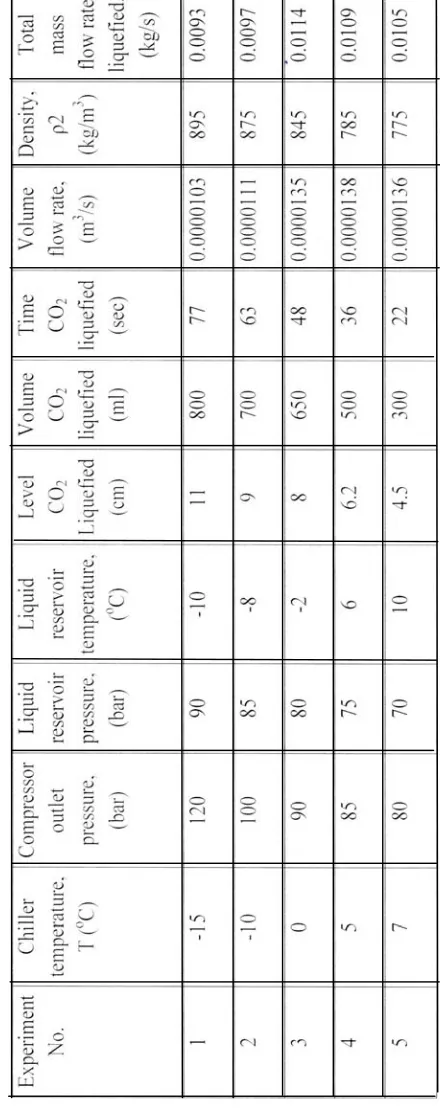
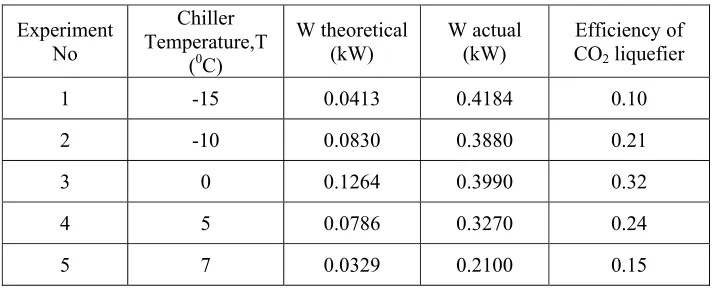
collected for the experiments are shown in Table 2 and Table 3. The efficiency of
CO
2liquefaction was evaluated using the ratio of the theoretical compression
Jurnal Mekanikal, December 2009
Table 2: T
otal mass flo
w
rate li
qu
efied using co
mpressor an
d hea
t exchange
r (sup
er
crit
ical
Jurnal Mekanikal, December 2009
Table 3: Efficiency of CO
2liquefier using compressor and heat exchanger
(supercritical path).
3.3
Liquefying using Heat Exchanger only
The technique to liquefy carbon dioxide gas using heat exchanger only, consist of
varying the supply gas to a pressure until its critical pressure and cooling the gas
to produce cooled supercritical fluid. The cooled supercritical fluid becomes
supercritical liquid and finally the liquid carbon dioxide is collected as the desired
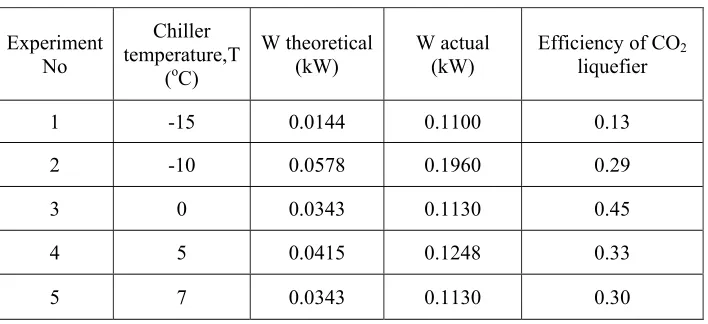
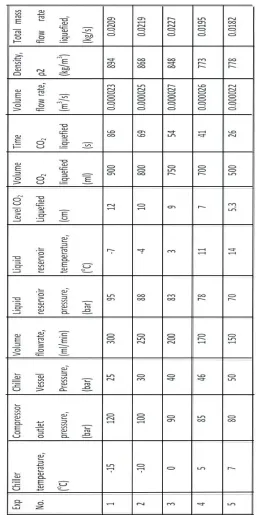
product. The data collected during the experiments are shown in Table 4 and
Table 5.
Experiment
No
Chiller
Temperature,T
(
0C)
W theoretical
(kW)
W actual
(kW)
Efficiency of
CO
2liquefier
1
-15
0.0413
0.4184
0.10
2
-10
0.0830
0.3880
0.21
3
0
0.1264
0.3990
0.32
4
5
0.0786
0.3270
0.24
Jurnal Mekanikal, December 2009
Table
4:
Total mass
flow rate us
in
g heat e
xchan
ger onl
Jurnal Mekanikal, December 2009
Table 5 : Efficiency of CO
2liquefier using heat exchanger only
3.4 Liquefying Using Combination of Both Compressor and Heat
Exchangers
The technique to liquefy carbon dioxide gas using a combination of both the heat
exchangers and compressor involves simultaneous application to produce the
supercritical liquid and finally the liquid is collected as the desired product. The
purpose of using this technique is to compare the performance of liquefaction of
carbon dioxide without combination and with combination of both compressor and
heat exchangers. The data collected during the experiments are shown in Table 6
and Table 7.
Experiment
No
Chiller
temperature,T
(
oC)
W theoretical
(kW)
W actual
(kW)
Efficiency of CO
2liquefier
1
-15
0.0144
0.1100
0.13
2
-10
0.0578
0.1960
0.29
3
0
0.0343
0.1130
0.45
4
5
0.0415
0.1248
0.33
Jurnal Mekanikal, December 2009
Tab
le
6
: Total m
ass flow rate li
quefied
u
si
ng
bot
h
trans
criti
cal an
d
su
per
criti
ca
l p
ath
Jurnal Mekanikal, December 2009
Table 7 : Efficiency of CO
2liquefier using both transcritical and supercritical
path.
Figure 7 The total mass flow rate liquefied versus chiller temperature
Figure 7 shows mass flow rate of the carbon dioxide varies with the chiller
temperature for all techniques described earlier. The carbon dioxide mass flow
rate liquefied using heat exchanger or without heat exchanger increases when the
Experiment
No
Chiller
temperature,T
(
oC)
W theoretical
(kW)
W actual
(kW)
Efficiency of
CO
2liquefier
1
-15
0.0236
0.0590
0.4
2
-10
0.0704
0.1303
0.54
3
0
0.0804
0.1044
0.77
4
5
0.0465
0.0877
0.53
5
7
0.0372
0.1328
0.28
Jurnal Mekanikal, December 2009
Figure 8 The efficiency of CO
2liquefier versus chiller temperature
In
Figure
8
the efficiency of CO
2liquefier versus the chiller temperature is
presented, for heat exchanger only, compressor and heat exchanger and the
combination mode. The efficiency of CO
2using heat exchanger only, is better
compared with the use of the chiller and compressor. Using the heat exchanger,
the carbon dioxide is further supercooled so that the fluid can be completely in the
liquid phase. When the heat exchanger is not used, the supercooling is avoided at
the suction of the compressor and therefore the enthalpy vaporization decreased. It
is important that the measured efficiency of carbon dioxide liquefier is used in this
experiment and using other design it could obtain different efficiency of liquefier
values.
Jurnal Mekanikal, December 2009
Figure 9 The liquid reservoir temperature versus chiller temperature
Figure
9
indicates that
the liquid reservoir temperature remained
approximately constant during the tests both when the experiment runs with and
without heat exchanger. It is due to the small oscillations at the chiller inlet and air
compressor inlet. The maximum carbon dioxide temperature at the discharge
compressor line has been about 110
oC. This value has been carried out without
using heat exchanger which has caused a further superheating of carbon dioxide
before it enters in the compressor.
4.0 CONCLUSION
As mentioned earlier in the introduction, the purpose of this study was to liquefy
the carbon dioxide gas using appropriate cryogenic system. This study has shown
that the total mass flowrate of liquefied fluid can achieve 0.0227 kg/s with
pressure and temperature of 83 bars and 4
oC respectively. The best mode to
liquefy the carbon dioxide gas is by using the simultaneous both transcritical and
supercritical path as compared to individual path. The performance test shows that
Jurnal Mekanikal, December 2009