Persistent User Authentication for Secure
Web Services
Amrita Gopal
M.Tech (Computer Networks and Information Security), Dept. of I.T., VNR VJIET, Hyderabad, India
ABSTRACT: Traditional authentication processes place confidence in username, parole and unimodal bio-metric user authentication developed united report, providing user affirmation in login section. As soon as the person identification has been proven, the method resources unit of dimension accessible for a difficult and fast range of a while or except certain logout from the consumer. CASHMA protocol is used for verification of the user and session management which would well timed realize the misuse of transportable laptop resources through measure unauthorized user. This protocol utilized at intervals the context-aware safety by using hierarchical development architectures procedure for comfy bio-metric identification on the online. The most undertaking of the protocol is to make and maintain the person session adjusting the session tour on the premise of bio-metric information of the user (u) and so the time on the spot (t) at intervals that the CASHMA utility acquires the bio-metric information. The data non-transmissible unit of dimension weighted at intervals the consumer verification approach supported i) type of the bio-metric qualities and ii) time, considering the fact that one-of-a-kind sensors unit of dimension in a position to provide information with completely exceptional timings. The CASHMA software operates to regularly preserve the session open, victimization trust at intervals the person and bio-metric approach.
KEYWORDS: Security, Bio-metric, Authentication, CASHMA, Trust
I. INTRODUCTION
Session management in dispensed internet offerings is in most cases supported username and password. Session time out would possibly occur throughout unperformed operational sessions or it expires once user is in idle activity quantity. Security of web based application is unbelievably very important as there is increase in quality of cyber attacks. Bio-metric application provides plenty of security for authentication methodology than proving the username and word. Bio-metric customer authentication is normally developed whilst shot providing patron verification most effective within the path of login phase as soon as one or a variety of bio-metric aspects would even be required. As quickly because the consumer's identification has been confirmed, the approach resources are available for a tough and the fast number of it slow or unless amazing log out from the man or woman. This process assumes that one verification is comfortable, that the identity of the character is commonplace during the whole session. To appear on the misuses of the computer belongings and discontinue that from the unauthorized man or woman replaces an accepted one with the aid of providing the solution supported the multimodal bio-metric steady authentication turning the patron authentication consequently of the continuous methodology instead than the one 1 party incidence. To restrict that one bio-metric attribute is forged, life science authentication can keep in mind a couple of existence science qualities. Finally, the employment of identification enables references to be nurtural evidenttly, i.e. Whereas now not expressly alerting the character or requiring his/her interaction, that's priceless to verify greater carrier necessity. Right here is awarded a contemporary approach for man or woman verification and session administration that's utilized inside the CASHMA (Context mindful safeguard with the help of graded structure Architectures) approach for at ease identification on Infobahn. CASHMA is prepared to govern firmly with any of internet supplier.
of bio-metric info. Face is procured whereas the consumer is placed before the camera, but not by choice for the securing of the bio-metric information; for example, the patron may scan a written SMS or viewing a film on the cell cellphone. The voice is obtained once the consumer talks on the phone, or with different people adjacent if the mouthpiece reliably catches foundation. Keystroke info is procured at no matter purpose the consumer types on the console, for example, once composing associate degree SMS, visiting, or poring over on the web. This technique separates from natural verification types, at any place username/secret key rectangular measure requested for 1 time at login time or expressly wanted at affirmation steps; original validation systems weaken easy use for upgraded safety and provide no preparations in opposition to falsification or taking of passwords.
Paper is organized as follows. Part II is expounded works. Section III is proposed methodology. Section IV results. Section V is concluding remarks and accelerated section for future study.
II. RELATED WORK
“E. LeMay, W. Unkenholz, D. Parks, C. Muehrcke, k. Keefe, and W.H. Sanders” [13] To provide perception on process protection and help choice-makers, we generally tend to suggest the opponent scan security evaluation (endorse) methodology to quantitatively reside the force of a approach's protection. Our process is to make practicable state-established safety mannequin of a approach. The security mannequin is initialized with information characterizing the approach and therefore the adversaries offensive the procedure. The mannequin then simulates the assault habits of the adversaries to deliver a quantitative assessment of procedure security strength. The process and opponent characterization understanding that subject unit collected as input for the plausible model. At the same time describes the simulation algorithms for person attack conduct and so the computation for the chance that assault strive is roaring. An easy case learn illustrates the to investigate method security exploitation the "ADVISE" [13]methodology. An instrument is at this time below development to facilitate computerized mannequin generation and simulation. The "ADVISE" methodology aggregates protection-central information just a few process and its adversaries to deliver a quantitative safety evaluation priceless for holistic method safety picks.
“A. Ceccarelli, A. Bondavalli, F. Brancati, and E. La Mattina”[12], rising biometric options regulate work username and word with bio-metric knowledge, however still, one verification is deemed spare, and moreover the identity of a user is taken into consideration changeless during the entire session. The protocol determines adaptational timeouts selected on the premise of the ordinary, frequency, and kind of bio-metric data bought transparently from the consumer. Session administration in allotted web services is regularly supported username and parole, and specific logouts and timeouts that expire because of the idle activity of the user. A secure protocol is printed for perpetual authentication through continuous user verification. To boot, the length of the timeout may impact on the usability of the service and resultant client satisfaction.
“A.K. Jain, A. Ross, and S. Pankanti”[2] Establishing identity is popping into important in our vastly interconnected society. queries like “Is she terribly world organisation agency she claims to be?,” “Is this person licenced to use this facility?,” or “Is he inside the watchlist denote by the government?” “Subject unit probably being posed in an exact type of matters starting from pastime a driver's license to gaining entry proper right into a nation. The need for nontoxic user authentication approaches has enlarged inside the wake of heightened disorders involving protection and speedy advancements in networking, conversation, and exceptional.” Bio-metrics portrayed as a consequence of the science of recognizing a private supported his or her physical or recreation characteristics, is establishing to obtain acceptance as an authentic system for finding out partner man or woman's identity. Bio-metric procedures have at the second been deployed within the quite a lot of exchange, civilian, and rhetorical functions as a system of making the identification.. Present a top level view of lifestyles science a discusses form of the salient analysis problems that need to be addressed for making bio-metric technological know-how an economical tool for offering knowledge security. The first contribution of this define involves 1) analyzing purposes anyplace existence science can solve problems relating information security; 2) enumerating the most important challenges encountered by the use of bio-metric systems in specific-world capabilities; 3) discussing solutions to manipulate the problems of measurability and protection in enormous-scale authentication approaches.
“ O. Sheyner, J. Haines, S. Jha, R. Lippmann, and J.M. Wing” [11] Fundamental part of modeling the worldwide learn of network protection is establishing assault graphs. Guide assault graph development is tedious, fallible, and impractical for attack graphs bigger than 100 nodes. It tends to computerized system for generating and analyzing assault graphs. It tends on symbolic model checking algorithms, It having a bent to furthermore describe a pair of
procedure and established it on just a little community example, which involves items of a firewall and an intrusion detection method.
III. PROPOSED ALGORITHM
User authentication processes that place confidence in username, secret and unimodal bio-metric (“T. Sim, S. Zhang, R. Janakiraman, and S. Kumar”[5] )user authentication is developed together shot. As soon as the customer's identity has been tested, the process resources square measure available in the market for a rough and quick quantity of it gradual or except exact log out from the user. Active user session permits intruders to impersonate the user and access personal data, which could be put-upon. the online could also be an area that serves anyone connected to that. Its edges go beside the numerous drawbacks like incomplete security and trust. Also, the prevailing authentication system contains a spread of security flaws. Hence, to watch and stop from unauthorized access, it provides a solution that's predicated on bio-metric data of user and continuous authentication is planned. The system provides a greenhorn technique for continuous user authentication that unceasingly collects bio-metric data. It turns user verification into continuous method rather than a former prevalence.
Hence, the system provides degree implementation of degree, the economic authentication system for secure internet services that have continuous and clear user bio-metric authentication mistreatment bio-metric traits.
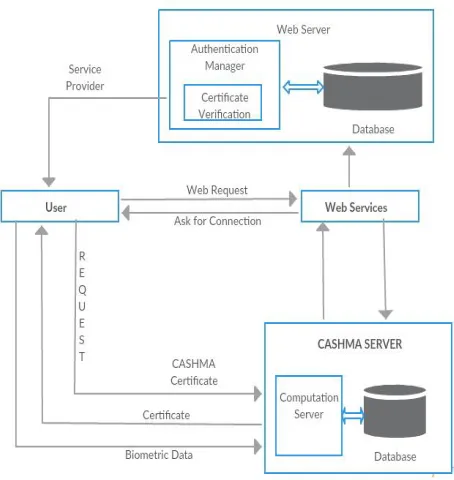
The CA(continuous Authentication) system design consult with fig. (1) and (2) purpose to supply the protection for web services. Also, the method detects misuses of pc assets and prevents malicious pursuits supported multimodal bio-metric steady authentication. For that victimization [7]CASHMA(Context mindful protection with the aid of Hierarchical structure Architectures) protocol. That might be a cozy protocol(CASHMA Protocol)that's outlined for constant authentication by means of continuous consumer verification. Bio-metric systems furnish a reply for relaxed and certain proof. The consumer session is unclosed and comfortable despite the attainable idle recreation of the consumer, whereas capabilities misuses are detected with the aid of without end confirming the presence of the proper person.
CASHMA authentication service involves (a.) an authentication server, that interacts with the consumers, (b.) a gaggle of excessive-performing laptop servers that participate in comparisons of bio-metric skills for verification of the enrolled users, and (c.) databases of templates that incorporate the bio-metric templates of the listed customers. Customers have got to be registered to the CASHMA authentication provider, expressing conjointly their trust threshold.
Fig. 2 CASHMA Architecture
CASHMA AUTHENTICATION PROTOCOL :
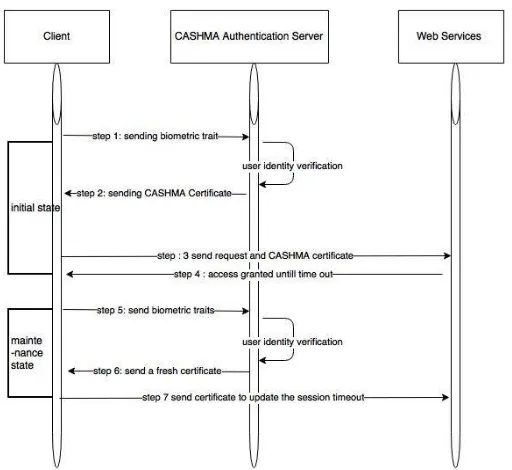
Refer to “A. Ceccarelli, A. Bondavalli, F. Brancati, and E. La Mattina” [12]The steady authentication protocol allows
supplying adaptive session time-outs to an web service to line up and maintain a cozy session with a purchaser. The time-out is tailored to the concept of the believe that the CASHMA authentication process puts inside the bio-metric subsystems and inside the consumer.
( Fig. 3 )[1] Execution of the protocol contains two consecutive phases: the preliminary section and accordingly the protection part. The preliminary section pursuits to happen the person into the process and establish the session with the net service. In the direction of the safeguard section, the session timeout is adaptively up to date when user identification is carried out mistreatment modern-day uncooked information furnished through the shopper to the CASHMA authentication server.
Biometric : Fingerprint Recognisation
“ Nalini Ratha and Ruud Bolle” [4]Fingerprints of every person is taken into account to be distinctive. Fingerprint detection and recognition is that the most accepted bio-metric recognition methodology. Fingerprints are used from lasting for distinguishing persons. A good exceptional fingerprint contains thirty - eighty trivialities aspects. Fingerprints contain an everyday texture pattern composed of ridges and valleys refer to. “A.K. Jain, A. Ross, and S. Pankanti,”[8]. These ridges square measure characterized by many landmark points, known as minutiae, that square measure principally within the variety of ridge endings and ridge bifurcations. The trivia points are distinctive to every finger, it's the gathering of trivia points during a fingerprint that's primarily utilized for matching 2 fingerprints. There exists some gap between the ridges, referred to as valleys. In a fingerprint, the darkie strains of the photograph rectangular measure often called the ridges and in addition, the white house between the ridges is called valleys.
Computation for trust in user and timeouts:
Timely from the predominant latest consumer bio-metric authentication, the probability that accomplice aggressor substituted to the official person will develop, or we can say, the amount of trust inside the consumer decreases. This lead to mannequin the customer believe stage by way of time utilising a operate that is asymptotically decreasing within the course of zero.
“A Ceccarelli, L .Montecchi, F. Brancati, P. Lollini, A. Marguglio and A bondavalli”[1] “M. Cinque, D.
Cotroneo, R. Natella, and A. Pecchia”[9] “A. Ceccarelli, A. Bondavalli, F. Brancati, and E. La Mattina” [12] User trust
level at time ti : the below equation is for computing user trust level where p( ui ) is “global trust level” which is set to 1
for initial session ∆ui is integrate value of time vary from i = 1...m, d is delay and f is slope. Refer. “Andrea Ceccarelli,
Leonardo Montecchi, Francesco Brancati, Paolo Lollini, Angelo Marguglio,Andrea Bondavalli” [1]
For initial session trust level is computed as following equation Refer. to “Andrea Ceccarelli, Leonardo Montecchi,
Francesco Brancati, Paolo Lollini, Angelo Marguglio,Andrea Bondavalli” [1]. here o(Vk , u0 ) is unimodal subsystem in
sensor level trust system at time u
for maintenance session [1] The trust level within the upkeep phase as an alternative is a linear combo of the consumer
believe degree and the sensor trust level. Here, “the user trust level” p(ui) and “the sensor trust level” o(Vf, , ui))
Refer.to “A. Ceccarelli, A. Bondavalli, F. Brancati, and E. La Mattina” [12] as follows:
Computation of session timeout:
Refer.to “A. Ceccarelli, A. Bondavalli, F. Brancati, and E. La Mattina” [12] the below equation is to compute “the
session time out” where pmin = “global trust level”, d = “delay”, f = “slope”, ui = “instant time” and Di = “Session time
out”.
if D_{i}>0
p(ui)=
(−arctan((Δui−d) f )+π ∕ 2) trust(ui−1)
−arctan(−d f )+π/2
trust(u0)=1− Πf=1. ...n(1−o(V f ,u0))
trust(ui)= p(ui)+ (1− p(ui))o(V f, ui)
D
i= (
p
min(
arctan(
−
d
f
)
− Π
2
)
trust
(
u
i)
+
Π
2
)
1
IV. RESULT
CASHMA protocol is used in registration process user should enter all their details including fingerprint. The server will send user id, account, and transaction password to the registered mail. Each time when user login to their account they have to verify themselves by using a fingerprint. The user can change its account and transaction password. The transaction can be performed in the own account, inter-account, and intra-account. Each time server will send OTP(One Time Password) to registered mail. The server will send mail to registered mail after the successful transaction. If the password is given wrong for more than 2 times it will block the account, when user input correct password it will show them the message saying your account is blocked for 24 hrs. When server unblocks the account, it will send a confirmation mail to registered mail id.
Session time-out is achieved. If the user is login to its account and more than 1-minute account is idle, it will log out automatically.
V.CONCLUSION AND FUTURE WORK
CASHMA protocol is employed for continuous verification that improves the safeguard and usability of the consumer session. The protocol used to compute adaptive timeouts on the premise of the trust exhibit within the consumer endeavor and within the satisfactory and sort of bio-metric expertise non-inheritable transparently by means of remark the history of the consumer's moves. This authentication procedure supplies a precise strategy to perpetually validating the identification of a consumer in real time via the employment of biometry features. This method shows the economical use of biometry to spot the legitimate user. Also, it endlessly verifies the physical identity of the legitimate user through their bio-metric information. The authentication is ready to attain a decent balance between security and usefulness with continuous and clear user verification. Hence, continuous authentication verification with bio-metry improves security and usefulness of user session.
Main challenges of the system are to reduce cost and maintenance. Add more bio-metric techniques (keystroke, face, voice etc) to get more accuracy.
REFERENCES
[1] Andrea Ceccarelli, Leonardo Montecchi, Francesco Brancati, Paolo Lollini, Angelo Marguglio,Andrea Bondavalli ”Continuous and Transparent
User Identity Verification for Secure Internet Services” IEEE Transaction on De-pendable and Secure Computing, VOL. 12,NO. 3,JUNE 2015. [2] Anil K. Jain, Sharath Pankanti, Salil Prabhakar, Lin Hong, Arun Ross, James L. Wayman, ”Biometrics: A Grand Challenge” International
Conference on Pattern Recognition , Aug 2004
[3] Dwijen Rudrapal, Smita Das, S. Debbarma, N. kar, N. Debbarma, ”Voice Recognition and Authentication as a Proficient Biometric Tool and its Application in Online Exam for P.H People”,International Journal of Computer Applications, Volume 39 No.12, February 2012.
[4] Nalini Ratha and Ruud Bolle,” Automatic Fingerprint Recognition Systems ” (Springer: New York,2004).
[5] T. Sim, S. Zhang, R. Janakiraman, and S. Kumar, ”Continuous Verification Using Multimodal Biometrics,”IEEE Trans. Pattern Analysis and Machine Intelligence, vol. 29, no. 4, pp. 687-700, Apr. 2007.
[6] S. Ojala, J. Keinanen, and J. Skytta, “Wearable Authentication Device for Transparent Login in Nomadic ApplicationsEnvironment,”Proc. Second Int’l Conf. Signals, Circuits and Systems(SCS ’08), pp. 1-6, Nov. 2008
[7] A. Altinok and M. Turk, “Temporal Integration for Continuous Multimodal Biometrics,” Proc. Workshop Multimodal User Authentication, pp. 11-12, 2003.
[8] A.K. Jain, A. Ross, and S. Pankanti, “Biometrics: A Tool for Information Security,” IEEE Trans. Information Forensics and Security, vol. 1, no. 2, pp. 125-143, June 2006.
[9] M. Cinque, D. Cotroneo, R. Natella, and A. Pecchia, “Assessing and Improving the Effectiveness of Logs for the Analysis of Software faults,” Proc. Int’l Conf. Dependable Systems and Networks (DSN), pp. 457-466, 2010.
[10] N. Mendes, A.A. Neto, J. Duraes, M. Vieira, and H. Madeira, “Assessing and Comparing Security of Web Servers,” Proc. IEEE Int’l Symp. Dependable Computing (PRDC), pp. 313-322, 2008.
[11] O. Sheyner, J. Haines, S. Jha, R. Lippmann, and J.M. Wing “Automated Generation and Analysis of Attack Graphs,” Proc. IEEE Symp. Security and Privacy, pp. 273-284, 2002.
[12] A. Ceccarelli, A. Bondavalli, F. Brancati, and E. La Mattina, “Improving Security of Internet Services through Continuous and Transparent User Identity Verification,” Proc. Int’l Symp. Reliable Distributed Systems (SRDS), pp. 201-206, Oct. 2012.