Division I
EVALUATION OF COMPRESSIVE AND SHEAR STRENGTH OF
CONCRETE IN STRUCTURES SUBJECTED TO SUSTAINED ELEVATED
TEMPERATURES
Kaoru Inaba1, Toshinobu Maenaka2, Yoshitaka Ichihara3, Hideo Kasami4, Takafumi Tayama5, and Hironobu Nishi6
1
Chief Researcher, Research & Development Institute, Takenaka Corporation, Japan
2
Manager, Power Facilities, Engineering Department, Takenaka Corporation, Japan
3
Engineer, Power Facilities, Engineering Department, Takenaka Corporation, Japan
4
Technical adviser, Japan Association for Building Research Promotion, Tokyo, Japan
5
Manager, Hachioji Building Material Inspection Center, Japan
Association
for Building Research Promotion, Tokyo, Japan6
Senior Researcher, Concrete Laboratory, FLOWRIC Co. Ltd., Ibaraki, Japan
ABSTRACT
Shielding walls in LWR type nuclear power plants are to be subjected to gradient elevated temperatures and moisture migration in concrete due to vapour pressure and dispersion causes change in moisture distribution and resulting non-uniform strength distribution over cross section in thick walls.
This paper presents a theoretical estimation of compressive and shear strengths based on the estimation of moisture migration and moisture distribution presented in the Authors’ previous paper and 2 series of experimental results on the compressive and shear strengths of concrete.
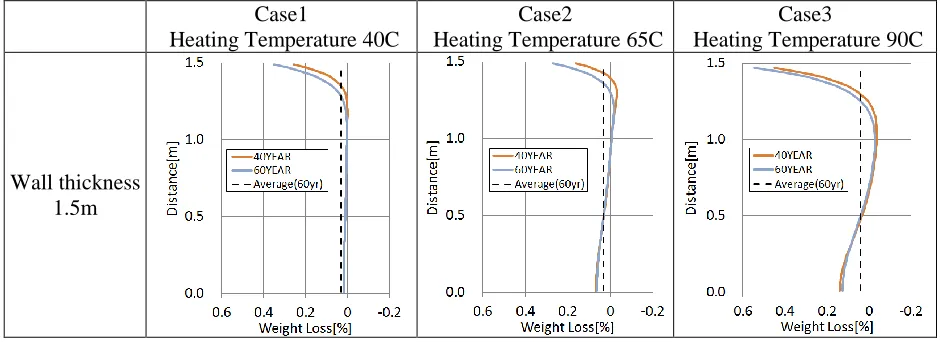
Simulation of moisture migration and moisture distribution was made on shielding wall models h 1.5 m thick under heating temperature of 40, 65 and 90C at liner side after 40 and 60 year. The moisture content of concrete in the shielding walls decreases both at the heating side and the surface side and increases in the intermediate zone due to the moisture migration accompanying the change in the pore vapour pressure under gradient temperature.The unit weight of concrete resultant from moisture migration is proportional to the moisture content, causing weight loss zone or dried zone at the heating and surface sides and weight increase zone or wet zone at intermediate zone in the walls.The difference in estimated moisture distribution curves between 40 and 60 years is small. Consequently the estimated weight change is proportional to the moisture content, indicating decreases at the heating and surface sides, and increase at the intermediate zone. The cross sectional average weight loss is 1.25% after 40 years.
The estimation of strength distribution was made by the application of 2 case of relationship between weight loss and residual ratio of compressive and shear strengths. In the case A, residual ratios of compressive and shear strengths of ordinary portland cement concrete containing crushed sandstone, crushed andesite and crushed limestone subjected to elevated temperatures up to 300C were applied. In the case B, residual strength ratios of sandstone concrete containing ordinary Portland cement and moderate-heat portland cement subjected to elevated temperatures up to 175C were applied.
The compressive strength in walls may not change monotonously with temperature, but may become larger at intermediate wet zone than the dried heating and surface sides. And concrete with ordinary portland cement has greater compressive strength in 40 years than that with moderate-heat portland cement. The shear strength may also become larger at the intermediate wet zone than the dried heating and surface sides, However, the shear strength of concrete with moderate heat portland cement may become higher than that with ordinary portland cement.
1.INTRODUCTION
In the shield design of nuclear power plant facilities in Japan, it is confirmed during construction that the desired values in shield design are satisfied by using the dry weight per unit volume of concrete. However, because it takes an extremely long time before the entire massive shielding concrete member of a nuclear power plant becomes dry, the shielding design in the dry unit weight is used as a safe-side evaluation.
Concrete contains moisture but the moisture in massive concrete structures such as shielding walls of a nuclear power plant causes complex phenomena such as generation of hydration heat and strength promotion during construction and density distribution changes due to heat and moisture transfer associated with a temperature gradient caused by long-time heating, an increase in voids associated with moisture transfer, and a strength change due to re-hydration during use.
If the required shielding performance changes due to equipment replacement, it is important in terms of design to grasp the actual shielding performance of concrete after secular change. And it is important in terms of maintenance to predict future shielding performance in consideration of the moisture in concrete and moisture transfer.
The authors created a predictive model of heat transfer and moisture transfer in concrete subject to heating, performed a predictive simulation of long-term moisture transfer and estimated variations in strength distribution in concrete due to variations in moisture distribution (Kasami et al.(2013), Ichihara et al.(2013)). It was confirmed that the calculation result is generally adequate and proper, and the variation in moisture distribution and strength distribution caused by heating temperature was evaluated
quantitatively.We also showed that we can simulate the moisture transport phenomenon consistent with the actual phenomenon by setting appropriate parameters in the heat transfer and moisture movement prediction model constructed by the authors (Inaba et al.(2015)).
Concerning shielding performance and strength of shielded concrete of nuclear power plants, performance evaluation is not easy because of density change and intensity change due to complex physical phenomena.In addition, it is not easy to collect samples on actual plants due to the influence of radiation etc, but it is very important to evaluate the actual performance of aging structures, so we expect that such data will be acquired in the future.
In the meantime, prediction by numerical simulation is an effective method. In this research, we report on the results of examining compression and shear strength distribution of shielding walls using actual measured relationship between weight loss, and compressive / shear strength of heated specimans by Kasami et al.(1975) and Tayama et al.(2016).
2.PREDICTION OF MOISTURE DISTRIBUTION IN SHIELD CONCRETE USING MOISTURE AND HEAT MIGRATION MODEL
(1) Model Outline
Several studies as follows : England and Ross (1972), England(1971), Chapman and England (1977), Shiire and Cheong(1988), Takeda et al. (1987), Kishitani et al.(1984), Harada and Terai (1995), Ichise, et al.(2013), and so on, have been conducted regarding moisture transfer in concrete subject to heating. There are several study reports, for example Abe(1987), Maruyama et al.(2006), regarding the modeling of heat/moisture transfer in the dry shrinkage process but non-stationary change of vapor pressure due to moisture evaporation was not included in the dry shrinkage model. The authors developed a multiphase flow model coupled with thermal hydraulics including non-stationary moisture evaporation to predict the moisture state in concrete subject to prolonged heating. By using this model, it is shown that
(2) Simulation Case Settings and Estimation Results of Moisture Distribution
Because the heat environment and shielding thickness or the like of a nuclear power plant will vary depending on the nuclear reactor type and equipment operation conditions, in this examination the temperature of heated surface is set as fluctuation factors, in reference to the existing documents as follows: AIJ(1985,2004a,2004b), JSME(2003), Fukuhara et al.(1997), Yanagi et al.(2001). Simulation case conditions are shown in Table 1. According to the study by the authors (Inaba et al.,2015), it is known that the unsaturation parameter greatly affects moisture transfer. Here, with regard to the relative permeability, we decided to examine the dangerous side using the one shown in Fig. 1 which promotes moisture transfer more.
Initial conditions were wall temperature 20 C, boundary grid of release surface was fixed boundary condition at 20 C, 1 atm, humidity 10%. Fig. 2 shows the calculation results of the weight loss at 40 years and 60 years from the start of heating in each case.
Table 1 Simulation cases
Case No. Wall thickness (m)
Heating temprature (C)
Absolute permeability (m2)
Thermal conductivity (Wm-1K-1)
Specific heat capacity (Jkg-1K-1)
1
1.5
40
3.0×10⁻¹⁷
1.62 879
2 65
3 90
Figure 1 Relative permeability of wet air
Case1
Heating Temperature 40C
Case2
Heating Temperature 65C
Case3
Heating Temperature 90C
Wall thickness 1.5m
Figure 2 The simulation result
3. ESTIMATION OF CHANGES IN STRENGTH DISTRIBUTOIN
(1) Modeling of Correlation between Weight Loss and Compressive & Shear Strength
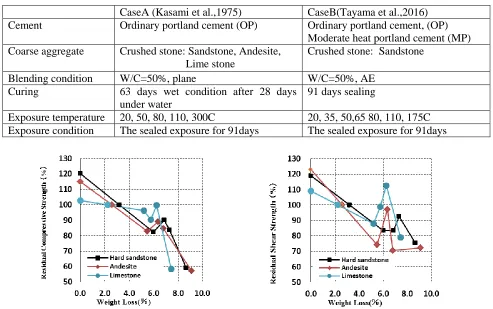
There are few technical documents on the shear strength of concrete after heating, only the data of Kasami et al.(1975), Tayama et al.(2016). Table 2 shows the experimental conditions for determining the residual shear strength after heating by Kasami et al. and Tayama et al. The relationship between weight loss and compressive / shear strength obtained by the experiment is shown in Fig.3, Fig.4.
Table 2 Experiment Situation
CaseA (Kasami et al.,1975) CaseB(Tayama et al.,2016) Cement Ordinary portland cement (OP) Ordinary portland cement, (OP)
Moderate heat portland cement (MP) Coarse aggregate Crushed stone: Sandstone, Andesite,
Lime stone
Crushed stone: Sandstone
Blending condition W/C=50%, plane W/C=50%, AE
Curing 63 days wet condition after 28 days under water
91 days sealing
Exposure temperature 20, 50, 80, 110, 300C 20, 35, 50,65 80, 110, 175C Exposure condition The sealed exposure for 91days The sealed exposure for 91days
Figure 3 Relationship between weight loss and residual ratio of compressive/shear strength (case A)
(2) Estimation of Residual Rate of Compressive Strength of Sheilding Wall Subjected to One-sided Heating
Fig.5 shows the compressive strength distribution in the shielding wall after 40 and 60 years calculated by fitting the relationship between the weight loss and the strength in Figs. 3 and 4 to the weight loss calculated from the moisture distribution map in the shielding wall shown in Fig.2.
Compressive strength is small on the heating side and the surface side, and it increases in the inside of the wall.
The compressive strength after 40 years in case A is the largest within 0.2 m from the surface and it becomes the minimum at the surface, and the strengths were in descending order of limestone, andesite, hard sandstone. In addition, case A showed an increase in strength in all cross sections except for the surface in case 3 (90 C). However, the area where the compressive strength decreases in case 3 is small.
The compressive strength after 40 years in case B were in descending order of ordinary cement, moderate heat cement. The strength distribution is the same as in case A, but the strength at the surface of the speciman using ordinary Portland cement was 3% lower than before the exposure. In addition, moderate heat cement has small compressive strength change in all cross sections except the surface.
For case A and case B, the difference between the maximum strength and the minimum strength after 40 years was about 10%.
(3) Estimation of Residual Rate of Shear Strength of Sheilding Wall Subjected to One-sided Heating
Fig.6 shows the shear strength distribution in the shielding wall after 40 and 60 years calculated by fitting the relationship between the weight loss and the strength in Figs. 3 and 4 to the weight loss calculated from the moisture distribution map in the shielding wall shown in Fig.2.
Shear strength slightly differs from the tendency of compressive strength, and the strength of case A after 40 years elapsed became the andesite, hard sandstone and limestone in descending order. It is the same as compressive strength that the strength is minimized at the surface and the strength increase at almost all cross sections.
The shear strength of case B after 40 years elapsed became moderate heat portland cement, ordinary portland cement, in reverse order of compressive strength. The ordinary cement has small compressive strength change in all cross sections except the surface. The strength at the surface of the speciman using ordinary cement was lower than before the exposure. The difference between the maximum strength and the minimum strength was 15% in case 1 and 12% in case 2.
4. DISCUSSIONS
When evaluating the strength change using the core of aged concrete structures subjected to elevated temperature, the evaluation based on the core strength at the surface is underestimated, and there is a possibility of overestimation in the core within 0.2 to 0.3 m from the surface. Particularly in the case of using a small diameter core, it is expected that the variation will be large, so it is necessary to pay attention.
Moreover, the following problems remain.
1)To confirm validity under various conditions, it is necessary to compare further observation results and simulation.
2) Although hydration and decomposition are not considered, these phenomena affect unsaturated properties, so these phenomena need to be taken into consideration in order to accurately predict long term.
4) At nuclear power plants, heating conditions change by periodic inspection, so it is necessary to consider repeated heating.
5) It is necessary to collect more data on the structural change such as the compressive strength of the region where mass increases due to moisture movement.
5. CONCLUSIONS
The following preliminary conclusions were obtained as results of present investigations concerning estimation of compressive strength in massive wall subjected to gradient elevated temperatures.
Although the analysis method of this report requires future research, it is thought that it is possible to evaluate the strength of the whole shielding wall including strength characteristics other than compressive strength.
1)Simulation of moisture movement in massive shielding concrete subjected to one side heating showed that the mass decreased on the surface side and the heating side and the mass increased inside.
2) We showed that compressive and shear strength can be calculated from the weight loss distribution obtained by the moisture transfer simulation using the relationship between weight loss and compressive / shear strength.
3)Depending on the material of the coarse aggregate and the material of the cement, there is a possibility that the tendency of compression / shear strength after aging may be different, and confirmation by experimental examination using more samples is necessary.
C
as
eA
40 years
60 years
C
as
e B
40 years
60 years
Case1(40C) Case2(65C) Case3(90C)
C
as
eA
40 years
60 years
C
as
e B
40 years
60 years
Case1(40C) Case2(65C) Case3(90C)
REFERENCES
Abe, T.(1987). “A Mathmatical Model of Heat and Moisture Transfer in Concrete”, Hukui national college technology study bulletin, Natural science engineering, No. 21, Japan, (in Japanese)
AIJ. (1985). Symposium, thermal stress design method for nuclear concrete structure, AIJ, Japan, (in Japanese)
AIJ. (2004a). Japan architectural standard specification for reinforced concrete work in nuclear power plants (JASS 5N), AIJ, Japan, (in Japanese)
AIJ. (2004b). Recommendations for durability design and construction practice of reinforced concrete, AIJ, Japan, (in Japanese)
Chapman, D. A. and England, G. L.(1977). "Effects of Moisture Migration on Shrinkage, Pore Pressures and other Concrete Properties", Trans. Int. Conf. SMiRT 4th, Vol. H, USA
England, G. L.(1971). "Migration of Moisture and Pore Pressures in Heated Concrete", Trans. Int. Conf. SMiRT, 3rd, Vol. H, USA.
England, G. L., Ross, A. D. (1972). "Shrinkage, Moisture and Pore Pressures in Heated Concrete", Concrete for nuclear reactors, American Concrete Institute, SP34-42, Detroit, USA
Fukuhara, T. et al. (1997). “Capillary infiltration and Estimation of Unsaturated Hydraulic Conductivity of Concrete by The Unsteady Method”, Journal of Materials, Concrete Structures and Pavements, 564,V-35, 89-96, (in Japanese).
Harada, K., Terai, T.(1995). “A model of heat and mass transfer in concrete during fire”, Journal of structural and construction engineering, Transactions of AIJ, No. 477, pp.185-190, (in Japanese) Ichihara, Y., Maenaka, T., Inaba, K. and Kasami, H.(2013)." Estimation of Long-Term Concrete Strength
in Massive Shielding Wall Subjected to Gradient Elevated Temperature in BWR Type Nuclear Power Plant", Division I, Transactions, SMiRT-22, San Francisco, California, USA.
Ichise, K. et al. (2013). “Physical properties of massive concrete exposure to long-term heating (part5) Physical properties of massive member after on year heating”, Summaries of Annual Meeting of AIJ, , pp.1331-332 ,Japan (in Japanese)
JSME (Japan Society of Mechanical Engineers).(2003), “Standards for Nuclear Power Generation Equipment: Concrete Reactor Containment Vessel”, JSME S NE1-2003.
Kasami, H., Okuno, T., Yamane, Y.(1975); "Effects of Sustained Exposure to Elevated Temperatures up to 300C on Concrete Properties",Vol.H/5. Trans. of Int. Conf. SMiRT-3rd, USA
Kasami, H., Nishi, H., Tamura, M., Ichihara, Y. and Maenaka, T.(2013). "Evaluation of Temperature, Moisture Evaporation and Strength of Concrete Subjected to Sustained Elevated Temperatures up to 300 ˚C", Division I, Transactions, SMiRT-22,San Francisco, California, USA..
Kishitani, K., Kasami, H., et al. (1984). “Experimental study on the properties of concrete exposed to sustained elevated temperature”, Cement & Concrete, No. 444, Cement Association, Japan, (in Japanese)
Maruyama, I., Noguchi, T., Sato, R.(2006). “Prediction of temperature and moisture distribution in high-strength mass concrete based on heat and moisture transport model”, Journal of structural and construction engineering, Transactions of AIJ, No.70, vol.600, pp.1-8, Japan, (in Japanese)
Shiire, T., Cheong, S.(1988). "Experimental study on strength characteristics of massive concrete structures subjected to high temperature from one side”, Journal of structural and construction engineering, Transactions of AIJ , 387, 8-14, Japan, (in Japanese)
Takeda, T. et al. (1987). "Experimental Studies on Characteristics of Concrete Members Subjected to High Temperatures", Vol. H. Trans. of 9th Int. Conf. on St. Mech. in Reactor Technology, USA
Tayama, T., Kasami, H., Hikosaka, N., Nishi, H., Moriya, K., Oike, S.,Maenaka, T., Ichihara, Y., Matsuzawa, K., Abe, M. (2016) “Effects of exposure temperature and exposure period on the various properties of concrete that has been exposed to high temperatures (Part 5) shear strength after exposure, flexural strength and tensile strength”, Summaries of Technical Papers of Annual Meeting, 443-444,Architectureal Institute of Japan, (in Japanese).