Demand Response in Smart Grid: Key
Implementation Challenges
Vinay Kumar K1, Dr. Balakrishna R2
Manager (IT & Smart Grid), BESCOM, Bangalore, India
Principal & HOD, RRCE, Rajarajeshwari Nagar, Bangalore, India
ABSTRACT: from decades the traditional energy sector has single way communication from generation to distribution
lacking a bi-directional communication between consumer and the grid. In traditional grid system, during mismatch between demand and supply, the grid operates on supply side management strategy as major tools thereby operating only on Generating Stations with very little or no Demand side Management. This paper presents the architecture and key technical challenges in implementing Demand Response1 on Smart Grid3. DR in simpler allows flexibility to the consumers to reduce the load (mostly non-critical load) using Load Control switches or any such mechanisms during peak hours thereby incentivizing them for the contribution made by them for overall reduction of peak load. The key challenges are Grid topology, regulatory norms, application of DR across various consumer bases5, Scalability, financial implications, privacy & security, interoperability issues etc.,
KEYWORDS: Demand Response, Smart Grid, Load Control
I. INTRODUCTION
Smart Grid programs aims to develop automated, self-healing system to optimse the effective utilization of the Grid by implementing modern technologies, tools and Strategies. One such strategically proven technology is use of Demand Response. Many methods such as Time-of-Day (TOD)6, critical peak pricing, variable peak pricing, real time pricing, and critical peak rebates are adopted as part of implementing this technology.
Effective incorporation of DR in Energy sector can maintain Grid Stability, reduce emission, empowers consumers & reduce peak time procurement costs. Smart Metering & Advanced Metering Infrastructure (AMI) 8 allows optimum response for DR Signals.
II. DEMAND RESPONSE (DR)
A. Basic Elements in DR System
i. Advance Planning & Contracting 2 : the utility needs to make well ahead planning for critical times when it may need to ask its consumers to respond on the Grid signals and execute binding agreement such consumers/participating entities
ii. Demand buyback: on a day ahead basis the consumers are incentivized for making long hours of load reduction than anticipated by the utility
iii. Direct Load Controls: the approach allows the utilities to have direct control on the loads as permitted by the consumer (critical / non-critical loads). This allows more flexibility on the utility end since, it sheds the load on the grid without consent of consumers for every instance of requirement.
Vol. 4, Issue 6, June 2016
B. Types of DR:
Broadly we can classify DR into
i. Real-time critical DR: This is adopted to avoid situations of unscheduled interruptions demand-supply mismatch (Shortage of Power)
ii. Incentive motivated DR: It allows consumers to receive the incentive upon recuing the load on the grid during critical peak / or any such grid emergencies
iii. Ancillary services: It is adopted for secure operation of traditional or less automated electrical grid networks.
III.SIMPLIFIED DEMAND RESPONSE ARCHITECTURE
The simplified DR architecture comprises 3 basic building blocks viz.,
Utility block
Aggregator/intermediate operator block
Consumer block
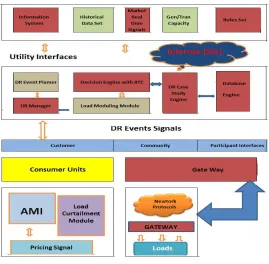
Fig 1: Demand Response Architecture
a. Utility Block: the utility block comprises of the systems which are designed & commissioned to store historical grid parameters, make analysis & create rule sets for generating DR signals.
The utility block uses the information from the intermediary block where the aggregators / mediating operators will share the information about the contractual binding and technical information about participating consumers.
The information exchange is via Internet through secured SSL protection.
b. Aggregator/ intermediate operator block: the block comprises of the following elements:
1. DR Event Planner: This will set the action plan upon any DR signal trigger given from the utility. This action plan may be using heuristics algorithms or based on Pre-historic data set analysis
2. Decision Engine with RTC: this engine will be in sync with the case study engine and comprises of generation
decision signals based on the consumer participation and grid requirement since the economic incentive given to consumers largely depends on the decision taken at this stage.
3. DR Case Study Engine & Database Engine: This contains the list of aggregators and details of role based authentication given for aggregator & consumer interface access. The case study engine is built up so as to take optimized decision based on historical data set available.
4. DR Manager : The DR Manager is responsible for overall operation of the Aggregator block and decision taken by other modules can be overrode by this manager which will compute techno-commercial implication for every response that an aggregator on behalf of consumers that are committed to the utility. The DR Manager notifies the consumers about DR event and allows consumer to know the utility bid and collects the bid placed by the consumer and lets the utility know the same.
5. Load Modeling: This module is responsible for load curve analysis, calculation of peak load and load staggering points and effective welfare gain / loss states in the Load Flow analysis.
c. Consumer block:
This comprises of a Home Area Network (HAN) 7 which integrates with the CLIR, load and other devices.
The Advanced Metering Infrastructure consists of Smart Meters which have bi-directional communication capability and responds to the pricing signals received from the utility through the aggregators with whom contracts are made.
The CLIR involves the logic coded to inform the aggregator the quantum of critical / no-critical loads that are open to shut down by utility directly and which needs consumer’s consent to shut down.
The loads are hardwired to the CLIR Logical circuit and interact with aggregator signals with information exchanges via Gateways using network protocols.
IV.CHALLENGES IN IMPLEMENTING DEMAND RESPONSE
There are various challenges in implementing an effective Demand Response System in the Grid. Few of the key implementation challenges are listed as follows:
1. Fostering Price-based Demand Response
Vol. 4, Issue 6, June 2016
2. Measurement & Valuation
M&V has major contribution to the long-term planning process to the extent that it will influence generation, transmission, and distribution investment decisions. There are Challenges in measuring DR impacts viz., – Direct Load Control, peak demand curve, off peak demand & welfare gain parameters.
There is lack of standardisedpractise of Demand reduction quantification & even if exists it varies across utilities leaving the computed results to be inconsistent. This will impact the contract settlement & resource planning.
3. Estimation of benefits
It is difficult to quantify the benefits of DR system because of CBA various across different segment forthe same input parameters. More detailed analysis tools are needed to evaluate the Base line and forecast parameter calculations.
4. Resource Planning & System Integration
The proposed Systems Architecture and Integration Systems play a huge role in the success of the smart grid and pose a significant cost to utilities and grid managers. Therefore, systems being implemented today must be flexible and extensible10
A loosely coupled and scalable architecture is essential to support new and changing requirements that are inevitable during the nascent stage of smart grid evolution. Integration of systems is an ongoing challenge for any enterprise. In the case of demand response at a mass market level, the networking requirements are on the scale of the Internet with added requirements for data and messaging security rivalling that of the global banking industry.
5. Handling Real time information between Utilities, operators & consumers
There is lack of real time grid information in response to an emergency event trigger. The very purpose of DR is to respond on real time grid triggers and the lack of real time information will lead to miscalculation of grid parameters and thereby leading to variation in settlement contracts.
6. Interoperability & Open Standard Issues
For the success of DR Project the equipment installed as part of AMI infrastructure & communication devices across the utility should be able to communicate to each other establishing bi-directional communication between grid and consumers. Open standards reduces the costs of implementations but whereas certain DR devices will communicate using the proprietary protocols and this is also one of the major implementation challenge
V. SECURITY THREATS &SOLUTIONS IN IMPLEMENTING DEMAND RESPONSE
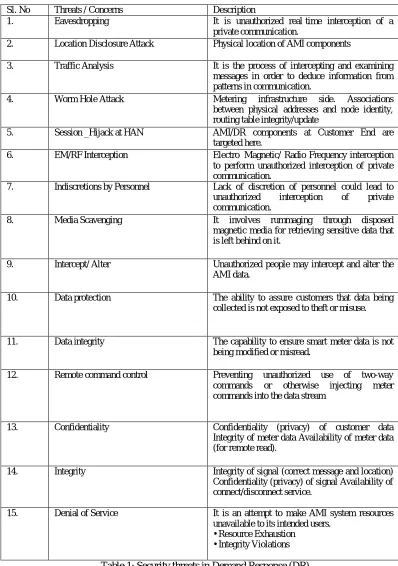
A. Security Threats in DR System11:
Sl. No Threats / Concerns Description
1. Eavesdropping It is unauthorized real‐time interception of a
private communication.
2. Location Disclosure Attack Physical location of AMI components
3. Traffic Analysis It is the process of intercepting and examining
messages in order to deduce information from patterns in communication.
4. Worm Hole Attack Metering infrastructure side. Associations
between physical addresses and node identity, routing table integrity/update
5. Session _Hijack at HAN AMI/DR components at Customer End are
targeted here.
6. EM/RF Interception Electro ‐Magnetic/ Radio Frequency interception
to perform unauthorized interception of private communication.
7. Indiscretions by Personnel Lack of discretion of personnel could lead to
unauthorized interception of private
communication.
8. Media Scavenging It involves rummaging through disposed
magnetic media for retrieving sensitive data that is left behind on it.
9. Intercept/ Alter Unauthorized people may intercept and alter the
AMI data.
10. Data protection The ability to assure customers that data being
collected is not exposed to theft or misuse.
11. Data integrity The capability to ensure smart meter data is not
being modified or misread.
12. Remote command control Preventing unauthorized use of two-way
commands or otherwise injecting meter
commands into the data stream
13. Confidentiality Confidentiality (privacy) of customer data
Integrity of meter data Availability of meter data (for remote read).
14. Integrity Integrity of signal (correct message and location)
Confidentiality (privacy) of signal Availability of connect/disconnect service.
15. Denial of Service It is an attempt to make AMI system resources
unavailable to its intended users. • Resource Exhaustion
• Integrity Violations
Vol. 4, Issue 6, June 2016
B. Solutions to address the threats and concerns
The Solution to be proposed varies from power transmission system to distribution systems and from distribution to power generating systems. In the proposed synopsis the solution discussed is more towards power distribution systems and few being common across all 3 i.e. generation, transmission and distribution.
Before starting on proceeding with solutions specific to AMI and DR we need to access the threats and perform risk analysis. Risk assessment can be classified as based on a. occurrence of such threats and b. intensity/nature of such treats.
RISK MATRIX (RM) = Minor, Major, Critical threat intensity Least, Most, Certain occurrence
Based on the combinations of these two factors the security plan can be created so that critical and certainly raising threats are well countered whereas minor and least occurred threat plans are deployed but run in rare instances.
Security plan of action for Demand Response:
Here the security plan is designed for 3 levels:
i. Cluster Nodes: Here Software based radios (SBR) / Cognitive radios are deployed & configured which is used for Messaging / Networking activities.
ii. Gateway : Wired/Wireless networks, versions and other bandwidth details iii. User Access Systems: Utility Software, SCADA etc.
Sl. No Zone of threat origins Solutions
1. Cluster Nodes Integrity validation, non-repudiation of signatures, Base station security model.
2. Gateway Audit Trail, Communication security, Key & Certification Management.
3. User Access System Auditing & Alarm, Memory Management, Configuration Management.
Table 2: DR Security plan
VI.CONCLUSION AND FUTURE WORK
REFERENCES
[1] "Federal Energy Regulatory Commission Assessment of Demand Response & Advanced Metering" (PDF). United States Federal Energy Regulatory Commission. United States Federal Energy Regulatory Commission.
[2] Smart Grid Report, http://new.abb.com/smartgrids/why-smart-grids
[3] Department of Energy, “The Smart Grid: An Introduction”, at http://energy.gov/oe/downloads/smart grid introduction.
[4] Outage Management System http://www.elp.com/transmission-and-distribution/outage-management.html
[5] Science direct aricle on AMI http://www.sciencedirect.com/science/article/pii/S0142061514003743
[6] http://www.enernoc.com/our-resources/term-pages/what-is-demand-response
[7] C. W. Gellings, The Smart Grid: Enabling Energy Efficiency and Demand Response, CRC Press, Aug, 2009.
[8] A. Carvallo, The Advanced Smart Grid: Edge Power Driving Sustainability, Artech House, June, 2011.
[9] X. Fang, S. Misra, G. Xue, and D. Yang, "Smart Grid The New And Improved Power Grid: A Survey"; accepted for publication in
IEEE Communications Surveys and Tutorials, 2012. Available at http://optimization.asu.edu/~xue/papers/SmartGridSurvey.pdf
[10] http://mycourses.ntua.gr/courses/ECE1220/document/Load_Flow_Analysis.pdf
[11] Aloul, Fadi, et al. "Smart grid security: Threats, vulnerabilities and solutions."International Journal of Smart Grid and Clean Energy1.1 (2012): 1-6.
BIOGRAPHY
Vinay Kumar Khas completed his Bachelor’s degree in Computer Science Engineering from VTU,
Karnataka. He has done his M.Tech degree in Information Technology from Mysore University. He has interdisciplinary experience of being an IT graduate & working at BESCOM, a State owned Power Distribution utility for more than 6 years. His areas of interests are Cloud Computing, SCADA and Smart Grid.
Dr.Balakrishna Ris a research scholar & HOD, Department Science, RRCE, Bangalore, Karnataka,