1
On the Dynamics of Rotationally Supported Galaxies
Ramzi Suleiman 1-4, *
1Triangle Research & Development Center (TRDC), Israel. 2Acuura-c LTD, Haifa, Israel.
3 Dept. of Philosophy, Al Quds University, Palestinian Authority. 4 Dept. of Psychology, University of Haifa, Israel, Israel.
* Email: [email protected]
Abstract
A recent finding, based on empirical data of 153 rotationally supported galaxies, with very different morphologies, masses, sizes, and gas fractions, revealed that the baryonic and the dark matter in galaxies are strongly coupled, such that, if the first is known, the second follows and vice versa. Here, we propose a completely theoretical analysis of the dynamics of rotationally supported galaxies, which results in the same conclusion. We find that the relationship between baryonic and dark matter densities at any radius r is governed by the law, 𝜌(𝑟) + 𝜌(𝑟) = 𝜌 , where 𝜌(𝑟) , and 𝜌(𝑟) are, respectively, the densities of matter and dark matter at radius r, and 𝜌 is the density at the galaxy’s center. Strikingly, we also found that the radius 𝑟, at which the rotation velocity is equal to half of its maximal value, constitutes a vivid signature of the galaxy, in the sense that it reveals rich information about the galaxy’s dynamics, including the distribution of its matter and dark matter and their total amounts in the galaxy.
Keywords: Dark matter; galaxies; galaxy rotation curve; radial acceleration relation.
2 1. Introduction
It is well-established observationally that a galaxy’s rotation curves typically rise from the galactic center in a small core and then bend down to reach an approximately constant value, extending to the galactic periphery [1] [2] [3] [4]. The flattening of a galaxy’s rotation curves is compelling evidence for the existence of large “missing” masses, conjectured to be the masses of dark matter halos (e.g., [5] [6] [7] [8] [9]). Recently, it was found, based only on data of 153 rotationally supported galaxies, with very different morphologies, masses, sizes, and gas fractions, that “when 𝑔 (the rotational acceleration due to baryons) is observed, 𝑔 (the observed rotational acceleration) follows, and vice-versa” [10]. The discovered radial acceleration relation is described as “tantamount to a natural law for rotating galaxies” [10]. In the framework of the dark matter paradigm, this discovery implies that the dark matter contribution to a galaxy’s mass is fully specified by that of the baryons and vice versa. The discovered law poses serious difficulty for the standard cosmological ΛCDM paradigm because simulations of galaxy formation based on this model, which assume dark matter halos in which galaxies form, do not naturally lead to realistic galaxies [10] [11] [12]. It also points to the possibility of a “new ‘dark sector’ physics,” in which “the dark matter needs to respond to the distribution of baryons (or vice versa) in order to give the observed relation” ([10], p. 5).
3 2. The Model
Our model is based on a recently proposed relativistic modification of Newtonian mechanics, accomplished only by accounting for the fact that any information carrier, including light waves, takes time to travel between two points in the 3D space [13]. Incorporating this fact into Newton’s dynamics “relativizes” classical physics, without adding any axioms or free parameters. The rationale behind our correction of classical physics is simple and straightforward. If point B moves away from point A, then the delay of a light signal traveling from B to A becomes continuously longer and longer. In contrast, if B moves toward A, then the time delay of the signal’s arrival from B to A becomes continuously shorter and shorter. In [13], we utilized the aforementioned modification to make inferences about the intergalactic dark matter, which is ill understood as some kind of negative vacuum “dark energy.” Here, we extend the model to the case of a homogeneous, purely gravitational rotating disk, although similar extensions for spheroidal and elliptical rotating bodies are also tractable. For the discussed case, the derived densities of matter and dark matter as functions of the rotation velocity (see Section A of the Supporting Information) are given by
( )
= ( )
( ) , (1) ( )
= ( )
( ) , (2)
where r is the radius, 𝛽(𝑟) = ( ), and 𝜌 is the Newtonian density, which equals the baryonic density at the galaxy’s center at which 𝛽(0) = 0. Note that
4
The theoretical relationship in Eq. (3) is concordant with the empirical radial acceleration law. Not only does it support the law, it also specifies the exact dependence of the density of baryonic matter in a galaxy on its dark matter and vice versa.
The energy densities (see Section A of the Supporting Information) are given by
( )
=
( )( )
𝛽
2
(
r
),
(4)( )
=
( )( ) , (5)
where 𝑒 is the Newtonian energy density: 𝑒 = 𝜌 𝑐 . The total energy density at a given radius r is equal to:
𝑒
(𝑟) = 𝑒 (𝑟) + 𝑒
(𝑟)
=
𝑒
𝛽
(
r
)
= 𝜌 𝑐𝛽
(
r
)
= 𝜌𝑣
(
r
),
(6)which, if solved for v(r), yields
v(r) =
𝑒
(𝑟)
. (7)A useful method for investigating a galaxy’s structure is to approximate the measured rotation curves by idealized mathematical curves. One idealization, proposed in [14], is the exponential function
( )
= (
1−
𝑒
),
(8)5
interpretation for; the same applies to the functions derivatives with respects to r. Here, we propose another idealization of measured rotation curves, which shares similar features with the function in Eq. (8) but has a nice physical symmetry. The alternative function we propose is the power function
( )
= (
1−
2
).
(9)A nice symmetry of the proposed idealization is
v
(
r =
𝑟
) =
. (10)The promise of the beauty of Eq. (10) in its utilization in the proposed model will be evidenced hereafter. For simplicity, we normalize the rotation curve by assuming
𝑉
= 1. Substituting the normalized velocity term from Eq. (9) in Eqs. (1), (2), (4), and (5) yields(𝑟̃) = ( )
( ) , (11)
(𝑟̃)= ( )
( )
,
(12)(𝑟̃) = ( )
( )
(1 − 2
̃
)
, (13)(𝑟̃) = ( )
6
Figure 1. Normalized velocity, matter, and dark matter densities as a function of
.
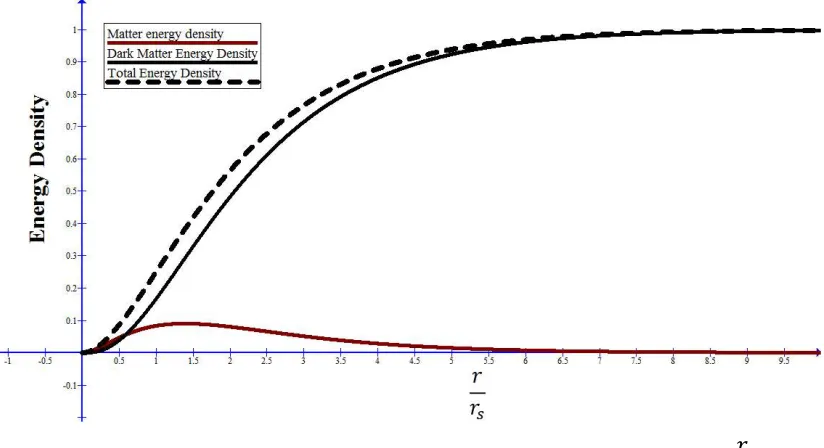
Figure 2. Matter and dark matter energy densities as functions of .
7 (𝑟 = 𝑟 ) =
(
)
(
)
=(
)
(
)
= = , (15)and
(𝑟 = 𝑟 ) =
(
)
(
)
=.
123 2
= . (16)
The total amount of matter within radius r is given by
M (≤
𝑟
) = 𝜌∫
( )( )
dr
= 𝜌𝑟 ∫
̃ ( ( ))𝑑𝑟̃
= 𝜌 𝑟 ⎜ ⎜ , (17)
which, for r→
∞
, yields a total amount of matter equaling𝑀 = lim
→
M (≤ 𝑟)
=𝜌
𝑟
.
(18) The total amount of dark matter within radius r is given byDM (≤r) =
∫ 𝜌
𝑑𝑟
=∫ (𝜌
− 𝜌
) 𝑑 𝑟
=𝜌
r
-
∫ 𝜌
𝑑 𝑟
=
𝜌
r
-
𝜌
𝑟
⎜ ⎜=
𝜌
(
r
-
𝑟
⎜ ⎜) .
(19)8
which coincides in our model with the distance at which the densities of matter and dark matter are equal. From Eq. (11), we have
(r = 𝑟) = ( )
( )
= , (20)
which solves for
𝑟 = ( )
( ) ( )𝑟 ≈ 1.709511 𝑟 . (21)
Interestingly the radius at which the energy densities of matter and dark matter are predicted to be equal, is 𝑟 . This surprising result could be easily verified by solving for
𝑟
∗,
which satisfies (𝑟∗) = (𝑟∗), or( ∗ ) ( ∗ )
(1 − 2
)
= (∗
)
(
∗ )
, (22)
which solves for
𝑟∗
=
( ) ( ) ( ) 𝑟 =( ) ( )
( )
( )
( ) ( ) 𝑟 = 𝑟 . (23) Thus, independently from measurements, we find that the radius at which the energy of matter is predicted to be half of the total energy is the famous core radius 𝑟 . 3. Model Testing
We tested the derived predictions using the data of the three large spiral galaxies in the local group: The Milky Way, Andromeda (M31), and Triangulum (M33). The mass of the Milky Way bulge, disk, and halo is estimated to be 𝑀 = 1.652 x 10 𝑀⊙, 𝑀 = 3.41 x 10 𝑀⊙, and 𝑀 = 6.524 x 10 𝑀⊙ [15], respectively, with a total mass equaling 𝑀 ≈
7.03 10 𝑀⊙. The galaxy’s disk core radius and maximal rotation velocity are estimated
9
6.9 x 10 𝑀⊙, and 𝑀 =1.5 x 10 𝑀⊙, respectively [15]. The diameter of Andromeda at
the widest point is estimated to be 67.45 ± 0.92 kpc. Andromeda’s core radius equals 𝑟 = 1.0 ± 0.2 kpc, and its maximal rotation velocity is about 𝑉 = 260 km sec-1 [16] [17].
Triangulum (M33) has an estimated disk mass of (3–6) x 10 𝑀⊙ and a gas component
of about 3.2 × 10 𝑀⊙, amounting together to a baryonic mass of (6.2 - 9.2) x 10 1010𝑀⊙.
The contribution of the dark matter component up to a radius of 17 kpc is about 5 ×
10 𝑀⊙ [18]. Triangulum’s core radius equals 𝑟 = 1.39 ± 0.04kpc, and its maximal
rotation velocity is about 𝑉 = 105.4 ± 6. km sec-1 [19] [20].
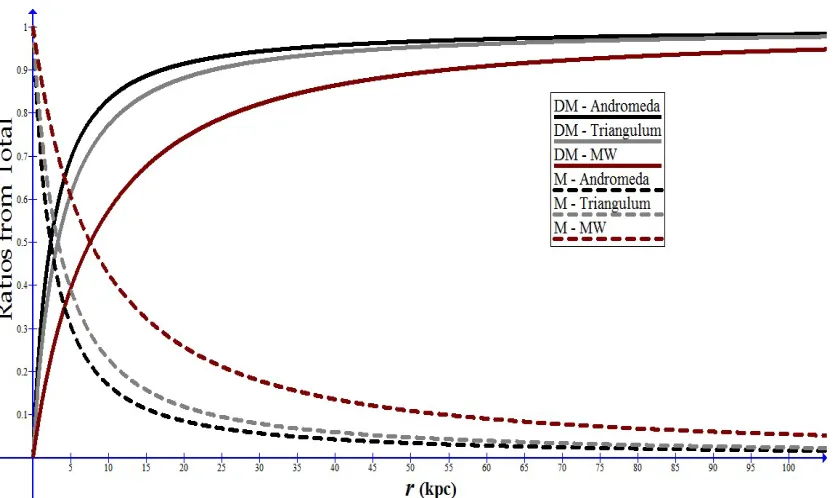
According to the above-quoted measurements, the percentages of the total dark matter in the Milky Way and Andromeda are, respectively, about 92.8%, and 99.3%; for Triangulum up to 17 kpc, the percentage of dark matter is about 86.7%. Figures 3 depicts the theoretical rotation curves of the three galaxies as functions of the distance r from their centers. Figures 4 and 5 depict, respectively, the matter and dark matter densities and cumulative distributions as functions of r.
10
Figure 4. Matter and dark matter density distributions in three galaxies as functions of r.
11
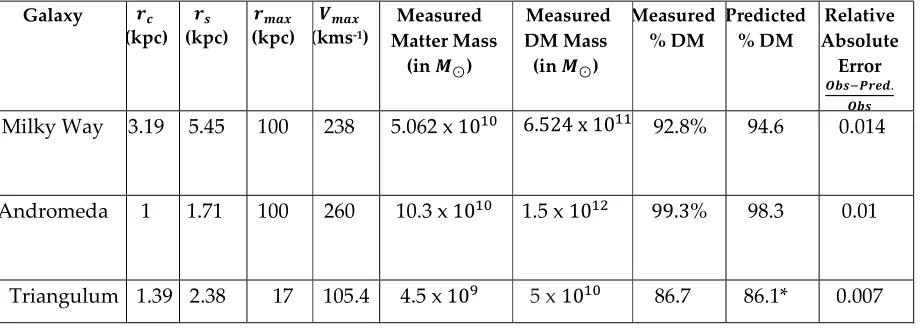
Table 1 depicts the relevant parameters for the three investigated galaxies, together with the prediction of the percentages of dark matter out of the total mass in each galaxy within given radii. As shown in the right-hand column of the table, the absolute prediction errors for all three galaxies are small, with a mean error of ≈ 0.01. The dependence of the predicted percentage of dark matter, on the scale radius 𝑟, is captured by the simple linear equation:
% DM = 100 - 𝑟 . (24)
Table 1
Comparison between Measured and Predicted Proportions of Dark Matter
Galaxy 𝒓𝒄
(kpc) (kpc) 𝒓𝒔 (kpc) 𝒓𝒎𝒂𝒙
𝑽𝒎𝒂𝒙
(kms-1) Matter Mass Measured
(in 𝑴⊙)
Measured DM Mass
(in 𝑴⊙)
Measured
% DM Predicted % DM Absolute Relative Error
𝑶𝒃𝒔 𝑷𝒓𝒆𝒅. 𝑶𝒃𝒔
Milky Way 3.19 5.45 100 238 5.062 x 10 6.524 x 10 92.8% 94.6 0.014
Andromeda 1 1.71 100 260 10.3 x 10 1.5 x 10 99.3% 98.3 0.01
Triangulum 1.39 2.38 17 105.4 4.5 x 10 5 x10 86.7 86.1* 0.007
* For r = 100kpc the model’s prediction for Triangulum is ≈ 97.6%
4. Concluding Remarks
12
acceleration relationship. It does so by specifying the exact relationship type, as captured in Eq. (3). The emerging dependence between the densities of baryonic matter and dark matter in galaxies turned out to be linear and beautifully simple.
An important feature of the proposed model, in addition to being a completely theoretical, axiom-free, and parameter-free model, is that the predicted dark matter component in galaxies is emergent from the model and not presupposed in it. This feature is diametrically opposed to the assumption of the standard dark matter paradigm that galaxies form within a presupposed dark matter halo. Our model prescribes that dark matter emerges from baryonic matter due to its rotation velocity. As shown by Eqs. (11) and (12) (see also Figure 1), the density of dark matter as a function of r is a tracer of the rotation velocity v(r). This feature of provides a plausible explanation for why the bulk of dark matter in galaxies resides at the galaxies halos, where the rotational velocity reaches its maximal value.
An intriguing testable prediction arising from the theoretical analysis detailed in the previous section is that one measurement, namely, the scale radius 𝑟, at which the rotation velocity becomes equal to (or, alternatively 𝑟, at which the density of baryons is equal to
)
is sufficient for revealing very rich information about the galaxy, including the distributions of matter and dark matter in the galaxy as functions of the distance from its center, and the proportions of matter and dark matter, out of the total amount of matter in the galaxy. Our test described in Section X gives strong support to this prediction. However, a more convincing test, using a significantly larger number of rotationally supported galaxies, with different morphologies, sizes, etc., is called for.13
between two points in three-dimensional space. Second, our model is concordant with the standard cosmological model.
Finally, the simple and beautiful symmetries pertaining to the relationships between matter and dark matter are difficult to ignore. If supported by empirical evidence, they could stand out as another significant example of the simplicity and beauty by which nature organizes itself.
References
[1] Rubin, V. C., & Ford, W. K., Jr. ApJ, 159, 379 (1970). [2] Roberts, M. S., & Whitehurst, R. N. ApJ, 201, 327 (1975).
[3] Bosma, A. The distribution and Kinematics of Neutral Hydrogen in Spiral Galaxies of Various Morphological Types, Ph.D. Thesis, Groningen Univ. (1978).
[4] Rubin, V. C., Ford, W. K. J., & Thonnard, N. ApJ, 238, 471 (1980). [5] Oort, J. Bull. Astron. Inst. Netherlands, 6, 249 (1932).
[6] Bosma, A. 1981a, AJ, 86 (1791).
[7] Bahcall, J. N. & Casertano, S. Some possible regularities in the missing mass problem. Astrophysical Journal, Part 2 - Letters to the Editor, 293, L7-L10 (1985). [8] Rubin, V. C., Waterman, A. H., & Kenney, J. D. P. AJ, 118, 236 (1999). [9] G. Bertone, D. Hooper, and J. Silk, Phys. Rep. 405, 279 (2005).
[10] McGaugh, S. S., Lelli, F., & Schombert, J. M. The Radial Acceleration Relation in Rotationally Supported Galaxies. Physical Review Letters, 117(20) (2016).
DOI: 10.1103/PhysRevLett.117.201101.
[11] W. J. G. de Blok, Advances in Astronomy, 789293 (2010), arXiv:0910.3538. [12] S. S. McGaugh, Canadian Journal of Physics, 93, 250 (2015), arXiv:1404.7525. [13] Suleiman, R. A model of dark matter and dark energy based on relativizing Newton’s physics. World Journal of Condensed Matter Physics, 8, 130-155 (2018).
14
[15] Sofue, Y., Grand rotation curve and dark matter halo in the Milky Way galaxy, Publ.
Astron. Soc. Japan, 64, 75 (2012).
[16] Kafle, P., et al. The need for speed: Escape velocity and dynamical mass measurements of the Andromeda galaxy. Monthly Notices of the Royal Astronomical Society. 475 (3): 4043–4054 (2018).
[17] Courteau, et al. The luminosity profile and structural parameters of the Andromeda galaxy, The Astrophysical Journal, 739 (1) [16 pages] (2011).
[18] Corbelli, E. Dark matter and visible baryons in M33. Monthly Notices of the Royal
Astronomical Society. 342 (1): 199–207 (2003).
[19] Seigar, M.S. The dark matter halo density profile, spiral arm morphology, and supermassive black hole mass of M33. Astronomy and Astrophysics, 8 pages (2011). doi:10.5402/2011/725697.
[20] Yoshiaki S. Rotation and mass in the Milky Way and spiral galaxies. Publ. Astron.
Soc. Japan, 69 (1), R1, 1–35 (2017). doi: 10.1093/pasj/psw103.
[21] Milgrom, M. A modification of the Newtonian dynamics as a possible alternative to the hidden mass hypothesis. Astrophys. J. 270, 365–370 (1983).
15
Supporting Information
Section S1. Derivation of the Expressions of Matter and Dark Matter Densities for a Rotating Thin Disk
. To probe the dynamics of matter/dark matter of a rotating disk, assume a uniform disk with rest mass density 𝜌 and rest radius of 𝑅 . To avoid unnecessary complexities, we assume that the disk is placed on the (x, y) plane and rotates around the z axis with constant angular velocity (see Fig. 1).
Figure S1. A uniform rotating disk.
In a previous article [S1], we applied our relativistic extension of Newtonian dynamics to the case of a rectilinearly receding body (e.g., a galaxy) along the line-of-sight of a stationary observer. The analysis gave rise naturally to a component of dark matter, which exists in duality to the receding body’s observable matter. We derived transformations for time, length, and matter and dark matter densities as well as their respective energy densities, as functions of the body’s recession velocity relative to a stationary observer. Here, we extend the model to infer about the dynamics of matter/dark matter at galactic scales. Without compromising the generality of our approach, for the sake of simplicity, we analyzed the relativistic dynamics of a homogeneous, purely gravitational rotating disk. However, the model could be applied without much difficulty to rotating bodies with different morphologies. To derive the dynamical equations of matter/dark matter duality for the case of a rotating
r
R
𝒗
𝒎𝒂𝒙z
16
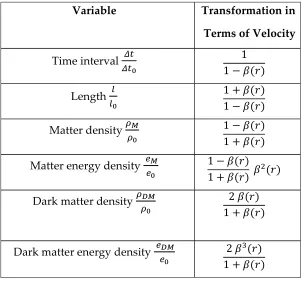
disk, we utilize a theoretical result indicating that that the rectilinear and rotational types of motion are dynamically equivalent [S2] [S3]. Thus, from the standpoint of a nonrotating frame of reference, the equations of motion of a rotating body of mass with constant radial velocity ω, could be written directly from the equivalent equations derived above for rectilinear motion with constant velocity v. Utilizing this equivalence, the relativistic expressions for relevant physical variables for the case of circular motion are depicted in Table S1.
Table S1
Relativistic Expressions for an Inertial Rotational Motion
In the table, 𝜌 is the Newtonian (rest) mass density, i.e., the density at the disk center where v(r) = 0, β(r) = ( )
, and is the Newtonian kinetic energy density
(𝑒
= ρ0 𝑐 ).Variable Transformation in
Terms of Velocity
Time interval 1
1 − 𝛽(𝑟)
Length 1 + 𝛽(𝑟)
1 − 𝛽(𝑟)
Matter density 1 − 𝛽(𝑟)
1 + 𝛽(𝑟) Matter energy density 1 − 𝛽(𝑟)
1 + 𝛽(𝑟) 𝛽 (𝑟)
Dark matter density 2 𝛽(𝑟)
1 + 𝛽(𝑟)
17
Section S2. Comparison between Two Possible Idealizations for Galactic Rotation Velocities
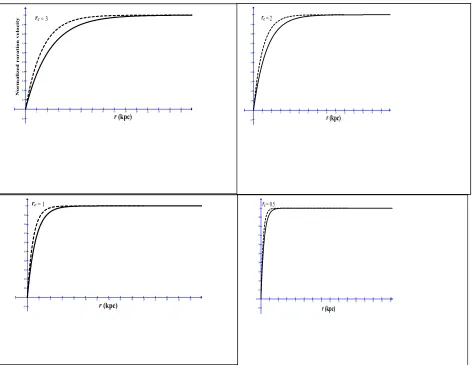
Figure S1 depicts two idealizations for galactic rotation curves for some hypothetical core radii: The exponential (power of e) function suggested in [S4] (dashed lines), and the power of 2 function proposed by us (full lines). As shown in the figures, the two functions behave quite similarly, i.e., they rise at lower r values and flatten at higher r values. A comparison between the figures in the four panels shows that the difference between the two functions is larger for large 𝑟 values and quite insignificant for small ones.
Figure 1. Comparison between two theoretical approximations of a galaxy’s rotation curve. 2 4 6 8 10 12 14 16 18 20 22 24 26 28
-0.1 0.1 0.2 0.3 0.4 0.5 0.6 0.7 0.8 0.9 1
r (kpc)
N o r m a li z e d r o r a ti o n v e lo c it
y rc= 3
2 4 6 8 10 12 14 16 18 20 22 24 26 28 -0.1 0.1 0.2 0.3 0.4 0.5 0.6 0.7 0.8 0.9 1
r (kpc)
= 2
rc
2 4 6 8 10 12 14 16 18 20 22 24 26 28 -0.1 0.1 0.2 0.3 0.4 0.5 0.6 0.7 0.8 0.9 1
r (kpc)
= 1
rc
2 4 6 8 10 12 14 16 18 20 22 24 26 28 30 -0.1 0.1 0.2 0.3 0.4 0.5 0.6 0.7 0.8 0.9 1
r (kpc)
= 0.5
18 References
[S1] Suleiman, R. A model of dark matter and dark energy based on relativizing Newton’s physics. World Journal of Condensed Matter Physics, 8, 130-155 (2018).
[S2] Suleiman, R. Circular and rectilinear Sagnac effects are dynamically equivalent and contradictory to special relativity theory. Physics Essays, 31 (2), 215 -218 (2018).