The Palestinian Experience in Developing The Banking System
Riyad Mustafa Abu Shehadeh
Introduction
The Palestine Monetary Authority (PMA)"the emerging Central Bank of Palestine" and the banking system in Palestine emerged after the initiation of the peace processes in the early 90's. But, due to the prevailing conditions of very unique economic and political circumstances in Palestine, the experience of the (PMA) is considered to be very different from other supervisory authorities.
The Israeli occupation has created many challenges to the Palestinians including political, economical and social life. This has created additional risks for the Palestinian banking system that made it necessary for the PMA to act in an efficient and systematic manner in order to mitigate those risks. The PMA has gone through deferent stages. During mid-nineties the legal infrastructure was laid down through issuing the PMA law in 1997. Starting the year 2000- 2005 the banking supervising role was enhanced and the banking law was issue. Capacity building in the area of banking supervision was give great importance. During 2005-2012 all the weak banks were restructured, merged, liquidated or rehabilitated.
This paper aims to shed light on the most important risks and challenges that are faced by the PMA and the Palestinian banking system as well as the mitigation measures taken to minimize their impact on the stability of the banking system and the Palestinian economy.
Challenges and Risks
1- Limited control:the Israeli occupation has left the new emerging Palestine National Authority with limited control overland, borders, water and natural resources. This has affected all spheres of the Palestinians' life. This has negatively affected the PMA and the banking system in the areas of business continuity, liquidity management and spreading banking services to all the geographical areas.
2- Economic interconnectedness:the Palestinian economy is very much connected to and impacted by the Israeli economy.95% of the Palestinian imports are made from Israel and other imports get to Palestine through the Israeli ports1.
3- Siege and checkpoints2:the Israeli siege and hundreds of checkpoints across the West Bank have severely affected the free movement of goods, services and people. It is even negatively impacting the movement of daily cash liquidity needs by the banking system from one city to another.
4- Splitting the Palestinian areas: splitting of the Palestinian areas into 3A , B and C, continued incursions, land confiscation and continued settlements building have resulted into huge financial losses to the Palestinian people and the Palestinian economy.
5- Violation of the signed agreements:Israel continuously violated the signed agreements with the PalestinianNational Authority(PNA) including Paris Economic Accord4. Israel has many times
1All sea and land borders are controlled by Israel 2
Hundreds of Israeli check points on the roads are barrier to the free movement of people, goods and services.
3
Areas are split according to the authority and jurisdiction, where A areas are the only one with full control by the PNA.
4
International Journal in Management and Social Science (Impact Factor- 4.358)
suspended the transfer of the Palestinian tax revenues that are collected by Israel on behalf of the (PNA)5. This has made it very difficult for the PNA to meet their financial commitments. 6- Clearing New Israeli Shekel (NIS) transactions:to clear the NIS transactions between the
Palestinians and the Israelis, the PMA needs to open an account at the Bank of Israel (BoI) and have membership in the Israeli Clearing House representing all the Palestinian banks. However, this has not been approved till date despite being stipulated in Paris Economic Accord. The Palestinian banks as well are not allowed to participate in the Israeli clearing house directly. They are represented by the Israeli banks. This has on several occasions affected the smooth functioning of the correspondent relations.
7- Excess NIS Liquidity6:The Israeli banks do not easily accept excess shekel cash from the Palestinian banks. They also stopped all banking transactions with Gaza based 54 branches since 2007-2008 after the Israeli government declared Gaza as a hostile entity. The Palestinian banks are incurring huge losses due to such Israeli policy.
8- The split between West Bank and Gaza: after 2007 Hamas7 controlled Gaza Strip8 whereby the PNA maintains full control over the West Bank. This has negatively affected the Palestinian efforts to achieve full independence and exert full control all over Palestine. It has added more difficulties and additional risks to the smooth functioning of the Palestinian banking system in Gaza.
9- Absence of a National Currency: the prevailing political and the economic situation and non-control of boarders have so far prevented the issuance of the Palestinian currency. There are four currencies in circulations in Palestine; US dollar, New Israeli Shekel (NIS), Jordanian Dinar (JOD) and the EURO). This has created huge currency and foreign exchange risks to the banking system and made Palestine vulnerable to the imported inflation from the issuing countries of those currencies.
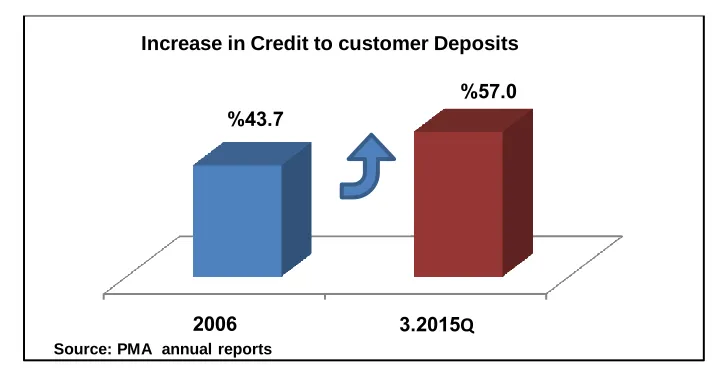
The absence of the Palestinian national currency limits the PMA's ability to have its' own monetary policy and the Palestinian economy loses hundreds of millions of dollars asseigniorage revenues.The use of different currencies and absence of national currency has made it necessary for the Palestinian banks to invest major portion of their assets outside Palestine and implement conservative lending policies. This deprives the Palestinian economy from an important financing source that can help boost the Palestinian economic growth. Despite the fact that the credit\ deposit ratio is around 57%, but it is still very low compared to many countries in the region where the ratio exceeds 100% in some countries.
10-Political Instability: the continued halt in the peace talks and the political instability have resulted into a huge political risk. This has negatively affected the capital flow into Palestine. It has as well forced adoption of conservative banking policies.
The above mentioned, complicated and difficult challenges have required extensive and extra ordinary efforts to maintain the soundness, efficiency and stability of the Palestinian banking system. It is noted that the PMA has set up a comprehensive strategy to mitigate those risks aiming to safeguard the depositors' money, enhance financial inclusion, spread banking services all over Palestine and safeguard the stability of the banking system.
The PMA could succeed in mitigating those risks and maintain stability of the banking system through the following two parallel tracks:
5
Israel suspends tax transfer collected on its borders on behalf of the PNA.
6
As per Paris Economic Accord Israel should receive Excess NIS from the PNA in an exchange of US Dollars.
7Hamas Islamic Movement 8
1-
Capacity building:soon after inception a huge investment was made by the PMA aiming to enhance competence and skills of its human capital and improvement of the supervisory tools. Aiming to transform the PMA into a fully fledge central bank a Strategic Transformation Plan9 (STP)was adopted. Under the (STP)the following was achieved:A- PMA restructuring: the PMA'sorganizational structure was developed to have two groups. The Financial StabilityGroup10 and the Monetary Stability Group11in addition to the support Function Departments. Independent offices affiliated to the board were also created online with governance best practices. The PMA's senior staff was appointed on merit and on competition basis.
B- Development of the legal and regulatory infrastructure:To be consistent with best international practices in the field of banking and supervision, the PMA has revisited all laws, regulations and instructions published to the institutions under it's' supervision. Many new laws and regulations that are consistent with best practices tailored to the Palestinian environment were developed. The Anti-Money Laundering 12 and new Banking Laws13consistent with the Basel Core Principles for Effective Banking Supervision were decreed. National Payment System Law14 was also issued. The Palestine Deposit Insurance Law15 was also decreed to enhance the safety network, safeguard depositors' money and maintain financial stability. Forex Prohibition Law16 was also issued to protect and safeguard people's savings due to the huge losses that people incurred while dealing in Forex.
The needed Presidential Decrees17were also issued such as the Money Changers Regulation18that aimed to safeguard this sector, enhance its governance and set the necessary legal grounds for anti-money laundering.
The Microfinance Institutions Regulation19was also issued aiming to safeguard, maintain soundness and efficiency of this sector and enhance the governance practices. The PMA has as well developed all necessary regulations in consistency with the recommendation of Basel Committee on Banking Supervision20 (BCBS), such as stress testing, fair lending, risk management, credit risk management, remuneration and incentives, bank merger, pro-cyclicality reserves, external auditing… etc. In the area of payment system the PMA has developed the Palestinian Real Time Gross Settlement system (RTGS) called (Buraq21) to enable banks issue payment orders with minimum operational and liquidity risks. The National Switch22 is also being developed.
9
The PMA embarked on this plan with the help of IMF.
10 It is consistent of the Banking supervision department, the Payment System Department and the Market
Conduct and Discipline Department.
11
It is consistent of the Monetary Operations Department and the Research and statistics Department.
12
This law was decreed in 2007 with the technical assistance of the IMF.
13 This law was decreed in 2010 with the technical assistance of the IMF to maintain compliance with BCBS core
principles.
14 This law was decreed in 2012 as a basis for a modern payment system.
15 This law was decreed in 2013 with the technical assistance of the World Bank as to enhance the safety network. 16This law was decreed in 2007 aiming to safeguard investors in the foreign commodities market.
As per the PMA law such decrees need to be adopted by the president.17
This regulation setsthe legal basis for the licencing and supervision of the moneychangers.18
19
This regulation sets the legal basis for the licensing and supervision of the microfinance sector. Basel Committee on Banking Supervision.20
21 The PMA's clearing system. 22
International Journal in Management and Social Science (Impact Factor- 4.358)
C- Rehabilitation of the banking system and improve access to finance:
i. Rehabilitation of weak banks:the PMA paid great attention to the rehabilitation of weak banks. Time frame oriented rehabilitation programmes were adopted and capitalization of those banks was enhanced. Some banks were restructured, others23were liquidated and some others24were successfully rehabilitated.
ii. Enhance governance practices:in the year 2008 the PMA has issued the first governance code ever in Palestine aiming to enhance governance practices in the banking system, safeguard stability of the banking system, protect depositors and shareholders, safeguard financial and economic stability, enhance customers trust in the banking system, encourage investment, mobilize savings, attract new capital, minimize financial risks and increase the market value of banks. A new governance code was issued in 2014 inline with the new sound governance principles issued by (BCBS).
iii. Improve the human capital: the PMA has paid attention have a very qualified staff in the banking system. The PMA required banks to have a policy for hiring, promotions, termination and resignation of its staff as well as the minimum qualifications required to be appointed as a senior staff. The PMA has also played pivotal role in introducing professional certification in many banking fields through the Palestine Banking Institute (PBI)25.
iv. Improve access to finance: the PMA adheres to Maya declaration26 for financial inclusion. The PMA has done a lot to improve access to finance aiming to enhance financial inclusion, improve financial services and improve the banking knowledge and culture. To achieve those aims, the Market Discipline and Customer Relations Department was established. This department is in-charge of the Credit Bureau, Bounces Check system, the Credit Scoring, the Mortgage Database and it is also in- charge of financial literacy and education. The PMA was instrumental in changing the school's curriculum and incorporate materials on banking and finance.
v. Enhance local and international relations: the PMA plays active role locally, regionally and internationally. It succeeded to maintain a very good business relation with the World Bank, the International Monetary Funds, the International Association of Deposit Insurers and Islamic Financial Services Board. It has signed memorandum of understanding with different counterparties locally and internationally like the Palestine Capital Market Authority (PCMA), Central Bank of Jordan (CBJ), Central Bank of Egypt (CBE), BankalMaghreb (BM), and Central Bank of Algeria (CBE) to maintain home and host relations and exchange of expertise in the different supervisory fields.
2-
Risk and Crises Management:Due to the unique circumstance of Palestine and the very different prevailing risks as most of the risks that are faced by Palestinian banking system are derived from the political risks, the PMA has taken lots of steps to control and mitigate those risks. Those steps are explained below:A. Strategic planning:the PMA has adopted the scenario planning27and always took into consideration the political environment. This has helped to develop the basis to decide on
233 banks were liquidated 24
3 banks were rehabilitated.
25Established through the banking contributions. It hosts training and certification for the banking system
personnel to enhance their expertise and capabilities.
26
It is the first global commitment by policymakers from developing and emerging countries to unlock the economic and social potential of the poor through greater financial inclusion.
27
the best suitable reaction under each scenario a head of time which is better than taking decisions under stress and panic.
B. Business continuity and alternative sites:the PMA has developed its own business continuity plan28 and the alternative site (AS)29. This has made it possible to maintain minimal operational risks and enabled PMA to perform and carry out its operations in the time of crisis and disaster. The PMA has also paid attention to the business continuity of the banking system due to the unique and unstable conditions in Palestine. The PMA has issued the necessary business continuity regulation in 2009 and directed the banking system to establish their business continuity plans and the alternative sites. This has proved very efficient30 during 2010,2011 Wars against Gaza.
C. Spreading of banking services:the PMA during last 8 years has almost doubled31 branches of the banking system aiming to spread banking activities all over Palestine including rural and urban areas. This has helped the Palestinian people overcome obstacles and barriers imposed by the Israeli occupation and have access to the banking activities nearest to their places.
D. Settlement and clearing: due to the Israeli incursions the PMA on several occasions had to execute the clearing and settlement operations in the different governorates through predetermined centers32.
E. Cash liquidity: the liquidity positions in all currencies and all branches are being monitored on daily basis33. Minimum liquidity requirement is imposed by the PMA to meet the public and depositors' withdrawal needs.
F. Credit registry34 development: the credit to deposit ratio was historically very weak. It was around 20%. The PMA has done a lot to improve it. It has developed an online 24\7 credit registry. This enabled the banking system to better manage their credit risk and thus extend more credit. After almost seven years of launching the credit registry this ratio has reached 57% despite the very difficult economic and political situation.
G. Enhance banks capitalization: the PMA aims to enhance ability of banks to face risks and absorb unforeseen losses in Palestine. To achieve this goal the minimum capital requirement was increased to 50 million US dollars. Recently it was increased to 75 million US dollars35. Some banks were required to even have more capital due to being Systemically Important Financial Institutions (SIFIS)36 or in the light of stress testing results. H. Half yearly stress testing: to cope up with the best practices and maintain solid and safe
banking system that can absorb shocks in the time of stress, the PMA has required banks to perform half yearly stress tests consistent with BCBS recommendations.
28
A plan set to maintain the critical business running under disaster conditions.
29The site that hosts the pre-identified critical staff as to maintain the operations under disaster scenarios. 30Banks maintained business efficiently and effectively even under the War conditions.
31In 2007 total branches was 160 and by the third quarter on 2015 it reached 274 branches. 32
Universities or banks headquarters in different cities.
33Cash liquidity in the 4 currencies on branches level is being monitored daily. 34
24/7 online and zero based credit registry with borrowers information is run by the PMA.
35
PMA issued circular no. 100/ 2015 on 15/7/2015 setting 3 years period for banks to raise capital up to 75 million USD.
36
International Journal in Management and Social Science (Impact Factor- 4.358)
I. Outside placements: the PMA has set up limits on the outside placements37 to maintain low country risk, currency risk, counterparty risk and concentration risk; this has helped the banking system escape the impact of the international financial crises.
J. Relations with the banking system:the PMA maintains very good business relation with the banking system whereby consultative meetings38 take place on regular basis to discuss the major banking and supervisory issues. Draft instructions are sent to the banking system for their input and feedback before officially issued and become binding.
K. Relations with the Israeli banks: the NIS is used for daily transactions and it is very important to maintain smooth corresponded relations with the Israeli banking system. The PMA managed to demonstrate the adherence to the best international practices in the area of Anti Money Laundering. This has helped the Palestinian banking system to overcome obstacles in the correspondent banking relations.
L. Money changers sectors supervision: before establishment of the banking system, some big money changers acted as banks whereby they accepted deposits and gave loans. After establishment of the PMA, it required some time for the PMA to stop such inherited culture and redirect all deposits to the banking system only.
M. Development of national payment system:it was very critical to develop this system as an essential step towards the use of electronic payments in Palestine and set the grounds to perform irrevocable and final electronic settlements for the banking system and financial institutions. It also provides the legal basis for the electronic clearing between banks using check imaging and electronic signature. This minimizes risks, enables smooth functioning and provides the legal grounds for efficient and effective payment system.
Results and Achievements
The over mentioned measures taken by the PMA have contributed to the growth of a sound banking system and the development of the Palestinian economy in general. This can be easily observed through the following financial stability, financial inclusion and growth indicators:
1- Financial Stability Indicators:
A-
Regulatory Capital: the capital is the first defense line against different types of risks. As per Basel norms the minimum regulatory capital adequacy ratio is 8%. The PMA has incremetally increased the paid up requirement. By the September 2015 the Palestinian banking system capital adequacy ratio reached 17.8% which is much higher than determined by Basel norms. This indiactes the soundness of the banking system in Palestine.B-
Non-Performing Loans: the decline in the non- performing loans as a percentage of gross loans from 14.4% since 2006 to 2.5% by end of September 2015 is another indicator on the soundness of the banking sector and the better management of credit risk.C-
Continued growth in the main indicators:Since 2006 till the end of September 2015 all the main indicators continued to grow. The paid up capital grew by 99.6%, the private sector deposits grew by 129.8%, the ownership equity grew by 139.1% and the private sector loans grew by 212.5%.
2- Financial Inclusion Indicators: 37Investments outside Palestine. 38
A- Increased Credit/ Customers Deposits: the measures taken by the PMA in promoting financial inclusion, i.e the establishment of the credit registry has contributed to increased credit/ customers' deposits ratio. Please see figure 1below:
Figure 1
B- Increasing Branches: the PMA has embarked on a new branching policy aiming to spread the banking services to the rural and urban areas as to serve all the geographic sectors in Palestine especially the unbanked. This has increased the number of branches and offices by almost 84% since 2006 till the end September 2015. Please see the chart1 below:
chart 1
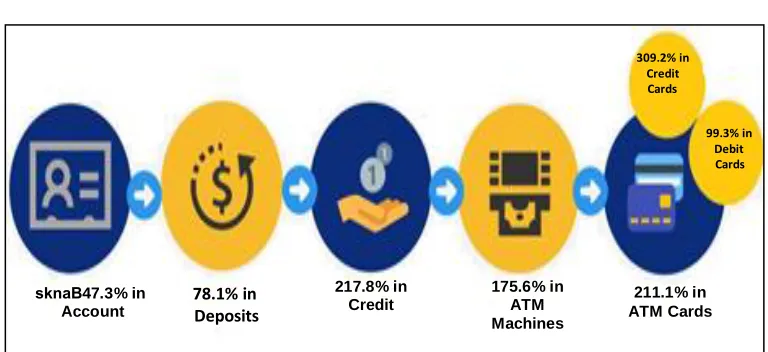
C- Other Financial depth indicators:other financial depth indicators' has also continued to improve. There has been a dramatic growth in the public interaction with the banking system and its' different products. The following figure(figure 2 )show the growth in banks' accounts, deposits, credit, ATM machines and ATM cards during 2007-2015:
2006 3.2015Q
43.7 %
57.0 % Increase in Credit to customer Deposits
Source: PMA annual reports
149 160
190 209 212 226
232 237 258 274
Increas in Banks' Branches & Offices %83.89
International Journal in Management and Social Science (Impact Factor- 4.358)
Figure 2
3- Growth Indicators:
a.
Paid up Capital and Owners Equity:Since the years 2006 Banks' paid up capital and owners' equity continued to increase. This has showed a better resilient banking system despite the political mounting risks in the region in general and in Palestine in specific. Please see chart 2 below:Source: PMA annual reports. Chart 2
200 300 400 500 600 700 800 900 10001100 1200 1300 1400 1500 1600
M
il
li
o
n
$
Paid-up Capital & Owners Equity
Paid up Capital Owners Equity
78.1% in Deposits
217.8% in Credit
175.6% in ATM Machines
211.1% in ATM Cards
309.2% in Credit
Cards
99.3% in Debit Cards
47.3% in sknaB
Account
b.
Customer Deposits and total Deposits39:PMA succeeded in maintaining customers' confidence in the banking system. Despite merger and liquidation of many banks in Palestine, all deposits were paid in full and no loss was suffered by any depositor. The recent establishment of the (PDIC) has also enhanced depositors' confidence. This can be observed through the following chart indicating the continued growth both in customers' and total deposits. Please see chart 3 below:Chart 3
Source: PMA annual reports.
c.
Credit Facilities40:Credit facilities as well continued to increase, especially since the establishment of the credit registry hosted by the PMA in 2008. It enabled banks to manage their credit risk more efficiently and effectively. Please see chart 4 below:Chart 4
Source: PMA annual reports.
39
40
Direct Credit facilities.
3,000.0 4,000.0 5,000.0 6,000.0 7,000.0 8,000.0 9,000.0 10,000.011,000.0
M
il
li
o
n
$
Total Deposits & C. Deposits
Customers Deposits Total Deposits
0.00 1,000.00 2,000.00 3,000.00 4,000.00 5,000.00 6,000.00
200 6 200 7 200 8 200 9 201 0 201 1 201 2 201 3 201 4 201 5
1,843
1,7051,828 2,234
2,886
3,4834,199 4,480
4,896 5,420
Mi
ll
io
n
$
International Journal in Management and Social Science (Impact Factor- 4.358)
d.
Net Assets: The main source of funds for banks is deposits. Since it continued to increase steadily, it has been efficiently used by the banking system to generate good profits. The following chart indicates the growth since 2006. Please see chart 5 below:Chart 5
Source: PMA annual reports.
e.
Net profits: the net profits of the banking system have almost tripled since 2006. The following chart indicates the net profits increase since 2006 till the end of 3rd quarter of 2015. It is anticipate that profits will exceed 150 million US dollars by the end of this year. Please see chart 6 below:Chart 6
Source: PMA annual reports.
Conclusions:
We conclude that the PMA has succeeded in developing a sound banking system and mitigate the prevailing risks in an efficient manner. The PMA has adopted international best practices in the field of risk management, business continuity, payment system, and financial inclusion.
The Palestinian experience in developing the banking system can be seen as a model for the region and beyond. Despite the political instability and the risks associated with that, the PMA has managed to build up an advanced banking system that is contributing a lot in the Palestinian economy. The intermediation function is being played by the banking system in an efficient manner. The financial
0 2,000 4,000 6,000 8,000 10,000 12,000
2006 2007 2008 2009 2010 2011 2012 2013 2014 2015
5,522 6,704
7,399 7,876
8,588 9,116 9,792
10,929 11,541 12,157
M
ill
ion
Net Asstes
0 20 40 60 80 100 120 140
2006 2007 2008 2009 2010 2011 2012 2013 2014 2015
52
68 84
103 140
129 124 143
146 150
M
ill
ion
indicators indicate the efficiency in saving mobilization and credit channelling into the economy. This is very rich and it makes lots of very good lessons that can be taught. The PMA has managed to enhance the capital adequacy of the banking system and the risk management sound practices. Weak banks were very effectively and efficiently handled through merger, liquidation or purchase and assumption. The developments and achievements gained praise of the international community and the international financial institutions i.e the International Monetary Fund and the World Bank.
References
1- PMA annual reports(different years). 2- World Bank Report.
3- IMF report to the Ad Hoc Liaison Committee 2015.