Nonthermal crystallization of amorphous silicates in comets
Tetsuo Yamamoto, Takeshi Chigai, Hiroshi Kimura, and Kyoko K. Tanaka
Institute of Low Temperature Science, Hokkaido University, Sapporo 060-0819, Japan
(Received July 31, 2008; Revised November 26, 2008; Accepted November 30, 2008; Online published February 12, 2010)
Recent observations show the ubiquity of crystalline silicate in various objects, among which comets provide the best opportunity to study possible processing of pristine matter during their formation and evolution. While thermal processing of bare amorphous silicates in the hot inner solar nebula has been invoked, its drawback is a difficulty in explaining the interstellar composition of cometary ices. Here we apply a model of core-mantle interstellar grains to propose nonthermal crystallization of the amorphous silicate core due to the energy released by chemical reactions in the organic refractory mantle when moderately heated by solar radiation. By formulating the nonthermal crystallization, we find that the degree of crystallinity is determined by a single parameter that is proportional to the amount of the released energy. We show that the present mechanism of crystallization is capable of reproducing the strengths of crystalline silicate features observed in comets. Our model can reconcile crystalline silicate in the comae of comets with the interstellar composition of ices in their nuclei.
Key words: Astrochemistry, radiation mechanisms: non-thermal, comets: general, solar system: formation, planetary systems: protoplanetary disks, dust, extinction.
1.
Introduction
The presence of crystalline silicates in comets was first identified by infrared spectra of dust in the coma of comet 1P/Halley (Bregmanet al., 1987). Since then, infrared fea-tures of crystalline silicate have been observed in a number of comae, but the origin of crystalline silicates is a mat-ter of debate. Experimental studies on thermal annealing of amorphous magnesium silicate smokes show that a dust temperature in a coma of a typical comet is too low for amorphous silicate∗1to crystallize in situ (Hallenbecket al., 1998, 2000). Therefore, thermal annealing of amorphous silicates in the hot inner solar nebula and incorporation of crystalline silicate into comet nuclei are suggested (see a review by Hanner, 1999). In contrast, the interstellar com-position of gas in the comae indicates the preservation of in-terstellar volatiles in the cold outer nebula (Biermannet al., 1982; Mumma, 1996). To reconcile hot and cold materi-als, crystalline silicates are considered as being transported from the inner solar nebula to the outer comet-formation region (Bockel´ee-Morvanet al., 2002). Nuthet al.(2000) claim that the fractional abundance of crystalline silicate in the solar nebula increases with time and thus can be used to date a comet’s formation age. Harker and Desch (2002) considered in-situ annealing of silicate at elevated temper-atures by nebular shocks that could proceed with crystal-lization up to 20 AU, depending on the model parameters (Nakamoto and Miura, 2005). Without the outward trans-port, however, the in-situ annealing mechanism predicts no crystalline silicate in the Kuiper Belt comets, contrary to
Copyright cThe Society of Geomagnetism and Earth, Planetary and Space Sci-ences (SGEPSS); The Seismological Society of Japan; The Volcanological Society of Japan; The Geodetic Society of Japan; The Japanese Society for Planetary Sci-ences; TERRAPUB.
doi:10.5047/eps.2008.11.002
observations (Watanabe, 2004). As noticed by Huebner (2002), none of the thermal mechanisms allow comets to retain the interstellar composition of ices in their nuclei.
We notice that a detection of crystalline silicates in a cometary coma does not necessarily mean the presence of the crystallites in the nucleus. Comet nuclei may consist of interstellar ices along with interstellar dust that is almost free from crystalline silicates. If low-temperature crystal-lization of amorphous silicate, as pointed out by Molster
et al.(1999), takes place in a comet coma, then one could automatically reconcile observable signatures of both inter-stellar ices and crystalline silicates in the coma. Recently, Carrezet al.(2002) have found that MgSiO3glasses irradi-ated by 300 keV electrons crystallize at room temperature. We propose yet another nonthermal mechanism to preserve interstellar composition of volatiles in comets.
2.
Nonthermal Crystallization Model
It is considered that a comet is an agglomeration of in-terstellar dust consisting of an amorphous silicate core, an organic refractory (OR) inner mantle, and an icy outer man-tle (e.g., Greenberg, 1982; Jessbergeret al., 1988). Because of the fluffiness of cometary dust, crystallization does not make essential difference between the aggregates and their constituent interstellar grains. The radius of the amorphous silicate core of the interstellar grain isa =0.07µm and the
thickness of the OR mantle ishr=0.03µm (Li and Green-berg, 1997). We assume Mg-bearing glass as the main com-ponent of the amorphous silicate core (see Jessbergeret al., 1988; Kimuraet al., 2003). Figure 1 depicts our nonther-mal mechanism of crystallization at moderate temperatures
∗1We use the term “amorphous silicate” meaning noncrystalline materi-als with a stoichiometric silicate composition following the astronomical literatures, although it may not be a correct mineralogical term.
Fig. 1. Illustration of our nonthermal crystallization mechanism.
(Yamamoto and Chigai, 2005). A typical temperature of cometary dust is several hundred K at heliocentric distances around 1 AU from the sun. This is insufficient for the amor-phous silicate core to crystallize but is sufficiently high for the icy mantle to sublime and produce the observed inter-stellar composition of gas in a coma. Such moderate heating also increases the diffusion rate of reactive molecules and triggers reactions among them in the OR mantle. In conse-quence, the energy released by the reactions increases the temperature and subsequently expedites further reactions. This is a positive feedback process resulting in chain reac-tions, a sudden rise in the temperature of the OR mantle, and heat flow into the amorphous silicate core. The heat flow brings about crystallization from the core surface to-wards the interior.
The degree of crystallinity fc(r,t)at a distancer from the center of the core at a timet is given (Haruyamaet al., 1993) by
1− fc(r,t)=exp
− t
0
dt AeEc/kT(r,t)
, (1)
wherekis Boltzmann’s constant andEcis the effective ac-tivation energy of crystallization. In Eq. (1), AeEc/kT
indi-cates the timescale for amorphous-to-crystalline transition (Brucatoet al., 1999; Fabianet al., 2000). Here, the vibra-tion period Aof diffusing atoms in silicate is 5×10⁻¹⁴s (Duschl et al., 1996). Equation (1) would overestimate the crystallization degree because it allows crystallization above the melting point (see Section 4). The temperature
T(r,t)is determined by the equation of heat conduction:
∂T
∂t −
χ
r2 ∂ ∂r
r2∂T
∂r
=0, (2)
whereχ is the thermal diffusivity. Heating due to deposi-tion of latent heat of crystallizadeposi-tion and cooling due to ther-mal emission and sublimation of organic molecules are neg-ligible because the time scales of these processes are much longer than that of heat conduction.
The duration of heating by reactions in the OR mantle is almost instantaneous compared to the timescale of heat conduction into the silicate core. We model such heating by putting an instantaneous spherical surface heat source on the silicate core surface and take the temperature dis-tribution of the silicate core at t = 0 to be T(r,0) =
const·δ(r−a). Here the proportional constant (i.e., the
strength of the source) is determined from the total energy released by the reactions given by
4πcp
a
0
r2dr T(r,0)=4πga2nrhrEr, (3)
wherecpis the specific heat per unit cell,g =1+hr/a+ (1/3)(hr/a)2is a geometrical factor,nris the number den-sity of reactive molecules in the OR mantle, Er is the amount of energy released per reaction, andis a volume of the unit cell of silicate. The initial temperature distribu-tion in the core is thus given by
T(r,0)= gnrhrEr cp
δ(r−a). (4)
We ignore the temperature prior to heating by the reactions because no crystallization takes place in practice at tem-peratures before the reactions. The solution to Eq. (2) for the initial condition (4) is given (Carslaw and Jaeger, 1959, p. 259) by
T(z,t)= gnrhrEr
2cp(πχt)1/2
e−z2/4χt (5)
forza,z=a−rbeing the depth from the core surface. In most cases of interest, the crystallized region is confined to the silicate core surface as shown below. Inserting Eq. (5) into Eq. (1), one obtains the degree of crystallinity at depth ζ =z/ (χA)1/2fort→ ∞to be
fc(ζ,∞)=1−exp
−θ2
∞
0
d x xexp
−xexp
ζ2 2θ2x2
,
where gether into the dimensionless parameterθ. The degree of crystallinity on the surface is given from Eq. (6) by
fc(0,∞)=1−e−θ 2
. (8)
This indicates that θ > 1 is the condition of substantial crystallization near the surface.
3.
Degree of Crystallinity
The parameterθis the key quantity that determines the degree of crystallinity. For forsterite whose density is ρ =3.2 g cm−3 and molecular weight isµ=140, we find =µmH/ρ = 7.3×10⁻²³cm3wheremHis the hydro-gen mass. The specific heat per unit cell is expressed as
cp = f k at temperatures higher than the Debye temper-ature, where f is freedom of motion of atoms (plus con-tributions from electrons) composing a unit cell. The spe-cific heat measured for forsterite is 40–50 cal mol−1K−1at
T = 900–2000 K (Chaseet al., 1985) which corresponds to f = 21–26. Following Hofmeister (2001), we esti-mate the thermal diffusivity of amorphous silicate with the sound velocity cs 3 × 105cm s−1 and phonon mean free path λ ≈ (3/4π)1/3 2.6×10⁻⁸cm to be χ =
csλ/3 ∼ 2.6×10⁻³cm2s−1 and the length scale(χA)1/2 to be 1×10⁻⁸cm. We taken
r=1021to 1022cm−3, corre-sponding to concentrations of reactive molecules of roughly 1 to 10% in the OR mantle (Greenberg, 1976). The energy released per reaction, Er, is a few to 10 eV (Schutte and Greenberg, 1991; Sorrell, 2001). Using these values,θ is expressed as
Theθvalue being on the order of unity implies that amor-phous silicates in comets do crystallize to a certain degree by the present mechanism. Figure 2 shows the degree of crystallinity fc(r,∞)calculated from Eq. (6) forθ = 0.9 to 9 (nr = 1021–1022 cm−3). Also plotted is the case for θ = 18 (e.g., nr = 1022 cm−3, Er = 10 eV) as a pos-sible upper limit. The crystallized region is localized near the core surface and hence the assumption posed in deriving Eq. (6) is not violated.
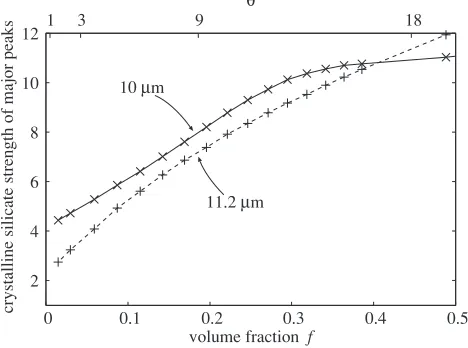
We examine whether the range of crystallinity derived from the present model provides the strengths of crystalline silicate peaks as observed in the 10µm band. The strength of a crystalline silicate peak is evaluated by the absorption cross section at a wavelengthλof the peak relative to that atλ=8µm, where the spectra show a continuum baseline arising from emission by the OR mantle. The absorption cross section is calculated for three-layered spherical grains consisting of an amorphous silicate core coated by crys-talline olivine together with an outermost OR mantle (see
0 of distancerfrom the center of the silicate core having the radiusa.
2
crystalline silicate strength of major peaks
volume fraction f
1 3 9 18
10 m
11.2 m
Fig. 3. Crystalline silicate strengths expected for observed major features as a function of crystallinityf¯c.
Friedman, 1998). We use the complex refractive indices for organic refractory given by Li and Greenberg (1997), amor-phous silicate by Scott and Duley (1996), and forsterite by Sogawaet al.(2006). The fraction f¯cof crystalline silicate in the volumeV of the silicate core is estimated as
¯ θ9)from Fig. 2. We focus for simplicity on the strengths of the major peaks at 10.0 and 11.2µm, which are attributed to forsterite. Figure 3 shows that the silicate peak strengths increase with crystallinity f¯c. The strengths at 10.0 and 11.2µm are comparable and, forθ = 0.9–9, the strengths of both peaks could reach up to 2–3 times the strengths due to amorphous silicate (f¯c = 0). These characteristics of the peaks are in harmony with infrared observations of cometary comae.
4.
Discussion
de-posited in the OR mantle. The volume fraction of crystal-lites as much as 20% is realized depending on theθ-values. As shown in Fig. 3, the crystallinity obtained in the present model may reproduce the observed strengths of crystalline silicate features in the 8–13µm spectra. See Kimuraet al.
(2008) for discussion of the detailed spectra. In spite of the success in reproducing the observed infrared features, the present mechanism does not require mixing of amor-phous and crystalline silicates. A natural consequence of the present model is that volatiles of interstellar composi-tion may be preserved composicomposi-tion in comets.
The present mechanism would also work for grains in other objects such as in protoplanetary disks if (1) the con-ditionθ > 1 to induce crystallization is fulfilled and (2) moderate heating is available to trigger exothermal reac-tions in OR mantles. Crystalline silicates found in debris disks might be brought in part from comet-like objects in the disks. It is also possible to make crystalline silicate by the present mechanism in the vicinity of protostars. Re-cent observations showed the existence of crystalline sili-cates around protostars at an early stage of 105years (Cia-rdiet al., 2005). This mechanism may also be triggered by shock waves and work at high temperature regions near O or B stars, although radiation pressure by these stars prevent any dust from staying in the vicinity of the stars. An upper limit of the degree of silicate crystallinity in the interstellar medium is estimated to be about 5% based on a compar-ison between a model and infrared observations (Liet al., 2007). To assess the degree of silicate crystallinity in the in-terstellar medium, it would be necessary to investigate the balance between the nonthermal crystallization and amor-phization by cosmic rays. More observations of crystalline silicate features in low-temperature environments will pro-vide a clue to specify the temperature that triggers the non-thermal crystallization.
Our results show a possibility of efficient crystallization by nonthermal process. As stated in Section 2, our model permits amorphous silicate to crystallize above its melting temperature. If we exclude crystallization at higher temper-atures than the melting temperature, we would have a lower volume fraction of crystalline silicate. On the other hand, our model neglects the finiteness of the particle size for the determination of the temperature. Actually the heat trans-mitted to the center of the particle cannot run away easily. As a result, the mean temperature of the particle would not decrease as we have modeled. We expect that this particle-size effect increases the volume fraction of crystal. There-fore, it is worth examining this nonthermal process more in detail by taking into account a more realistic crystallization model and the particle-size effect.
Crystallization is a process for atoms to overcome an ac-tivation energy of crystallization at an appreciable proba-bility. In general, low-temperature crystallization is possi-ble if (1) a significant amount of input energy is stored and (2) there is a trigger to release the stored energy to induce crystallization. d’Hendecourtet al.(1982) observed that the energy stored in their OR is released at∼30 K. Recently, Kaitoet al.(2006) preparedparticlesof amorphous Mg sil-icate coated with amorphous carbon. They found that their crystallization temperatures are lowered substantially due
to the energy released by graphitization of amorphous car-bon. Inclusion of CH4in the amorphous carbon mantle fur-ther reduces the crystallization temperature to room temper-ature (Kaitoet al., 2007). Although their experiments does not necessarily simulate crystallization of cometary silicate, they prove that a silicate core proceeds with forsterite crys-tallization upon releasing energy in its outer layer. The tem-perature to trigger the nonthermal crystallization could be further lowered, if the stored energy is released at much lower temperatures. Experiments on a search for mecha-nisms of low-temperature crystallization are encouraged to better understand the ubiquity of crystalline silicate in vari-ous objects.
Acknowledgments. We thank C. Kaito, Y. Kimura, M. Honda, and T. Nakagawa for useful communications. This work is sup-ported by MEXT and JSPS under Grant-in-Aid for Scientific Re-search.
References
Biermann, L., P. T. Giguere, and W. F. Huebner, A model of a comet coma with interstellar molecules in the nucleus,A&A,108, 221–226, 1982. Bockel´ee-Morvan, D., D. Gautier, F. Hersant, J.-M. Hur´e, and F. Robert,
Turbulent radial mixing in the solar nebula as the source of crystalline silicates in comets,A&A,384, 1107–1118, 2002.
Bregman, J. D., H. Campins, F. C. Witteborn, D. H. Wooden, D. M. Rank, L. J. Allamandola, M. Cohen, and A. G. G. M. Tielens, Airborne and groundbased spectrophotometry of comet P/Halley from 5-13 microm-eters,A&A,187, 616–620, 1987.
Brucato, J. R., L. Colangeli, V. Mennella, P. Palumbo, and E. Bussoletti, Mid-infrared spectral evolution of thermally annealed amorphous py-roxene,A&A,348, 1012–1019, 1999.
Carrez, P., K. Demyk, H. Leroux, P. Cordier, A. P. Jones, and L. d’Hendecourt, Low-temperature crystallisation of MgSiO3glasses un-der electron irradiation: Possible implications for silicate dust evolution in circumstellar environments,Meteorit. Planet. Sci.,37, 1615–1622, 2002.
Carslaw, H. S. and J. C. Jaeger,Conduction of Heat in Solids, Oxford Univ., Oxford, 1959.
Chase, M. W., C. A. Davies, J. R. Downey, D. J. Frurip, R. A. McDonald, and A. N. Syverud, JANAF Thermochemical Tables, 3rd ed.,J. Phys. Chem. Ref. Data,14, 1, 1985.
Ciardi, D. R., C. M. Telesco, C. Packham, C. G. Martin, J. T. Radomski, J. M. De Buizer, C. J. Phillips, and D. E. Harker, Crystalline silicate emission in the proostellar binary serpens SVS 20,ApJ,629, 897–902, 2005.
Duschl, W. J., H.-P. Gail, and W. M. Tscharnuter, Destruction processes for dust in protoplanetary accretion disks,A&A,312, 624–642, 1996. d’Hendecourt, L. B., L. J. Allamandola, F. Baas, and J. M. Greenberg,
Interstellar grain explosions—Molecule cycling between gas and dust,
A&A,109, L12–L14, 1982.
Fabian, D., C. J¨ager, Th. Henning, J. Dorschner, and H. Mutschke, Steps toward interstellar silicate mineralogy. V. Thermal Evolution of Amor-phous Magnesium Silicates and Silica,A&A,364, 282–292, 2000. Friedman, S. P., A saturation degree-dependent composite spheres model
for describing the effective dielectric constant of unsaturated porous media,Water Resour. Res.,34, 2949–1961, 1998.
Greenberg, J. M., Radical formation, chemical processing, and explosion of interstellar grains,Astrophys. Space Sci.,39, 9–18, 1976.
Greenberg, J. M., What are comets made of? A model based on interstellar dust, inComets, edited by L. L. Wilkening, pp.131–163, Univ. Arizona Press, Tucson, 1982.
Hallenbeck, S. L., J. A. Nuth III, and P. L. Daukantas, Mid-infrared spec-tral evolution of amorphous magnesium silicate smokes annealed in vac-uum: Comparison to cometary spectra,Icarus,131, 198–209, 1998. Hallenbeck, S. L., J. A. Nuth III, and R. N. Nelson, Evolving optical
properties of annealing silicate grains: From amorphous condensate to crystalline mineral,ApJ,535, 247–255, 2000.
Hanner, M. S., The silicate material in comets,Space Sci. Rev.,90, 99–108, 1999.
at 10 AU,ApJ,565, L109–L112, 2002.
Haruyama, J., T. Yamamoto, H. Mizutani, and J. M. Greenberg, Thermal history of comets during residence in the Oort cloud: effect of radio-genic heating in combination with the very low thermal conductivity of amorphous ice,J. Geophys. Res.,98, 15079–15090, 1993.
Hofmeister, A. M., Thermal conductivity of spinels and olivines from vibrational spectroscopy at ambient conditions,Am. Mineral.,86, 1188– 1208, 2001.
Huebner, W. F., Composition of comets: observations and models,Earth Moon Planets,89, 179–195, 2002.
Jessberger, E. K., A. Christoforidis, and J. Kissel, Aspects of the major element composition of Halley’s dust,Nature,332, 691–695, 1988. Kaito, C., S. Sasaki, Y. Miyazaki, A. Kumamoto, M. Kurumada, K.
Yokoyama, M. Saito, Y. Kimura, and H. Suzuki, Direct observation of the crystallization of carbon-coated amorphous Mg-bearing silicate grains,Adv. Geosci.,7, 125–131, 2006.
Kaito, C., Y. Miyazaki, A. Kumamoto, and Y. Kimura, Exothermic chemi-cal reactions can drive nonthermal crystallization of amorphous silicate grains,ApJ,666, L57–L60, 2007.
Kimura, H., I. Mann, and E. K. Jessberger, Composition, structure, and size distribution of dust in the local interstellar cloud,ApJ,583, 314– 321, 2003.
Kimura, H., T. Chigai, and T. Yamamoto, Mid-infrared spectra of cometary dust: the evasion of its silicate mineralogy,A&A,482, 305–307, 2008. Li, A. and J. M. Greenberg, A unified model of interstellar dust,A&A,323,
566–584, 1997.
Li, M. P., G. Zhao, and A. Li, On the crystallinity of silicate dust in the interstellar medium,Mon. Not. R. Astron. Soc.,382, L26–L29, 2007.
Molster, F. J., I. Yamamura, L. B. F. M. Waters, A. G. G. M. Tielens, Th. de Graauw, T. de Jong, A. de Koter, K. Malfait, M. E. van den Ancker, H. Van Winckel, R. H. M. Voors, and C. Waelkens, Low-temperature crystallization of silicate dust in circumstellar disks,Nature,401, 563– 565, 1999.
Mumma, M. J., Hyakutake’s interstellar ices,Nature,383, 581–582, 1996. Nakamoto, T. and H. Miura, Crystallization of silicate particles by shock
waves,Highlights Astron.,13, 525–527, 2005.
Nuth III, J. A., H. G. M. Hill, and G. Kletetschka, Determining the ages of comets from the fraction of crystalline dust,Nature,406, 275–276, 2000.
Schutte, W. A. and J. M. Greenberg, Explosive desorption of icy grain mantles in dense clouds,A&A,244, 190–204, 1991.
Scott, A. and W. W. Duley, Ultraviolet and infrared refractive indices of amorphous silicates,ApJS,105, 401–405, 1996.
Sogawa, H., C. Koike, H. Chihara, H. Suto, S. Tachibana, A. Tsuchiyama, and T. Kozasa, Infrared reflection spectra of forsterite crystal,A&A,451, 357–361, 2006.
Sorrell, W. H., Origin of amino acids and organic sugars in interstellar clouds,ApJ,555, L129–L132, 2001.
Watanabe, J., Meteor streams and comets,Earth Moon Planets,95, 49–61, 2004.
Yamamoto, T. and T. Chigai, A mechanism of crystallization of cometary silicates,Highlights Astron.,13, 522–524, 2005.