FORMULATION AND IN-VITRO/EX-VIVO
CHARACTERIZATIONS OF MICROEMULSION-BASED
HYDROGEL FORMULATION OF ACECLOFENAC FOR TOPICAL APPLICATION
ABDUL BAQUEE AHMED
1*, ROWSHAN AHMED
1, RUPA SENGUPTA
21Department of Pharmaceutics, Girijananda Chowdhury Institute of Pharmaceutical Science, Azara, Guwahati - 781 017, Assam, India. 2Department of Pharmacognosy, Rofel Shri G.M.Bilakhia College of Pharmacy, Namdha Road, Vapi - 396 191, Gujarat, India.
Email: [email protected]
Received: 04 April 2016, Revised and Accepted: 14 April 2016
ABSTRACT
Objectives: In this study, microemulsion-based hydrogel (MBH) formulation of aceclofenac was prepared for topical administration in the management of pain and inflammation to overcome the gastrointestinal toxicity of the drug occurs with oral administration.
Methods: The MBH formulation was prepared by two-step methods. In the first step, the drug loaded o/w microemulsion was prepared first by titration method and in the second step; xanthan gum was added slowly to the microemulsion under homogenization to produce clear MBH. The developed MBH formulations were characterized by in-vitro evaluations, stability studies, and skin irritancy test. The ex-vivo permeation across rat epidermis using modified Keshary-Chien diffusion cell and anti-inflammatory activity of the selected MBH formulation was also evaluated in rat hind paw edema model.
Results: The developed MBH formulations showed good stability and acceptable physicochemical properties. The selected formulation (MBH2) showed the highest skin permeation rate (transdermal flux, 193.59±5.01 µg/cm2/h; lag time, 0.80±0.01 h) and a maximum of 70.96% inhibition of the hind paw edema was measured after 8 h of the study.
Conclusion: Thus, the results obtained in this study suggest the feasibility of the MBH formulation of aceclofenac for topical application for the treatment of pain and inflammation.
Keywords: Aceclofenac, Microemulsion-based hydrogel, Transdermal flux, Ex-vivo permeation.
INTRODUCTION
A microemulsion is a single optically isotropic and thermodynamically stable liquid solution consists of oil phase, surfactant, cosurfactant, and an aqueous phase. The microemulsion is either an o/w or w/o emulsion producing a transparent product that has a droplet size <0.15 µm and does not have the tendency to coalesce [1]. Microemulsions have several advantages over conventional formulations such as good thermodynamic stability, high drug solubilizing capacity, the high permeation rate of drug across stratum corneum (SC) from microemulsion [2]. The surfactant and cosurfactant in the microemulsion may reduce the diffusion barrier of the SC by acting as permeation enhancers [1]. In the last decades, much research has been focused on the topical delivery of drugs using microemulsion such as estradiol [3], meloxicam [4], triptolide [5], and lidocaine [6].
Recently, different hydrogel matrices such as carbomer 940, xanthan gum, and carrageenan have been used to increase the viscosity of microemulsion for topical application [3,7-10]. The addition of hydrogel matrix into the microemulsion resulted in the formation of the microemulsion-based hydrogel (MBH), which is more suitable for topical application when compared with microemulsion [11].
Aceclofenac (2-[(2, 6-dichlorophenyl) amine] phenylacetoxyacetic acid) is an orally effective non-steroidal anti-inflammatory drug of the phenylacetic acid group, which possesses remarkable anti-inflammatory, analgesic, and antipyretic properties [12]. It is used in the treatment of osteoarthritis and inflammatory disease of the joints [13,14]. The oral administration of aceclofenac causes gastrointestinal ulcers and bleeding, causes anemia with chronic use [14,15]. To avoid the systemic toxicity of the drug arise with oral administration, one of the promising methods is to administer the drug through transdermal route for better therapeutics effect [16].
Aceclofenac is a highly lipophilic drug having log (P) value about 1.705, molecular weight of 354.2 Da, pKa 4-5 and melting point in the range of 151-152°C can be considered ideal for transport of the drug through the skin [12].
Therefore, in this study, an attempt has been made to develop an MBH formulation of aceclofenac for topical application. The developed MBH formulations were characterized by in-vitro evaluations, stability studies, and skin irritancy test. The ex-vivo permeation across rat epidermis using modified Keshary-Chien diffusion cell and anti-inflammatory activity of the selected MBH formulation was also evaluated in rat hind paw edema model.
METHODS Materials
Aceclofenac was a gift sample from IPCA Pharmaceuticals Pvt. Ltd. (Sikkim, India). Castor oil, polyoxyethylene sorbitan monooleate (Tween 80), and ethanol were purchased from Merck Chemicals (Mumbai, India). Xanthan gum and methylparaben (Himedia Laboratories Pvt. Ltd., Mumbai, India); sodium bromide (Loba Chemie Pvt., Ltd., Mumbai, India) and chloroform (Thomas Baker Chemicals Pvt., Ltd., Mumbai, India) were procured and used in this investigation. All other chemicals and solvents used in the studies were of analytical grade.
Methods
Preparation of MBH formulations
The details composition of MBH formulations were shown in Table 1. Aceclofenac loaded MBH formulations were prepared by two-step methods. First, aceclofenac was added to the oil, surfactant and cosurfactant mixture (10% v/v castor oil, 25% v/v tween 80/ethanol at 4:1 ratio) and after that, the required quantity of water was added
to the mixture drop by drop under constant stirring at 25°C to obtain the o/w microemulsion. Second, xanthan gum was added slowly to the microemulsion under homogenization to produce clear MBH. The developed formulations were left overnight at room temperature (25-27°C) for complete dissolution.
Characterization of MBH formulations
Measurement of droplet size and conductivity of microemulsion
The average droplet size and polydispersity index of the microemulsion were determined by photon correlation spectroscopy (Zetasizer Nano S90, Malvern, UK) at 25±0.5°C using He-Ne laser at 632 nm. To characterize the conductivity of the microemulsion, a CM 180 conductometer (Elico, India) was used [11].
Physical examination
The prepared MBH formulations were inspected visually for their color, appearance, and consistency [17].
Spreadability
The spreadability of the MBH formulations was determined at 24 h after dissolution. 1 g of MBH formulations were placed between two horizontal plates (20 cm × 20 cm), and the upper plate was tied with 125 g of standardized weight. The spreading diameter was measured after 1 min [18].
Determination of pH
The pH of the formulations was determined using a pH meter (TOSHNIWAL, Model CL 54, India) at 25±1°C.
Rheological study
The viscosity of MBH formulations was measured using a Brookfield rotational viscometer with spindle no. 64 (LV2, Brookfield Inc., USA). The formulation whose viscosity was to be determined was placed in the sample holder which was connected to a thermostatically controlled circulating water bath maintained at 25°C and allows the spindle to move and rotate freely in the MBH at a speed of 10 rpm and the reading was noted [19,20].
Drug content
For assay of the drug in MBH formulation, 1 g of MBH formulations were extracted with 20 ml of methanol for 30 minutes. The resultant mixture was filtered through membrane filter (pore size 0.45 mm). The absorbance of the sample was determined spectrophotometrically at 273 nm (Shimadzu, UV-1800 spectrophotometer, Japan) after appropriate dilution with phosphate buffer pH 7.4.
Stability of MBH formulations
In stability studies, the MBH2 formulation was packed in aluminum collapsible tube (5 g) and stored at 25°C/60% relative humidity (RH) and 40°C/75% RH for a period of 3-month in a stability chamber (REMI, Environmental Test Chamber, India). Samples were withdrawn in duplicate at 0 and after 1, 2, and 3 months, and their physical and chemical stabilities were assessed. Physical stability was evaluated by visual inspection for physical appearance, pH, and rheological properties. Chemical stability was expressed as aceclofenac content, which was determined spectrophotometrically [20,21].
Skin irritation study
The skin irritation study was performed as per the procedure described byBarakat NS, 2010. [22]. Briefly, the Wistar albino male rats weighing 200-250 g were used for skin irritation test. The animals were kept under standard laboratory conditions (25±1°C and 55±5% relative humidity) with free access to standard laboratory diet and water adlibitum. The abdominal hairs of the rats were shaved carefully avoiding peripheral damage on the previous day of the experiment [23]. The rats were divided into three groups with four animals each. Group 1 was treated as control (without any treatment), Group 2 was treated with MBH2 formulation, and Group 3 was treated with standard irritant (0.8% v/v aqueous solution of formalin) once daily for 3 days. Finally, animals were observed for any sign of flare and wheal for a period of 7-day [24].
In-vitro skin permeation study
The abdominal hair of Wistar male albino rats, weighing 150-200 g, was shaved using an electric razor after sacrificing with excess chloroform inhalation. The abdominal skin was surgically removed and adhering subcutaneous fat was carefully cleaned. The epidermis was then separated from dermis by soaking the full thickness skin in 2 M sodium bromide solution in water for 6-8 h [25]. The epidermis was thoroughly washed with water, dried at 25% RH, wrapped in aluminum foil and stored in freeze until further use. All experiments with animals were approved by the Institutional Animal Ethics Committee of Girijananda Chowdhury Institute of Pharmaceutical Science, India (GIPS/IAEC/M. ph/2014/3).
For in-vitro permeation studies, skins were allowed to hydrate for 1 h before being mounted on the Keshary-Chien diffusion cell with the SC with effective surface area 1.54 cm2 facing the donor compartment. The receptor compartment was filled with 19.5 ml of phosphate buffer pH 7.4 and its temperature was maintained at 37±0.5°C. On the SC side of the donor compartment, 1 g of the formulation was applied and covered with aluminum foil to prevent drying out. 1 ml of receptor medium was withdrawn at an interval of 1 h and at the each time of withdrawal, 1 ml of fresh corresponding receptor medium was replaced in the acceptor compartment to maintain the sink condition. The content of the drug permeated was determined spectrophotometrically at 273 nm using a Shimadzu UV-1800 spectrophotometer.
In-vitro anti-inflammatory activity
The in-vitro anti-inflammatory activity of the gel formulation was performed using carrageenan induced rat hind paw edema model [17,26]. The Wistar albino male rats weighing 150-210 g were fasted overnight, but water was allowed ad libitum. The animals were divided into three groups of four animals each. Group 1 (control) received placebo gel (applied topically), Group 2 received ME formulation, and the Group 3 received MBH2. Immediately after the drug administration, 0.05 ml of 1% w/w solution of carrageenan was injected into the planter surface of the hind paw. The hind paw volume was measured at different time intervals for 6 h, after carrageenan treatment using a plethysmograph. The percent inhibition in hind paw edema volume was calculated using the following formula and compared with those recorded for the control group.
Anti-inflammatory activity (%) = (1 − D/C) × 100 (1)
Where, D is the change in paw volume in the treated group and C is the change in paw volume in the control group.
Table 1: Composition of MBH formulations
Formulations Aceclofenac
Data and statistical analysis
The steady state flux (J, µg/cm2/h) was calculated from the slope of the linear plot of the cumulative amount permeated per unit area (µg/cm2) as a function of time (t, h). The lag time (tL, h) was determined from the x-intercept of the slope at the steady state. The permeability coefficient (KP, cm2/S) was calculated from the flux and donor drug concentration. Data are represented as mean ± standard deviation (n=3). Statistical comparisons were made using Student’s t-test at a significance level of p<0.05 using MS Excel software.
RESULTS AND DISCUSSION
Measurement of droplet size and conductivity
The droplet size and polydispersity index of the microemulsion were found to be 101.2±2.15 to 108.6±1.25 and 0.230±0.02 to 0.343±0.08, respectively, indicated the narrow size distribution of the oil globules in the microemulsion. The conductivity of the formulations was found to be 132.5±0.04 to 136.5±0.03 µS/cm, revealed the o/w structure of the microemulsion.
Physicochemical parameters
The results of the physicochemical study are presented in Table 2. The study revealed the formation of clear and homogeneous gel with good spreadability. The spreading diameter of ME formulation after 1 min study was found to be 123±3.12 mm which was observed to be highest as compared with the other MBH formulation. These studies suggest that addition of xanthan gum in formulations increased the viscosity which may be the cause of decrease in spreadability of the MBH formulations. The pH of the MBH formulations was found to be in the range of 6.2±0.16 to 6.5±0.22, which lies within the range of normal skin pH and would not produce and skin irritation. The drug content of the MBH formulation was found to be 87±0.93 to 94±0.81%, showing content uniformity.
Viscosity
The viscosity of the formulations generally reflects its consistency. The viscosity of MBH was increased with the increase of the concentration of xanthan gum in the formulations (MBH3 > MBH2 > MBH1). The consistency of MBH containing 1% xanthan gum (MBH1) led to a low viscosity of 11.69±0.3 Pa S. However, consistency of MBH containing 2% xanthan gum (MBH3) resulted in a too high viscosity of 35.40±0.45 Pa S. The MBH containing 1.5% xanthan gum (MBH2) had a suitable viscosity of 22.88±0.38 Pa S for topical application.
Stability study
The results of stability studies revealed that the MBH2 formulation was stable at both the storage conditions in terms of physical and chemical properties. No significant change was observed for physical appearances, pH, and viscosity. The drug content of the formulation before stability and after stability study was found to be 89.03±1.02% and 88.11±0.09%, respectively, revealed no significant chemical change in the formulation after 3 months of stability study.
Skin irritancy test
The skin irritation studies were carried out to evaluate the tolerability of the MBH after application. The skin irritancy test of the selected MBH formulation (MBH2) showed that the mean value of a skin irritation score (erythema and edema) of <2. Earlier studies reported that a value between 0 and 9 indicates that the applied formulation probably would
not be irritant to human skin [27,28]. Thus, the selected microemulsion is considered to be safe for the use of transdermal drug delivery.
In-vitro skin permeation study
The permeation ability of MBH formulations across rat epidermis was evaluated using in-vitro permeation experiment, and the permeation profiles are presented in Fig. 1. The cumulative amount of aceclofenac permeated through excised rat skins was plotted as a function of time. The slope and intercept of the linear portion of the plot were derived by regression. The permeation rate at steady state (Js, µg/cm2/h) was calculated as the slope divided by the skin surface area. The intercept on the X-axis was taken as the lag time (TL, h). The permeation parameters calculated from the profiles are presented in Table 3.
The permeation profile of MBH formulations followed a linear relationship (R2>0.9 [0.92-0.98]) was obtained between amount released and the square root of time as proposed by Higuchi’s theory [29] indicating diffusion controlled mechanism of drug release kinetics. The highest transdermal flux of aceclofenac from the microemulsion formulation (ME) was found to be 243.97±3.08 µg/cm2/h, and a lag time 0.64±0.01 hrs. In another hand, the transdermal flux of MBH formulations containing various concentrations of xanthan gum MBH1 (1%), MBH2 (1.5%) and MBH3 (2%) was found to be 218.35±9.04, 193.59±5.01 and 143.62±11.66 µg/cm2/h, respectively. The result showed an inverse relationship between permeation rate and viscosity of the formulations. As mentioned earlier that with increased concentration of xanthan gum leads to increase the viscosity of the formulation which may causes increased diffusion path length of the drug thereby reduced the permeation rate. This phenomenon is in accorded with the earlier results reported by Chen et al., 2006 [11]; Das and Ahmed, 2007 [17]. Statistical comparison of the transdermal flux of ME formulation showed a significant difference (p<0.05) with MBH3 formulation. However, the differences of the transdermal flux of MBH1 and MBH2 was not significant statistically (p>0.05). Thus, formulation MBH2 showed suitable viscosity for topical application
Table 2: Physicochemical parameters of various MBH formulations
Formulations pH* Droplet size of
microemulsion* (nm) Polydispersity Index* Drug content* (%) Spreading diameter after 1 min* (mm) Conductivity(µS/cm) Viscosity(Pa S)
ME 6.2±0.16 105.3±1.05 0.310±0.05 93±1.15 123±3.12 136.5±0.03 5.81±0.38
MBH1 6.3±0.05 101.2±2.15 0.255±0.03 94±0.81 67±2.11 133.5±0.05 11.69±0.30
MBH2 6.5±0.22 108.6±1.25 0.343±0.08 89±1.02 61±1.04 132.5±0.04 22.88±0.38
MBH3 6.4±0.06 111.7±1.03 0.230±0.02 87±0.93 56±3.05 134.5±0.02 35.40±0.45
*Mean±SD, n=3, MBH: Microemulsion-based hydrogel, SD: Standard deviation, ME: Microemulsion
Fig. 1: In-vitro skin permeation profile of aceclofenac from microemulsion (ME) and microemulsion based hydrogel (MBH)
with good permeation rate of 193.59±5.01 µg/cm2/h was considered as best formulation.
Ex-vivo anti-inflammatory activity
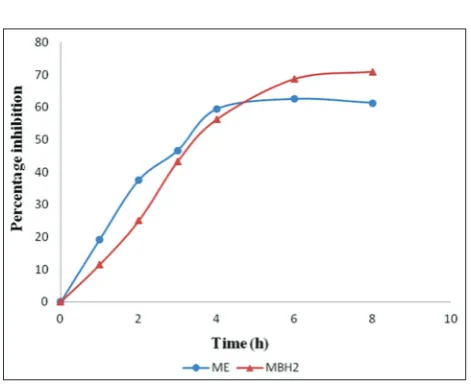
The carrageenan-induced rat hind paw edema model was used to compare the oral and topical anti-inflammatory effect of aceclofenac. The measured changes in edema volume of different treated group of animals are presented in Table 4. The result revealed that both orally administered ME (inhibited the paw edema by 62.50% at 6 h) and topically applied MBH2 (inhibited the paw edema 70.96% at 8 h) formulation significantly inhibited (p<0.05) the edema formation (Table 5 and Fig. 2) when compared with the control (Placebo gel). It was observed that hydrogel based formulation, MBH2, showed an initial slower permeation of drug (initial 11.5% inhibition and
extended to maximum 70.96% at 8 h) with compare to microemulsion formulation, ME (initial 19.23% and extended to maximum 62.50% at 6 h). On the other hand, the difference of percent inhibition values between the ME and MBH2 formulation was not statistically significant (p>0.05). Hence, incorporation of aceclofenac in MBH formulation does not significantly altered the transdermal permeation of the drug but, significantly inhibited the inflammatory response induced by carrageenan. Therefore, MBH formulation may be a promising vehicle for topical delivery of aceclofenac.
CONCLUSION
In this study, MBH formulation of aceclofenac was prepared using castor oil as the oil phase of the microemulsion for good solubilizing capacity of the drug and xanthan gum as a gel matrix. The MBH2 formulation showed the highest skin permeation rate (transdermal flux, 193.59±5.01 µg/cm2/h; lag time, 0.80±0.01 h) and inhibition of the hind paw edema (70.96% at 8 h). The results of physicochemical property, stability study and skin irritancy tests showed that the selected MBH formulation of aceclofenac was a promising vehicle for transdermal application which is expected to overcome the gastrointestinal toxicity of the drug when administered orally.
ACKNOWLEDGMENT
The authors would like to thank IPCA pharmaceuticals Pvt. Ltd. (Sikkim, India) for providing aceclofenac gift sample for the study.
REFERENCES
1. Rhee YS, Choi JG, Park ES, Chi SC. Transdermal delivery of ketoprofen using microemulsions. Int J Pharm 2001;228(1-2):161-70.
2. Lawrence MJ, Rees GD. Microemulsion-based media as novel drug delivery systems. Adv Drug Deliv Rev 2000;45(1):89-121.
3. Peltola S, Saarinen-Savolainen P, Kiesvaara J, Suhonen TM, Urtti A. Microemulsions for topical delivery of estradiol. Int J Pharm 2003;254(2):99-107.
4. Yuan Y, Li SM, Mo FK, Zhong DF. Investigation of microemulsion system for transdermal delivery of meloxicam. Int J Pharm 2006;321(1-2):117-23.
5. Chen H, Chang X, Weng T, Zhao X, Gao Z, Yang Y, et al. Astudy of microemulsion systems for transdermal delivery of triptolide. J Control Release 2004;98(3):427-36.
6. Sintov AC, Shapiro L. New microemulsion vehicle facilitates percutaneous penetration in vitro and cutaneous drug bioavailability in vivo. J Control Release 2004;95(2):173-83.
7. Lapasin R, Grassi M, Coceani N. Effects of polymer addition on the rheology of o/w microemulsions. Rheol Acta 2001;40(2):185-92. 8. Spiclin P, Homar M, Zupancic-Valant A, Gasperlin M. Sodium ascorbyl
phosphate in topical microemulsions. Int J Pharm 2003;256(1-2):65-73.
Table 3: Permeation parameters of aceclofenac from various formulations across rat epidermis
F code (Mean±SD, n=4) KP (cm2/S×10-6) Best fit regression
equation for permeation plot
R2 Amount permeated
at 12 h (µg/cm2)
Flux, J (µg/cm2/h)
Lag time, TL (h)
ME 2819.72±37.03 243.97±3.08 0.64±0.01 3.39±0.004 Q=251.15t−98.33 0.9909
MBH1 2620.22±108.53 218.35±9.04 0.75±0.02 3.03±0.013 Q=232.26t−98.48 0.9909
MBH2 2323.15±60.02 193.59±5.01 0.80±0.01 2.69±0.007 Q=202.86t−97.78 0.9921
MBH3 1723.55±140.02 143.62±11.66 1.02±0.06 1.99±0.016 Q=149.88t−101.83 0.9855
SD: Standard deviation, ME: Microemulsion, MBH: Microemulsion-based hydrogel
Table 4: Edema volume of different treated groups of animals of anti-inflammatory activity
Treated group Paw volume before treatment
(ml) (mean±SD, n=4) Edema volume (mean±SD, n=4) (h)1 2 3 4 6 8
Control (placebo gel) 0.55±0.03 0.81±0.02 0.83±0.06 0.85±0.01 0.87±0.07 0.87±0.02 0.86±0.04
ME 0.53±0.06 0.74±0.02 0.71±0.05 0.69±0.03 0.66±0.02 0.65±0.04 0.65±0.07
MBH2 0.54±0.08 0.77±0.01 0.75±0.04 0.71±0.02 0.68±0.06 0.64±0.03 0.63±0.08
SD: Standard deviation, ME: Microemulsion, MBH: Microemulsion-based hydrogel
Table 5: Percent inhibitions of hind paw edema
Formulations Percentage inhibition (h)
1 2 3 4 6 8
ME 19.23 35.71 46.66 59.37 62.50 61.29
MBH2 11.50 25.00 43.33 56.26 68.75 70.96
ME: Microemulsion, MBH: Microemulsion-based hydrogel
Fig. 2: Percent inhibitions of hind paw edema after oral administration of aceclofenac microemulsion (ME) and application of microemulsion based hydrogel formulation
9. Valenta C, Schultz K. Influence of carrageenan on the rheology and skin permeation of microemulsion formulations. J Control Release 2004;95(2):257-65.
10. Gulsen D, Chauhan A. Dispersion of microemulsion drops in HEMA hydrogel: A potential ophthalmic drug delivery vehicle. Int J Pharm 2005;292(1-2):95-117.
11. Chen H, Chang X, Du D, Li J, Xu H, Yang X. Microemulsion-based hydrogel formulation of ibuprofen for topical delivery. Int J Pharm 2006;315(1-2):52-8.
12. Yang JH, Kim YI, Kim KM. Preparation and evaluation of aceclofenac microemulsion for transdermal delivery system. Arch Pharm Res 2002;25(4):534-40.
13. Brogden RN, Wiseman LR. Aceclofenac. A review of its pharmacodynamic properties and therapeutic potential in the treatment of rheumatic disorders and in pain management. Drugs 1996;52(1):113-24.
14. Yamazaki R, Kawai S, Matsuzaki T, Kaneda N, Hashimoto S, Yokokura T, et al. Aceclofenac blocks prostaglandin E2 production following its intracellular conversion into cyclooxygenase inhibitors. Eur J Pharmacol 1997;329(2-3):181-7.
15. Shakeel F, Baboota S, Ahuja A, Ali J, Aqil M, Shafiq S. Nanoemulsions as vehicles for transdermal delivery of aceclofenac. AAPS PharmSciTech 2007;8(4):E104.
16. McNeill SC, Potts RO, Francoeur ML. Local enhanced topical delivery (LETD) of drugs: Does it truly exist? Pharm Res 1992;9(4):1422-7. 17. Das MK, Ahmed AB. Formulation and ex vivo evaluation of rofecoxib
gel for topical application. Acta Pol Pharm 2007;64(5):461-7.
18. Vennat B, Gross D, Pourrat A, Pourrat H. A dosage form for procyanidins gels based on cellulose derivatives. Drug Dev Ind Pharm 1991;17(15):2083-92.
19. Bonacucina G, Cespi M, Palmieri GF. Characterization and stability
of emulsion gels based on acrylamide/sodium acryloyldimethyl taurate copolymer. AAPS Pharm Sci Tech 2009;10(2):368-75.
20. Khullar R, Kumar D, Seth N, Saini S. Formulation and evaluation of mefenamic acid emulgel for topical delivery. Saudi Pharm J 2012;20(1):63-7.
21. Subramanian N, Ghosal SK, Moulik SP. Enhanced in vitro percutaneous absorption and in vivo anti-inflammatory effect of a selective cyclooxygenase inhibitor using microemulsion. Drug Dev Ind Pharm 2005;31(4-5):405-16.
22. Barakat NS. Evaluation of glycofurol-based gel as a new vehicle for topical application of naproxen. AAPS Pharm Sci Tech 2010;11(3):1138-46.
23. Namdeo A, Jain N. Liquid crystalline pharmacogel based enhanced transdermal delivery of propranolol hydrochloride. J Control Release 2002;82(2-3):223-36.
24. Mutalik S, Udupa N. Glibenclamide transdermal patches: Physicochemical, pharmacodynamic, and pharmacokinetic evaluations. J Pharm Sci 2004;93(6):1577-94.
25. Thomas NS, Panchagnula R. Transdermal delivery of zidovudine: Effect of vehicles on permeation across rat skin and their mechanism of action. Eur J Pharm Sci 2003;18(1):71-9.
26. Vyas SP, Gogoi PJ, Jain SK. Development and characterization of pseudolatex based transdermal drug delivery system of diclofenac. Drug Dev Ind Pharm 1991;17(8):1047.
27. Utely M, Van Abbe NJ. Pharmaceutical and cosmetic products for topical administration. J Soc Cosmet Chem 1973;24(5):217.
28. Draize JH, Woodward G, Calvery HO. Methods for the study of irritation and toxicity of substances applied topically to the shin and mucous membranes. J Pharmacol Exp Ther 1944;82(3):377-9. 29. Higuchi WI. Analysis of data on the medicament release from