© 2015, IRJET.NET- All Rights Reserved
Page 793
Development And Performance Evaluation Of Nursery Fertilizer Mixer
using Human Powered Flywheel Motor as Source of Energy
H S Bhatkulkar
1, J P Modak
21
Assistant Professor , Department of Mechanical Engineering,S B Jain Institute of Technology , Management &
Research , Nagpur, Maharashtra State, India
2 ‘
Professor (Emeritus) & Dean (R&D), Department of Mechanical Engineering, Priyadarshini College of
Engineering, Nagpur, Maharashtra State, India
---***---Abstract -
Since invention Flywheel motor is beingextensively used in various application. Because of increasing range of application flywheel motor is being the subject of interest of the researchers for the optimum use of human energy .Literature survey reveals that a system for pumping energy in flywheel using muscular energy is feasible and the energy stored in flywheel can be used for different applications[1]. In an attempt this paper presents the development and performance of a Human Powered Flywheel Motor (HPFM) operated Nursery Fertilizer Mixer to mix nursery fertilizers in proper proportion which is then used for plantation in small size farming [3].Since this is a man-machine system, it is rather difficult and unreliable to adopt total theoretical approach for the development, thus, the experimental approach is adopted. This set up consists of three subsystems namely. (i) Human powered flywheel motor (HPFM) i.e. energy unit. (ii)Torque amplification gears and clutch unit and (iii) process unit i.e. Nursery Fertilizer Mixer. In this paper an attempt is made to develop and experimentally validate a human powered mixing machine to mix nursery fertilizer in proper proportion
Key words: Human powered Flywheel Motor, Peddling, Nursery Fertilizer Mixer
1.
INTRODUCTION
Agriculture is an economic driven activity aims to produce and increase production to feed the human population. However, the continued exploitation of our natural resources such as land and other resources lead to poor productivity level and future shortage of food supply. Agriculture and environment has a relationship. Agricultural production affects and contributes to climate change. The use of agricultural land contributes to 12% of global greenhouse gas emission The figure will continue to increase due to the increase in the demand of food, farmers are clearing new land resulting in deforestation, tilling of pasture and soil degradation. This activity opens carbon sinks and so releases greenhouse gases (International Trade Center UNCTAD/WTO, 2007). For the
agricultural sector, the need to shift into a sustainable farming practices is necessary for food security and to mitigate climate change. Organic land management i.e. use of organic fertilizers may help to stop soil erosion and convert carbon losses into gains (Reganold et al.,1987). There are several methods for mixing the various ingredients of fertilizers together. A good system for mixing fertilizers components in a nursery is use of a rotary-type mixer, such as a cement mixer or a drum and paddle type mixer. A shovel could be used to manually stir the media, but it is extremely important that mixtures so formed should be uniform and consistent in quality so that plant growth results are also uniform. However the increasing prices of such mechanized machines in the market is a common problem to small farmers because not everyone could afford to buy farm inputs just to increase productivity . Also there is a huge scarcity of electricity in most of the rural part of india .Because of the socio-economical conditions of farmers in developing countries including India, human muscle power is going to contribute energy requirements for performing many farm activities for the next two decades. Pedalling is the most efficient way of utilizing power from human muscles. Keeping these points into consideration ,human powered brick making machine was first of its kind developed for the manufacturing of bricks (Modak J.P. J.P.1982, 1994, 1997, 1998) [4]. and since then various processes are energized by the human power such as chaff cutter, wood turning, cloth washing, potter‟s wheel, flour mill etc [5]. In an attempt this paper presents the development and performance of a Human Powered Flywheel Motor (HPFM) operated Nursery Fertilizer Mixer to mix nursery fertilizers in proper proportion which is then used for plantation in small size farming. This machine is evolved applying methodology of experimentation proposed by H. Schanck Jr. (1961).
2. SCOPE OF PRESENT RESEARCH:
© 2015, IRJET.NET- All Rights Reserved
Page 794
farmer for bringing about low cost automation in his farm.Thus end result of this project will be useful (1) Partly as an aid to a low/ medium capacity farmer (2) alternatively to a low profiled entrepreneur who can execute the business of manufacturing ready made nursery fertilizer to be used by small farmer. As the work is ultimately useful for a low profiled farmer in present context of lot many cases of suicide of farmers in India this scientific research effort is likely to be useful in lessening the severity of this socio economic problem
3. MATERIALS AND METHOD
3.1 Human Power
Until about two and half centuries ago, muscle power was the prime source of energy for performing all the physical activities on our earth, and much of this power had been from human muscles. Because of the socio-economic conditions of farmers in several developing countries including India, human muscle power will go on contributing energy requirements for performing many farm activities at least for next two decades. In remote villages in India, where electric power supply is not available and repair and maintenance facilities for internal combustion engines are scarce, human power is still one of the major contributors of energy for production agriculture as well as for post harvest agricultural operations. Human energy has generally been utilized through arms, hands, and back. It was only with the invention of the bicycle, that legs also began to be considered as a means of developing power from human muscles. Maximal power produced with legs is generally limited by adaptations within the oxygen transport system[1]. On the other hand, the capacity for arm higher rate as that achieved by hand cranking, but with far less effort and fatigue. The main use of pedal power in the high-power range (75Wand above) is still for bicycling during exercise training, sports and rehabilitation activities. In the low-power range the major occupational use of pedal power is for transport of people using cycle rickshaw. However, pedal power seems to be potentially advantageous in agriculture, construction and electrical power generation, when electrical or internal combustion engine power is unavailable/expensive. The power levels that a human being can produce through pedalling depend on how strong he/she is and on how long he/she can pedal. If the task to be powered has to continue for hours at a time, 75W mechanical power is generally considered the limit for a larger, healthy non-athlete. A person who is smaller and less well nourished, but not ill, would produce less; the estimate for such a person should probably be 50 W for the same kind of power production over an
extended period (Wilson, 1986). Power levels are also directly related to the environment in which the person is doing pedalling. [1]
3.1.Human Powered Flywheel Motor
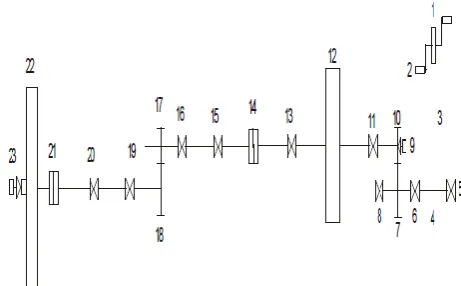
Because of the wide range of applications, the flywheel motor is being the constant subject of researchers for the performance improvement of the many system through parameter optimization. For this various experimentation is done on the flywheel motor. Alexandrove 1981 stated that to power any machine by human energy, its driving power should be less than 75 watts but if any machine or process requiring more than 75 Watts and if process is intermittent without affecting end product, it can also be operated by human energy with the provision of intermittent energy storing unit such as flywheel [6]. This stored energy is supplied periodically at required rate to process unit. This necessitates the use of flywheel in human energized machines and called as flywheel motor. This machine system comprised of three subsystems; energy unit, mechanical power transmission system and process unit. Energy unit comprised of an arrangement similar to a bicycle, a speed raising gear pair and a flywheel. The flywheel size is 1m diameter, 10 cm width and 2 cm thickness. The flywheel is with 6 armed constructions and each arm is with elliptical cross section. Mechanical transmission comprises of spiral jaw clutch and torque amplification gear pair. The process units is a actual machine use for doing the work . Schematic arrangement of a this system is shown in fig below
Fig 1. Human powered Flywheel Motor system
© 2015, IRJET.NET- All Rights Reserved
Page 795
4.OPERATION
OF
THE
HUMAN
POWERD
NURSERY FERTILIZETR MIXER
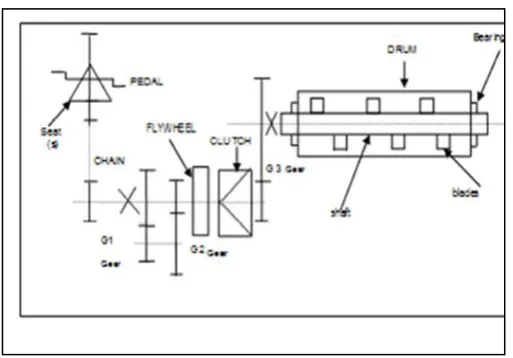
Schematic arrangement of a Nursery shown in fig below.
Fig.2 Nursery Fertilizer Mixer
Developed fertilizer mixer is type of cylindrical drum of 40mm diameter in which a shaft of 35 mm diameter & 900mm in length supported in between two bearing is rotated when it receive the energy from energy unit. Drum has a opening at top to fed ingredients .After mixing material can be taken out from bottom opening. No of rectangular blades are attached to the rotating shafts which are adjustable along its length to change the pitch. In operation various ingredients of the fertilizer viz Soil, Sand, water and Cow dung in required proportion by weight is admitted in the drum through the opening . Then operator seats on the seat(S) and peddles the bicycle mechanism. The rider accelerates the flywheel to a desired speed in about one minute, through a chain and a pair of gears . A free wheel is used between pedals and the flywheel to prevent the back flow of energy from flywheel to pedals. Initially the operator has to put in somewhat more driving torque to overcome the inertia during initial acceleration phase of the motion. Once the steady speed of the motion is reached, the torque input gets reduced. This torque now just balances all the resistances. When flywheel attains desired speed, pedaling is stopped and it is connected to the process unit i.e. Mixer though torque amplification gears by engaging a two jaw spiral clutch. The energy stored in flywheel is supplied at the required rate to nursery fertilizer mixer for mixing ingredients .There is a provision of operating the system at five different speeds by properly choosing the gear ratio of a torque amplification gear pair G3 provided on the shaft of the drum.
5.SELECTION OF INSTRUMENT FOR
MEASUREMENT
Linear measurement- By various caliper, micrometer, scales
Angular velocities- Angular velocity of cutter shaft and flywheel shaft is to be measured. The slotted opto-couplers were mounted on the shaft. These sensors measure the angular velocity with real time clock. This angular velocity is recorded and stored via micro controller 89C51 RD2 which is connected to personal computer through USB port
Variation in torque: The variation of torque on cutter shaft will be evaluated on the basis of speed plots of mixer speed verses time.
Process time: It can be evaluated on the basic of π terms obtained from dimensional analysis
Fig 4. Block Diagram of Instrumentation
6. TEST PROCEDURE
© 2015, IRJET.NET- All Rights Reserved
Page 796
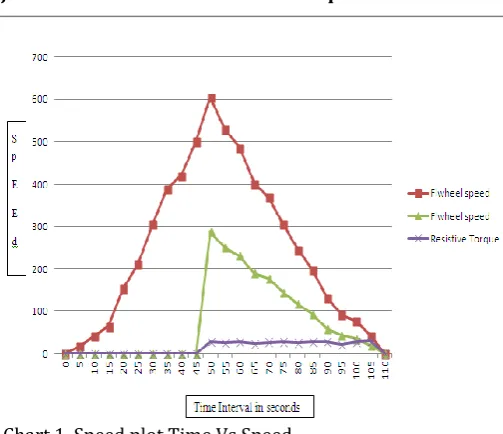
at various time interval & resistive torque on mixer shaftis shown in table below
Sample reading for Blade tip
Diameter
Pitch of blade
Gear Ratio
Speed of Flywheel
300 130 0.5 600
Time Interval
Flywheel speed
Flywheel speed
Resistive Torque
5 18.3 0 0
10 42.7 0 0
15 64.9 0 0
20 154.6 0 0
25 211.3 0 0
30 306.1 0 0
35 389 0 0
40 421.2 0 0
45 502.3 0 0
50 606 288 27.96592
55 529.6 251.3 25.97943
60 487.2 231 28.41684
65 401 189.2 23.36101
70 369.3 177 27.19366
75 305.6 144.2 27.45149
80 245.3 117 26.31231
85 199.2 93.6 28.44567
90 133.6 59 28.6408
95 92.2 42.9 21.22176
100 77 34.3 27.82343
105 43 19 29.59601
Table 1.Input/Output speed at various time interval
Chart 1. Speed plot Time Vs Speed
7.CONCLUSION
A new theory of mixing of nursery fertilizer from the manually driven nursery fertilizer mixer is proposed. This hypothesis states that on engagement of the clutch, the speed of flywheel suddenly falls indicating energy loss. A part of this energy loss is due to developing pressure due to mixing resistance offered by the ingredients when this pressure in the ingredients crosses yield stress, mixing commences. It is further hypothesized that the mixing time is a function of available energy for mixing, resisting torque and average angular speed of the mixer shaft. In designing the Human energized mixer, the main objective was on cost and ergonomic designed, readily-available materials and we proposed a simplistic design that can deliver productive, efficient, and reliable mixer for rural area. This equipment can adequately replace electric motor-driven fertilizer mixer in rural areas where there is no or limited supply of electricity. From the output result. From the results of experimentation obtained ,empirical models to predict the performance of the manually driven nursery fertilizer mixer to mix various ingredients of nursery fertilizer can be established and optimum values of various parameters can be arrived at on the basis of experiments.
REFERENCES
[1]. P.S. Tiwari a,*, L.P. Gite a, M.M. Pandey b, A.K. Shrivastava ,”Pedal power for occupational activities: Effect of power output and pedalling rate on physiological responses., International Journal of Industrial Ergonomics 41 (2011) 261e267
[2] H. Schenk Jr. “Test Sequence and Experimental Plans, “Theories of Engineering Experimentation” McGraw Hill Book Co., New York.
© 2015, IRJET.NET- All Rights Reserved
Page 797
Energized by Human Powered Flywheel Motor.’International journal for Research in Emerging Science and Technology , Vol-1 , issue-5 , October-2014
[4] Modak J.P, Bapat A.R. “Various efficiencies of human powered flywheel motor” Human power number 54; pp21-23.
[5]. Dhale A. and Modak, J. P., “Formulation of the approximate generalized data based model for oilseed presser using human powered flywheel motor as an energy source” International Journal of Agricultural Engineering.
[6] Modak J.P, Moghe S.D “Design and development of human powered machine for the manufacture of lime fly ash sand bricks” Human power; volume 13 number2; 1998; pp3-7.
[7] Modak, J. P. and Bapat, A. R., “Formulation of Generalized Experimental Model for a Manually Driven Flywheel Motor and its Optimization”, Applied Ergonomics, U.K., Vol. 25, No. 2, pp 119-122, 1994.
[8]. Modak J. P. “Design and development of manually energized process machines having relevance to village / agriculture and other productive operations” Human Power, USA International Human Power Vehicle Association no 58 pp 16-22, Fall 2004.
[9]. Modak, J. P. and Katpatal A.A., “Design of Manually Energized Centrifugal Drum Type Algae Formation Unit”Proceedings International AMSE Conference on System, Analysis, Control and Design, Layon (France), Vol. 3, 4-6 July 1994, pp 227-232