© 2015, IRJET.NET- All Rights Reserved
Page 2283
An efficient approach to improve throughput for TCP vegas in ad hoc
network
1
Payal Vispute, Electronics and tele-communication , D.Y.Patil college of engg. Akurdi Pune, Maharashtra , India
2Sayali N. Mane, Electronics and tele-communication , D.Y.Patil college of engg. Akurdi Pune, Maharashtra , India
---***---Abstract - The wireless communication TransmissionControl Protocol (TCP) plays an important role in developing communication systems which provides better and reliable communication capabilities in almost all kinds of networking environment. Vegas is much better in performance as compare to other TCP variants like TCP reno and new Reno because of its packet delivery ratio and full use of packet transmission bandwidth. Some parameters like throughput and transmission delay plays a vital role in vegas performance. The purpose of this paper is to control congestion and improve performance of tcp vegas in mobile ad-hoc network (MANET). The simulation results show that vegas has higher throughput and lower delay of whole network and control congestion. Also, vegas has more capabilities of bandwidth estimation.
Keywords: TCP Vegas; ICA for TCP Vegas; Throughput model; Grey Predictor; Q-learning.
1. 1 INTRODUCTION
TCP vegas is known for its stable and brilliant congestion control capabilities. There are many competitive versions of TCP like Westwood plus, Reno but TCP vegas provides high throughput with minimum loss of packets. It is developed by Brakmo and Peterson in 1992. Vegas is more reliable protocol because it provides congestion control before collision in ad hoc networks.
In mobile ad hoc networks, vegas performs better at three aspects-
1. RTT (Round trip time) is prepared for the later prediction of throughput.
2. Vegas halve the congestion window (cwnd) size by identifying difference between expected throughput and actual throughput.
3. Vegas emphasize packet delay instead of packet loss by calculating transmission rate.
The simulation results show that the ICA for TCP has lower delay, higher throughput and more fair allocation of bandwidth in multi-hops ad hoc scenarios. The related work is shown in section 2. Section 3 introduces ICA (Improved Congestion Avoidance) for TCP vegas. Section 4 formulates the throughput model. Section 5 describes the grey predictor. Q-Learning is as shown in section 6. Section 7 shows obtained results. The article available competitive versions like Reno and New Reno. It has been proved that packet delivery ratio using TCP vegas is much better than other variants. M. Jehan, Dr. G. Radhamani and T. Kalakumari [2] have compared six different TCP standard congestion control algorithms namely BIC, cubic, TCP compound, vegas, reno and westwood congestion control algorithms. It is concluded that vegas provides impressive and desired results like throughput. Also, vegas is best suitable for small and active mobile ad hoc network.
K. Tsiknas and G. Stamatelos [3] have concentrated on the effect of suitable TCP variants on various adverse conditions of WiMax networks like link congestions, asymmetric end to end capabilities, wireless errors etc. G. Abed, M. Ismail and K. Jumari [4] have scenario because of increased path length which leads to a significant increase of segment loss probability.
© 2015, IRJET.NET- All Rights Reserved
Page 2284
802.11WLANs. The proposed bandwidth estimationalgorithm can also be extended for IEEE 802.11e and IEEE 802.11p. R. Belbachir, M. M. Zoulikha, A. Kies and B. Cousin [7] have illustrated a new technique namely “Accurate Bandwidth Reservation – ABR” for bandwidth reservation in MANET. ABR improves existing approach of bandwidth estimation techniques on wireless links.
C. Samios and M. Vernon [8] have proposed a better than TCP Reno in both wired and satellite networks. It overcome rerouting conditions in wired and fluctuating RTT in satellite networks and overcome bias against high bandwidth. whole network performance by future prediction of throughput.
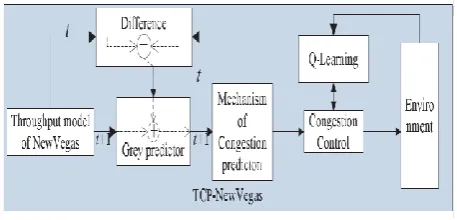
ICA for TCP is a model which proposed to deal with the problem of real achievable throughput of whole network and online congestion control. Using difference (diff) between expected flow and actual flow, congestion avoidance stages. Three views are throughput model, grey prediction model and q learning model. Throughput model calculates the theoretical throughput. Grey prediction
based on forward throughput prediction mechanism is used to promote the online cwnd control. Q-learning is
layer. TCP throughput model is shown by equation (3) and (4).
In equation (3) and (4), P and
CW
peak are Lossevent rate and average peak size of congestion window respectively.
p
slr andp
TO denote segment loss rate and© 2015, IRJET.NET- All Rights Reserved
Page 2285
For MAC layer, DCF (Distributed Coordination Function) with RTS and CTS is shown in figure (5) and parameters are shown in table (1).
Figure 2 : DCF scheme
dh Length of packet header
1
CW
Initial size of cwndTable 1 : Parameters of MAC layer
The delivery probability, probability of node to send data and loss probability of one packet are given by equation (6), (7) and (8),respectively.
1
Another important way to control the congestion is queue management model. Assume for queue management model, RED (Random Early Discard) is used.
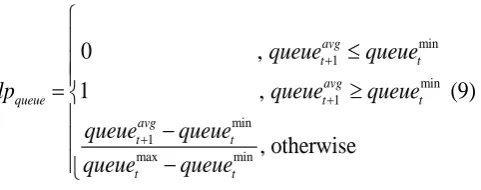
Loss probability is as shown in equation (9).
queue
tminand
queue
tmax are minimal and maximal size of queue inevery congestion control stage at t time.
queue
tavgindicates the average queue length at t+1 time.
min
© 2015, IRJET.NET- All Rights Reserved
Page 2286
used to maximize smoothness and minimize interferenceby reducing randomness and volatility of original data. Using AGO initial data are generated. The predicted value at t+1 is used to decide what action congestion window should take.
6. Q-LEARNING MODEL
When large data transmit under limited bandwidth and less delay then it is possible to send more packets and if more transmission time takes then there is a use of less bandwidth. It is important to manage bandwidth properly in the network and hence use vegas conditions.
To change congestion window, RTT depends on different values such as minimum RTT and maximum RTT at each congestion control change. The interval between minimum RTT and maximum RTT is the quantization of RTT. To improve quantization Markov Decision Model is best. Q-learning process is one of the Markov process.
7. SIMULATION RESULTS
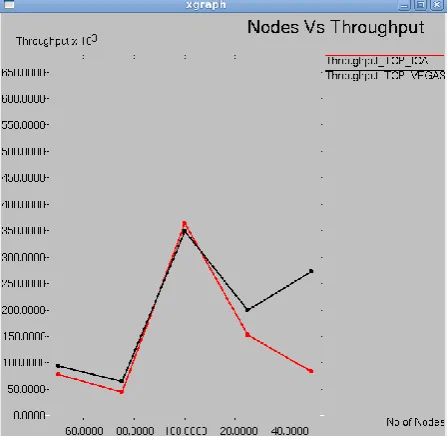
Network Simulator 2 is used to simulate ICA for TCP. In the scenarios, 50 to 150 mobile nodes move in a 1000*1000 meter rectangular region. Normally channel capacity of mobile nodes for speed is 2Mbps but it may vary up to 4Mbps. Assume that all mobile nodes move independently with same speed. All nodes have transmission range is 250meters. Simulation time is 100 seconds.
Fig 3: Simulation result for nodes vs throughput.
Fig 4: simulation result for nodes vs delay.
The simulation results for nodes vs throughput and nodes vs delay is as shown in figure (3) and (4) respectively. It shows that the throughput of ICA for TCP is not stable because of environmental awareness.
8. CONCLUSION
The study of TCP vegas and its parameters such as throughput, transmission delay is important in wireless ad hoc network. The conclusion is TCP vegas is an algorithm which provides impressive and desired results. TCP vegas uses throughput model to improve performance of the network and also it predicts throughput for next time which helps to adjust congestion window. It is also observed that NS2 simulation tool is the best way to illustrate and measure the performance of vegas in ad hoc network.
REFERENCES
[1] F. U. Rashid, J. Singh, A. Panwar and M. Kumar, “Congestion control analysis over wireless ad hoc networks”, International journal of engineering research and technology, vol. 2, no. 5, pp. 462- 465, 2013.
© 2015, IRJET.NET- All Rights Reserved
Page 2287
[3] K. Tsiknas and G. Stamatelos, “Performance evaluationof TCP in IEEE 802.16 networks”, IEEE wireless communications and networking conference: mobile and wireless networks, vol. 2, no. 5, pp. 2951-2955, 2012.
[4] G. Abed, M. Ismail and K. Jumari, “Influence of parameters variation of TCP Vegas in performance of congestion window over large bandwidth-delay networks”, 17th Asia-pacific conference on communicaions, vol. 7, no. 2, pp. 434-438, 2011.
[5] H. Xie, R. Pazzi and A. Boukerche, “A novel cross layer TCP optimization protocol over wireless networks by markov decision process”, Wireless networking symposium conference, vol. 2, no. 5, pp. 5723-5728, 2012.
[6] Z. H. Yuan, H. Venkataraman and G. Muntean, “A novel bandwidth estimation algorithm for IEEE 802.11 TCP data transmissions”, International journal of computer science and information security, vol. 3, no. 1, pp. 377-382,2012.
[7] R. Belbachir, M. M. Zoulikha, A. Kies and B. Cousin, “Bandwidth reservation in mobile adhoc networks”, IEEE wireless communication and networking conference: mobile and wireless networks, vol. 2, no. 1, pp. 2608-2613,2012.
[8] C. Samios and M. Vernon, “Modelingthe Throughput of TCP Vegas”, Sigmetrics pp. 664 – 668, 2003.
[9] K. Srijith, L. Jacob and A. Ananda, “TCP Vegas-A: Improving the Performance of TCP Vegas”, Communication and Internet Research Lab, pp. 429-440, 2003