Volume 2011, Article ID 392529,18pages doi:10.1155/2011/392529
Research Article
Energy-Efficient Source Authentication for Secure Group
Communication with Low-Powered Smart Devices in Hybrid
Wireless/Satellite Networks
Ayan Roy-Chowdhury
1and John S. Baras
21Institute for Systems Research, University of Maryland, College Park, MD 20742, USA
2Department of Electrical and Computer Engineering, Institute for Systems Research, University of Maryland,
College Park, MD 20742, USA
Correspondence should be addressed to Ayan Roy-Chowdhury,[email protected]
Received 1 June 2010; Revised 19 August 2010; Accepted 14 September 2010
Academic Editor: Christos Verikoukis
Copyright © 2011 A. Roy-Chowdhury and J. S. Baras. This is an open access article distributed under the Creative Commons Attribution License, which permits unrestricted use, distribution, and reproduction in any medium, provided the original work is properly cited.
We describe a new class of lightweight, symmetric-key digital certificates called extended TESLA certificates and a source authentication protocol for wireless group communication that is based on the certificate. The certificate binds the identity of a wireless smart device to the anchor element of its key chain; keys from the chain are used for computing message authentication codes (MACs) on messages sourced by the device. The authentication protocol requires a centralized infrastructure in the network: we describe the protocol in a hybrid wireless network with a satellite overlay interconnecting the wireless devices. The satellite is used as the Certificate Authority (CA) and also acts as the proxy for the senders in disclosing the MAC keys to the receivers. We also design a probabilistic nonrepudiation mechanism that utilizes the satellite’s role as the CA and sender proxy. Through analysis, we show that the authentication protocol is secure against malicious adversaries. We also present detailed simulation results that demonstrate that the proposed protocol is much cheaper than traditional public key-based authentication technologies for metrics like processing delay, storage requirements, and energy consumption of the smart devices.
1. Introduction
Large networks of mobile wireless devices have the ability to provide rapid connectivity in disaster areas or military battlefields, or to interconnect users in far-flung geographical locations. However, present limitations on performance, robustness, and security issues have delayed the adoption of such networks. In [1], we have shown that the addition of a satellite overlay to such wireless networks can lead to a great improvement in the network performance. We term this network architecture ahybrid network, which has wireless smart devices in terrestrial clusters with dual satellite connectivity providing alternate high-bandwidth and robust forwarding paths through satellite links.
Security is a necessary parameter in hybrid wireless networks if the communication between a pair of smart devices (henceforth also referred to as networknodes inter-changeably), or a group of devices, is to be protected from
unauthorized access. Due to the open nature of the wireless channel, intruders can eavesdrop on the communication between other nodes if the messages are sent in the clear; they can inject fake messages into the network, purporting to come from other nodes, or attempt to modify or delete messages between other nodes. Therefore, strong security mechanisms to prevent such attacks are important, especially for scenarios like military operations where hybrid networks can be of great use.
Many envisioned applications for hybrid networks are collaborative in nature, and it is necessary to ensure that routing control messages and the application data between communicating devices or nodes are properly authenticated
to enablecommunication. In this work we therefore focus
network protocols and thereby ensure their correct and robust operation.
Authentication in group communication is traditionally based on asymmetric techniques such as public key-based digital signatures that are appended to the messages [2]. This requires universal access to a trusted Certificate Authority (CA) to generate the certificate binding a node’s identity to its public key. Digital signatures also provide nonrepudiation— a noncompromised node cannot deny later that it generated a message that has been signed using its private key.
Public key-based authentication is however computa-tionally very expensive (both in CPU cycles and energy expenditure) to generate digital signatures for messages, and also to verify them [3–6]. The public and private keys are larger in size compared to symmetric keys (e.g., 2048-bit RSA public key against 112-bit equivalent symmetric key [7]); the certificates can also take up significant storage space (e.g., X.509 certificate with 1024-bit RSA key is 1 kilobytes while PGP certificate is 1024 bits). In wireless networks where many devices/nodes might have resource constraints, public key cryptography can become a drawback. For example, handheld wireless devices in hybrid networks can have limited processor power, limited storage capacity, and limited available energy supplied by a battery. Performing digital signature generation and verification frequently will consume significant processor capacity and drain the battery quickly. Therefore in hybrid wireless networks it is preferable to use authentication protocols that are based on symmetric cryptography, which expend less node energy. However, designing authentication protocols for group communica-tion using symmetric cryptography is a significant challenge. The primary difficulty is how to create the asymmetry such that each participant has a unique secret with which to authenticate its messages, while allowing all the receivers the capability for validation.
The problem, therefore, is to design an asymmetric source authentication protocol for group communication with resource-constrained devices, that is efficient in terms of energy needs. As a solution to this problem, we propose a dig-ital certificate construct that uses symmetric cryptographic primitives to achieve asymmetric authentication. The cer-tificate is based on a new class of cercer-tificates called TESLA Certificate. The TESLA certificate concept was originally proposed in [8]. We modify and enhance the original TESLA certificate design and apply the new certificate to hybrid wireless networks to propose an energy-efficient source authentication protocol for nodes in group communication that takes advantage of the centralized infrastructure present in the network, which is the satellite overlay in this particular example of the hybrid network. In the proposed protocol, source authentication using TESLA certificate is based on MAC computation using keyed hash functions, with delayed disclosure of the key by the Certificate Authority (CA), to achieve the asymmetry required for authentication. Due to the use of MACs to generate and verify certificates, the scheme is fast, has low processing overhead, and consumes much less energy than digital signature algorithms. It also avoids the assumption that the user nodes have some sort of security association established a priori, as many other
protocols assume. Using the centralized satellite infrastruc-ture, we also design a probabilistic nonrepudiation algorithm for the source authentication protocol.
We refer to our proposed modifications to the TESLA certificate, as theextended TESLA certificate. The extended TESLA certificate and the source authentication protocol that is based on it, have been described briefly in [9], while the proposed nonrepudiation algorithm has appeared in [10]. In this paper, we provide an integrated and more extensively detailed description of the proposed algorithms, and add the previously unreported algorithm for key dis-closure delay. We also provide more in-depth evaluation of the proposed design, including a detailed security analysis of the proposed protocol and extensive simulation results with detailed analyses. The simulation results demonstrate how much energy efficient the protocol is, in comparison to public key based technologies.
The rest of this paper is organized as follows. We review related work in source authentication algorithms for group communication in Section 2. In Section 3, we describe the TESLA broadcast authentication protocol on which the TESLA certificate is based. The original TESLA certificate algorithm is reviewed inSection 4. We describe our mod-ifications to the original TESLA certificate, and the source authentication protocol based on the extended certificate, in Section 5. The associated probabilistic nonrepudiation protocol is described in Section 6. Security analysis of the proposed protocol is inSection 7. Performance analysis of the authentication protocol is given in Section 8, along with detailed simulation results. We conclude with a brief discussion inSection 9.
2. Related Work
There has been significant research on efficient multicast source authentication algorithms based on symmetric cryp-tography that attempt to minimize the computation expense of the devices. In the following paragraphs we highlight some of the better known proposals.
Canetti et al. [11] proposed one of the early solutions to use symmetric MACs for multicast source authentication. In their scheme, the source has l keys and computes l
MACs on each packet. Each recipient holds a subset of the
lkeys, and verifies the MAC according to the keys it holds. The authentication protocol has probabilistic security—the choice of key subsets held by each recipient is critical in insuring that with high probability no coalition of up tow
colluding members know all the keys held by a good member (where wis the security parameter), and thus maintaining the security of the scheme. The scheme also requires the multicast group members to store a large number of keys.
of even one packet means that the information required to authenticate future packets will be lost. For most multicast protocols, such reliability cannot be guaranteed, since the transmission protocol is UDP, which is best effort.
Wong and Lam [13] have proposed an approach where the source is allowed to delay and group together several consecutive packets. The source collects the packets in a time interval into an authentication tree and signs the root of the tree. The root signature and hash information on the nodes of the tree are included in each transmitted packet. The signing and verification operations are thus amortized over many packets, and the protocol operations are one to two orders of magnitude faster compared to individual packet signatures.
Rohatgi has proposed a hybrid scheme [14] using offline/online signature generation scheme for creating k -time public/private key pairs so that the cost of signature generation can be amortized overksignatures. The size of the keys is reduced by using hash functions with target collision resistance. The size overhead of the proposed scheme is however still considerable on a per-packet basis (of the order of 300 bytes per packet).
Anderson et al. have proposed the Guy Fawkes protocol in [15], which achieves source authentication using a small number of hash computations. In this protocol, the source selects a series of one-time secrets X0,X1,X2,. . .;
the source commits to Xi in message Mi−1 and reveals it
in message Mi+1. The commitment for Xi has the form
h(Mi+1,h(Xi+1),Xi), while the first secret X0 is committed
by some external mechanism such as a conventional digital signature. In the Guy Fawkes protocol, the secrets are not related to one another, and the authentication mechanism cannot tolerate packet losses—if a commitment is lost, the corresponding secret cannot be authenticated.
Perrig has proposed a broadcast authentication scheme named BiBa [16] which exploits the birthday paradox in trying to find two or more colliding hash computations on a given message, where the hash values are computed using a set of self-authenticating values (SEALs)s1,. . .,st. The two or
more SEALs for which the hash on the message collide form the signature. The scheme exploits the asymmetric property that the source has more SEALs than the adversary, and hence it can easily generate the BiBa signature with high probability. However, the adversary only knows the few SEALs disclosed by the source, and hence has a low probability of forging a valid BiBa signature. The algorithm is probabilistic in nature in the signature generation, and has a significant computation overhead at the source to find a valid signature. Also, the probability of an adversary to forge a signature increases with time as more and more SEALs are disclosed by the source.
As the description in the following sections make clear, our proposed authentication algorithm differs significantly from the ones highlighted in this section. We introduce a new type of certificate, which none of the above attempt to do. The most closely related existing work in this regard is the initial work on TESLA certificates by Bohge and Trappe [8], which we describe separately inSection 4, due to its relation to our design. Also unlike the aforementioned
s0
F2 F2 · · · · · ·
· · ·
F2 F2
K0 K1 Kn−1 Kn
F1
s1
F1
Sequence of key generation
Sequence of key usage Time
F1
sn−1 sn
F1
Figure1: TESLA key generation.
algorithms, our design uses time to provide the asymmetry which makes the individual source authentication in groups possible. The use of time is due to the underlying TESLA broadcast authentication protocol [17,18], which is reviewed inSection 3.
Some of the related work described in this section uses public key-based digital signatures for most authentication, with the cost of signature processing amortized over several packets. In contrast, our protocol does not need public key-based digital signatures, except for the initial bootstrapping phase. In addition, our design is robust to packet losses dur-ing transmission such that the authentication of individual packets are not dependent on reliable reception of previous or future packets in the transmission. Moreover, the receivers have to process only one MAC per packet for authentication, where the MAC is computed only on the contents of the associated packet. Either of the former two cannot be claimed of some of the protocols described earlier.
3. Review of TESLA Authentication Protocol
The TESLA broadcast authentication protocol [17, 18] achieves asymmetric authentication between a source and receivers through the use of symmetric cryptographic MAC functions. The asymmetry is obtained through the delayed disclosureof the authentication keys.
The TESLA algorithm is illustrated in Figure 1. TESLA divides the time of transmission by the source intonintervals of equal duration. The source generates a random key seed
sn for interval n, and computes a one-way hash chain by repeatedly applying a public one-way function F1 to sn.
The number of elements of the hash chain correspond to the number of intervals in which the source transmits. The source computes the key used for generating the MAC in each time interval by applying a second public one-way functionF2to each element of the hash chain.
The sender uses the keys in the reverse order of their generation, that is, starting withK1in interval 1, followed by
K2in interval 2, and so on. Owing to the one-way property
ofF1andF2, it is computationally infeasible for any node to
generatesiknowingKi, or to generatesi+1knowingsi.
meet the security criterion, and buffers only the packets that satisfy the freshness condition. The receiver cannot authenticate the packets immediately since it does not know the corresponding key Ki. The sender discloses the key Ki
at a later instant in time by broadcasting the corresponding key seed si. Upon receiving si, each receiver first verifies the authenticity ofsiby checkingsi F1
−→ si−1(and therefore
ultimately verifying against the anchor element s0 which
has already been authenticated). Ifsiverifies correctly, each receiver can compute Ki : si F2
−→ Ki and subsequently use the computedKito verify the MAC on the packets received during intervali.
Oncesiis disclosed, any node with knowledge ofsican compute Ki and attempt to masquerade as the sender by
forging MACs using Ki. Therefore, Ki is used to compute
MACs on packets generated only during the intervali.siis disclosed onlydtime slots afteriso that no malicious node can computeKiand forge packets in the intervening period.
dis computed based on the maximum network delay from the source to all the receivers. This is the principle of delayed disclosure of keys.
The above is a basic description of TESLA. The algorithm has several enhancements to mitigate various drawbacks; they are described in [18].
4. Review of the TESLA Certificate Algorithm
The idea of certificates based on TESLA was proposed in [17]. The idea has been formalized to form a TESLA-based public key infrastructure (PKI) in [8].
In the algorithm described in [8], there is a certificate authority CA who creates certificates for an entityB. During time slotn, the CA generates authentication keyaKBnforB
to use to compute the MAC on its messages in that interval. The CA creates a certificate CertCAn(B) to bindaKBntoBfor
intervaln. The CA uses its TESLA keytKCAnto encryptaKBn
in the certificate, and uses the same key to compute a MAC on the certificate:
CertCAn(B)=
IDB,
aKBntKCA
n,n+d, MACtKCAn(· · ·)
.
(1)
aKBnis known only to the CA andBduring periodn, while tKCAn is known only to the CA.n+dindicates the time at
which the CA will disclosetKCAnto the nodes, that is, it is the
expiration time of the certificate. The CA sends CertCAn(B) to
Balong withaKBn, which is encrypted with keyKCA,Bthat is
shared between the CA andB.
In the time intervaln,n+d, a low-powered deviceD
sends a request toBfor usingB’s service:D→ B: (request). To authenticate itself toD,Bsends an authentication packet containing its certificate and a MAC on the request:
B−→D:CertCAn(B), MACaKBn
request. (2)
When D receives the authentication message, it checks the timestamp of CertCAn(B) to make sure it has arrived before timen+d. If the certificate is “fresh”, Dbuffers the
authentication packet. At timen+d, the CA disclosestKCAn.
Upon receiving the key,D verifies CertCAn(B) by checking the MAC in the certificate usingtKCAn. If the MAC verifies correctly,DobtainsaKBnfrom the certificate by decrypting with tKCAn. Subsequently, D checks MACaKBn(request) to
verify the authenticity ofB. Therefore,Dis able to verify the identity ofBonly if it receives CertCAn(B) beforen+d. Once the CA discloses its TESLA keytKCAn, any node could forge a certificate for the time intervaln.
The TESLA certificate algorithm described above allows a node to add authentication to packets for asingleperiod in time. Therefore, a source nodeBthat transmits for multiple time intervals will need several TESLA certificates from the CA. If there are many sources that send data over long intervals, this can add up to a substantial overhead.
The authors describe an application of TESLA certificates for authentication in hierarchical ad hoc sensor networks in [19]. The focus of the work is on authentication between sensor nodes and the base stations/applications, that is, point-to-point authentication between nodes of varying capabilities. The paper does not address authentication between peer nodes, or authentication in group communi-cation.
5. Extended TESLA Certificate and Source
Authentication Protocol
We extend the original TESLA certificate design and propose a new source authentication protocol based on the extended TESLA certificate, by incorporating the following primary modifications:
(i) we extend the lifetime of the TESLA certificate from single use to multiple uses;
(ii) we allow disclosure of source TESLA keys via proxy; (iii) we add a probabilistic nonrepudiation mechanism to
the source authentication protocol.
A detailed description of the extended TESLA certificate and the source authentication protocol are given in the fol-lowing sections. We start with a statement of the assumptions that we have made for our solution.
5.1. Network Requirements and Security Assumptions. The
extended TESLA certificate implementation requires the presence of a Certificate Authority (CA) to generate the certificates. In our source authentication algorithm, the CA broadcasts the TESLA keys of the source nodes to the network at periodic key disclosure intervals. In the exemplary hybrid network topology discussed in this paper, we use the satellite for providing the services of the CA. The reasons for using the satellite as the CA are as follows.
(i) The satellite is a network node that is always available, connected to the entire network, and is physically secure.
(iii) The energy available to the satellite is renewable via solar power. Therefore the satellite can perform intensive security and network operations without the risk of draining its energy.
Therefore the presence of the satellite allows the imple-mentation of efficient and secure centralized authentication protocols that would have been difficult to implement in terrestrial wireless networks without comparable centralized infrastructure. Hence we consider the satellite as the root CA in our authentication protocol design and assume that it is trusted by all other nodes in the network. In the proposed source authentication protocol, the satellite generates the TESLA certificates for all the terrestrial user nodes, and it acts as the proxy for the terrestrial nodes for disclosing the TESLA MAC keys used by the nodes for authentication and message integrity—instead of the source node, the satellite broadcasts the TESLA keys to the network at regular time intervals. Therefore the TESLA keys reach all the user nodes in one broadcast transmission. This saves the delay in TESLA authentication, and reduces the processing load on the source nodes, and also the network transmission overhead.
In order to describe the operation of the authentication protocol, let us consider, without loss of generality, a group of three wireless nodesA,B, andC, whereAsends messages to B and C. Our objective is to design an authentication mechanism that allows B and C to securely authenticate messages fromAusing a computationally efficient algorithm that expends low node energy. We make the following assumptions about the initial security setup of the network for authentication purposes:
(i) all three nodes have limited energy and processing power, and none has any pre-existing security infor-mation about the others;
(ii) the public key +KCAof the CA is available to all nodes;
(iii) all nodes are time-synchronized with the CA; (iv) appropriate security policies are in place to allow each
node to securely identify itself to the CA during the initial bootstrapping phase, and each nodeXshares a unique secret keyKCA,Xwith the CA;
(v) one-way functions F1 and F2 [20] are publicly
available;
(vi) message transmission fromAtoBandCstart at time
t0;
(vii) time is divided into intervals, each of durationΔ.
The three-user network above can be extended to larger networks with multiple sources and receivers; the extended TESLA certificate and the source authentication protocol described in the following sections would be equally applicable to the larger networks.
5.2. Initial Setup: Key Generation by CA and Source Node. At the time of the initial setup, before any messages are transmitted in the network, the CA and all sources generate the keys that each will need for message authentication. The sets of keys are generated using the TESLA algorithm.
The CA uses a TESLA key chain{tKCA,i},i= {1,. . .,N}
to authenticate the TESLA certificates that it generates for the group sources. The CA generates a random seed sCA,N and
applies one-way function F1 tosCA,N to form ahash chain
(3):
sCA,0 ←F1 sCA,1 ← · · ·F1 ←F1 sCA,N−1 ←F1 sCA,N, (3)
whereN > 0 is equal to the number of unique MAC keys that the CA expects to use for authenticating the certificates and messages it generates during its operational lifetime. The value N depends on the length of each time interval and the total duration that the CA node will perform the function of the CA. We assume that in each time interval, the CA uses only one key for computing the MACs on all the messages it generates in that time interval. Therefore, if the CA’s operational lifetime is T and the interval for key disclosure isd, we haveN=T/d.
It is not necessary thatT (and hence,N) are associated with the entire lifetime of the CA.T could be a duration that is less than the CA operational life. When timeT has elapsed, and the CA has disclosedsCA,N, the CA can start
with a new hash chain with starting element N = T/d
corresponding to a new durationT and a new disclosure intervald(which can be the same asd). The CA will have to broadcast the anchor element of the new chain to the network in the manner described in (5), or the new chain can be generated such that one can securely derivesCA,Nfrom
the new one. We describe the rest of the algorithms assuming thatTis equal to the CA lifetime, since this is not central to the algorithm development.
Once the hash chain has been generated as described in (3), the CA applies functionF2 to each element of the
chain to obtain the certificate keystKCA,i, which it uses in
the certificates (4):
F1 F1 F1 F1
sCA,0 sCA,1 · · · · · ·
sCA,N−1 sCA,N
F2 F2 F2
· · ·
tKCA,1 tKCA,N−1 tKCA,N
(4)
sCA,0 is the anchor element of the CA’s authentication key
chain. All TESLA certificates and signed messages from the CA are authenticated using the anchor element during the protocol run.sCA,0is broadcast to the network at timet < t0
(5):
CA−→network :sCA,0, SIGN−KCA(· · ·)
. (5)
The anchor element itself is authenticated using traditional public key cryptography: the CA generates a signature on the message containing the anchor element and broadcast the message with the signature. All network nodes receiving the broadcasts message verify the signature on the message using the public key +KCA of the CA. If the signature is verified,
the nodes store in local memory the keysCA,0along with the
IDA
Identity of sourceA
CA’s initial TESLA key MAC on the
certificate CA’s digital
signature Disclosure time forKCA,0
A’s hash chain anchor
(sA,0)tKCA,1
t0+d
MACtKCA,1(· · ·)
SIGN−KCA(· · ·)
Figure2: TESLA certificate for nodeA.
In a manner similar to the above, each source node A
generates a random seedsA,nand applies one-way function F1tosA,nto form a hash chain, before any messages are sent. Asubsequently appliesF2 to each keysA,igenerated above
and obtains the outputsA,i(3):
F1 F1 F1 F1
sA,0 sA,1 · · ·
· · ·
· · ·
sA,n−1 sA,n
F2 F2 F2 F2
sA,0 sA,1 sA,n−1 sA,n
(6)
Heren >0 is equal to the number of unique MAC keys that
Aexpects to use for authenticating its messages. The value
ndepends on the length of each time interval and the total duration ofA’s transmission. We assume that in each time interval Δ, a source uses only one key for computing the MACs on all the messages it generates in that time interval Therefore, if the total time ofA’s transmission isT, we have
n=T/Δ.
At timet < t0,AsendssA,n,nto the CA, along with details
onA’s key disclosure interval. The message fromAto the CA is secured using the shared secretKCA,A betweenAand the
CA. The CA can obtain all the elements ofA’s TESLA key chain fromsA,nandn, as in (3).
5.3. Extended TESLA Certificate. On successful verification of node A’s identity subsequent to the steps described in
Section 5.2, the CA generates the TESLA certificate forA. A schematic of the TESLA certificate forAis given inFigure 2. The certificate maps the identity of the source node A to the keysA,0 which is the anchor element of A’s key chain.
sA,0is encrypted using key tKCA,1 from the CA’s key chain.
tKCA,1is the CA MAC key for the time periodt0,t0+d. The
certificate mentions the timet0+dup to which the certificate
is valid, that is, after timet0+d, keysA,0is made public to the
group and it can no longer be used for new messages. The certificate contains a MAC for authentication, computed on the previous elements usingtKCA,1.
For added security, the certificate might also contain CA’s public key signature on all the previous elements as shown in (7). However, this is not necessary if the CA has previously
successfully broadcast the anchor element of its own key chain, following (5):
CertCA(A)
=IDA,
sA,0
tKCA,1,t0+d, MACtKCA,1(· · ·), SIGN−KCA(· · ·)
, (7)
CA−→A: CertCA(A). (8)
Hered ≥ Δis the key disclosure delay for the CA TESLA signature key.
5.4. Message Transmission from Source to Receiver. Asends messages toBandCstarting in the time intervalt0,t0+d.A
computes a MAC over the messagem0usingsA,0and includes
its TESLA certificate CertCA(A) with the message:
A−→ {B,C}:M0|M0:
m0, MACsA,0(m0), CertCA(A)
.
(9)
Each of B and C checks the freshness of the certificate by checking the timestamp of CertCA(A) to make sure it has
arrived within the periodt,t0+d. The receivers also check
thatsA,0is not publicly known, that is, MACs
A,0(m0) cannot yet be computed by them. If all the checks pass,BandCstore
M0in their respective buffers, else they discard the message.
Checking the timestamp on CertCA(A) is critical for the
security of the algorithm. Once the CA discloses sCA,1 at
time t1 t0 +d, any node in the network can create a fake certificate with timestamp t0 +d, allegedly generated
by the CA, similar to (7). Therefore receivers will only accept certificates for which the CA TESLA key has not been disclosed at the time of receiving the certificate.
5.5. Message Authentication at Receiver. At timet1=t0+d,
the CA broadcasts the keysCA,1to the network:
CA−→network :t0,t0+d,sCA,1, SIGN−KCA(· · ·)
. (10)
If receiverBorChas received the anchor elementsCA,0 (5),
they can check the authenticity of sCA,1 by verifying sCA,1
againstsCA,0:
sCA,1
F1
−→sCA,0. (11)
Otherwise,BorC can verifysCA,1 from the signature using
+KCA. If verification is successful, each receiver derives
tKCA,1fromsCA,1(4) and usestKCA,1 to verify the MAC on
CertCA(A). If the MAC is correct, receiverBobtainssA,0from
CertCA(A) by decrypting withtKCA,1.BobtainssA,0fromsA,0
(6). ThenBchecks MACsA,0(m0) usings
A,0and acceptsm0if
the MAC verifies correctly.Bsaves CertCA(A) and the anchor
elementsA,0ofAs key chain in long-term memory—they are
Generate CA key chain CA anchor
element broadcast
Compute certificate forA
CA key disclosure
sCA,1
Source key
sA,1
disclosure by CA
Ti
m
e
sCA,0
Certificate requestsA,n,n
CertCA(A)
sCA,1
sA,1
sCA,0
sCA,0
BuffersCA,0
Generate key chain Compute MAC & send msgM0
MessageM0
sCA,1
MessageM1
MessageM2
BuffersCA,0
MessageM0
MessageM1
BufferM0
MessageM2
ComputetKCA,1
verify CertCA(A)
obtainsA,0
computesA,0
verify MAC onM0
BufferM2
BufferM2
BufferM1
VerifysA,1
computesA,1
verify MAC onM1
VerifysA,1
computesA,1
verify MAC onM1
BuffersCA,0
BufferM0
ComputetKCA,1
verify CertCA(A)
obtainsA,0
computesA,0
verify MAC onM0
BufferM1
CA SourceA ReceiverB ReceiverC
Figure3: Time diagram for source authentication using the extended TESLA certificate.
Adoes not have to include its TESLA certificate in messages subsequent toM0, under the assumption that every receiver
has receivedM0correctly. For example, in the periodti,ti+
Δ, messageMifromAtoBwould look like
A−→B:Mi|Mi:mi, MACsA,i(mi)
. (12)
At timeti+d,theCAbroadcastssA,i to the network. Since d > Δ, when sA,iis disclosed,Ais no longer using sA,i for
computing the MACs on its messages. Any receiverB that receives the CA broadcast, verifies thatsA,iindeed belongs to A’s MAC key chain as
sA,i−→F1 sA,i−1−→ · · ·F1 −→F1 sA,0. (13)
The above verification is correct sinceF1is a secure one-way
function andsA,0has already been verified from CertCA(A).
However, ifBwants to be additionally careful, it can verify
sA,igoing through the additional steps described above, using
the CA key broadcast message and CertCA(A).Figure 3gives
a timing diagram representation of the protocol.
After the initial anchor element broadcast message from the CA signed with−KCA, subsequent key disclosure
messages from the CA can be authenticated using one-way chains. For example, CA discloses the keysCA,iused in period
ti,ti+dat timeti+d. ReceiverBcan verify thatsCA,ibelongs
to CA’s one-way chain:
sCA,i F1
−→sCA,i−1
F1
−→ · · · F1
−→sCA,0. (14)
wheresCA,0has been verified before using +KCA.Bdoes not
need to check CA’s signature to verifysCA,i.
Thus messages fromAtoBandCcan be authenticated. The source authentication protocol requires thatAperform one signature verification to verify the certificate it receives from the CA (7). Each receiver also performs one signature verification on the anchor element broadcast message from the CA (5). SinceAis not a receiver, it does not need the verification in (5). All other messages from the CA and the sources can be authenticated using low-computation symmetric MACs. Moreover, sources and receivers do not have to perform clock synchronization directly with one another, synchronizing with the CA is a necessary and sufficient condition for the protocol. This saves additional message rounds and protocol complexity and also breaks the cyclical dependency between authentication and clock synchronization.
5.6. Certificate Revocation. At any time the circumstances warrant that the extended TESLA certificate of a node has to be revoked, the CA would need to broadcast a certificate revocation message to the network. Assume that the CA revokes the TESLA certificate of nodeAin the time period
the network:
CA−→network:(ti,ti+d, REVOKE(CertCA(A)),
MACtKCA,i+1(· · ·)
.
(15)
The receiver buffers the message and waits for the CA to disclosesCA,i+1at timeti+d. The traffic received fromAin the
intermediate period is also buffered, awaiting the verification of the revocation message, due to the possibility that the revocation message might be a fake. At time ti+1 = ti +
2d, the CA broadcasts sCA,i+1 to the network. Bcan verify
the authenticity ofsCA,i+1 from (14) and thus validate the
revocation message. If the revocation message is correctly verified, the receiver discards the buffered messages fromA
and adds the sender to the revoked users list.
The revocation message can be merged with the key disclosure message, the combined message looks like
CA−→network:ti,ti+d, REVOKE(· · ·),sCA,i,
MACtKCA,i+1(· · ·), SIGN−KCA(· · ·)
, (16)
where the REVOKE field will contain the TESLA certificates to be revoked, the MAC is computed on the revoked certificates and the signature verifies sCA,i for nodes that
might need the verification (instead of verifyingsCA,iusing
(14)).
Equation (16) implies that the revocation list is sent out at regular intervals with the key disclosure message. The revocation list will contain only those revoked certificates that are otherwise unexpired. Therefore revocation lists in multiple messages might repeat revoked certificates. This helps to make the revocation messages resilient to random channel losses of CA messages.
5.7. Key Disclosure Delay
5.7.1. Time Synchronization. Due to the use of the key
disclosure delay to achieve asymmetry in authentication, time synchronization between the nodes taking part in the group communication is important for the correct operation of the source authentication protocol. We use the satellite as the time reference due to its centralized location and global reach. Each terrestrial node synchronizes its local clock with the satellite time. Figure 4 illustrates the time synchronization of the terrestrial nodes with the satellite/CA. The time synchronization algorithm works as follows.
(1) At periodic intervals, the CA broadcasts its local timetCAto the network, authenticated with a digital
signature. As shown inFigure 4, let the local times at that instant at a terrestrial source nodeSand receiver nodeRbet1andt2, respectively.
(2) Sender S receives the CA time broadcast at its local time tS. The sender computes the maximum difference in time from the CA as
tS−tCA=tS−t1+t1−tCA=δS+S, (17)
whereS is the synchronization error of the source
clock with the time reference. Therefore the upper bound on the CA’s local time, with reference toS, is
t≤tS+δS+S, (18)
(3) Receiver R receives the CA time broadcast at its local timetR. The receiver computes the maximum difference in time from the CA as
tR−tCA=tR−t2+t2−tCA=δR+R. (19)
whereR is the synchronization error of the source
clock with the time reference. Therefore the upper bound on the CA’s local time, with reference toR, is
t≤tR+δR+R. (20)
The above method of time synchronization with the CA also indirectly synchronizes the time between the terrestrial nodes. After synchronization, the difference in time between the nodesSandRis
δS−δR+S−R. (21)
It can be deduced from Figure 4 that δS and δR are the network propagation times from the satellite to the terrestrial nodes, that is,δS≈δRand hence the difference in local time is only
S−R=SR (22)
IfSandRare well synchronized with the CA:SR≈0.
5.7.2. Computation of the Key Disclosure Delay. The key
disclosure delaydis a critical parameter affecting both the security and the performance of the proposed protocol. It depends on the duration of each time interval Δ and the network propagation delay from the sources to the receivers. As is shown below, if the message transmission from the sources to the receivers happens exclusively over the satellite links, then the key disclosure delay depends only onΔand the satellite link propagation delay, which is known and fixed.
We follow the method outlined in [18] in computing the key disclosure delay for our proposed protocol. Let us consider a packetpj being sent by sourceSand received by nodeRin time intervalIj. Let the local times atSbetSj when
the packet is sent, while the local time atRistRj, when the
packet is received. The requirement to satisfy the security condition is
⎢ ⎢
⎣tRj +δR+R−t0
Δ
⎥ ⎥ ⎦−I
j< d, (23)
whereδRandRare the propagation delay from the CA to the
receiver and the time synchronization error atR, respectively, as explained inSection 5.7and shown inFigure 4
Also, we must have
Local time of satellite
Local time of terrestrial
nodes
tCA
t1 ts
δs
δR
t2 tR
Figure4: Time synchronization between the protocol participants in the extended TESLA certificate protocol.
Equation (24) merely states that the local time at the source must correspond to the time in interval Ij. If DSR is the
network propagation delay fromStoR, then
DSR=tRj +R−tSj−S, (25)
whereSis the time synchronization error forS.
From (23), (24), (25), we get: ⎢
⎢
⎣DSR−R+tSj+S+δR+R−t0
Δ
⎥ ⎥ ⎦−I
j< d,
that is,
DSR+t0+Ij∗Δ+Δ+S+δR−t0
Δ
−Ij< d,
that is,
DSR+S+δR
Δ
+ 1< d.
(26)
If we assume that the packet transmission fromStoRis over the satellite links, thenDSRis one-way propagation delay over the satellite fromStoR, whileδRis the direct propagation delay from the satellite to any terrestrial node. We thus have
DSR=2∗δRand hence from (26), we get
3∗δR+S
Δ
+ 1< d. (27)
For a given satellite configuration,δRis known and fixed. For example, for a geostationary satellite,δR is of the order of 0.12 seconds. Moreover, for fine synchronization of the terrestrial nodes with the time reference, S is negligible
compared to the satellite propagation delay. Hence, (27) gives
0.36 Δ
+ 1< d. (28)
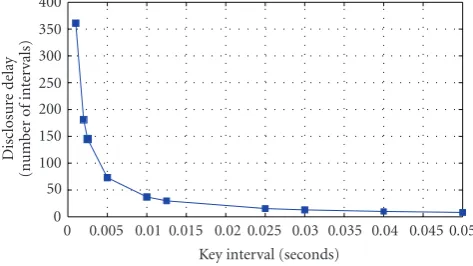
Figure 5shows the variation in the key disclosure delay
d as a function of the key use interval Δ. As the figure demonstrates, the product of the disclosure delay and the key
0 50 100 150 200 250 300 350 400
Disclosur
e
dela
y
(n
umber
o
f
int
er
vals)
0 0.005 0.01 0.015 0.02 0.025 0.03 0.035 0.04 0.045 0.05 Key interval (seconds)
Figure5: Key disclosure delaydas a function of key use intervalΔ.
use interval is bounded by the network propagation delay, which is a constant. Hence as the key use interval increases from 1 ms to up to 50 ms, the disclosure delay varies between 361 ms and 410 ms.
6. Nonrepudiation of the Source
Authentication Protocol
In our extended TESLA certificate algorithm, we propose to add nonrepudiation by taking advantage of the satellite infrastructure and the proposed mechanism of key disclosure by proxy. This is achieved as follows.
The source authenticates each message by two or more MACs, computed using keys from two or more key chains, respectively. The root key of each chain is shared between the source and the CA (the satellite) as described inSection 5.2, and the anchor elements of all the key chains used by the source is included in the extended TESLA certificate for that source. The source includes all the MACs with each message transmission. Each receiver buffers the message along with all the MACs if the basic security check is satisfied, as described in the protocol inSection 5.5. At the time of key disclosure, the CA broadcastsonly one of the MAC keysout of the set of MAC keys for the given source and message. Each receiver verifies the single MAC associated with the key broadcast by the CA, and accepts the message as correct if the MAC is verified. If any receiver wants to be able to check the message for nonrepudiation at a later time instant, it saves the message along with all its MACs.
The MAC key that is disclosed by the CA is chosen at every disclosure instant, with uniform probability from the set of available keys for that time interval. Therefore, the source cannot know in advance, with a high degree of probability, which key will be used by the receivers for authentication. Hence, if the source would like its messages to be accepted by the receivers, it will have to include all the MACs correctly computed with the corresponding keys.
If at a later instant in time, a receiver would like to prove that a message was indeed generated by the source (i.e., nonrepudiation), the receiver can simply send a nonrepudiation request to the CA. Upon receiving the request, the CA discloses one of the previously undisclosed MAC keys for the message in question. The receiver can compute the MAC for the message with the newly disclosed key and compare the MAC with the set of MACs it had saved previously. If the CA and the receiver operates correctly, the newly computed MAC will match one of the saved MACs. Since (i) the undisclosed MAC keys were known only to the source and the CA, and (ii) the CA is universally trusted, therefore the saved MAC must have been computed by the source using its MAC key and hence the message must have been generated by the source. Thus nonrepudiation is achieved.
The security of the above algorithm is proportional to the number of MACs included with each message. For two MACs per message, the probability of a particular key being disclosed by the CA is 0.5. We term this probability the r -factor, wherer is acronym for repudiation. It is computed as the inverse of the number of MACs included with each message. A nonconforming source which includes only one correctly computed MAC with its message in order to avoid nonrepudiation, can expect the message to be accepted by the receivers only with 50% probability. If four MACs are included with every message, the r-factor is to 0.25, and so on. There is hence a tradeoff between the strength of the nonrepudiation algorithm and the security overhead per message in terms of number of MACs involved. There is also
the processing overhead at the source since its node has to computeM, number of MACs per message whereM >1.
The number of MACs per message also affects the security of the algorithm in the context of the receivers. If there are two MACs per message, the nonrepudiation mechanism will be successful for the request from one receiver. For any subsequent request from other receivers for that particular message, nonrepudiation will fail since both MAC keys are now known to the receivers. The number of successful nonrepudiation requests for a given message is therefore directly proportional to the number of MACs per message. This drawback can be solved by modifying the protocol steps for nonrepudiation. Instead of sending a request for an undisclosed key, the receiver can send the entire message along with the saved MACs, to the CA. The CA itself will compute the MACs on the message with any one of the undisclosed keys and compare with the saved MACs sent by the receiver. Since the undisclosed keys are known only to the CA and the source, in the event of a match, the CA can confirm to the receiver that the message was indeed generated by the source. The security of this mechanism depends only on the amount of trust placed on the CA and is independent of the number of MACs per message. The tradeoffis the additional load on the CA and the network overhead in transmission of the message with the MACs, to the CA.
7. Security Analysis: Prevention of
Authentication Attacks
The source authentication protocol based on the extended TESLA certificate is resistant to active attacks by malicious nodes in the network. In the following sections we discuss the security provided by the protocol against specific active attacks. In our analysis, we assume that the CA is always secure, since compromise of the CA is a single point of failure for security in the network.
7.1. Malicious Node with Connectivity to Source and Receiver. We consider the case where a malicious nodeXattempts to create fake packets from a source to the receiver(s). Without loss of generality, we consider one sourceAis sending data to one receiver B, the data being authenticated using the proposed source authentication protocol. We assume that
X can hear packet transmissions from A, and can also transmit to B. X can also receive the broadcast messages from the CA. Therefore, shortly after time t0 +d, X has
knowledge of CertCA(A), message M0 from A to B, sCA,0
broadcast by the CA, and sA,0 from the certificate. X can
verify thatsA,0belongs to the authentication hash chain ofA
by performing the verification procedure. Having obtained a verified element ofAs authentication chain,X can attempt to spoof messages as coming fromA, starting at timet0+kd,
wherek > 0. To achieve this,Xneeds to generatesA,k from sA,0 wheresA,k = F1−k{sA,0}. Due to the one-way property
of F1, this is computationally infeasible for X and is of
complexity O(2K), where each element of the hash chain
160 bits for SHA-1 HMAC [21]). Without a valid sA,k, it
would be impossible forXto spoof a message that would be successfully authenticated byB.
X could also attempt to spoof packets fromAat any time betweent0,t0+d. This would require thatXsuccessfully
generates an element ofAs hash chain without knowledge of any legitimate element of the hash chain. This has the same computational complexity ofO(2K) and is computationally
infeasible for anyXwith finite resources.
A third approach X attempt would be to generate an independent hash chain that produces the hash value sX,0
that is computationally indistinguishable from sA,0. This
would allowX to use elementsX,0of its own hash chain to
authenticate messages purportedly generated byA. However, this is computationally infeasible due to the collision-resistance property ofF1andF2.
Failing any attack on As hash chain as above,X could attempt to masquerade as the CA and generate a fake certificate for A as in (7), and also generate fake CA key disclosure broadcast message similar to (10). However, unless
X knows the CA private key −KCA, it will not be able to
correctly sign the fake CertCA(A), and therefore the fake
certificate will be rejected by A. Likewise, the fake CA broadcast message from X will be rejected by the receivers unless the signature in the message is verified as correct using +KCA. As per our assumption of the security of the CA,−KCA
is known only to the correct CA, and thereforeXwould not be successful in this attack.
X could attempt to fake CA key disclosure messages subsequent to (10), but (a) the fake hash elementsCAX,iwill
not verify successfully to the anchor elementsCA,0 and (b)
this does not allowXto fake elements ofAs hash chain.
7.2. Attack on the CA Revocation Messages. A malicious
node X in the network can attempt to broadcast fake revocation messages, similar to (15), and thereby attempt to disqualify legitimate sources in the network. To generate a fake revocation message that will be successfully accepted by the receivers, X should be able to compute a MAC on the fake revocation message using the keysCA,i+1, with knowledge
of at most the keysCA,i, where sCA,i+1 = F1−1{sCA,i}. Using
reasoning similar to the previous section, owing to the one-way property ofF1, this has computational complexityO(2K)
and is infeasible forX. At most,Xcan trick the receivers in buffering the fake revocation message, till the next message disclosure from the CA, when the MAC on the fake message will not verify correctly using the recently disclosed (correct)
sCA,i+1, and therefore be discarded.
Therefore, the source authentication protocol based on the extended TESLA certificate approach is secure against message spoofing attacks by malicious nodes in the network.
7.3. Signal Jamming Attacks. Adversarial nodes can attempt to prevent the successful transmission of protocol messages by jamming the channel with unwanted signals. This is a physical layer attack and not an attack against the authentica-tion algorithms per se. Methods to achieve resiliency against such attacks are ideally the domain of the physical and
link layer algorithms, for example, spreading algorithms and acknowledgment-retransmission algorithms, amongst other measures.
For the hybrid network architecture described in this work, a large network-wide signal corruption is mostly infeasible, due to the vast footprint of the satellite. Channel losses are localized to small regions at any given time; the satellite physical and link layer protocols incorporate sufficient mechanisms to recover from such losses.
At the same time, the proposed authentication algorithm is robust to random channel losses of protocol messages.
(i) Authentication of any individual packet is indepen-dent of authentication of prior packets. If the source key disclosure message containing the keys for a set of buffered packets, is lost due to channel errors, then only that set of buffered packets cannot be authenticated; it does not affect packets whose MAC keys are not in the lost disclosure message.
(ii) If a certificate revocation message (associated with the CA key disclosure message) is lost due to channel errors, the receivers will not be aware of any newly revoked certificate that is contained in the lost message. Consequently the packets from the corresponding source will continue to be treated as valid, till the next revocation message is received, or the certificate expires, whichever is earlier.
8. Performance Evaluation of Extended TESLA
Certificate Algorithm
We have run simulations of the proposed source authentica-tion protocol to analyze the demands the protocol can make of node resources, and also to compare it with public key-based authentication protocols. For our performance analy-sis, we consider that all security protocol and data messages from the source to the receivers are sent over the satellite channel where the satellite is in Ka-band and geostationary orbit. Therefore, the one-way satellite propagation delay is of the order of 130 ms and the terrestrial propagation delays from the group nodes to the local gateways are negligible in comparison. Moreover, the satellite uplink bandwidth is much less in comparison to the satellite downlink bandwidth and usually also lower than the terrestrial wireless bandwidth (assuming the wireless MAC protocol is IEEE 802.11). By our assumption, all data has to traverse the satellite uplink and hence we limit the overall network bandwidth to be equivalent to the satellite uplink bandwidth. In the following analyses, the uplink bandwidth is varied between 64 Kbps and 10 Mbps.
0 Key use interval (seconds)
64 Kbps
Figure6: Receiver buffer size for varying network bandwidths and key use intervals.
0 200 400 600 800 1000 1200 1400 1500 Receiver buffer size (KB)
64 Kbps
Figure7: Key use intervalΔas a function of receiver buffer size and network bandwidth.
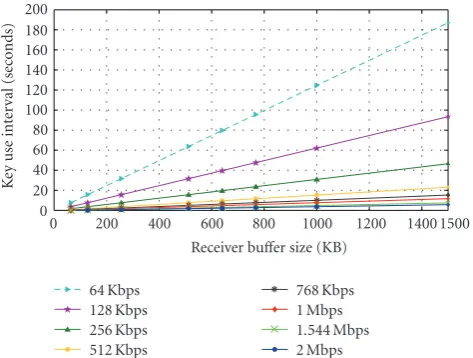
In theory, the receiver buffer size depends on the time interval of key use (since the key disclosure delay is a function of that) and the network bandwidth. AsFigure 6shows, the buffer size varies little with the key disclosure delay since it is limited to a narrow range by the network propagation delay. However, the buffer size is significantly affected by the rate at which data is received—for higher rates, larger buffer is required. Even so, the buffer requirement is only in the order of hundreds of kilobytes, which is a small fraction of the memory present in wireless smart devices today.
If the receiver buffer is fixed due to hardware constraints, the key disclosure delay (and hence the key use interval) has to be dynamically determined based on the smallest buffer size available, and the network bandwidth. Figure 7shows that the key use interval can be longer for larger buffers, while it is shorter for higher bandwidths.
8.2. Comparison of the Certificate Size. The size of the
TESLA certificate and the MACs computed on each message, compare favorably to digital certificates and signatures used in public key-based cryptography. If the MAC algorithm is based on SHA-1 [21], the key used is 160 bits. For a TESLA certificate with fields as shown in 2, the certificate size is computed as follows.
(i) 32 bits for the ID—this will cover 4 billion nodes; (ii) 160 bits for the encrypted anchor element (128 bits if
MD5 is used instead of SHA-1);
(iii) 64 bits for the time field—this gives the current time in UTC since January 1, 1900, with a resolution of 200 picoseconds [22];
(iv) 160 bits for the MAC;
(v) 1024 bits for the CA digital signature (assuming PKCS no. 1-based [23] digital signature with mod-ulus 1024 bits).
Therefore, the total size of the certificate is 1440 bits or 180 bytes. In contrast, a typical X.509 certificate size is of the order of 1 KB.
8.3. Comparison of Signature Size Overhead. The size of the MAC appended to each message in our protocol is 128 bits for HMAC-MD5 or 160 bits for HMAC-SHA1 (and with
r-factor 1). In comparison, if RSA-based digital signature is used, the signature size would be 512 bits, 1024 bits, or 2048 bits for RSA modulusN=512, 1024, 2048, respectively. For DSA or ECDSA-based digital signatures, the signature size is 320 bits for a security level of 80 bits [2].
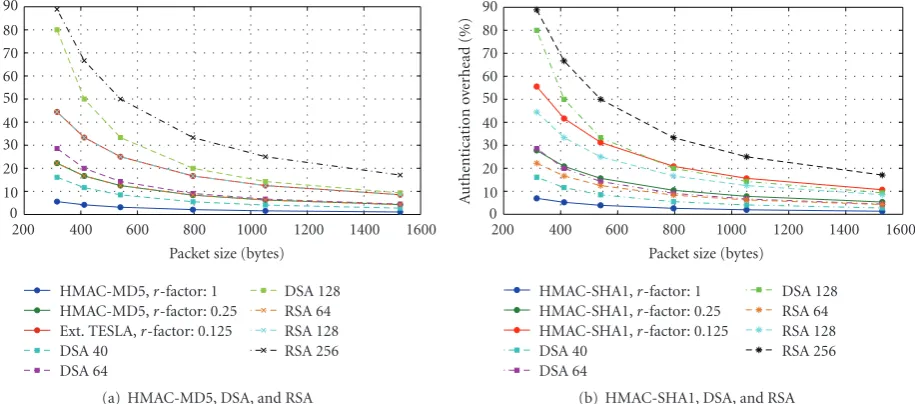
A comparison of the size overhead incurred for authen-ticating 500 MB data using our proposed protocol or DSA or RSA, is shown inFigure 8.Figure 8(a)compares extended TESLA with HMAC-MD5 against DSA and RSA, while
0
200 400 600 800 1000 1200 1400 1600 Packet size (bytes)
HMAC-MD5,r-factor: 1 HMAC-MD5,r-factor: 0.25 Ext. TESLA,r-factor: 0.125 DSA 40 (a) HMAC-MD5, DSA, and RSA
0
200 400 600 800 1000 1200 1400 1600 Packet size (bytes)
HMAC-SHA1,r-factor: 1 HMAC-SHA1,r-factor: 0.25 HMAC-SHA1,r-factor: 0.125 DSA 40 (b) HMAC-SHA1, DSA, and RSA
Figure8: Comparison of percentage byte overhead due to authentication for 500 MB data.
0
200 400 600 800 1000 1200 1400 1600 Packet size (bytes)
HMAC-MD5,r-factor: 1 HMAC-MD5,r-factor: 0.25 HMAC-MD5,r-factor: 0.125
HMAC-SHA-1,r-factor: 1 HMAC-SHA-1,r-factor: 0.25 HMAC-SHA-1,r-factor: 0.125
Figure9: Percentage size overhead comparison between HMAC-MD5 and HMAC-SHA1, 500 MB data.
overhead due to strong RSA (256 byte signature) or DSA (128 byte signature-) based security. The graphs suggest that we should go for the largest packet size allowed by the underlying link layer protocol, since the overhead drops significantly. However, this has to be considered against the energy expense for authenticating larger packet sizes, as shown in some following figures.
Figure 9shows that the size overhead with HMAC-SHA1 is more than that with HMAC-MD5 for allr-factors, since each individual MAC for the former is 1.25 times in size that of the latter. However, for higher r-factors and larger packet sizes, the overheads tend towards equal values. The graphs again emphasize the need for larger packets, since the overhead drops from 50% for the worst-case scenario (HMAC-SHA1, r-factor 0.125, 316 byte packet), to 8.72% (1528 byte packet).
50 200 300 400 500 600 700 800 1000 1200 1400 1570 Receiver buffer size (kilo-bytes)
N
Network bandwidth (Kbps) 64 128
Figure 10: Number of keys required for authenticating 1 GB message.
8.4. Number of MAC Keys Required. The number of
10−5
600 700 800 900 1000 1100 1200 1300 1400 1500 1600 Packet size (bytes)
HMAC-MD5,r-factor: 1 HMAC-MD5,r-factor: 0.25 HMAC-MD5,r-factor: 0.125 HMAC-SHA1,r-factor: 1 HMAC-SHA1,r-factor: 0.25
HMAC-SHA1,r-factor: 0.125 RSA 1024
RSA 2048 RSA 4096 (a) Processing delay per packet
101
600 700 800 900 1000 1100 1200 1300 1400 1500 1600 Packet size (bytes)
HMAC-MD5,r-factor: 1 HMAC-MD5,r-factor: 0.25 HMAC-MD5,r-factor: 0.125 HMAC-SHA1,r-factor: 1 HMAC-SHA1,r-factor: 0.25
HMAC-SHA1,r-factor: 0.125 RSA 1024
RSA 2048 RSA 4096 (b) Processing delay per message
Figure11: Comparison of authentication processing delay for 500 MB data, PIII500 MHz.
0
600 800 1000 1200 1400 1600 600 800 1000 1200 1400 Packet size (bytes)
HMAC-MD5,r-factor: 1 HMAC-MD5,r-factor: 0.25 HMAC-MD5,r-factor: 0.125
(a) Energy consumed per packet
0
600 700 800 900 1000 1100 1200 1300 1400 1500 1600 Packet size (bytes)
HMAC-MD5,r-factor: 1 HMAC-MD5,r-factor: 0.25 HMAC-MD5,r-factor: 0.125
(b) Percentage energy consumed for 500 MB data
Figure12: Energy consumption for HMAC-MD5 authentication only, iPAQ H3670.
the effect of the bandwidth is less important. Therefore, one should consider the receiver buffer size as a more important factor than the network bandwidth in designing the protocol parameters.
8.5. Comparison of Processing Delay Overhead. An analysis
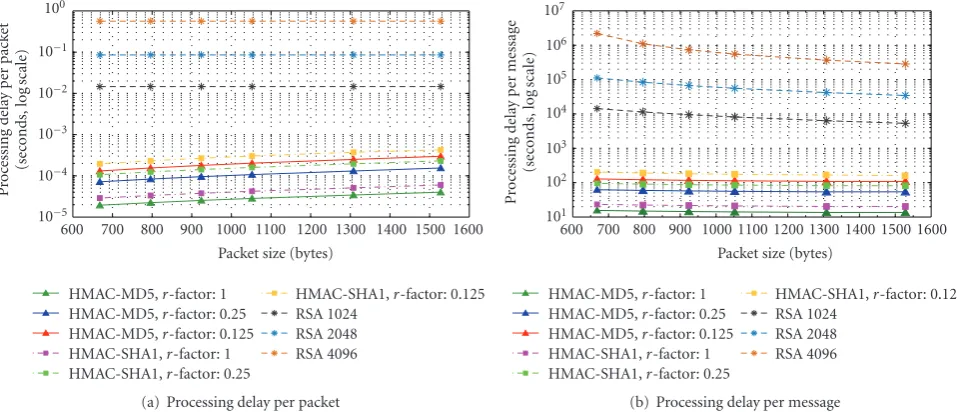
of the processing delay overhead of the extended TESLA protocol, and its comparison to the processing delay for RSA signatures, is given inFigure 11. We simulate the delay due to authentication for 500 MB data on a 500 MHz Pentium III machine. The delay figures for MD5 and HMAC-SHA1 are computed based on the approximation that each operation is executed in one processor clock tick for the 500 MHz PIII processor. The delay figures for RSA per
Table 1: RSA signature timings (ms) per packet on 500 MHz Pentium III [24].
Processor Key length (bits)
1024 2048 4096
PIII-500 MHz 14.6 85.6 562.8
packet for the 500 MHz PIII processor are from [24] and are reproduced here inTable 1.
0
600 700 800 900 1000 1100 1200 1300 1400 1500 1600 Individual packet size (bytes)
HMAC-MD5,r-factor: 1 HMAC-MD5,r-factor: 0.25 HMAC-MD5,r-factor: 0.125
Figure13: Total number of packets processed by source authenti-cation protocol with HMAC-MD5 on iPAQ H3670.
5.69
650 700 800 900 1000 1100 1200 1300 1400 1500 1550 Packet size (bytes)
HMAC-MD5,r-factor: 1 HMAC-MD5,r-factor: 0.25 HMAC-MD5,r-factor: 0.125 RSA sign
Figure14: Comparison of total energy required for authenticating 500 MB data on iPAQ H3670.
operations (1110 per 512-bit block) compared to HMAC-MD5 (744 per 512-block) and this fact is reflected in the graphs. For RSA, the processing delay depends only on the size of the modulus N and is independent of the size of the message. The cheapest RSA delay, 14.6 ms per packet (for modulus 1024 bit), is still significantly higher than the most expensive HMAC delay, 0.43 ms (for HMAC-SHA1 with eight MACs). This is a major advantage of our protocol over signature-based schemes.
The total processing delay for authenticating 500 MB data is shown inFigure 11(b). The total number of 512-bit blocks in the overall message is independent of the size of each packet, and hence also the HMAC processing delay for the entire message. However, for RSA the processing delay is directly proportional to the number of message chunks processed. Here also our protocol performs significantly better than using RSA signatures—the worst-case delay is
Table2: Energy cost of digital signature algorithms and HMAC, for Compaq iPAQ H3670 [26].
Algorithm Key size (bits) Sign (mJ) Verify (mJ)
RSA 1024 546.50 15.97
DSA 1024 313.60 338.02
ECDSA 163 134.20 192.23
HMAC 1.16 (μJ/B)
204 seconds (for HMAC-SHA1, 8 MACs), while the best-case delay for RSA is a prohibitive 5321 seconds (forN =1024, 1528-byte packets).
8.6. Analysis of Energy Consumption. We analyze the energy consumption of our protocol for authenticating 500 MB data in Figure 12. We simulate the energy consumption for a Compaq iPAQ H3670 handheld computer [25], which is fairly representative of the low-power smart devices that we have considered in our protocol design. The handheld contains an Intel SA-1110 StrongARM processor clocked at 206 MHz. It is powered by a Li-polymer battery with capacity 950 mAh at 3.7 V, which gives the total battery capacity to be 12654 Joules. The base figures for energy expenditure of different cryptographic operations of the handheld are obtained from [26] and are reproduced here inTable 2.
Figure 12(a) shows that the energy consumption for authentication each packet ranges between 0.7238 mJ and 12.73 mJ, with larger packets and higherr-factors consuming more energy, as is expected. Figure 12(b) shows the total energy consumed for authenticating 500 MB data, as a percentage of the battery capacity. For higher r-factors, the energy consumption is a significant percentage of the capacity and implies that more than 500 MB data cannot be authenticated without recharging. However, it is to be noted that in most cases, the higher energy expense for the higher
0
650 700 800 900 1000 1100 1200 1300 1400 1500 1550 Packet size (bytes)
HMAC-MD5,r-factor: 1 HMAC-MD5,r-factor: 0.25 HMAC-MD5,r-factor: 0.125 RSA sign (a) Percentage energy consumed for 5 MB data
100
650 700 800 900 1000 1100 1200 1300 1400 15001550 Packet size (bytes)
HMAC-MD5,r-factor: 1 HMAC-MD5,r-factor: 0.25 HMAC-MD5,r-factor: 0.125 RSA sign (b) Maximum amount of data processable
Figure15: Energy performance comparison of different authentication protocols on iPAQ H3670.
0
600 700 800 900 1000 1100 1200 1300 1400 1500 1600 Packet size (bytes)
HMAC-MD5,r-factor: 1 HMAC-MD5,r-factor: 0.25 HMAC-MD5,r-factor: 0.125
HMAC-SHA1,r-factor: 1 HMAC-SHA1,r-factor: 0.25 HMAC-SHA1,r-factor: 0.125
Figure16: Total energy required for authenticating 500 MB data, ARM1176JZ(F).
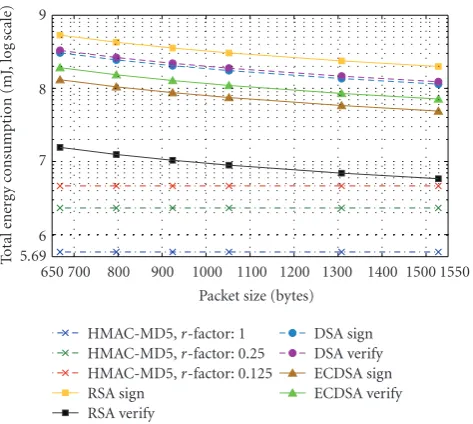
Figure 14compares the amount of energy that would be required to authenticate 500 MB data on the iPAQ handheld for different authentication algorithms. Clearly, authenticat-ing 500 MB data without additional energy sources is not possible except for the proposed protocol.
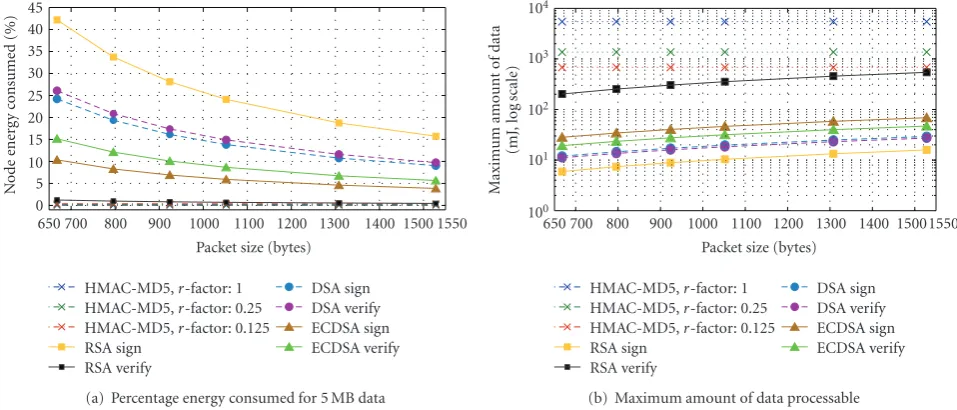
Given the energy constraints above, authenticating 5 MB data on the handheld is more realistic—Figure 15(a) com-pares the percentage of the total node energy that is spent in authenticating 5 MB data. The graphs validate our claim that the energy consumption of the proposed protocol is significantly less in comparison to standard signature protocols, even efficient protocols like ECDSA. Moreover, the graphs show that for nodes with limited energy, the standard signature algorithms cannot be applied for authenticating every packet—even in the best case scenario, ECDSA signing algorithm consumes nearly 4% of the node energy for only 5 MB data. For the iPAQ handheld, the standard protocols
can authenticate only a few mega bytes of data before they completely spend the available energy, as shown in
Figure 15(b). Here also we assume that up to 50% maximum of the node energy may be spent in authenticating the data packets. The best scenario for the standard protocols is for RSA signature verification, where a node can authenticate nearly 543 MB of data if it is split into 1528 byte packets. The worst scenario is for RSA signature generation, where only 6 MB of data can be authenticated, for 668 byte packets. The extended TESLA protocol with HMAC-MD5 performs significantly better in comparison—being capable of authen-ticating 682 MB even withr-factor 0.125. The analyses above with iPAQ H3670 has the limitation that the processor power and battery capacity is on the lower end of the scale for mobile nodes that are available today. To illustrate the energy performance of the proposed protocol for a more current smart device, we have performed a simulation analysis of the energy consumption for different message sizes on the Apple iPhone processor, ARM1176JZ(F) [27]. The processor has an operating frequency of 620 Mhz and consumes 0.45 mW per cycle. We consider the node energy capacity to be equivalent to the iPhone battery capacity, 1400 mAh at 3.7 V [28]. Under the assumption that one HMAC operation is performed in one cycle of the processor,Figure 16gives the total energy consumed for authenticating 500 MB data, for both HMAC-MD5 and HMAC-SHA1. As is expected, HMAC-SHA1,r -factor 0.125, consumes the most energy. However, even in the worst case, the 1541 joules of energy consumed represent 8.2% of the total battery capacity.