Copyright to IJIRSET DOI:10.15680/IJIRSET.2016.0508107 14856
Experimental Study on Durability Properties
of High Performance Self Compacting
Concrete
T.H Patel1, J M Srishaila2, Prahalada.V3
Professor, Department of Civil Engineering, RYMEC Engineering College, Ballari, Karnataka, India1
Assistant Professor, Department of Civil Engineering, RYMEC Engineering College, Ballari, Karnataka, India2
P.G. Student, Department of Civil Engineering, RYMEC Engineering College, Ballari, Karnataka, India3
ABSTRACT:Concrete is versatile material used in many different construction. There are different types of concrete which have more beneficial than conventional concrete. Self compacting concrete is one type of the special concrete having many advantages when compared with conventional concrete. After studying the various literature reviews, We have carried out investigation on durability study on high performance of self compacting concrete by using various different mineral admixtures such as fly-ash (F type), Ground granulated blast furnace slag (GGBS This admixture are replaced with cement material by various percentage.
Fly ash is replaced with 10% 20% 30% 40% 50%, GGBS is replaced with 10% 20% 30% 40% 50%, To carry out the durability studies concentrated for 10% sodium chloride ( NaCl ), magnesium sulphate (MgSo4) as been used, the ph valve of NaCl 6.8 and MgSo4 6.5, By the design mix the cubes are cast, they are curried in water for 28 and 56days.. Durability study is carried out after curing in water for 28 days, the cubes are immersed in NaCl and MgS04 solution for 28 and 56 days. Residual Strength & weight loss are compared with water curing & chemical curing for 10% concentrate
KEYWORDS:Self-compacting concrete, Fly ash, and GGBS, sodium chloride and magnesium Sulphate , Mineral admixture..
I. INTRODUCTION
The Self~compacting concrete is a special concrete it was introduce by Japan in 1980’s due to growing shortage of skilled labors , this concrete will flow by its self weight and it do not required any additional equipments for bounding. The usage of scc started growing rapidly,. According to IS 456 -2000 it has a very high degree of workability mineral admixture are use as partially replacement of cement, Durability refers to resistance of concrete to adverse conditions. Adverse conditions include the corrosive, erosive and abrasive factors which are expected to reduce the strength and hamper microstructure that may limit the possibility of usage in construction sector. It is well established that coastal construction sites are more exposed to air and water with higher salt concentration. The sites near industries are more susceptible to sulphate attack, since soil near these areas does have more sulphate contents
II. LITERATURESURVEY
1. GANESH BABU AND SREERAMAKUMAR (2000)In thisstudied the chloride diffusivity of GGBS concretes and reported that chloride ion diffusion resistance of GGBS concretes were high compared to normal concretes. The resistance is increased with an increase in percentage replacement of cement by GGBS, up to 15 percent.
2. DHIYANESHWARAN,~S.RAMANATHAN,P. BASKAR,I. AND VENKATASUBRAMANI,R.(2013)the investigation,
Copyright to IJIRSET DOI:10.15680/IJIRSET.2016.0508107 14857
The Glenium super plasticizer B233 was used & adopting a water-binder ratio of 0.45. The absoption are done at the age of 28 56&90days to know the durability of concrete on acid resistance and sulphate attack test.
3. AIAD HASSAN,1HILMI BIN MAHMUD,1 MOHD. ZAMIN JUMAAT,1BELAL ALSUBARI,1 AND AZIZ
ABDULLA2(2013):,The durability of SCC gives a good advice about concrete suffering from weight loss. To
over come such problem. this investigation is carried out, by using replacement of cement with different admixture such as FA, RHA, and GGBS with various percentage levels of 15%, 10%, and 5%, respectively, the effect of magnesium on some of the durability properties of concrete such as compressive’strength, & weight compared with similar samples. He concluded the strength loss and weight losses is less when compared with similar samples and ms samples
4. SADAQATULLAH KHAN,MUHAMMAD FADHILNURUDDIN,TEHMINAAYUB,* AND NASIR SHAFIQ(2014):In this
paper he had compared normal and high-strength concrete reactivity of using of different admixture by replacing the cement, he substitute admixture in cement such as fly ash,metakaoline,silicafume,ggbs, & rice husk ash (RHA). Decreases workability, and setting time of concrete and increases the reactivity and heat of hydration with presents of chemical admixture,Micro filler admixture acts vise versa to chemical admixture.
III.MIXPROPORTIONS
Table 1: Below table is describe about mix proportions of fly ash and the quantity of material in kg/ m3
Materials Control FA 10%
FA 20%
FA 30%
FA 40%
FA 50% Cement 550 495 440 385 330 275 Fly ash - 55 110 165 220 275 Water/Powder 0.3 0.3 0.3 0.3 0.3 0.3 Sand 880.9 880.9 880.9 880.9 880.9 880.9 Coarse
aggregate 714.42 714.42 714.42 714.42 714.42 714.42 Super
plasticizer -- 1.00% 0.95% 0.90% 0.85% 0.80%
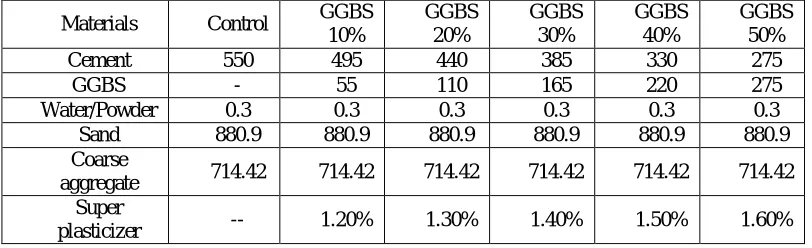
Table 2: Below table is describe about mix proportions of GGBS and the quantity of material in kg/ m3
Materials Control GGBS 10%
GGBS 20%
GGBS 30%
GGBS 40%
GGBS 50% Cement 550 495 440 385 330 275
GGBS - 55 110 165 220 275 Water/Powder 0.3 0.3 0.3 0.3 0.3 0.3 Sand 880.9 880.9 880.9 880.9 880.9 880.9 Coarse
aggregate 714.42 714.42 714.42 714.42 714.42 714.42 Super
Copyright to IJIRSET DOI:10.15680/IJIRSET.2016.0508107 14858
IV.EXPERIMENTAL RESULTS
4.1DISCUSSIONOFWEIGHTLOSSINNACL&MGSO4
TABLE 5:FLY ASH TEST RESULT IN NACL
Material
Weight loss (kg)28 days Weight loss (kg)56days
Before immersed
inNaCl
After immersed
inNaCl
% of Reduction
Before immersed
inNaCl
After immersed
inNaCl
% of Reduction
Fly ash 0% 2.455 2.386 2.8 2.410 2.326 3.5
Fly ash 10% 2.400 2.354 1.9 2.400 2.345 2.3
Fly ash 20% 2.410 2.357 2.2 2.440 2.372 2.8
Fly ash 30% 2.425 2.364 2.5 2.420 2.345 3.1
Fly ash 40% 2.425 2.355 2.9 2.435 2.352 3.4
Fly ash 50% 2.435 2.355 3.3 2.400 2.309 3.8
TABLE 6:FLY ASH TEST RESULT IN MGSO4
Material
Weight loss (kg)28 days Weight loss (kg)56days
Before immersed
in MgSo4
After immersed
in MgSo4
% of Reduction
Before immersed
in MgSo4
After immersed
in MgSo4
% of Reduction
Fly ash 0% 2.410 2.323 3.6 2.455 2.349 4.3
Fly ash 10% 2.430 2.369 2.5 2.440 2.369 2.9
Fly ash 20% 2.420 2.347 3.0 2.430 2.347 3.4
Fly ash 30% 2.435 2.355 3.3 2.425 2.330 3.9
Fly ash 40% 2.445 2.355 3.7 2.425 2.318 4.4
Copyright to IJIRSET DOI:10.15680/IJIRSET.2016.0508107 14859 GRAPH 3:FLY ASH TEST RESULT FOR NACL& MGSO4
TABLE 7:GGBS TEST RESULT IN NACL
Material
Weight loss (kg)28 days Weight loss (kg)56days
Before immersed
inNaCl
After immersed
inNaCl
% of Reduction
Before immersed
inNaCl
After immersed
inNaCl
% of Reduction
GGBS 0% 2.455 2.386 2.8 2.410 2.326 3.5
GGBS 10% 2.415 2.364 2.1 2.400 2.347 2.2
GGBS 20% 2.410 2.350 2.5 2.420 2.345 3.1
GGBS 30% 2.405 2.340 2.7 2.435 2.355 3.3
GGBS 40% 2.420 2.345 3.1 2.415 2.330 3.5
GGBS 50% 2.435 2.350 3.5 2.450 2.354 3.9
TABLE 8:GGBS TEST RESULT IN MGSO4
Material
Weight loss (kg)28 days Weight loss (kg)56days
Before immersed
in MgSo4
After immersed
in Mgso4
% of Reduction
Before immersed
in MgSo4
After immersed
in MgSo4
% of Reduction
GGBS 0% 2.410 2.323 3.6 2.455 2.349 4.3
GGBS 10% 2.425 2.355 2.9 2.425 2.345 3.3
GGBS 20% 2.420 2.343 3.2 2.440 2.352 3.6
GGBS 30% 2.435 2.350 3.5 2.435 2.335 4.1
GGBS 40% 2.415 2.323 3.8 2.420 2.311 4.5
Copyright to IJIRSET DOI:10.15680/IJIRSET.2016.0508107 14860 GRAPH 4:GGBSTEST RESULT FOR NACL& MGSO4
4.2DISCUSSIONOFRESIDUALSTRENGTHINNACL&MGS04
TABLE 9:FLY ASH TEST RESULT IN NACL
Material
Residual Strength (N/mm2) 28days Residual Strength (N/mm2) 56days
Before immersed
in NaCl
After immersed
inNaCl
% of Reduction
Before immersed
in NaCl
After immersed
inNaCl
% of Reduction
Fly ash 0% 41.00 39.00 4.87 41.00 38.00 7.31
Fly ash 10% 48.00 46.00 4.16 52.00 49.00 5.76
Fly ash 20% 46.00 44.00 4.34 49.00 46.00 6.12
Fly ash 30% 45.00 43.00 4.44 47.00 44.00 6.38
Fly ash 40% 42.00 40.00 4.76 44.00 41.00 6.81
Fly ash 50% 39.00 3700 5.12 40.00 37.00 7.50
TABLE 10:FLY ASH TEST RESULT IN MGSO4
Material
Residual Strength (N/mm2)28days Residual Strength (N/mm2)56days
Before immersed in MgSo4
After immersed in MgSo4
% of
Reduction
Before immersed in MgSo4
After immersed in MgSo4
% of
Reduction
Fly ash 0% 41.00 38.00 7.57 41.00 37.00 9.75
Fly ash 10% 48.00 45.00 6.25 52.00 49.00 6.09
Fly ash 20% 46.00 43.00 6.52 49.00 46.00 6.75
Fly ash 30% 45.00 42.00 6.66 47.00 44.00 7.37
Fly ash 40% 42.00 39.00 7.14 44.00 40.00 8.09
Copyright to IJIRSET DOI:10.15680/IJIRSET.2016.0508107 14861 GRAPH 5:COMPARED THE RESIDUAL STRENGTH IN FLY ASH FOR NACL&MGSO4
TABLE 11:GGBS TEST RESULT IN NACL
Material
Residual Strength (N/mm2)28 days Residual Strength (N/mm2)56days
Before immersed
in NaCl
After immersed
inNaCl
% of Reduction
Before immersed in
NaCl
After immersed
inNaCl
% of Reduction
GGBS 0% 41.00 39.00 4.87 41.00 38.00 7.31
GGBS 10% 39.00 38.00 2.56 40.00 39.00 5.00
GGBS 20% 45.00 44.00 4.44 49.00 46.00 6.12
GGBS 30% 47.00 45.00 4.25 52.00 50.00 5.76
GGBS 40% 42.00 40.00 4.76 46.00 43.00 6.52
GGBS 50% 38.00 36.00 5.26 39.00 36.00 7.69
TABLE 12:GGBS TEST RESULT IN MGSO4
Material
Residual Strength (N/mm2)28 days Residual Strength (N/mm2)56days
Before immersed in
MgSo4
After immersed in
MgSo4
% of Reduction
Before immersed in
MgSo4
After immersed in
MgSo4
% of Reduced
GGBS 0% 41.00 38.00 7.57 41.00 37.00 8.31
GGBS 10% 39.00 37.00 5.12 40.00 38.00 5.00
GGBS 20% 45.00 42.00 6.66 49.00 46.00 6.12
GGBS 30% 47.00 44.00 6.38 52.00 48.00 7.69
GGBS 40% 42.00 39.00 7.14 46.00 42.00 8.69
Copyright to IJIRSET DOI:10.15680/IJIRSET.2016.0508107 14862 GRAPH 6:COMPARED THE RESIDUAL STRENGTH IN GGBSFOR NACL&MGSO4
V. CONCLUSION
1. The compressive strength values of specimen immersed in chloride and sulphate solution were tabulated. From the result we can observe that compressive strength of specimen decreases strength of the solution increases. 2. The mechanical properties of concrete for 10% fly ash replacement, is very high compared to 20% 30% 40%
50%. Percentage is varies 5.76% to 23.6%
3. The maximum compressive strength. 520 kn achieved, when cement is replaced with 10% of fly ash
4. When cement is replaced with 30% of GGBS achieved the higher compressive strength, compared with 20% & 40%, Percentage is varies 5.76% to 11.53 %
5. The chloride resistance (NaCl) of SCC is effect is higher when compared with 0% replacement admixture at the curing period of 28,56 days
6. The sulphate resistance (MgSo4) of SCC is effect is higher when compared with 0% replacement admixture at the curing period of 28,56 days
7. The sulphate resistance (MgSo4) of SCC effect is higher when compared with the chloride resistance (NaCl)
REFERENCES
1. Yogesh, Aggarwal and Paratibha, Aggarwal. 2008. Selfcompacting concrete-Procedure for mix design, Leonardo Electronic Journal of
Practices and Technologies-ISSN 1583-1078 (12): 15-24.
2. Dhiyaneshwaran, S. 1), Ramanathan, P. 2), Baskar, I. 3) and Venkatasubramani, R. 4 (2013).Study on Durability Characteristics of Self-Compacting Concrete withFly Ash, Jordan Journal of Civil Engineering, Volume 7, No. 3,
3. Elsayed, A.A. (2011). “Influence of Silica Fume, Fly Ash, Super Pozz and High Slag Cement on Water Permeability and Strength of
Concrete”. Jordan Journal of Civil Engineering , 5 (2), 245-257.
4. Wang Ling, Tian Pei, and Yao Yan. (2004).“Application of Ground Granulated Blast Furnace Slag in High- Performance Concrete in China”.
International Workshop on Sustainable Development and Concrete Technology, Organized by China Building MaterialsAcademy, PRC, 309-317.
5. J. P. Behera, “Investigations on the Development of Blended Cement using Fly Ash”, The Indian Concrete Journal, May 2000, pp. 260-263.
6. K. SuvarnaLatha, M V Seshagiri Rao, SrinivasaReddy. V, Estimation of GGBS and HVFA Efficiencies in Concrete with Age, International
Journal of Engineering and Advanced Technology (IJEAT)ISSN: 2249 – 8958, Volume-2, Issue-2(2012)E-ISSN 097682-84 ivelyieved 0%, ralnce d - Volume 2, Issue Strength(2012), 212-225
7. Hwang CL, Shen DH. The effects of blast-furnace slag and fly ash on the hydration of Portland cement. Cement and Concrete Research.
1991;21(4):410–425.
8. Nabil M. Al-Akhras : durability of metakaolin concrete to sulfate attack civil engineering department, jordan university of science and technology, p.o.box 3030, irbid 22110, Jordan
Copyright to IJIRSET DOI:10.15680/IJIRSET.2016.0508107 14863
10.Shetty, M. S. (2005). "Concrete Technology". S. Chandand Co., Ltd., New Delhi.Sadaqat Ullah Khan, Muhammad Fadhil Nuruddin,
Tehmina Ayub,* and Nasir Shafiq(2014): Effects of Different Mineral Admixtures on the Properties of Fresh Concrete the scientific world journal volume 2014 article id 986567 11 page
11.Hani H. Nassif Najim, Nakin Suksawang:Effect of mineral admixtures on durability properties of concrete international journal of advanced
structures and geotechnical engineering issn2319-5347vol.03 no 2014
12.A.P. Shetti , B. B. Das: Acid alkali and chloride resistance of earlyage cured silica fume concrete springer chapteradvance instructural engineering pp1849-1862 (2014)