
Delay in Construction Projects and
Comparision with Time and Cost
Md Faisal1, B.Harish Naik2
P.G. Student, Dept. of CE, Shri Shirdi Sai Institute of Science and Engineering, Ananthapuram, India1 Assistant Professor, HOD, Dept. of CE, Shri Shirdi Sai Institute of Science and Engineering, Ananthapuram, India2
ABSTRACT: Delay in the completion of a construction project can be a major problem for contractor companies lead-ing to costly disputes and adverse relationships amongst project participants. Projects can be delayed for a large number of reasons. The reasons are related to the various types of uncertainty associated with activities during the construction process. This research was conducted to determine the most important causes of delays within building projects in In-donesia. A questionnaire survey was carried out targeting 89 respondents from large contractors and 23 respondents from small contractors. The respondents were asked to assess the level of effect the 31 potential delay causes on their projects.
The delay factors were grouped into six major groups. The level of importance of the delay variables and the groups were computed and ranked for both the large and small contractors. Personal interviews were conducted to clarify responses. The agreement between the rankings of delay causes of two groups contractors were measured using Spearman Rank Correlation Coefficients. The results showed that the large and small contractors generally agree on the importance ranking of the individual delay variables. In relation to the groups of the delay variable, however, the result showed that there is no agreement between the two groups of contractors. The professional management group was ranked the highest and the external groups was ranked the lowest by large contractors. Whereas, small contractors ranked the design and documentation group as the highest and the execution group as the lowest.
KEYWORDS: Delay.
I. INTRODUCTION
GENERAL
Construction delays are often the result of miscommunication between contractors, subcontractors, and property own-ers. These types of misunderstandings and unrealistic expectations are usually avoided through the use of de-tailed critical path schedules, which specify the work, and timetable to be used, but most importantly, the logical se-quence of events which must occur for a project to be completed. Delays in construction projects are frequently expen-sive, since there is usually a construction loan involved which charges interest, management staff dedicated to the pro-ject whose costs are time dependent, and ongoing inflation in wage and material prices. However, in more complex projects, problems will arise that are not foreseen in the original contract, and so other legal construction forms are sub-sequently used, such as change orders, lien waivers, and addenda.
Delays may be caused by:
The uniqueness of the project Speed of decision making Poor or unrealistic scheduling Lack of information
Delays can be minimised by:
Detailed site investigation
Care full monitoring and regular meeting Effective site management
Collaborative working and effective coordination Care full scheduling
Whenever delay occurs a contractor may make a claim for time extension, a monitory settlement or both. Delays for strike and bad weather usually result in time extension only. A delay caused by a sub contractor will probably result in compensation only change orders issued by the owner are the most common means by which compensation is coupled with a time extension.
Active Interference
Acts or omissions of the owner which actively interfere with work progress are often beyond the protection of a no-damage-for-delay clause. The courts have ruled that the existence of such a provision does not give the owner license to cause delays willfully. The term delayrefers to situations in which the contract completion date is extended. The term interference relates to performance problems that result in increased costs, whether or not the completion date is changed.
Example: Suppose a negotiated contract was let to construct a small office building. The contractor was issued a notice to proceed, but the plans for the foundation were not complete. The contractor was forced to wait for the plans, which were being drafted by the owner's personnel. The court ruled that the owner had interfered
.
II. LITERATURE REVIEW
GENERAL
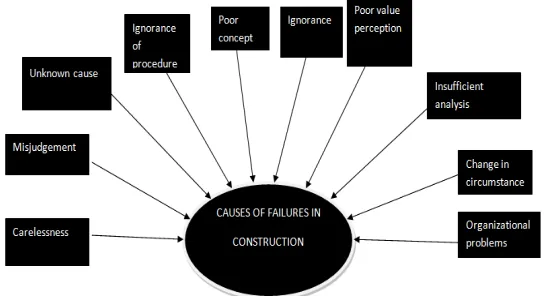
Figure 2.1 Causes of Failures
Construction projects suffer from many problems and complex issues in performance such as cost, time, and safety. This project is the investigation on the causes of failures of construction industry due TO inefficient management and improvements in terms of strategic management. The causes of factors mainly focused on the following factors. The project is said to be successful when it is completed in desired time and cost. The construction delays are common problems in private residential projects in Chennai city. This problem occurs frequently during life time leading to dis-pute and litigations. Therefore it is essential to study and analyse .causes of construction delay. The construction indus-try is large, volatile and requires tremendous capital outlays. Delay of the project is a main factor and major cause of construction claims. There is an acute necessity for a detailed investigation to identify the delay factors and choose cor-rect actions to minimize the adverse effect of delay on time, within cost and for high quality output.
1) Time Delay
2) Cost Overruns
3) Project risk
Over Views of Earlier Studies
Murali sambasivan(5) (2007): In this study the causes and effects of delays facing in the Malaysian construction indus-try. A questionnaire was designed and distributed among the three major groups of participants (clients, consultants and contractors). We identified main causes of delay and ten most important causes were: (1) contractor’s improper plan-ning, (2) contractor’s poor site management, (3) inadequate contractor experience, (4) inadequate client’s finance and payments for completed work, (5) problems with subcontractors, (6) shortage in material, (7) labour supply, (8) equip-ment availability and failure, (9) lack of communication between parties, and (10) mistakes during the construction stage. We identified main effects of delay and they were: (1) time overrun, (2) cost overrun, (3) disputes, (4) arbitra-tion, (5) litigaarbitra-tion, and (6) total abandonment. As an important contribuarbitra-tion, we also studied the empirical relationships between the causes and effects of delays. We isolated the causes of delay for each of the six effects. We believe that the results of this study can be of immense help to the practitioners (clients, contractors and consultants) and academicians. The practitioners can better understand the dynamics of project management and make efforts to reduce the incidences of delays. The academicians can conduct similar studies in other parts of world and identify causes and effects of de-lays. As mentioned earlier, some causes and effects may be unique to certain countries.
construction, (3) poor site management, (4) slowness in decision making process by client, (5) financial difficulties by contractors, (6) late in reviewing and approving design documents by client, (7) problems with subcontractors, (8) inef-fective planning and scheduling of project by contractor, (9) mistakes and discrepancies in design documents, and (10) bad weather. Six major effects of delay were: (1) time overrun, (2) cost overrun, (3) disputes, (4) total abandonment, (5) arbitration, and (6) litigation.
III. DELAYS ANALYSIS IN CONSTRUCTION PROJECT
A.GENERAL
Several controllable and controlled factors adversely affect the project schedule and cause delays. These delays defi-nitely create negative impacts on project performance. Schedule delay in the completion of a construction project may be a major difficultly for contractors leading to costly disputes and adverse relationships between project participants. The challenge is to measure the net impact of construction delays accurately. Otherwise, delay claims will be developed between all parties involved in the construction process. The method of schedule delay analysis technique should be acceptable to all participants through the project. The hindrances, bottlenecks faced in construction projects which are ultimately delaying the project execution are a serious cause of concern. In view of this a comprehensive study needs to be conducted on the reasons, factors causing delay. Completing projects on time is an indicator of efficiency, but the construction process is subject to many variables and unpredictable factors, which result from many sources. These sources include the performance of parties, resources availability, environmental conditions, involvement of other par-ties, and contractual relations. However, it rarely happens that a project is completed within the specified time. The Construction industry is large, volatile, and requires tremendous capital outlays. Typically, the work offers low rates of return in relation to the amount of risk involved. Delays on construction projects are a universal phenomenon and con-tract termination. They are almost always accompanied by cost and time overruns. Construction project delays have an adverse effect on parties (developer, contractor, and consultant) to a contract in terms of a growth in adversarial rela-tionships, distrust, litigation, arbitration, cash-flow problems, and a general feeling of apprehension towards each other. So, it is essential to define the actual causes of delay in order to minimize and avoid the delays in any construction project.
B. STATUS OF NHAI PROJECTS
NHAI MISSION
NHAI’s mission is to meet the nation’s need for the development, construction and maintenance of a national highways network in line with global standards and to meet user expectations in the most time bound and cost effective manner, within the strategic policy framework set by the Government of India and thus promote economic well being and quali-ty of life of the people.
3.2.1 Deviation details
IV.PARAMETRIC STUDY OF DELAYS OF CONSTRUCTION PROJECTS
A. INTRODUCTION
Delays can be avoided or minimized when their causes are clearly identified. The aim of this research is to identify the delay factors in construction projects, since delays are considered to be a serious problem in the construction industry. Through detailed literature review and interviews with experts from construction industry, a total of sixty (60) different delay factors are identified. The identified delay factors are categorized into six (6) groups in alphabetical order as fol-lows: Owner related factors, Contractor related delay factors, consult1ant related delay factors, equipment and material related delay factors, labour related delay factors site, and third party related delay factors. The demonstration of these groups of delay factors is achieved by utilizing the Ishikawa (Fish Bone) diagram as it is capable of showing factors, interrelations between different groups of factors, and consequences affected from factors. The quantified relative im-portance of delay factors are demonstrated for ranking of the factors and groups according to their imim-portance level on delay. This objective is achieved through analysis of interview out comings. Accordingly, computed relative impor-tance indices (RII‟s), all factors and groups are ranked. The most and the least important factors and groups are achieved through ranking of results.
Construction owners demand the timely completion of projects without delay or additional cost. The findings from the views of construction stakeholders is that financial related delays such as financial / cash flow difficulties faced by clients, contractors and public agencies are the top significant causes of delay in construction project delivery. Cost and time overruns and interest accumulation on capital are the most frequent effects of delay in the construction industry although the effects are slightly more on time overruns than cost overruns. This could be as a result of contractors’ ina-bility to honour contract deadlines and using shortages of material as an excuse or the consultants’ inaina-bility to imple-ment proper design and obtaining adequate knowledge about the usage of materials. Arbitration/litigation and total ab-andonment of projects are no longer seen to be the usual effects of delay as outlined by past researchers. This could be as a result of the implementation of risk management procedure which enables the parties to the contract to terminate, treat, transfer and tolerate contractual risk hence, the number of disputes and court proceedings on construction con-tracts have enormously declined. The questionnaire surveys are done using randomly sampled responses and analysis of data obtained from the responses. Each study has a unique approach and unique results are derived from the ques-tionnaire response data. Various indices like Importance Index (I), Rank Correlation Coefficient, Relative Importance Index (RII), Frequency Index (FI), Severity Index (SI) and Mean Score (MS) have been determined to assess the
im-11% 14%
20% 21%
12%
0% 5% 10% 15% 20% 25%
2011 2012 2013 2014 2015
construction percentage
The Relative Importance Index (RII) is a statistical method to determine the ranking of different delays. As this survey is designed to determine the relative importance of various causes of delays, the method is adopted in this study within various groups (i.e. owners, contractors or engineers). The RII five-point scale, ranging from 1 (very low important) to 5 (very high important) is adopted and transformed the relative importance indices (RII) for each factor as follows.
The sample for this study is relatively small. As a result, the analysis had combined all groups of respondents (owner, contractor, and consultants) in order to obtain significant results. Data is analysed by calculating frequencies and Rela-tive Importance Index (RII).
RII =
∑
∗
Where
RII: Relative importance index
W: Weighting given to each other by the respondents (ranging from 1 to 5) A: Highest weight (i.e. 5 in this case)
N: Total number of respondents
The RII value had a range from 0 to 1 (not inclusive), higher the value of RII, more important is the cause of delays. The RII’s are then ranked, and average RII’s of the causes in each group gives the RII’s of the mean groups.
RII = Sum of weights (W1 + W2 + W3 + ……+ Wn ) / A x N
For the purpose of this study A=5 and N=45. However, amongst 45 returned questionnaires some of the causes and effects are not ranked thus N varies between 45 and 40. The RII is used to rank the relative importance index of the different causes. These rankings made it possible to cross-compare the relative importance of the factors as perceived by the three groups of respondents (i.e. owners, contractors and consultant). Each individual causes of RII, as perceived by all respondents is used to assess the general and an overall ranking in order to give overall picture of the causes of construction delays. To identify the main causes of delay the following research methodology is proposed in thesis.
V. CONCLUSION
In construction industry owners demand the timely completion of projects without delay or additional cost. The find-ings from the views of construction stakeholders are the top significant causes of delay in construction project delivery system. Cost and time overruns and interest accumulation on capital are the most frequent effects of delay in the con-struction industry although the effects are slightly more on time overruns than cost overruns. This could be as a result of contractors’ inability to honour contract deadlines and using shortages of material as an excuse or the consultants’ inability to implement proper design and obtaining adequate knowledge about the usage of materials. Arbitra-tion/litigation and total abandonment of projects were no longer seen to be the usual effects of delay as outlined by past researchers. This could be as a result of the implementation of risk management procedure which enables the parties to the contract to terminate, treat, transfer and tolerate contractual risk hence, the number of disputes and court proceed-ings on construction contracts have enormously declined.
Based on the research work, literature review, and questionnaire survey the following conclusions are made:
The results of analysis shows time overrun and cost overrun were two most common effects of delays in con-struction project.
Owner related factors, contractor related delay factors, consultant related delay factors, equipment and materi-al related delay factors, labour related delay factors site, and third party related delay factors are important factors and achieved by utilizing the Ishikawa (Fish Bone) diagram.
The most and the least important factors and groups are achieved through ranking results.
Site management and supervision; poor procurement strategic planning; clear information and communication channels; collaborative working in construction; proper project planning and scheduling; poor communication and coordination between the parties involved; complete and proper design at the right time; use appropriate construction methods; accurate initial cost estimates; proper material procurement; and proper emphasis on past experience are some other causes.
The delays are mainly due to Owner (Rank 1), Contractor (Rank 2), Consultant and Contractual relationships (Rank 3). Materials and Equipment’s (Rank 4), Labour (Rank 5).
Owner's delay in freeing the payments of contractor, up to 3 months for each one. Payments were signed in the donated country, so this contributes to the delay process.
Limitation of consultant work from 8.00 AM to 5.00 PM and stopping of work at 5.00 PM.
Bad weather especially in winter plays a role for delay and fluctuation in the cost of construction materials The common effects of delays are times overrun, Cost overrun, Dispute, total abandonment, Arbitration, and Litigation.
Causes of delays-State Project
Construction has to be stopped as a water main belonging to Chennai metro water could not be shifted
A 600 m long pipe carrying drinking water could not be shifted. The pipe line is 1.5 m wide. ”Even metro wa-ter couldn’t find a contractor who could do this job”. Because if any disruption occurs the contractor should face the legal issues. For this change of design they increased the design cost from 6crores to 21 crores
Stalling of the project, i.e, because of the contractor
Govt called for 2 tenders, no contractor interested to do the work.
While shifting of pipe line if any disturbances occurs they cannot supply the water to that area. The contractor should face legal issues.
In these cases the PWD should help the contractor while it is shifting.
Causes of delay-Private project
Fifteen major causes of delays are identified in the research work are such as Delivery site to the contractors, Delay in issue of drawings, Change orders by owner during construction, Delay in progress payments, Slowness in decision making, Ineffective project planning and scheduling, Delay in resources mobilization, Approving major changes in the scope of work, Late reviewing & approving design documents, Late delivery of materials, Escalation of prices in ma-terial, Shortage of labours, Effects of subsurface conditions (soil, rock, high water table), Site conditions like inaccessi-bility remote location, terrain etc., Delay in obtaining permits & licences from authorities Slow delivery of materials by contractor to the site, absence of time schedule that is effective for delivery of materials to the site, and also poor man-agement of the project, mismanman-agement of consultant plays an important role for timely completion of work. It is very important to mention that contractor has the right to claim compensation for any loss he hold due to payment delay more than the agreed period in the contract.
rea- Annual survey of construction
Techno economic surveys
Annual report of development wing
Industry potential surveys
The stock exchange directory
Plan reports
Other publications
REFERENCES
1. Afshari ,hejjiJO. Controlling cost in the construction industry. Lagos QS Digest, Lagos 2011;1(1):8–12.
2. Atholot , Alkhalil M, Al-Hazmi M. Causes of delay in large building construction projects. J Manage Eng, ASCE 1995;11(2):45–50.
3. Hasee S, Mazerolle M, Harris F. Construction delay analysis techniques. Construction Manage Econ international journal of construction
engi-neering and management 1996;14(5):375–94.
4. Jones DWM, A comparative study of causes of time overruns in Hong Kong construction projects. Journal of construction engineering and
man-agement 2010;15(1):55–63.
5. Murali sambasivam The effects of delays in construction industry in Malaysian construction industry. DOI: 10.1016/j.ijproman.2006.11.007
6. Majid SA, Al-Hejji S. Causes of delay in large construction projects. Int J Project Manager 2002;24(4):349–57.
7. Nuru braimah Construction Delay Analysis Techniques—A Review of Application Issues and Improvement Civil Engineering Department, School
of Engineering and Design, Brunel University, Uxbridge, Middlesex UB8 3PH, UK; E-Mail: [email protected]; Published: 23 July 2013
8. Pourostam .delays in building projects’ contingency. In: Conference: proceedings of association of researchers in construction management,
AR-COM 96, Sheffield Hallam University, England, 11–13 September 2012. p. 507–16.
9. Raj bharat A. Construction delay: a quantitative analysis. Int J Project Manager 2013;20:51–9.
10. Bassioni, H.A. and El-Razak 2008. Causes of Delays in Building Construction Projects in Egypt. Journal of Construction Engineering and Man-agement.
11. Assaf, S.A. and AlHeiji 2006. Causes of Delays in Large Construction Projects. International Journal of Project Management, Volume24, 349 -357.
![Polarity Opinion Detection in Arabic Forums by Fusing Multiple SVMs (Détection de polarité d’opinions dans les forums en langue arabe par fusion de plusieurs SVM) [in French]](data:image/gif;base64,R0lGODlhAQABAIAAAP///wAAACH5BAEAAAAALAAAAAABAAEAAAICRAEAOw==)