A Database for Measuring Linguistic Information Content
1
Richard Sproat,
2Bruno Cartoni,
3HyunJeong Choe,
4David Huynh,
1
Linne Ha,
1Ravindran Rajakumar,
4Evelyn Wenzel-Grondie
Google, Inc
1New York,2Zurich,3Seoul,4Mountain View
{rws,brunocartoni,hyunjeongc,dfhuynh,linne,ravirajakumar,evelynw}@google.com
Abstract
Which languages convey the most information in a given amount of space? This is a question often asked of linguists, especially by engineers who often have some information theoretic measure of “information” in mind, but rarely define exactly how they would measure that information. The question is, in fact remarkably hard to answer, and many linguists consider it unanswerable. But it is a question that seems as if it ought to have an answer.
If one had a database of close translations between a set of typologically diverse languages, with detailed marking of morphosyntactic and morphosemantic features, one could hope to quantify the differences between how these different languages convey information. Since no appropriate database exists we decided to construct one. The purpose of this paper is to present our work on the database, along with some preliminary results. We plan to release the dataset once complete.
Keywords:Information content, morphosyntax, morphosemantics
1. Introduction
In April 2013 one of the authors was asked by a sci-ence journalist to comment on the question of which languages can pack the most information into a Tweet (Taylor, 2013). To a first approximation, Twitter de-fines a character as a Unicode code point, and thus ‘A’ or the Chinese character 肉count the same, even though the former is from a set that makes a few tens of distinctions, whereas the latter is from a set that makes a few thousand distinctions. Thus for this very limited notion of “space”, the question turns out to be relatively easy to answer: Chinese, with its mor-phosyllabic writing system, where each character cor-responds to a morpheme, is a strong contender since one can pack a lot more message into 140 morphemes than into 140 characters of a language like English. But that question led naturally to another broader question, one often asked of linguists: Which languages are the most “efficient” at conveying information in a given amount of space, where “space” is not as arbi-trarily defined as on Twitter, and where “information” is at least implicitly more broadly intended than just, e.g., how many words one can convey? Often the ques-tioner may have an information-theoretic notion of “in-formation” in mind (Shannon, 1948), though the ques-tioner rarely defines how they would actually compute the information. This question is, in fact, remarkably difficult to answer and as Taylor notes, many linguists consider it unanswerable.
Yet it is a question that seems as if it ought to have an answer – if one could define what one means by information. The problem is that to convey what is theoretically the same message, different languages frequently mark different kinds of information. For example in English, one might say Grandfather died. An appropriate translation of this sentence into
Korean might be something like
할아버지께서 돌아가셨어요
harabeoji-kkeseo doraga-sy-eoss-eo-yo (grandfather+ref-resp-nom
pass-away+ref-resp+past+linking-vowel+addressee-resp)
This conveys the same message, but it also con-veys other information too. In particular, by using the verbal ending -yo, the speaker is indicating politeness towards the hearer. Even more importantly, several pieces indicate respect towards the grandfather: the honorific nominative marker -kkeseo, the choice of doraga as the expression of “die” (literally “return”) and the honorific marker -sy- on the verb. In Korean one cannot avoid marking respect — for the hearer and for the referent. To drop such markers and say, for example
할아버지가 죽었어 harabeoji-ga chugeoss-eo
(grandfather+nom die+past+linking-vowel)
with the normal nominative marker -ga, the common verb for “die” chug, with no honorific marker, and failing to use the politeness marker-yo, would convey a lack of respect for the grandfather and for the hearer. It is these kinds of differences that are at the core of what makes it tricky to quantify the amount of “information” conveyed by different languages. As Jakobson (Jakobson, 1959) famously noted, “lan-guages differ essentially in what they must convey and not in what they may convey.”
Figure 1: Sample of instructions for French annotators.
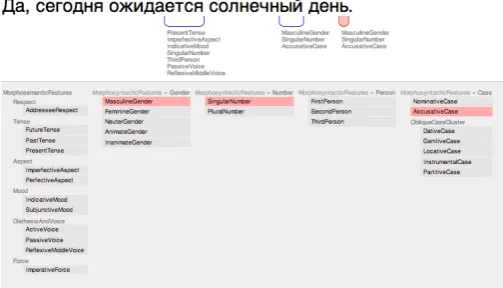
Figure 2: Example of an annotation window in the annotation tool for a Russian sentence.
marking the singular, since it contrasts withdogs. Sim-ilarly the French singular definite article le is Mascu-lineGender since it contrasts with FeminineGenderla. However, in the plural, les never shows a contrast in gender, so gender would not be marked. A fragment of the instructions for French giving a concrete example is given in Figure 1. Figure 2 shows an example of an annotation of a Russian sentence using the annotation tool.
The total mean number of features, as well as the number of bytes annotated for each language is as follows:
# feats # bytes # feats # bytes
Ar 2034 4441 De 2275 5972
En 851 4842 Fr 1582 6297
It 1757 5748 Ko 672 2234
Ru 1657 5046 Zh 187 1879
We hope eventually to expand the set to around 1,000 sentences per language. However, as we will see below, we can already learn a lot from the dataset thus far developed.
4. Measuring Information
Before we turn in the next section to the analysis and the actual measures we develop, we wish to lay out a few general issues on how different kinds of features relate to information content.
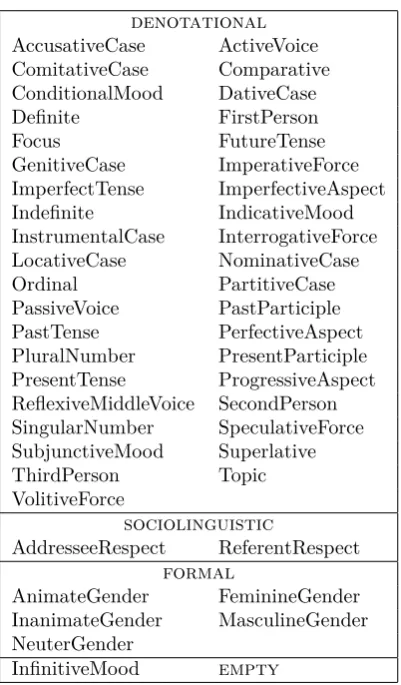
The simplest approach to measuring information would simply be to count the morphosyntactic and morphosemantic features that are marked for each sen-tence. However, this would surely overreward some bits of information that are less informative than oth-ers. For example, consider grammatical gender. On the one hand gender could be useful in language com-prehension: gender agreement of a predicate adjec-tive with a preceding noun, for example, might help to reinforce the fact that the adjective is predicated of the noun. On the other hand, grammatical gen-der is purely formal feature and does not really con-vey much information in the common-language sense of this term. This is in contradistinction to, say, case marking, which can convey quite a bit of information about the role of a noun phrase in the sentence. Put another way, formal gender (as opposed to natural gen-der) generally corresponds to nothing in the world. On the other hand, case marking, even if indirectly, marks the role of particular nominals in an action or state of affairs, and thus can be said to reflect something in the world.
Another possible dimension to compare features is in terms of their contribution to the truth value versus their pragmatic status. If a speaker mixes up nomina-tive and accusanomina-tive case, the result could be a sentence that is no longer true: if the situation is that John ate a fish, markingJohnwith accusative andfish with nominative would result in a sentence that is proba-bly false. On the other hand, using an inappropriate respect marker would not change the truth condition, though it would probably render the result socially in-appropriate. Depending now how we weigh the im-portance of denotation versus pragmatics, we could quantify the “importance” of these different kinds of features.
We also do not want to count the same piece of in-formation twice: in our Korean example above, there were multiple parts that conveyed respect for the ref-erent (grandfather), but taken together these mark a single instance of ReferentRespect. This latter point can in fact easily be taken care of either during the annotation process by requiring the annotators to de-scribe the multiple exponents of a particular feature as being the same feature instance, or by post hoc pro-cessing of the annotations.
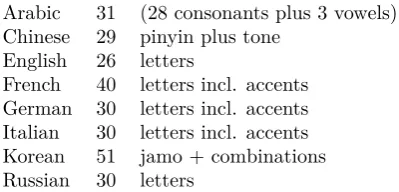
As noted above, we also need a good definition of “space”: as we discuss below we consider several mea-sures of this, including byte count, character count, and measures correlated with phoneme count.
5. Analysis
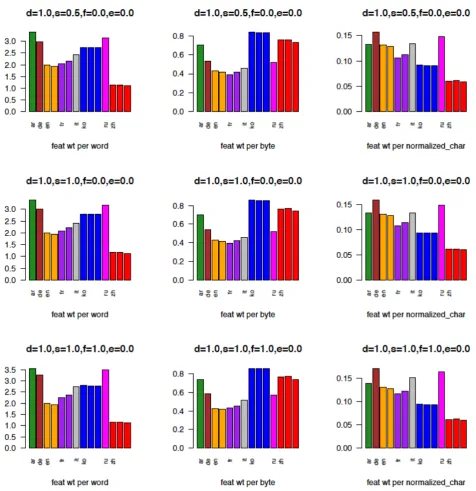
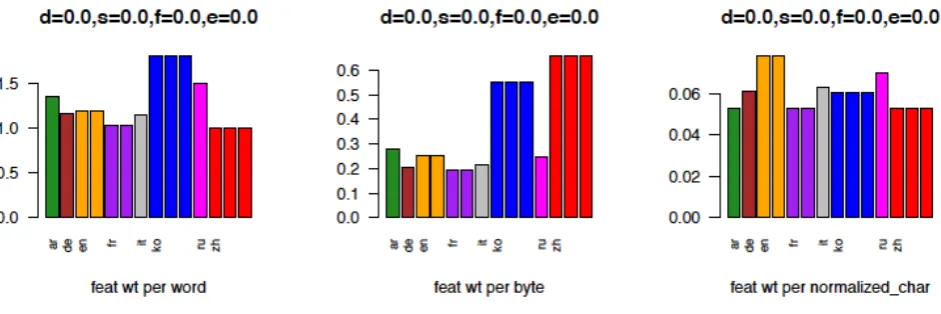
Figure 3: information
length (vertical axis) for eight languages. See the text for the explanation of the headers and footers for each plot. Note that the feature weights are the same along eachrow. Annotators for each language (where there was more than one), are grouped together. Colors for the languages for all plots are: Arabic – green, German – brown, English – orange, French – purple, Italian – grey, Korean – blue, Russian – magenta, Chinese – red.
duplicates (Figure 4) the following patterns emerge: feats per word ko>ru>ar>de>en>it>fr>zh
feats per byte ko>zh>ar>ru>en>de>it>fr
feats per norm. char ru>en>de>it>ko>ar>fr>zh
Here again Korean and Chinese top the list by the features-per-byte measure. Weighting morphosyn-tactic and morphosemantic features as 0 (Figure 5) comes out as follows, with Korean being about the same as German, and French as Chinese, in the
features-per-normalized-character condition:
feats per word ko>ru>ar>en>de>it>fr>zh
feats per byte zh>ko>ar>en>ru>it>de>fr
feats per norm. char en>ru>it>ko ~ de>fr ~ zh>ar
Figure 4: information
length for eight languages, when we eliminate duplicates for any feature within a sentence.
Figure 5: information
length for eight languages, when we only consider the lexical features (setting all weights for morphosyntactic and morphosemantic features to 0).
feats per word ru>ar>de>it>ko ~ fr>en>zh
feats per byte ar>ko>de>ru>it>zh>fr>en
feats per norm. char ru>en>de>it>ko>ar>fr>zh
If now we consider all of the ways in one might measure information, both in terms of feature weight-ings and the length against which that is being compared, and for each condition, weights the lan-guage by the position in the partial ordering, and then sums over all conditions, one arrives at the following ranking:
ru>ar>de>ko>it>en>zh>fr
To a large extent this ranks the highly inflected languages at the top of the hierarchy, with the single exception of French, whose position at the bottom may be due in part to the French translations being more verbose than for the other languages, but in part to other differences — e.g. French being non-pro-drop and thus expressing pronouns where, say, Italian does not, and more use of possessives in French.
This, then, constitutes an answer to the question of which languages are the most efficient at communi-cating information. While it is not the only possible answer, it is at least defensible.
6. Further work
Figure 6: information
length for eight languages, weighting the lexical features as before, but weighting each feature as the negative log probability of that feature setting, estimated separately for each annotator.
Other measures of the “importance” of a feature may be considered. For example (Acedański and Przepiórkowski, 2010) discuss various measures that better assess the importance of tagging errors for different applications, and such measures may be rel-evant here too as a way to assess the salience of a feature.
Many of the assumptions that have gone into the database and its analysis may strike the reader as silly. For example, why assume that a given morphosyntac-tic feature has the same amount of information as some other, or as a lexeme? Why do all case features have the same weight in some of our analyses? And so forth. One could of course as easily ask, why not? The point is that in order to make any sense at all of the question of how much information is conveyed by different lan-guages, in the same amount of space, one must make concrete assumptions about what one means by “in-formation” and by “space”. Only then can one even begin to answer the question. Since to our knowledge nobody has ever tried to formally quantify these no-tions with a view to answering the main question, one may view the current work as an initial step towards an answer, which can hopefully be improved upon with further research. In the worst case, this work is a re-ductio ad absurdumof the question.
Beyond the linguistic questions that have motivated this work, we believe that this work is also relevant for practical applications such as language modeling and natural language generation (NLG). Considering just NLG, one of the problems in multilingual generation from the same core data structure is how to make the result sound both correct and appropriate. The anno-tated data we will provide will be of direct use to con-structing models for NLG since it will indicate exactly what morphosyntactic and morphosemantic informa-tion must be added beyond what is in the informainforma-tion in the core message, and where that information must be added.
We plan to make the current dataset along with the features annotated for each language freely available
in the near future.5
7. Acknowledgements
We wish to thank the language experts who helped us with designing language-particular feature sets and an-notating the data: Costanza Asnaghi, Elixabete Mur-guia Gomez, Zainab Hossainzadeh, Josie Li, Thomas Meyer, Fayeq Oweis, Tanya Scott. Thanks also to Daniel van Esch for helping arrange for some of the annotation work.
8. References
Szymon Acedański and Adam Przepiórkowski. 2010. Towards the adequate evaluation of morphosyntac-tic taggers. InCOLING.
GOLD. 2010. http://linguistics-ontology.org/ gold/2010.
Roman Jakobson. 1959. On linguistic aspects of trans-lation. In R. A. Brower, editor, On Translation, pages 232–239. Harvard University Press, Cam-bridge, MA.
Anna Kibort. 2008. A typology of grammatical fea-tures. 11. http://www.features.surrey.ac.uk/ inventory.html.
Claude Shannon. 1948. A mathematical theory of communication. Bell Labs Technical Journal, 27:379–423, 623–656, July, October.
Ashley Taylor. 2013. Twitter in foreign lan-guage. http://www.theconnectivist.com/2013/ 04/twitter-in-foreign-languages/.