A Fusion (Palm and Speech) Using Corner
Edge Detection and Linear Predictive Coding
Techniques
Shailza Thakur 1, Akanksha Sambyal 2
P.G. Student, Department of Computer Science and Engineering, Sri Sai University, Palampur,
Himachal Pradesh, India1
Associate Professor, Department of Computer Science and Engineering, Sri Sai University, Palampur,
Himachal Pradesh, India2
ABSTRACT: A biometric recognition is the process to verify or identify user identities by comparing some sort of behavioural or physiological trait of the user to a previously stored sample of the trait. The recent developments in the biometrics area have lead to smaller, faster and cheaper systems, which in turn has increased the number of possible application areas for biometric identity verification. Palm-print and Speech are the biometrics, used for personal identification or verification. As a small part of the palm-print image and limited time interval speech signal are used for this purpose. In this research work, main focus on feature extraction and matching. For the feature extraction, corner edge detection (CED) and linear predictive coding (LPC) techniques are proposed for Palm and Speech recognition. During the template generation, firstly the palm-print images are cropped (512*512) or the speech signals are compressed and then the features are extracted and compared with the stored features in the database. Noise is removed by using Gaussian filter (GF) and high-pass filter (HPF). The proposed system consists of three major steps i.e., normalization, generation of similarity score and fusion of weighted scores. The final score is then used to declare the person as genuine or an impostor. The system is tested on database collected by the authors for 120 subjects and gives an overall accuracy of 99.25% with FAR of 1% and FRR of 0.75%.
KEYWORDS:Biometrics, Automatic Authentication System, Multimodal, Palm print, Speech signal, Fusion.
I. INTRODUCTION
From past 10 years, many problems had arisen related to the security of accessing the same information at anytime and anywhere by the people. Most of the time system uses ID cards and passwords for personal identification. Now our daily life is getting much computerized in every field such as business, education and entertainment etc. Automated authentication systems [2] are getting more and more important for security point of view. Now electronic gadgets like mobile phones are mostly used for the personal banking tasks over the Internet. The aim of automated authentication systems is to verify that the users are valid to access the system or not. The automated authentication systems can ask the user to provide some data like username, password or bio-metric traits to access the system. The automated authentication systems can identify only some kind of trait that is unique for the user. Here a developed system in which palm image and voice are used for login the system by using authentication. By using these trait, there is no chance of forgetting password and not even anyone theft your password because it is used by only the intentional person. In bio-metric system, human body trait takes as password as well used for the registration and verification.
being used are fingerprint and face but for face authentication people are still working with the problem of pose and illumination invariance where as fingerprint does not have a good psychological effect on the user because of its wide use in crime investigations. If any biometric modality is to succeed in the future it should have the traits like uniqueness, accuracy, richness, ease of acquisition, reliability and above all user acceptance. However, uni-modal biometric systems which use a single trait for authentication, will suffer from problems like noisy sensor data, non-universality, lack of distinctiveness of the biometric trait, unacceptable error rates, and spoof attacks. These problems can be tackled by using multi-biometrics in the system. Multi-modal biometric technology which can use complementary information between different modals to improve the recognition rate has four levels, data level, feature level, score level and decision level. This paper focuses on the fusion of score level.
This paper proposes multimodal biometric system [1] using two traits, i.e. palm-print and speech signal. The proposed system is designed for applications where the training data contains a palm-print and speech signal. Combination of the palm-print and speech features increases robustness of person authentication. The main Task of Biometric system is to extract the biometric trait data and then store in the database. We store the biometric trait in the database for authentication because the data should already present in the database for the verification process. This biometric trait provides best security for identification purpose to login the system as compared to other method and services where person need to prove their personal identity.
Corner Edge Detection method (CED) is used to extract feature for palm-print mean while Linear Predictive Coding (LPC) is used to extract features of speech signal. The matcher weights are calculated based on Equal Error Rate (EER) of the intended matchers for fusion, which significantly increases the accuracy of the recognition system.
II. RELATEDWORK
N.Priya, Sundararajan.M, Arulselvi S [1] in this research work, low resolution palm images[128*128] having principle line has taken for feature extraction by using the 2D Discrete wavelet transform technique and distance formula is used to calculate the distance between principle lines. In speech section, high quality voice has taken for the feature extraction using MFCC. Overall accuracy is 98.63%, FAR is 1.67% and FRR is 0.84%.
Ravi Kant Thakur [2] Advances in the field of Information Technology make Information Security an inseparable part of it. In order to deal with security, Authentication plays an important role i.e. verifying that the user is who he claims to be. We can authenticate an identity in three ways: by something the user knows (such as a password or personal identification number), something the user has (a security token or smart card) or something the user is (a physical characteristic, such as a fingerprint, called a biometric. Biometrics ensures that the rendered services are accessed only by a legitimate user, and not anyone else. By using biometrics it is possible to confirm or establish an individual’s identity. In this paper we have outlined opinions about the usability of biometric authentication systems, different techniques, their advantages and disadvantages and its future possibilities.
Madhuri R Dubey and S. A. Chhabria [3] proposed a system for eye and speech fusion in human computer interaction. In their work, Geometry Feature Extraction method is used to extract the features of eye recognition by finding the contours (contains the iris boundary) of the eye and Discrete Wavelet Transform method is used to extract the features of speech recognition by analyzing the speech signal at different frequencies for calculating the coefficients of the speech signal.
Jaspreet Kour, Shreyash Vashishtha, Nikhil Mishra, Gaurav Dwivedi, Prateek Arora [4], in this paper existing methods have been reviewed for palm-print recognition. In the proposed approach, dominant spectral features have been extracted such as the major lines using region of interest method, instead of using the whole palm-print image at a time. This approach helps in increasing the performance and accuracy of the system. A lot of work has to be done with the feature extraction algorithms as well as the matching algorithms. The main goal is to develop a system with increased speed of working on the palmprint recognition system and accuracy.
used in various applications like access control, time and attendance, point-of scale, anti-pass back and interactive kiosks etc. This paper presents biometric user recognition system based on hand geometry. The goal of a biometric verification system consists in deciding whether two characteristics belong to the same person or not.
Er. Tarandeep Singh, Er. Amanpreet Kaur [9] had compared the two unique segmentation techniques. By using linguistic interpretation, the conventional method is used for hand labelling of speech that what was spoken with the Automatic Segmentation technique. Finally, the manual and automatic segmentation deviation between them had been calculated for the onset and offset values for the syllable boundaries. Speech Reorganization system requires segmentation of Speech waveform into fundamental acoustic units according to them. Proposed method was implemented and analyzed for different Punjabi speech signals. Results for signal were shown where the syllables boundaries are marked automatically. It had also been observed that the difference between Automatic and Manual methods is very much negligible and the boundaries of syllables marked by automatic technique were very much accurate.
Michael GohKahOng, Connie Tee and Andrew TeohBeng Jin [13], in their paper new touch-less palm print recognition is presented. The proposed touch-less palm print recognition system offers several advantages like flexibility and user-friendliness. They proposed a novel palm print tracking algorithm to automatically detect and locate the ROI of the palm. The proposed algorithm works better under dynamic environment by using cluttered background and varying illumination. A new feature extraction method has also been introduced to extract the palm print effectively. In addition, they applied a modified PNN to tailor the requirement of the online recognition system for palm print matching. Extensive experiments have been conducted to evaluate the performance of the system. It takes less than 3 seconds to capture, process and verify a palm print image in a database containing 12, 800 images. The EER is 0.57% and the execution time is 0.73s.
Guangming Lu, David Zhang ,Kuanquan Wang [15], In this paper, the eigenpalm method is developed by using the K–L transform algorithm for print recognition. It can represent the principal components of the palm-prints fairly better. Features of palm print image are extracted by projecting palm-print images into an eigenpalms subspace. To access the Efficiency of our technique, a classifier is applied on the weighted Euclidean distance. A correct recognition rate of up to 99% can be obtained using our approach.
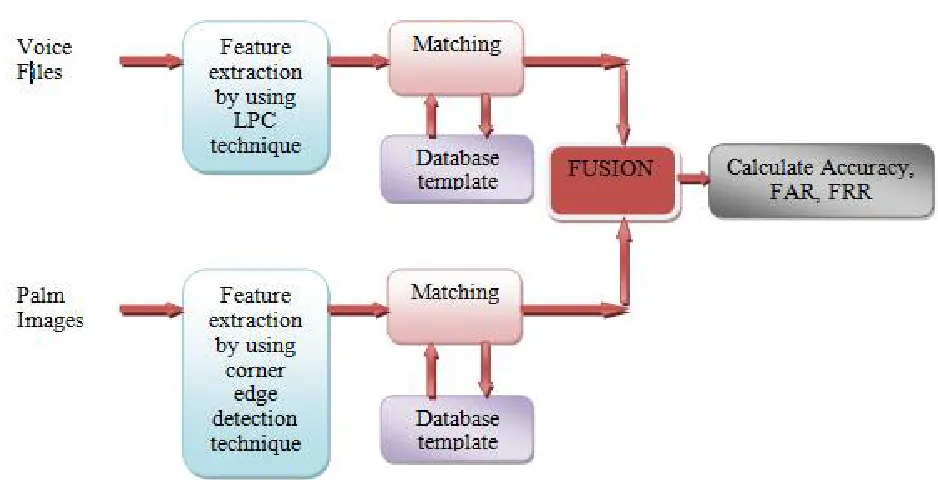
III.SYSTEMSTRUCTURE
Fig. 1 Proposed Fusion system for Palm and Speech
IV.EXPERIMENTALRESULTS
Algorithm for Calculating Features of Palm Image
Step1: Read palm image.
Step2: Apply Pre-processing (Gaussian filter) Step3: Detect the edges.
Step4: Detect the corner edges.
Step5: Compare each maxima with its two local minima to remove false corners. Step6: find T-junctions within (gap by gap) neighbourhood.
Step7: Calculate the end and start points of the Corner edge.
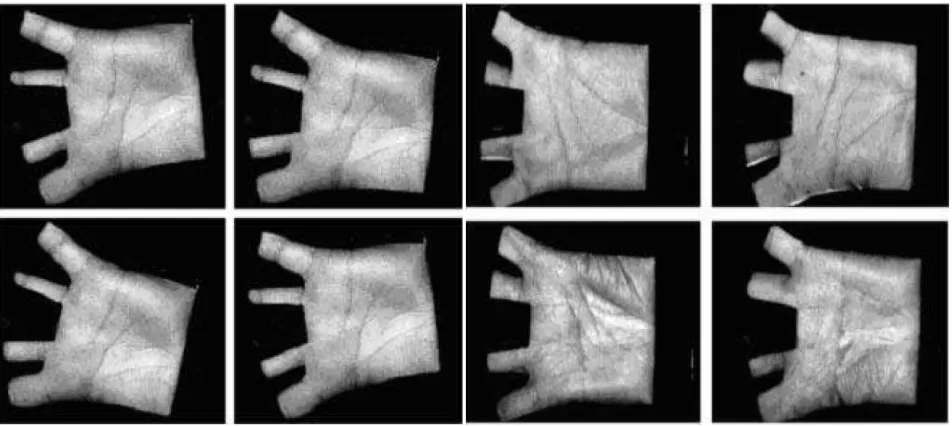
Fig. 2 Palm print Database images
Test results are showing in the below images. Firstly, take a palm print image for detection of corner edges are done in Fig. (a) From the 512*512 palm print image. After that matching of feature is done by comparing the feature with the database feature.
(a) (b) (c)
Fig. 3 Palm print Corner Edge Detection (a) Edge Detected image (512*512) (b) Original image (c) Matched image
Result testing is done by taking different image such as images at different angel. A Image with their non-standard size is a non recognized image.
Detected corners on the edge image Detected corners and their curvature on the original image
430
430 280
210 300
180
200 240
160
280 450
Table 1: Result of Palm Recognition
TEST IMAGES RESULT
1.bmp Recognized
3. bmp Recognized
3. bmp Recognized
4.bmp non-recognized
18.bmp Recognized
44.bmp Recognized
63. bmp Recognized
77. bmp Recognized
91. bmp Recognized
95. bmp Recognized
Algorithm for Calculating Features of Speech Signal
Step1: Read Speech Signal.
Step2: Apply Pre-processing (Segmentation) Step3: Apply windowing function
Step4: Apply pre-emphasis filter.
Step5: Obtain Linear Prediction co-efficient. Step6: Calculate Formant frequencies.
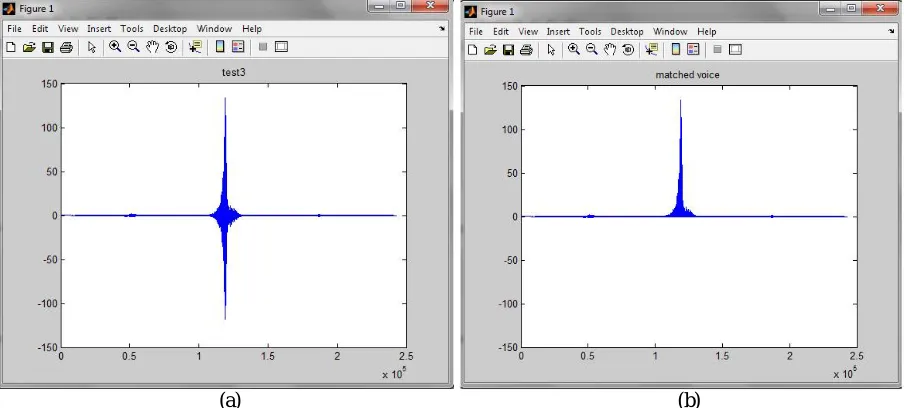
(a) (b)
Fig. 4 Speech Linear Predictive Coding (a) Input Voice signal (b) Matched Voice signal
taken 6 test voices for checking the system performance. In this one voice sample is not recognized due to their different file format.
Table 2: Test Results of Speech Recognition
Test Voice Result
test1.wav Recognized
test2.wav Recognized
test3.wav Recognized
test4.wav Recognized
test.wav Non-recognized
test5.wav Recognized
Fusion
The different biometric system can be integrated to improve the performance of the verification system. The matcher weights are calculated based on Equal Error Rate(EER) of using FAR(false acceptance rate) and FRR(False rejection rate).
V. EVALUATIONS
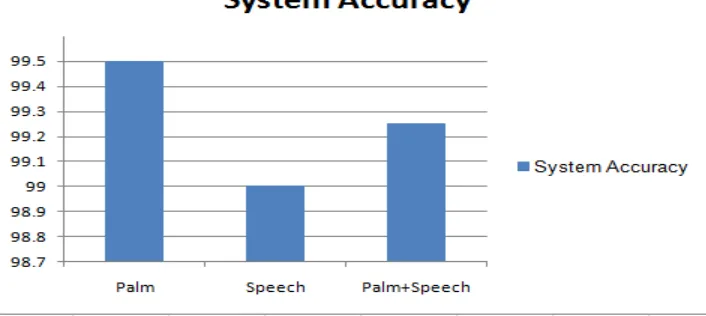
The simulations are conducted on our own database. Database contains speech signal and palmprint images of 125 subjects. Each subject has 10 palm images taken at different time intervals and 6 different words, which is stored in the database. Before extracting features of palmprint, we locate palmprint images to 512*512. After fusion, we can achieve high genuine acceptance (99.25%) with a low false acceptance (1%) and a low false rejection (0.75%) verification rates.
VI.CONCLUSION & FUTURE WORK
The use of bio-metrics as a reliable means meeting the security concerns of today’s information and network based society cannot be belittled. Bio-metrics is being used all over the globe and is undergoing constant development. The hand geometry has proved to be a reliable bio-metric. The proposed work shows how to utilize the shape of palm to extract the features using very simple algorithms. We are attempting to improve the performance of the bio-metric system by combining speech recognition with the palm recognition. The hybrid system is more accurate than previous systems. The performance of the system is analysed on the bases of False Acceptance Rate (FAR) and False Rejection Rate (FRR). In future, speech and palm bio-metric system can be develop on the basis of multi-feature attributes and also new bio-metric trait can be combining with it. The performance of the system can be improved by increasing and decreasing the size of the palm image and speech signal.
REFERENCES
[1] N.Priya, Sundararajan.M, Arulselvi S, “A Novel Approach on Signal Biometric Identification System- Using the Fusion of Palmprint and Speech Signal”, International Journal of Innovative Research in Computer and Communication Engineering, Vol. 3, Issue 1, Jan. 2015. [2] Ravi Kant Thakur, “Biometric Authentication System: Techniques and Future”, International Journal of Advance Research in Computer
Science and Management Studies, Volume 3, Issue 6,pp. 2321-7782, Jun. 2015.
[3] S. A. Chhabria, Madhuri R. Dubey,” Eye and Speech Fusion in Human Computer Interaction”, International Journal of Advance Research in Computer Science and Management Studies, Volume 2, Issue 3, ISSN: 2321-7782, Mar. 2014.
[4] Jaspreet Kour, Shreyash Vashishtha, Nikhil Mishra, Gaurav Dwivedi, Prateek Arora, ” Palmprint Recognition System”, International Journal of Innovative Research in Science, Engineering and Technology, Vol. 2, Issue 4, ISSN: 2319-8753, Apr. 2013.
[5] Jobin J., Jiji Joseph, Sandhya Y.A, Soni P. Saji and Deepa P.L., “ Palm Biometrics Recognition and Verification System”, International Journal of Advanced Research in Electrical, Electronics and Instrumentation Engineering, Vol. 1, Issue 2, pp. 2278 – 8875, Aug. 2012. [6] DR. Sunita Rana, “The Process of the Speech Production, Perception, Speech Signals and Speech Production”, International Journal of
Advanced Research in Computer Engineering & Technology, Volume 1, Issue 9, pp. 2278-1323, Nov. 2012.
[7] K.Y. Rajput, Melissa Amanna, Mankhush Jagawat and Mayank Sharma, “Palmprint Recognition Using Image Processing”, International Journal of Computing Science and Communication Technologies, VOL. 3, NO. 2, pp. 0974-3375, Jan. 2011.
[8] J.Dai and J.Zhou, “Multi-feature-based High Resolution palm recognition”, IEEE Trans. Pattern Analysis and Machine Intelligence, Vol. 33, No. 5, pp.945-957, May 2011.
[9] K. Amanpreet, and S. Tarandeep, “Segmentation of Continuous Punjabi Speech Signal into Syllables”, Proceedings of the World Congress on Engineering and Computer Science, Vol. I, San Francisco, USA, pp. 20-22, Oct. 2010.
[10] Prica Biljana et al., “Recognition of vowels in Continuous Speech by using Formants”, Facta Universitatis, Vol. 23, No. 3, pp. 379-393, Dec. 2010.
[11] G Lakshmi Sarada, et al, “Automatic transcription of continuous speech into syllable-like units for Indian languages”, Vol. 34, Part 2, pp. 221–233, Apr. 2009.
[12] N.Uma Maheswari, A.P.Kabilan, R.Venkatesh, “Speech Recognition System Based On Phonemes Using Neural Networks”, IJCSNS International Journal of Computer Science and Network Security, VOL.9 No.7, Jul. 2009.
[13] Michael GohKahOng, Connie Tee, Andrew TeohBeng Jin,”Touch-less Palm print Biometric System”, International Conference on Computer Vision Theory and Applications, Jun. 2008.
[14] Tolba F. M. et al., “A Novel Method for Arabic Consonant/Vowel Segmentation using Wavelet Transform”, International Journal of Intelligent Computing and Information Sciences, Vol. 5, No. 2, pp. 353-364, Jun. 2005.