Alu Insertion Polymorphisms for the Study of Human Genomic Diversity
Astrid M. Roy-Engel,*
,1Marion L. Carroll,
†,1Erika Vogel,* Randall K. Garber,
†,‡Son V. Nguyen,
†Abdel-Halim Salem,
†,‡Mark A. Batzer
†,‡,2and Prescott L. Deininger*
,§,2*Tulane Cancer Center, Department of Environmental Health Sciences, Tulane University Health Sciences Center, New Orleans, Louisiana 70112,†Departments of Pathology, Genetics, Biochemistry and Molecular Biology, Stanley S. Scott Cancer Center, Louisiana State
University Health Sciences Center, New Orleans, Louisiana 70112,‡Department of Biological Sciences, Biological Computation
and Visualization Center, Louisiana State University, Baton Rouge, Louisiana 70803 and§Laboratory of
Molecular Genetics, Alton Ochsner Medical Foundation, New Orleans, Louisiana 70121 Manuscript received February 24, 2001
Accepted for publication June 8, 2001
ABSTRACT
Genomic database mining has been a very useful aid in the identification and retrieval of recently integrated Alu elements from the human genome. We analyzed Alu elements retrieved from the GenBank database and identified two new Alu subfamilies, Alu Yb9 and Alu Yc2, and further characterized Yc1 subfamily members. Some members of each of the three subfamilies have inserted in the human genome so recently that about a one-third of the analyzed elements are polymorphic for the presence/absence of the Alu repeat in diverse human populations. These newly identified Alu insertion polymorphisms will serve as identical-by-descent genetic markers for the study of human evolution and forensics. Three previously classified Alu Y elements linked with disease belong to the Yc1 subfamily, supporting the retroposition potential of this subfamily and demonstrating that the Alu Y subfamily currently has a very low amplification rate in the human genome.
A
LU elements have been accumulating in the human result in groups of elements that are identifiable as newsubfamilies. genome throughout primate evolution, reaching
Collectively, the Alu Y, Ya5, Ya5a2, Ya8, and Yb8 sub-a copy number of over sub-a million per genome. However,
families comprise ⬍10% of the Alu elements present
most of these Alu copies are not identical and can be
within the human genome, with the Ya5/8 and Yb8
classified into several subfamilies (reviewed in
Dei-subfamilies together accounting for⬍0.5% of all Alu
ningerandBatzer1993). These different subfamilies
elements. Although the human genome contains of Alu elements were generated once mutations
oc-⬎1,000,000 copies of Alu (ⵑ10% of the genome;Smit curred within the “master” or “source” gene that actively
1996), ⬍0.5% are polymorphic. Due to their recent
retroposed at different rates and time periods of primate
evolutionary introduction into the human genome,
evolution (Deininger et al. 1992). Currently, the Alu
many of the young Alu elements are polymorphic be-retroposition rate is reduced by 100-fold from its peak
tween individuals and/or populations. There is an
in-early in primate evolution (Shen et al.1991). The vast
verse correlation between the age of the Alu subfamily majority of the Alu elements present in the human
and the percentage of polymorphic elements it con-genome inserted before the radiation of extant humans
tains. Identification of evolutionarily recent Alu sub-and are therefore observed in all individuals in the
hu-families and their polymorphic insertions is useful for man population. However, almost all of the recently
human population studies, forensics, and DNA finger-integrated Alu elements in the human genome are
re-printing for two reasons: (i) There is no apparent spe-stricted to several closely related “young” subfamilies,
cific mechanism to remove newly inserted Alu repeats, with the majority being Ya5 and Yb8 subfamily members
making inserts identical by descent; and (ii) the Alu (Batzeret al.1994, 1995). Several of these new
subfami-insertions have a known ancestral state (Batzer and
lies appear to originate from an Alu element that
fortu-Deininger1991;Batzeret al.1994). itously inserted into a favorable region of the genome
The availability of large quantities of human genomic capable of supporting Alu retroposition. Subsequent
DNA sequence provided by the Human Genome Project or concurrent mutations in the new source element(s)
facilitates genomic database mining for recently inte-grated Alu elements. Through this approach we were able to identify the youngest Alu subfamily reported to Corresponding author:Prescott L. Deininger, Tulane Cancer Center, date, termed (Ya5a2), and determined that the majority SL-66, Tulane University Medical Center, 1430 Tulane Ave., New
of its members are Alu insertion polymorphisms (Roy
Orleans, LA 70112. E-mail: [email protected]
et al.2000). We expanded our computational analyses 1These authors contributed equally to this work.
2These are equal senior authors. to identify other Alu subfamilies derived from the Alu
Y and Yb8 subfamilies. Here, we present the analysis of were retrieved from the nr database (30.4% of the hu-man genome at the time), giving an estimated size of three of the most recently formed Alu subfamilies and
demonstrate their utility for the study of human geno- 82 members for the Yb9 subfamily. This estimate is also
in good agreement with a search of the draft human mic diversity.
genomic sequence (Landeret al.2001) that identified
79 perfect matches with a Yb9 subfamily-specific query
MATERIALS AND METHODS sequence.
Using a different approach, we also retrieved one
Computational analyses:Sequence alignments for the
iden-tification of Alu subfamilies were made using MegAlign soft- previously identified subfamily, Yc1 [formerly termed
ware (DNAStar version 3.1.7 for Windows 3.2). Screening of Sb0 (Jurka 1995)], and a new variant, Yc2. GenBank
the GenBank nonredundant (nr), the high throughput ge- database searches for Alu Y elements that perfectly
nome sequence (htgs), and the genomic survey sequence (gss)
match the consensus sequence brought several Alu Y databases was performed using the advanced basic local
align-elements to our attention that share one or two specific
ment search tool 2.0 (BLAST;Altschulet al.1990) available
from the National Center for Biotechnology Information mutations that differ from the Y consensus. Closer
in-(http://www.ncbi.nlm.nih.gov/). Database searches for Yb8 spection facilitated the retrieval of the additional Alu
consensus Alus showed a common single-base variant termed subfamilies. BLAST searches using the consensus
se-Yb9. The databases were searched for matches to the 289 bases
quence for Alu Yc1 and Yc2 will also retrieve a large of the Yb9 consensus sequence (as inferred from the previous
number of elements that are matches to the Alu Y sub-Yb8 analysis) or the 281 bases of the Alu Y consensus with
the expected value (real) set at⫺e 1.0e⫺150and ⫺e1.0e⫺140, family as well, making the analysis of the elements
identi-respectively, in the advanced BLAST options. Only Alu Yb9 fied in this manner impractical. Therefore, we selected
elements with all nine diagnostic mutations were selected. A only the elements of these subfamilies with 100%
iden-similar type of search procedure was performed with the Yc1
tity to the oligonucleotide query sequence that con-and Yc2 consensus sequences or with an oligonucleotide query
tained the subfamily-specific diagnostic bases. A total of sequence complementary to the subfamily diagnostic base
po-sitions. Only Alu Yc1/Yc2 elements with 100% identity to the 176 Yc1 (13 perfect matches to the entire subfamily
oligonucleotide query sequences or entire subfamily-specific consensus sequence) and 17 Yc2 (11 perfect matches
consensus sequence were utilized for further analysis. To esti- to the entire subfamily consensus sequence) elements
mate the copy numbers of the Yb9 subfamily we searched the
were retrieved. A count of all Yc1 elements retrieved by
draft sequence of the human genome (Landeret al.2001),
BLAST on a single initial search of the nr database using a subfamily-specific probe that contained the
Yb9-spe-cific mutation as well as the insertion in the Yb8 subfamily. A yielded a total of 116 elements, giving an estimated copy
complete list of the Alu elements identified from the GenBank number of 381 Yc1 elements in the human genome (the
search is available from M. A. Batzer or P. L. Deininger. nr database contained 30.4% of the human genome
DNA samples:Human DNA samples from the European,
sequence at the time of the search). Interestingly, three African-American, Alaskan Native, Egyptian, and Asian
popu-of the four elements previously classified as Alu Y ele-lation groups were isolated from peripheral blood
lympho-cytes (Ausubelet al.1996) that were available from previous ments linked to disease (DeiningerandBatzer1999)
studies (Royet al.1999). belong to the Alu Yc1 subfamily (Figure2): thede novo
Oligonucleotide primer design and PCR amplification: insertion in the C1 inhibitor gene (C1inh; Stoppa
-Flanking unique DNA sequences adjacent to each Alu repeat
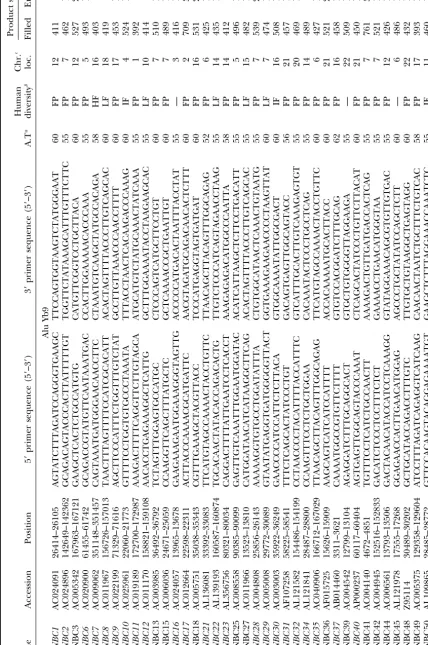
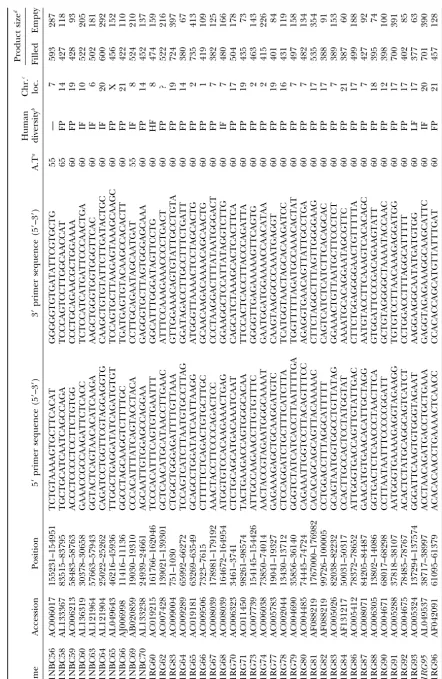
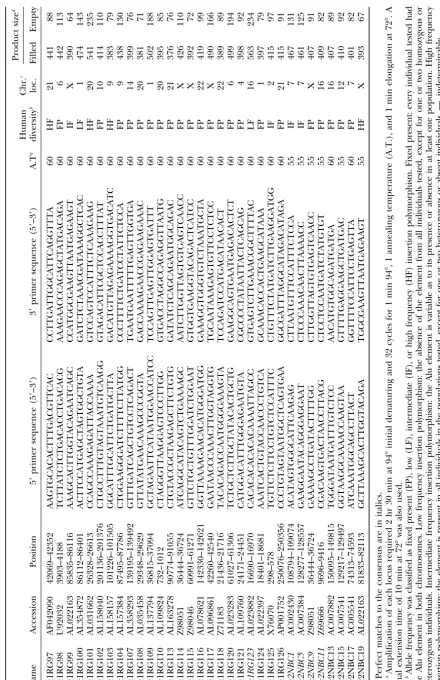
Lyonnet et al. 1990), another de novo insertion in were used to design primers for the Yb9, Yc1, and Yc2 Alu
BRCA2 (BRCA2;Mikiet al.1996), and glycerol kinase
elements (Table 1). PCR primers and reactions were
per-formed as previously described (Royet al.1999). The heterozy- deficiency (GK;Zhanget al.2000).
gosity associated with each element was determined by the About one-half of the 56 total Yb9 elements (29)
amplification of 20 individuals from each of four populations shared 100% nucleotide identity with the subfamily
con-(African American, Alaskan Native or Asian, European, and
sensus sequence. To get an approximation of the age Egyptian; 160 total chromosomes). The chromosomal location
of the Yb9 subfamily, we evaluated the number of non-for elements identified from randomly sequenced anonymous
large-insert clones was determined by PCR as previously de- CpG mutations present within the different Alu
ele-scribed (Royet al.1999). ments as previously described (Royet al.2000). A total
of 19 CpG mutations, 25 non-CpG mutations, and two
5⬘truncations occurred within the 56 Alu Yb9 subfamily
RESULTS
members identified. Using a neutral rate of evolution for primate intervening DNA sequences of 0.15% per
The Alu Yb9, Yc1, and Yc2 subfamilies:Analysis of a
set of 243 Yb8 Alu elements retrieved from the GenBank million years (Miyamotoet al.1987) and the non-CpG
mutation density of 0.1908% (25/13,104 bases using database allowed us to identify a putative subfamily
con-taining all the known Yb8 diagnostic mutations plus one only non-CpG bases) within the 56 Yb9 Alu elements
yield an estimated average age of 1.27 million years new mutation, which is referred to as Yb9 in compliance
with the standard Alu subfamily nomenclature (Batzer (myr). The age for the Yb9 subfamily members is
pre-dicted at a 95% confidence level in the range of 0.8–1.8 et al.1996). The Yb9 consensus sequence is shown in
Figure 1. Searches from the nr, the htgs, and gss re- myr, given that the mutations were random and fit a
Figure1.—Consensus se-quence alignment of Y, Yb8, and the potential new sub-family Yb9 identified. Nucle-otide substitutions at each position are indicated with the appropriate nucleotide. Deletions are marked by dashes (-). The Yb8 and Yb9 diagnostic nucleotides are indicated in boldface type with the corresponding di-agnostic numbers above.
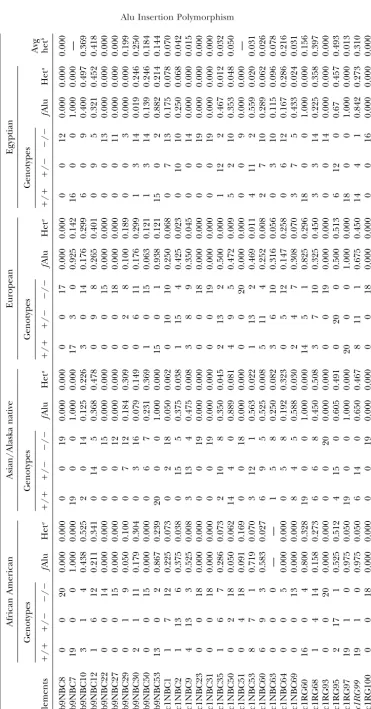
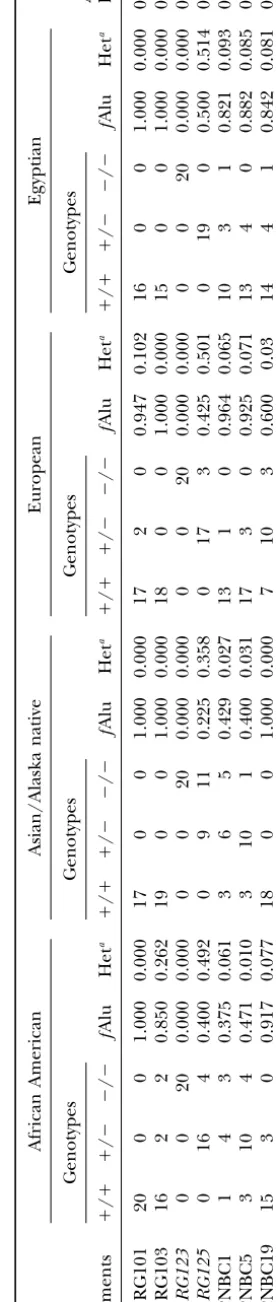
Yc1 and Yc2 Alu elements, because only subfamily mem- 28, Yc1 with 24/97, and Yc2 with 3/8). The
population-bers with perfect identity to the subfamily consensus specific genotypes and levels of heterozygosity for each
sequence or one mismatch were isolated from the data- element are shown in Table 2. The high proportion of
base using one of the database screening procedures. polymorphic elements in these Alu subfamilies is in
Phylogenetic distribution and human genomic diver- good agreement with our previous observations,
indicat-sity of the new subfamilies:Amplification of the Yb9, ing that these subfamilies are very recent in origin and
Yc1, and Yc2 elements from nonhuman primate ge- still actively retroposing within the human genome.
nomes facilitated the analysis of the phylogenetic distri-bution of these elements, using PCR and the
oligonucle-otide primers in Table 1. Almost all of the elements DISCUSSION
evaluated were absent from the genomes of the
nonhu-From our subset of AluYb8 and Y elements, we were man primates, suggesting that these elements dispersed
able to retrieve three Alu subfamilies termed Yb9, Yc1, and were fixed in the human genome after the human
and Yc2. A schematic of the evolutionary relationship and African ape divergence.
of these subfamilies with the previously defined Alu We performed a PCR analysis on a panel of human
subfamilies is shown in Figure 3. Alu subfamilies arise DNA samples to determine the levels of human diversity
as a result of mutations occurring in an existing master associated with the Alu elements from these new
subfam-element or new source subfam-elements capable of significant ilies, using the oligonucleotide primers shown in Table
amplification. In this case, the new subfamilies are pre-1. The panel consists of 20 individuals of European
sumably examples of Alu subfamilies that may have origi-origin, African-Americans, Asians, and Egyptians for a
nated from the rare instances when an Alu element total of 80 individuals (160 chromosomes). We were
fortuitously becomes both transcriptionally and retropo-able to analyze 28 out of the 56 Yb9 elements, 97 out
sitionally active, therefore allowing it to be another Alu of 176 Yc1 elements, and 8 out of 17 Yc2 Alu elements,
source gene. using this approach. Several factors did not allow for
The young Alu subfamilies are currently active with analysis of all the elements. Mainly, we were unable to
respect to retroposition, whereas the older Alu subfamil-design appropriate primers due to insufficient flanking
ies typically are not. The old Alu subfamilies (Sx, J, unique DNA sequences or because the element
ana-and Sg1), which comprise the vast majority (⬎1,000,000 lyzed resided within another type of repeat as described
copies) of the Alu elements present in the human
ge-previously (Batzeret al.1991). The Alu elements were
nome, appear completely inactive as none of their mem-classified as fixed present and high, intermediate, or
bers have been associated withde novoAlu inserts that
low frequency insertion polymorphisms (see Table 1 for
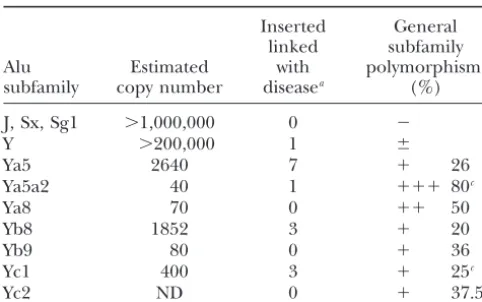
result in human diseases (Table 3). When noting the definitions). In general, we observed that approximately
ratio of reported Alu insertions associated with diseases one-fourth to one-third of the elements analyzed had
Figure2.—Consensus se-quence alignment of Y, Yc1, Yc2, and three Alu Yc1 ele-ments associated with dis-ease. The diseases linked withYc1 Alu elements are the angioedema caused by a de novo insertion in the C1 inhibitor gene (C1inh;
Stoppa-Lyonnetet al.1990),
breast cancer with another de novoinsertion in BRCA2
(BRCA2;Miki et al.1996),
and glycerol kinase
defi-ciency (GK; Zhang et al.
2000). Nucleotide substitu-tions at each position are indicated with the appro-priate nucleotide. Deletions are marked by dashes (-). The diagnostic nucleotides are indicated in boldface type with the corresponding diagnostic numbers above.
subfamilies Ya5, Yb8, and Yc1 currently appear to be very young Alu subfamilies with a high proportion of
polymorphic members provides new sources of Alu
in-ⵑ1000 times more active than the Alu Y subfamily with
7/2640, 3/1852, and 3/400 compared to 1/200,000 (Ta- sertion polymorphisms for the study of human
popula-tion genetics. However, it is important to note that an ble 3). The Alu Ya5a2 subfamily appears to have even
a higher current retroposition rate (1/40), but the very exhaustive analysis of these small subfamilies will only
generate a relatively small number of new Alu insertion young age and small size of the subfamily may be an
influencing factor. In general, two independent obser- polymorphisms.
Master elementvs. source gene:Alu elements have
vations support the current mobility of these young Alu
subfamilies within the human genome. First, there are been proposed to fit an evolutionary model where the
copies arose from “master” genes (Deiningerand
Sla-examples of Alu inserts that have caused disease that
belong to these young subfamilies. Second, the subfami- gel1988;LabudaandStriker1989;Shenet al.1991;
Deiningeret al.1992). A master gene can be defined lies have a high proportion of Alu insertion
polymor-phisms between individuals/populations (Table 3), in- as an element that is highly active during a long period,
therefore generating a lot of copies of itself. However, dicating the recent proliferative/amplification activity
of these Alu elements in the human genome. we demonstrated that recently inserted Alu elements
(de novo) belong to a variety of Alu subfamilies, indicat-Alu elements that are polymorphic for insertion
pres-ence/absence have previously proven useful for the ing the simultaneous presence of multiple active
ele-ments in the human genome. These active eleele-ments study of human population genetics and forensics
(Batzeret al.1991, 1994;Pernaet al.1992;Novicket al. that have a low rate of amplification and are only active for a very short period of time should not be classified
1993;Hammer1994;Tishkoffet al.1996;Stonekinget
al.1997;Majumderet al.1999;Comaset al.2000;Jorde as master genes. To distinguish between them, we
Figure3.—Schematic diagram of the evolution of recently integrated Alu subfamilies. All the origins of the young Alu subfamilies are shown. The origins of the Yb9, Yc1, and Yc2 Alu subfamilies are shown after the divergence of the Yb8 and the Y subfamily, respectively. The size of the font is relative to the number of elements within each subfamily, the largest representing 100,000–200,000 copies; medium, 1000–2000 copies; and the smallest, 50–500 copies. The total number of elements from each subfamily linked to disease is indicated to the right. The proportion of polymorphic elements within
each family is represented by the following:⫾, rarely
polymor-phic elements are found;⫹, low percentage of polymorphic
elements; ⫹⫹, ⵑ50% the elements are polymorphic; and
⫹⫹⫹, most of the elements are polymorphic.
referring to the highly active genes for long evolutionary periods of time, like the Alu element that generated the majority (⬎90%) of the Alu elements currently pres-ent in the genome today. For those copies, or daughters, that acquired the ability to retropose we propose the use of the term “source genes.” However, some of the elements classified as source genes may be potential master genes, and only the progression of time will allow the appropriate distinction to be made.
Evolutionary reduction in the Alu retroposition rate:
Our data indicate the existence of several currently ac-tive Alu elements that belong to different subfamilies within the human genome. However, the present ampli-fication rate of Alu elements has drastically decreased from when it reached its peak between 35 and 60 million years ago (mostly Sx subfamily). The majority of the Alu elements present in the genome of extant humans inserted during this peak amplification period. There are multiple reasons that could explain the reduction in the amplification rate of Alu elements. First, mutations within or near the master Alu element could reduce its retroposition activity or even totally abolish it by a variety
of mechanisms (DeiningerandBatzer1993;Schmid
1996). Alternatively, mutations within the master gene or in the LINE elements that affect the ability to “parasit-ize” LINE element-encoded enzymes necessary for
retro-TABLE
2
(Continued)
African
American
Asian/Alaska
native
European
Egyptian
Genotypes
Genotypes
Genotypes
Genotypes
Avg
Elements
⫹
/
⫹⫹
/
⫺⫺
/
⫺
f
Alu
H
et
a
⫹
/
⫹⫹
/
⫺⫺
/
⫺
f
Alu
H
et
a
⫹
/
⫹⫹
/
⫺⫺
/
⫺
f
Alu
H
et
a
⫹
/
⫹⫹
/
⫺⫺
/
⫺
f
Alu
Het
a
het
b
Yc1RG101
2
0
0
0
1.000
0.000
1
7
0
0
1.000
0.000
17
2
0
0.947
0.102
16
0
0
1.000
0
.000
0.026
Yc1RG103
1
6
2
2
0.850
0.262
1
9
0
0
1.000
0.000
18
0
0
1.000
0.000
15
0
0
1.000
0
.000
0.065
Yc1RG123
0
0
20
0.000
0.000
0
0
2
0
0.000
0.000
0
0
20
0.000
0.000
0
0
20
0.000
0
.000
0.000
Yc1RG125
0
1
6
4
0.400
0.492
0
9
1
1
0.225
0.358
0
1
7
3
0.425
0.501
0
1
9
0
0.500
0
.514
0.466
Yc2NBC1
1
4
3
0.375
0.061
3
6
5
0.429
0.027
13
1
0
0.964
0.065
10
3
1
0.821
0
.093
0.061
Yc2NBC5
3
1
0
4
0.471
0.010
3
10
1
0.400
0.031
17
3
0
0.925
0.071
13
4
0
0.882
0
.085
0.049
Yc2NBC19
1
5
3
0
0.917
0.077
1
8
0
0
1.000
0.000
7
1
0
3
0.600
0.03
14
4
1
0.842
0
.081
0.047
aThis
is
the
unbiased
heterozygosity.
bAverage
heterozygosity
is
the
average
of
the
population
h
eterozygosity.
Elements
in
italics
were
screened
using
DNA
collected
from
A
laska
n
atives
rather
than
from
the
Asian
population.
polymorphism in two small subfamilies of recently amplified
hu-TABLE 3
man Alu repeats. J. Mol. Biol.247:418–427.
Young Alu subfamilies copy number, inserts linked to disease, Batzer, M. A., P. L. Deininger, U. Hellmann-Blumberg, J. Jurka, D. Labudaet al., 1996 Standardized nomenclature forAlu
re-and polymorphism
peats. J. Mol. Evol.42:3–6.
Comas, D., F. Calafell, N. Benchemsi, A. Helal, G. Lefrancet al.,
Inserted General 2000 Alu insertion polymorphisms in NW Africa and the Iberian
linked subfamily Peninsula: evidence for a strong genetic boundary through the
Alu Estimated with polymorphismb
Gibraltar Straits. Hum. Genet.107:312–319.
subfamily copy number diseasea (%) Deininger, P. L., andM. A. Batzer, 1993 Evolution of retroposons,
pp. 157–196 inEvolutionary Biology, edited by M. K.Heckht,R. J.
J, Sx, Sg1 ⬎1,000,000 0 ⫺ MacIntyreandM. T. Clegg. Plenum Publishing, New York.
Deininger, P. L., andM. A. Batzer, 1999 Alu repeats and human
Y ⬎200,000 1 ⫾
disease. Mol. Genet. Metab.67:183–193.
Ya5 2640 7 ⫹ 26
Deininger, P. L., andV. Slagel, 1988 Recently amplified Alu family
Ya5a2 40 1 ⫹⫹⫹ 80c
members share a common parental Alu sequence. Mol. Cell. Biol.
Ya8 70 0 ⫹⫹ 50 8:4566–4569.
Yb8 1852 3 ⫹ 20 Deininger, P. L., M. A. Batzer, C. A. HutchisonandM. H. Edgell,
Yb9 80 0 ⫹ 36 1992 Master genes in mammalian repetitive DNA amplification.
Yc1 400 3 ⫹ 25c Trends Genet.8:307–311.
Hammer, M. F., 1994 A recent insertion of an Alu element on the
Yc2 ND 0 ⫹ 37.5c
Y chromosome is a useful marker for human population studies. Mol. Biol. Evol.11:749–761.
ND, not determined.
Jorde, L. B., W. S. Watkins, M. J. Bamshad, M. E. Dixon, C. E.
aPreviously published Alu elements linked with disease
Rickeret al., 2000 The distribution of human genetic diversity:
(DeiningerandBatzer1999).
a comparison of mitochondrial, autosomal, and Y-chromosome
bThe proportion of polymorphic elements within each
fam-data. Am. J. Hum. Genet.66:979–988.
ily is represented by the following: ⫾, rarely polymorphic Jurka, J., 1995 Origin and evolution of Alu repetitive elements, pp.
elements are found;⫹, low percentage of polymorphic ele- 25–42 inThe Impact of Short Interspersed Elements (SINEs) on the Host
ments;⫹⫹,ⵑ50% the elements are polymorphic; and⫹⫹⫹, Genome, edited by R. J.Maraia. R. G. Landes Company, Austin,
most of the elements are polymorphic. Texas.
cPercentage polymorphism was determined using a selected
Labuda, D., andG. Striker, 1989 Sequence conservation in Alu
subgroup introducing a bias. evolution. Nucleic Acids Res.17:2477–2491.
Lander, E. S., L. M.Linton, B.Birren, C.Nusbaum, M. C.Zodyet al., 2001 Initial sequencing and analysis of the human genome. Nature409:860–921.
mechanisms to reduce Alu proliferation. Finally, the Majumder, P. P., B. Roy, S. Banerjee, M. Chakraborty, B. Deyet
availability of suitable genomic “insertion sites” may be al., 1999 Human-specific insertion/deletion polymorphisms in
Indian populations and their possible evolutionary implications.
reduced, since most evolutionarily neutral or positive
Eur. J. Hum. Genet.7:435–446.
sites are presumably already “filled” with different types Miki, Y., T. Katagiri, F. Kasumi, T. YoshimotoandY. Nakamura,
of preexisting repeats. Alternatively, new Alu insertions 1996 Mutation analysis in the BRCA2 gene in primary breast
cancers. Nat. Genet.13:245–247.
may result in unacceptable local levels of unequal
homo-Miyamoto, M. M., J. L. SlightomandM. Goodman, 1987
Phyloge-logous recombination (DeiningerandBatzer1999).
netic relations of humans and African apes from DNA sequences AMR was supported by a Brown Foundation fellowship from the in the psi eta-globin region. Science238:369–373.
Novick, G. E., T.Gonzalez, J.Garrison, C. C.Novick, M. A.Batzer Tulane Cancer Center. This research was supported by National
Insti-et al., 1993 The use of polymorphic Alu insertions in human tutes of Health RO1 GM45668 (P.L.D.); Department of the Army
DNA fingerprinting. Exper. Suppl.67:283–291. DAMD17-98-1-8119 to (P.L.D. and M.A.B.); Louisiana Board of
Re-Perna, N. T., M. A. Batzer, P. L. DeiningerandM. Stoneking, 1992 gents Millennium Trust Health Excellence Fund HEF (2000-05)-05
Alu insertion polymorphism: a new type of marker for human and HEF (2000-05)-01 (M.A.B. and P.L.D.); and award
1999-IJ-CX-population studies. Hum. Biol.64:641–648. K009 from the Office of Justice Programs, National Institute of Justice,
Roy, A. M., M. L. Carroll, D. H. Kass, S. V. Nguyen, A.-H. Salem Department of Justice (M.A.B.). Points of view in this document are et al., 1999 Recently integrated human Alu repeats: finding nee-those of the authors and do not necessarily represent the official dles in the haystack. Genetica107:149–161.
position of the U.S. Department of Justice. Roy, A. M., M. L. Carroll, S. V. Nguyen, A.-H. Salem, M. Oldridge
et al., 2000 Potential gene conversion and source gene(s) for recently integrated Alu elements. Genome Res.10:1485–1495. Schmid, C. W., 1996 Alu: structure, origin, evolution, significance
LITERATURE CITED and function of one-tenth of human DNA. Prog. Nucleic Acid
Res. Mol. Biol.53:283–319. Altschul, S. F., W. Gish, W. Miller, E. W. MyersandD. J. Lipman,
Shen, M. R., M. A. BatzerandP. L. Deininger, 1991 Evolution of 1990 Basic local alignment search tool. J. Mol. Biol.215:403–
the master Alu gene(s). J. Mol. Evol.33:311–320. 410.
Smit, A. F., 1996 The origin of interspersed repeats in the human Ausubel, F. M., R. Brent, R. E. Kingston, D. D. Moore, J. G.,
genome. Curr. Opin. Genet. Dev.6:743–748. Seidmanet al., 1996 Current Protocols In Molecular Biology. John
Stoneking, M., J. J. Fontius, S. L. Clifford, H. Soodyall, S. S. Wiley & Sons, New York.
Arcot et al., 1997 Alu insertion polymorphisms and human Batzer, M. A., andP. L. Deininger, 1991 A human-specific
subfam-evolution: evidence for a larger population size in Africa. Genome ily of Alu sequences. Genomics9:481–487.
Res.7:1061–1071. Batzer, M. A., V. A. Gudi, J. C. Mena, D. W. Foltz, R. J. Herrera
Stoppa-Lyonnet, D., P. E. Carter, T. MeoandM. Tosi, 1990
Clus-et al., 1991 Amplification dynamics of human-specific (HS) Alu
ters of intragenic Alu repeats predispose the human C1 inhibitor family members. Nucleic Acids Res.19:3619–3623.
locus to deleterious rearrangements. Proc. Natl. Acad. Sci. USA Batzer, M. A., M. Stoneking, M. Alegria-Hartman, H. Bazan,
87:1551–1555. D. H. Kasset al., 1994 African origin of human-specific
polymor-Tishkoff, S. A., G. Ruano, J. R. KiddandK. K. Kidd, 1996 Distribu-phic Alu insertions. Proc. Natl. Acad. Sci. USA91:12288–12292.
tion and frequency of a polymorphic Alu insertion at the plasmin-Batzer, M. A., C. M. Rubin, U. Hellmann-Blumberg, M.
Watkins, W. S., C. E. Ricker, M. J. Bamshad, M. L. Carroll, S. V. et al., 2000 AluY insertion (IVS4–52ins316alu) in the glycerol Nguyenet al., 2001 Patterns of ancestral human diversity: an kinase gene from an individual with benign glycerol kinase defi-analysis of Alu-insertion and restriction-site polymorphisms. Am. ciency. Hum. Mutat.15:316–323.
J. Hum. Genet.68:738–752.