Pain Expression Recognition Based on Fuzzy
Classification Approach
Shaoping Zhu
Department of Information Management, Hunan University of Finance and Economics, 410205, China Email: [email protected]
Abstract—Human activity analysis and expressions recognition play a central role in pervasive health care. Expressions recognition is an active research field in computer vision. In this paper,We propose an approach for automatically recognizing the pain expression from video sequences, in which pain is categorized into four levels, including “no-pain”, “slight pain”, “moderate pain” and “severe pain”. First of all, each frame in video sequences is represented as a “word” by extracting facial velocity information, which is used to charaterize pain expression. Then boostingfuzzy classification algorithm is used for pain expression recognition. The algorithm can automatically categorize and recognize the human pain expression which is contained in the video. Finally we test our algorithm on a pain expression dataset built by ourselves. Experiment results show that the average recognition accuracy is over 91%, which validates its effectiveness. Our results are significantly better than three state-of-the-art approaches for pain expression recognition on the same data.
Index Terms—Pain recognition, Motion feature, Bag of Words, Boosting algorithm
I. INTRODUCTION
In pervasive healthcare, human activity analysis and expressions recognition play a central role because the specific activities people perform in their daily lives can be used to assess the fitness of human body and quality of life. There are numerous potential applications for pain recognition. Doctors can recognize and take the patients’ pains seriously when patients are experiencing genuine pain, like young children who couldn’t self-report pain measures, or many patients in postoperative care or transient states of consciousness, and with severe disorders requiring assisted breathing, among other conditions[1-3]. Real-time automatic system can be trained which could potentially provide significant advantage in patient care and cost reduction.
Measuring or monitoring pain is usually conducted via self-report because it is convenient and does not require special skill or staffing. However, when patients can not communicate verbally, self-report measures can not be
used. Many researchers have worked on obtaining a continuous objective measure of pain through analyzes of tissue pathology, neurological “signatures”, imaging procedures, testing of muscle strength and so on [3]. These approaches have many difficulties with measure of pain due to be inconsistent with other evidence of pain [3] except being highly invasive and constraining to the patient.
In this paper, we propose a method for automatically inferring pain from video sequences. This approach includes two steps: extracting feature of pain expression and classifying pain expression. In the extracting feature, features of pain expression are extracted by motion descriptor based on optical flow. Then we convert facial velocity information to visual words using “bag-of-words” models [4,5], and pain expression is represented by a number of visual words; Final boosting algorithm is used for pain expression recognition.
The rest of this paper is organized as follows. Section 2 gives a brief survey of some recent work on human pain expression recognition. After reviewing previous work, we describe the pain feature extraction based on optical flow technique and “bag-of-words” models in section 3. Section 4 gives details of boosting algorithm for recognizing pain expression. Section 5 shows experiment result, also comparing our approach with three state-of-the-art methods, and the conclusions are given in the final section.
II. PREVIOUS WORK
A number of research has been carried out in the field of automatic expressions recognition from video sequence, such as pain, anger, sadness etc. Pain expressions recognition is still difficult because pain is a subjective and personal experience. The experience of pain is often represented by changes in facial expression. So, facial expression is considered to be the most reliable source of information when we are judging on the pain intensity experienced by another. In the past several years, many significant efforts have been made to identify reliable and valid facial indicators of pain [6-16]. An approach was developed to automatically recognize acute pain in [6,7], where Active Appearance Models (AAM) was used to decouple shape and appearance parameters from face images, three pain representations were derived by AAM-based, and then SVM were used to classify pain. In [12], Prkachin and Solomon validated a Facial Action
Foundation item: Project supported by Research Foundation of Hunan Provincial Science & Technology Department under Grant No.2012FJ3021, 2012GK4006, and by the Foundation for Key Constructive Discipline of Hunan Province.
⋅⋅⋅ ⋅⋅⋅ ⋅⋅⋅ ⋅⋅⋅
⎛ ⎞⎛ ⎞⎛ ⎞⎛ ⎞ ⎜ ⎟⎜ ⎟⎜ ⎟⎜ ⎟⋅⋅⋅ ⋅⋅⋅ ⋅⋅⋅ ⋅⋅⋅ ⎜ ⎟⎜ ⎟⎜ ⎟⎜ ⎟ ⎜ ⎟⎜ ⎟⎜ ⎟⎜ ⎟⋅⋅⋅ ⋅⋅⋅ ⋅⋅⋅ ⋅⋅⋅ ⋅⋅⋅ ⎜ ⎟⎜ ⎟⎜ ⎟⎜ ⎟
⋅⋅⋅ ⋅⋅⋅ ⋅⋅⋅ ⋅⋅⋅
⎜ ⎟⎜ ⎟⎜ ⎟⎜ ⎟ ⎜ ⎟⎜ ⎟⎜ ⎟⎜ ⎟⋅⋅⋅ ⋅⋅⋅ ⋅⋅⋅ ⋅⋅⋅ ⎝ ⎠⎝ ⎠⎝ ⎠⎝ ⎠
1
w
4
w
3
w
5
w
2
w
Figure 1. Flowchart of our approach
Coding System (FACS) based measure of pain, which can be applied on a frame-by-frame basis. These methods are both timely and costly because they require manual labeling of facial action units or other observational measurements by highly trained observers [17, 18]. Most of them must be performed offline, which makes them ill-suited for real-time applications in clinical settings. In [13], Monwar et al. presented a robust approach for pain expression recognition using video sequences. An automatic face detector is employed to detect human face in the video sequence, which uses skin color modeling. The pain affected portions of the face are obtained by using a mask image. The obtained face images are then projected onto a feature space, defined by Eigenfaces, to produce the biometric template. Pain recognition is performed by projecting a new image onto the feature spaces spanned by the Eigenfaces and then classifying the painful face by comparing its position in the feature spaces with the positions of known individuals. Zhang [15] used Supervised Locality Preserving Projections
(SLPP) to extract feature of pain expression, and used Multiple Kernels Support Vector Machines (MKSVM) is employed for recognizing pain expression.
Methods described above used static features to characterize pain expression, but these static features cannot fully represent pain expressions. In this paper, we propose a novel model approach to learn and recognize pain expressions in video sequence, which take advantage of the robust representation of visual words and an approach for boosting fuzzy classification during recognizing pain expression. Our method is motivated by the recent success of object detection classification [19] or scene categorization [20] from unlabeled static images. Given a collection of unlabeled videos, our goal is to automatically learn different classes of pain expressions which are presented in the data, and apply the learned model to pain expressions categorization and localization in the new video sequences. Our approach is illustrated in Figure 1.
We firstly extract facial velocity features to characterize pain. These facial velocity features (optical flow vector) are then clustered into a set of video codewords, called codebook. Pain expressions are recognized automatically using an approach for boosting fuzzy classification.
III. PAIN EXPRESSION REPRESENTATIO A Facial Velocity Feature Extraction
We use facial velocity features to characterize pain. The facial velocity features (optical flow vector) are estimated by optical flow model, and each pain
expression is coded on a 4-level intensity dimension: “no pain”, “slight pain”, “moderate pain”, “server pain”.
Given a stabilized video sequence in which the face of a person appears in the center of the field of view, we compute the facial velocity (optical flow vector)
( , )x y
u= u u at each frame using optical flow equation, which is expressed as:
0 x x y y t
I u +I u + =I (1)
where x , y , t
I I I
I I I
x y t
∂ ∂ ∂
= = =
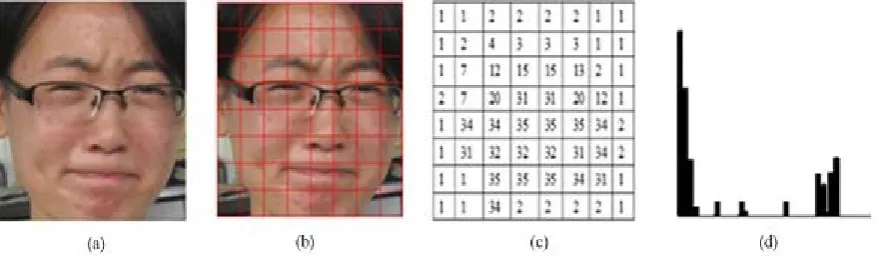
(a) given a image, (b) divide intoN×N blocks, (c) represent each block by a “visual word,” and (d) ignore the ordering of words and represent
the facial image as a histogram over “visual words.”
Figure 2. The processing pipeline of the “bag-of-words” representation ,
x y
dx dy
u u
dt dt
= =
where ( , , )x y t is the image in pixel ( , )x y at time t, where ( , , )
I x y t is the intensity at pixel ( , )x y and time t, u ux, y is the horizontal and vertical velocities in pixel( , )x y .
We can obtain u=( , )u ux y by minimizing the
objective function:
2
2 ( )2
t D
C=
∫
⎡⎣λ ∇u + ∇ ⋅ +I u I ⎤⎦dxdy (2)There are many methods to solve the optical flow equation. We use the Lucas-Kanade algorithm [21] to compute the optical flow velocity.
1
2 2
1
2 2
k k
x x x y y t
k k
x x
x y
k k
y x x y y t
k k
y y
x y
I I u I u I
u u
I I
I I u I u I
u u
I I
λ
λ
+
+
⎡ + + ⎤
⎣ ⎦
= −
+ +
⎡ + + ⎤
⎣ ⎦
= −
+ +
(3)
where k is the number of iterations, initial value of velocity ux uy U
− = −= , , x y
u− u− is the average velocity of the neighborhood of point ( , )x y .
The optical flow vector field u is then split into two scalar fields uxand uy, corresponding to the x and y
components of u . ux and uy are further half-wave
rectified into four none-gative channels ux+, ux-, uy+, uy-, so
that ux ux ux + −
= − and uy uy uy
+ −
= − . These four
nonnegative channels are then blurred with a Gaussian kernel and normalized to obtain the final four channels ubx+, ubx-, uby+, uby-.
Facial pain expression is represented by velocity features that are composed of the channels ubx+, ubx-, uby+,
uby- of all pixels in facial image. Because pain expression
can be regard as facial motion, the velocity features can describe pain effectively, in addition to, the velocity features have been shown to perform reliably with noisy image sequences [22], and have been applied in various tasks, such as action classification, motion synthesis, etc. But the dimension of these velocity features is too high
(4×N×N, where N×N is image size) to be used directly for recognition, so, we convert these velocity features into Visual words using “bag-of- words” [23].
B Visual Words for Characterizing Pain
The “bag-of-words” model was originally proposed for analyzing text documents. At present, it is one of the most popular representation methods for object categorization, where each image is represented as a histogram of the visual words.
In this paper, at first we divide each facial image into blocks whose size is L×L, and then we represent each image block by optical flow vector of all pixels in the block. On this basis, finally we represent pain expression as visual words using the method of BOW (bag-of-words).
We randomly select a subset from all image blocks to construct the codebook. Then, we use k-means clustering algorithms to obtain V clusters and define codewords as the centers of the obtained clusters, namely visual words. In the end, we convert each face image to the “bag-of-words” representation by appearance times of each codeword in the image, which is used to represent the image, namely BOW histogram.
The step for characterizing pain is as follows:
Step 1: Optical flow channels ubx+, ubx-, uby+, uby- are
computed;
Step 2: Each facial image is divide into N×N blocks, which is represented by optical flow vector of all pixels in the block;
Step 3: Vision words are obtained using k-means clustering algorithms;
Step 4: Pain expression is represented by BOW histogram xj:
{
( , ),1 ( , ), , ( , )}
j j M
x = n I w n I w n I w (4) where n I w( , )j is the number of visual word wjincluded
IV PAIN EXPRESSION RECOGNITION BASED ON
BOOSTING
A Boosting Fuzzy Classification Algorithm
Boosting fuzzy classification algorithm is a very fast algorithm and mathematical model based on a fuzzy rule system, which is useful for class prediction [24]. A fuzzy rule system is defined as a beginning by the classical case. In the classical case, a rule is a function formulated which has parameters coupled by logical operators and can yield a logical expression and a corresponding response. If the conditions of the rule are fulfilled, namely the logical expression is true, then the response has to be true. Thus the logical expression can be formulated with simple bivariate logical operators. A fuzzy rule consists of a set of parameters in the form of fuzzy sets, which have membership functions and a response in the form of a fuzzy set. Let us consider a set of training input datum
1
{ , , }n
X = x … x . For a general input vector, the rule is defined as follows:
1 1 2 2
:
j j j N nj j
R if x is A and x is A and and x is A then Y=c
where xi is the i-th attribute of the input vector X, and Y is a classification label, which can be considered as an output variable, cj is classification, and cj∈
{
c1, ,cm}
,1,2, ,
j= N, and j is the fuzzy set of xj, and ( )
j R xj μ is a subordinate function. We assume that the subordinate function is gaussian function as follows:
2 1 exp 2 ij j i i A j i x x μ σ ⎡ ⎛ − ⎞ ⎤ ⎢ ⎥ = − ⎜ ⎟ ⎢ ⎝ ⎠ ⎥
⎣ ⎦ (5)
For any input variable X ={ , , }x1 … xn , the rules of Rj
for excitation degrees is given by
1 1
( ) ({ , , }) min ( )
j j ij
n
R xj R x xn i A xj
μ =μ … = = μ (6)
The category of Rj can be expressed as:
max
/
( ) arg max j( ) j j m
j m R j
R c C
C x c μ x
=
=
∑
(7)A set of fuzzy classification rules, which are from the given training input data, are obtained by parameters of the subordinate function. Previously the fuzzy rules are mainly determined by using the neural network method. The neural network method is usually slow, order dependent and incomprehensible. We use boosting and genetic algorithms, which generate fuzzy classification rules. Assuming a set of training input dates which are independent of each other, we propose a genetic algorithm for boosting fuzzy classification rules determination as follows.
Given a set of training input data 1 2
1 2
{( , ),( , ),x c x c ,( , )}N
N
x c , where cN∈
{
c1, ,cm}
,ωi is the initial weight value calculated by i 1/N
ω = .
Genetic algorithm for boosting fuzzy classification rules is determined as follows:
1,2,
For t= T Do .
We define fitness functions as follows:
| 1 | ( ) k t t k t k k R k c c
k k c c
x
f ω μ
ω
=
=
=
∑
∑
(8)| 2 ( ) ( ) k t t t k k R k c c
k k R k x f x ω μ ω μ ≠ =
∑
∑
(9) where ωk is thek-th weight value of the training sample set. f1,f2 are fitness functions. We calculate:
2 max
2
1 2 max
max
0
*(1 )
f k
f f
f f k
k > ⎧ ⎪ =⎨ − ≤ ⎪ ⎩ (10) max
k is set as 0.5. We use genetic algorithm to obtain a fuzzy rule Rt, which is calculated by the maximum f
value. When the greater f1 is and the smaller f2is, the
greater f is and the smaller classification error rate Et of fuzzy rule Rt.
Under the current sample distribution, we assume that there are classification error rate Etof fuzzy rules Rt and
the corresponding weights αt of the rule Rt . We
calculate: |
( )
( )
( )
t i t t i i R i C Ct i i
R i
x
E R
x
ω μ
ω μ
==
∑
∑
(11))
1 ( ) 1 ln 2 ( t t t E R E R α = ⎛⎜⎜ − ⎞⎟⎟
⎝ ⎠ (12)
Assuming the normalized factor zt, we update sample
weights according to error rate as follows:
( ) ( ) ( ) ( 1) i t rt i t Rt x i i t i x
t i j
e c c
t t
z e c c
α μ α μ ω ω − ⎧ = ⎪ + = ×⎨ ≠
⎪⎩ (13)
For unknown sample
{ , , , }
1 2n
k k k k
x
=
x x
…
x
, thecategory are obtained by the fuzzy classifier as follows:
max
/
( ) arg max t( )
i t k
k k
m t R
t R c C
C x c α μ x
=
=
∑ ∑
(14)(a) no pain,(b) slight pain, (c)moderate pain,(d) severe pain Figure 3. Examples of recognizing pain from facial videos
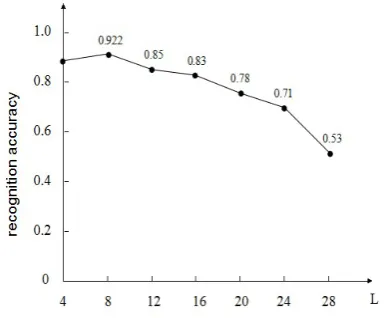
Figure 4. Recognition accuracy curve with different block sizes
fuzzy genetic applications. As boosting method is adopted, every learning fuzzy rules mainly aim at the current rule set which cannot classify correctly the training sample. The new rules have good complementaries and are helpful for classification. Reflecting the different rules in the classification is different, Boosting fuzzy classification method uses the weighted voting classification criterion, and the classification accuracy is higher than the general fuzzy classification (e.g.,(3)).
B Pain Expression Recognition Based on Boosting We use the boosting algorithm to learn and recognize human pain expressions. In human pain expression recognition, it may consist of four pain expressions (e.g. “no pain”, “slight pain”, “moderate pain”, “severe pain”). The sample is represented by the optical flow method to obtain the feature vector and as input of classifier. Assuming the observed data be independent of each other, we use genetic algorithm for boosting fuzzy classification to learn and recognize human pain expressions as follows.
INPUTS:
j
x : feature of pain expression OUTPUTS:
max( )j
C x : the category of pain expression
Step 1: Extract feature of pain expression by motion descriptor based on optical flow and convert facial velocity information to visual words using “bag-of-words” models.
Step 2: Using the method of boosting access to fuzzy classification rule set.
Assuming the training sample sets 1
1
{( , ), s= x c
2
2
( , ), ,( , )}N N
x c x c , cN∈
{
c1, ,cm}
. It consists offeature vector xj of pain expression, which categories of
pain expressions are known in a stabilized video sequence in which the face of a person appears in the center of the field of view.
Give equal initial weights of each sample: i 1/ N
ω = . The training sample set trains for T rounds of training and obtains T fuzzy classification rules.
1,2,
For t= T Do
Find out a fuzzy rule Rt to maximize the fitness f by
using genetic algorithm.
Under the current sample distribution, we calculate the corresponding weights αt of fuzzy rules by the formula
(11).
Update the sample weight by the formula (12). Step 3: pain expression recognition based on boosting. Extract pain expression characteristics of the unknown image and get the feature vector xj.
Calculate each of the excitation of fuzzy rules Rj by
the formula (5).
Determine the category of the pain expression by the formula (13).
V EXPERIMENTAL RESULTS AND ANALYSIS
The effectiveness of the proposed algorithm was verified by using C++ and Matlab hybrid implement-tation on a PC with Pentium 3.2 GHz processor and 4G RAM.
We have built a database of painful and normal face images. In this database, there are four groups of images (“no pain”, “slight pain”, “moderate pain”, “severe pain”), and each group includes 30 males and 30 females. The images were taken under various laboratory controlled lighting conditions. Sample images are shown in Figure 3.
In these experiments, we randomly chose sixty face images per class for training, while the remaining images were used for testing. These images were pre-processed by aligning and scaling them. After being pre-processed, the distances between the eyes were the same for all images and also ensured that the eyes appeared in the same coordinates of the image. We run the system for five times and obtained five different training sample and five different testing sample sets. The recognition rates were found by averaging the recognition rate of each run.
no pain 0.87 0.09 0.03 0.01 slight pain 0.10 0.81 0.08 0.01 moderate pain 0.01 0.08 0.83 0.08 severe pain 0.01 0.01 0.09 0.89
no pain slight
pain moderate pain severe pain Figure 8. Confusion matrix for pain recognition of SLPP+ Figure 5. Relation curve between M and accuracy
no pain 0.93 0.05 0.02 0
slight pain 0.04 0.90 0.06 0 moderate pain 0.01 0.03 0.91 0.05 severe pain 0 0.02 0.06 0.92
no pain slight
pain moderate pain severe pain Figure 9. Confusion matrix for pain recognition of our method
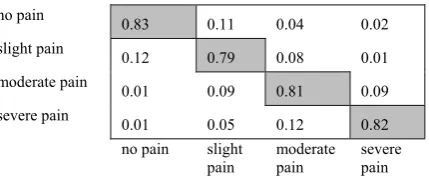
no pain 0.83 0.11 0.04 0.02
slight pain 0.12 0.79 0.08 0.01 moderate pain 0.01 0.09 0.81 0.09 severe pain 0.01 0.05 0.12 0.82
no pain slight
pain moderate pain severe pain Figure 6. Confusion matrix for pain recognition of AAM+ SVM
no pain 0.84 0.12 0.03 0.01 slight pain 0.10 0.80 0.08 0.02 moderate pain 0.02 0.08 0.81 0.09 severe pain 0.01 0.04 0.12 0.83
no pain slight
pain moderate pain severe pain Figure 7. Confusion matrix for pain recognition of “Eigenimage”
the recognition accuracy curve with different block sizes L. We could conclude that the accuracy peaked when the block sizes L was 8. Therefore L was set as 8.
In the experiment, we studied recognition accuracy of four kinds of pain expression from facial videos and the impact of the value of M that is the number of the visual word set, the relation between M and recognition accuracy observed, which was displayed in Figure 5.
Each relation curve between M and accuracy was the average results. Here, blue curve, red curve, green curve and purple curve represented relation curve between M and accuracy of “no pain”, “slight pain”, “moderate pain”, and “severe pain” respectively. They were revealed that with the increasing of M recognition accuracy was rising up at the beginning and when M was larger than or equal to 70, the recognition accuracy was stabled to 0.91. As a result, M was set as 70.
To examine the accuracy of our proposed pain recognition approach, 240 different expression images were used for the experiment. Some images contained the same person but in different mood. We compared our method to three state-of-the-art approaches for pain expression recognition using the same data, which were “AAM+SVM”, “Eigenimage” and “SLPP+ MKSVM”.
The first method was “AAM+SVM”, its recognition results were presented in the confusion matrices as shown in Figure 6.
The method of “AAM+SVM” used Active Appearance Models (AAM) to extract face features and used SVM to classify pain expression. Each cell in the confusion matrix was the average result of every pain expression respectively. The confusion matrix for per-video classification was shown in Figure 6, which built a database of painful and normal face images using 70
codewords. We could see that the algorithm correctly classified most pain expression. Most of the mistakes that the algorithm made were confusions between “slight pain” and “moderate pain”. This was intuitively reasonable since “slight pain” and“moderate pain” were similar
pain expressions.
The second method was “Eigenimage”, its recognition results were presented in the confusion matrices as shown in Figure 7. The method of “Eigenimage” used Eigenface for pain expression recognition.
The third method was “SLPP+ MKSVM”, its recognition results were presented in the confusion matrices as shown in Figure 8. “SLPP+ MKSVM” used SLPP to extract feature of pain expression and multiple kernels support vector machines (MKSVM) for recognizing.
The recognition of our method results were presented in the confusion matrices as shown in Figure 9. Our method used optical flow model and “bag-of-words” model to extract feature of pain expression and used boosting fuzzy classification algorithm for recognizing pain expression. Our method improved the recognition accuracies in all categories.
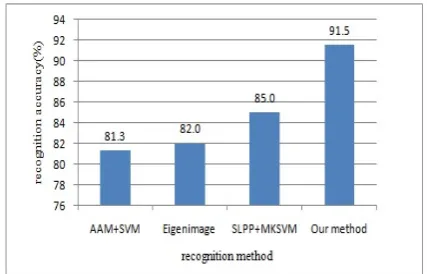
Figure 10. Recognition accuracy comparison of different method
comparison was fair, the results of recognition accuracy comparison were shown in Figure 10 from recognition accuracy comparison of different method.
In Figure 10, we shown that AAM+SVM [6] obtained average recognition accuracy of 81.3%. The average recognition rate of “Eigenimage” [13] was to 82.0%. The average recognition accuracy of SLPP+ KSVM [15] was to 85.0%. Our method was stabled to average recognition accuracy of 91.5% .We could see that our method performed significantly better than the above three state-of-the-art approaches for pain expression recognition. The reason was that we improved the recognition accuracy in the two stages, which extracted pain feature and recognized pain expression. In the stage of pain feature extraction, we used motion features that were reliably with noisy image sequences and bag-of-words framework to describe pain effectively. In the stage of expression recognition, we used genetic algorithm and boosting algorithm to classify expression images. Our method performed the best, its recognition accuracies and speeds were satisfactory.
VI. CONCLUSIONS
In this paper, we presented a novel method to recognize the pain expression and gave the pain level at the same time, we combined “bag-of-words” model with Optical flow model to represent visual words for characterizing pain, and we used boosting algorithm for pain expression categorization. Using a pain expression data set which is built by ourselves, our experiments validated the proposed model in classification performance. Experimental results revealed that our proposed method performed better than previous ones. The main contribution of this paper could be concluded as follows:
First, we introduced a novel BOW (bag-of-words) representation for video sequences. At first, visual words were used for pain expression. Optical flow model was used for extracting facial velocity features, then we converted facial velocity features into visual words using “bag-of-words” models.
Second, we proposed the algorithm for boosting fuzzy classification to learn and recognize human pain expressions. We improved boosting fuzzy classification
algorithm with genetic algorithm and used the weighted voting classification criterion, and the classification accuracy was higher than the general classification.
Third, we used the challaging data set to validate the proposed model in classification performance, where experiments were performed on a pain expression data set built by ourselves. We presented extensive experimental results to show that the proposed method performed better than previous ones and achieved state-of-the-art recognition accuracies.
ACKNOWLEDGMENT
This work was supported by Research Foundation for Science & Technology Office of Hunan Province under Grant (NO.2012FJ3021), by the Teaching Reform Foundation of Hunan Province Ordinary College under Grant (NO. 2012401544) and by the Foundation for Key Constructive Discipline of Hunan Province.
REFERENCES
[1] D. L. Wong, C. M. Baker, “Pain in children: comparison of assessment scales,” Pediatric Nursing, vol. 1, issue 14, pp.9-17, 1988.
[2] K. D. Craig, K. M. Prkachin, R. V. E. Grunau, “The facial expression of pain, in Handbook of pain assessment, D. C. Turk, R. Melzack,2nd Eds. New York: Guilford, 2001, pp.
153-169.
[3] D. Turk, R. Melzack, “The measurement of pain and the assessment of people experiencing pain,” in Handbook of pain assessment, D. C. Turk, R. Melzack, 2nd Eds. New York: Guilford, 2001, pp. 1-11.
[4] K. M. Prkachin, S. R. Mercer, “Pain expression in patients with shoulder pathology: validity, properties and relationship to sickness impact,” Pain, vol. 3, issue 39, pp. 257-265, 1989.
[5] T. Li, T. Mei, I. S. Kweon, X. S Hua,“ Contextual bag-of-words for visual categorization,” IEEE Transactions on Circuits and Systems for Video Technology, vol. 4, issue 21, pp. 381-392, 2011.
[6] A. B. Ashraf, S. Lucey, T. Chen, “The Painful Face: pain expression recognition using active appearance models,” Proceedings of the 9th ACM International Conference on Multimodal Interfaces, Nagoya, Aichi, Japan: ACM, 2007, pp. 9-14.
[7] A. B. Ashraf, S. Lucey, J. Cohn, K. M. Prkachin, P. Solomon, “The painful face II-pain expression recognition using active appearance models,” in Image Vision Computing, vol. 12, issue 27, pp. 1788-1796,2009.
[8] P. Lucey, J. Cohn, S. Lucey, I. Matthews, S. Sridharan, K. Prkachin, “Painful monitoring: automatic pain monitoring using the UNBC- McMaster shoulder pain expression archive database,” in Image and Vision Computing, vol. 3, issue 30, pp. 197-205, 2012.
[9] P. Lucey, J. Cohn, S. Lucey, I. Matthews, S. Sridharan, K. Prkachin, “Automatically detecting pain using facial actions,” 3rd International Conference on Affective Computing and Intelligent Interaction and Workshops, ACII, pp. 1-8, September 2009.
[11] Shaowei Wang, Hongyu Yang, and Haiyun Li, “Facial expression recognition based on incremental isomap with expression weighted distance”, in Journal of Computers, vol. 8, issue 8, pp. 2051-2058, 2013.
[12] K. M. Prkachin, P. E. Solomon, “The structure, reliability and validity of pain expression: Evidence from patients with shoulder pain,” in Pain, vol. 2, issue 139, pp. 267-274, 2008.
[13] M. Monwar, S. Rezaei, K. Prkachin, “Eigenimage based pain expression recognition,” in IAENG International Journal of Applied Mathematics, vol. 2, issue 36, pp. 1-6, 2007.
[14] K. M. Prkachin, “The consistency of facial expressions of pain: a comparison across modalities,” in Pain, vol. 3, issue 51, pp. 297-306, 1992.
[15] W. Zhang, L .M. Xia, “Pain expression recognition based on SLPP and MKSVM,” in International Journal of Engineering and Manufacturing,issue 3, pp. 69-74, 2011. [16] Y. Zhang, R. Jin, Z. H. Zhou, “Understanding
bag-of-words model: a statistical framework,” in International Journal of Machine Learning and Cybernetics, vol. 1-4, issue 1, pp. 43-52, 2010.
[17] J. F. Cohn, Z. Ambadar, P. Ekman, “Observer-based measurement of facial expression with the facial action coding system,” in The Handbook of Emotion Elicitation and Assessment, New York, NY: Oxford University Press, 2007, pp. 203-221.
[18] P. Ekman, W. V. Friesen, J. C. Hager, Facial Action Coding System: Research Nexus, Salt Lake City, UT: Network Research Information, 2002.
[19] J. Sivic, B. C. Russell, A. A. Efros, A. Zisserman, and W. T. Freeman, “Discovering objects and their location in images,” in Tenth IEEE International Conference on Computer Vision (ICCV),ICCV 2005,vol. 1, pp. 370-377, October 2005.
[20] L. Fei-Fei and P. Perona, “A bayesian hierarchical model for learning natural scene categories,” In IEEE Computer
Society Conference on Computer Vision and Pattern Recognition, CVPR 2005,vol. 2, pp. 524–531, 2005. [21] B. D. Lucas, T. Kanade, “An iterative image registration
technique with an application to stereo vision,” in IJCAI, vol. 81, pp. 674-679, 1981.
[22] A. A. Efros, A. C. Berg, G. Mori, J. Malik, “Recognizing action at a distance,” in 9th IEEE International Conference on Computer Vision, Nice, France, pp.726-733, October 2003.
[23] A. Bosch, X. Munoz, R. Marti, “Which is the best way to organize/ classify images by content,” in Image and Vision Computing,vol. 6,issue 25, pp. 778-791, 2007.
[24] Lihua Fu, Hongwei Li, Meng Zhang, “Tree based orthogonal least squares regression with repeated weighted boosting search,” in Journal of Computers, Vol 7, issue 1, pp. 187-195, Jan 2012
[25]Xue, Chaogai, Lili Dong, and Guohua Li, "An improved immune genetic algorithm for the optimization of enterprise information system based on time property," in Journal of Software (1796217X), Vol 3, issue 6, 2011.
Shaoping Zhu was born in Hunan