ISSN(Online): 2319-8753 ISSN (Print): 2347-6710
I
nternational
J
ournal of
I
nnovative
R
esearch in
S
cience,
E
ngineering and
T
echnology
(An ISO 3297: 2007 Certified Organization)
Website: www.ijirset.com
Vol. 6, Issue 8, August 2017
Effectiveness of Technology in Learning
Process of Visually Impaired Students
Bablu Samanta
Guest Lecturer, Muralidhar Girls’ College, Kolkata, West Bengal, India.
ABSTRACT: A visual impairment is an undesirable any visual condition having impact on an individual’s ability to successfully complete the activities of everyday life. Students with visual impairments are infants, toddlers, children and youths who usually experience impairments in the visual system that affect their ability to learn. To implement appropriate classroom accommodations for students with visual impairment, teachers do use different types of aids and technology. They can develop learning ability through using aids and assistive technology. This study focuses on use of aids and technological materials which help to learning process of visually impaired students and effect on building their learning ability. The study seeks to explore the effectiveness of level of technology in learning of visually impaired students. It shows the comparison between upper primary and higher secondary level students on effectiveness of technology. The study comprises of 40 samples which are collected from both upper primary level and higher secondary level students. Data tools included general information and opinionnaire. Descriptive method and statistical techniques are used for this study. The study shows that the most used technical aids are audio recorder and computer and other special aids and the most important reading aid is brail. The study also shows that the most effective technical aids are recorder and chart and model. It is derived that the level of effectiveness is medium.
KEYWORDS:Visually impairment, Technical aid, Learning ability, Opinionnaire, Reading aid. I. INTRODUCTION
Visual impairment is a learning disability of the students. The experts of the education usually classify the visually impaired as follows - legally blind, an individual must have visual acuity of 20/200 or less, or have a field of vision restricted to 20 degrees or less at the widest point. To implement appropriate classroom accommodations for students with visual impairment, these students are also classified according to their level of functional vision such as low vision, totally blind etc. Classroom accommodations would be varied and should be individualized according to the specific needs of the student. However, there are some basic best practices that can guide the development of the most effective adaptations.
A technical aid is a tool used by teachers to help learners to improve the language skills, illustrate or reinforce a skill, fact, idea, relative anxiety, fear or boredom. A teacher can make the experience of learning interesting and memorable for learners by using teaching aids. There are so many types of learning aids such as Braille, Large Print, Magnifying devices, Charts and Models.
The use of computers is particularly important to students with visual impairments, as their ability to use written communication may be enhanced and access to information may be improved. A computer system for a student with blindness will include a computer or laptop with the following components. Screen Reader/Speech Synthesizer (JAWS, Screen Reader/DOS), Voice Access).
Tactile Strategies:
It is a specific strategy to support instruction of students who have severe and multiple visual disabilities and who do not learn visually. When students with severe disabilities are unable to use their vision effectively for obtaining information, they require tactile information that is accessible to their hands or other parts of their body.
Assistive Technology:
ISSN(Online): 2319-8753 ISSN (Print): 2347-6710
I
nternational
J
ournal of
I
nnovative
R
esearch in
S
cience,
E
ngineering and
T
echnology
(An ISO 3297: 2007 Certified Organization)
Website: www.ijirset.com
Vol. 6, Issue 8, August 2017
Computer hardware and software are continuously advancing, allowing for more access to information than ever before.
Objectives of the study: The study aims
To identify teaching learning materials which are useful for learning of visually impaired students.
To specify the aids both conventional and modern.
To judge the effectiveness level of students.
To find out the differences in effectiveness between upper primary level and higher secondary students. II. RELATEDWORK
Muttayya and Puttaraj, 2009 have tried to explore the views and concerns about to achieve the goals of inclusive education in the Indian higher education system. It may be achieved through the computer and assistive technologies of a ‘Learning Resource Centre for the Visually Impaired Students. It also enumerated the salient features, special services, special resources, assistive/adaptive technologies and futuristic plans of a state-of-the-art ‘Learning Resource Centre for the Visually Impaired Students’ to foster inclusive education.
Adetoro, 2010 studied that information materials can only become usable to persons with visual impairment when they are transcribed into alternative formats. As per Adetoro, secondary school respondents had high reading interest in art subjects, reference materials, manuals and animal story materials. The secondary school respondents preferred talking books/audio recordings (55%). Transcription and provision of information materials for the visually impaired through libraries should be based on knowledge of their reading interest and information needs.
Ojha, 2014 studied that education for the visually impaired is made available through the medium of touch and sound. The intention was to make the textbooks accessible to these students and by converting the printed textbooks into audio books. An effort was made in this to investigate the perception of visually impaired students of these audio books. The work was focused on upper primary to higher secondary level students.
Mohamed and Syamili, 2014 studied the use of Information and communication technology (ICT) by the visually impaired students in Calicut University, Kerala. The study found that a large majority of the students are computer literates and use mobile phones frequently. A good number of them use screen readers in their mobile phones. However, the foreign accent of screen reading programs is a challenge for the students. The support of friends and family members is very helpful for the students to acquire the skills of ICT. Microsoft Office and Jaws screen reader supported by Windows operating system are the most popular software among the students. Use of internet by the students is very less and most widely used internet service is www followed by e-mail. It is found that a majority of the students need training in word processing and Internet. This study provides useful information about the use of ICT by visually impaired students in India.
III. RESEARCHMETHODOLOGY Research design:
The descriptive survey research design was used in thestudy. As indicated by Cohen, Manion and Morrison (2007), the descriptive design identifies the opinions ofvisually impaired students about effectiveness of teaching aids. In this study, theuse ofteaching aids was identified and this study revealed the level of effectiveness of teaching aids.
Research Instrument:
ISSN(Online): 2319-8753 ISSN (Print): 2347-6710
I
nternational
J
ournal of
I
nnovative
R
esearch in
S
cience,
E
ngineering and
T
echnology
(An ISO 3297: 2007 Certified Organization)
Website: www.ijirset.com
Vol. 6, Issue 8, August 2017
Sampling:
The Authors used purposive and stratified sampling and samples are collected from the Upper primary level and Higher secondary level students in Narendrapur Blind Boys Academy, located in Narendrapur Ramakrishna Mission, district South 24 Parganas, West Bengal state, India.
Data Collection:
The Trainee visited the institution on 3rd December, 2014 and 16th March, 2015. The total respondent of the institution is 43. Out of 40 the Trainee selected only samples from the respondent. Out of 40 respondents 18 samples are drawn from Higher secondary level students and 22 samples are drawn from Upper primary level students.
Hypothesis:
H0 - 1: There is no effectiveness of teaching aids among the visually impaired children.
H0 - 2: There is no significant difference between effectiveness of teaching aids on learning of Upper primary and
higher secondary visually impaired students.
Data Analysis Techniques:
In this study two types of data analysis techniques have been used. These are Item analysis and Hypothetical test. For item analysis Microsoft Excel software was used. For hypothetical test Univariate chi-square test and Independent t test were used. Misrosoft Excel and Grafic Pad online statistic software were used for these two tests.
Determination range of level:
The items were weighted 1-3 in which case 1 = ‘No’ for negative, 2 = ‘Sometimes’ and 3 = ‘Yes’ for the positive statements. A summative approach was used in which case a respondent who scored 3 in all the 6 items would have a total score of 18 while one who scored 1 in all the 6 items would have a total score of 6. The final highest score for every respondent was resulting into an interval awareness scale ranging from 6 to 18 as described as low (6-10), medium (10.1-14.1) and high (14.2-18).
IV.RESULTANDDISCUSSION
The data collected were analysed and the summaries of the analyses were presented in tables and figures to highlight the findings. Statistical procedures are applied. These were presented in tables to highlight the findings. Some data were presented with figure. Total 40 respondents were interviewed face to face in the survey. Among them 22 respondents were Upper primary students and 18 were Higher Secondary students. Results and findings are as follows.
Demographic Information:
The survey was done on two categories of students, such as upper primary students and higher secondary students. Average age of upper primary students is 14 and average age of H.S students is 18. All of the students are residential. There are two types of visual impairment identified, such as congenital and adventitious. The first one is at birth and second is after birth.
Use of Teaching Learning Material:
ISSN(Online): 2319-8753 ISSN (Print): 2347-6710
I
nternational
J
ournal of
I
nnovative
R
esearch in
S
cience,
E
ngineering and
T
echnology
(An ISO 3297: 2007 Certified Organization)
Website: www.ijirset.com
Vol. 6, Issue 8, August 2017
Table 1: Subject wise Teaching Learning Materials and technology for visual impaired students
Subject Teaching Learning Material
Language Flash card, Braille, Screen Reader, JAWS software etc. Science 3D Models, Human body model, Skeleton model, CCTV,
Lance, Type Board etc. Social Science Map, Chart, Models etc.
Use of technology and learning aids:
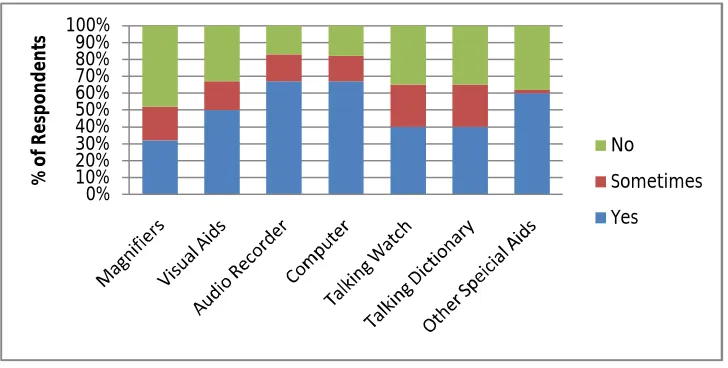
When teachers and students were asked about the of their visual aids, 32 % students responded ‘yes’ and 20% ‘sometimes’ used and 48% students responded ‘no’ option. So, it can be considered that there almost 50% students are blind and 50% students are low vision category.
The visual aids are sufficiently available in the institution said by both teacher and students. Fifty percent of respondent students are opted ‘yes’ and 70 percent student answered ‘sometimes’ and rest of the students are disagreed with the availability. So, in reference to these responses it can be considered that visual aids are available in the institution. It has been found through the conversation with visually impaired students that the most used aids are audio recorder, computer and other special aids (eg. Tactile Model), because 67%, 67% and 60% students have agreed respectively.
Figure 1: Use of Teaching Aids on learning of visually impaired students
In this study two types of student usually read by different aids. The result shows Braille is the most important teaching aids. Maximum students in both Upper primary and Higher Secondary level are agreed with Braille. Next important aids are Regular Print and then large print and Cassette Tape respectively.
0% 10% 20% 30% 40% 50% 60% 70% 80% 90% 100%
%
o
f
R
e
sp
o
n
d
e
n
ts
No
Sometimes
ISSN(Online): 2319-8753 ISSN (Print): 2347-6710
I
nternational
J
ournal of
I
nnovative
R
esearch in
S
cience,
E
ngineering and
T
echnology
(An ISO 3297: 2007 Certified Organization)
Website: www.ijirset.com
Vol. 6, Issue 8, August 2017
0 2 4 6 8 10 12 14 16 18
Regular Print
Braille Large Print Cassette Tape
N
o
o
f
re
sp
o
n
d
en
ts
Reading Materials
Higher Secondary
Upper Primary Student
0 10 20 30 40 50 60 70 80 90 100
%
o
f
R
e
sp
o
n
d
e
n
ts
Poorly Effective
Moderately Effective
Highly Effective
Effectiveness of aids and technology:
The study revealed that the most effective aids and technology are Braille, Record player and Model and Charts. Moderately effective teaching aids are large print and computer. More than 80 % of students have agreed with Record player and Braille about effectiveness. So Braille and Record Player are most effective on learning process of visually impaired students.
Hypothesis 1:
The level of effectiveness was assessed based on responses to Likert Scale statements. The items were weighted 1-3 in which case 1 = Strongly Disagree and 3 = Strongly Agree for the positive statements. A summative approach was used in which case a respondent who scored 3 in all the 6 items would have a total score of 18 while one who scored 1 in all the 6 items would have a total score of 6. The final highest score for every respondent was resulting into an interval
Figure 2: Use of reading aids
ISSN(Online): 2319-8753 ISSN (Print): 2347-6710
I
nternational
J
ournal of
I
nnovative
R
esearch in
S
cience,
E
ngineering and
T
echnology
(An ISO 3297: 2007 Certified Organization)
Website: www.ijirset.com
Vol. 6, Issue 8, August 2017
Table 2: Effectiveness of aids and technology on learning process
Variables n % df χ2 p
Low 2 5
2 10.56* 0.00 Medium 23 57.5
High 15 37.5
*Significant at 0.05 level. df = 2, critical χ2 value = 5.991
Using level of effectiveness as the only variable, a univariate chi-square test was used to test the hypothesis that the level of effectiveness of aids and technology among visually impaired students is not significantly low. The above results of the study show that null hypothesis is rejected. The respondents recorded a medium level of effectiveness of aids and technology.
Hypothesis 2:
There is no significant difference between effectiveness of aids and technology on learning of Upper Primary and Higher secondary visually impaired students. The independent variable is student’s class type. Independent t-test statistical analysis is used to compare the mean scores of effectiveness of teaching aids on different level students. A summary of the result is presented in Table 3.
Table 3: Independent t-test analysis
Variables N SD SEM t-value Upper Primary 22 13.630 1.989 0.424
0.1106* Higher Secondary 18 13.705 2.300 0.542
*Not significant at 0.05level. df = 38, critical t-value = 2.0244
The above result shows null hypothesis is accepted. So there is no significant difference between effectiveness of aids and technology on learning of visually impaired students.
Discussion:
Effectiveness of aids and technology is a conception, perception dependence of students. The study revealed the effectiveness of aids and technology on visually impaired students. It is identified by student’s responses. How much they able to use the aids? How much it affects on their learning? These questions are creating to find out the effectiveness of aids and technology. The effectiveness of technology varies from class to class, student to student. It also depends on level of blindness. In this study the result shows the effectiveness of aids and technology is medium level. The result shows 5% students belong to low effectiveness, while 57.5 % students belong to medium level and 37.5% students belong to high level.
Table 4: Level of effectiveness of teaching aids
Level Range of frequency Frequency %
High 6-10 2 5
Medium 10.1-14.1 23 57.5
Low 14.2-18 15 37.5
In spite of this medium level of effectiveness some gaps have been found. If we go through the result, it has been observed that there is lack of effect of Computer Talking watch, Talking Dictionary, Large Print, Regular Print. According to result it is found that maximum students used computer for their study purpose, but it is not effective in their learning. It may be point out that they can’t able to use computer in particular and exact purpose. Probably it may cause to medium level of effectiveness. If it would be fulfilling the effectiveness of aids and technology would be high level.
ISSN(Online): 2319-8753 ISSN (Print): 2347-6710
I
nternational
J
ournal of
I
nnovative
R
esearch in
S
cience,
E
ngineering and
T
echnology
(An ISO 3297: 2007 Certified Organization)
Website: www.ijirset.com
Vol. 6, Issue 8, August 2017
There are important findings that there is no difference of effectiveness of aids and technology among upper primary student and higher secondary students, because there are no differences in use of aids.
V. CONCLUSION
The findings show that the effectiveness of teaching aids is not significantly low. There is there is medium level of effectiveness of teaching aids on learning of visually impaired children. For this result item analysis, chi-square test has been used. To compare the effectiveness of teaching aids between two different levels of student’s independent t-test is used. And the result shows that there is no difference.
Based on the result the conclusion is that there is medium level of effectiveness of teaching aids. But there are some gaps. To improve this type of effectiveness to more high modern technologies are required.
REFERENCES
[1] Adetoro, N. (2010). Reading Interest And Information Needs of Persons With Visual Impairment In Nigeria. SA Jnl Libs & Info Sci , 49-56.
[2] Chester, M. D. (2012). Guidelines: For The Specialized Assessment of Students With Visual Impairments. Malden: Massachusetts Department of Elementary And Secondary Education.
[3] Dash, N. (2003). Integrated Education For Children With Special Needs. New Delhi: Dominant Publishers And Distributors. [4] Debnath, D. D., & Debnath, P. A. (2011). Byaticromi Shishu O Tar Shiksha (Bengali). Kolkata: Rita Book Agency.
[5] Dixit, D. (2013, November 1). Effective Teaching Learning Material (TLM). Retrieved 3 7, 2015, From Teachers of India Website: Http://Www.Teachersofindia.Org/En/Article/Effective-Teaching-Learning-Material-Tlm
[6] Downing, J. E., & Chen, D. (2003). Using Tactile Strategies With Students Who Are Blind And Have Severe Disabilities. Teaching Exceptional Children, 36 (2), 56-60.
[7] Ee, W. M., & Cohen, L. (N.D.). Assistive Technology Use Amongst Students With Visual Impairments And Their Teachers: Barriers And Challenges In Special Education. Retrieved February 2, 2015, From Research Brief.
[8] Gangopadhayay, A. (2013). Teaching Of English. Kolkata: Rita Book Agency.
[9] K, M. H., & C, S. (2014). Use Of Information And Communication Technology By Visually-Impaired Students: A Study In University Of Calicut, Kerala. DESIDOC Journal of Library & Information Technology, 34 (4), 342-348.
[10] Mangal, S. (2010). Educating Exceptional Chikdren: An Introduction To Special Education. New Delhi: Prentice-Hall Of India Pvt Ltd. [11] Muttayya, M. K., & Choukimath, P. .. (N.D.). Learning Resource Centre For The Visually Impaired Students In The Universities To
Foster Inclusive Education. Retrieved January 11, 2015, From ICAL 2009 – Library Services.
[12] Ojha, S. S. (2015). Creating An Effective Learning Environment For Visually Impaired Students: Assessing Their Perception Of Audio Books. Research Journal Of Educational Sciences, 3 (1).
[13] Teaching Students With Visual Impairments. (N.D.). Retrieved February 23, 2015, From Http://Www.Sasked.Gov.Sk.Ca/K/Pecs/Se/Publications.Html