from ISC’02 (LNCS 2433)
Fangguo Zhang1 Shengli Liu2 and Kwangjo Kim1 1 International Research center for Information Security (IRIS)
Information and Communications University(ICU), 58-4 Hwaam-dong Yusong-ku, Taejon, 305-732 KOREA
{zhfg, kkj}@icu.ac.kr
2 Dept. of Computer Science and Engineering, Shanghai Jiao Tong University,
Shanghai 200030, P.R.China
Abstract. In ISC 2002, J. Zheng [8] proposed a new public key
cryp-tosystem whose security is based upon the algebraic problem of reducing a high degree matrix to its canonical form by similarity transformations. In this paper, we show that factoring a polynomial over a finite field can be used to break down Zheng’s public key cryptosystem. The complexity of our attack is polynomial time. In other word, the underlying problem of Zheng’s public key cryptosystem is not a “hard” problem.
Key words: Public key cryptography, Attack, Polynomial, Matrix, Finite field.
1
Introduction
Since the public key cryptography had been introduced by Diffie and Hellman in 1976 [3], many cryptosystems have been put forth but only few of them have survived. In such a public-key system it must be computationally infeasible to deduce the decryption key from the public key, even when general information about the system and how it operates is known. Finding a new cryptosystem that overcomes deficiencies of existing ones is a challenging task of paramount importance.
2
Zheng’s Public Key Cryptosystem
First of all, we briefly describe Zheng’s public key cryptosystem.x∈RX denotes the elementxis randomly chosen fromX.
System parameter:p, r,andb2 are system parameters, wherepis a prime number,ris an integer chosen to ber >4,andb2 ar-dimension vector defined overGF(p).
Secret key: Randomly choseλ1, λ2, . . . , λr,fromGF(p),and chose a invert-ible matrixH = (h1, h2, . . . , hr), where hi,1 ≤i ≤ris randomly chosen from GF(p).
Public key: The public key are A, a r×r matrix, and b1, a r-dimension vector, all defined onGF(p),where
A=H
λ1 λ2
. .. λr
H−1( modp).
That means that λ1, λ2, . . . , λr be distinct eigenvalues of A, and h1, h2, . . . , hr be the corresponding eigenvectors.b1 is located in a subspaces spanned by some eigenvectors of A, it can be determined by
b1= (α1h1+α1h1+· · ·+αmhm)( modp), 1< m < r.
Encryption: Let (z1, z2, . . . , zr) ∈ GF(p) r
be the plaintext, here zi is a r-dimension vector. Choose ki∈RGF(p),and
Y = (k1A r−1+
k2A
r−2+· · ·+
krI)( modp).
Letd=Y2b1+Y b2(hereb2is selected as a system parameter), and the ciphertext is given by (C, d),where
C=Y(z1, z2, . . . , zr).
Decryption: Let
(δ1, δ2, . . . , δr) =H−1d( modp), (α1, α2, . . . , αr) =H−1b1( modp),
(β1, β2, . . . , βr) =H−1b2( modp).
Note thatY has the same eigenvector set asA, so we can suppose that
Y =H
µ1 µ2
. .. µr
Thenµi, i= 1,2, . . . , r,can be solved from the following equations,
δi= (αiµ2i +βiµi)( modp), i= 1,2, . . . , m, δi= (βiµi)( modp), i=m+ 1, m+ 2, . . . , r.
When the eigenvalues of Y is determined, the plaintext (z1, z2, . . . , zr) can be recovered by
zi=Y−1ci=H
µ−1
1 µ−1
2 . ..
µ−1
r
H−1ci,
i= 1,2, . . . , r,andci is theith column ofC.
3
Attack and Analysis
As for a public key cryptosystem, it is very important that private key cannot be easily derived from public key. Here “easily” means no polynomitime al-gorithm exists for this problem. However, in this section, we will show that the private keys (λ1, λ2, . . . , λr) and H can be easily obtained from the public key A.
Given ar×r matrixA, to find its reigenvalues is equivalent to find ther solutions of the following equation
f(λ) =det(λI−A)( modp) = 0, (2)
wheredet(·) means the determinant of a matrix.
The left side of Equation (2) is a univariate polynomial of degreer defined over GF(p). It is the characteristic polynomial of matrixA. So it is split com-pletely over GF(p). This means finding the solutions of f(λ) = det(λI −A)( modp) = 0 is equivalent to factor the univariate polynomial of degree r over GF(p).
In fact, the problem of factoring a polynomial of degreerover a finite field GF(p) can be solved withO(r1.815
logp) arithmetic operations inGF(p) accord-ing to [6]. As early as 1970, Berlecamp already proposed a random polynomial-time algorithm for such a problem. If multiplying twor×rmatrices needsO(rw
) arithmetic operations, then Berlecamp’s algorithm needs O(rw
+r1+o(a)logp) arithmetic operations [1]. It should be noted that the result of Coppersmith and Winograd’s paper [2] in 1990 shows that 2< w≤3.
Let f(x) ∈ GF(p)[x] has degree r. Factoring f(x) goes with three steps according to [6]:
Step 1:Square-free factorization The input is a polynomialf(x)∈GF(p)[x]. The output isf1(x), f2(x), . . . , fn(x) such thatf(x) =f1(x)·f2(x)2. . . fn(x)
Step 2: Distinct-degree factorization The input is f(x) ∈ GF(p)[x]of de-greer. The output isf[1], f[2], . . . , f[n]∈GF(q)[x], wheref[d],1≤d≤n,is the product of the monic irreducible factors off(x) of degreed.
Step 3: Equal-degree factorization The input is a polynomialf(x)∈GF(q)[x] of degreerand an integerdsuch thatf(x) is the product of distinct monic irreducible polynomials, each of degreed.The output is the set of irreducible factors off(x).
Step 1 usesO(r1+o(1)+rlogp) (with Yun’s algorithm, see [7]), Step 2 uses O(r1.844logp)(see [6]), and Step 3 usesO(r1.688+r1+o(1)logp) operations over GF(p)(see [5]).
As for the case of solving Equation (2), we know thatAhasrdistinct eigen-values. Therefore, the polynomialf(λ) of degreerdetermined by det(λI−A)( modp) = 0 hasrdistinct solutions overGF(p).In other words, f(x) is already a completely split and square-free polynomial over GF(p). Consequently, here we only need to solve the equal-degree factorization problem. In [5], von zur Ga-then and Shoup have given an algorithm to solve this problem with complexity ofO(r1.688+r1+o(1)logp).
Above factoring algorithm is probabilistic polynomial time. Thanks to [4], for a completely split and square-free polynomial over GF(p), under the extended Riemann hypothesis (ERH), it can be factored deterministically in polynomial time.
4
Implementation of Attack
With the analysis in the previous section, we attack Zheng’s public key cryp-tosystem as follows:
S1 Input ar×r matrixAand prime numbersp. S2 Computef(λ) =det(λI−A)( modp). S3 Factoringf(λ) overGF(p).
S4 Get (λ1, λ2, . . . , λr).
S5 Solve (h1, h2, . . . , hr) from (λiI−A)hi= 0. S7 Output H= (h1, h2, . . . , hr) and (λ1, λ2, . . . , λr).
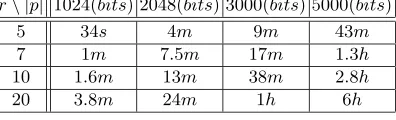
We implemented this attack with Maple 7 on PIII 650 MHz, and illustrate the average time of breaking down the cryptosystem in Table 1.
r\ |p| 1024(bits) 2048(bits) 3000(bits) 5000(bits)
5 34s 4m 9m 43m
7 1m 7.5m 17m 1.3h 10 1.6m 13m 38m 2.8h 20 3.8m 24m 1h 6h
5
Conclusion
In this letter, we break down a new public key cryptosystem proposed recently in [8] with the known method of factoring polynomial over a FieldGF(p). With our attack the private key (λ1, λ2, . . . , λr) can be derived from public keyAwith polynomial time.
References
1. E.R. Berlecamp, Factoring polynomials over large finite fields, Proc. 22nd IEEE Symp. Foundations Comp. Sci., pp. 713-735, 1970.
2. D. Coppersmith and S. Winograd, Matrix multiplication via arithmetic progres-sions, J. Symbolic Comput. Vol.9, no.3, pp. 251–280, 1990.
3. W. Diffie and M.Hellman,New Directions in Cryptography, IEEE Transactions on Information Theory, IT-22(6), pp.644-654, 1976.
4. S. Gao,On the deterministic complexity of polynomial factoring, J. Symbolic Com-putation 31 (2001), pp.19-36.
5. J. von zur Gathen and V. Shoup,Computing Frobenius maps and factoring poly-nomials, Comput. Complexity, Vol.2, pp. 187-224, 1992.
6. E. Kaltofen and V. Shoup,Subquadratic-Time Factoring of Polynomials over Finite Fields, Proceeding 27th Annual ACM Symp. Theory of Computing, ACM Press, pp. 298–406, 1995.
7. D.E. Knuth,The art of computer programming, vol. 2, Seminumerical algorithms, Ed. 2, Addison Wesley, Reading, MA, 1981.