Introduction to
M
ultivariate
Q
uadratic
Public Key Systems and their Applications
Christopher Wolf
´
Ecole Normale Sup´
erieure, D´
epartement d’Informatique
45 rue d’Ulm, F-75230 Paris Cedex 05, France
[email protected]
or
[email protected]
March 22, 2006
Abstract
In this article, we investigate the class of multivariate quadratic (MQ) public key systems. These systems are becoming a serious alternative to RSA or ECC based systems. In particular, we outline the four basic trapdoors Matsumoto-Imai Scheme A (MIA), Hidden Field Equations (HFE), Unbalanced Oil and Vinegar (UOV), and Stepwise Triangular System (STS), give some typical choices of parameters and discuss the advantages and disadvantages of these kinds of schemes. After this concise overview, we determine specific application domains in whichMQ-schemes have advantages over RSA or ECC. We concentrate on product activation keys, electronic stamps and fast one-way functions.
Keywords: Multivariate Quadratic Equations, Public Key Schemes, Applications
1
Introduction
Public key cryptography is used in e-commerce systems for authentication (electronic signatures) and secure communication (encryption). The security of using current public key cryptography centres on the difficulty of solving certain classes of problems. The RSA scheme relies on the difficulty of factoring large integers, while the difficulty of solving discrete logarithms provide the basis for ElGamal and Elliptic Curves [MvOV96]. Given that the security of these public key schemes relies on such a small number of problems that are
currentlyconsidered hard, research on new schemes that are based on other classes of problems is worthwhile.
Such work provides greater diversity and hence forces cryptanalysts to expend additional effort concentrating on completely new types of problems. In addition, important results on the potential weaknesses of existing public key schemes are emerging as techniques for factorisation and solving discrete logarithm continually improve. Polynomial time quantum algorithms [Sho97] can be used to solve both problems and hence, the existence of quantum computers in the range of 1000 bits would be a real-world threat to systems based on factoring or the discrete log problem. This points to the importance of research into new algorithms for asymmetric encryption. We want to stress at this point that there are not many results known about the vulnerability of cryptographic hard problems against quantum algorithm. We are only aware of [Sho97] at this point. Hence, more research effort in this direction seems to be imperative if we assume the existence of quantum computers within the next decades.
In addition, we want to point out that different types of schemes have different kinds of properties: with schemes based on ECC, rather short signatures in the range of 320 bits (cf [MvOV96]) are possible, in comparison to 1024–4096 for RSA. On the other hand, the patents on RSA have expired, while there are still patents guarding the use of ECC (cf [MvOV96]). Hence, applications which require a patent-free algorithm are likely to prefer RSA while the requirement for short signatures would lead to the use of ECC. There are other properties of schemes such as verification time, signature creation time, public and private key size. All of them play an important role when choosing a specific algorithm for a particular application domain. Hence, having secure schemes based on different problems, increases the variety of algorithms and hence gives the users of cryptographic primitives more choice. In turn, this increases the chance to have the “right fit” for a particular problem and reduces the necessity to make compromises — either in terms of speed, memory, or security.
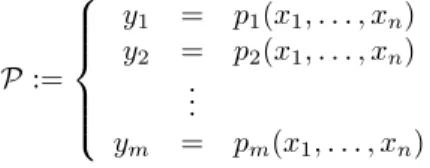
One proposal for secure public key schemes is based on the problem of solving Multivariate Quadratic equations (MQ-problem) over finite fields. In the last two decades, several such public key schemes have been proposed,e.g., [MI88, Pat96b, KPG99]. All of them use the fact that theMQ-problem is difficult, namely N P-complete (cf [GJ79, p. 251] and [PG97, App.] for a detailed proof)). Here, we mean withMQ-problem finding a solution x∈Ffor a given system of quadratic polynomials (cf Fig. 1) and a given vector y∈Fm.
We will introduce theMQ-problem more formally in Sect. 2.1. In this context, we want to stress that linear
P := y1 = p1(x1, . . . , xn) y2 = p2(x1, . . . , xn) .. . ym = pm(x1, . . . , xn),
Fig. 1: Example of anMQ-problem withnvariables andmequations
or affine polynomial equations can be solved in polynomial time, e.g., using Gaussian elimination. The knapsack cryptosystem is also based on anN P-complete problem (cf [MvOV96]). Due to special properties of these kinds of schemes, it was possible to break most of the proposals in this area. Therefore, basing a scheme on anN P-complete problem does not guarantee its security. But in the case ofMQ-schemes, much research has been done on the average complexity of solving the corresponding equations with trapdoor. Although some schemes have been broken (e.g., [Pat95, CSV97, KS98, KPG99, KS99, FJ03, WBP04]), the area is vital and promises efficient algorithms — at present mostly for signing, but encryption should be possible, too, at least from a theoretical perspective. As this article can only give a short overview, we point to [WP05c] for the mathematical background and more details on the schemes discussed here.
In this paper, we introduce the basic concepts of multivariate quadratic schemes and investigate for which types of applications they are particularly suitable. This paper is organised as follows: after introducing the necessary mathematical notation in Sect. 2, we give a concise overview of proposed basic schemes and discuss their advantages and disadvantages in Sect. 3. Then, we move on to possible applications such as fast one-way functions, electronically signed stamps, and product activation keys (Sect. 4). This paper concludes with Sect. 5.
2
Basic Concepts
2.1
Mathematical Background
Let F be a finite field of prime characteristic with q :=|F| elements; hence q is a prime-power, cf [LN86]
for the theory of finite fields. Moreover, using a polynomial i(t), irreducible over F, we can define an
extension field E:=F[t]/i(t) over F. We have the degree of polynomial i(t) to be n and hence, Eis an
n-dimensional extension of the ground fieldF. Addition inEis the coefficient-wise addition of polynomials and
multiplication corresponds to the multiplication of polynomials, performed modulo the generating polynomial i(t). In this context, we want to recall that we havexq =xfor anyx∈
Fin the finite field. Consequently,
the operation Xq for X ∈
Eis linear in the extension field E. We denote with φ:E →Fn the canonical,
coefficientwise bijection between the extension field E and the vector space Fn and with φ :
Fn → E its
inverse. With these preliminaries, we are now able to define the MQ-problem more rigorously. In the multivariate system of equationsP (cf fig. 1 and 2), the polynomialspi have the form
pi(x1, . . . , xn) := X 1≤j≤k≤n γi,j,kxjxk+ n X j=1 βi,jxj+αi,
for 1≤i≤mandαi, βi,j, γi,j,k∈F(constant, linear, and quadratic terms),i.e., they form an instance of an
MQ(Fn,Fm)-problem withm equations innvariablesx1, . . . , xn each. For the ease of notation, we define
the polynomial-vector P := (p1, . . . , pm). Each coefficientpi is a quadratic polynomial in the n variables
x1, . . . , xn.
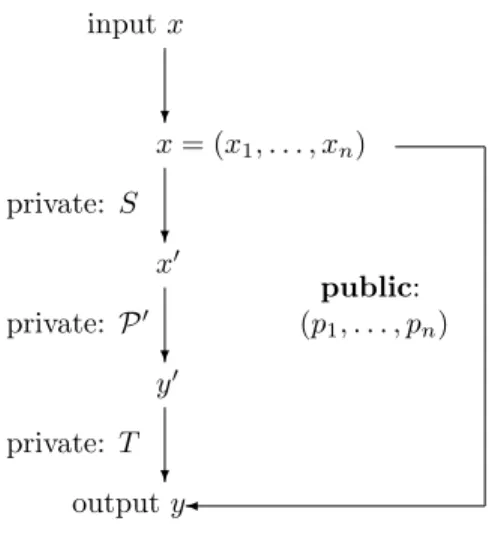
With these terms defined, we are now able to express the private key as the triple (S,P0, T) where S ∈ Aff−1(Fn), T ∈ Aff−1(Fm) are affine transformations and P0 ∈ MQ(Fn,Fm) is a polynomial-vector
P0:= (p0
1, . . . , p0m) inmpolynomials; each polynomial depends on the input variablesx01, . . . , x0n. Throughout
inputx ? x= (x1, . . . , xn) ? private: S x0 ? private: P0 y0 ? private: T outputy public: (p1, . . . , pn)
Fig. 2: Graphical Representation of theMQ-trapdoor (S,P0, T)
it is necessary that the polynomials p01, . . . , p0mare of degree 2 at least. For efficiency reasons, they should
be of degree 2 at most. In addition, the affine transformation S can be represented in the form of an invertible matrix MS ∈ Fn×n and a vector vs ∈ Fn, i.e., we have S(x) := MSx+vs. Similarly, we have
T(x) :=MTx+vt forMT ∈Fm×man invertible matrix and vt∈Fm a vector.
In contrast to the public polynomial vector P ∈ MQ(Fn,Fm), the design goal for public key schemes
based on theMQ-problem is to have a central mapP0:
Fn →Fmwhich allows efficient inversion,i.e., easy
computation ofx01, . . . , x0n for giveny10, . . . , y0m. At least for secureMQ-schemes, this is not the case if the public keyP together with knownsy1, . . . , yn alone is given. The main difference betweenMQ-schemes lies
in their special construction of the central mapP0 and consequently the trapdoor they embed into a specific class ofMQ-problems.
2.2
Public Key Generation
In all MQ-schemes, the public key P is computed as function composition of the affine transformations S : Fn →
Fn, T : Fm → Fm and the central map P0 : Fn → Fm, i.e., we have P = T ◦ P0◦S. By
construction, we have ∀x ∈ Fn : P(x) = T(P0(S(x))). Efficient algorithms for computing the public
key for a given private key can be found in [MI88, Wol04]. Decomposing P into (S,P0, T) is called the “Isomorphism of Polynomials” (IP), cf [Pat96b]. For P,P0 without structure, i.e., in particular random equations forP0, it is considered to be a hard problem in itself. Security evaluations for IP can be found in [PGC98, GMS02, LP03, Per05].
2.3
Decryption/Signing
To decrypt for a giveny∈Fm(or to compute its signature, respectively), we have to invert the computation
of y = P(x). Using the trapdoor-information (S,P0, T), cf Fig. 2, this is easy. First, we observe that transformationT is a bijection. In particular, we can computey0=MT−1(y−vt). The same is true for given
x0 ∈Fn and S ∈Aff−1(
Fn). Using the LU-decomposition of the matricesMS, MT, this computation takes
time O(n2) and O(m2), respectively. Hence, the difficulty lies in evaluatingx0=P0−1(y0). We will discuss different strategies in Sect. 3 as they depend on the structure of the central mapP0.
2.4
Encryption/Verification
In contrast to decryption/signing, the encryption/verification step is the same for allMQ-schemes: given a vectorx∈Fn, we evaluate the polynomials
pi(x1, . . . , xn) := X 1≤j≤k≤n γi,j,kxjxk+ n X j=1 βi,jxj+αi,
for 1 ≤ i ≤ m; 1 ≤ j ≤ k ≤ n and given αi, βi,j, γi,j,k ∈ F. Obviously, all operations can be efficiently
computed, in particular if the field F is of characteristic 2. Assuming uniform costs for the finite field
operations, we obtain a total ofO(mn2) steps for evaluating the public key.
3
Schemes based on the
MQ-problem
As explained in the previous section, all schemes based on theMQ-problem have the same structure for the public key. Hence, their key-sizes can be computed using the same formula. First, we define
τ(n) := 1 +n+n(n2−1) = 1 +n(n2+1) ifF=GF(2) 1 +n+n(n2+1) = 1 +n(n2+3) otherwise
for the number of terms per polynomial. The first row in the above expression comes from the fact that we have x2
i =xi forF= GF(2) and 1≤i≤n,i.e., quadratic terms of the formx2i over GF(2) reduce to linear
terms.
Using the above formula, we obtainmτ(n) =O(mn2) for the number of coefficients and hence a memory
requirement of log256(q)mτ(n) byte. For a secure MQ-system, the public key polynomials should behave
similar to random equations. Therefore, we do not expect to find efficient compression techniques for these keys but move on to a detailed description of concrete examples for the central mapP0.
3.1
Unbalanced Oil and Vinegar Schemes: UOV
The “Unbalanced Oil and Vinegar” (UOV) scheme was introduced in [KPG99], cf [KPG03] for an extended version of this paper. UOV is a generalisation of the original Oil and Vinegar scheme of Patarin [Pat97].
Definition 3.1 Let F be a finite field and n, m∈Nwith m < n and α0i, βi,j0 , γi,j,k0 ∈F for1 ≤i≤m and
1≤j≤k≤n. We say that the polynomials below are central equations in UOV-shape:
pi(x01, . . . , x0n) := n−m X j=1 n X k=1 γi,j,k0 x0jx0k+ n X j=1 βi,j0 x0j+α0i.
In this context, the variablesx0ifor 1≤i≤n−mare called the “vinegar” variables andx0i forn−m < i≤n the “oil” variables. We also write o := m for the number of oil variables and v := n−m = n−o for the number of vinegar variables. Note that the vinegar variables are combined quadratically while the oil variables are only combined with vinegar variables in a quadratic way. Therefore, assigning random values to the vinegar variables, results in a system of linear equations in the oil variables which can than be solved, e.g., using Gaussian elimination.
Moreover, Unbalanced Oil and Vinegar schemes (UOV) omit the affine transformation T but only use S ∈Aff−1(Fn). To fit in our framework, we set it to be the identity transformation,i.e., we haveT =idfor
UOV by definition. UOV is able to omit T as all equations have the same shape. Hence, we do not needT to hide a special structure. Moreover, using the notion of equivalent private keys [WP05a, WP05b] we can actually show that the transformation T could always be moved into the central equations P0 and hence, does not give a security-gain.
The UOV scheme can only be used for signature schemes as we needv ≥2o for a secure construction. The first attack against the original OV, i.e., with parameters o =v or n = 2m can be found in [KS98]. This attack has been extended to UOV in [KPG99]. The latest security evaluation — also taking Gr¨obner bases into account, can be found in [BWP05]. As shown in all these papers, we have on averageqv different pre-imagesx∈Fn on average for a given vectory∈Fm, so decryption is by no means efficient. In a nutshell,
the most efficient attacks have a complexity of O(qv−m−1m4) = O(qn−2m−1m4) and are due to [KPG99].
Possible choices for UOV areq= 2, m= 64, n= 192 orn= 256, respectively, as suggested in [KPG03].
3.2
Stepwise Triangular Systems: STS
Another approach to obtain an invertible central map is used in step-wise triangular systems (STS) as a generalisation of Bilinear Maps [Sha93], Triangular Plus Minus [GC00], and RSSE(2)PKC [KS05] — and can be found in [WBP04]. As UOV, STS are defined over a finite fieldFand use a special structure for the
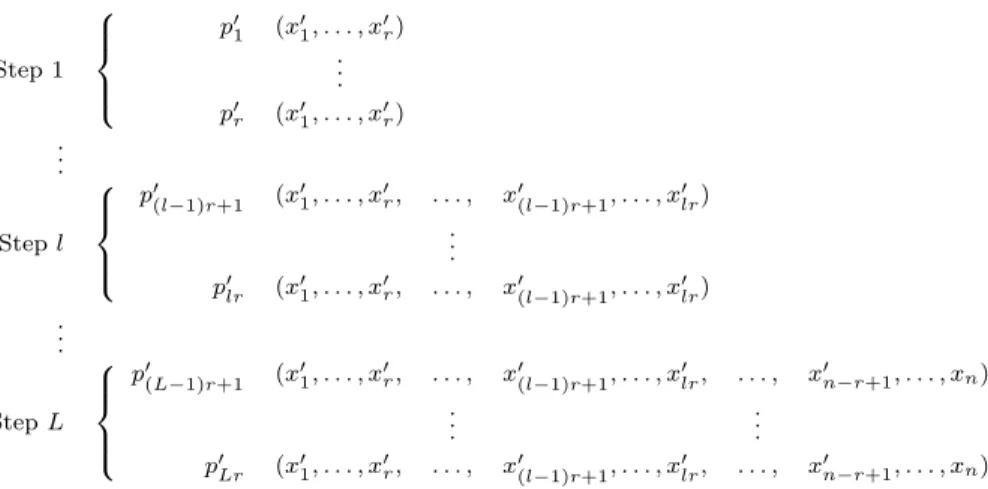
Step 1 8 > > < > > : p01 (x01, . . . , x0r) . . . p0r (x01, . . . , x 0 r) . . . Stepl 8 > > < > > : p0(l−1)r+1 (x01, . . . , x0r, . . . , x0(l−1)r+1, . . . , x 0 lr) . . . p0lr (x01, . . . , x0r, . . . , x0(l−1)r+1, . . . , x 0 lr) . . . StepL 8 > > < > > : p0(L−1)r+1 (x01, . . . , x0r, . . . , x0(l−1)r+1, . . . , x 0 lr, . . . , x 0 n−r+1, . . . , xn) . . . . . . p0Lr (x01, . . . , x0r, . . . , x0(l−1)r+1, . . . , x 0 lr, . . . , x 0 n−r+1, . . . , xn)
Fig. 3: Central Equationsp0iin a Regular STS Scheme
central map P0 which allows easy inversion (cf Figure 3 for regular STS). Here, the step-width (number of new variables) and the step-height (number of new equations) is controlled by the parameterr. As usual, we usemfor the number of equations andnfor the number of variables. In addition, we denoteLthe number of layers,qthe size of the ground fieldF, andrthe step-width. The overall shape of the private polynomials leads to the name step-wise Triangular Scheme (STS), cf Figure 3.
To invert a system of central equationsP0(x0) =y0 for giveny0 ∈
Fm, we exploit the step-structure: in
each level l, we haveqr possible vectors and only need to keep the intermediate values (x0
(l−1)r+1, . . . , x
0
lr)
which satisfy the corresponding equations
y0(l−1)r+1 = p0(l−1)r+1(x01, . . . , x0lr) ..
.
ylr0 = p0lr(x01, . . . , x0lr)
for giveny0(l−1)r+1, . . . , y0lr∈F. Having a bijective structure in each level makes sure we get only one possible
solution — this way, STS becomes particularly efficient. However, we impose some conditions on our choices for the coefficients γ0i,j,k, βi,j0 , α0i∈F this way. Anyway, in a signature scheme, it is even enough if we only
get one solution for the corresponding equation. However, observe that the legitimate user has a workload growing withqrwhich implies that this number cannot be too large if there is no special trapdoor embedded for each layer.
Obviously, the above idea can be easily extended: letr1, . . . , rLbeLintegers such thatr1+· · ·+rL=n,
the number of variables, andm1, . . . , mL∈Nsuch thatm1+· · ·+mL=m, the number of equations. Hererl
represents the number of new variables (step-width) andml the number of equations (step-height), both in
steplfor 1≤l≤L. In a general step-wise Triangular Scheme (gSTS), themlprivate quadratic polynomials
of each layerl, contain only the variablesx0kwithk≤Pl
j=1rj,i.e., only the variables defined in all previous
steps plusrl new ones. We want to stress in this context that we do not assume any specific structure for
the private polynomials p01, . . . , p0m here. In particular, all coefficients γi,j,k0 , βi,j0 , α0i ∈F may be chosen at random. When not mentioned otherwise, we concentrate on regular STS schemes (rSTS or STS for short) in this section to simplify explanations. For regular STS schemes we set r1 =· · · =rN =m1=· · ·=mL,
which we denote byr(see above). Consequently, we haven=m=Lr.
After outlining both regular and general step-wise triangular schemes, we give a brief account of con-structions suggested so far. We begin with the Birational Permutation Schemes of Shamir [Sha93]. They are regular STS schemes with r= 1. However, they are not defined over a (small) finite field but over a (large) finite ring. So strictly speaking, they are no STS schemes although they are clearly related. In contrast, the TPM (Triangle Plus Minus, [GC00]) class of Goubin and Courtois coincides with STS for the parameters r1 =u, mL =v, m1 =· · · =mL−1 =r2 =· · · =rL = 1, i.e., we remove u∈N initial layers, add v ∈N
polynomials in the last step, and have exactly one new variable at all intermediate levels. TPM is a true subclass of STS as it is not defined over a ring but over a field, and hence, is an example of anMQ-scheme. Shamir’s scheme was broken shortly after its publication in [CSV93, The95, CSV97]. The TPM scheme
of Goubin and Courtois has been broken in the same paper that proposed it [GC00]. In fact, the aim of their construction was to show that Moh’s TTM (Moh’s Tame Transformation Method, [Moh99]) construction is weak.
The schemes RSE(2)PKC and RSSE(2)PKC, proposed by Kasahara and Sakai, cf [KS04b, KS04a], also fall in the class of STS schemes. Both schemes — and actually the whole STS class — have been broken in [WBP04]. The first attack is an inversion attack which computes the message/signature for given ci-phertext/message with a workload ofO(mn3Lqr+n2Lrqr), the second is a structural attack which recovers an equivalent version of the secret key with a workload of O(mn3Lqr+mn4) operations. Hence, for small parameters of qr these schemes are highly insecure. Unfortunately, this is exactly the case of STS without
any extra trapdoor, so we have to conclude that STS is broken in general. Still, there are some nested constructions like Rainbow, enTTS, and TRMS possible. Picking enTTS as a typical example, we have 1 = 256, m= 20, n= 28, which leads to a public key of 8 kB and a private key of 1.4 kB.
3.3
Matsumoto-Imai Scheme A: MIA
The scheme MIA is due to Matsumoto and Imai [IM85, MI88]. It is the first scheme in this article which uses two different finite fields, namely a ground fieldFand an extension fieldE. To relate between the extension
field Eand the vector spaceFn, we use the canonical bijectionφ:E→Fn.
Definition 3.2 LetEbe an extension field of dimensionnover the finite fieldFwithq:=|F|elements and
λ∈Nan integer with gcd(qn−1, qλ+ 1) = 1. We then say that the following univariate polynomial overE
is of the MIA-type:
P(X0) := (X0)qλ+1.
Now we say the central mapP0:=φ◦P0◦φ−1 is in MIA-shape.
The restriction gcd(qn−1, qλ+ 1) = 1 is necessary first to obtain a permutation polynomial and second to
allow efficient inversion ofP(X0). This is due to the fact that the equationh.(qλ+ 1)≡1 (modqn−1) has
exactly one solutionh∈Nwithh < qn−1, as we have the previously mentioned condition on the possible
choices of the value λ. Givenh, we can solveY0=P0(X0) as (Y0)h=X0[h.(qλ+1)] =X0 by raisingY0 to the power ofh. Note that these operations take place in then-th dimensional extensionEof the finite fieldF. All
in all, this approach is similar to RSA. However, the hardness of MIA is not based on the difficulty of finding the exponenthbut in the intractability to obtain transformationsS, T for given polynomial equationsP,P0 (IP-problem, cf [Pat96b]). As X and Xqλ withq :=|
F| are linear over the vector spaceFn, their product
P(X0) := (X0)qλ+1
leads to aMultivariateQuadratic system overFn.
We want to note that MIA is insecure, due to a very efficient attack by Patarin [Pat95]. Moreover, we want to point out that Geiselmann et al. showed how to reveal the constant parts of these transformations [GSB01]. Hence, havingS, T affine instead of linear does not seem to enhance the overall security of MIA. The papers [WP05a, WP05b] discuss the question of equivalent keys for MIA and some variations.
Remark. In the paper [MI88], MIA was introduced under the name C∗. Moreover, it used the branching modifier (cf [WP05c] for the terminology) by default. As branching has been attacked very successfully, C∗ has been used without this modification for any later construction,e.g., [CGP00b, CGP02, CGP00a, CGP02]. However, without the branching condition, the scheme C∗coincides with the previously suggested “Scheme A” from [IM85]. To acknowledge this historical development, we decided to use the earlier notation and call the scheme presented in this section “MIA” for “Matsumoto-Imai Scheme A”. As an additional benefit, the notation becomes more uniform as all basic schemes are now named with 3 letter acronyms.
3.3.1
MIA-We move on to a description of MIA- or C∗−− [Pat96a]. Its name is motivated by the fact that many of the public key polynomials are “subtracted”. Less loosely speaking, we use the idea of a projection π:Fn→Fn−rforn, r∈Nandr≥1. The overall construction of the public key becomesP =π◦T◦ P0◦S.
This means in particular that we obtain the function P : Fn → Fn−r for the public key by removing the
last r polynomials pn−r+1, . . . , pn from the public key. Hence, for solving the equation P(X) = Y for a
vector Y ∈ Fn−r and unknown X ∈ Fn, we add r random elements from F for the missing components
yn−r+1, . . . , ynbefore inverting the transformationT. The rest of inversion ofP works as for MIA. In terms
of cryptanalysis, the new scheme has a strength ofqr(cf [Pat96a, CGP02]). In particular, the construction of MIA- with a special choice of parameters has been used in the signature scheme Sflashv2. It uses the
parameters q = 128, n = 37, r = 11. This leads to a private/public key size of 15.4/2.5kB. In [CGP02, Sect. 8], the time to verify or generate a signature is empirically obtained to be less than 1 ms on a PC, without giving further details on the hardware used.
3.4
Hidden Field Equations: HFE
After breaking MIA, Patarin generalised the underlying trapdoor to “Hidden Field Equations” [Pat96b]. This generalisation aims at the central equations and uses a univariatepolynomial rather than a univariate
monomial here. But the basic idea of MIA,i.e., to mix a given ground field with one of its extension fields
is still used in HFE as we see in the following definition:
Definition 3.3 Let F be a finite field with q:=|F|elements, Eits n-th degree extension, and φ:E→Fn
the canonical bijection between this extension field and the corresponding vector space. Moreover, let P(X)
be a univariate polynomial over Ewith
P0(X0) := X 0≤i,j≤d qi+qj≤d Ci,j0 X0 qi+qj + X 0≤k≤d qk≤d B0kX0 qk +A0 where Ci,j0 Xqi+qj forC0
i,j∈E are the quadratic terms,
Bk0Xqk forB0
k∈Eare the linear terms, and
A0 forA0 ∈Eis the constant term
fori, j∈Nand a degree d∈N. Now we say the central mapP0:=φ◦P0◦φ−1 are in HFE-shape.
As the degree of the polynomialP0is bounded byd, this allows efficient inversion of the equationP0(X0) =Y0 for givenY0∈Eand smalld, cf [Pat96b, Section 5] for an overview of possible algorithms for this problem;
in a nutshell, these algorithms depend both on dimension n of the extension field E and degree d of the
central polynomial P. Hence, from an efficiency point of view, both should be rather small. Moreover, in contrast to MIA, HFE is in general no surjection, cf [Pat96b, WP05c] for possible ways to overcome this problem.
As for MIA, we notice that the HFE polynomial P0(X0) can be expressed as Multivariate Quadratic equationsMQ(Fn) and are hence a possible central equation, cf [WP05c].
From a cryptanalytic point of view, basic HFE are broken: an efficient key recovery attack, using the MinRank-problem, has been demonstrated in [KS99]. An inversion attack which uses both Gr¨obner bases and general linearization methods has been shown in [FJ03]. In [SG03] we find an attack which works better if n is not a prime, i.e., we have splitting fields. A more detailed discussion of HFE can be found in [Pat96b, Cou01, WP04]. Here, [Pat96b] gives some general considerations of HFE after its development, e.g., a general linearization attack against all multivariate schemes, while [Cou01] summarised the situation of HFE in 2001 and also improves over the attack from [KS99]. The latest such summary of attacks can be found in [WP04]. In particular, this paper outlines two versions of HFE which are secure against all known attacks. Finally, [WP05a, WP05b] show that HFE allow many equivalent keys and hence, waste memory. Typical choices of parameters are q = 2, n = 107, m= 100, r = 7, d = 129 for Quartz-7m, which lead to a public/private key of 71/3 kB, respectively [WP04]. Using a so-called “Chained-Patarin-Construction” (CPC), we obtain a signature size of only 128 bits — avoiding the birthday paradox.
3.5
General Characteristics of
MQ-schemes
As we saw in the previous sections, multivariate quadratic schemes have rather large public keys in the range of 8kB – 71kB. The private key is usually much smaller,e.g., 71 kB vs. 3 kB for HFE. In terms of signature or message sizes, we can go down until 128 bits (Quartz-7m). In any case, signature verification and encryption take less than 1 ms on a PC while the time for signature generation reaches 10 s (Quartz-7m), but is usually in the range of 100 ms for the other schemes. Hence, the strong points of multivariate quadratic schemes are short signatures, low message overhead/short signature sizes and fast encryption/signature verification.
4
Applications
Starting from the observations from the previous section, we develop applications based on multivariate quadratic schemes. All proposals in this section have an expected security level of 280 — based on our
current knowledge of cryptanalysis. A level of 2803-DES computations has been identified in the European
project [NES] as an adequate security level for nowadays cryptographic applications.
4.1
Electronic Stamps
The idea here is to replace the current stamping machines by digitally signed stamps which can then be printed on any normal printer — if they are printed more than once, the person who has bought the stamp will be caught, cf [NS00, PV00] for a thorough discussion of this idea. In a nutshell, we have two objectives in this context. First, we want the corresponding signature to be as short as possible — for example, using message recovery techniques, cf [MvOV96]. Second, the signature verification time should be low as the post service has to verify the signed stamps on a rather high rate. In addition, stamps have a rather low value, so signature verification may not be costly and must hence be fast.
Table 1: Proposed Scheme for Electronic Stamps
Hash Parameter Priv. Key Pub. Key Sign Verify Expansion
[bit] [kByte] [kByte] [ms] [ms] [bit]
q= 128
160 n= 37 2.5 15.4 <2.7 ¡ 0.8 237
r= 11
The characteristics of our proposal are summarised in Table 1. We base our proposal on Sflashv2 as this is a bijection and hence, we will be able to obtain a valid signature in any case. The overall idea is to compute a 160-bit hash of the whole message, using a cryptographically secure hash function. Due to the ongoing discussion in this field, we do not recommend any at the moment. The remaining 259-160=99 bits are used to encode a part of the message to sign. Hence, the overall message expansion becomes 77 + 160 = 237 bits although the whole signature has — strictly speaking — a size of 259 bits, cf [CGP02] for details on Sflashv2.
4.2
Product Activation Keys
For product activation keys, nowadays mostly symmetric key techniques are used. To the knowledge of the authors, the idea to use public key techniques for this problem is due to [Ber03]. In contrast to symmetric key techniques, crackers cannot retrieve the symmetric key and hence, they are not able to compute valid activation keys — even if they manage to get a copy of the (public) key of the corresponding product. Therefore, techniques based on asymmetric cryptology are clearly superior — if they allow similar size and speed as their symmetric counterparts. In this paper, we propose to use a construction based on HFE- as outlined in [CGP01] and with the tweaks proposed in [WP04]. In particular, we suggest to compute an 80-bit
Table 2: Proposed Schemes for Product Activation Keys
User-ID Key Parameter Priv. Key Pub. Key Gen. Ver. Signature
[bit] [char] [byte] [kByte] [s] [ms] [bit]
20 21 q=2,n=107,r=7 3264 71 ≈10 <1 107
40 25 q=2,n=127,r=7 4509 119 ≈15 <2 127
hash from a user-ID of 20/40 bits. The product activation key is then the signature of the 100/120 bits concatenation of the user-ID and the corresponding hash. In symbols: m:=i||h(i) wheremis the 100/120 bit message to be signed, ithe 20/40-bit user-id, h(·) a cryptographically secure hash function and·||·the concatenation of bit-strings. In this context we want to point out that this proposal is not vulnerable to the birthday paradox and hence, we do not need a hash-length of 160 bits to achieve a security level of 280. To
distinguish different products, we suggest to use different public (and hence private) keys for each product as this rules out attacks using valid signatures for one product for another product. We want to stress that a public key size in the suggested range is not a problem to be put on a product CD/DVD and hence the additional memory requirement is negligible. Finally, we give the length of the corresponding activation key
in characters, assuming a code with 36 symbols. For information: Microsoft uses a 25 character code for its products. The verification and signature timings are extrapolations from [CGP01].
4.3
Fast One-Way functions
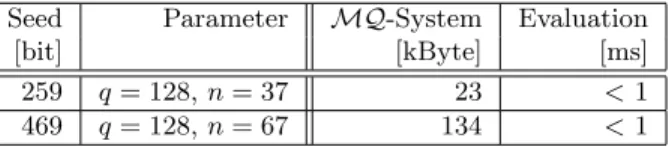
The last application we see are fast but secure one-way functions. In this case, we do not need a trapdoor but merely the intractability of theMQ-problem. Hence, we suggest to generate random MQ-polynomials with the parameters as suggested in Table 3. As for Table 1, the evaluation timings are based on [CGP02]. A
Table 3: Proposed Schemes for One-Way functions
Seed Parameter MQ-System Evaluation
[bit] [kByte] [ms]
259 q= 128,n= 37 23 <1
469 q= 128,n= 67 134 <1
similar construction — but based on sparse polynomials over large finite fields — has been used by Purdy in [Pur74] to construct a kind of hash function. While this proposal is based on the intractability of univariate polynomial equations of large degree, our proposal is based on the difficulty of solving polynomial-equations of small degree, but with a high number of variables. Although the construction we propose here is difficult to invert, it is not resistant against collisions. The reason is a general attack from [Pat96b, Sect. 3, “Attack with related messages”] against MQ-schemes which can be applied here.
5
Conclusions
In this paper, we gave a concise overview of an alternative class of public key schemes, called “Multivariate Quadratic” schemes. A more detailed introduction is given in [WP05c]. In particular — using the variations HFE- and MIA- — we developed practical instantiations for the problems of fast one-way functions, electronic stamps, and product activation keys. In all cases, the short signature verification times and also the rather short signature generation times (resp., encryption and decryption) are a clear advantage over schemes based on RSA and ECC. In particular, the authors is not aware of patent-restrictions for HFE- and MIA-. Hence, they are also a good alternative for projects where patent royalties are a serious consideration. We also want to point out that Sflashv2has been recommended by NESSIE for special application domains. Similar, Quartz was a recommendation in NESSIE for applications which require particularly short signatures.
References
[Ber03] Giuliano Bertoletti. Private communication, June 2003.
[BWP05] An Braeken, Christopher Wolf, and Bart Preneel. A study of the security of Unbalanced Oil and Vinegar signature schemes. InThe Cryptographer’s Track at RSA Conference 2005, volume 3376 ofLecture Notes in Computer Science. Alfred J. Menezes, editor, Springer, 2005. 13 pages, cfhttp://eprint.iacr.org/ 2004/222/.
[CGP00a] Nicolas Courtois, Louis Goubin, and Jacques Patarin. Flash: Primitive specification and supporting documentation, 2000. https://www.cosic.esat.kuleuven.be/nessie, submissions, 9 pages.
[CGP00b] Nicolas Courtois, Louis Goubin, and Jacques Patarin. Sflash: Primitive specification and supporting documentation, 2000. https://www.cosic.esat.kuleuven.be/nessie, submissions, Sflash, 10 pages. [CGP01] Nicolas Courtois, Louis Goubin, and Jacques Patarin. Quartz: Primitive specification (second revised
version), October 2001. https://www.cosic.esat.kuleuven.be/nessieSubmissions, Quartz, 18 pages. [CGP02] Nicolas Courtois, Louis Goubin, and Jacques Patarin. Sflash: Primitive specification (second revised
version), 2002. https://www.cosic.esat.kuleuven.be/nessie, Submissions, Sflash, 11 pages.
[Cou01] Nicolas T. Courtois. The security of Hidden Field Equations (HFE). InThe Cryptographer’s Track at RSA Conference 2001, volume 2020 ofLecture Notes in Computer Science, pages 266–281. D. Naccache, editor, Springer, 2001. http://www.minrank.org/hfesec.{ps|dvi|pdf}.
[Cr93] Douglas R. Stinson, editor. Advances in Cryptology — CRYPTO 1993, volume 773 ofLecture Notes in Computer Science. Springer, 1993. ISBN 3-540-57766-1.
[Cr95] Don Coppersmith, editor. Advances in Cryptology — CRYPTO 1995, volume 963 of Lecture Notes in Computer Science. Springer, 1995. ISBN 3-540-60221-6.
[CSV93] Don Coppersmith, Jacques Stern, and Serge Vaudenay. Attacks on the birational permutation signature schemes. In Cr [Cr93], pages 435–443.
[CSV97] Don Coppersmith, Jacques Stern, and Serge Vaudenay. The security of the birational permutation signa-ture schemes. Jounal of Cryptology, 10:207–221, 1997.
[DBP96] Hans Dobbertin, Antoon Bosselaers, and Bart Preneel. RIPEMD-160: A strengthened version of RIPEMD. InFast Software Encryption — FSE 1996, volume 1039 ofLecture Notes in Computer Science, pages 71–82. Dieter Gollmann, editor, Springer, 1996. Updated version athttp://www.esat.kuleuven. be/~cosicart/ps/AB-9601/AB-9601.ps.gz.
[FC 00] Yair Frankel, editor. Financial Cryptography, 4th International Conference, FC 2000 Anguilla, British West Indies, February 20-24, 2000, Proceedings, volume 1962 of Lecture Notes in Computer Science. Springer, 2001. ISBN 3-540-42700-7.
[FIP] National Institute of Standards and Technology. Federal Information Processing Standards Publication 180-1: Secure Hash Standard, 17th April 1995. http://www.itl.nist.gov/fipspubs/fip180-1.htm. [FJ03] Jean-Charles Faug`ere and Antoine Joux. Algebraic cryptanalysis of Hidden Field Equations (HFE) using
Gr¨obner bases. InAdvances in Cryptology — CRYPTO 2003, volume 2729 ofLecture Notes in Computer Science, pages 44–60. Dan Boneh, editor, Springer, 2003.
[GC00] Louis Goubin and Nicolas T. Courtois. Cryptanalysis of the TTM cryptosystem. In Advances in Cryp-tology — ASIACRYPT 2000, volume 1976 ofLecture Notes in Computer Science, pages 44–57. Tatsuaki Okamoto, editor, Springer, 2000.
[GJ79] Michael R. Garey and David S. Johnson. Computers and Intractability — A Guide to the Theory of NP-Completeness. W.H. Freeman and Company, 1979. ISBN 0-7167-1044-7 or 0-7167-1045-5.
[GMS02] Willi Geiselmann, Willi Meier, and Rainer Steinwandt. An attack on the Isomorphisms of Polynomials problem with one secret. Cryptology ePrint Archive, Report 2002/143, 2002. http://eprint.iacr.org/ 2002/143, version from 2002-09-20, 12 pages.
[GSB01] W. Geiselmann, R. Steinwandt, and Th. Beth. Attacking the affine parts of SFlash. InCryptography and Coding - 8th IMA International Conference, volume 2260 ofLecture Notes in Computer Science, pages 355–359. B. Honary, editor, Springer, 2001. Extended version: http://eprint.iacr.org/2003/220/. [IM85] Hideki Imai and Tsutomu Matsumoto. Algebraic methods for constructing asymmetric cryptosystems.
InAlgebraic Algorithms and Error-Correcting Codes, 3rd International Conference, AAECC-3, Grenoble, France, July 15-19, 1985, Proceedings, volume 229 ofLecture Notes in Computer Science, pages 108–119. Jacques Calmet, editor, Springer, 1985.
[KPG99] Aviad Kipnis, Jacques Patarin, and Louis Goubin. Unbalanced Oil and Vinegar signature schemes. In
Advances in Cryptology — EUROCRYPT 1999, volume 1592 ofLecture Notes in Computer Science, pages 206–222. Jacques Stern, editor, Springer, 1999.
[KPG03] Aviad Kipnis, Jacques Patarin, and Louis Goubin. Unbalanced Oil and Vinegar signature schemes — extended version, 2003. 17 pages,citeseer/231623.html, 2003-06-11.
[KS98] Aviad Kipnis and Adi Shamir. Cryptanalysis of the oil and vinegar signature scheme. In Advances in Cryptology — CRYPTO 1998, volume 1462 ofLecture Notes in Computer Science, pages 257–266. Hugo Krawczyk, editor, Springer, 1998.
[KS99] Aviad Kipnis and Adi Shamir. Cryptanalysis of the HFE public key cryptosystem. In Advances in Cryptology — CRYPTO 1999, volume 1666 ofLecture Notes in Computer Science, pages 19–30. Michael Wiener, editor, Springer, 1999. http://www.minrank.org/hfesubreg.ps or http://citeseer.nj.nec. com/kipnis99cryptanalysis.html.
[KS04a] Masao Kasahara and Ryuichi Sakai. A construction of public-key cryptosystem based on singular simul-taneous equations. InSymposium on Cryptography and Information Security — SCIS 2004. The Institute of Electronics, Information and Communication Engineers, January 27–30 2004. 6 pages.
[KS04b] Masao Kasahara and Ryuichi Sakai. A construction of public key cryptosystem for realizing ciphtertext of size 100 bit and digital signature scheme. IEICE Trans. Fundamentals, E87-A(1):102–109, January 2004. Electronic version: http://search.ieice.org/2004/files/e000a01.htm\#e87-a,1,102.
[KS05] Massao Kasahara and Ryuichi Sakai. A construction of public-key crypto based on singular simultaneous equations and its variants. Technical report, 2005. http://www.osaka-gu.ac.jp/php/kasahara/km.pdf, 6 pages.
[LN86] Rudolf Lidl and Harald Niederreiter. Introduction to Finite Fields and their Applications. Cambridge University Press, 1986. ISBN 0-521-30706-6.
[LP03] Fran¸coise Levy-dit-Vehel and Ludovic Perret. Polynomial equivalence problems and applications to mul-tivariate cryptosystems. InProgress in Cryptology — INDOCRYPT 2003, volume 2904 ofLecture Notes in Computer Science, pages 235–251. Thomas Johansson and Subhamoy Maitra, editors, Springer, 2003. [MI88] Tsutomu Matsumoto and Hideki Imai. Public quadratic polynomial-tuples for efficient signature verifica-tion and message-encrypverifica-tion. InAdvances in Cryptology — EUROCRYPT 1988, volume 330 ofLecture Notes in Computer Science, pages 419–545. Christoph G. G¨unther, editor, Springer, 1988.
[Moh99] T. Moh. A public key system with signature and master key function. Communications in Algebra, 27(5):2207–2222, 1999. Electronic version: http://citeseer/moh99public.html.
[MvOV96] Alfred J. Menezes, Paul C. van Oorschot, and Scott A. Vanstone. Handbook of Applied Cryptography. CRC Press, 1996. ISBN 0-8493-8523-7, online-version: http://www.cacr.math.uwaterloo.ca/hac/. [NES] NESSIE: New European Schemes for Signatures, Integrity, and Encryption. Information Society
Tech-nologies programme of the European commission (IST-1999-12324). http://www.cryptonessie.org/. [NS00] David Naccache and Jacques Stern. Signing on a postcard. In FC — Financial Crypto [FC 00], pages
121–135. http://citeseer.ist.psu.edu/naccache00signing.html.
[Pat95] Jacques Patarin. Cryptanalysis of the Matsumoto and Imai public key scheme of Eurocrypt’88. In Cr [Cr95], pages 248–261.
[Pat96a] Jacques Patarin. Asymmetric cryptography with a hidden monomial. In Advances in Cryptology — CRYPTO 1996, volume 1109 ofLecture Notes in Computer Science, pages 45–60. Neal Koblitz, editor, Springer, 1996.
[Pat96b] Jacques Patarin. Hidden Field Equations (HFE) and Isomorphisms of Polynomials (IP): two new families of asymmetric algorithms. In Advances in Cryptology — EUROCRYPT 1996, volume 1070 of Lecture Notes in Computer Science, pages 33–48. Ueli Maurer, editor, Springer, 1996. Extended Version: http: //www.minrank.org/hfe.pdf.
[Pat97] Jacques Patarin. The oil and vinegar signature scheme. presented at the Dagstuhl Workshop on Cryp-tography, September 1997. transparencies.
[Per05] Ludovic Perret. A fast cryptanalysis of the isomorphism of polynomials with one secret problem. In
Advances in Cryptology — EUROCRYPT 2005, Lecture Notes in Computer Science. Ronald Cramer, editor, Springer, 2005. 17 pages.
[PG97] Jacques Patarin and Louis Goubin. Trapdoor one-way permutations and multivariate polynomials. In
International Conference on Information Security and Cryptology 1997, volume 1334 ofLecture Notes in Computer Science, pages 356–368. International Communications and Information Security Association, Springer, 1997. Extended Version: http://citeseer.nj.nec.com/patarin97trapdoor.html.
[PGC98] Jacques Patarin, Louis Goubin, and Nicolas Courtois. Improved algorithms for Isomorphisms of Poly-nomials. InAdvances in Cryptology — EUROCRYPT 1998, volume 1403 of Lecture Notes in Computer Science, pages 184–200. Kaisa Nyberg, editor, Springer, 1998. Extended Version: http://www.minrank. org/ip6long.ps.
[Pur74] George B. Purdy. A high security log-in procedure. Communications of the ACM, 17(8):442–445, August 1974.
[PV00] Leon A. Pintsov and Scott A Vanstone. Postal revenue collection in the digital age. In FC — Financial Crypto [FC 00], pages 105–120. http://citeseer.ist.psu.edu/pintsov00postal.html.
[SG03] Andrey V. Sidorenko and Ernst M. Gabidulin. The weak keys for HFE. InProceedings of the “Seventh International Symposium on Communication Theory and Applications (ISCTA03)¨, 13th-18th July, 2003, Ambleside, Lake District, UK, pages 239–244, 2003. 6 pages.
[Sha93] Adi Shamir. Efficient signature schemes based on birational permutations. In Cr [Cr93], pages 1–12. [Sho97] Peter W. Shor. Polynomial-time algorithms for prime factorization and discrete logarithms on a quantum
computer. SIAM Journal on Computing, 26(5):1484–1509, October 1997.
[The95] Thorsten Theobald. How to break Shamir’s asymmetric basis. In Cr [Cr95], pages 136–147.
[Tol03] Ilia Toli. Cryptanalysis of HFE, June 2003. arXiv preprint server,http://arxiv.org/abs/cs.CR/0305034, 7 pages.
[WBP04] Christopher Wolf, An Braeken, and Bart Preneel. Efficient cryptanalysis of RSE(2)PKC and RSSE(2)PKC. In Conference on Security in Communication Networks — SCN 2004, volume 3352 of
Lecture Notes in Computer Science, pages 294–309. Springer, September 8–10 2004. Extended version:
http://eprint.iacr.org/2004/237.
[Wol02] Christopher Wolf. Hidden Field Equations (HFE) - variations and attacks. Diplomarbeit, Universit¨at Ulm, December 2002. http://www.christopher-wolf.de/dpl, 87 pages.
[Wol04] Christopher Wolf. Efficient public key generation for HFE and variations. InCryptographic Algorithms and Their Uses 2004, pages 78–93. Dawson, Klimm, editors, QUT University, 2004.
[Wol05] Christopher Wolf. Multivariate Quadratic Polynomials in Public Key Cryptography. Ph.D. thesis, Katholieke Universiteit Leuven, Belgium, November 2005. http://hdl.handle.net/1979/148, 156+xxiv pages.
[WP04] Christopher Wolf and Bart Preneel. Asymmetric cryptography: Hidden Field Equations. InEuropean Congress on Computational Methods in Applied Sciences and Engineering 2004. P. Neittaanm¨aki, T. Rossi, S. Korotov, E. O˜nate, J. P´eriaux, and D. Kn¨orzer, editors, Jyv¨askyl¨a University, 2004. 20 pages, extended version: http://eprint.iacr.org/2004/072/.
[WP05a] Christopher Wolf and Bart Preneel. Equivalent keys in HFE, C∗, and variations. In Proceedings of Mycrypt 2005, volume 3715 ofLecture Notes in Computer Science, pages 33–49. Serge Vaudenay, editor, Springer, 2005. Extended versionhttp://eprint.iacr.org/2004/360/, 15 pages.
[WP05b] Christopher Wolf and Bart Preneel. Superfluous keys inMultivariateQuadratic asymmetric systems. In
Public Key Cryptography — PKC 2005, volume 3386 of Lecture Notes in Computer Science, pages 275– 287. Serge Vaudenay, editor, Springer, 2005. Extended versionhttp://eprint.iacr.org/2004/361/. [WP05c] Christopher Wolf and Bart Preneel. Taxonomy of public key schemes based on the problem of multivariate
quadratic equations. Cryptology ePrint Archive, Report 2005/077, 12th of May 2005. http://eprint. iacr.org/2005/077/, 64 pages.