The Superposition of
Discrete-Time Markov Renewal
Processes
with
an Application
to Statistical Multiplexing of
Bursty Traffic Sources
K. M. Elsayed
H. G.
Perros
Center for Communications
and
Signal Processing
.
Department of Computer Science
North Carolina State University
~/
/TR-94/15
The Superposition of Discrete-Time Markov Renewal
Processes with an Application to Statistical
Multiplexing of Bursty Traffic Sources
*
Khaled M. Elsayed
Harry G. Perras
Department of Computer Science
and
Center for Corrununications
and
Signal Processing
North Carolina State University
Raleigh, NC 27695-8207
Abstract
L~ this paper we introduce a methodology for approximately characterizing the su perpo sition process of J.V ~ 2 arbitrary discrete-time Markov Renewal Processes (MP2). The superposition process is also a ~..,,1RP with a state space that grows expo-nentially with N. We introduce the arbitraryanioff traffic source model as a special caseof the general~.For this special case, we devise an iterative algorithm which can be used to characterize the superposition process in a compact form. Subse-quently, a queueing model for a FIFO finite-buffer multiplexer with arbitrary anioff input sources is analyzed. We provide extensive numerical and validation results for the algorithms introduced in the paper. We also study the effect of some of the statistical properties ofanioff input sources on the multiplexer's performance.
1
Introduction
In this paper, we consider the problem of characterizing the superposition of multiple
discrete-time Markov Renewal Processes (IvfRP). A lot of research has been reported in
the area of characterizing the superposition process of renewal and Markovian processes.
However, to the best of our knowledge characterizing the superposition of MP~'s has not
as yet been adequately addressed.
Non-Markovian processes are more versatile since they can provide realistic models
of arrival processes in an ATMenvironment. However, the analysis of queueing systems
with non-Markovian input is considerably more complex than that with renewal and
Markovian arrival processes.
Cherry and Disney [1] studied the superposition of two continuous-time MRP's. The
structure of the interval process resulting from superposing two independent MRP was
characterized. The resulting stochastic process has a very large number of states which
limits the applicability of the model to two processes.
Korolyuk [6]introduced a mathematical model for the superposition of multiple
inde-pendent continuous-time lv1RP's. The model keeps track of the time each process spends
in the current state. This limits the model's applicability to cases where analytic
expres-sions for the sojourn times between states can be found. The author also introduced the
notion of
phase space lumping/
an aggregation process, in crder to red uce dimensionalityof the MF.P.
Following a similar methodology to the one presentedin [1]and[6],we characterize the
superposition of N
2
2independent discrete-time MRP's. The constructed superpositionis a 11R.P with a state space that grO\VS exponentially with N. Only small values of N
can be handled on a conventional computer. An aggregation method was developed in
the case of onloff processes, where the on and off periods have an arbitrary distribution.
Such a process is hereafter referred to as an arbitrary orr/off process. This aggregation
causes a distortion of the statistical properties of the original superposition. However,
the aoczregation works well in the case of Interrupted Bernoulli Processes. Finally, a
be,
FIFO finite buffer statistical multiplexer with N arbitrary onloff arrival processes was
analyzed. The analysis is non-standard due to the new model of the superposition of the
arrival processes.
Sohraby [8] presented innovative results on the tail beha~ior of a multiplexer with
infinite waiting room shared by multiple arbitrary
ani
off sources. For the case ofgeneous sources, the model is valid only in heavy traffic. For the case of homogeneous
sources, the model can be used for all levels of multiplexer utilization. In the
heteroge-neous case, the asymptotic decay parameterisa simple function of the first two moments
of the on and off periods and peak rates. However, our results show that for the case
of a multiplexer with finite buffer, more parameters are needed than just the first two
moments of the on and off period lengths (when peak rate is equal to link speed).
The rest of this paper is organized as follows. In section 2, we first provide a quick
reviewofMarkov renewal processes and present some results from discrete-time renewal
theory. Wethen proceed to describe the methodology for characterizing the superposition
of multiple independent:MRP'
s.
In section 3, we present thearbitraryonl
off source model.A step-wise algorithm which uses aggregation in order to obtain a superposition process
ofarbitrary
onl
off sources with a manageable numberof statesisintroduced in section 3.2.Insection 4, a finite buffer FIFO statistical multiplexer shared by multiple arbitrary on/off
traffic sources is introduced and analyzed. Insection 5, we present extensive validation
results of the algorithms presentedin this paper. Insection 6, we examine the effects of
some of the parameters of an arbitrary orr/offsource on the performance of a statistical
multiplexer. Section 7 gives the conclusions ofthis papero
2
The Superposition of Multiple Independent Discrete-time
Markov Renewal
Processes
2.1
A Revie-w of Discrete-fune Markov Renewal Processes and Some Basic
Results from Renewal Theory
A Markov renewal process GvfRP) is a stochastic process which moves from one state to
another with a random sojourn times which has a distribution that depends on the state
being visited as well as the next state to be entered. The successive states visited by the
MRP form aMarkov chain. Let 3 be the state space of an :tvIRP.
n E Z+I and 0
==
To ::;T1 ::; T2 · · .,isa discrete-time:MRP withstate space:=:
iffor all T,k E Z+ and z E 3. Let us further assume that (X, T) is time-homogeneous;
that is P {Xn+1
==
y,Tn+1 - Tn==
kl"-Yn==
x}==
G(x,y,k) independent of n. The familyof probabilities G
==
{G(x,y,k): x,y E 3,k E Z+} is called a discrete-time semi-Markovkernel on 3. The process (X) is called the associated semi-Markov process (S1vfP) of the
11RP (X, T). Whenever appropriate, we would use the termS1vfPinplace of:MRP.
The sum
p(
z ,y)==
Ek~O G(z ,y, k) is not necessarily equal to one, butp(
z ,y) ~ 0andL:
lIEs p( x , y ) must be equal to one. The p(x,y) are in fact the transition probabilities for some Markov Chain with state space E and probability transition matrix P==
[p(x,y)].We now review some basic results from renewal theory that will be used below to
construct the superposition process. Let f(k), 0
<
f(k)<
1, k ~ 0,be a probability massfunction. Let w
==
~k=O f(k),a
<
l.k' ~ 1, andSf
==
~k==O kf(k). Let F(k) == ~7=o f(l), bethe associated cumulative probability density function of length up to k. The probability
~~:.;-~ssruncrio.. ofthe residual life-timeis given by :
....
[W-F(k-l)]
f(k)=w M ' k=1,2, .. · (1)
Note
that whenw isequal to
1,we getthe known
results for discrete-time renewal theory[9].
2.2
Characterization of The Superposition Process of Multiple
Indepen-dent Markov Renewal
Processes
Consider pI
2:
2independent discrete-time}ARP's. Each individual MP,j)iis characterizedin terms ofc.semi-Markov kernel Gi ==
(gi(
z ,y"Ic)]defined over the set of states 1,2,· · ·NilN,
>
1. In order to characterize the superposition process, we have to define the states of the process and then for each state find the distribution of the sojourn time between thestate and
any
other directly accessible state of the superposition process.In [1] the superposition state descriptor is a vector consisting of the current state of
each component process and the time each process has spent in its current state since its
last transition. It is clear that such a characterization results in an enormous state space,
since the time a component process spends in a state can be quite large especially when
some of the functions
s. (
x, y,k )have a long tail.To show how our superposition is constructed, let us assume for the moment that only
one particular process, say process i, has just experienced a state transition and another
process j, j
#-
i, did not change state at that instant and that it is in state Xj. Let T(xj)be the time that process j has spent so far in state Xj. Due to the independence of the
two processes, the distribution ofT(xj) will be equal to the distribution of the life-timein
state Xj. The time
T'(xj)
that it takes process j to undergo a state change would have adistribution equal to the residual time distribution at state Xj.
This is illustrated through the example given in figure 1. At the instant marked
observation Instant,process 1 makes a state transition from state 2 to state 3. The distribution
of time until processes:2 and 3 e.oerience a state transition, T'(
X2)
andT'(X3)
respectively,i.3 appro~<i:-n.a.tel)/ equal to the residual life-time distribution in state 2 and state 1 of each
process respectively. Thisis true when we take all possible realization of the above event
and
assuming
that all processes are independent.We define the superposition state at instants when one or more of the individual
processes experience a state transition. The superposition state is described by the tuple
[(Xl,tl),(X2,t2),···,(XN,tN)]
where Xi E{1,2,··.,N
i } is the state of process i observedimmediately after a transition occurs, and ti E {O, 1} indicates whether process i has
changed state or not, with ti
==
1iffprocessi has changed state.The state space E of the superposition process is givenby
Note that ~~1ti =I- 0 because the superposition process is observed immediately after a transition occurs. The number of states in the superposition processisobviously equal to
Ooservalion Instant
2
L
Process1. . . - - - .I. . . - - - . Process 3
Process2
L
1"(IJ
_ _1_---. :
_---~ I~_
Io....---L---l
2 2
Figure 1: The distribution of residual life-time for a process not experiencing a state change.
In order to fully characterize the superposition process as a MRP, we must obtain the
distribution of the time it takes the :t\,fr.J> to move from a stateu to state v, whereu,v E ::::
and v is directly accessible from u, Let the probability of going from u to v in k slots be
denoted byq(1.£,1),k). ThenQ = [q(U,11, k)
J
isthe semi-Markov kernel of the superpositionprocess. We now proceed to calculate the functions q(u, v,k).
Let9i(
x,
y,k)be the residual life-time probability mass function associated withs.
(x,
y,k)which is calculated using equation 1. Also, let Gi(x,k)
=
:L~~1:L7=1
9i(X,y,1),be thecu-mulative distribution function of sojourn time up to slot k in state z for process i, and
G
i (z ,k) = :L~1:L7=1
9i(z ,v,
l)be similarly defined for the functions 9i(z ,y,k).The function q(u,v,k) depends on the values of
(Xi(U),ti(u))
and(Xi(V),ti(V))
for allprocesses i, where
(Xi(S), ti(S))
isthe state of process i when the superposition isin state s.We assume that the transition from state u to state v would take place in kslots and then
proceed to calculate the probability of this event to occur. Consider an arbitrary process
i, based onthe values of ti(
u)
andti(v ),
the following four distinct cases are possible:1-
ti(
u)
=
ti(
v)
== O. In this case we haveXi(
u)
==
Xi(
v),
i.e. process i does not change state in either state u orv. The probability of such an event to occur for process i isapproximately given by <p;(u,v,k)
=
1 - G;(x;(u),k), which is the probability that the residual life-time in state Xi(u)is greater than k.11-
tie
u) =a
andtie
v) = 1.Inthis case processi changes state atvbut not atu, Since processi has not changed state at u, the probability that this event occurs is
1Ji(
u, v,k)==
9;(X;(u),x;(v),k),which is the probability that the residuallife-tirne in state Xi(U) is
equal to k.
111- ti(
u)
==
1 and ti(v)
== O. In this case process i changes state atu
but not atv.
The probability that this event occurs is <Pi(u,v,k)
==
1 - Gi(x,:(u),k), which is theprobability that the sojourn time in state Xi(u) islonger than k.
IV- ti(U)
==
ti(V)==
1. In this case process i changes state at both u and v. Theproba-bility that this event occurs is given by cPi(u,v,k)
==
9i(Xi(U),Xi(V),k), which is theprobability that the sojourn time from state Xi( u) to state
Xi(
v)isequal to k slots.Thus, due to tile in.dependence of the component processes, we have the result
N
q(u,v,k)
==
II
cPi(u,v,k)i=1
for all u; v E
:=:
and k E Z+~(2)
We now discuss the computational complexity of the algorithm for constructing the
kernel of the superposition process. Let us assume that the maximum length of the
probability density function tail in any of the kernels {Gi}~lis given by L. The storage space needed for the semi-Markov kernel Q to be generatedis 0
((n~l
N;)2(2
N -1?
L).
The computational complexity (number of floating point multiplications) is
o
((nf:l
N;)(2
N -1?
L).
This is due to the fact that for an arbitrary state u, the number ofstates directly accessible from u afterone transition is (2N - 1). Even for a small valueofN, say N = 5, N,
=
2Vi,and L=
1000, the storage needed is 0 (220 X 1000 x L) whichis excessively large for implementation on a conventional computer. By using sparse
matrix techniques the storage capacity needed cnnbe reduced to 0
((n~l
Nt)(2
N - 1)2L).
Clearly, for a large number of processes, an approximate solution should be sought instead.
The validation of the methodology presented above for characterizing the
superposi-tion process is given in section 5.1. It is shown there that the proposed method is quite accurate.
3
The Superposition of Multiple Arbitrary on/off Sources
3.1
The Arbitrary On/Off Source Model
In this section, we introduce the arbitrary
onl
off traffic source model whichis to be usedthroughout the paper. Consider a traffic source that alternates between active (on) and
idle (off) periods. The source always transmits one cell per slot when it is inthe on state,
see figure 2. For traffic source if the length of the on and off periods has an arbitrary
distribu tion. For sourcei, let
ft
n(k)andIt!
f(k)be the probability that the length of an onand off period is k tirne slots respectively.
'The stochastic process describing tile source is L.T).fact art alternating renewal process
with two states which can be described by means of a MRP. Let the two states be 0
and 1 corresponding to the off and on state of the source respectively. The associated
semi-Markov kernelis givenby
_ [ a
ftff(k) ]Gi(k) -
ft'(k)
a
·
We can now directly apply the results of section 2.2 to characterize the superposition
process of N
2:
2 arbitrary onloffsources. Since N,=
2, i=
1,2,'" N, and Xi E {O,1},the expression for
¢i(
U,v, k) in equation 2is sir.rplified. Pot N sources, the superpositionprocess has 2N(2N - 1)states.
As discussed in section 2.2, this method is limited to small number of input sources,
since the time and space complexity grows exponentially with the number of sources.
Below, we present an aggregation method for constructing the superposition of arbitrary
orr On
i
I
orr On Off On
Figure 2: The arbitrary
ani
off source model.3.2
On the Aggregation of States
in
the
Superposition of Multiple
Arbi-trary
on/off Sources
Consider a discrete-time MRP with kernel Q
=
[q(u,v,k)]
andM
states. This:MRP,referred to as the
origina111RP,
is to be approximated by anaggregate
:MRP with kernelQ
and M<
J-'1 states which is equivalent in some sense to Q. Let the states of the originalMl~IJbe numbered as 1,2,·· 3 ,.It;f. Let the state space of the original process be divided
into the clisjcirlt sets Zl)Z2,···,Zif
' where Zi
n
Zj ==0,
ii-),
andIZil
2: 1, Vi,j. All states inset Z;will be represented by a single statei in the aggregate process. The entriesq(i,j,
k) of the kernelQ
are givenby(3)
where {7ru}~l is the invariant probability vector of the underlying Markov chain with
probability transition matrix P == [P(u, v)] == [Ell:q(u, v, k)]. It can be shown that the
aggregate MRP
Q
has the same first order characteristics as the original NfRP Q. Forexample the fundamental mean(see [7])is the same. For the casewhen the original MP~
is the su.perposition of arbitraryonloffsources, the aggregate process will have the same mean number of arrivals and mean time between instants at which arrivals occur. For
this originalMRP, an intuitive approach to constructing the aggregate F)rocessis to lump
suggests an aggregation scheme in which superposition states
are lumped to a single state c, where 0
:s
c ::; N. In essence we define the sets Z;{[(Xl, tl),··· (XN, tN)] :
2:f:1
Xi=
c}, c
=
0,1···N and then use equation 3.In general, the aggregation is difficult to carry out since it requires to first construct
the superposition process of N arbitrary orr/off processes using the method given in
section 2.2. Time and space complexity limits this superposition to about four arbitrary
ani
off processes. An alternative approach is to construct the aggregate superposition process in a stepwise fashion as follows. First, the aggregate superposition process isinitialized to the MRP of the first orr/off source. Thisisfollowedby an iterative scheme in
which the current aggregate superposition processis superimposed with another orr/off
source using the methodology in section 2.2 at each step. The resulting intermediate
processis then aggregated as described above to provide the new aggregate superposition
process. The i.er ation is repeated.i\T - 1times.
The advantage of this algorithmisthatthe space and time complexityisreducedfrom
an exponential to a polynomial function of the number of superimposed sources. The
algorithm isshown in figure3.
c Let the kernelofthe MRP of sourcei be Gi
o Let Q = G1
o Fori
=
2 to N do- Let Q = superposition of
Q
with Giusing the method described in section 2.2
- Aggregate
Q
intoQ
by lumping all states with the same numberof active sources into one stateI
Figure 3: Th.e Step-WL?,2 aggregation alglJritrtffi for constructing the superposition process.
The resulting process has N
+
1 states. TIle largest nurnber of states encounteredis during the last iteration where we superpose a process an orr/off source (2 states)
with a process with N states (aggregate superposition of N - 1 sources). The resulting
o
o
• • •
Finite BufferQueue(B-5)
Traffic Sources
o
1 Slot Service (5 Servers)
Figure 4: The Statistical Multiplexer Model with S servers and B total waiting capacity.
provide the final approximate process withN
+
1 states.The accuracy of this aggregation scheme depends on the characteristics of the input
traffic sources and the extent of their homogeneity. Theaggregation distorts thestatistical
propertiesofthe original superposition:tvIRP. Eveninthe caseof completely homogeneous
sources, the proposed aggregation scheme may give inaccurate results. However, it is
quite accurate when all the input sources are IBP's. Validation results for the aggregation
algorithm are gi"\len in section 5.3.
4
Analysis of a Statistical Multiplexer with Multiple
Arbi-trary
on/off Input Sources
Consider a FIFO finite buffer multiplexer serving N
2:
2 arbitraryani
off sources asdepicted in figure 4. Each sourceis described in terms of the probability density function
of its on and off periods. A source emits cells at each time slot when it is in the on state.
The multiplexer has S ~ 1servers and can accommodate a total of B 2: S cells at any time instant including those in service. The service time for all cells is constant al1dis equal to
one time slot. The multiplexer can serve S cells every time slot. 'rVe assume that N
>
S,otherwise no queue will ever form in the multiplexer and the problem will be trivial to
handle.
State Transition
Service Completion
k+2 k+3
Time Slot
Figure 5: Timing of eventsin the early arrival model.
multiplexer's queue. From this we can obtain other measures of interest such as the mean
queue length, the probability of full buffer and the cell loss probability.
Let us first discuss the timing of events in oursystem. We follow an
early arrival
timingmodel as definedbyHunt [5]. That is, during an arbitrary time slot, the sequence of events
is as follows: a state transition in the superposition may occur, followed immediately by
cell arrivals (if any), which is followed by service of waiting cells if there are any, and
finally departure of cells that received service. Thisis shown in figure 5. If an arbitrary
cell sees one or more empty servers upon its arrival,it isimmediately admitted to one of
the available servers without waitingtillthe next slot. Hence, the multiplexeriseffectively
of the cut-through type.
The superposition process of the JV sources is first characterized as a MRP. Let M be
the number of states of the MRP, with states numbered O,I,···,M -1 Q
==
[q(x,y,k)]its semi-Markovkernel with M states numbered 0,1,···, M - 1. The superposition can
be constructed using the method described in section 2.2 or the aggregation method
describedinsection 3.2. Leta(h)
be
the numberof
active sources at stateh E{a,
1, · · · ,M-1} of the superposition process.
System State: The system state at any particular slot is described by the pair (n,
h)
where 0 ~ n
<
B - S is the number of cells in the multiplexer buffer at the beginningof the slot (not counting the cells that are to arrive at this slot) and 0 ~ h ~ M - 1is the
current state of the superposition process. We note here that the process
(n, h)
at successive
time slots does not form a Markov chain. This is due to the non-Markovian nature of the
superposition process. However, by observing the system at instants immediately after
the superposition process experiences a state transition, the states (n, h) at these instants
form an embedded Markov chain since successive states visited by a MRP form a Markov chain.
Solution Method: The probability transition matrix P governing transitions between
all possible states (n, h) is first generated. Then the embedded steady state probabilities
i(
n, h) are calculated. Finally, the arbitrary point probabilities of observing state (n,h),7r(
n,h), are obtained from ~(n,h). The two fundamental technical difficulties that arise here are generating the matrix P and the calculation of7r(n,
h)from ir(n,h).Generation of the Probability Transition Matrix: Consider the queue occupancy
evolu-tion process at the multiplexer. Assume that the superposievolu-tion has just made a transievolu-tion
to state hand that the number of cells in the multiplexer immediately before that transition occurs was
no.
During the time interval at which the superposition process is i11 state h,a(h) cells arrive at the beginning of each slot. At each time slot, if the number of newly
arrived cells plus the number already in the system is greater than B, then the excess
(2115 are dropped randomly, i.e. independently of which source they originate from. By
the er.d cf a tirr-e slot a maximum of S cells in the multipl-xer (possibly including those
who have just arrived) are served. Assume that the superposition is in state h and that
it makes a transition to state hi in k slots. Also, assume that the number of cells in the
multiplexer when the superposition process made the transition to state hwas no. Then,
the number of cells in the multiplexer after T slots can be calculated using the following
recursive equation:
n; == max (O,min(nr-l
+
a(h), B) - S), T==
1,2,···(4)
By applying the above equation k times we can find the number of cells in the multiplexer
k slots after a transition to state hoccurs. By conditioning on the probability that super-position makes a transition from state htostate h'in ksteps, we
increment
the probability of going from state (no, h) to state (nk,h') by q(h,h',k). Note that it is possible that aspecific state (n',hi) can be visited from state (no,h)for different values of k. For example if no
=
a
and a(h)=
0, then for all k2
1, state (0,hi) will be the next visited state ofo Letp[(n, h), (n', h')] == 0for all states. oFor all states (no, h)do
*
For all values of k and h'*
Find tu; using equation4*
If q(h, h', k)=I
0then let p[(no, h),(n1c,
h')]==
p[(no, h),(nk'
hi)]+
q(h,i',
k)Figure 6: The algorithm for generating the probability transition matrix.
probability transition matrixP
=
[p[(
n,h),(n', h')]]'Once the probability transition matrix P is generated, we solve for the invariant
probability vector ir(n, h) which is the probability of observing the queueing system in
state (n, h)given that the superposition process has just undergone a state transition.
Arbitrary-time Probability Calculation: The key to the calculationofthe arbitrary-time
probability distribution of the queue occupancy is that the system evolution is
determin-istic given a specific state h of the superposition process, an initial queue occupancy level
no,and the number of slots k measured from the instan: when the superposition process
moved to state h.
Let the state of the system at an instant where a transition occurs be (no1h). Let us
assume that the superposition process makes a transition to state h' after k
2::
a
slots withprobability q(h, h', k). Then, all states (nr ,h), 1 ::;T ::; k - 1,where ti; is calculated using
equation 4, will be observed with probability one, conditioned on the initial state (no, h)
and that
a
transition from state hto stateh' occursin I>
kslots. Probabilities7r(
n,h)can then be calculated using the algorithm shown in figure 7. Note the essential normalizationstep.
Once the arbitrary point probabilities
7\(n,
h)have been found, performance measuresof the multiplexer like the mean queue length and the cell loss probability can be
ob-tained. The mean queue length can be easily obtained from the probabilities :r(n, h). The
probability of loss P( Loss) is calculated as follows:
(5)
whichis equal to the average loss rate divided by the average arrival rate.
oForall states (n,h),let
7r(
n,h)== 0<>For all states (no, h)do
o For all possible states h'
For all possible values of 1 If
q(
h, h',1)i-
a
thenfor all values of i,
a
<
k<
1 Find n/c from equation 4Let
7r(nk'
h)== 7r(n/c,
h)+
ir(no, h) q(h, h', k)<>Let K,
==
I:(n,h)7r(
n,h)o For all states (n,h),let1r(n,h) = ....(:,h) (Normalization)
Figure 7: The algorithm for calculating the arbitrary-time probability
5
Validation Results
In this section, numerical results are presented in order to study the accuracy of the
algorithms presented in sections 2.2, 3.2, and 4. The accuracy of these algorithms is
assessed by comparing their results with detailed simulation results. First, we present
results for the approximation method for characterizing the superposition process of
discrete-rime Mr'-t.D's presented in section 2.20 Validation of the statistical multiplexer
model follows. The validation of these two algorithmsiscarried out assuming two :MRP/s
or two onloff sources. The methodology can be used for a small number of processes, say three or four, without running into computational problems. We conjecture that the
methodology should remain accurate for than two processes, however, we do not have
data to support our claim. Finally, we provide results for testing the accuracy of the
stepwise aggregation algorithm for more
ani
off sources.5.1
Validation of the Superposition of Discrete-time Markov Renewal
Processes
In this section, we report results for testing the accuracy of the approximate
characteriza-tion of the superposicharacteriza-tion process of multiple discrete-time MRP'describedinsection 2.2.
We consider the superposition of two:tvfRP' s with the following structure. Let
g(
i,k)
be theprobability of going from state i to state j. Then, g(i,j,k) is equal to g(i,k)p(i,j), where
g(i,j, k) is the probability that the sojourn time from statei to statej is of length k.
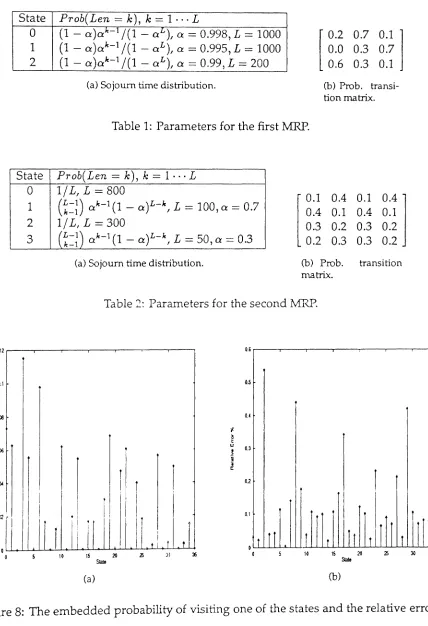
The first MRP has three states, the distribution of the sojourn time in each state is
truncated geometric with the parameters shown in table 1. The underlying probability
transition matrix is also shown in table 1. The second process has four states, the
distri-bution of the sojourn time in states 0 and 2 is uniform and in states 1 and 3 is modified
binomial. The parameters of the distributions and the underlying probability transition
matrix are shown in table 2. In both tables 1 and 2, the column marked Prob(Len
==
k)gives the probability that the sojourn time in a particular stateisequal to k.
The approximate superposition process was obtained as described insection 2.2 and
it is characterized by a MRP with 36 states. In order to validate the superposition process
we conducted a long simulation experiment and observed the statistical properties of
the superposition process. In the results shown below, the relative error for a measured . . d f d
I
:r(analytic)-:r:(JJimulation)I
100 h ( I · ) d (. I . )quantity x 15 e me as :r:(an-alytic) X , were z ana yttC an z sirrni ai.ioti
is the estimate of z as obtainedbyanalysis and simulation respectively.
'TJ.-L2 embedded probability of visiting a particular state and the associated rela.:»e
erroris shown in figure 8, the largest erroris 0.53%. We also show the mean sojourn time
in states of the superposition and the associated relative error in figure 9. The largest
relative error is approximately 5.7%. The results in figure 10 show the distribution of
sojourn time between two arbitrary source-destination pairs. The first pair is [(1,1),(1,0)]
and [(1,0),(2,1)], while the second pair is [(0,0),(0,1)] and [(2,1)/(0/0)]. The analytic and
simulation results are almost identical.
The approximation model was observed, in general, to be accurate. We have
experi-mented with other types of distributions and different processes and found the accuracy
to bereasonable. Also, we observed that the more the states' sojourn time distribution
re-sembles a mernor vless distributions, the better the approximation is. This isdueto the fact
thatif all the sojourn time distributions are memoryless the approximate superposition is
State Prob(Len
==
k), k==
1 ...L0 (1- a)a.l.:-1/ (1 - 0:£),a
==
0.998,L==
10001 (1 - a)ak- 1/(1 - o:L),a
==
0.995, L==
10002 (1 - a)ak-1/(1 - aL) , a
==
0.99, L==
200[
0.2 0.7 0.1]
0.0 0.3 0.7
0.6 0.3 0.1
(a) Sojourn time distribution. (b) Prob. transi-tion matrix.
Table 1: Parameters for the first MRP.
State Prob(Len
==
k), k==
1 ... L0 I/L, L == 800
1 (~=D ci-1(1 - a)L-k, L
=
100,a=
0.72 1/ L, L
==
3003
(~=D
a k-1(1 - a)L-k, L=
50,a=
0.3(a) Sojourn time distribution.
0.1
0.4
0.10.4
0.4 0.1 0.4 0.1
0.3
0.2 0.3 0.2
0.2 0.3 0.3 0.2
(b) Probe transition matrix.
Table'2: Parameters for the second MRP.
0.6 0.5 o.~ i-~ t w 0.3 ~ i
..
cr:: 0.2 0.1 lS 20 10 • t!
I I I I t rIr
r
I
r, r
I
t ro o 0.1 0.12 o.~ o.cw o.~ (a) (b)
•
t
•
I
I
1
tiiriltl
30 1S 20
StBtt 10
o~"""""-L...L...L...L-..&...+-J-..L-..4--L-L..L..-L-LL.J~....L...-L..1...-L...-~...L....+-L.L.U o
.,.
~
w
!
i
..
cr:
35 30
25 10
o o 200
(a) (b)
Figure 9: The mean sojourn time in a state and the relative errore
..
.,.-,.,
01 '''~d'''''''"11~
o 10 20 jQ J)) 50 &0 70 80 00 100
l&r9~
100 200 ~ ~ 500 600 700 ~
lefYJt\
o~____'I..---'_--L_ _ _ L_ _ _ J __ _..J__~_ _
o
0.00<11
o.~
0.00:115
o0003r---r----,----r----r---.--~--- ...
0.01.»25
-,
+.
0.002 0.003
0.001
(a) ((1,1), (1,0)) -. ((1,0), (2, 1)) (b) ((0, 0), (0, 1)) -. ((2,1), (0, 0))
Figure 10: The distribution of the sojourn time between two arbitrary states.
5.2
Validation of the Statistical Multiplexer Model
In section 4 we presented a stochastic queueing model for the analysis of a finite buffer
FIFO statistical multiplexer whpse input is a MRP which can be the superposition of a
number of independent arbitraryonloff sources. We reportresults from two experiments
that have been carried out. In the two experiments the buffer size B was taken to be
40 and there was only one server (5 == 1) in the multiplexer. Inthe graphs showing the
obtained results, the curves labeled as detailed, aggregate, and simulationdemonstrate the
results obtained by characterizing the superposition process in terms of a l2-state MRP
obtained using the results from section 2.2; by characterizing the superposition process in
terms of a 3-stateMRP obtained by the iterative aggregation algorithm; and by simulation
respectively. We note here that confidence intervals for the simulation results are not
shown because they were very narrow. This is also true for the curves shown in the
remaining sections.
Exan1ple 1:In the first experiment, we let the multiplexer input be two homogeneous
onloffsources, where the on period is deterministic and the off periodishyper-geometric
with parameters given in table 3. The constant on period length is taken from the set
{28, 63, 108,167,251} providing a source throughputor {G.l, 0.2, 0.3, 004, O.S} respectively.
Figure 11 shows the results for this particular model. We again observe here the proximity
of the results obtained by simulation and detailed superposition. The results obtained by
the aggregate superposition model are less accurate.
Mean CV2\
Off period 251 1.5
I
Table 3: Parameters of off period for results in example 1.
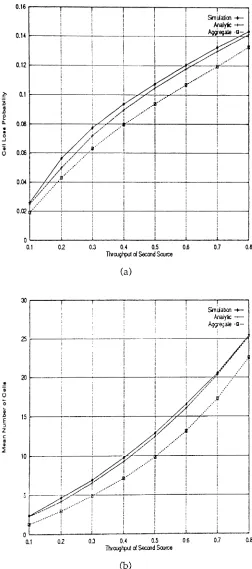
Example 2 -Heterogenous Sources: We tested the effect of source heterogeneity on the
accuracy of the queueing model by studying the case of twoheterogeneous onloffsources with hyper-geometric distribution for the on and off periods with the parameters shown
in table 4(a) and table 4(b). For the second source the mean on period
an
is adjusted suchthat the source throughput takes values fromL'1eset {O.l, 0.2,0.3,0.4,0.5,0.6,0.7, O.8}. The
throughput of the first source is fixed to 0.2.
: //,
.f~/
,.:
~;
./.;-! i ..
y
1 ...
····j4~
O~
02r--I---:--t---+---+---.;.---+-~£.J
025r--r--,---r--.,---r---r---~---.
£
~ 0.15r----r----:---~--+---+--,l't-..L---L--J
.8 o
n:
.
.
o..J
~
o
02 0.3 0.4 0.5 0.6
Uiization 0.7 0.8 0.9
(a)
I i··· ..
: . ' .~'
...~:~_-..:--~-_--.;..---o--~----J
.--':
0.5 0.6 J7
UHzalioo
0.8 0.9
(b)
Figure 11: Validation of statistical multiplexer model. Buffer Size = 40, two input on/off
sources with deterministic on and hyper-geometric off periods. (a) Cell loss probability,
0.16 r---r---r----r---~--.,r---..---Srn~a.licrl -+-~Y':-+ AW~·8-0.12 ~---.;.----.:..---~//""""'j
/ : ... I
/
.,
.., ~0.1r---T---:----+-~;.L_+-+---i---+----l
"i
o O.t))r---:-~~~--+---t---t---+---l
?'
~
~
e
~ o.~ r---r---r7~~~---1--~---4---J
.
o..J
/~/
...-/1 .. "~/
0.8
0.7 0.3 o.~ 0.5 0.6
Tht0J9~eXSocood~
02
O --""_ _--'--_ _...-_-...L_ _--L._ _..J..._----l
0.1
(a)
Srn~aba1
-+-Wytic~ Atr;e-;ate '8-2) .! "i o '0 ~ 15 E :J Z C l'll 0 ~ 10
2S1 - - - -: i ---~---..I{.
i
!
---/7r=--····_···_"'-,·
- + - --l---~. >
~~~
•• ( . / ,0.8
0.7 0.3 o.~ 0.5 0.6
fu0J9~ri Second So.1rD3
02
o\---_---.l.--~_-...Io..---~-_..oI_-~---..j 0.1
(b)
Figure 12: Validation of statistical multiplexer model. Buffer Size=40, two heterogeneous
detailed model and simulation results are pretty close, while the aggregate superposition
model is less accurate. The results are shown in figure 12. In example 1 the aggregate
model provided higher values than simulation, whereas in this case, it provides values
that are lower than simulation. It is not clear which parameters of the input sources
make the aggregation model give higher or lower values than the simulation results. We
observed the same behavior in the case of more than two input sources, discussed in
section 5.3.
Mean CV2
On period 62.5000 5.0
Offperiod 250 1.5
(a) Firs t source parameters
Mean CV2 On period 011, 5.0
Offperiod 250 1.5
(b)Second source parameters
Table 4: Parameters for example 2.
5.3
Valid ation of the Iterative Aggregation Algorithm
In sec:i~Jn3.2, we introduced an iterative algorithm based on the notion of aggregation to characterize the superposition process of N ~ 2arbitrary orr/off source. We study the accuracy of this algorithmbyexamining the following three examples.
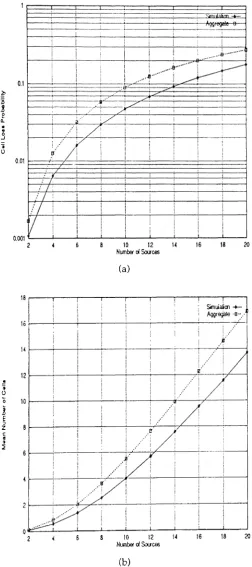
Example 1: We consider a finite buffer multiplexer with buffer size equal to 40 and one
server. All input sources are homogeneous and the on and off periods are hyper-geometric
with parameters shown in table 5. The throughput ofa single source is equal to 0.0385.
The number of input sources was increased from 2 to 20. The simualtion and analytic
results for the cell loss probability and the mean number of cells in the multiplexer queue
are shown in figure 13.
iV-lean CV2 On period 10.0 5.0
Off period 250.0 1.5
Table 5: Parameters of on and off periods.
These results indicate that the aggregation method does not have a good accuracy.
results. For this particular example, the iterative aggregation method seems to smooth
out the original superposition process bymaking it less bursty and less correlated. This
effect is magnified as the number of sources increases, because of the errors introduced
at each stage of the aggregation method. The aggregate superposition, however, still
captures the first order characteristics of the real superposition process and hence the
multiplexer witnesses a longer queue buildup and a larger cell loss probability as the
number of sources increases.
Example2:We consider the same multiplexer parameters and we let the
ani
off sourcehave a deterministic on period with length equal to 50 and a geometric off period with
mean equal to 1101.484. The throughput ofasingle sourceisequal to 0.0434. The number
of input sources was increased from2to20. The simualtion and analytic results are shown
in figure 14. We observe a similarbehavior as in the first example. However, in this case
the analytic results are doser to the simulation data than in the first example and they
provide
an upper
bound of the cell loss probability and themean
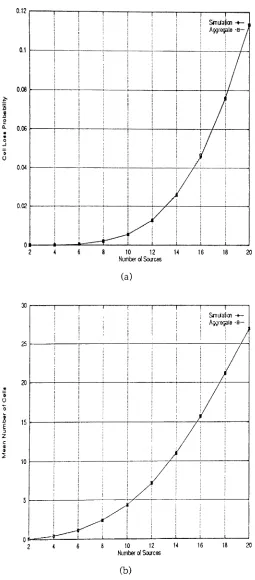
number of cells.Exam.pIe 3:Weconsider a finite buffer multiplexer with buffer size equal to 60 and one
server. PJlinput sources are homogeneous and the on and off periods are geometric with
means11.77and2:3.23respectively. The throughput of a single sourceisequal to0.05. The
number of input sources was increased from 2 to 20. The results are shownin figure 15.
We note that the aggregation method is accurate in the case of Interrupted Bernoulli
Processes. We can then conclude that the inaccuracy in the previous cases is not due to
the successive iterations but mainly due to the aggregation process which distorts the
statistical characteristics of the original superposition process. Inthe case of heterogenous
IBP'5, the accuracy of the aggregation is acceptable if the ratio of maximum to minimum
squared coefficient of variation of the inter-arrival time is small, as demonstrated in [3].
6
Studv of
.,;the Effect of Traffic Parameters on Queueing
Per-formance
In this section, we conduct a study of the effect of various traffic parameters on the
_. ..
-: Agg'~ -~
I
i ;i iI
i i
1----I i,
, ~ ~ .----: : ; I: l ...
-.
,
~~...' : :
/: I . i - » :~ I : : : :
/ i .>:.(1. i i I
/ .tr··· ! ! ! j !
./
.... j i I iI i
i
0.001 i I ! i j
: 1 : : : I
:
j : :
: :
! !
i ! \
i
:
I!
I i i i
O.COOl
2 10 12 1. 16 18 20
NumOOfclSxrces (a) 20 18 16
!
.~,
10 12NumCe" cJSxrces 12r l ---r----r--r-~----,.----,r---...--.,...---.! "i o '0
!
E :J Z c"
~ ~ (b)Figure 13: Validation of the iterative method. Buffer Size=40. All sources are identical and
have a hyper-geometric distribution for the on and off periods. (a) Cell loss probability, (b) Mean number of cells.
0.1 ~
s
~ 0 Il:..
0 .J "i o 0.01...
_.l-···_··t·_~
I / .
! /
/ " -I· " / ; : : ; : :: I : :
: : /
"ll
i i i, t
Sinuaioo
-+-A~r~~.•
?.:
Rt' ,': ...• 1
::I
1~ 12 .! ~ o '0 102
E :l Z C a:! ~ :i ..,~ i f.···· 20 18 16 10 12 14NUffiOOfciSxrces
o~_~_--..L--_--..&..._--"'---"'----_.-.-_-"--_.-...._---l
2
(b)
Figure 14: Validation of the iterative method. Buffer Size = 40. All sources are identical
with a deterministic on period and a hyper-geometric off period. (a) Cell loss probability,
20
18
16
10 12 14
NumwolSxrces
y
y
~
!: !I l: i .
j i !
.
:
: ! l ocs ~ :8 ] 0 n: 0.00·
·
0 ..J i o 0.04 0.12 r--~-.,---.---,---,--~----.---(a) 18 1610 12 14
NumbefdSxrces I 1 , ! , SrnLiaboo -+-A9J(EIjOlle
-8-I
Y
V
y
/
:rr:
I :i
:
I
i l l
:---' o 2 20 15 10
·
i o o Z E ::l Z c as Q :l (b)Figure 15: Validation of the iterative method. Buffer Size
=
60. All sources are identicalwith a geometric on and off periods. (a) Cell loss probability, (b) Mean number of cells.
6.1
Effect of the Distribution of the On and Off Periods on the
Multi-plexer's
Pe.rforrnarice
In this section, we study the effect of the distribution of the on and off periods on the
multiplexer's behavior. In the literature, it is common to approximate the distribution of
sojourn times in a stateby a geometric or a hyper-geometric distribution. The geometric
distribution characterization requires only the first moment, while the hyper-geometric
distribution characterization requires the first two moments. The question that usually
arises is whether these approximations are accurate. We consider an extreme case where
the original input source is correlated and then study how the multiplexer's performance
would change if the source is replaced by an IBP (sojorun times are geometric) or by
a source with hyper-geometric on and off periods. Note that in these two models the
inter-arrival times are uncorrelated. We consider a single server multiplexer with two
homogeneous input sources and abuffer size taken from the set{l O, 20, 30,40,50,60}.
The distribution of the on and off periods of the original input source is a mixture of
tvo deterministic distributions. The inter-arrival time lag-1 correlation is equal to 0.048.
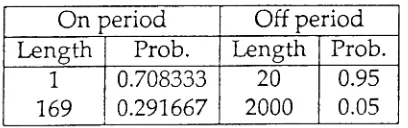
The parameters of the pdf of the on and off periods are shown in table 6. The throughput
of a single source is equal to 0.296, the mean on and mean off periods are 50 and 119
respectively, and the CV~ and the C~2ff are 2.332 and 13.150 respectively. Given these
values we can approximate the original source by an IBP source and a source with a
hyper-geometric on and hyper-geometric off periods.
On period Offperiod
Length Prob. Length Prob.
1 0.708333 20 0.95
169 0.291667 2000 0.05
Table 6: Parameters of the pdf of the on and off periods.
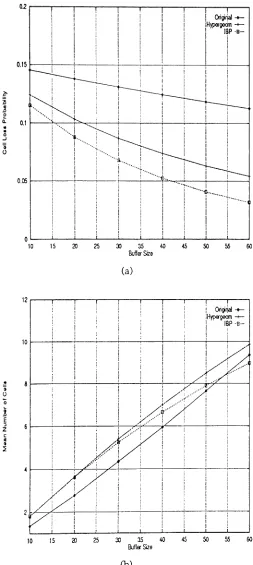
In figure 16 we plot the mean number of cells and cell loss probability for the
orig-inal source, the single-moment approximation by an IBP source, and the two-moment
approximation by a source with the hyper-geomtric on and off periods. The IEP model
underestimates the cell loss probability and overestimates themean number ofcells
(ex-cept when the buffer size increases above 52). This suggests that the rBPisnot a faithful
Sohraby [8] introduced a model for handling general on/off sources. The model
gives an approximate upper bound for the cell loss probabilityasa function of the first
two moments of the on and off periods assuming multiplexer with an infinite buffer
size. This suggests that only the first two moments of the one an off periods affect the
performance. However, the results in figure 16, demonstrate the inaccuracy of the
two-moment approximation when the buffer sizeisfmite. The approximate source model with
two-moments matching provides an underestimationofthecellloss probabilityandmean
number of cells. This shows that the two-moment approximation may not be accurate in all cases.
6.2
Effect of the Interrival-time Correlation of Traffic Sources on the
Mul-tiplexer's Performance
For an arbitrary onloffsource, the lag-l correlation coefficient of the inter-arrival timeis
gi\renby Calmes[4]:
fI
=
1on(1) -~
1
+
C~2jf - ~where
f
on(l) is the probability that the on periodis of length 1,on
is the mean on period,and
CV;}f
f is the squared coefficient of variation of the off period length. We have beenable to identify some distributions for which the value of ¢>l is non-negligible. The key
to obtaining such distributions is to concentrate a large portion of the probability mass at
length 1 of the on period distribution, i.e. make
fon(l)
as large as possible while satisfyingsome of the other source characteristics (e.g. given values of
on
and/or CV~.) Onesuch distribution is the
mixture of two deterministic distributions
whichisa distribution thatcan be of length L1 or ~ with probabilities p and 1 - p respectively. Wefix one of the
deterministic lengths to be equal to 1and let the other be of a variable length L. Given a
particularvalueof
an
and~ andtheoffperioddistribution, we canfind valuesforpand Lwhich would satisfy the given values ofo1l, and ¢>l using a simple enumerative algorithm.
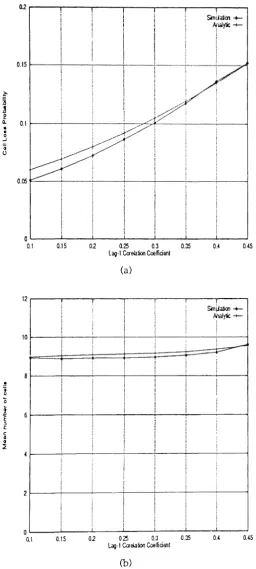
To study the effect of the inter-arrival time correlation on the multiplexer behavior, we consider the case of two input homogeneous sources where the off period of a source
I Ori~r}aI-+ iHyp«gocm
-+-I
I~P'8-I
!I
i
I
i
I
".s. ..i: i··· i
·'t··
'.
• 110"• • • •
0.1r---~--:~~---+----T---+--+--~-~----I
~
s
]o
cl:
.
.
o-'
~
o
·~····~····t
·_···-·L...
i iI !
i :
j i
45 SO 55 60
l) as 40
Bufter Size 2S
15
o~_'---'~-"'_--I._--L_---I.._--..L.._--!.._-L_...J 10
(a)
12
r--~.---,r----y---r-~-~---r---..,....----.
CKi9rlaJ-+-iHypa-QOOTl
-+-; lap ·8·-I
!
10 15 25 3) as 40
Buffer Size
45 50 55 60
(b)
Figure 16: Effect of the distribution of the on and off periods on the multiplexer's
Sin~atiQ1
-+-
~ytic-+-I
0.15
E
:8 / '
~ ~/
2
Q.
.
0.1 , /tl
0 .J
~
o
0.05
0.45
0.4 02 0.25 0.3 0.35
Lag-l Caelation Coefficient 0.15
O'"-_--A-_ _~_ _ _ L_ ____L__ _.L..__ __L_ ___l
0.1
(a)
12
10
r ! 1 I !
i i Sin~atio1
-+-:
i
I
r~ -+-!
!
I
~----!
:
o
Ql 0.15 02 0.25 0.3 0.35
Lag-I Caetltion Ccefficient
0.4 0.45
(b)
Figure 17: Effect of correlation on the multiplexer's performance. Buffer Size = 40, two
input onloffsources with hyper-geometric on and off periods. (a) Cell loss probability,
(b) Mean number of cells.
is fixed at 50, making the source's throughput equal to 0.35. Using the mixture of two
deterministic distributions for the on period, we vary
4>t
so that it takes values from theset {O.lO, 0.15,0.20,0.25,0.30,0.35,0.40, 0.45}. The value ofp and L satisfying the given
parameters is then calculated. The cell loss probability and the mean number of cells in
the multiplexer queue are shown in figure 17.
We note that by increasing the lag-l correlation, the cell loss probability and the mean
number of cells increase. As it can be seen from figure17,the cell loss probability increases
more sharply than the mean number of cells with the increase of the correlation coefficient.
The mean number of cells is almost constant and increases very slowly with the increase
of the correlation coefficient.
6.3
Effect
of the Squared Coefficient of Variation of the on and off periods
on the Multiplexer's Performance
Using the versatile hyper-geometric distribution we studied the effect of the squared
coeffident of variation of the on and off periods, respectively CV;. and cvo~f' on the
multiplexer's performance. Byspecifying the mean and squared coefficient of variation of
the period length, itispossible to fit a hyper-geometric distribution given some conditions
are metbythe specified mean and coefficient of variation ( see [2]for more details).
We considered two input sources each with a throughput fixed at0.4. The mean on and
off periods were fixed at 100 and 150 respectively. CV;. andCVo
2
f! take values from the set
{l.O, 5.0, 10.0,15.0.20.0}. The results obtained from simulation and detailed superposition
are shown in figure 18. Note that by increasing the CV~, while CVo~f is kept constant,
both the cell loss probability and mean number of cells increase (see parts (a) and (b) of
figure 18). Also, note that the rate of increase of the mean number of cells and cell loss
probability whenCV;. E [1,5]islarger thanfor the rest of the values. Moreover, for larger
values of CV;ff' the rate of increase of cell loss probability and mean number of cells
as a function ofCV;. is relatively slower than for smaller values of
cV;J
J. A surprisingresult is observed when varying C~2ffwhile CV~ is kept constant (see parts (c) and (d)
of figure 18). As CV;ffincreases, the cell loss probability
increases
while the mean number17
-y---
_
~ orr CV2 - 1
... orr CV2 - 5
...- orr CV2 - 10
•••~•... orr CV2 - 15
... orr CV2 - 20
20 15 10 .
...
~.~ ~...•...
~.
.-
..
-.,... D ••· · · - · · · ·
~./.
". o::
:::~·
/
r:-:;.··:::::·:·_···-/ ..~P:::"~·
A/;~~~~~;::::~····
~
....
o 15
13
12-t---r----~---
...
- - - . . : I~
o
20
--...- orr CV2 - 1
•• - .... _. OrT CV2 - 5
._..,..._. OrT CV2 - 10
•• _,;r._'OrT CV2 - 15
.•-..,..._. orr CV2 - 20
0.1'70 0.165 0.160 >. +oJ orl ~ 0.155 ~e ~ 0.150
..
'" S 0.1.t5 ~ ~ u 0.140 0.135 0.130 0OM CV2 OM CV2
(a) (b)
0.1& - , - - - 1&
-r---20 ····0-..·ow CV2 - 1.0
····0--· C)II CV2 - 15
.0' • .,. __ ' 0If CV2 - 20
• • • • • • • _ . ()tlI CV2 - 5
o
12-+- -....
---J
15
..
.... ....~ tJ ~ 0 ~ 14i
:z: ~ :i 13 20- . . . . - OM CV2 - 1 . -. . . _- OM CV2 - 5
._••• _ - OM CV2 - 1. 0
._~o---OM CV2 - 1.5
.-...,._- ow CV'2 - 20
o
O.1..t
O.1~
0.13-+--+---1
orr CV2 orr CV2
(c) (d)
Figure 18: Effectofthe squared coefficient of variation of the on and off periods on
mul-tiplexer's performance. Buffer Size
=
40, two inputani
off sources with hyper-geometricon and off periods. (a) Cell loss probability vs. CV;'. (b) Mean number of cells vs. CV;'.
(c) Cell loss probability vs. CV;ff' (d) Mean number of cells vs. CV;ff'
7
Conelusions
In this paper we presented a new approximation method for characterizing the
superposi-tion of multiple independent Markov Renewal Processes. The presentasuperposi-tion here focused
on discrete-time processes, but the methodology is readily applicable to continuous-time
processes with little modification. The model developed for characterizing the
superpo-sition can be directly applied to the area of tele-traffic engineering and statistical
multi-plexing. One special case of this model is the arbitrary
onl
off source that was used in thispaper. We have presented a queueing model for the analysis of a statistical multiplexer
whose inputis a :rvfRP representing the superposition of multiple traffic sources.
The advantage of our methodology is that it provides a uniform framework in which
a variety of models of traffic sources can be handled. The basic limitation is the huge state
space and the computational complexity of the algorithms. These disadvantages can be
overcomeifan elegant state aggregation scheme is found such that the resulting aggregate
process has a number of states which is preferably a linear function of the number of
sources while still preserving the characteristics of the real superposition process. We
introduced an aggregation scheme for reducing the dimensionality of the superposition
process. However, during the aggregation, the statistical properties of the original process
may be distorted and may subsequently lead to inaccurate results for the multiplexer's
performance metrics.
The work presented here introduces many challenging issues. An important problem
that is yet to beconsidered is the characterization of the departure process from a
mul-tiplexer with multiple arbitrary orr/off input sources, or in general, with an :rvfRP input.
Characterizing the departure process of one of the input sources isev~nmore challenging.
The methodology presented here introduced a new versatile modeling device for arrival
processes which can be called the Batch Semi-Markov Arrival Process (B-SMAP). This is
a semi-Markov process with as many states as necessiated by the physical source being
modeled, and in which the sojourn times in states are arbitrarily distributed. This process
is analogous to the well-known BMAP. However, it is more flexibile than a BMAP but
References
[1] W. P. CherryandR. L.Disney. The Superposition of Two Independent Markov Renewal
Processes. Zastosowania Matematyki,17:567-602, 1983.
[2] T.E. Eliazov, V. Ramaswami, W. Willinger, and G. Latouche. Performance of an ATM Switch: Simulation Study. In Proceedings of theIEEEInfocom, pages 644-659, 1990.
[3] K. M.Elsayed andH. G.Perras. AComputationally Efficient Algorithm for
Character-izing the Superposition of Multiple Heterogeneous Interrupted Bernoulli Processes. Submitted for publication, 1994.
[4] S. Calmes. Analysis of On-Off Processes With Independent Arbitrary Distributions. Unpublished technical report, North Carolina State University, 1992.
[5] J. Hunter. Mathematical Techniques of Applied Probability. Volume2: Discrete TimeModels: Techniques and Applications,chapter 9. Academic Press, 1983.
[6] V. S. Korolyuk. Superposition of Markov Renewal Processes. Cybernetics, 17:556-560, 1981.
[7] M. F. Neuts. Matrix-Geometric Solution in Stochastic Models: An Algorithmic Approach.
John Hopkins Univ. Press, 1981.
[8] K. Sohraby. On the Theory of General On-Off Sources With Applications in High-Speed Networks. In Proceedings of the IEEE Infocom, pages 401-410, 1993.