ABSTRACT
SNEAD, ROBIN LYNNE. Tracing Activity: The Multimodal Composing Processes of First-Year Writing Students. (Under the direction of Dr. Susan Miller-Cochran).
This ethnographic study examined the composing processes of novice multimodal
composers as they developed digital autoethnography videos for an assignment in a first-year
writing course at a large southeastern university. Participants included six student volunteers
from a single section of the university’s required first-year writing course. The research
questions focused specifically on the processes the students engaged in when composing
multimodally, how they made rhetorical choices and decisions, and how they navigated the
use of various technologies as they composed. Data was collected over a seven-week period
(the duration of the students’ work on the project) through classroom observation, interviews,
written reflections, collection of project artifacts, and screen capture recording. The data
indicate that students engage in two phases of intellectual work as they compose
multimodally. While the phases are distinct in the types of actions and operations involved,
they are recursive, intertwined, and interrelated. Students’ choices and decision-making are
influenced by a wide range of textual and contextual factors, including the mediating nature
of their tools of inscription. Students use trial and error as well as resources such as YouTube
and Google to navigate unfamiliar technologies as they compose. The results suggest a new
model of composing involving phases of conceptualization and actualization, and indicate
that further study is needed into the roles of technological anxiety, off-task activity, and
procrastination in composing. Further, results indicate that multimodal assignments do
© Copyright 2013 Robin Lynne Snead
Tracing Activity: The Multimodal Composing Processes of First-Year Writing Students
by
Robin Lynne Snead
A dissertation or thesis submitted to the Graduate Faculty of North Carolina State University
in partial fulfillment of the requirements for the degree of
Doctor of Philosophy
Communication, Rhetoric, and Digital Media
Raleigh, North Carolina
2013
APPROVED BY:
_______________________________ ______________________________
Dr. Susan Miller-Cochran Dr. Christopher Anson
Committee Chair
BIOGRAPHY
Robin L. Snead is a scholar with primary research interests in multimodal
composition and pedagogy. She is also interested in issues of digital literacies and writing
program administration. Prior to her graduate work in Communication, Rhetoric, and Digital
Media at North Carolina State University, Robin received her MA from the University of
North Carolina at Pembroke, and her BA from the University of North Carolina at Chapel
Hill, both in English Education. She taught Communication Skills and English for twelve
years in the public schools, and earned certification from the National Board for Professional
Teaching Standards in 2001. She currently holds NC teaching certification in English, grades
9-12; Communication Skills, grades 6-8; and Academically Gifted Education, grades K-12.
Robin has seven years of experience as an instructor of composition in higher
education. She teaches at the University of North Carolina at Pembroke, where she works
primarily with a group of at-risk, basic writing students in a freshman bridge program, both
as their instructor and their advisor.
As a part of her doctoral work at NC State, Robin has completed research on
multimodal composition, composition pedagogy, digital literacies, and the staffing of
first-year writing programs. She has given presentations at the national Conference on College
Composition and Communication (CCCC), Computers and Writing (C&W), the Southern
States Communication Association annual conference (SSCA), and several other local and
regional conferences. Her research bibliography titled “Transfer-Ability: Issues of Transfer
and FYC” was published by WPA-CompPile, and she has two forthcoming collaborative
ACKNOWLEDGMENTS
Although I don’t really remember this myself, my mother tells a story of the day she
was awarded a second Master’s Degree, and our family attended her graduation ceremony. It
was the first time I’d ever seen graduation regalia, and I was, apparently, in awe. When
mama tells the story, she says that I was “not at all impressed” with her robe, or hood, or
mortarboard. Instead, I wanted to know when she was going to get her “funky hat,” my
childhood description of the doctoral tam. She replied that she would likely never get one of
those, that she would leave that up to me. A journey was set in motion. And what a journey
that has been.
I have not taken the traditional route to the PhD. Most people don’t enter a
face-to-face PhD program ninety miles from home with no ability to move, at age 36, while teaching
full time at another university, and while also raising a child as a single mom after a
separation and later a divorce. That has been my path. Call me crazy. I consider myself
lucky. Not everyone has this opportunity. I am grateful. Through the good times as well as
the frustrating ones, I have always been grateful.
Many, many people have helped me along this path, particularly as I completed this
dissertation. First, I have the most fabulous committee any graduate student could hope to
have. Rock stars, each one of them. My chair, Dr. Susan Miller-Cochran, has helped me to
navigate my less-than-traditional path, helped me think through the conceptualization of this
study, and provided guidance and support along the way. She also has an innate ability to
know when I’m about to fall over the proverbial ledge! Dr. Chris Anson, Dr. Deanna
pushed me to think and to think again. I know that their thoughts have made this a better
project. I would also like to acknowledge of Dr. Nancy Penrose, whose assistance during a
directed readings course helped me to determine the focus for this study. Dr. Jason Swarts
introduced me to activity theory, and although it took some time for me to understand its
usefulness, I am most appreciative. I would be remiss not to thank Dr. Kenneth Zagacki, who
taught me in my first semester of doctoral study, agreed to direct my first directed readings
course, and most graciously stepped in to substitute for Dr. Deanna Dannels who was unable
to attend my defense.
Throughout my program, I have had a wonderful cadre of colleagues in my cohort
who have been critical to my success in graduate school. A few deserve special recognition. I
would like to thank my “twin” Dana Gierdowski for her unwavering support, insight, and
collaboration, and Jen Ware for her technical help and ideas. I thank Dana, as well as Lauren
Clark and Wendi Sierra, for performing reliability checks on my data. Wendi has been my
long-distance writing partner in the last crazy weeks of writing, and our “check ins” offered
both motivation and morale maintenance. Finally, Kevin Brock never once failed to
respond—and quickly—to my emails or my status updates on Facebook when I was stuck. I
am grateful for the friendships developed with each of these individuals, as well as with
others I’ve met through the program.
I owe a huge debt of gratitude to the instructor who welcomed me into her class, and
who, unfortunately, must remain unnamed here to protect the confidentiality of the study.
conferences, and to ask questions, she has continued to provide support and answers long
after the official observations ended. She is a gem.
I have met many wonderful people in my time at NC State who are always willing to
share their time and their ideas. Although there are too many to single out here, I truly
appreciate and value each and every one of them. When people ask me, jokingly, how this
UNC-Chapel Hill graduate could ever choose NC State for graduate school, it is very easy
for me to respond. It’s the people. They are the best.
I also wish to acknowledge the support of my colleagues and the administration at
UNC-Pembroke. I would not have been able to complete this degree without the financial
support from the Native American-Serving, Non-tribal Institution Grant (NASNTI) that
offered partial funding in the early stages of my study. I am grateful for the support of my
colleagues in the College Opportunity Program and the encouragement of those in the
English department.
I also thank my family. My parents have always supported me in every way possible
and have always believed in me no matter what. My uncle, a former Vice Chancellor for
Development at Appalachian State University, has consistently encouraged me through this
process. Finally, there is my son, Andrew. I will never be able to make up for the sacrifices
my son has made to enable me to complete this degree. In the space of his life that he can
TABLE OF CONTENTS
LIST OF TABLES... xi
LIST OF FIGURES ... xii
INTRODUCTION ... 1
CHAPTER ONE: REVIEW OF LITERATURE ... 9
MULTIMODALITY... 9
Defining Multimodality ... 9
Legitimizing Multimodal Means of Communication... 15
Focusing on Multimodality in Composition Courses ... 18
Theoretical Perspectives ... 21
Developing Multimodal Compositions ... 29
WRITING PROCESSES... 32
An Overview of Process Scholarship ... 32
Representations of Multimodality in Process Scholarship ... 38
Process and Rhetorical Invention ... 43
Concluding Thoughts ... 45
THE MULTIMODAL COMPOSING PRACTICES OF FIRST-YEAR COMPOSITION STUDENTS... 47
CHAPTER TWO: METHODS... 50
SAMPLING AND SITE DESCRIPTION... 54
PARTICIPANTS,DEMOGRAPHICS, AND BACKGROUNDS... 60
Writing Experience ... 64
Familiarity and Comfort with Technology ... 67
INSTRUCTOR PROFILE AND COURSE DESIGN... 75
Instructor Profile ... 75
Course Project Design ... 76
Researcher Role ... 82
Screen Capture Recording ... 85
Interviews ... 86
Work Samples... 89
DATA ANALYSIS... 89
CHAPTER THREE: RESULTS FROM OBSERVATION, INTERVIEWS, AND STUDENTS’ WRITTEN REFLECTIONS... 95
ACTS OF COMPOSING... 95
Inventing ... 97
Assembling, Arranging, and Coordinating ... 105
Navigating the Tools ... 109
Crediting Sources... 118
Procrastinating ... 119
INFLUENCES ON INVENTION... 122
Exigency and assignment limitations... 123
Instructor Influence... 127
Purpose and Goals... 131
Intertextual Influences ... 133
Influences on Modal Possibilities ... 139
Awareness of Audience Expectations... 147
Interactions with Others about the Text... 150
Limitations of the tools of inscription or the user’s knowledge of those tools ... 156
Students Perceptions and Feelings about the Project ... 157
SUMMARY... 160
CHAPTER FOUR: RESULTS FROM A SINGLE STUDENT’S SCREEN CAPTURE ... 161
BACKGROUND INFORMATION ON TYLER... 161
ACTIONS RELATED TO INVENTION AND DECISION MAKING... 169
Interacting with classmates and the instructor ... 170
Scripting ... 172
Searching for Material... 184
ACTIONS AND OPERATIONS OF ASSEMBLING THE VIDEO... 188
Exploring the technology ... 190
Adding still images... 192
Adding audio ... 195
Adding video footage ... 198
Adding citations, titles, captions, and credits ... 200
Manipulating visual effects, transitions, and timing... 205
Cross-checking with the script... 208
ENGAGING IN UNRELATED ACTIVITY... 208
SUMMARY... 211
CHAPTER FIVE: ANALYSIS AND CONCLUSIONS... 212
OVERVIEW OF THE STUDENTS’PROCESSES... 214
THE COMPLEX SYSTEMS IN MULTIMODAL COMPOSING... 215
Conceptualization and Actualization ... 221
Invention, Decision-Making, and Influences on Invention ... 229
Acts and Operations of Production... 240
Navigating the tools of inscription... 243
Off-Task Activity and Procrastination ... 246
ANSWERING INSTRUCTOR CONCERNS... 252
“When I teach multimodal composing, am I really teaching composition?”... 252
“If I teach multimodal composition will the focus on technology detract in significant ways from a focus on rhetorically-based composition instruction?” ... 257
LIST OF TABLES
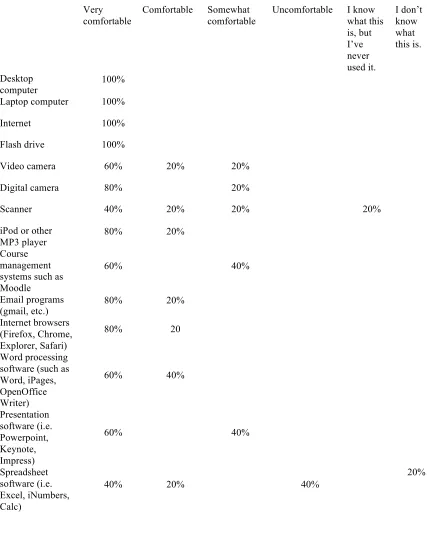
Table 1. Participants’ self-‐reported familiarity with various technologies...68
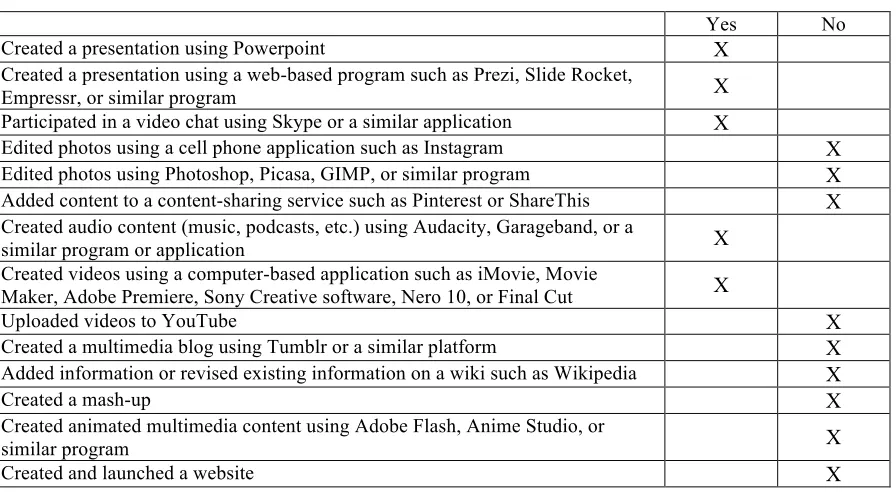
Table 2. Participants’ self-‐reported past uses of technology...71
Table 3. Participants’ preferences and beliefs about technology use...74
Table 4. Tyler's self-‐reported familiarity with various technologies... 164
Table 5. Tyler's self-‐reported past uses of technology... 165
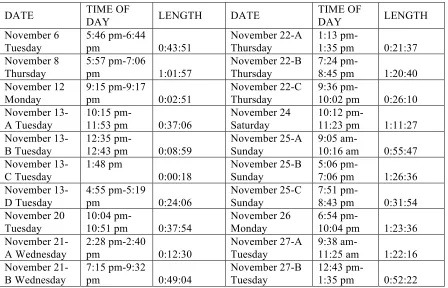
Table 6. Dates and lengths of Tyler's screen capture recordings... 166
LIST OF FIGURES
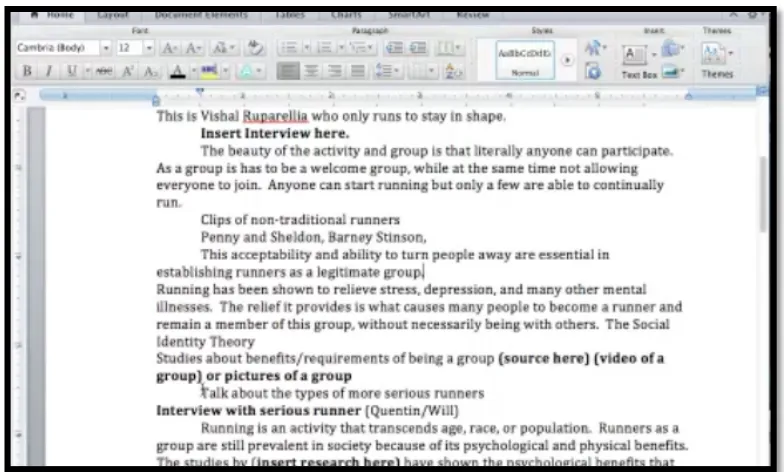
Figure 1. A screenshot from Tyler’s script-‐in-‐progress...99
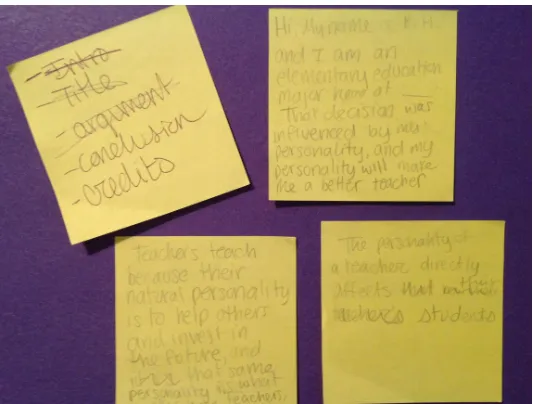
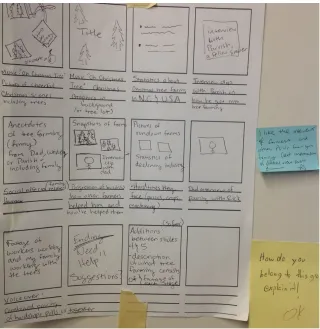
Figure 2. A sampling of Amanda’s post-‐it notes used for planning. ... 100
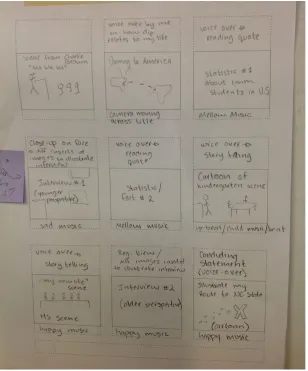
Figure 3 Maryam's storyboard ... 102
Figure 4 Catherine’s storyboard with comments from her classmates... 103
Figure 5. First part of the assignment sheet for project 3: Digital autoethnography. ... 124
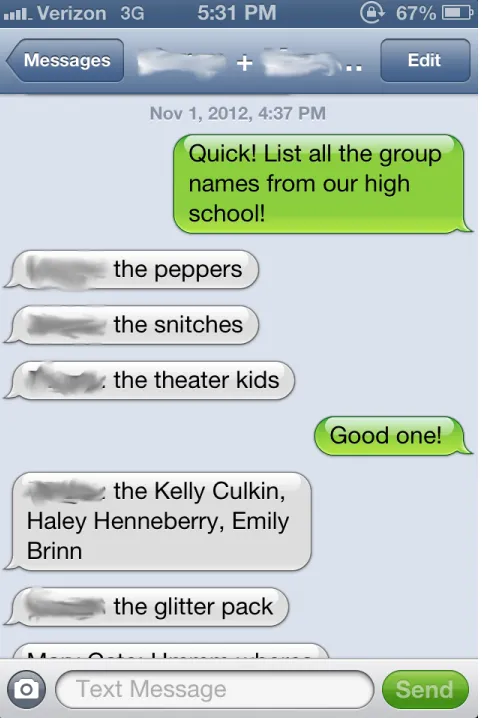
Figure 6. One screen shot from Morgan’s text messages with friends... 152
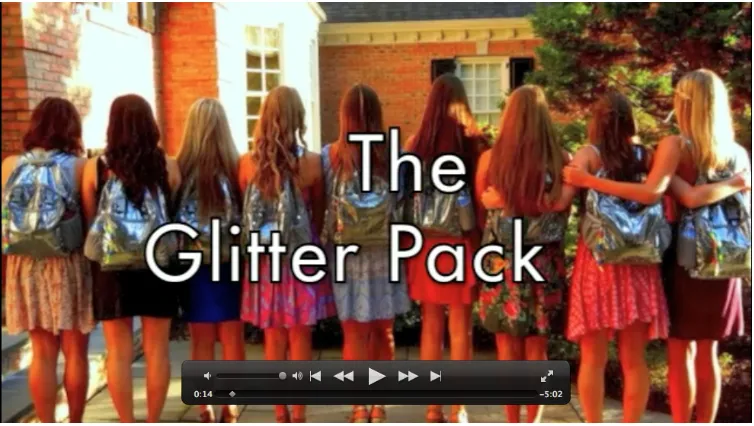
Figure 7. A screen shot from Morgan’s video showing “the glitter pack.”... 153
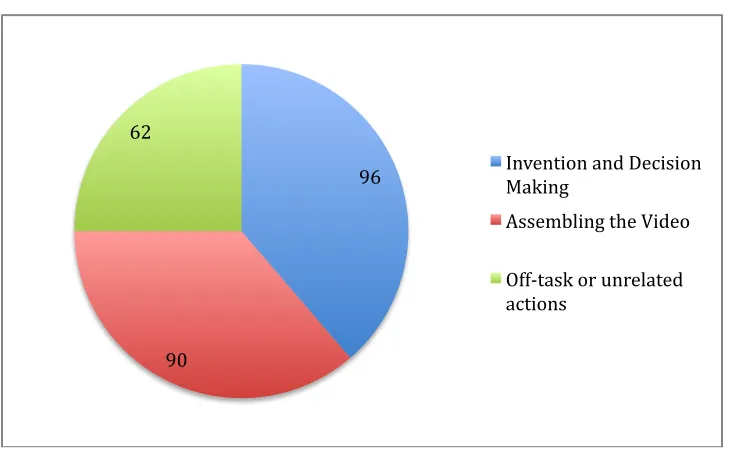
Figure 8. Number of actions within themes in Tyler's screen capture recordings... 168
Figure 9 Number of actions within categories in the theme of Invention and Decision Making ... 169
Figure 10. A screenshot from the 00:00:00 mark of the November 20th capture... 173
Figure 11. A screenshot from the 00:10:41 mark of the November 20th capture... 174
Figure 12. Screenshot from the 00:10:55 mark of the first November 21st capture. ... 176
Figure 13. A screenshot from the 00:11:44 mark of the first November 21st capture. 177 Figure 14. A screenshot from the first November 21st capture, showing the "cutting" of material that is to be relocated... 178
Figure 15. A screenshot from the first November 21st capture, showing the new location of previously "cut" material. ... 179
Figure 16. A screenshot from a November 21st capture showing the artifact ecology of source material and script... 181
Figure 18. A screenshot from November 8th showing reminders and placeholders.... 183
Figure 19. The iMovie interface, labeled. ... 189
Figure 20. Tyler selecting an image from his downloads folder... 194
Figure 21. Tyler dragging an image from his downloads folder into the storyboard. .. 194
Figure 22. Tyler recording an audio track in Audacity. ... 197
Figure 23. Tyler dragging the audio file "Transition" into the storyboard. ... 197
Figure 24. The iMovie interface just after Tyler imported an interview... 199
Figure 25. Tyler adding a citation for an image. ... 201
Figure 26. A screenshot from Tyler's video, showing part of his thesis statement... 203
Figure 27. A screenshot from Tyler's video showing an interview with a superimposed question. ... 204
Figure 28. Tyler adjusting the Ken Burns effect... 206
Figure 29. Tyler adjusting the length of an image... 207
Figure 30. Frequency Tyler's off-‐task activity by work session date... 209
Figure 31. Tyler's activity system... 217
Figure 32. Acts of Composing... 222
Figure 33. Diagram of the writing process emerging from this study ... 224
INTRODUCTION
About a year ago, I began working to build a website that accurately reflects my
scholarly identity, a website that might offer visitors a snapshot of who I am as a teacher, as a
researcher, as a thinker, as someone who might make a useful contribution to the somewhat
stable, somewhat dynamic field of Rhetoric and Composition. Constructing this website has
been a challenge for me. Even as a PhD student in Communication, Rhetoric, and Digital
Media, I had no prior experience with HTML code, and only pedestrian knowledge of issues
of design, typography, layout, and readability. Although I have studied theories of
multimodality, analyzed the multimodal work of others, and opened assignments in my
classes to modalities beyond alphabetic text, I have been paralyzed by the development of
this website, a website that serves as a representation of my identity, that conveys a rhetorical
message about what matters to me. Further, learning how to make the site “do” what I want
it to do—learning to link the pages, developing the navigational tools, focusing on
usability—have all been challenges. These are not things I was trained to do in any of my
courses on writing, rhetoric, or teaching. It is as if I need to learn to compose all over again in
a new language. As much as I am an experienced writer, I am a novice composer of web
sites. This sort of composing is different; in many ways, it is more complex. Deciding what to say is one thing. Deciding how to say it, with all of the choices available, is another.
As I continue to work through the processes involved in completing this website, I
have relied on a wide variety of resources available to me. I am fortunate to have colleagues
fluent in HTML with whom I can discuss my ideas and who can help me to manipulate the
visual impact of the website, ensuring that theme selection, color choice, layout, images, and
navigation contribute positively to the site’s overall effect. Printed guidebooks (I’ve become
quite familiar with the “for Dummies” series) and online information have proven valuable
when a “how to” issue temporarily stymies progress, or when something just doesn’t work as
it should, and there have been many of those moments. My own rhetorical training has been
beneficial in making decisions related to purpose, audience, and content, as well as in
thinking about the multimodal elements of the site. The processes involved in composing
this website have included not only my own individual work with writing the content and
selecting the images for the site, but also my engagement with an interactive network of
knowledge and support, a network that has assisted me in making and enacting rhetorical
decisions. Developing the site has been a collaborative experience, and, as much of the
collaboration has occurred remotely, it has truly been “netWORK” (Nardi, Whittaker, &
Schwarz, 2002).
The experience of designing my first website, as limited as it has been, as well as
working with students on audio and video projects, has taken me well outside of my “writing
comfort zone.” These experiences have highlighted for me the complexities of composing for
media other than 8 ½ x 11” paper, and of composing in modalities other than alphabetic text, particularly when such compositions involve the use of current technologies and new media.
As a composition instructor whose life’s work is teaching students to write, this has been
enlightening. It has called me to question and consider what existing rhetorical knowledge
and skills “map on to” the task of composing multimodally, as well as what other knowledge
I am reminded by this experience of Mary Louise Pratt’s 2002 talk at the MLA
Conference (Pratt, 2002), in which she discussed the destabilization of the monolingual
emphasis inherent in the MLA’s division of scholarship into English and foreign languages
by the growing multilingualism in the United States. While Pratt’s talk (and its later
publication in the PMLA) focuses specifically on linguistic issues, those of us in Rhetoric and Composition are in the midst of a similar destabilization of the singular focus on the
alphabetic for “writing” and for our writing courses. Although my personal experience with
different types of composing is recent, relatively speaking, this destabilization is not new
within the discipline. As Takayoshi and Selfe (2007) note “It is fast becoming a
commonplace that digital composing environments are challenging writing, writing
instruction, and basic understandings of the different components of the rhetorical situation
(writers, readers, texts) to change” (p. 1). To scholars in writing studies and rhetoric and
composition, our discipline is at once both familiar and foreign.
As technologies change and shift, so, too, do our notions of what it means to write. In
the words of the Writing in Digital Environments (WIDE) Research Center Collective
(2005), “Writing no longer means merely words on the printed page. Today, writing means
selecting among and scripting multiple media, including photographs, charts, video, images,
audio, diagrams, hyperlinks, and more” (“How Should We Teach Digital Writing?”).
Writing is, as claimed by Kathleen Blake Yancey (2004b), “made not only in words” (p.
297). It is multimodal.
Multimodality has deep historical roots. In fact, Gunther Kress (2010) argues that
meaning has always been multimodal” (p. 174). Elizabeth Birr Moje (2009) cites Heath and
Wollach, who trace the interdependence of communication modes to the Middle Ages, when
illuminated manuscripts bore witness to the interplay of text and image in early written
documents. Gleick (2012) shows that multimodality goes back even farther, to the
beginnings of symbolic thought evidenced in cave painting. As Kress (2010) notes, many
common media of communication, including road signs, blend word, image, and color to
relay meaning. Increasingly, sound and video are being added. Takayoshi and Selfe (2007)
point out that multimodality “has been encouraged” throughout history as evidenced by
“engraving, film photography, recording devices, animation, and television” (p. 7).
Multimodality is not entirely new to the academic discipline of writing studies, either.
In his historical account of multimodal pedagogy, Palmeri (2012) outlines “the vivid,
multimodal scenes that flourished in our field’s past” (p. 5) and the “multimodal approaches
to writing pedagogy” (p. 14) in our disciplinary history, calling specific attention to the work
of Berthoff, Smitherman, Murray, Elbow, Moffet, Corbett, and Shor, as well as to the work
of process researchers who “conceptualized alphabetic writing as a deeply multimodal
thinking process that shares affinities with other forms of composing (visual, musical, spatial,
gestural)” (p. 25).
Multimodality is an intrinsic part of communication, and is not limited to the digital
realm; however, the ubiquity of digital technologies has invigorated attention to and interest
navigate composing in digital spaces utilizing more than one semiotic mode to create a text1. For example, how do students decide what should be shared visually as opposed to textually?
How do they make decisions regarding sound? Also, how do they learn to use technology
that may be unfamiliar to them but is necessary to complete the project? It is in such
composing spaces and situations that students face not only complex rhetorical choices
regarding modality, but they also must learn to work with and within the technologies they
utilize as they compose. While I would not argue with the assertion that working with any less familiar medium poses challenges, digital technologies can prove particularly tricky,
especially if the user is unfamiliar with the software or applications. Technology choice
shapes the potentials for compositions and affects the final product, as does a writer’s
experience and knowledge in using the technology. Further, as Kress and van Leeuwen
(2001) explain, “production and distribution produce their own layers of signification” (p.
20). Because composing with digital technologies is a more complex, layered act of
composing than writing an essay on a pair of pointe shoes or on a t-shirt (Shipka, 2011) (acts
which, although certainly different materially, involve the more familiar action of
handwriting alphabetic text with a writing implement), and because such acts of composing
are more likely to serve students well in their composing situations beyond the first-year
composition course, this may be the more productive and useful approach to incorporating a
multimodal focus into composition classrooms. Such a focus is also more likely to address
concerns about 21st century literacies and preparation for the world of work as well as concerns about bridging students’ in-school and out-of-school writing practices, while
incorporating multiple ways of knowing, acts of creativity, and complex rhetorical awareness
and decision making.
In “Rethinking research on composing: Arguments for a new research agenda,” Odell
and Prell (1999) wrote:
What we have needed for at least a decade, and what we must have soon, is a period
of vigorous research on composing. Not just writing—composing. To modify a
phrase from Richard’s Philosophy of Rhetoric (1965), we need studies not solely of ‘the interanimation of words,’ but the interanimation of words, visual images, and
page (or screen) design. (p. 295)
Unfortunately, over a decade after this call, Composition Studies still lacks such a body of
research. As communication increasingly becomes more digital, and allows more integration
of semiotic modes, the need to study multimodal composing in digital spaces becomes more
imperative. At this point, we’ve developed theories about multimodality (Kress, 2010;
Rowsell, 2013; Wysocki, Johnson-Eilola, Selfe, & Sirc, 2004), we’ve composed
multimodally ourselves (Sheppard, 2009; Shipka, 2011; Sorapure, 2006), we’ve assigned our
students multimodal projects (Anderson, 2003; Anderson et al., 2006; Hess, 2007; Jones,
2010; Shipka, 2011), and we’ve written about why multimodality is important and belongs in
the Composition classroom (Selfe, 2009; Takayoshi & Selfe, 2007; WIDE, 2005). What we
have not done enough of is to study, in an empirical, “RAD” (Haswell, 2005) way, how our
theories play out in praxis with student composers. We need to return to earlier process
studies, and to complete similar types of research with digital, multimodal composition,
examines how interaction with even more, and perhaps less familiar, technology affects
composing, and how composing differently, using multiple semiotic modes rather than
alphabetic text alone, changes what we know about composing processes. When
environments for composing change, so, too, do composing practices (WIDE, 2005).
Changed composing spaces require new tools, skills, and strategies to produce different types
of texts. This requires that we adjust our approaches to teaching composition. However, we
should not assume that we know, without careful examination, what specific adjustments
should be made. Instead, we need to study what students do when they compose
multimodally, and to compare that with what more experienced multimodal composers do.
This will allow us to understand what new skills and strategies are required in order to
compose effective multimodal compositions. Then we can adjust our approaches
accordingly.
I have always written with my students. Frequently, I will compose a paragraph as
they observe, or along with them as they offer input. I want them to see that I, too,
sometimes struggle to put words together, that I change my mind about what I want to say,
that I often delete more sentences than I write. I am always mindful, though, of the students’
perceptions of my writing processes and my writing ability, articulated a few semesters ago
by one student who said “even as much as you work on your paragraph, we have to work
even harder. We don’t have the same amount of practice you have. We can’t recognize what
is good or not-so-good in our writing like you can.” Jaylan is right. The skills and strategies I
may need, after decades of writing practice, are different from the skills and strategies my
As we move to working in different composing spaces, with differently shaped
products, research such as the present study is needed to determine what existing knowledge
about writing processes may transfer from alphabetic writing into multimodal composing,
and what about multimodal composing is entirely different. Such research is needed to
develop pedagogical approaches and instructional strategies appropriate to helping our
students become thoughtful, critical composers of multimodal texts. This dissertation,
focused on describing what novice, student composers of multimodal text do as they
compose, may begin to fill that research need.
In chapter one, I offer a review of relevant literature in the areas of multimodality,
writing processes, and invention. Chapter two describes the methods utilized in conducting
this study. Chapters three and four present results from observation, interviews, and written
reflections of the student participants (chapter three) and from screen capture data generated
by a single participant (chapter four). Chapter five presents overall analysis of the results,
including a model of the multimodal writing processes that emerged from this study. I also
CHAPTER ONE: REVIEW OF LITERATURE
To inform the direction of this dissertation, I draw from several areas within Rhetoric
and Composition. Studying multimodal composing processes requires a foundation not only
in current work in multimodality, but also in process theory and rhetorical invention.
Multimodality
Writing scholars draw on work in semiotics, literacy education, and rhetoric, to write
about multimodality. Much of the scholarship focuses on: 1) Defining multimodality, 2)
justifying the importance of attention to multimodality in rhetoric and composition, 3)
constructing or revising theory to reflect and accommodate multiple modalities for creating
meaning, 4) assessing multimodal compositions, 5) offering analysis of a multimodal work,
or 6) offering narratives that outline the development of particular multimodal compositions.
In the latter category, scholarship might be divided into publications focused on professional
writers and publications focused on students. This section offers a discussion of the literature
on multimodality that grounds and informs this dissertation.
Defining Multimodality
“Multimodality” is a slippery term with disparate interpretations of meaning. The
term developed out of work in literacy, literacy pedagogy, and social semiotics (the study of
signs and sign systems), originating in the work of the New London Group2 (1996), Gunther Kress (1997, 2003, 2010), and Kress and van Leeuwen (2001). In the New London Group’s
2 Courtney Casden, Bill Cope, James Cook, Norman Fairclough, James Gee, Mary Kalantzis,
1996 “A Pedagogy of Multiliteracies: Designing Social Futures,” multimodality is defined as
the “relations between the different meaning-making processes” (“Dimensions of Meaning,”
para. 2) or multiliteracies. “Multiliteracies” refers to the multiple modes of communication,
including textual, auditory, visual, gestural, spatial, and behavioral modes. In semiotics, a
mode is a “material resource which is used in recognizably stable ways as a means of
articulating” knowledge (Kress & van Leeuwen, 2001, p. 25). Modes include the written
word, still or moving image, speech, sound (music or sound effect), movement, and gesture,
each mode being a different means of encoding information.
The New London Group’s “pedagogy of multiliteracies” outlines both the “what”
(what students need to learn) and “how” (the pedagogy) to expand the scope of literacy from
a narrow, monolingual perception to a more diverse representation that recognizes all the
multimedia forms and media used in meaning making. Within this framework, a person
engaged in a semiotic act utilizes “available designs,” the resources available for meaning
making, such as orders of discourse, style, genre, dialects, and voice to engage in
“designing.” Designing is the active and dynamic process of shaping meaning through
re-presentation, re-contextualization, and/or transformation of available designs to create the
“Redesigned,” the resultant meaning. In designing, a communicator may work with any of
the six different modes of meaning, each with its own functional grammar. Multimodal
design, then, involves the utilization of more than one mode of communication in dynamic
relationship. Adding focus to the relationship between the modes, Kress and Van Leeuwen
define multimodality not only as “the use of several semiotic modes in the design of a
(2001, p. 20). Different modes may be mutually reinforcing, complementary, or hierarchical
(one mode is dominant, with other modes adding “emotive colour” or “realistic presence”)
(2001, p. 20).
Building on the theoretical work of these scholars, Anderson et al. (2006) define
multimodal compositions as “compositions that take advantage of a range of rhetorical
resources—words, still and moving images, sounds, music, animation—to create meaning”
(p. 59).Similarly, Takayoshi and Selfe (2007) identify multimodal texts as “texts that exceed
the alphabetic and may include still and moving images, animations, color, words, music, and
sound” (p. 1).Given the similarities in these definitions, multimodal composition can be
defined, at its most basic, as the creation of any text involving more than one modality to
relay meaning (Dunn, 2001; Kress, 2010; Shipka, 2011; Takayoshi & Selfe, 2007; Wysocki,
2004b).
Because it is the growing availability of digital tools for writing that has most lead to
the increasing attention to multimodality in rhetoric and composition, some scholars
(Anderson, 2003; Porter, 2003; Selfe, 2004; Takayoshi & Selfe, 2007; WIDE, 2005) argue
that multimodal composition within the context of the discipline of Composition Studies
should be defined with an explicit connection to digital writing and to new media. If
multimodality a contested term within scholarship in the field, so too is “new media.” It is
important to consider this term, as well, for its significance in some definitions of
multimodality.
Manovich (2001) defines new media as those which exhibit five principles:
automation (many operations involved in its creation are automated), variability (not fixed),
and cultural transcoding (understandable and recognizable to both human users and to
computer systems). Others (Selfe, 2004) define new media as those created primarily in and
belonging to the digital realm, a definition in line with, if not as sophisticated as, that of
Manovich. More specifically, Selfe (2004) connects multimodality with “new media texts,”
which she defines as “texts created primarily in digital environments, composed in multiple
media (e.g. film, video, audio, among others) and designed for presentation and exchange in
digital venues” (p. 43). Wysocki (2004b), however, differs greatly from most scholars in her
definition, calling “’new media texts those that have been made by composers who are aware
of the range of materialities of texts and who then highlight the materiality” (p. 15). Because
Wysocki defines new media texts in terms of materiality rather than digitality, her definition
opens space to consider, with any text we compose, the issues that are perhaps made more
obvious to us or that demand our attention in digital work. For example, we are called to
consider the placement of words on the page, the typography, the use of color, margins, and,
perhaps more importantly, how the use of particular materialities become conventional and
accepted while others are not, and what those accepted practices suggest and perhaps mask.
With this focus, we are called to consider our rhetorical choices, to question “how and why we make [particular] combinations of materials, not simply that we do it” (Wysocki, 2004b, p. 19).
Wysocki’s unconventional definition of “new media” is useful for what it encourages
in terms of the considerations of rhetorical choice both with, and outside of, the parameters
Given the understanding that some new media remediates previously existing media (Baron,
1999; Bolter & Grusin, 2000) it is the materiality of new media—as defined by Selfe and
Manovich—that differentiates “new” media from that which preexisted it. Changes in
materiality highlight not only the material affordances of new media, but call our attention to
the materiality of previous media. Thus, changed materiality does cause us to focus more
precisely on rhetorical choices, as Wysocki suggests, and to question convention in terms of
our products for knowledge creation and distribution.
I value the focus on materiality that Wysocki’s (2004a, 2004b, 2005) scholarship adds
to definitions of multimodality and to new media. I also believe that it is beneficial to
consider the views of those whose definitions of multimodality do not involve either the
technologies used for producing a multimodal composition, or on characteristics of the
resultant product. Jody Shipka is one example. Shipka (2011) defines multimodality as a
process, and asserts, following Prior (2009), that “multimodality is not some special feature
of certain kinds of utterances, but a ‘routine dimension of language in use’” (Shipka, 2011,
pp. 12-13 quoting Prior, 2009). Multimodality is, she claims, an elemental part of “all
communicative practice” (p. 13). Such a definition aligns with process-oriented emphases on
multimodality within the history of the discipline, highlighted by Palmeri (2012), and opens a
space to reconsider and rethink process (or post process, or post-post process) theory to
address “the multimodal, technologically mediated aspects” (Shipka, 2011, p. 13) of
communication, as well as to consider potential interdisciplinary interaction as the emphasis
of composition courses expands to include means of representing knowledge that extend
I understand the resistance of some scholars to define multimodality within the realm
of the digital. Ultimately, my own broad notions of multimodality align with these scholars,
as well as with the work of Dunn (2001). I believe that multimodality is an innate part of the
communication process. I have watched my own son draw pictures and diagrams to share
ideas (Kress, 1997) without thinking about his means of communication, and few of us
consistently, consciously consider our use of gesture, facial expression, or tone, all of which
affect the interpretations of our speech. Where multimodality is, at times, made unnatural is
in the composition course, due it its historical focus on alphabetic text, and in other
disciplines, due to their specific foci. Rather than viewing communication as a whole
(Shipka, 2011), and the varying modes as interrelated, we have bracketed off speech,
drawing, sound, and writing, to make these activities more manageable to study, research,
and teach, and to allow specialization (Kress, 2010). Such separations are uneasy, as the
making of meaning is often synaesthetic.
Although I acknowledge that multimodal texts are not exclusively produced and
distributed through digital media, and I agree that multimodality should not be defined solely
in terms of a final product or resultant text (Dunn, 2001; Shipka, 2011), I assert that the
increased access and the regularity with which digital tools are being utilized for composing
suggests the digital realm as an appropriate site for studying and theorizing about multimodal
work. Given that the increased attention to multimodality has arisen largely as a result of
advances in computer technologies as well as concerns over the disconnection between “in
and the continuing relevancy of composition courses, it makes sense in the current context to
think about multimodal composition in terms of its relationship with digital technologies.
Legitimizing Multimodal Means of Communication
Increased access to (digital) technologies of production has changed the power
dynamics in communication. These technological changes are enmeshed in a network of
social, economic, and cultural changes that profoundly affect the way we communicate. Both
Wysocki (2005) and Kress (2010) discuss communication practices as historically situated.
Wysocki (2005) argues that our particular uses of communication materials are “unseparable
[sic] from place and time” (p. 56); social, historical, economic, political, and technological
contexts define the “acceptable” means for disseminating meaning. Similarly, Kress (2010)
states that communication choices are “mediated by the interests of members of social groups
so that practices, resources, and technologies of communication respond, at different rates at
different times, to social, economic, and technological developments” (p. 19). Though our
various semiotic resources experience regularity of use based on tradition, convention, or
“officialdom” (Kress, 2010, p. 2), those uses are not fixed and unquestionable (Wysocki,
2005). Alphabetic text has long been the “accepted” means of creating and communicating
scholarly knowledge, and alphabetic text, therefore, has been emphasized in our composition
classes. We have been conditioned to believe that words are serious, and images are not
serious (Wysocki, 2004b). However, there is nothing inherent in white 8 ½ x 11-inch white paper and black serif font that suggests intellectuality; this has simply been the accepted
You have assigned a research paper in a graduate class you teach. Under what
conditions would you accept a paper handwritten in crayon on colored construction
paper? If you can imagine no conditions whatsoever, then for you color of paper and
technologies of print typography are like water or stones: things whose natural
properties (seem to) necessarily constrain how we can use them. We do not attempt to
make soup from stones, nor do we imagine early hominids attacking mammoths by
throwing water at them. If paper and typography are similar in having such inherent
constraints, then it is the neat rows of typographically clean letters on letter-size white
paper that are necessary for serious thought. But. My claims about the limitations of
water, at least, are incorrect, for we can and do use water as a weapon. (p. 55).
Wysocki goes on to explain how the “acceptable” uses of particular materials— water or
letter-size white paper—are socialized, and determined by context. Water, not often
considered as a weapon, was used as one in the Civil Rights Movement. Wysocki urges us to
question how various communication materials might be utilized differently. We must, she
argues, learn to consider other potentialities, potentialities that “have been rendered
unavailable by naturalized, unquestioned practice” (Wysocki, 2005, p. 57).
Kress (2010) argues that the relationship between the government and the economy is
one important factor that determines the appropriate or legitimate means of communication.
Shifts in that relationship have led to shifts in the media-audience relationship. Kress
observes that in previous, state-controlled markets, there was an interest in developing and
maintaining a socially cohesive, homogeneous work force of “citizens”—“social subjects
forms of knowledge dissemination. Currently, the global market fosters fragmentation,
distinct lifestyle choices, and more fluid, mobile communication practices, in which the
favored subjectivity of individuals emphasizes choice and less social cohesion. One result of
reduced social cohesion is reduced uniformity in the notion of what constitutes a text, and
how we define such terms as “authorship” (Kress, 2010). User-created content reflects a
“redistribution of power in communication” with “profound” effects on “conceptions of
learning [and] of knowledge” (Kress, 2010, p. 21).
The proliferation of and access to new media tools (both a cause and an effect of
changing social, economic, political, and technological conditions) has led to this upsurge in
attention to multiple modes for creating meaning. As Moje (2009) asserts, visual, aural, and
embodied/performed means of communication are being newly recognized as legitimate
means for learning, communicating meaning and disseminating information (see also Kress,
2010; Shipka, 2011). As noted by Kress and van Leeuwen (2001), prior to the advances in
digital technologies, different modes of relaying meaning were generated in hierarchical
levels by “specialists in charge of the different modes” (p. 2) brought together only through
editing. While the resulting composition (a film, for example) might be multimodal, in the
development of the text each mode was composed separately. More currently, technological
advances allow the development of multimodal texts by “one multi-skilled person, using one
interface, one mode of manipulation, so that he or she can ask, at every point: ‘Shall I express
this with sound or music?’, ‘Shall I say this visually or verbally?’, and so on” (Kress & van
Leeuwen, 2001, p. 2). As a result, there is a burgeoning interest in theory and practical
Focusing on Multimodality in Composition Courses
Increased access to methods of production and delivery is making it possible for
students to produce, not solely consume, digital text. Student writers are now, at a level
heretofore unreachable, able to compose texts that move well beyond linearly structured
paragraphs formed of sentences formed of words. Anderson (2003) argues that students have
the opportunity to become “prosumers”—a “mashup” or an amalgamation of the terms
“producer” and “consumer”—reflecting the affordances we now have for not only
consuming, but also creating new media texts as a result of the “convergence of professional
and consumer level equipment and software” Anderson (2003) available. Lister, Dovey,
Giddings, Grant, and Kelly (2003) define prosumer technologies as those “that are aimed at
neither the professional nor the amateur consumer market but both—technologies that enable
the user to be both consumer and producer” (p. 33). Such equipment and software allow
those who are not media professionals (students and their instructors, for example) to create
texts that in the past only professionals with access to expensive equipment would have been
capable of creating. While Lister et al. (2003) identify the personal computer as the
“ultimate figure of media ‘prosumer’ technology” (p. 34), Anderson (2003) calls specific
attention to the potential for creating digital video given the low cost video equipment and
easy-to-learn video editing software available.
The changed spaces for writing (inclusive of the means of production and delivery)
mean that the traditional practices and principles based on print culture and print views of
writing are now changing, and our scholarship and pedagogy need to accommodate and
viewpoint, writing concerns not only the words on the page (the product) but also concerns
the means and mechanisms for production (…); mechanisms for distribution or delivery;
invention, exploration, research, methodology, and inquiry procedures; as well as questions
of audience, persuasiveness, and impact” (“A Rhetorical View of Writing”). While this is
also true for writing in print media, as the medium changes, this changes, as well. The
current means for production are largely digital, and that allows for easier incorporation of
multiple modalities. Composing multimodal text is different, as different modes have
different ways of making meaning (Fortune, 2005; Hull & Nelson, 2005; Kress, 2010;
Rowsell, 2013), and we need to help students navigate the differences and make effective
choices in utilizing all of the available means.
Many scholars argue for a rhetorical approach to multimodality (Kress, 2010; J.
Murray, 2009; Rowsell, 2013; Shipka, 2011; Takayoshi & Selfe, 2007; WIDE, 2005;
Yancey, 2004b), making composition a natural disciplinary home for theorizing, researching,
and developing pedagogy related to multimodality. A rhetorical approach to communication
has long been the purview of Composition Studies. Kress (2010) argues that because
communication practices are now more fluid and offer more choice, it is even more
imperative that students are rhetorically aware. He points out that
the absence of secure frames requires of each participant in an interaction that they
assess, on each occasion, the environment, the social relations which obtain in it and
the resources available for shaping the communicational encounter […]. Given the
and a social world where choice is demanded and the instability of the environment of
communication, a rhetorical approach is essential. (Kress, 2010, p. 26)
Borton and Huot (2007) agree, as do Takayoshi and Selfe (2007). Following Sirc, Borton and
Huot (2007) define “composing” as “the rhetorically informed process of producing texts
appropriate for a specific purpose and audience” (p. 99) and they argue that this rhetorically
based understanding of composition should inform discussions of multimodality and
multimodal composing. Takayoshi and Selfe (2007) argue that not only is multimodality
“one pathway to accomplishing long-valued pedagogical goals” (p. 5) of composition, but
also “opportunities to think and compose multimodally can help us develop an increasingly
complex and accurate understanding of writing, composition instruction, and text” (p. 6).
Many scholars argue that to continue to emphasize a dominance of alphabetic text is
to ensure that our discipline is out dated and our pedagogy out of touch with the needs of our
students (Selfe, 1999; Takayoshi & Selfe, 2007; Yancey, 2004b). Cynthia Selfe is perhaps
the loudest voice in this conversation, arguing as early as 1999 that Composition Studies
scholars must “pay attention” to changing communication technologies and the implications
of those technologies for our work. In 2004, Selfe stressed that “if our profession continues
to focus solely on teaching only alphabetic composition—either online or in print—we run
the risk of making Composition Studies increasingly irrelevant to students engaging in
contemporary practices of communicating” (p. 72). To adequately fulfill our mission to our
students, to prepare them to fully participate not only functionally, but also critically and
rhetorically in society (Selber, 2004), those of us in the discipline of Composition Studies
Theoretical Perspectives
In many ways, the work of Gunther Kress (1997, 2003, 2005, 2010) offers the most
developed body of work in multimodal theory, and his contributions have provided a
vocabulary for discussing multimodal meaning making and the rhetorical choice of mode.
Further, and particularly significant for this dissertation, Kress’s theoretical work on the
strata of discourse, design, production, and distribution offers a starting point for discussing
the processes of multimodal composing.
The work of Kress (both alone and with Van Leeuwen) reflects a focus on a
multiplicity of semiotic modes and their logics as the defining feature of a multimodal
composition. Kress (2003) argues that in a given communication situation, modal choices are
made based on the fixed meaning potentials of modes, including questions about what can be
achieved by a specific mode given its limitations and affordances, as well as on the social
and cultural context that “regularize” the use of modes and define their functional
specialization and appropriateness. In other words, these choices are based both on the
current social and conventional uses of a mode and whether or not a given mode can
adequately represent that which the communicator wishes to convey. Good decision-making
about particular modes is based on the principle of aptness, or “fitness for purpose,” as in
“this is the best fit (the most apt) for this purpose” (Kress, 2010, p. 156).
According to Kress, modes have “specific potentials for representation” (Kress, 2003,
p. 45) based on their materiality. Different modes have different potentials. For example,
alphabetic writing involves words and sentences, organized according to rules of grammar
rhythm, accent, volume, and tone. (According to Kress, sound is a materiality, not a mode.
Modes of sound include music, speech, ambient sounds, sound effects, and so forth.)
Whereas bolding, italics or a change in font size or color might be used for emphasis in
alphabetic text, loudness, accenting, or changes in pitch might be used in modes of sound.
The materiality of a mode affects how a mode is produced (connecting to the strata of
production) and received in terms of both the sensory channels involved and its affective
affordances. He argues that any theory of meaning making must take this “bodilyness”
(Kress, 2003, p. 46) of modes into account. In his 2010 work, Kress (2010) broadens his
focus on materiality, noting that a material focus
makes it possible to link the means for representation with the bodyliness of humans:
not only in the physiology of sound and hearing, of sight and seeing, of touch and
feeling, of taste and tasting, but also in the fact that humans make meaning through
all these means and the fact that all these are linked and make meaning together.
Beyond that, the focus on materiality offers the possibility of seeing meaning as
embodied. (p. 83)
Modes, according to Kress (2003, 2010) are either temporal (following the logic of time) or
spatial (following the logic of space) based on their materiality. In time-based modes, Kress
(2010) suggests, elements are ordered sequentially in time, while in space-based modes,
elements are simultaneously present and organized in relation to one another. In some of his
work, Kress acknowledges that a few modes (he specifically mentions gesture, writing, and
but it is spatial in terms of the presentation of the words on a page. In 2010, Kress repeats
this assertion in his latest work, Multimodality: A Social Semiotic Approach to
Communication. Here, he argues “writing is not dominantly and finally organized by the logic of space; as readers we are bound both by the orderings of syntax and the directionality
of the line” (p.81). While Kress argues that single modes generally have a singular space or
time logic, he notes “Mixed logics are, above all, a feature of multimodal texts” (Kress &
van Leeuwen, 2001, p. 46). Kress (2003) argues that a theory of meaning for multimodality
must account for these mixed logics, and to address this, Kress offers the concept of design. Kress first introduces his concept of design in his 2001 publication with Van
Leeuween titled Multimodal Discourse: The Modes and Media of Contemporary
Communication. Design is a part of a stratified system with four domains of practice or strata—discourse, design, production, and distribution—across which meanings are made. Whereas discourses “are socially constructed knowledges of (some aspect of) reality” (p. 4),
designs realize those discourses for a particular rhetorical situation. Production and
distribution are, at one level, the material realizations of design, but are more than mere realizations, as these strata “produce their own layers of signification” and have their own
meaning potential (Kress & van Leeuwen, 2001, p. 20). Designs involve “(uses of) semiotic
resources, in all semiotic modes and combinations of semiotic modes” (p.5). Design
establishes the “organisation [sic] of what is to be articulated” (p. 50), involving issues of
modal choice and arrangement. Taking up the concept of design in 2003, Kress states “design
asks ‘what is needed now, in this one situation, with this configuration of purposes, aims
emphasizing the importance of context and rhetorical situation in modal choice and
arrangement. Extending this discussion in 2010, Kress notes “rhetorical processes underlie,
precede, and then become design processes” (p. 121).
Although Kress’s work emphasizes semiotic modes, other theories have emerged
foregrounding issues of materiality, ecology, rhetoric, and complexity in relation to
multimodality. In examining multimodal composing processes, it is important to consider the
influence of each of these issues composing. In Embodied Literacies: Imageword and a Poetics of Teaching, Kristie Fleckenstein (2003) argues for a poetics (a term she defines as a systematic exploration and explanation) of meaning that recognizes meaning as “an ecology in which the mutually constitutive logics of imagery and language complement and clash in a
writhing network of reciprocal loops” (p. 7). For Fleckenstein, imagery is “the incarnation of meaning in various modes and modalities” (p. 2). Imagery is, therefore, inherently
multimodal. Imagery works in concert with language in a “double dialectic” (p.4) as
imageword, irrevocably linked in an ecological and mutually constitutive creation of
meaning. Further, imagery is not an object, instead it is a process. Drawing on scholars such
as Aristotle, neuroscientist Antonio Damasio, and philosopher Suzanne Langer, Fleckenstein
argues for imagery as foundational to thought and to the development of meaning. Therefore,
if we hope to understand meaning-making, we must study multimodality as an important
facet of literacy. Literacies evolve through bodies, cultures, places, and times and “resolve
into three embodied literacies” (p. 76): somatic, “how we construct and participate in the
world through our bodies and how we know the world as bodies positioned in specific sites”
realities, including our textual realities, according to specific networks of reinforcing images”
(p.83); and lateral “how we evolve and organize narratives faceted by time and space” (p.
87). Meaning making is, therefore, embodied within a body that works within an ecological
network of places, spaces, and times. It is multisensory, and therefore multimodal.
Wysocki also takes up the issue of embodiment, but concentrates solidly on the
connections between embodiment and materiality. In her 2012 introduction to composing (media) = composing (embodiment) (Arola & Wysocki, 2012), she questions “what might be possible if we encouraged a democracy of the senses in our teaching instead of a hegemony
of sight?” (p. 7) and asks us to consider “writing’s particular and varying embodying
possibilities” (p.8). Given our current technologies, we are in a position to make more
“thoughtful decisions” (Wysocki, 2004b, p. 11) and adopt “mindful textual practices”
(Wysocki, 2004b, p. 19) with attention to how and why we combine various materials in our compositions and what values those texts embody. In her 2004 “Opening New Media to
Writing: Openings and Justifications,” she encourages the composition of “arguments that
use photographs or drawings instead of words” (Wysocki, 2004b, p. 16) and the
experimentation with text manipulation in a way that encourages looking both “at” and
“through” the text, as described by Richard Lanham (1993). Further, she argues against Kress
who distinguishes modes from media that “our media really are modes” (Wysocki, 2004b, p.
13). Kress’s separation of mode and media, she claims, suggests that media contribute
nothing to the meaning of a text, and she responds by stating “I disagree—the material stuff
of our texts may sometimes seem not open to individual choice . . . but that means the choice
important in the creation of meaning as mode. Form, the materiality of a text and the shape
the text takes on within that materiality, cannot be separated from content. Issues of
appropriateness and effectiveness in the relationship between form and content become
increasingly significant when more material and modal choices are possible.
Kathleen Yancey’s approach involves issues of complexity and arrangement,
focusing not on individual modes but on their assemblage. In “Looking for Sources of
Coherence in a Fragmented World,” Yancey (2004a) draws on Cynthia Selfe’s work on
layered literacies to explain that literacies have become “textured,” overlapping, and
intertextual (p. 89). To understand these literacies and their complexities in the digital realm,
we must focus on their work within a composition, and find the patterns that lend coherence, and therefore meaning, to the text. From a rhetorical standpoint, coherence, “a defining
feature of composition,” she argues, “is all about relationships” (p. 90). She draws on the
notion of relationships to define composition in her CCCC Chair’s address (2004b), stating:
A composition is an expression of relationships—between parts and parts, between
parts and whole, between the visual and the verbal, between text and context, between
reader and composer, between what is intended and what is unpacked, between hope
and realization. And, ultimately, between human beings. (p.100)
These relationships become more complex in multimodal, digital work, as there are multiple
ways to create meaning. To further explain her position, Yancey focuses on the creation of
Here, Yancey emphasizes not only the multiplicity of multimodality, but also the role of the
composer as one who arranges the various aspects or multiple “threads” of meaning to create
a coherent whole. It is the arrangement, the particular patterns generated by the “weaving” of
the various threads, that is important. There is no mention of the work of individual modes
beyond what they contribute to the whole. It is not the affordances, limitations or meaning
potentials of the individual “threads” that matter. Instead, she suggests that composers ask of
themselves “what arrangements are possible?” (p. 96) and how the chosen arrangement
realizes the intention of the piece.
Arguing that scholars in Rhetoric and Composition need more than “this moment”
(Yancey, 2004b) to justify a focus on multimodality, Joddy Murray (2009) draws on the
disciplines of philosophy, rhetorical theory, neuroscience, and composition theory to argue
for attention to non-discursive modes of making-meaning and to theorize about multimodal
composing. Citing scholars such as Bakhtin, Vygotsky, and, like Fleckenstein, Langer and
Damasio, Murray traces connections between composition and symbolization, affect and
emotion, the imagination, and cognition to ground his theories of non-discursive rhetoric and
multimodality. Murray argues that discursive rhetoric—a rhetoric focused on
non-alphabetic symbol systems and non-discursive forms of meaning-making—“provides us a
way to talk about rhetoric as it is experienced in many multiple and layered textual modes
and media” (2009, p. 2). Non-discursive rhetoric relies on imagery (both mental images and
the broader sensory definition), which, he argues, is the “building block of language and
“free of ordering,” often “happens at once,” and it expresses that which cannot be expressed
in words (p. 4).
Based on his work with non-discursive rhetoric, Murray (2009) posits five qualities of
multimodality that offer a theoretical base for incorporating multimodal work into
composition classes. The first of these qualities is image, which Murray argues is central to
thinking and therefore to producing text. Specifically, he argues that students need to be
taught how images are rhetorically invented. The second quality is that of unity. Murray
argues that just as unity is important in alphabetic text, it is important in multimodal text.
Unity is audience and purpose specific, and is achieved by ensuring the various elements of a
text are in dialogue, as well as through repetition, visual proximity and similarity, use of
color, and theme. The third quality is layering. Murray’s concept of layering connects
specifically with Yancey’s (2004a) notion of complexity. The layers within a multimodal
text create tension and resolution. The fourth quality is juxtaposition. Juxtaposition, defined
by Murray as the dialogue between different types of text (different modes), can, like
layering, create tension and resolution by adding to the complexity of a composition, or may
simply add nuance. The fifth and final quality is perspective, defined as the “architecture of
space” or the creation of a vantage point or point of view for the composition (J. Murray,
2009, p. 180). Murray argues that “multimodal texts [. . .] must construct a world in which
the reader can reside” (J. Murray, 2009, p. 181). Although the distinctions between these
qualities (particularly layering and juxtaposition) are blurry, they are useful for considering
multimodal forms of communication. These qualities may also be useful in developing
methods for assessing multimodal compositions.
Shipka’s (2011) conceptualization of multimodality as a practice, not as a product,
affects her theoretical frame and offers another perspective for studying multimodal
composing practices. Labeling texts or artifacts as multimodal, Shipka argues, “limit[s]
potentials for considering the scope, complexity, and pervasiveness of multimodal practice”
(p. 12). She asserts that we must take notice of the varying modes involved in the processes
of development and production, not only those modes evidenced in the resultant product.
Her framework for composing “resists attempts to bracket off individual senses and
deployment of select semiotic resources” (p. 86); instead, she argues for attention to the
“blended” (p.65) aspects of all communication practice. This notion of blending connects
with Yancey’s concept of “weaving,” but has a more organic sensibility. Semiotic mode is
one of many tools that mediate composing, including the material, technological, and textual
resources involved in the communication act as well as the influences of social interaction,
embodied activity, aspects of space and time, and cultural tools. Rather than focusing on
individual mode, a more appropriate focus privileges nuanced rhetorical awareness and
rhetorical sensitivity through “purposeful choosing, adaptation, and material flexibility” (p.
89). Of course, this is what makes assessing the quality of a multimodal composition such a
vexing task.
Developing Multimodal Compositions
Another branch of work on multimodality traces the development of specific