Just In Time Dynamic Voltage Scaling:
Exploiting Inter-Node Slack to Save Energy in MPI
Programs
∗Nandini Kappiah
Vincent W. Freeh
Department of Computer ScienceNorth Carolina State University Raleigh, NC, USA
{
nkappia,vwfreeh
}@ncsu.edu
David K. Lowenthal
Department of Computer ScienceThe University of Georgia Athens, GA, USA
[email protected]
ABSTRACT
Recently, improving the energy efficiency of HPC machines has become important. As a result, interest in using power-scalable clusters, where frequency and voltage can be dynam-ically modified, has increased. On power-scalable clusters, one opportunity for saving energy with little or no loss of per-formance exists when the computational load is not perfectly balanced. This situation occurs frequently, as balancing load between nodes is one of the long standing problems in parallel and distributed computing.
In this paper we present a system called Jitter, which re-duces the frequency on nodes that are assigned less computa-tion and therefore haveslacktime. This saves energy on these nodes, and the goal of Jitter is to attempt to ensure that they arrive “just in time” so that they avoid increasing overall ex-ecution time. For example, in Aztec, from the ASCI Purple suite, our algorithm uses 8% less energy while increasing exe-cution time by only 2.6%.
1. INTRODUCTION
The tremendous increase in computer performance has come with an even greater increase in power usage. As a result, power consumption is a primary concern. According to Eric Schmidt, CEO of Google, what matters most to Google “is not speed but power—low power, because data centers can con-sume as much electricity as a city” [30]. This does not im-ply speed is not important, rather that excessive power limits performance. Such a limit might exist due to either a limited
∗This research was funded in part by a University Partnership
award from IBM and NSF grants 0429643 and CCF-0234285.
Permission to make digital or hard copies of all or part of this work for personal or classroom use is granted without fee provided that copies are not made or distributed for profit or commercial advantage and that copies bear this notice and the full citation on the first page. To copy otherwise, to republish, to post on servers or to redistribute to lists, requires prior specific permission and/or a fee.
SC|05November 12–18, 2005, Seattle, Washington, USA Copyright 2005 ACM 1-59593-061-2/05/0011 ...$5.00.
power supply or a limited capacity to dissipate and remove heat. Additionally, reducing the energy and cooling costs can be a high priority. Regardless of the reason, a power constraint is aperformance-limitingfactor.
As a result, power-aware computing has gained traction in the high-performance computing (HPC) community. Recently, low-power, high-performance systems have been developed to stem the ever-increasing demand for energy. We are most in-terested in clusters composed of microprocessors that support frequencyandvoltage scaling. Such systems increase the en-ergy efficiency of nodes at lower frequency-voltage settings, which we term lowerenergy gearsin this paper. This either reduces the energy required to complete a task, or conversely increases the number of tasks that can be performed with a given amount of energy. Thus, one can dynamically adjust the tradeoffs between performance and energy savings.
Previously, we have shown how to exploit this energy-time tradeoff using a single frequency-voltage setting [16] as well as multiple settings [15]. Both of these approaches primarily attack theintra-node bottleneck, where the CPU is not on the critical path. At such times, some other component (e.g., the memory) is the bottleneck resource; therefore, reducing the performance of the CPU saves energy with little performance penalty.
This paper addresses the inter-node bottleneck, where at least one of the nodes is not on the critical path. In other words, some of the nodes arrive early at a synchronization point, meaning that one or more (different)bottleneck nodes
determine program execution time. In such a situation, a non-bottleneck node will wait for a message (or other event) from another node, which wastes energy. As an analogy, consider a car speeding between stop lights. Because a traditional micro-processor has only one gear, which uses full power and pro-vides the maximum performance, it must race between meta-phorical stop lights. With frequency scaling, a node can shift into a reduced power and performance state so that computa-tion is potentially completedjust in timefor the unblocking event—i.e.,arriving just as the light turns green.
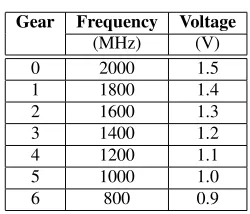
Gear Frequency Voltage
(MHz) (V)
0 2000 1.5
1 1800 1.4
2 1600 1.3
3 1400 1.2
4 1200 1.1
5 1000 1.0
6 800 0.9
Table 1: Frequency-voltage pairs for Athlon-64.
MPI. It monitors the time a program waits for external events and then usesdynamic voltage scaling—meaning that it dy-namically adjusts the CPU frequency (and voltage)—to min-imize wait time and energy consumption. (See Table 1; for convenience, in the remainder of this paper we describe this as simply varying the frequency.)
The Jitter system saves 8% energy, with a 2.6% time penalty, on a unbalanced program, and it does this without modification to the application or the communication library. Furthermore, our system is within 5% of the hand-tuned (“optimal”) solu-tion. Additionally, we show that our solution adapts to changes in load, which a hand-tuned solution cannot do.
The remainder of this paper is organized as follows. Sec-tion 2 discusses related work, and SecSec-tion 3 describes the Jit-ter implementation. Next, Section 4 describes performance results on a wide variety of benchmarks. Finally, Section 5 summarizes this paper.
2. RELATED WORK
There has been a voluminous amount of research performed in the general area of energy management. The closest work to ours comes from the real-time community, where the goal is to meet a given deadline while running each task at the lowest possible energy gear. One example is in [45], where an ap-proach to slack sharing in multiprocessor real-time systems is presented. Another is [46], which extends this work to handle AND/OR graphs.
In the rest of this section, we describe work in more general areas of energy management, including both server/desktop and mobile systems. In addition, there has been a significant amount of work on dynamic load balancing, which is relevant because the difficulty of balancing load dynamically gives rise to our Jitter system.
2.1 Server/Desktop Systems
Several researchers have investigated saving energy in ser-ver-class systems. The basic idea is that if there is a large enough cluster of such machines, such as in hosting centers, energy management can become an issue. Chaseet al.[8] il-lustrate a method to determine the aggregate system load and then determine the minimal set of servers that can handle that load. All other servers are transitioned to a low-energy state. A similar idea leverages work in cluster load balancing to de-termine when to turn machines on or off to handle a given load [35, 36]. Elnozahyet al. [13] investigated the policy in [35] as well as several others in a server farm. They found
that when each node independently sets its voltage, the perfor-mance was almost as good as more complicated schemes that required coordination between server nodes. Such work shows that power and energy management are critical for commer-cial workloads, especommer-cially web servers [6, 29]. Additional ap-proaches have been taken to include dynamic voltage scaling (DVS) [12, 38] and request batching [12]. The work in [38] applies real-time techniques to web servers in order to con-serve energy while maintaining quality of service.
Our work differs from most prior research because it fo-cuses on HPC applications and installations, rather than com-mercial ones. A comcom-mercial installation tries to reduce cost while servicing a highly-variable stream of client requests. On the other hand, an HPC installation exists to speedup an ap-plication, which is often regular and predictable. One HPC effort that addresses the memory bottleneck is given in [23]; however, this is a purely static approach.
In server farms, disk energy consumption is also significant. Much work has been done on saving disk energy, including reducing spindle speed [7], modulating the speed of the disk energy [19, 20], improving cache performance so that the disk can be kept in a low power state more often [47], and using program counter techniques to infer the disk access pattern [17]. In addition, there are schemes to aggregate disk accesses, which again allows the disk to be kept in a lower power state more often; one of these uses an integrated compiler/run time approach [21], and the other uses prefetching [33].
Our work is complementary to techniques that save disk en-ergy. Specifically, while the disk can consume a non-trivial amount of power in HPC applications, the CPU is typically a much larger power consumer. Moreover, unlike the CPU, disks with more than one power-performance setting (i.e., gear) are not yet commercially available. Therefore, we focus solely on scaling the CPU.
There are also a few high-performance computing clusters designed with energy in mind. One is BlueGene/L [1], which uses a “system on a chip” to reduce energy. Another is Green Destiny [40], which uses low-power Transmeta nodes. A re-lated approach is the Orion Multisystem machines [32], though these are targeted at desktop users. The latter two approaches sacrifice performance in order to save energy by using less powerful machines.
Finally, our prior work was an evaluation-based study that focused on exploring the energy/time tradeoff in the NAS suite [16]. Specifically, we found that using asingleslower gear was in some cases able to save energy with little time delay. We also found a significant benefit to usingmultiplegears per iteration (varying the gear per phase), and developed an algo-rithm for choosing the assignment of gear to phase [15].
2.2 Mobile Systems
There is also a large body of work in saving energy in mo-bile systems; most of the early research in energy-aware com-puting was on these systems. Here we detail some of these projects.
de-vices focuses on collaboration with the OS (e.g., [42, 44, 2]). Such application-related approaches are complementary to our approach.
In terms of research on device-specific energy savings, there is work in the CPU via dynamic voltage scaling (e.g., [14, 34, 18]), the disk via spindown (e.g., [22, 10]), and on the mem-ory or network (e.g., [28, 26]). The primary distinction be-tween these projects and ours is that energy saving is typically the primary concern in mobile devices. In HPC applications, performance is still the primary concern.
2.3 Dynamic Load Balancing
There has been a large volume of work in load balancing in parallel programs. It should be noted that application pro-grammers themselves often employ a specific load-balancing scheme. Here, we focus on runtime system techniques to bal-ance the workload. A few of these include shared-memory systems such as SUIF-Adapt [31] as well as MPI-based ones such as Adaptive MPI [5, 27], Dyn-MPI [41], and Tern [24].
The important point here is that dynamic load balancing, whether it is employed at the application or system level, de-creases the need for Jitter. However, many applications are at least somewhat resistant to dynamic load balancing; this is proven by the fact that the balancing must be done repeatedly throughout the lifetime of the application. In any case, Jitter could be integrated with the load balancing systems to gain information about the estimated amount of work per node.
3. JITTER IMPLEMENTATION
The general idea behind our implementation is to exploit a node that is not on the critical path. Such a node completes its work and idles waiting for a message from another node. With
just-in-time(JIT) scaling, this node executes at reduced perfor-mance and completes its work just before the message arrives from the remote node. Ideally, with JIT scaling, the reduction in performance does not increase application completion time. This is the case as long as the node executing at a reduced gear finishes its computation before the bottleneck node.
In this paper we assume iterative programs, which comprise the vast majority of scientific programs; furthermore, we as-sume that the iterations are relatively stable. This allows us to use past behavior to predict future behavior. There can be hundreds of compute-communicate bursts per second. Thus, reacting on a per-burst basis is too fine-grain. Therefore, our model aggregates all bursts in an iteration together, rather than monitoring and reacting to each individually. To do this Jitter uses the notion ofslack, defined as the sum of individual wait times for each burst in the iteration divided by the time of the iteration.
It is important to note that modern OSs such as Linux are al-ready power-aware in that they issue aHALTinstruction send-ing the CPU into a reduced power state dursend-ing idle/wait pe-riods. A trivial improvement possible in a scalable cluster is to shift to the lowest gear before issuing theHALT. However, this change adds a latency to transition into and out of the low gear due to theHALT, which can take more than 1 millisec-ond on our AMD. As there are many compute-communicate bursts per iteration, this latency can swamp any possible im-provement.
We have created an implementation of just-in-time scaling called Jitter. The implementation is within a layer beneath the
application that interacts with MPI, so that it is independent of any particular application. There are several items that Jitter must determine:
• the iteration boundaries,
• the net slack of each node, • when to reduce the performance, • when to increase the performance, • when to remain in the same gear, and
• when to reset algorithm parameters.
We describe each of these in turn.
3.1 Determining the Iteration Boundaries
Currently, we manually insert a special Jitter MPI call,MPI -Jitter, at the top of the main loop in the program; however, this is easily automated [25]. Such a loop must exist, as we are assuming iterative programs. When iterations are too short, Jitter limits the overhead by waiting several iterations before
MPI Jittertakes action. The current implementation combines iterations until the time exceeds half a second. Jitter performs several actions inMPI Jitter, which are described next.
3.2 Determining the Net Slack
Slack in Jitter is determined as follows. First, to determine wait time, we use our MPI-jack tool, which is an interface that exploits PMPI [37], the profiling layer of MPI. MPI-jack en-ables a user transparently to intercept (hijack) any MPI call. A user can execute arbitrary code before and/or after an in-tercepted call usingpreandposthooks. In this work, we use MPI-jack to determine the time spent in blocking MPI calls, such asMPI Recv,MPI Wait, andMPI Barrier.The pre hook records the time the routine began. The post hook records when it ends, computes the wait time, and updates the node’s overall wait time.
Second, we then compute the absolute or gross slack as the ratio of thewait timedivided by theiteration time. The global minimum slack among all nodes is determined using a reduc-tion (MPI Allreduce). Then the node’snet slackis computed as the difference between its slack and the global minimum slack.
Net slack, rather than absolute slack, is used for two rea-sons. First, the amount of slack can vary widely between dif-ferent applications. For example, in the NAS suite average slack varies from less than 10% to over 90%. Second, the amount of slack can vary widely among nodes within an ap-plication and in practice is never zero on any node (because it is highly unlikely that any single node is always last to arrive at a large number of communication calls within an iteration).
3.3 When to Reduce Performance
Jitter reduces a node’s performance if there is enough net slack. The Jitter prototype uses the following relationship to determine whether there is enough slack to reduce the gear:
net slack> S·dg→enough slack.
The termSis thebase slack threshold.It represents the amount
of net slack needed to reduce the gear. We have tunedSover several applications, and currently chooseSbetween 10 and 20%. Because a user must defineS, Jitter is not completely
transparent. Future work will develop techniques to deriveS
While net slack is better than gross slack at identifying a bottleneck node, it is not enough. If Jitter chooses to reduce and it turns out to be a bad choice (which is learned when the node later increases performance, as described below) the threshold to reduce again is raised. This threshold increase is captured in the termdg, which we call thedownshift factor. Each time a node reduces from geargit increasesdg using the formuladg = dg ∗bias. Through experimentation, we found that bias = 2and initialdg = 1works well for all applications. We have not found that the benchmarks are very sensitive to the bias value; however, further experiments are ongoing.
3.4 When to Increase Performance
Each node determines if it is a bottleneck node according to the following relationship.
net slack< α·S/ug→bottleneck node.
The termα, explained below, defines the initial range in which the gear remains the same and must be less than 1. We use anupshift factor,ug, that is similar in spirit to the downshift factor above. It is adjusted each time there is an increase in performance using bias in the same way asdg. This lowers the threshold slack required to shift up.
Because there is always at least one bottleneck node every iteration, being a bottleneck node is not a sufficient condition for increasing performance, for two reasons. First, a node can be a bottleneck in a lower gear without slowing down the com-putation. This happens when there is another node that is as slow or slower but is in the top gear. Second, there is vari-ance in the times between iterations even in the best situation. Therefore, some conditions are transient and we do not want Jitter to react to them. Consequently, a bottleneck node will increase its performance if either of the following conditions hold: (1) the iteration time has increased, and the node re-duced its gear on the previous iteration, or (2) the node has been a bottleneck for three consecutive iterations.
3.5 When to Remain in the Same Gear
Jitter remains in the same gear if it chooses not to reduce or increase, as described above. Initially, this range isαS <
net slack< S, because upshift and downshift factors are ini-tialized to 1. The more the algorithm shifts gears, the larger this range is, due to the biasing of the upshift and downshift factors. Thus the algorithm tends to stabilize. We useα= 0.5 in our tests, but it could be a user-provided parameter. How-ever, this simplifies use and has little adverse effect on Jitter’s performance.
3.6 When to Reset Algorithm Parameters
In addition the above threestandard actions (reduce, in-crease, remain), there is a the fourth, extraordinary action, which is to reset the algorithm parameters. This action is trig-gered by a dramatic change in the iteration time. Currently, a reset occurs if the time between adjacent iterations changes by 50% or more. The reset is not because of a problem within Jitter, but rather because because the application has changed in a significant way. (Jitter only otherwise changes by a single gear per iteration, which is not likely to cause a large change because frequencies change by 20% or less between adjacent gears.) None of the tested NAS or ASCI benchmarks
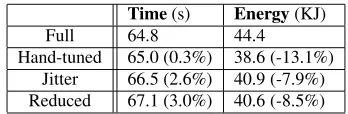
algo-Time(s) Energy(KJ)
Full 64.8 44.4
Hand-tuned 65.0 (0.3%) 38.6 (-13.1%) Jitter 66.5 (2.6%) 40.9 (-7.9%) Reduced 67.1 (3.0%) 40.6 (-8.5%)
Table 2: Aztec results
rithms causes a reset; however, we force a reset with our syn-thetic benchmark (see the next section).
4. RESULTS
This section present our results. First, we describe our method-ology. Next, we show the benefits of Jitter on imbalanced ap-plications. Then, using a synthetic benchmark, we show the full capabilities of Jitter. Last, we show that Jitter does not slow down a program unnecessarily when its load is balanced.
4.1 Methodology
Our experimental platform is a cluster of 10 frequency- and voltage-scalable AMD Athlon-64s. Its available operating points are in the range of 800–2000MHz and 0.9–1.5V, see Table 1 in Section 1. Each node has 1GB main memory, a 128KB L1 cache (split), and a 512KB L2 cache, and the nodes are con-nected by 100Mb/s network. In this paper, we vary the CPU power and measure overall system energy. Although there are other components, throttling the CPU is effective in saving en-ergy because the CPU is a major power consumer. In particu-lar, the Athlon-64 CPU used in this study consumes approxi-mately 45–55% of overall system energy.1
The programs we studied included two of the ASCI Purple benchmarks [3] as well as all of the NAS suite [4]. Presum-ably, such mature benchmarks have been thoroughly analyzed and are well-written (e.g., see [43])—so some work has been done to balance the computational load. Therefore, well-tuned programs like those in ASCI and NAS should result in an ap-proximate lower bound in terms of saving energy due to load imbalance. We used as many nodes as possible on each test; this number is typically 8, though BT and SP run on 9 nodes.
For each program we measure execution time and energy consumed. Execution time is elapsed wall clock time. Total system power consumed by each node is measured by Watts-Up power meters at the wall outlet, which are connected to the serial port their respective node. These meters report average power consumption (in Watts) since last queried. Each node reads its associated meter every second and integrates power over time to determine the energy it consumes.
4.2 Non-uniform Loads
This section shows the results of two benchmark programs that have load imbalance. The first one, Aztec, is a parallel iterative solver for sparse linear systems from the Purple suite. Table 2 shows results for Aztec using four different methods.
1CPU power is not measured directly. However, the system
800 1000 1200 1400 1600 1800 2000
0 10 20 30 40 50 60 70
Frequency
Iteration
0
1 23 45 67
Figure 1: Gears for each node for each iteration in Aztec.
All results are the average of at least 3 runs, with little vari-ance. The first method isFull power, where all nodes exe-cute in top gear (2000MHz). It is used as the baseline. The next uses ahand-tuned set of per-node gear settings. Using the slack on each node at Full as a guide, we tested many solutions to find the “best.” Because we are biasing towards performance, the goal was to save as much energy as possi-ble while allowing only small performance impact, which we somewhat arbitrarily define as less than 2.5% increase in time. While our search was not exhaustive, it was extensive. The third method isJitter, where all nodes begin in top gear and dynamically shift according to the algorithm described in Sec-tion 3. In the last method (Reduced), every node executes at 1800MHz—performance is reduced by one gear. This method serves as another baseline.
The hand-tuned run saves 13% energy with no time penalty. Each node executes in a single, but possibly different gear: one node runs in top gear (node 4), four in 1800MHz (nodes 1, 2, 3, and 5), and one each in the next three gears. (Frequency is used to name the gear, but both frequency and voltage are scaled.)
The Jitter run takes more time than Full, but saves nearly 8% energy. As expected, it does not save as much energy as the hand-tuned method. The primary reason for this is that the gears selected by the algorithm are higher than in hand-tuned. Five of the nodes execute more than half of the iterations in top gear. The secondary reason is the cost of constantly shift-ing gears, as it takes Jitter a handful of iterations to determine a solution. During this time it continually refines the gear set-tings. Note that Aztec is the least stable of all benchmarks—
e.g., it still shifts to some extent after 50 iterations—which we believe is likely typical of a production application than the other benchmarks.
The four nodes that execute at 1800MHz in the hand-tuned case execute at 2000MHz in Jitter. Jitter mis-predicts this gear because the slack varies due to constant gear shifting. This variance causes these nodes to shift back to top gear. They often reduce performance again, but will eventually shift back to top gear. Each time through this cycle it becomes harder to reduce due to the increasing downshift factordg(see Sec-tion 3). Our goal of favoring performance over energy forces these nodes into the top gear. Nevertheless, Jitter performs well. It is possible to extract better numbers from Jitter by
800 1000 1200 1400 1600 1800 2000
0 50 100 150 200
Frequency
Iteration
0
1 23 45 67
Figure 2: Gears for each node for each iteration in Sweep3d.
tuning the parameters to optimize it for Aztec; however, this paper presents a more general usage of Jitter.
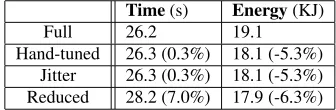
Figure 1 shows the gears per node per iteration for Aztec. It shows a single, representative run. Because there are more nodes than gears, the lines overlap significantly. At the end there are 5 nodes that execute at 2000MHz (nodes 1–5). Node 7 reduces one gear each iteration down to 1000MHz, where it remains for the duration of the program’s execution. Node 0 predominantly executes at 1200MHz and node 6 at 1400MHz. The second program that shows load imbalance isSweep3d, which is also a Purple benchmark. Sweep3d solves a time-independent discrete geometry neutron transport problem in 3-dimensions. Table 3 shows the results. In the hand-tuned method two nodes, 6 and 7, are in 1800MHz, while the rest are in top gear. There is essentially no time penalty for hand-tuned. Even with this little difference from full performance, there is a noticeable energy savings.
Figure 2 shows the gears used by Jitter in Sweep3d. Be-cause the application iteration length is about 0.1 seconds, Jit-ter takes action only every 5 iJit-terations; therefore, the figure plots every 5 iterations. It stabilizes much more quickly than Aztec, reaching stability within 50 iterations (10 Jitter itera-tions). After iteration 50, the nodes are in the same gears as hand-tuned. Before that, 4 different nodes reduce to 1600MHz, two of which climb back to top gear. Overall, 89% of the time Jitter is in the same gear as hand-tuned, and only 2% of the time are any nodes more that one gear away from hand-tuned. Therefore, Jitter performs nearly the same as hand-tuned.
4.3 Synthetic Benchmark Results
This section presents results from a synthetic benchmark, which was created to fully exercise Jitter. It is an iterative PDE solver, where we added (artificial) parameters that make
Time(s) Energy(KJ)
Full 26.2 19.1
Hand-tuned 26.3 (0.3%) 18.1 (-5.3%) Jitter 26.3 (0.3%) 18.1 (-5.3%) Reduced 28.2 (7.0%) 17.9 (-6.3%)
600 800 1000 1200 1400 1600 1800 2000
0 5 10 15 20 25 30 35 40
Frequency
Iteration
0
1 23 45 67
Figure 3: Gears for each node for each iteration in syn-thetic benchmark with stable, non-uniform load.
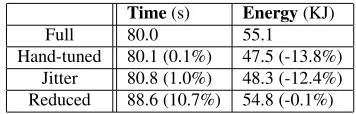
Time(s) Energy(KJ)
Full 80.0 55.1
Hand-tuned 80.1 (0.1%) 47.5 (-13.8%) Jitter 80.8 (1.0%) 48.3 (-12.4%) Reduced 88.6 (10.7%) 54.8 (-0.1%)
Table 4: Synthetic benchmark results
the amount of load per node configurable. Essentially, each node does an customized amount of work each iteration. Then it sends data to each of two neighbors and executes a barrier.
Figure 3 (on page 6) shows gears for each node. In this example, each node has an increasing amount of work, so node 0 has the least work and node 7 the most. Through separate experimentation, we determined these loads so that each node should select a different gear. (Because there are only 7 gears, 0 and 1 should select the same gear).
Table 4 shows the overall results. As expected, when using Jitter, there is significant energy savings and little time penalty. Jitter is nearly the same as the hand-tuned case because it sta-bilizes quickly to the same gear assignments as hand-tuned.
Figure 4 shows the slack for each node. There is a large spread initially, from almost zero to nearly 80%, but this range rapidly compresses. Node 0, which has half as much load as node 1, still has a significant amount of slack. However, five nodes have less than 10% slack. There is spike at iteration 12 that we cannot explain. Apparently, all communication takes longer in this iteration. Every node’s total wait time increases about the same amount (15ms). This spike is seen in every run (but different iterations) of the synthetic benchmark for all methods and every run of MG (from the NAS benchmark suite). These are the only programs that have several nodes with less than 10% slack. It is possible that there is a transient delay in the network that programs with more slack are able to absorb, which is why we do not see spikes in other programs.
Figure 5 shows the energy consumed by each node for the three methods. The less loaded nodes use significantly less en-ergy when using Full because Linux issues aHALTinstruction during idle. The figure shows that the most energy is saved in these lower loaded nodes. Importantly, for this program, Jitter achieves nearly the same results as the hand-tuned method.
0 0.1 0.2 0.3 0.4 0.5 0.6 0.7 0.8
0 5 10 15 20 25 30 35 40
Slack
Iteration
0 1 2 3 4 5 6 7
Figure 4: Slack for each node and each iteration in syn-thetic benchmark with stable, non-uniform load.
0 1000 2000 3000 4000 5000 6000 7000 8000 9000
0 1 2 3 4 5 6 7
Engery consumed (Joules)
Node
Full Hand tuned Jitter Reduced
Figure 5: Energy consumed for each node in synthetic benchmark with stable, non-uniform load.
The next test shows that Jitter can adapt to a changing work-load. The work assigned to each node changes at iteration 17. Initially, the work is assigned as above, with 0 having the least and 7 the most. In the second, half the workload distribution is reversed with 0 having the most and 7 the least. Figure 6 shows the gears selected at every iteration. Because node 0 is in the slowest gear and it has a large increase in work, it-eration 18 takes a long time (5 seconds instead of 2 seconds). This causes a reset. After that the algorithm acts as before, only the nodes select gears in a “mirror-image” fashion. In Full this test takes 77.5 seconds and consumes 56.8 KJ. Jitter is 4.1% slower, but uses 11.1% less energy.
4.4 Uniform Loads
This section presents the performance of the NAS bench-mark suite. Most of the NAS programs have well-balanced workloads, with the exception of CG. Therefore, generally speaking, the actions taken by Jitter should be to choose a uniform gear vector. In other words, we perform these tests primarily to ensure that Jitter does no harm to the application when the load isbalanced.
600 800 1000 1200 1400 1600 1800 2000
0 5 10 15 20 25 30 35 40
Frequency
Iteration
0
1 23 45 67
Figure 6: Gears for each node for each iteration in syn-thetic benchmark with unstable, non-uniform load.
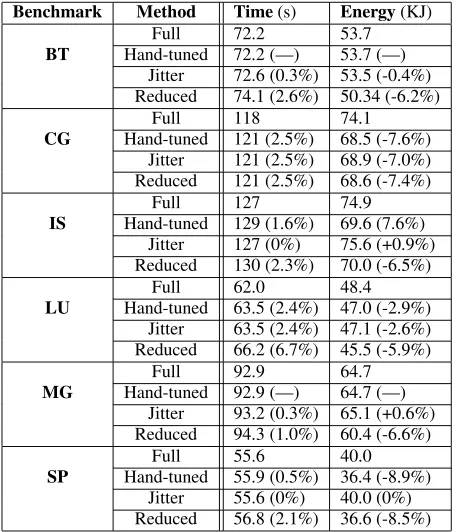
than Full and saves an average of 0.8% energy. Those numbers for Jitter are 1.0% and 0.6%, respectively. Clearly, both hand-tuned and Jitter perform similarly to Full, which justifies that Jitter does not adversely affect load balanced applications.
Finally, we consider the cases of CG, IS, and SP. For CG, both hand-tuned and Jitter save significant energy with a small time penalty. Essentially, the reason for the impressive perfor-mance of CG is because it is highly memory bound, as indi-cated by the performance of Reduced. This result is consis-tent with our previous results that studied exploiting the intra-nodebottleneck [16]. Nevertheless, Jitter and hand-tuning are able to take advantage of the small amount of load imbalance present.
For IS and SP, there is a large amount of slack time, but it is constant over all nodes. Hence, the net slack is zero on all nodes, so Jitter takes no action. Note that in this case, the hand-tuned version reduces the gear such that all nodes exe-cute in first gear (1800 MHz). IS and SP represent programs that do not have an inter-node bottleneck because the load is well balanced. We have different techniques, that leverage the memory bottleneck, to save energy in such cases [15].
5. CONCLUSION
In this paper we have designed and implemented a system we call Jitter, which leverages inter-node bottlenecks in MPI programs to save energy. The basic idea behind Jitter is to ex-ploitslack time spent by nodes at synchronization points by reducing the energy gear on those nodes, which in turn signif-icantly reduces the consumed energy. Jitter is designed so that nodes will arrive at a synchronization as close as possible to “just in time”, so that there will be little or no execution time increase.
Performance results showed that Jitter saves as much as 8% energy, with as little as a 2% time penalty, on a unbalanced program. Furthermore, it has almost no effect on programs that it cannot help—ones where the load is already balanced. We believe that as scientific applications become more com-plex and adaptive, making it more difficult to balance the load, the usefulness of Jitter will only increase.
6. REFERENCES
Benchmark Method Time(s) Energy(KJ)
Full 72.2 53.7
BT Hand-tuned 72.2 (—) 53.7 (—)
Jitter 72.6 (0.3%) 53.5 (-0.4%) Reduced 74.1 (2.6%) 50.34 (-6.2%)
Full 118 74.1
CG Hand-tuned 121 (2.5%) 68.5 (-7.6%) Jitter 121 (2.5%) 68.9 (-7.0%) Reduced 121 (2.5%) 68.6 (-7.4%)
Full 127 74.9
IS Hand-tuned 129 (1.6%) 69.6 (7.6%) Jitter 127 (0%) 75.6 (+0.9%) Reduced 130 (2.3%) 70.0 (-6.5%)
Full 62.0 48.4
LU Hand-tuned 63.5 (2.4%) 47.0 (-2.9%) Jitter 63.5 (2.4%) 47.1 (-2.6%) Reduced 66.2 (6.7%) 45.5 (-5.9%)
Full 92.9 64.7
MG Hand-tuned 92.9 (—) 64.7 (—)
Jitter 93.2 (0.3%) 65.1 (+0.6%) Reduced 94.3 (1.0%) 60.4 (-6.6%)
Full 55.6 40.0
SP Hand-tuned 55.9 (0.5%) 36.4 (-8.9%) Jitter 55.6 (0%) 40.0 (0%) Reduced 56.8 (2.1%) 36.6 (-8.5%)
Table 5: NAS benchmark programs using Full, Hand-tuned, and Jitter. Percentage differences are given relative to Full; a line (—) means that same gear vector as Full was used.
[1] N.D. Adiga et al. An overview of the BlueGene/L supercomputer. InSupercomputing 2002, November 2002.
[2] Manish Anand, Edmund Nightingale, and Jason Flinn. Self-tuning wireless network power management. In
Mobicom, September 2003.
[3] ASCI Purple Benchmark Suite. http://www.llnl.gov/-asci/platforms/purple/rfp/benchmarks/.
[4] D. Bailey, J. Barton, T. Lasinski, and H. Simon. The NAS parallel benchmarks. RNR-91-002, NASA Ames Research Center, August 1991.
[5] Milind Bhandarkar, L. V. Kale, Eric de Sturler, and Jay Hoeflinger. Adaptive load balancing for MPI programs. InInternational Conference on Computational Science, pages 108–117, San Francisco, CA, May 2001. [6] Pat Bohrer, Elmootazbellah Elnozahy, Tom Keller,
Michael Kistler, Charles Lefurgy, Chandler McDowell, and Ram Rajamony. The case of power management in web servers. In Robert Graybill and Rami Melham, editors,Power Aware Computing. Kluwer/Plenum, 2002.
[7] Enrique V. Carrera, Eduardo Pinheiro, and Ricardo Bianchini. Conserving disk energy in network servers. InProceedings of International Conference on Supercomputing, pages 86–97, San Fransisco, CA, 2003.
Amin Vahdat, and Ronald P. Doyle. Managing energy and server resources in hosting centres. InSymposium on Operating Systems Principles, pages 103–116, 2001. [9] Compaq Computer Corporation, Intel Corporation,
Microsoft Corporation, Phoenix Technologies Ltd., and Toshiba Corporation. Advanced configuration and power interface specification, revision 2.0. July 2000. [10] F. Douglis, P. Krishnan, and B. Bershad. Adaptive disk
spin-down policies for mobile computers. InProc. 2nd USENIX Symp. on Mobile and Location-Independent Computing, 1995.
[11] C.S. Ellis. The case for higher-level power management. InProceedings of the 7th Workshop on Hot Topics in Operating Systems, March 1999.
[12] Elmootazbellah Elnozahy, Michael Kistler, and Ramakrishnan Rajamony. Energy conservation policies for web servers. InUSITS ’03, 2003.
[13] E.N. (Mootaz) Elnozahy, Michael Kistler, and Ramakrishnan Rajamony. Energy-efficient server clusters. InWorkshop on Mobile Computing Systems and Applications, Feb 2002.
[14] K. Flautner, S. Reinhardt, and T. Mudge. Automatic performance-setting for dynamic voltage scaling. In
Proceedings of the 7th Conference on Mobile
Computing and Networking MOBICOM ’01, July 2001. [15] Vincent W. Freeh, David K. Lowenthal, Feng Pan, and
Nandani Kappiah. Using multiple energy gears in mpi programs on a power-scalable cluster. InPPOPP 2005, Chicago, IL, June 2005.
[16] Vincent W. Freeh, David K. Lowenthal, Rob Springer, Feng Pan, and Nandani Kappiah. Exploring the energy-time tradeoff in mpi programs on a
power-scalable cluster. InIPDPS 2005, Denver, CO, April 2005.
[17] Chris Gniady, Y. Charlie Hu, and Yung-Hsiang Lu. Program counter based techniques for dynamic power management. InProceedings of the 10th International Symposium on High-Performance Computer
Architecture, February 2004.
[18] D. Grunwald, P. Levis, K. Farkas, C. Morrey, and M. Neufeld. Policies for dynamic clock scheduling. In
Proceedings of 4th Symposium on Operating System Design and Implementation, October 2000.
[19] S. Gurumurthi, A. Sivasubramaniam, M. Kandemir, and H. Franke. Dynamic speed control for power
management in server class disks. InProceedings of International Symposium on Computer Architecture, pages 169–179, June 2003.
[20] Sudhanva Gurumurthi, Anand Sivasubramaniam, Mahmut Kandemir, and Hubertus Franke. Reducing disk power consumption in servers with DRPM.IEEE Computer, pages 41–48, December 2003.
[21] Taliver Heath, Eduardo Pinheiro, Jerry Hom, Ulrich Kremer, and Ricardo Bianchini. Application transformations for energy and performance-aware device management. InProceedings of the 11th International Conference on Parallel Architectures and Compilation Techniques, September 2002.
[22] D. P. Helmbold, D. D. E. Long, and B. Sherrod. A
dynamic disk spin-down technique for mobile computing. InMobile Computing and Networking, pages 130–142, 1996.
[23] C-H. Hsu and U. Kremer. The design, implementation, and evaluation of a compiler algorithm for cpu energy reduction. InACM SIGPLAN Conference on
Programming Languages, Design, and Implementation, June 2003.
[24] Jian Ke and Evan Speight. Tern: Migrating threads in an MPI runtime environment. Technical Report
CSL-TR-2001-1016, Cornell, November 2001.
[25] Ken Kennedy and Ulrich Kremer. Automatic data layout for distributed-memory machines.ACM Transactions on Programming Languages and Systems, 20(4):869–916, 1998.
[26] Ronny Krashinsky and Hari Balakrishnan. Minimizing energy for wireless web access with bounded slowdown. InMobicom 2002, Atlanta, GA, September 2002. [27] Orion Lawlor, Milind Bhandarkar, and L. V. Kale.
Adaptive MPI. TR 02-05, University of Illinois, 2002. [28] A. R. Lebeck, X. Fan, H. Zeng, and C. S. Ellis. Power
aware page allocation. InArchitectural Support for Programming Languages and Operating Systems, pages 105–116, 2000.
[29] Charles Lefurgy, Karthick Rajamani, Freeman Rawson, Wes Felter, Michael Kistler, and Tom W. Keller. Energy management for commerical servers.IEEE Computer, pages 39–48, December 2003.
[30] John Markoff and Steve Lohr. Intel’s huge bet turns iffy. New York Times Technology Section, September 29, 2002. Section 3, Page 1, Coumn 2.
[31] Donald G. Morris and David K. Lowenthal. Accurate data redistribution cost estimation in software distributed shared memory systems. InPrinciples and Practice of Parallel Programming, pages 62–71, June 2001.
[32] Orion Multisystems. http://www.orionmulti.com/. [33] Athanasios E. Papathanasiou and Michael L. Scott.
Energy efficiency through burstiness. InWMCSA, October 2003.
[34] T. Pering, T. Burd, and R. Brodersen. The simulation and evaluation of dynamic voltage scaling algorithms. InProceedings of the International Symposium on Low-Power Electronics and Design ISPLED ’98, pages 76–81, August 1998.
[35] E. Pinheiro, R. Bianchini, E. V. Carrera, and T. Heath. Dynamic cluster reconfiguration for power and performance. InCompilers and Operating Systems for Low Power, September 2001.
[36] Eduardo Pinheiro, Ricardo Bianchini, Enrique V. Carrera, and Taliver Heath. Load balancing and unbalancing for power and performance in cluster-based systems. InWorkshop on Compilers and Operating Systems for Low Power, September 2001.
[37] Rolf Rabenseifner. Automatic profiling of MPI applications with hardware performance counters. In
PVM/MPI, pages 35–42, 1999.
servers. In24th Annual IEEE Real-Time Systems Symposium, Cancun, Mexico, December 2003. [39] A. Vahdat, A. Lebeck, and C. Ellis. Every joule is
precious: The case for revisiting operating system design for energy efficiency.SIGOPS European Workshop, 2000.
[40] M. Warren, E. Weigle, and W. Feng. High-density computing: A 240-node beowulf in one cubic meter. In
Supercomputing 2002, November 2002. [41] D. Brent Weatherly, David K. Lowenthal, Mario
Nakazawa, and Franklin Lowenthal. Dyn-MPI: Supporting MPI on non dedicated clusters. In
Supercomputing 2003, November 2003.
[42] M. Weiser, B. Welch, A. J. Demers, and S. Shenker. Scheduling for reduced CPU energy. InOperating Systems Design and Implementation (OSDI ’94), pages 13–23, 1994.
[43] F. C. Wong, R. P. Martin, R. H. Arpaci-Dusseau, and D. E. Culler. Architectural requirements and scalability of the NAS parallel benchmarks. InProceedings of Supercomputing ’99, Portland, OR, November 1999. [44] Heng Zeng, Carla S. Ellis, Alvin R. Lebeck, and Amin
Vahdat. Currentcy: Unifying policies for resource management. InUSENIX 2003 Annual Technical Conference, June 2003.
[45] D. Zhu, R. Melhem, and B. Childers. Scheduling with dynamic voltage/speed adjustment using slack reclamation in multi-processor real-time systems.IEEE Transactions on Parallel and Distributed Systems, 14(7):686–700, July 2003.
[46] D. Zhu, D. Mosse, and R. Melhem. Power-aware scheduling for and/or graphs in real-time systems.IEEE Transactions on Parallel and Distributed Systems, 15(9):849–864, September 2004.