ISSN (Online) : 2319 - 8753
ISSN (Print) : 2347 - 6710
I
nternationalJ
ournal ofI
nnovativeR
esearch inS
cience,E
ngineering andT
echnologyAn ISO 3297: 2007 Certified Organization, Volume 2, Special Issue 1, December 2013
Proceedings of International Conference on Energy and Environment-2013 (ICEE 2013)
On 12th to 14th December Organized by
Department of Civil Engineering and Mechanical Engineering of Rajiv Gandhi Institute of Technology, Kottayam, Kerala, India
EVALUATION OF DYNAMIC MODULUS OF
MODIFIED AND UNMODIFIED ASPHALT
MIXTURES
Rekha K Nair, Yoga Priyadharshini. R
M. Tech scholar, Transportation Engineering, R I T, Kottayam, Kerala, 686501, India
Project Associate, IIT Madras Chennai, Tamil Nadu, 600036, India
Abstract
Modified binders are increasingly used in Indian pavement to cater to the ever‐increasing traffic. As of now, a wide variety of modified binders are being used ranging from elastomers, plastomers and crumb rubber to natural rubber. This paper describes the experimental procedure for the determination of dynamic modulus with Bituminous Concrete Grade 2 of the Indian Specification. The AASHTO protocol was followed for fabricating the samples of bituminous mixtures and dynamic modulus was determined as a function of frequency and temperature. The collected dynamic modulus values were used to fit a master curve and it was found that the polymer modified binder was having better performance than unmodified mixtures over a range of temperatures. Thus it demonstrates that the temperature resistance and fatigue resistance of modified over unmodified at low temperature as well as at high temperature.
1. INTRODUCTION
Pavement is composed of several layers of material. The design life of a pavement diminishes mainly due to rutting, and fatigue cracking. Rutting is nothing but the longitudinal depression along the wheel track this may be caused due to increased wheel loading and also due to high temperature. Fatigue cracking is a series of interconnected cracks that are caused by fatigue failure on the HMA surface under repeated loading condition. In this cracks initiates at the bottom and then it propagates to the surface. Due to these defects, plastic deformation is caused in the pavement. So in order to overcome these defects some modifiers are added to the asphalt binders. Modified binders are increasingly used to cater to the high tire pressure and frequency of loading. A polymer modified binder was used for the evaluation. The performance of a pavement on a long term depends on the properties of materials comprising the asphalt mix. The Mechanistic Empirical Pavement Design Guide (MEPDG) recommends the dynamic modulus (|E*|) of hot mix asphalt (HMA) as an important input parameter for the design and analysis of flexible pavements. Several researchers reported that the |E*| of a HMA mix is highly correlated to pavement distresses (i.e. rutting, fatigue, and low temperature cracking) over a wide range of traffic and climatic conditions [1-7].
2. MATERIAL PROPERTIES
In this work, modified binder like polymer modified binder and an unmodified binder was used for fabricating samples satisfying the Bituminous Concrete grade-2 (BC-2) specification of the Ministry of Road Transport and Highways, India (MoRTH, 2001)[8]. The material properties [9 & 10] of the binders used in this investigation are listed in Table 1 & 2.
TABLE 1. MATERIAL PROPERTIES OF UNMODIFIED BINDER
TABLE 2. MATERIAL PROPERTIES OF MODIFIED BINDER
Tests Modified
Penetration at 25 °C 60
Softening Point (R&B) (°C) 57
Elastic recovery of half thread in 66
ductilometer at 15 °C (%)
Temperature corresponding to G*/sin δ for 93.2 1.0 kPa at 10 rad/s (°C)
Separation, difference in softening point, 3.1 Tests Unmodified Absolute viscosity at 60 °C (Poise) 2503.6 Kinematic viscosity at 135 °C (cSt) 358.66 Penetration at 25 °C 69 Softening Point (R&B) (°C) 47 Viscosity ratio of unaged and short
-
2.55 term aged binder at 60 °C
Ductility of short- term aged binder at
R&B (°C)
Viscosity at 150 °C (Poise) 19.71
Loss in mass on short-term aging (%) 0.14 Increase in softening point on short-term 2.85+
aging (°C)
Reduction in penetration after short-term 26.33
aging
Elastic recovery of half thread in 73.0
ductilometer at 25 °C of short-term aged
binder (%)
Temperature corresponding to G*/sin δ for 83.7
2.2 kPa at 10 rad/s (°C)
3. EXPERIMENTAL PROCEDURE 3.1 Specimen preparation
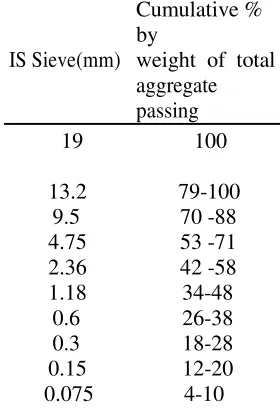
For fabricating modified and unmodified specimens, BC - Grade 2 aggregate gradation with nominal maximum aggregate size of 13 mm were used. The aggregate gradations were carried out in order to obtain the void ratio in the range of 3 to 5% for 5% asphalt content. The asphalt content was fixed as per Marshall test conducted. The aggregate gradation used for BC is listed in Table 3.
TABLE 3. BC GRADATION
13.2 79-100 9.5 70 -88 4.75 53 -71 2.36 42 -58
1.18 34-48
0.6 26-38
0.3 18-28
0.15 12-20
0.075 4-10
The mixing and compaction temperatures of modified and unmodified asphalt were determined using the viscosity- temperature relationship [11]. Based on this the unmodified binder was heated to a temperature of 165 °C and modified to 185 °C. The aggregates were heated to 170 °C. The hot mix asphalt mixtures (HMA) were then short- term aged for 4 hours. Conditioning temperature for unmodified binder mix was kept at 135 °C and for modified binder mix it was kept at 155 °C. After conditioning for 4 hours the mix
Cumulative % by
IS Sieve(mm) weight of total aggregate passing
was transferred to an oven set to the compaction temperature and was kept there for thirty minutes. The compaction temperature for unmodified binder mix was 150 °C and for modified binder mix was 170 °C The hot mix asphalt mixtures (HMA) were then short- term aged for 4 hours. Conditioning temperature for unmodified binder mix was kept at 135 °C and for modified binder mix it was kept at 155 °C. After conditioning for 4 hours the mix was transferred to an oven set to the compaction temperature and was kept there for thirty minutes. The compaction temperature for unmodified binder mix was 150 °C and for modified binder mix was 170 °C [12]. The cylindrical specimens of 165 mm height and 150 mm diameter were produced using Superpave gyratory compactor, a pressure of 600 kPa was applied to the sample at an eccentricity of 1.25° from the vertical axis. The number of gyrations given to a sample is based on the
expected ESAL’s on the pavement. Assuming design traffic of more than γ0 million ESAL, the total
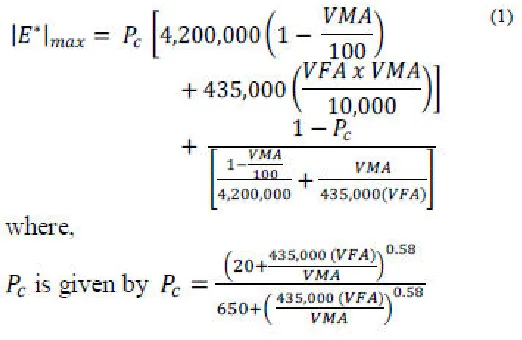
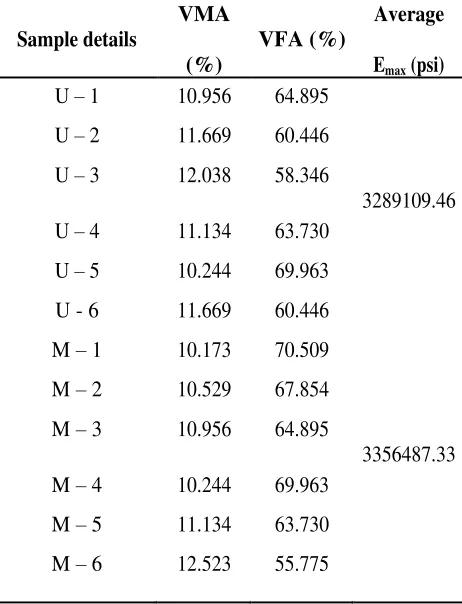
number of gyrations applied was 205. The samples were cored to the size of 150 mm height and 100 mm diameter for testing. Totally 12 set of samples were casted and cored for testing. The air voids of the 12 samples were in the range of 3.5 to 4 %. The maximum dynamic modulus was determined from equation (1). Table 4 shows the details of calculations carried out to find the maximum limiting dynamic modulus.
4. DYNAMIC MODULUS TEST
In this investigation, the dynamic modulus test was carried out as detailed in the provisional AASHTO standard given as part of NCHRP 9-29 project1. This test method covers procedures for testing asphalt concrete mixtures to determine the dynamic modulus and phase angle at a single effective temperature Teff and design loading frequency.
Proposed Standard Test Method for Determining the Dynamic Modulus and Flow Number for Hot Mix Asphalt (HMA) Using the Simple Performance Test System, NCHRP 9-29: PT 01.
TABLE 4. MAX.LIMITING DYNAMIC MODULUS
Sample details
VMA
VFA (%)
Average
(%) Emax (psi)
U – 1 10.956 64.895
U – 2 11.669 60.446
U – 3 12.038 58.346
3289109.46 U – 4 11.134 63.730
U – 5 10.244 69.963
U - 6 11.669 60.446
M – 1 10.173 70.509
M – 2 10.529 67.854
M – 3 10.956 64.895
3356487.33 M – 4 10.244 69.963
M – 5 11.134 63.730
M – 6 12.523 55.775
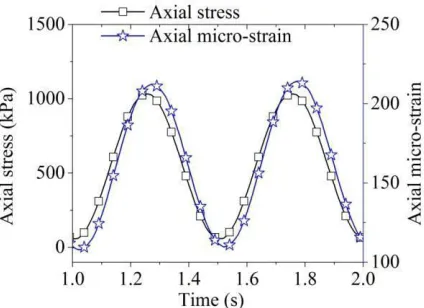
Dynamic Modulus, |E*| is the norm value of the complex modulus calculated by dividing the peak-to-peak stress by the peak-to-peak-to-peak strain for a material subjected to a sinusoidal loading. Phase angle, δ is the angle in degrees between a sinusoidally applied stress and the resulting strain in a controlled-stress test. Dynamic modulus values, measured at one effective temperature Teff and one design frequency
selected by the design engineer are used as performance criteria for permanent deformation resistance of the asphalt concrete mixture. Dynamic modulus values measured over a range of temperatures and frequencies of loading can be shifted into a master curve for characterizing asphalt concrete for pavement thickness design and performance analysis. In this test, the test specimen is placed in the environmental
chamber and allowed to equilibrate to the specified testing temperature. Three axial LVDT’s are mounted
on the sample at an angle of 1200. The LVDT’s are adjusted to near the end of their linear range to allow the full range to be available for the accumulation of deformation. Figure 1 shows the sample fixed with LVDTs inside the chamber. Friction reducing end treatment and platen are placed on top and bottom of the specimen.
4.1 Test Protocol
modulus values measured for the modified and unmodified mixtures.
FIGURE 2. STRESS- STRAIN RESPONSE
5. MASTER CURVE
To account for the influence of temperature and rate of loading on the viscoelastic properties of bituminous mixtures, design codes throughout the world suggest constructing a master curve at a specific reference temperature. For constructing a master curve, the principle of time-temperature superposition is appealed to. The first step is to choose a standard reference temperature and the data of the material at various temperatures are shifted with respect to time until a single smooth curve is obtained. The master curve of modulus as a function of time formed in this manner describes the time dependency of the material. The amount of shifting at each temperature required to form the master curve describes the temperature dependency of the material. Thus, both the master curve and the shift factors are needed for a complete description of the rate and temperature effects. The shift factor used for shifting the dynamic modulus was obtained from equation 3.
Here ǀE*ǀmax represents maximum limited dynamic value of the mix. Optimization algorithms were coded
TABLE 5. FITTING PARAMETER
Fitting
Unmodified Modified Parameter
Delta(δ) 4.12 4.25
Beta( ) -0.35 -0.70
Gamma( ) -0.58 -0.33
Activation
159938.98 276000.42
energy(ΔE)
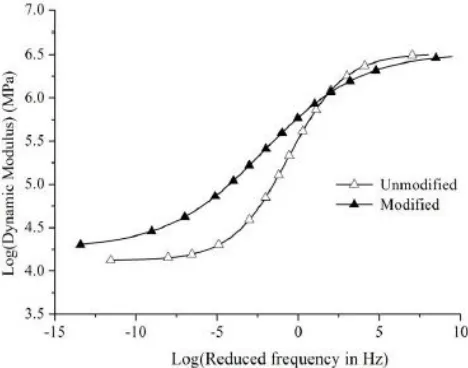
By substituting the parameter values in above shown equations, logarithm values of dynamic modulus, reduced frequency at the reference temperature and shift factors are calculated. Based on the values, master curve for every binder mix is plotted. A reference temperature of 35oC is taken for the generation of master curves. The master curve obtained is shown in Figure 6 and 7. Figure 8 shows the comparison of master curve calculated for modified and unmodified binder.'
FIGURE 3. DYNAMIC MODULUS – UNMODIFIED MIX
Figure 5 shows the comparison of dynamic modulus of modified and unmodified binder at 5°C
FIGURE 5. COMPARISON OF DYNAMIC MODULUS 5 °C
FIGURE 6: MASTER CURVE FOR UNMODIFIED MIXTURE
FIGURE 8: MASTER CURVE COMPARISON
6. CONCLUSION
From the dynamic modulus values and the master curves generated, it can be seen that unmodified binder consistently had dynamic modulus lower than modified binder at all frequencies. Higher modulus value indicates higher stiffness at higher temperature (low frequency) so it can have more rutting resistance than unmodified binder.
ACKNOWLEDGEMENT
The authors are very grateful to Dr. J. Murali Krishnan, Associate Professor, Department of Civil Engineering, Indian Institute of Technology (IIT), Madras for providing the technical support and also would like to thank IIT Madras for providing us with the facilities to use the pavement engineering laboratory equipments.
REFERENCES
[1] Goh, S.W., You, Z., Williams, R.C., and Li, X. (β011). “Preliminary Dynamic Modulus Criteria of HMA for Field Rutting of Asphalt Pavements.” Michigan’s Experience, Journal of Transportation Engineering, 1γ7(1), pp. γ7-45.
[2] Loulizi, A., Flintsch, G., Al-Qadi, I., and Mokarem, D. (2006). “Comparing Resilient Modulus and Dynamic Modulus of Hot Mix Asphalt as Material Properties for Flexible Pavement Design.” Transportation Research Record, No. 1970, pp.161-170.
[3] Bonaquist, R.F. (β00γ). “Simple Performance Tester for Suparpave Mix Design.” Quarterly Progress Report (Appendix B), NCRHP Project 9-29, TRB, Washington, D.C., USA.
[4] Pellinen, T.K. and Witczak, M.W. (β00β). “Use of Stiffness of Hot-Mix Asphalt as a Simple Performance Test.” Transportation Research Record, No. 1789, pp. 80-90.
[5] Shenoy, A. and Romero, P. (β00β). “Standardized Procedure for Analysis of Dynamic Modulus (E*) Data to Predict Asphalt Pavement Distresses.” Transportation Research Record, No. 1789, pp. 17γ-182.
[6] Witczak, M., Kaloush, K., and Von Quintus, H. (β00β). “Pursuit of the Simple Performance Test for Asphalt Mixture Rutting.” Journal of the Association of Asphalt Paving Technologies, Vol. 71, pp. 671-691.
[7] Cominsky, R.J., Killingsworth, B.M., Anderson, R.M., Anderson, D.A., and Crockford, W.W. (1998). “Quality Control and Acceptance of Superpave Designed Hot Mix Asphalt.” Project D9-7, NCHRP Report No. 409, TRB, Washington, DC.
[8] MoRTH. (β001). “Specification for roads and bridge work.” 4th revision, Ministry of Shipping, Road Transport and Highways, New Delhi,
India.
[9] IS:7γ (β01β). “Paving bitumen –specification. The Bureau of Indian Standards.” New Delhi, India.
[10] IS:1546β (β004). “Polymer and rubber modified bitumen - specification. The Bureau of Indian Standards” New Delhi, India. [11] Asphalt Institute (β00γ). “Superpave mix designs.” superpave series no. β. (SP-2). Asphalt Institute, Lexington, KY, USA.