ISSN(Online): 2320-9801
ISSN (Print): 2320-9798
I
nternational
J
ournal of
I
nnovative
R
esearch in
C
omputer
and
C
ommunication
E
ngineering
(An ISO 3297: 2007 Certified Organization)
Vol. 3, Issue 3, March 2015
Construction and Selection of Six Sigma Quick
Switching Sampling System: Sample Size
Tightening
Dr. D. Senthilkumar
1, B. Esha Raffie
2Associate Professor, Department of Statistics, PSG College of Arts & Science, Coimbatore, India1* Research Scholar, Department of Statistics, PSG College of Arts & Science, Coimbatore, India2
ABSTRACT: Six Sigma at many organizations simply means a measure of quality that strives for near perfection. Six Sigma is a disciplined, data-driven approach and methodology for eliminating defects in any process, from manufacturing to transactional and from product to service. The statistical representation of Six Sigma describes quantitatively how a process is performing. To achieve Six Sigma, a process must not produce more than 3.4 defects per million opportunities. A Six Sigma defect is defined as anything outside of customer specifications. A Six Sigma opportunity is then the total quantity of chances for a defect. In this article, desining of Six Sigma Quick Switching Variables Sampling System [SSQSVSS(nN,nT;k)] indexed by Six Sigma Quality Level's is presented. Procedures are
indicated and tables are constructed for designing the system indexed by six sigma quality levels, viz., six sigma acceptable quality level (SSAQL) and six sigma limiting quality level (SSLQL).
KEY WORDS: Quick Switching Sampling System, Variables Sampling Plan, OC Function, SSAQL and SSLQL.
I. INTRODUCTION
In quality control, the statistical procedure employed in determining whether to accept or reject a production batch. If the proportion of the units having a certain negative characteristic exceeds the acceptable limit for a given batch, it is rejected. Two types of acceptance sampling are (1) attributes sampling, in which the presence or absence of a characteristic in the inspected item is only taken note of, and (2) variable sampling, in which the presence or absence of a characteristic in the inspected item is measured on a predetermined scale.
Dodge (1967) proposed a sampling system called a 'quick switching system' (QSS), consisting of pairs of normal and tightened plans. The implication of the system is as follows:
(1) Adopt a pair of sampling plans--a normal plan (N) and a tightened plan (T). (2) Use plan N for the first lot (optional, but can start with plan T). (3) For each lot inspected, if the lot is accepted, then use plan N for the next lot; if the lot is rejected, then use plan T for the next lot.
Romboski (1969) studied the QSS with the single-sampling plan as a reference plan and introduced a system designated as QSS(n, kn; c0), where (n, c0) and (kn, c0), k > 1 are respectively the normal and the tightened
single-sampling plans. It is found that this system requires a lower average sample number (ASN) than that of its equivalent single-sampling plan. Also, the system offers an operating characteristic (OC) curve, referred to as a 'composite OC curve', which is more discriminating than the OC curves of corresponding normal and tightened single-sampling plans. Govindaraju (1991), Deveraj Arumainayagam (1991) and Taylor (1996) investigated how to evaluate and select quick switching systems. Soundarajan and Palanivel (1997 & 2000) have investigated on a quick switching variables sampling (QSVS) systems. Radhakrishnan and Sivakumaran (2008) have developed the procedure for the construction of six sigma repetitive group sampling plans of type (n1, n2; c)indexed by six sigma quality levels with attributes
ISSN(Online): 2320-9801
ISSN (Print): 2320-9798
I
nternational
J
ournal of
I
nnovative
R
esearch in
C
omputer
and
C
ommunication
E
ngineering
(An ISO 3297: 2007 Certified Organization)
Vol. 3, Issue 3, March 2015
In this article, designing of six sigma quick switching variables sampling system [SSQSVSS(nT, nN; k)]
indexed by six sigma quality level's is presented. The SSQSVSS (nT, nN; k), where (nN, k) and (nT, k), nT > nN are
respectively the normal and tightened single sampling plans. Procedures are indicated and tables are constructed for designing the system indexed by six sigma acceptable quality level (SSAQL) with the producer’s risk α*=3.4x10⁻⁶ and
six sigma limiting quality level (SSLQL) with the consumer’s risk β* ≥ mα*, where m=2.
II. SIX SIGMA QUICK SWITCHING VARIABLES SAMPLING SYSTEM OF TYPE SSQSVSS (nT, nN; k)
The conditions and the assumptions under which the SSQSVSS scheme can be applied are as follows:
Conditions for applications
The production is steady, so that results on current and preceding lots are broadly indicative of a continuous process.
Lots are submitted substantially in the order of production.
Inspection is by variables, with the quality being defined as the fraction of non- conforming. The sample units are selected from a large lot and production is continuous.
The production process should be depends on automation and man handling the process is very limited.
Basic Assumptions
The quality characteristic is represented by a random variable X measurable on a continuous scale. Distribution of X is normal with mean and standard deviation.
An upper limit U, has been specified and a product is qualified as defective when X>U. [when the lower limit L is Specified, the product is a defective one if X<L].
The Purpose of inspection is to control the fraction defective, p in the lot inspected.
The fraction defective in a lot will be
p= 1-F(v)=F(-v)
withv=(U-μ)/σ
and2/ 2
1 F(y)
2
z
e dz
y
(1)
Where z ~ N (0,1). Under the σ- method plan, the lot would be accepted if
X + k σ
≤
U,
where U is theupper specification limit or
X + k σ
≥
L,
where L is the lower specification limit.III. SSQSVSS(nTσ, nNσ; kσ) WITH KNOWN σ VARIABLES PLAN AS THE REFERENCE PLAN
The operating procedure of the six sigma quick switching variables sampling system with known σ variables plan is as follows:
Operating Procedure
Step 1: Under normal inspection, draw a sample of size nNσ from the lot, inspect and record the measurement of the
quality characteristic for each unit of the sample. Compute the sample mean
X
. Where XN=
X / ni NStep2: i) If XN+ k σU or XNk σL accept the lot and repeat Step 1 for the next lot.
ii) If XN+ k σ > U or XNk σ < L, reject the lot go to step 3.
Step 3: Under tightened inspection, draw a sample of size nTσ from the next lot inspect and record the measurement of
the quality characteristic for each unit of the sample. Compute the sample mean
X
. Where X =T
X / ni TStep 4: i) If XT+ k σU or XTk σLaccept the lot and repeat step 1, for the next lot.
ii) If XT+ k σ > U or XTk σ < L,reject the lot and repeat step 3.
Where nNσ and nTσare the sample sizes of normal and tightened single sampling variable plans respectively
ISSN(Online): 2320-9801
ISSN (Print): 2320-9798
I
nternational
J
ournal of
I
nnovative
R
esearch in
C
omputer
and
C
ommunication
E
ngineering
(An ISO 3297: 2007 Certified Organization)
Vol. 3, Issue 3, March 2015
tightened plan sample size nT is greater than the normal plan sample size nN, for designing the SSQSVS system nT is
fixed as a multiple of nN i.e. nT = m nN, where m >1.
Operating Characteristic Function
Based on Romboski (1969), the OC function of QSVSS (nT, nN; kσ) can be written as
a T
T N
P P (p)=
1-P +P (2)
where PT and PN are the proportion of lots expected to be accepted using tightened (nT, k) and normal (nN, k) variable
single sampling plans respectively.
Under the assumption of normal approximation to the non-central t distribution (Abramowitz and Stegun, 1964), the values of PN and PT are given by
PN= (w N)P[(U-X) / k] (3)
P = (w )
T
T
P[(U-X) /
k]
(4)respectively. Equation (3) and (4) are substituted in (2) to find Pa(p) values for given p, nN, nT and k.
As the individual values of X follows normal distribution with mean µ and variance σ2, the expressions given
in (3) and (4) can be restated as
T 2 (-z /2) T 1
P e dz
2 w
and N 2 (-z /2) N1
P
e
dz
2
w
respectively, withT Tσ Tσ
w = n
(U-k σ-μ)/σ=(v-k) n
N Nσ Nσ
w = n (U-k σ-μ)/σ=(v-k) n
and ν = (U - μ) / σ
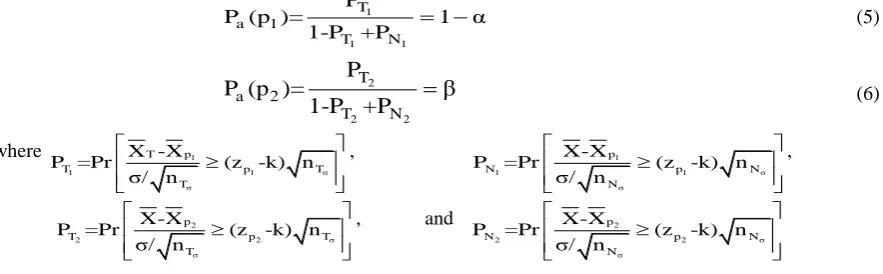
For given p1, p2, α and β the values of nTσ and nNσ and k can be determined and should satisfy the following the
equations. 1 1 1 T a 1 T N P
P (p )= 1 α
1-P +P (5)
2 2 2 T a 2 T N
P
P (p )=
β
1-P +P
(6)where 1
1 1 σ
σ
T p
T p T
T
X -X
P =Pr (z -k) n
σ/ n
, 1
1 1 σ
σ
p
N p N
N
X-X
P =Pr (z -k) n
σ/ n , 2
2 2 σ
σ
p
T p T
T
X-X
P =Pr (z -k) n
σ/ n
, and 2
2 2 σ
σ
p
N p N
N
X-X
P =Pr (z -k) n
σ/ n
Designing SSQSVSS(nNσ, nTσ; kσ) with known σ for given SSAQL and SSLQL
Example
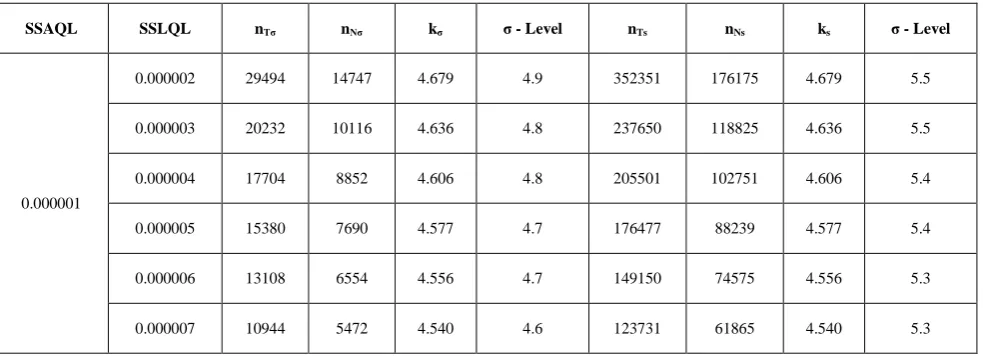
Table 1 can be used to determine SSQSVSS(nTσ, nNσ; kσ) for specified values of SSAQL and SSLQL. For
example, if it is desired to have a SSQSVSS(nTσ, nNσ; kσ) for given SSAQL = 0.000002 and SSLQL =0.000007, and
m=2, α*= 3.4x10⁻⁶
, β* ≥ 2α*. Table 1 gives nN = 6019, and k= 4.428. The sample size nTσ = m nNσ = (2) (6019) =
12038. Thus, for given requirement, the SSQSVSS (nTσ, nNσ; kσ) is specified by the parameters nTσ =12038, nNσ = 6019,
ISSN(Online): 2320-9801
ISSN (Print): 2320-9798
I
nternational
J
ournal of
I
nnovative
R
esearch in
C
omputer
and
C
ommunication
E
ngineering
(An ISO 3297: 2007 Certified Organization)
Vol. 3, Issue 3, March 2015
Practical Explanation
For the test, lot-by-lot acceptance inspection of Cylindrical Cell it is proposed to apply the system with nT=12038, nN=6019, and k=4.428. The characteristic to be inspected is the Cylindrical Cell with the upper limit (U)
diameter of 14.5 mm with a known standard deviation (σ) of 0.006 mm.
Now, take a random sample of size n=6019 and record the diameter of each Cylindrical Cell. Compute the
sample mean (
X
). IfX
+k σ ≤ U ⇒X
+(4.428) (0.006) ≤ 14.5, accept the lot. Otherwise, switch to tightened inspection.Draw a sample of 12038 from the next lot and record the results. Compute the sample mean (
X
) and a known standard deviation (σ) of 0.006. IfX
+k σ ≤ U ⇒X
+(4.428) (0.006) ≤ 14.5, accept the lot. Then, switch to normal inspection. Otherwise, continue with tightened inspection process.IV. SELECTION OF SSQSVSS (nTS, nNS; kS)UNKNOWN σ FOR GIVEN SSAQL AND SSLQL
If the population standard deviation σ is unknown, then it is estimated from the sample standard deviation S (n-1 as the divisor). If the sample size of the unknown sigma variables system (s method) is nTs, nNs and the acceptance
constant is k, then the operating procedure is as follows
Step 1: Draw a sample of size nNs from the lot, inspect and record the measurement of the quality characteristic for each
unit of the sample. Compute the sample mean X and standard deviation S.
Where XN=
X / ni N,2
i N
S=
(x -x) n -1Step2: i) If XN+ k SU or XN k SL accept the lot and repeat step 1 for the next lot.
ii) If
X + k S
N
U or X
N
k S < L
reject the lot go to step 3.Step 3: Draw a sample of size ns from the next lot inspect and record the measurement of the quality characteristic for
each unit of the sample. Compute the sample mean X.
Where X =T
X / ni T,,2
i T
S=
(x -x) n -1Step 4: i) If XT+ k SU or XTk SL accept the lot and repeat step 1 for the next lot.
ii) If XT+ k SU or XTk SL reject the lot and repeat step 3.
where
X
and S are the average and the standard deviation of quality characteristic respectively from the sample. Under the assumptions for a six sigma quick switching system stated, the probability of acceptance Pa(p) of alot is given in the equations (3) and (4) and PT and PN respectively are
2
-z /2 T
1
P e dz
2 T w
and 2-z /2 N
1
P e dz
2 N w
with T
T
T
2
Ts Ts
U-k S -μ
1
w =
S
1
k
(
+
)
n
2n
and N
N
N
2
Ns Ns
U-k S -μ
1
w
=
S
1
k
(
+
)
n
2n
The values of nTS, nNS, and ks for given p1, p2, α and β can be determined and should satisfy the following
equations
1
1 1
T
a 1
T N
P
P (p )=
1
α
1-P +P
(7)2
2 2
T
a 2
T N
P
P (p )= β
ISSN(Online): 2320-9801
ISSN (Print): 2320-9798
I
nternational
J
ournal of
I
nnovative
R
esearch in
C
omputer
and
C
ommunication
E
ngineering
(An ISO 3297: 2007 Certified Organization)
Vol. 3, Issue 3, March 2015
where
1 1
1
S S S S
p p
T 2 2
T T T T
(k-z ) X-X
P =Pr
1 k 1 k
S + +
n 2n n 2n
, 1 1
1
NS NS NS NS
p p
N 2 2
(k-z ) X-X
P =Pr
1 k 1 k
S + +
n 2n n 2n
2 2 2
S S S S
p p
T 2 2
T T T T
(k-z ) X-X
P =Pr
1 k 1 k
S + +
n 2n n 2n
, and 2 2
2
N N N N
S S S S
p p N 2 2 (k-z ) X-X P =Pr
1 k 1 k
S + +
n 2n n 2n
Designing SSQSVSS (nTs, nNs; ks) with unknown σ for given SSAQL and SSLQL
Example 2
Table 1 can be used to determine SSQSVSS (nTs, nNs; ks) for specified values of SSAQL and SSLQL. For
example, if it is desired to have a SSQSVSS (nTs, nNs; ks) for given SSAQL = 0.000003 and SSLQL =0.00008, and
m=2, α*= 3.4x10⁻⁶
, β* ≥ 2α*. Table 1 gives nNS = 6260, and k= 4.047. The sample size nTs = m nNs = (2) (6260) =
12520. Thus, for given requirement, the SSQSVSS (nTs, nNs; ks) is specified by the parameters nTs =12520, nNS = 6260,
and k= 4.047 as desired system parameters, which is associated with 4.7 sigma level.
Practical Explanation
For the test, lot-by-lot acceptance inspection of one liter water bottle it is proposed to apply the system with nT= 12520, nN=6260, and k=4.047. The characteristic to be inspected is the water bottle with the upper limit (U)
diameter of 7.6 cm.
Now, take a random sample of size nN=6260, record the diameter of each water bottle. Compute the sample
mean (
X
) and unknown standard deviation (S). IfX
+k S ≤ U ⇒X
+(4.047) S ≤ 7.6 cm, accept the lot. Otherwise, switch to tightened inspection.Draw a sample of 12520 from the next lot and record the results. Compute the sample mean (
X
) andunknown standard deviation (S). If
X
+k S ≤ U ⇒X
+(4.047) S ≤ 7.6 cm, accept the lot. Then, switch to normal inspection. Otherwise, continue with tightened inspection process.Table 1: SSQSVSS(nT, nN; k) with known and unknown σ indexed by SSAQL and SSLQL (α=3.4 x 10⁻⁶ and β≥2α). (nTσ=mnNσ, where m = 2)
SSAQL SSLQL nTσ nNσ kσ σ - Level nTs nNs ks σ - Level
0.000001
0.000002 29494 14747 4.679 4.9 352351 176175 4.679 5.5
0.000003 20232 10116 4.636 4.8 237650 118825 4.636 5.5
0.000004 17704 8852 4.606 4.8 205501 102751 4.606 5.4
0.000005 15380 7690 4.577 4.7 176477 88239 4.577 5.4
0.000006 13108 6554 4.556 4.7 149150 74575 4.556 5.3
ISSN(Online): 2320-9801
ISSN (Print): 2320-9798
I
nternational
J
ournal of
I
nnovative
R
esearch in
C
omputer
and
C
ommunication
E
ngineering
(An ISO 3297: 2007 Certified Organization)
Vol. 3, Issue 3, March 2015
0.000008 8810 4405 4.525 4.6 99005 49503 4.525 5.2
0.000009 6724 3362 4.511 4.5 75138 37569 4.511 5.2
0.00001 4662 2331 4.499 4.4 51844 25922 4.499 5.1
0.00002 2380 1190 4.417 4.2 25597 12798 4.417 4.9
0.00003 2092 1046 4.368 4.1 22049 11025 4.368 4.9
0.00004 1846 923 4.331 4.1 19159 9580 4.331 4.8
0.00005 1788 894 4.313 4.1 18418 9209 4.313 4.8
0.00006 1560 780 4.291 4.0 15922 7961 4.291 4.8
0.00007 1350 675 4.271 4.0 13663 6831 4.271 4.7
0.000002
0.000003 22255 11128 4.524 4.8 249999 125000 4.524 5.5
0.000004 19474 9737 4.494 4.8 216127 108064 4.494 5.4
0.000005 16918 8459 4.465 4.8 185559 92779 4.465 5.4
0.000006 14419 7209 4.444 4.7 156798 78399 4.444 5.4
0.000007 12038 6019 4.428 4.7 130058 65029 4.428 5.3
0.000008 9691 4846 4.413 4.6 104055 52028 4.413 5.3
0.000009 7396 3698 4.399 4.5 78961 39481 4.399 5.2
0.00001 5128 2564 4.387 4.4 54476 27238 4.387 5.1
0.00002 2618 1309 4.305 4.2 26878 13439 4.305 4.9
0.00003 2301 1151 4.256 4.2 23143 11571 4.256 4.9
0.00004 2031 1015 4.219 4.1 20103 10051 4.219 4.8
0.00005 1967 983 4.201 4.1 19322 9661 4.201 4.8
0.00006 1716 858 4.179 4.1 16700 8350 4.179 4.8
ISSN(Online): 2320-9801
ISSN (Print): 2320-9798
I
nternational
J
ournal of
I
nnovative
R
esearch in
C
omputer
and
C
ommunication
E
ngineering
(An ISO 3297: 2007 Certified Organization)
Vol. 3, Issue 3, March 2015
Table 1: (Continued…)
SSAQL SSLQL nTσ nNσ kσ σ - Level nTs nNs ks σ - Level
0.000003
0.000004 21422 10711 4.412 4.8 229918 114959 4.412 5.5 0.000005 18610 9305 4.382 4.8 197282 98641 4.382 5.4 0.000006 15861 7930 4.353 4.8 166130 83065 4.353 5.4 0.000007 13242 6621 4.332 4.7 137496 68748 4.332 5.3 0.000008 10660 5330 4.316 4.7 109948 54974 4.316 5.3 0.000009 8136 4068 4.301 4.6 83389 41694 4.301 5.2 0.00001 5641 2821 4.287 4.5 57477 28739 4.287 5.1 0.00002 2880 1440 4.275 4.3 29195 14597 4.275 4.9 0.00003 2531 1266 4.193 4.2 24783 12392 4.193 4.9 0.00004 2234 1117 4.144 4.2 21413 10706 4.144 4.9 0.00005 2163 1082 4.107 4.2 20410 10205 4.107 4.9
0.00006 1888 944 4.089 4.1 17668 8834 4.089 4.8
0.00007 1634 817 4.067 4.1 15143 7571 4.067 4.8
0.00008 1362 681 4.047 4.0 12520 6260 4.047 4.7
0.000004
0.000005 20471 10235 3.655 4.9 157206 78603 3.655 5.4
0.000006 17447 8723 4.300 4.8 178742 89371 4.300 5.4 0.000007 14566 7283 4.270 4.7 147361 73680 4.270 5.4 0.000008 11726 5863 4.241 4.7 117179 58590 4.241 5.3 0.000009 8950 4475 4.220 4.6 88639 44320 4.220 5.2 0.00001 6205 3103 4.204 4.5 61039 30519 4.204 5.1 0.00002 3168 1584 4.189 4.3 30961 15481 4.189 5.0 0.00003 2784 1392 4.175 4.2 27052 13526 4.175 4.9 0.00004 2457 1229 4.163 4.2 23748 11874 4.163 4.9 0.00005 2380 1190 4.081 4.2 22197 11099 4.081 4.9 0.00006 2076 1038 4.032 4.2 18954 9477 4.032 4.8
0.00007 1797 898 3.995 4.1 16136 8068 3.995 4.8
0.00008 1499 749 3.977 4.1 13351 6675 3.977 4.7
0.00009 1198 599 3.955 4.0 10567 5283 3.955 4.7
Table 1: (continued…)
SSAQL SSLQL nTσ nNσ kσ σ - Level nTs nNs ks σ - Level
0.000005
0.000006 19191 9596 3.583 4.9 142380 71190 3.583 5.4 0.000007 16023 8012 3.560 4.8 117558 58779 3.560 5.3 0.000008 12899 6449 3.543 4.8 93857 46928 3.543 5.3 0.000009 9845 4922 4.188 4.6 96179 48089 4.188 5.3 0.00001 6826 3413 4.158 4.5 65830 32915 4.158 5.2 0.00002 3485 1742 4.129 4.3 33188 16594 4.129 5.0 0.00003 3063 1531 4.108 4.3 28907 14454 4.108 4.9 0.00004 2703 1351 4.092 4.2 25331 12665 4.092 4.9 0.00005 2618 1309 4.077 4.2 24374 12187 4.077 4.9 0.00006 2284 1142 4.063 4.2 21136 10568 4.063 4.9
0.00007 1977 988 4.051 4.1 18195 9097 4.051 4.8
0.00008 1649 824 3.969 4.1 14634 7317 3.969 4.8
0.00009 1318 659 3.920 4.0 11442 5721 3.920 4.7
ISSN(Online): 2320-9801
ISSN (Print): 2320-9798
I
nternational
J
ournal of
I
nnovative
R
esearch in
C
omputer
and
C
ommunication
E
ngineering
(An ISO 3297: 2007 Certified Organization)
Vol. 3, Issue 3, March 2015
0.00001
0.00002 3833 1917 4.046 4.4 35206 17603 4.046 5.0 0.00003 3369 1685 4.017 4.3 30552 15276 4.017 5.0 0.00004 2973 1487 3.996 4.3 26709 13355 3.996 4.9 0.00005 2880 1440 3.980 4.3 25687 12843 3.980 4.9 0.00006 2512 1256 3.965 4.2 22261 11131 3.965 4.9 0.00007 2174 1087 3.951 4.2 19144 9572 3.951 4.8
0.00008 1813 907 3.939 4.1 15882 7941 3.939 4.8
0.00009 1449 725 3.857 4.1 12231 6115 3.857 4.7
0.00005
0.00006 2764 1382 3.853 4.3 23278 11639 3.853 4.9 0.00007 2392 1196 3.839 4.2 20015 10008 3.839 4.9
0.00008 1995 997 3.827 4.2 16602 8301 3.827 4.8
0.00009 1594 797 3.745 4.1 12775 6388 3.745 4.7
0.0001
0.0002 1341 670 3.584 4.1 9952 4976 3.584 4.7
0.0007 261 131 3.470 3.4 1833 917 3.471 4.2
0.0008 226 113 3.453 3.4 1574 787 3.454 4.1
V. CONSTRUCTION OF TABLE 1
The OC function of SSQSVSS (nT, nN; k) is given by the equation (2) for as a specified (p1, α) and (p2, β).
a T
T N
P P (p)=
1-P +P
where
P = (w
N
N)
P[(U-X) / σ
k]
and
P = (w )
T
T
P[(U-X) / σ
k]
Using iterative procedure equations, (3) and (4) are solved for given values of p1, p2, m, α and β to get the
values of nNσ and kσ for the specified pair of points, say (p1, α) and (p2, β) on the OC curve. Here, the values of m can
be taken m >1and find the desired parameters. In Table 1, provided, if m=2, the values of nTσ, nNσ and kσ are
constructed. A procedure for finding the parameters of unknown σ - method plan from known σ-method plan with parameters (nS, kTS, kNs), are obtained by using computer search routine through C++ programme.The sample size nTσ
equals mnNσ and nTs equals mnNs, and hence only nNσ nNs and k are tabulated.
Table 1 provided the values of nTσ, nNσ, kσ, nTs, nNs and ks which satisfying the equations (3) and (4). The sigma
(σ) value is calculated using the process sigma calculator for given n and k for known σ and unknown σ methods.
VI. CONCLUSION
Six Sigma Quick Switching Variable Sampling System has wide potential applications in industries to ensure a higher standard of quality attainment and increased customer satisfaction. Here, an attempt made to apply the concept of Quick Switching Variable Sampling System to propose a plan designated as Six Sigma Quick Switching Variable Sampling System of type SSQSVSS in which disposal of a lot on the basis of normal and tightened plan. The concept of this article may used for assistance to quality control engineers and plan designers in the further plan development, which were useful and tailor made for industrial shop-floor situations.
REFERENCES
[1]. Abramowitz and Stegun,” Handbook of mathematical functions with Formulas, Graphs, and Mathematical Tables”. 1964
[2]. Devaraj Arumainayagam, S., “Contributions to the study of Quick Switching System(QSS) and its Applications”. Doctoral Dissertation, Bharathiar University, Coimbatore, Tamil Nadu, India,1991.
[3]. Dodge,H.F., “A New Dual System of Acceptance Sampling Technical Report No.16”, The Statistics Center, Rutgers – The State University, New Brunswick, NJ, 1967.
[4]. Govindaraju, K., “Procedures and tables for the selection of Zero Acceptance Number Quick Switching System for Compliance testing”. Communications in Statistics – Simulation and Computation, vol.20, No.1, pp. 157-172, 1991.
[5]. Hamaker, H,C., “ Acceptance Sampling for Percent Defective and by Attributes”, Journal of Quality Technology, 11, pp.138-148,1979. [6]. Radhakrishnan, R, and Sivakumaran, P.K., “Construction of Six Sigma Repetitive Group Sampling Plans”, International Journal of
ISSN(Online): 2320-9801
ISSN (Print): 2320-9798
I
nternational
J
ournal of
I
nnovative
R
esearch in
C
omputer
and
C
ommunication
E
ngineering
(An ISO 3297: 2007 Certified Organization)
Vol. 3, Issue 3, March 2015
[7]. Senthilkumar, D., and Esha Raffie, B., “Six Sigma Quick Switching Variables Sampling System Indexed by Six Sigma Quality Levels”, International Journal of Computer Science & Engineering Technology (IJCSET), ISSN: 2229-3345 Vol. 3 No.12, pp. 565 – 576, Dec 2012. [8]. Soundarajan, V., and Palanivel, M., “Quick Switching Variables Single Sampling (QSVSS) System indexed by AQL and LQL Acceptance
Criterion Tightening”. Journal of Applied Statistics Science, Vol.6 (1): 45-57, 1997.
[9]. Soundarajan, V., and Palanivel, M., “Quick Switching Variables Single Sampling (QSVSS) System indexed by AQL and AOQL”.Journal of Applied Statistics. Vol.27 (7): 771-778, 2000.