University of Windsor University of Windsor
Scholarship at UWindsor
Scholarship at UWindsor
Electronic Theses and Dissertations Theses, Dissertations, and Major Papers
1-1-2019
Distributed Formation Control for Ground Vehicles with Visual
Distributed Formation Control for Ground Vehicles with Visual
Sensing Constraint
Sensing Constraint
Jie Tang
University of Windsor
Follow this and additional works at: https://scholar.uwindsor.ca/etd
Recommended Citation Recommended Citation
Tang, Jie, "Distributed Formation Control for Ground Vehicles with Visual Sensing Constraint" (2019). Electronic Theses and Dissertations. 8181.
https://scholar.uwindsor.ca/etd/8181
This online database contains the full-text of PhD dissertations and Masters’ theses of University of Windsor students from 1954 forward. These documents are made available for personal study and research purposes only, in accordance with the Canadian Copyright Act and the Creative Commons license—CC BY-NC-ND (Attribution, Non-Commercial, No Derivative Works). Under this license, works must always be attributed to the copyright holder (original author), cannot be used for any commercial purposes, and may not be altered. Any other use would require the permission of the copyright holder. Students may inquire about withdrawing their dissertation and/or thesis from this database. For additional inquiries, please contact the repository administrator via email
Distributed Formation Control for
Ground Vehicles with Visual
Sensing Constraint
by
Jie Tang
A Thesis
Submitted to the Faculty of Graduate Studies
through the Department of Electrical and Computer Engineering in Partial
Fulfillment of the Requirements for
the Degree of Master of Applied Science
at the University of Windsor
Windsor, Ontario, Canada
2019
c
Distributed Formation for Ground Vehicles with Visual Sensing Constraint
by
Jie Tang
APPROVED BY:
M.J.Ahamed
Department of Mechanical, Automotive and Materials Engineering
B.Balasingam
Department of Electrical and Computer Engineering
X.Chen, Advisor
Department of Electrical and Computer Engineering
Author’s Declaration of Originality
I hereby certify that I am the sole author of this major paper and that no part of this
major paper has been published or submitted for publication.
I certify that, to the best of my knowledge, my major paper does not infringe upon
anyone’s copyright nor violate any proprietary rights and that any ideas, techniques,
quotations, or any other material from the work of other people included in my major
paper, published or otherwise, are fully acknowledged in accordance with the standard
referencing practices. Furthermore, to the extent that I have included copyrighted
material that surpasses the bounds of fair dealing within the meaning of the Canada
Copyright Act, I certify that I have obtained a written permission from the copyright
owner(s) to include such material(s)in my major paper and have included copies of
such copyright clearances to my appendix.
I declare that this is a true copy of my major paper, including any final revisions, as
approved by my major paper committee and the Graduate Studies office, and that
this major paper has not been submitted for a higher degree to any other University
Abstract
Formation control combined with different tasks enables a group of robots to reach
a geographical location, avoid a collision, and simultaneously maintain the designed
formation pattern. The connection and perception are critical for a multi-agent
for-mation system, mainly when the robots only use vision as a communication method.
However, most visual sensors have limited Field-of-view (FOV), which leaves some
blind zones. In this case, a gradient-based distributed control law can be designed
to keep every robot in the visible zones of other robots during the formation. This
control strategy is designed to be processed independently on each vehicle with no
network connection. This thesis assesses the feasibility of applying the gradient
de-scent method to the problem of visual constraint vehicle formation.
Dedication
Acknowledgments
I would like to take this opportunity to thank my supervisor, Dr. Xiang Chen, for
his elaborate guidance through every stage of this research paper. His support and
feedback helped in transforming this paper into a more meaningful one. His immense
passion for teaching and research have further inspired me to pursue this path in the
future.
I would also like to thank my committee members, Dr. Balakumar Balasingam and Dr.
Jalal Ahamed, for their constructive comments, valuable feedback, positive criticism
and their time in reviewing my work.
I would like extend my gratitude to my lab colleagues, Tong Zhang and Youying Hua,
in the Graduate Control and Robotics Lab, for their friendship, support, their constant
involvement, and their valuable feedback.
Finally, I would like to thank my family and friends who continuously aid me in my
research. My parents, Jun Tang and Wenhui Zhang, support me both mentally and
financially, and my friend Zichun Zhao helped me do the experiments on weekends
Contents
Author’s Declaration of Originality . . . iii
Abstract . . . iv
Dedication . . . v
Acknowledgment . . . vi
List of Tables . . . ix
List of Figures . . . x
List of Abbreviations . . . xiii
1 Introduction 1 1.1 Vision-based Formation of Ground Vehicles . . . 1
1.2 Field of View Constraint . . . 3
1.3 Literature Review . . . 3
1.4 Research Objective . . . 6
1.5 Thesis Outline . . . 6
2 Theoretical Foundations 8 2.1 Geometry . . . 8
2.1.1 Euclidean Distance . . . 8
2.1.2 Inner Product . . . 8
2.1.3 Rotation Matrix . . . 9
CONTENTS
2.3 Graph Theory and Terminology . . . 11
2.4 Gradient Formation Control . . . 12
2.5 Camera Model and Pose Estimation . . . 13
3 Distributed Formation System Design 16 3.1 Problem Statement . . . 16
3.2 General Solution . . . 18
3.2.1 Potential Function . . . 18
3.2.2 Local Controller . . . 20
3.3 System Design . . . 21
3.3.1 Distributed Multi-vehicle System . . . 21
3.3.2 Embedded System Design . . . 22
4 Implementation Detail 24 4.1 Overview of Vehicle Setup . . . 24
4.2 Configurations of the Vehicle . . . 25
4.2.1 Vehicle Kinematics and Control . . . 25
4.2.2 Vehicle Specifications . . . 27
4.2.3 Localization System . . . 29
4.3 Software Environments . . . 32
4.3.1 ROS . . . 32
4.3.2 Ar_track_alvar . . . 32
4.3.3 Camera Calibrator . . . 33
4.3.4 MATLAB . . . 33
4.3.5 Other Libraries and Packages . . . 34
5 Experiments and Result Analysis 35 5.1 Indoor Environment . . . 35
CONTENTS
5.3 Long Range Turning Test . . . 39
5.3.1 Result Analysis . . . 41
5.4 Conclusion . . . 47
6 Conclusion 49 6.1 Overall . . . 49
6.2 Future Works . . . 50
6.2.1 Precise Control Algorithm and Accuracy . . . 50
6.2.2 Relaxing the Connection Constraint . . . 50
6.2.3 Non-artificial feature based Localization . . . 50
6.2.4 Aerospace Vehicle Formation . . . 51
6.2.5 Basis of Formation Problem . . . 51
Appendix A Equipment . . . 52
Appendix B Code . . . 55
Appendix C Stability Prove . . . 57
References . . . 60
List of Tables
5.1 Parameters Used in the Experiment . . . 38
5.2 Parameters Used in the Experiment . . . 40
5.3 MAE of relative positions before turning. . . 45
5.4 MAE of orientations before turning . . . 45
5.5 MAE of relative positions after turning. . . 45
List of Figures
1.1 A Leader-follower Control Strategy[1] . . . 4
1.2 The Virtual Structure Control Strategy[2] . . . 5
2.1 Fixed Point Rotation Convention . . . 10
2.2 Non-holonomic vehicle model . . . 11
2.3 Camera model transform point from 3D to 2D . . . 14
2.4 The transformation from world frame to camera coordinate . . . 15
3.1 Relative angle between vehicle i and vehicle j . . . 17
3.2 Transition zone used in Jv(s) . . . 20
3.3 Multi-vehicle Formation System with Visual Constraint . . . 22
3.4 The control structure for each vehicle . . . 22
4.1 Project Architecture . . . 25
4.2 The Sketch of Omnidirection Wheel Vehicle . . . 26
4.3 PID Control of Vehicle Base Chassis . . . 27
4.4 The Hardware Structure of Vehicle . . . 28
4.5 The photo of vehicle . . . 29
4.6 The Marker Box Illustration . . . 30
4.7 The Mount of Cameras . . . 31
4.8 The Photos Captured from Two Cameras . . . 31
LIST OF FIGURES
4.10 Checkerboard Borad for Calibration . . . 34
5.1 The indoor environment with 4 vehicles . . . 36
5.2 A General Setup of the Formation System . . . 36
5.3 A Predefined Formation Pattern Target . . . 37
5.4 Experiment of Different Initial Poses . . . 38
5.5 Path of the Experiment in Fig5.4.(c) . . . 39
5.6 Experiment of formation turning test . . . 40
5.7 Trajectories of all the Vehicles . . . 41
5.8 Orientation of vehicles during the experiment . . . 42
5.9 Velocity of vehicles during the experiment . . . 42
5.10 (a)(b) Formation Error of X and Y Directions before Turning, (c)(d) Formation Error of X and Y Directions after Turning . . . 44
5.11 Relative angle between different vehicles (a) vehicle1&2 (b) vehicle1&3 (c) vehicle1&4 (d)vehicle3&1 (e)vehicle3&2 (f) vehicle3&4 . . . 46
5.12 Final Formation Pattern . . . 47
A.1 The Nvidia TX2 . . . 52
A.2 The Micro-controller . . . 53
A.3 The Camera Module . . . 53
A.4 The Inertia Measurement Unit . . . 54
List of Abbreviations
FOV Field of View
HD High Definition
IMU Inertial Measurement Unit
MAE Mean Absolute Error
MATLAB Matrix Laboratory
MCU Micro Controller Unit
NVIDIA NVIDIA Corporation
PID Proportional, Integral, and Derivative
PnP Perspective-n-Point
ROS Robot Operation System
UAV Unmanned Aerial Vehicle
Chapter 1
Introduction
A group of robots needs cooperation when fulfilling a certain task. It has
numer-ous reasons to let robots work cooperatively. Not only efficiency, redundancy, and
flexibility can be improved dramatically, but also, some tasks single robot impossibly
performed are feasible with multi-robots. Although the prospect is attractive, there
are still some scientific and technological challenges. One can imagine the control of a
group of robots, the method of communications among multi-robots, dealing with
un-stable and constraint communicating, etc. These kinds of challenges will be discussed
in following sections, section.1.1 and section.1.2. Also, some popular control
strate-gies of multi-robots cooperation, particularly formation control, will be introduced in
section.1.3.
1.1
Vision-based Formation of Ground Vehicles
Formation control generally refers to the control approach to accomplish a specific
pattern with a group of robots. It is the foundation of autonomous cooperative control
with multi-robots, which can be widely used in surveillance, distributed manipulation,
mapping of unknown environments, and transportation of large objects[3]. Formation
CHAPTER 1. INTRODUCTION
fusion, embedded systems, and distributed systems.
Meanwhile, depending on whether there is any central controller doing motion
plan-ning and making decisions for all the vehicles, a formation control can be classified
to the central or distributed controller. Distributed control strategy means that the
robots give a response mainly relay on the local information and decisions. The
central operator may exist but only fulfill the supervisory control. Excepting with
the feature of full autonomy, the distributed system also has the following benefits:
(1)The computing can be done parallel. (2)The system will be more robust without
the central controller. (3)The increase of total agent numbers will not dramatically
rise the computing power.
One of the critical aspects of a robotic system is perception. It determines how robots
senses the environment and extract useful information, which usually means the
es-timation of robots’ pose for the formation problem. Vision has long been considered
as one of the most intuitional and powerful means of perception. Visual sensing can
provide sufficient information to perform control tasks. However, the challenge will
come with the fact that real-time control will require a lot of computing power,
espe-cially with distributed onboard computation. Also, the limitation of field of view is
another challenge, which will be discussed later in the next section.
In the 2D case, the ground vehicles can be chosen as an appropriate research
ob-ject. Most of the ground vehicles have nonholonomic kinematics, which constrains
the movement along the side direction. The nonholonomic constraints should also be
CHAPTER 1. INTRODUCTION
1.2
Field of View Constraint
It is well-known that every sensor has a limitation with the working range and field.
As for vision sensors, the field-of-view (FOV) defines the area of inspection captured
by the camera. It restricts the horizontal and vertical angle as a boundary for
vi-sual sensors. Under the condition of limited FOV constraint, the vivi-sual connection
between every two robots may be unstable during the formation. In some sensing
and communication constraint cases, one of the tasks could be maintaining visibility
among all the vehicles.
In some particular scenarios, the robots need to see all each other simultaneously.
For example, a group of UAVs or robots with bidirectional full vision connections can
prepare defense when any vehicle in formation is getting attacked by the enemy or
invader. Keeping visibility is meaningful for defense-purposed surveillance.
1.3
Literature Review
In recent years, our society has developed an ever-growing interest in autonomous
cooperative agents. Specifically, formation problem has been attracting the most
attention in the multi-agent research field. Based on various criteria, some control
architectures have been constructed in the past few years, such as leader-follower[1,4,5],
virtual structure[2,6,7], behavioural-based[8] etc.
In the leader-follower approach[1], the leader and follower relationships between two
vehicles are defined. The leaders track the predefined or on-line planned trajectories,
and the followers track leaders based on the relative pose of their nearby leaders.
com-CHAPTER 1. INTRODUCTION
pared with the followers. Concurrently, the first follower will attempt to maintain
the distance and the orientation with the leaders. Meanwhile, the second follower
will try to track the first follower in the front . The leader-follower approach is easy
to implement and understand. Besides, when leaders are disturbed by external
en-vironments, the formation can still maintain the objective pattern. However, in the
leader-follower approach, the leader vehicles do not have the feedback information
from follower vehicles. A general illustration of the leader-follower approach is shown
in Fig.1.1.
Figure 1.1: A Leader-follower Control Strategy[1]
In[2] a concept of virtual structure is introduced. The author uses virtual structure
to force an ensemble of robots to behave as if they form a rigid body. The control
strategy for virtual structure can be illustrated as a bi-direction control. The
mo-bile robots can be controlled by applying a virtual force field to the whole structure;
also the position and shape of the virtual structure is determined by the action of
each mobile robots. Many considerable works based on virtual structure have been
done in the past few years. In[6], Norman and Hugh decrease the formation error by
using motion synchronization to modify the trajectory. In[7], formation feedback is
used to improve the robustness of virtual structure formation. The advantage of this
approach is that it is easy to maneuver robots with group behaviour. However, it is
challenging to do extra applications when the formation needs to maintain the virtual
CHAPTER 1. INTRODUCTION
keep precise formation patterns. A brief illustration of the virtual structure method
is shown in Fig.1.2
Figure 1.2: The Virtual Structure Control Strategy[2]
A behavior-based approach is introduced by considering of doing various tasks, such
as avoiding an obstacle, tracking neighbor vehicles, and formation keeping,
simulta-neously during the formation. Tucker, and Ronald[8] used the gain factors to balance
the importance of different objectives. The combined behavior was generated by
multiplying the outputs of each fundamental objective by its weighting gain, then
summing and normalizing the results. In[9], the initial formation problem combined
with the navigation task was solved by extending the behavior-based approach with
a navigating algorithm. It is natural to use a behavior-based approach to describe
a formation problem with multiple objectives; however, this approach has
disadvan-tage because the behavior-based approach makes it difficult to analyze the inherent
mathematical properties and prove the stability and convergence.
One of the main challenges for real-time visual-based formation control is the
local-ization of other vehicles. . Locating robots has been an active research topic in recent
years[10] [11] [12]. There are currently two ways for 6D vision-based pose estimations.
The first is solving PnP (Perspective-n-Point) problems[13], which is a traditional way
for visual . The second is deep learning methods[14] also become popular in recent
CHAPTER 1. INTRODUCTION
for localization.
1.4
Research Objective
The main goal of this thesis is to design a distributed formation system that can
be work with visual constraints. The overall design primarily consists of the vision
localization and distributed local controller.
Three performances will be used as the primary evaluation criteria that will be tested
in the thesis:
1. objective velocity and handing orientation synchronizing,
2. formation pattern convergence and maintenance, and
3. avoidance of blind zones.
1.5
Thesis Outline
This thesis begins with an introduction to the visual-based formation tasks and field
of view (FOV) constraints in chapter 1. Section 1.3 gives some popular formation
control strategies.
Chapter 2. talks about the theoretical foundations used in this thesis. Section 2.1
introduces some basic geometry knowledge that will help to characterize the
forma-tion problem. Secforma-tion 2.2 gives two widely used vehicle dynamic models. Secforma-tion 2.3
presents a brief introduction of graph theory, which is used to describe multi-agent
CHAPTER 1. INTRODUCTION
will be used to solve the related formation problem in this thesis. Section 2.5 shows
the camera model and visual-based pose estimation method that facilitate
localiza-tion between vehicles.
Chapter 3 introduces the design of distributed formation control system. Section
3.1 outlines the problem formulation of visual constraint formation task . Potential
function design, including visual constraint Cij and formation pattern Vij, and local
controller design are the main components of section 3.2. Section 3.3 presents a
con-trol structure of each vehicle.
Chapter 4 focuses on the details of implementing a formation control system. Section
4.1 presents the general structure of a distributed formation system , and section 4.2
shows the configuration of the vehicles used in the experiment, including the
kinemat-ics, physical performance, and localization method. Software and the library package
used in the project are shown in section 4.3.
Chapter 5 shows the experiment setups and analysis of the results. Introductions
of the experimental environments are given in section 5.1, while random initial pose
conditions are used in section 5.2 to test the convergence ability for different initial
states of the system. In section 5.3, the detailed analysis of experiments is illustrated,
which includes the trajectory, speed, orientation, and relative angles.
Chapter 2
Theoretical Foundations
To support the some of the mathematical definitions and technical concepts this
thesis utilizes, this chapter will give a brief review of geometry definitions, dynamic
models of vehicle, graph theories, and gradient control. The chapter also introduces
the camera model and pose estimation method.
2.1
Geometry
2.1.1
Euclidean Distance
The Euclidean distance is the most obvious way of representing the distance between
two points in a metric space. The distance between two points X = (x1, x2, ..., xn)
and Y = (y1, y2, ..., yn) in n-dimensional Euclidean space is defined as:
kX−Yk=
v u u t
n X
i=1
(xi−yi) 2
(2.1)
2.1.2
Inner Product
On <2, a Euclidean vector is a geometric object that possesses both a magnitude and
CHAPTER 2. THEORETICAL FOUNDATIONS
arrow points to. The magnitude of a vector ais denoted by kak. The inner product
of two Euclidean vectors a and b is defined by
a·b =kakkbkcosθ (2.2)
Where θ is the angle betweena and b. It also can be calculated by
θ= arccos a·b
kakkbk (2.3)
2.1.3
Rotation Matrix
A rotation matrix R in Euclidean n-space is a n×n real orthogonal matrix, whose transpose is its inverse,i.e. RT = R−1,and it determinant det(R) = 1. The product of two rotation matrices is still a rotation matrices. On <2, the standard rotation
matrix has the following form:
R(θ) =
cosθ −sinθ
sinθ cosθ
(2.4)
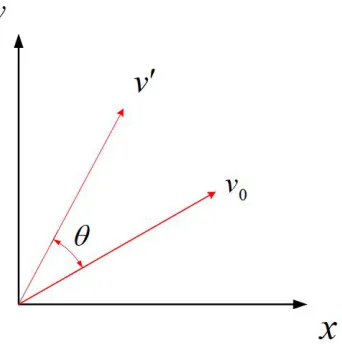
whereθmeans that a vector has a counterclockwise rotation through angleθ. A given vector v0 = [x, y] rotated by a counterclockwise angleθ in a fixed coordinate system
can be represented by:
v0 =R(θ)v0 (2.5)
Which is also shown in the Fig.2.1.
CHAPTER 2. THEORETICAL FOUNDATIONS
Figure 2.1: Fixed Point Rotation Convention
2.2
Dynamic Model of Vehicles
The dynamical model of vehicles plays a crucial role in the formation control
prob-lem. In real world vehicle systems, there are different types of vehicle models, like
holonomic model, nonholonomic vehicle model, Euler-Lagrange vehicle model, and
high-order dynamic model[15].
In holonomic vehicle systems, the motion of a vehicle in every axis is independent with
each other. Thus, the vehicles can directly go to any position without constraints.
The general expression of a holonomic vehicle is
˙
pi =vi, v˙i =ui, i∈ {1, . . . , N} (2.6)
Where pi, vi ∈ <n ,n ∈ {2,3}, are the position and the velocity vectors of vehicles. ui
CHAPTER 2. THEORETICAL FOUNDATIONS
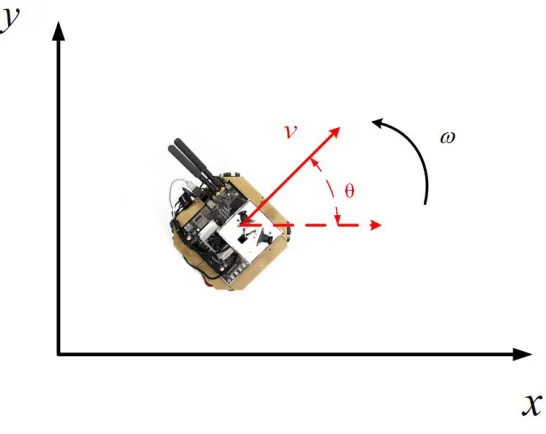
For nonholonomic models, the model on<2 is generally given by
˙
xi =vicosθi
˙
yi =visinθi
˙
θi =ωi, i= 1, . . . , N
(2.7)
Where the vi, θi and ωi are linear velocity, handing direction and angular velocity
respectively. The vehicle position in world frame is presented by pi =|xi, yi| >
∈ <2.
A general illustration of nonholonomic vehicle model is shown in Fig.2.2
Figure 2.2: Non-holonomic vehicle model
2.3
Graph Theory and Terminology
Basic concepts of graph theory can be found in any graph theory books[16] [17]. In this
section, it will introduce the modeling of multi-vehicle systems by using graph theory.
CHAPTER 2. THEORETICAL FOUNDATIONS
1,2...N. Where theV ={1,· · · , N}andE ={(i, j)|j ∈Ni, i, j ∈V, i6=j}represent
the vertex and edge sets of graph G separately. Each vehicle is an element included
in the vertex set V. Also, the edge set represent connections among the vehicles.
The connections can be direction or undirected connection. For example, if the
connections between two vehicles 1 and 2 is undirected, it means both the vehicle
1 and 2 can receive the information from each other. A neighbor set Ni is used to
characterizing the connection with vehicle i. The graph set,Gf = (V,Ef), is used to
represent desired formation patterns and relation shapes.
2.4
Gradient Formation Control
Gradient formation controllers are based on the gradient descent optimization
algo-rithm, which can find the minimum of a function by using iteration methods. For
a general formation control case, consider the formation of n vehicles with typical
holonomic dynamic 2.6 and a graph pattern G. Between arbitrary two vehicles has
an edge Eij where a corresponding potential function (cost function)Vij can be
con-structed. When these two vehicles are at the desired relative position, the potential
function Vij gets the global minimum value. A typical potential function Vij could
have the following conditions[18] .
Vij :Rm →R≥0 is continuously differentiable (2.8)
Vij = 0⇐⇒ kpi−pjk=dij (2.9)
∇piVij = 0⇐⇒ kpi−pjk=dij (2.10)
Where the dij is the desired relative position between the vehicle iand vehiclej. ∇x
is defined as∇x ,
h ∂ ∂x1, . . . ,
∂ ∂xm
iT
, in 2D case∇pi = h ∂ ∂xi, ∂ ∂yi iT
CHAPTER 2. THEORETICAL FOUNDATIONS
edges inside the graph, the potential function can be defined as :
V = X
(i,j)∈E(t)
Vij (2.11)
Thus, a gradient descent controller for each vehicle can be defined as:
ui =−∇pi X
(i,j)∈E(t)
Vij (2.12)
It has been proved in[19] [20] that the formation will finally converge to the desired
patternGf. If all the conditions (2.8),(2.9),(2.10) are satisfied.
Sometimes developing the potential functions is a kind of art. Different functions are
needed according to various scenarios and tasks.
2.5
Camera Model and Pose Estimation
There are different types of camera models. Take the most common pin-hole cameras
for example. A camera model can be divided into intrinsic and extrinsic parts. The
intrinsic parameters characterize the pin-hole camera model and lens distortion. The
extrinsic matrix includes the translation and rotation of cameras respect to the world
frame[21].
The camera model can characterize transformations from a 3D world frame to a 2D
image plane. Here using K to represent the intrinsic matrix[22]. Where [p
CHAPTER 2. THEORETICAL FOUNDATIONS
translation vector which indicates the offset of 2D points in a image plane.
xpix ypix 1 =K Xc Yc Zc
, W hereK=
fx 0 px
0 fy py
0 0 1
| {z }
intrinsic matrix
(2.13)
Where [xpix, ypix]T represents a point in camera image planes (pixel coordinates),
[Xc, Yc, Zc]T represents a point in 3D camera coordinates.
Figure 2.3: Camera model transform point from 3D to 2D
Distortion caused by optical components in the camera is another problem in real
world image systems. The distortion of an image can be characterized by using a
mapping function D, [xdistorted, ydistorted]T =D([xideal, yideal]T) :
xdistorted =xideal(1 +k1?r2+k2?r4+k3?r6)
ydistorted =yideal(1 +k1?r2 +k2?r4+k3?r6)
(2.14)
Where [xdistorted, ydistorted]T represents the point in distorted images, [xideal, yideal]T
means the point in ideal images. rexpresses the distance to the image center,k1, k2, k3
are distortion factors, which respect to different camera and lens.
CHAPTER 2. THEORETICAL FOUNDATIONS
is represented by the rotation matrixRand translation vector t. The transformation
from world frames Pw to camera coordinates Pc is shown in(2.15) and Fig.2.4.
Figure 2.4: The transformation from world frame to camera coordinate
Pc= [R|t]Pw (2.15)
Combining the (2.13),(2.14),(2.15), the transformation from world coordinates to
im-age planes can be established in (2.16).
xpix ypix 1
=D(K xc yc zc
)=D(K[R|t] Xw Yw Zw 1 ) (2.16)
In (2.16), the intrinsic parameters, D, and K can be identified by doing camera
calibration and the Pw can be known by using prior designed artificial features.
Chapter 3
Distributed Formation System
Design
This chapter will include the mathematical expression of visual constraint formation
problems, the solution to such a problem, and a control system designed to solve
these problems.
3.1
Problem Statement
The overall objective of this thesis is to create a distributed formation system working
under visual field constraint, with no network information exchange. To express the
visual field constraint, arelative angle γij between the vehicleiand jis introduced
based on (2.3).
cosγij ,f(pi−pj, θj) =
−cosθj
−sinθj T ·
xi−xj
yi−yj
−cosθj
−sinθj
xi−yj
CHAPTER 3. DISTRIBUTED FORMATION SYSTEM DESIGN
Figure 3.1: Relative angle between vehicle i and vehicle j
Where thepi = [xi, yj]T represents the position of vehicle i in the world coordinate,θj
expresses the heading direction of vehicle j. An illustration of relative angle is shown
in the Fig.3.1. A blind angle α dividing blind zone equally is imported for the sake of simplicity.
It is obvious that when cosγij < cosα, γij > α. It means vehicle i is outside
the blind zone of vehicle j. So the neighbor set of vehicle i is expressed by Ni = {j ∈V|cos (γji)<cos(α),kpj −pik< Rs, j 6=i}. This neighbor set Ni indict the
robot j within the visible zone of robot i.
Thus, two objectives are established, which are keeping the visibility among all
vehi-cles and driving the vehivehi-cles to a desired formation set. The corresponding expressions
are shown:
Objective 1 The restrict {cosγij < cosα,kpj−pik < Rs, j 6= i} holds for all
CHAPTER 3. DISTRIBUTED FORMATION SYSTEM DESIGN
camera.
Objective 2The lim
t→∞||(pi−pj)−(hi−hj)|| →0, and θi →θf satisfied fori, j ∈Gf.
Where thehi−hj is the desired relative position in world coordinate for vehicle i and
j.
3.2
General Solution
Based on the section 2.4 and 3.1, one of an appropriate way to solve the
forma-tion control problem is finding a suitable potential funcforma-tion under the given scenario
constraint. In[23], a potential function with visibility constraint has been proposed.
3.2.1
Potential Function
The potential function were divided into two parts in the paper[23],Vij andCij, which
is shown in (3.2). The Vij focuses on the formation pattern convergence, and the Cij
represents the task of visibility maintenance. kc and kv are two weighting factors to
balance the Cij and Vij
J =
N X
i=1
(kc X
(i,j)∈E(t)
Cij +kv
X
(i,j)∈Esub(t)
Vij) (3.2)
Where Esub(t) means a sub edge set, which vehicle i and j inside it is in a visible zone within the distance r . r is a design factor given by Rs−r
CHAPTER 3. DISTRIBUTED FORMATION SYSTEM DESIGN
max{||hi−hj||}. The expression of Esub(t) are shown in below.
1.Esub(0) =E(0)∩Ef
2.Esub(t+) =Esub(t−)∪ {(i, j)| kpi(t)−pj(t)k ≤r ,cos (γji(t))<cos(α), i, j ∈V)}
(3.3)
The cost function Vij is presented
Vij =
k(pi−pj)−(hi−hj)k2
kpi−pjk2 ,kpi−pjk ∈(0,khi−hjk] k(pi−pj)−(hi−hj)k2
(Rs−kpi−pjk)2 ,kpi−pjk ∈(khi−hjk, Rs)
(3.4)
It is obvious that the equation(3.4) satisfies the requirements, (2.9), and (2.10). More
over it also has lim
kpi−pjk→0Vij(pi−pj) = +∞and kpi−limpjk→RsVij(pi−pj) = +∞, which
prevent the vehicle i collision with vehicle j or excess visibility distance.
The cost functionCij is represented byCij =ρ(kpi−pjk)Jv(γji), whereρ(kpi−pjk)
is a smooth function to avoid effects ofJv(γji), when a sudden change ofG(t) happen.
Jv(γji) is used to drive vehicles goes out the blind zone(3.5).
Jv(s) =
0, s > β
Rs β
cosβ−cos(τ)
cos(α)−cos(τ))3dτ, s∈(α, β]
Rs
β ∞, s ∈[0, α]
(3.5)
In the (3.5), a transition zone is defined by usingαandβ. Whenγij is in the transition
CHAPTER 3. DISTRIBUTED FORMATION SYSTEM DESIGN
Figure 3.2: Transition zone used inJv(s)
The ρ(kpi−pjk) is given by
ρ(kpi−pjk) =
1, kpi−pjk ∈[0, r)
1 2
1 + cosπkpiRs−pj−k−r r, kpi−pjk ∈[r, Rs]
0, kpi−pjk ∈[Rs,∞)
(3.6)
3.2.2
Local Controller
The controller designed by (2.12) can only be directly used in the vehicle having
holonomic kinematic model. Thus, a method convert the gradient to linear and
angular velocity need to be proposed[23].
vi =−sgn
∂J ∂xi
cos (θi) +
∂J ∂yi
sin (θi)
k∇iJk+v0
ωi =
∂J ∂xi
sin
θi+θf
2 − ∂J ∂yi cos
θi+θf
2
v0
−sin
θi−θf
2
CHAPTER 3. DISTRIBUTED FORMATION SYSTEM DESIGN
Where ∇iJ = [∂xi∂J,∂yi∂J]T. And sgn(s) is a signum function defined as:
sgn(x) :=
−1 if x <0
0 if x= 0
1 if x >0
(3.8)
The convergence ability of the proposed local controller in (3.7) is proved in[24] by
Lyapunov method and a detail derivation is given in the page57 Appendix C. It is
obviously that
∂J ∂xi
= ∂J
∂yi
= 0 → vi =v0 (3.9)
And when ∂xi∂J = ∂yi∂J = 0 & θi =θf the ωi = ˙θi = 0.
3.3
System Design
3.3.1
Distributed Multi-vehicle System
Due to the communication is restricted, and each vehicle is seen as an individual
unit. Thus, a distributed system are constructed to verify the control algorithm. In
a distributed environment each vehicle perceives environments and makes decisions
independently. All the setup related with the experiments are predefined inside in
each vehicle include relative positions, desired velocity, handing, etc.
A general illustration of the multi-vehicles formation system is shown in the 3.3. With
N vehicles included, the system can be established to test the effectiveness of
CHAPTER 3. DISTRIBUTED FORMATION SYSTEM DESIGN
Figure 3.3: Multi-vehicle Formation System with Visual Constraint
3.3.2
Embedded System Design
Based on (3.7), a local controller can be designed to maintain the formation pattern
which only relay on the information explored by itself. Thus, we can focus on design
control for each vehicle individually.
Figure 3.4: The control structure for each vehicle
Combining the previous results with a real word sensing environment scenario,
illustra-CHAPTER 3. DISTRIBUTED FORMATION SYSTEM DESIGN
tion of control structure is shown in Fig3.4 . The whole structure can be divided into
three parts (1) Percetion (2)Planning (3)Control. In the percetion section,the IMUs
are used to get the heading direction of themselves, and cameras are used to resolve
the relative pose between vehicles. In the planning part, based on the pre-processing
information from last step, the ∂xi∂J and the ∂yi∂J are are calculated. In the flow chart
the Cij is given by (3.5)and(3.6), Vij is given by (3.4) respectively. As long as the
robot j is detected by the robot i, we calculate Cij and only when (i, j)∈Esub(t) the
Vij is included in the cost function. The control part is responded for regulation the
Chapter 4
Implementation Detail
This chapter will introduce the setup of experiment equipment and the development
of software.
4.1
Overview of Vehicle Setup
It is a comprehensive work to design an embedded system including variety of
dif-ferent architecture, such as software and hardware, which need cooperation to get
decent performance. According to needs of visual formation, the primary task of the
project is setting a platform with appropriate hardware and open-source software that
can be used to test formation algorithm in indoor environments. Priority is give to
the object recognition and pose estimation. It is essential to the existing formation
framework in section 3.3 for on-board autonomous control .
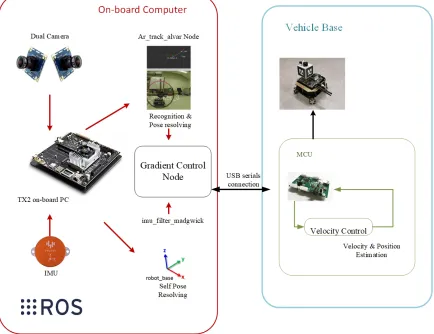
Fig.4.1 is a general architecture that briefly illustrate the main components used in
this project. The main program runs on NVIDIA TX2 with Linux system. Robot
Operation System[25] (ROS) are used to fulfill high-level action which finally send the
CHAPTER 4. IMPLEMENTATION DETAIL
motors control. The detailed features will be talked in the following sections.
Figure 4.1: Project Architecture
4.2
Configurations of the Vehicle
Each vehicle is seen as one basic unit for the formation system. It is necessary to
consider the kinematics and some on-board sensor performance of the vehicle.
4.2.1
Vehicle Kinematics and Control
Nowadays, there are several of different kinematic models for vehicles, such as,
differ-ential two wheels, omnidirectional, ackerman, mecanum, etc. In this experiment, four
CHAPTER 4. IMPLEMENTATION DETAIL
omnidirectional wheel vehicles is shown in Fig.4.2. With the φ = 45◦ in graph.4.2, the wheels are orthogonal. The forward and inverse kinematic models[26] of the
om-nidirectional vehicles are shown below (4.1),(4.2):
Figure 4.2: The Sketch of Omnidirection Wheel Vehicle
Vr = vx vy ω = 1 4
−√2 −√2 √2 √2
√
2 −√2 −√2 √2 1 L 1 L 1 L 1 L v1 v2 v3 v4 (4.1)
Vw= v1 v2 v3 v4 =
−√2 2
√ 2 2 L −√2
2
−√2 2 L √
2 2
−√2 2 L √ 2 2 √ 2 2 L vx vy ω (4.2)
WhereVw = [v1 v2 v3 v4]T,v1 v2 v3 v4 are the wheel velocities in the active direction. Vr = [vx vy ω]T,vx and vy are the translational velocities of the robot center, ω is
CHAPTER 4. IMPLEMENTATION DETAIL
this thesis, we only use the vx as linear velocity and ω as angluar velocity to control
the vehicle. There is no vy included in high-level control part.
For the velocity control of chassis, four PID controllers are used to track the desired
linear and angular velocities by controlling four motor drives. An illustration of the
low-level velocity control is shown in 4.3.
Figure 4.3: PID Control of Vehicle Base Chassis
4.2.2
Vehicle Specifications
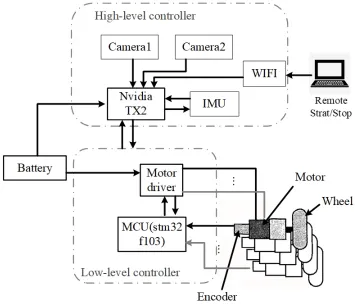
The hardware structure of vehicles are shown in Fig.4.4. The control units of vehicles
are divided to two parts: (a) Master Controller used as a High-level controller (b)
Servo controller used as a low-level controller. The low-level controller is a customized
board based on STM32f103RCT6, which is used to drive the motors according to the
linear and angular velocities sent from high-level controller, meanwhile, resolve the
real-time linear and angular velocity based on encoder data. The NVIDIA TX2
de-veloper board is used as the High-level controller. All computing power consuming
programs are calculated on TX2, like image processing and motion planning.The
NVIDIA TX2 controls the vehicle just by sending linear and angular velocity to the
CHAPTER 4. IMPLEMENTATION DETAIL
including two cameras and IMU. The laptop is used to control all vehicles start/stop
or trigger special event, like changing heading direction.
Figure 4.4: The Hardware Structure of Vehicle
A picture of the omnidirectional vehicles used in this thesis is designed and
con-structed as illustrated in Fig.4.5. Each side of the vehicle is 260mm, the height of the vehicle is 340mm, and the motor drives and controller are placed in the space between the platform and ground. With the selected motor and arrangement mechanism, the
vehicles have maximum linear and angular velocity 1.2 m/s and 5.3 rad/s respectively.
CHAPTER 4. IMPLEMENTATION DETAIL
Figure 4.5: The photo of vehicle
4.2.3
Localization System
Localization system here means both the vision capture method and the features used
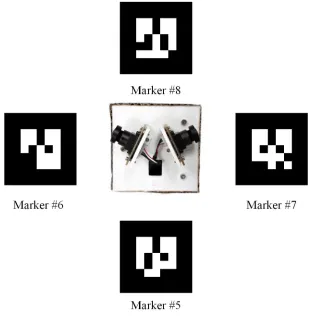
for recognition. This vehicle equipped a marker box with four markers mounted on
the top, which is used as the artificial features to identify different vehicles and do
the localization as shown in Fig.4.5. By using four orthogonal markers, the vehicle
can be detected in any direction An illustration can been found in Fig.4.6.
Each marker forms 90 degree angles with two adjacent markers. Also, the markers on
every surface are unique for the convenience of identification the nubmer and heading
of the vehicles. As shown in Fig4.6, taking vehicle 2 for example, the marker 5 is on
the back of the marker box. When other vehicles get the relative handing of marker
CHAPTER 4. IMPLEMENTATION DETAIL
Figure 4.6: The Marker Box Illustration
To mimic a super wide angle fish-eye camera, two cameras are mounted in opposite
direction with a 170◦ horizontally angle of view and the rotation angle θl =θr = 60◦
which leaves an angle of 70◦ for blind zone as shown in Fig.4.7. In Fig.4.7, the green
areas represent visible zone, the red represent the blind zone. The resolution for each
camera is full HD 1920*1080 and support 30 fps at 1920*1080 mode. A demonstration
of the photo captured by two cameras mounted on the vehicle is shown in Fig.4.8.
The green areas in Fig.4.8 represent the overlap area captured in both two cameras
CHAPTER 4. IMPLEMENTATION DETAIL
Figure 4.7: The Mount of Cameras
CHAPTER 4. IMPLEMENTATION DETAIL
4.3
Software Environments
This section will introduce the software environments and the packages or libraries
used in the thesis will be introduced.
4.3.1
ROS
ROS is the abbreviation of RobotOperatingSystem and ROS is a distributed
frame-work for developing and testing robotics software or algorithms[27]. It provides bunch
of services, including hardware abstraction, low-level device control, implementation
of commonly-used functionality, message-passing between processes, and package
management. ROS has a distributed developing and running structure. By Using
the publish-subscribe mechanism, each node (program or process) can subscribe to
so-called topics and push message to others. ROS also provide the data recording
package named rosbag. By using rosbag, it is easy to record different types message
data for late analyzing like, image and odometer. Hence, the control of autonomous
vehicle is mainly developed and ran on ROS.
4.3.2
Ar_track_alvar
Ar_track_alvar is a package in ROS based on ALVAR library. ALVAR is a
suite of SDKs and products that help researchers and engineers to create augmented
reality applications[28]. In Ar_track_alvar, it provides the fast object recognition
and tracking through fiducials. The fiducials or markers can be also generated with
Ar_track_alvar, which looks like QR-code. The markers with several features help
to be detected, such as clear border and unique pattern. Combined with the prior
knowledge, the size of markers and camera intrinsic matrix, the 2D image plane will
be transformed to 3D world frame. Thus, a 6 DoF pose estimation can be realized in
CHAPTER 4. IMPLEMENTATION DETAIL
Figure 4.9: A Visualization Demo of Ar_track_alvar
Fig.4.9
4.3.3
Camera Calibrator
Camera_calibrator is a camera calibration tool in ROS based on OpenCV camera
calibration library[29]. Camera_calibrator allows easy calibration of monocular or
stereo cameras using a checkerboard calibration target. A demo of using checkerboard
to calibration is show in Fig.4.10.
4.3.4
MATLAB
Matlab(matrix laboratory) is one of the most widely used numerical computing
envi-ronment. In this thesis, Matlab is used for reading and analyzing the data recorded
CHAPTER 4. IMPLEMENTATION DETAIL
Figure 4.10: Checkerboard Borad for Calibration
4.3.5
Other Libraries and Packages
Some libraries and packages used in the project are briefly introduced in the following.
Gscam[30]based on gstreamer library is used as camera driver in the project. Rosbag[31]
is a set of tools for recording from and playing back to ROS topics. A remote control
node, udp_server, is programmed with universal UPD protocol to receive command
from the laptop. Imu_complementary_filter[32] is imported to fuses angular
ve-locities, accelerations, and (optionally) magnetic readings from a generic IMU device
into a quaternion. Rosserial[33] is a set of library used to communication between
Chapter 5
Experiments and Result Analysis
In this chapter, the procedure of experiment will be introduced and results will also
be analyzed. In order to test the performance and effectiveness, some different initial
poses, heading directions, and desired velocity conditions are configured during the
experiments. The stability, visual constraint and the synchronization of linear and
angular velocity will be evaluated as the system performance.
5.1
Indoor Environment
All the experiments are finished in the indoor environment with no global localization
information can be used. In Graduate Control and Robotics Lab shown in Fig5.1, it
shows the environment to test the convergence ability and another long range turning
experiment for testing visual constraint using the aisle on the 1st floor in Center for
Engineer Innovation (CEI).
A general setup can be seen in the Fig.5.2. With the number of N vehicles in the
system, each vehicle is set to run independently. By using the UDP protocol, the
laptop computer is only used to send command to start, end the experiment and
CHAPTER 5. EXPERIMENTS AND RESULT ANALYSIS
Figure 5.1: The indoor environment with 4 vehicles
direction.
To test the system, a set of random initial poses are chosen to only test the
con-vergence and a set of neat initial patterns are chosen to analysis several kinds of
performance. However, the initial pose for G(0) should be connected.
CHAPTER 5. EXPERIMENTS AND RESULT ANALYSIS
The desired formation pattern in these two experiments are setting to be a
parallel-ogram shape, which satisfy the visual constraint. A sketch of the desired formation
pattern is shown in the Fig.5.3. The relative position for two experiments in world
frame are set toh1 = [0 0]T, h2 = [0.7 0.4]T,h3 = [1.4 0]T,h4 = [2.1 0.4]T.
Figure 5.3: A Predefined Formation Pattern Target
5.2
Random initial position
In order to test the convergence ability, several sets of initial positions are chosen
which can be seen in Fig.5.4. Some parameter used in the experiments are listed in
the Table5.1. The video containing whole process of three different initial poses is
upload on the following website address.
https://youtu.be/Tp5egQl2Bg0.
In Fig.5.4, it also shows some screen shots in this video with corresponding time.
In Fig.5.4(a), Fig.5.4(b) and Fig.5.4(c), the experiments are using 3 different inital
poses.Form the video and Fig.5.4, it can be notice that, in the most of case, the
formation can converge to the desired pattern within 10 seconds. And a path record
CHAPTER 5. EXPERIMENTS AND RESULT ANALYSIS
α
(factor indicate the bland zone)
35
◦k
c(weight factor of
C
ij)
0.12
k
v(weight factor of
V
ij)
0.2
v(boundary of transition zone)
0.5
R
s(maximum visual distance)
5m
r(design factor of range)
3m
θ
f(desired heading angle)
90
◦v
0(desired velocity)
0
.
2
m/s
Table 5.1: Parameters Used in the Experiment
CHAPTER 5. EXPERIMENTS AND RESULT ANALYSIS
Figure 5.5: Path of the Experiment in Fig5.4.(c)
5.3
Long Range Turning Test
In this experiment, the vehicles will change to different heading direction to test the
visual constraint and the influence under disturbance of changing objective target.
Considering the convenience of analysis the performance, a set of straight line initial
position z1 = [0 0 90◦]T,z2 = [0.5 0 90◦]T,z3 = [1 0 90◦]T,z4 = [1.5 0 90◦]T is chosen.
In the experiment, vehicles begin with an objective heading direction θf1 = 90◦ first.
After all robots converged into the desired formation and direction, we change the
objective handing direction to θf2 = 135◦ . All parameters used in the experiment
are listed in the Table.5.2.
The full experiment process can be seen at
https://youtu.be/5x1tOIw7TJc
CHAPTER 5. EXPERIMENTS AND RESULT ANALYSIS
α
(factor indicate the bland zone)
35
◦k
c(weight factor of
C
ij)
0.08
k
v(weight factor of
V
ij)
0.12
v(boundary of transition zone)
0.5
R
s(maximum visual distance)
5m
r(design factor of range)
3m
θ
f1(heading before turning)
90
◦θ
f2(heading after turning)
135
◦v
0(desired velocity)
0
.
2
m/s
Table 5.2: Parameters Used in the Experiment
CHAPTER 5. EXPERIMENTS AND RESULT ANALYSIS
5.3.1
Result Analysis
The result are retrieved from the odometer of each vehicle separately. By adding the
initial offset, the trajectories of all the vehicles are collected together in Fig.5.7. And
the orientations and velocities of four vehicles are illustrated in Fig.5.8 and Fig.5.9
separately.
CHAPTER 5. EXPERIMENTS AND RESULT ANALYSIS
Figure 5.8: Orientation of vehicles during the experiment
CHAPTER 5. EXPERIMENTS AND RESULT ANALYSIS
From the Fig.5.8 and Fig.5.9, it can be noticed that the orientation angles of all
ve-hicles fluctuate around the desired handingθf1 = 90◦ before turning, and around the
θf2 = 135◦ after changing desired heading direction. And the velocity of all vehicles
fluctuate around the desired velocityv0 = 0.2m/sboth before and after changing the
objective handing angle.
The Formation errors corresponding with the desired pattern are shown in the Fig.5.10.
Fig.5.10(a),(b) are the formation errors of X and Y axis with world coordination
CHAPTER 5. EXPERIMENTS AND RESULT ANALYSIS
(a) (b)
(c) (d)
Figure 5.10: (a)(b) Formation Error of X and Y Directions before Turning, (c)(d) Formation Error of X and Y Directions after Turning
From table5.3 to 5.6, it collects all the mean absolute errors of relative positions and
orientations in steady states both before and after the turning action.
In Fig.5.11, the relative anglesγij are illustrated in the view of vehicle 1 and 3. All
rel-ative angles are larger than 35◦ during the whole formation procedures which means
CHAPTER 5. EXPERIMENTS AND RESULT ANALYSIS
Mean Absolute Error
Position[m]
Vehicle#
1&2
2&3
3&4
X
0.0126
0.0684
0.0077
Y
0.0429
0.0552
0.0530
Table 5.3: MAE of relative positions before turning.
Orientation[
◦]
Vehicle#
1
2
3
4
Yaw
1.1758
0.7120
1.5396
1.0856
Table 5.4: MAE of orientations before turning
Mean Absolute Error
Position[m]
Vehicle#
1&2
2&3
3&4
X
0.0137
0.0418
0.0456
Y
0.0622
0.0246
0.0863
Table 5.5: MAE of relative positions after turning.
Orientation[
◦]
Vehicle#
1
2
3
4
Yaw
1.0761
0.7887
0.9335
0.8803
CHAPTER 5. EXPERIMENTS AND RESULT ANALYSIS
(a) (b)
(c) (d)
(e) (f)
CHAPTER 5. EXPERIMENTS AND RESULT ANALYSIS
A final pattern of the relative position is shown in the Fig5.12, which is coincident
with the objective pattern.
Figure 5.12: Final Formation Pattern
5.4
Conclusion
From these two experiments, it can be seen the formation can converge to and
main-tain a desired pattern with the connected initial graph. In section 5.3 The velocities
and orientation angles of all vehicles can also synchronize to the objective valuev0 and
θf. During this process, the visual constraint also can be satisfied and no collisions
occur among the vehicles. Overall this distributed system can solve the restriction
formation problem.
From the experiment results in graph Fig.5.8 to Fig.5.11, we can notice there are some
CHAPTER 5. EXPERIMENTS AND RESULT ANALYSIS
from several places. The fluctuation may from the residual of gradient at the global
minimum of potential function, and insufficient control frequency. The stabilizing
error may mainly from the visual system error, recording error of odometer, and
Chapter 6
Conclusion
6.1
Overall
A gradient-based control method for formation problem has been developed which
converges well, provides synchronized orientations and velocities, while keeps visual
connections. This provides a base upon which can develop some high-level
applica-tions like surveillance, multi-agent cooperation.
Currently, the algorithm shows that it is feasible for a distributed multi-agent system
to fulfill self-driving formation under visual restriction. Moreover, a part of nature in
this thesis is to give a generalized framework to solve a series of these problems, which
is an optimization task under the special restriction or some certain constraints. A
basic conceptualization will be introduced in the Section6.2.5.
The major implementation drawback is the steady error and fluctuation. Improving
this situation can be a future work on using more powerful hardware and improving
algorithm. Such as a more accuracy camera calibration method can decrease visual
CHAPTER 6. CONCLUSION
6.2
Future Works
6.2.1
Precise Control Algorithm and Accuracy
Now the distributed control algorithm implemented on each vehicle is absolutely
independent. A synchronized control strategy may be worth to have a try on low
control frequency and computation power limitation situation. The computing can
be still finished on the vehicles individually, meanwhile, some synchronized method
can be added to unify the motion of whole group. The most intuitional way is adding
the synchronized clocks[34].
6.2.2
Relaxing the Connection Constraint
Currently, the connection between vehicles is a strong fully connected structure. It is
not necessary to make and maintain the formation with such a strong condition. The
pattern will has more variety if the assumption of fully connection can be relaxed.
Thus, some vehicles can stay in the blind zone of others. Such a relaxation should be
possible to use the existing gradient based controller essentially unmodified, requiring
only some modification on the definition of sub graph Gsub and the graph G which
are used for calculating Cij and Vij .
6.2.3
Non-artificial feature based Localization
It is desirable for the formation system to recognize and localization based on the
nature feature or object rather than the artificial markers. Such an adaption is
feasible with the neural network and deep learning technique[35]. It will definitely be
6.2.4
Aerospace Vehicle Formation
Aerial vehicles can provide more flexibility for variety of tasks and have the 3D motion
capability. It will be a challenge to develop a neat distributed formation strategy in
3D scenario. Lie group and Lie[36] algebra might be a good way to characterize this
kind of problems.
6.2.5
Basis of Formation Problem
The ultra goal should be developing a framework which allows solving most of the
Appendix A
Equipment
A.1 on-board computer –Nvidia TX2
The on-board computer is responsible for those computation consuming calculations,
which may include processing sensor information, proposed algorithm calculation and
network connection. Here the Nvidia TX2 are used in the project which is a
power-efficient high performance embedded device with GPU inside.
Figure A.1: The Nvidia TX2
A.2 Low-level Microcontroller
The low-level controller used in the project is a STM32 based customized controller,
convert chip. The microcontroller board response for resolving the control command
and converting to the speed on each motor,meanwhile, calculate the real velocity
based on the encoder signal.
Figure A.2: The Micro-controller
A.3 Camera
Cameras are used to capture image which contain the information of environments.
The camera module used in the project is ELP full HD camera with 170◦ ultra-wide
lens. The camera support USB connection with 60 fps in 1280x720 resolution,30 fps
in 1920x1080.
A.4 IMU
Inertia Measurement Unit(IMU) include Compass/Gyroscope/Accelerometer which
is used to estimate the pose of vehicles. Two kind of IMU sensors are used in the
project: VMU931 and phidgets Spatial.
Appendix B
Code
All source codes are managed at https://github.com/Alvintang6/robot formation.
For any question, you are welcomed to email [email protected].
Schematic
Appendix C
Stability Proof
The stability proof is imported from[23] and[24] by using Lyapunov stability theory.
Taking the following Lyapunov candidate function
W =J+ 8
N X
i=1
sin2
θi −θf
4
. (C.1)
Define a moving virtual reference frame with the following dynamics:
˙
x0 =v0cos (θf)
˙
y0 =v0sin (θf)
˙
θf = 0
(C.2)
The position of ith vehicle regarding with the virtual reference frame C.2 is
˜
pi = ˜ xi ˜ yi =
cosθf sinθf −sinθf cosθf
∆xi
∆yi
=S(θf)
xi−x0
Taking the derivative of ˜pi have
˙˜
pi = ˙˜ xi ˙˜ yi
=S(θf)
cosθi
sinθi
vi−
cosθf
sinθf
v0
=S(θf)
cosθi
sinθi
˜vi+
cosθi−cosθf
sinθi−sinθf
v0
(C.4)
Here the ˜vi =vi−v0.
At first consider the case,Esub(0) = Ef , which means the initial graph has all our
desired connection inside.
˙
J =
N X
i=1
({∇pi˜J} ·K[ ˙˜pi])
⊂ N X i=1 ∂J ∂xi ∂xi
∂x˜i
+ ∂J
∂yi
∂yi
∂x˜i
∂J ∂xi
∂xi
∂y˜i
+ ∂J
∂yi
∂yi
∂y˜i
·K[ ˙˜pi] ⊂ N X i=1 ∂J ∂xi
cosθi+
∂J ∂yi
sinθi
K[˜vi]
+
∂J ∂xi
(cosθi−cosθf) +
∂J ∂yi
(sinθi−sinθf)
v0
(C.5)
where K[f](s) is Filipov set-valued mapping and satisfies K[sgn(s)](s) =|s|.
˙ J ⊂ N X i=1 − ∂J ∂xi
cos(θi) +
∂J ∂yi
sin(θi)
k∇iJk
+
∂J ∂xi
(cosθi −cosθf) +
∂J ∂yi
(sinθi−sinθf)
v0
˙
W = ˙J +
∂
4−4
N P i=1
cos(θi−θf 4 )
∂θi
˙
θi
= ˙J + 2
N X
i=1
sinθi−θf 2 ˙ θi ⊂ N X i=1 − ∂J ∂xi
cos(θi) +
∂J ∂yi
sin(θi)
k∇iJk
−2 sin2
θi−θf
2
≤0
(C.7)
Where ˙θi =ωi is shown in the equation(3.7). Obviously,W ≥0 and its derivative ˙W
Bibliography
[1] M. A. Dehghani and M. B. Menhaj, “Communication free leader–follower
forma-tion control of unmanned aircraft systems,” Robotics and Autonomous Systems,
vol. 80, pp. 69–75, 2016.
[2] M. A. Lewis and K.-H. Tan, “High precision formation control of mobile robots
using virtual structures,” Autonomous Robots, vol. 4, pp. 387–403, Oct 1997.
[3] A. K. Das, R. Fierro, V. Kumar, J. P. Ostrowski, J. Spletzer, and C. J. Taylor,
“A vision-based formation control framework,” IEEE Transactions on Robotics
and Automation, vol. 18, pp. 813–825, Oct 2002.
[4] L. Consolini, F. Morbidi, D. Prattichizzo, and M. Tosques, “Leader–follower
formation control of nonholonomic mobile robots with input constraints,”
Auto-matica, vol. 44, no. 5, pp. 1343–1349, 2008.
[5] J. P. Desai, J. P. Ostrowski, and V. Kumar, “Modeling and control of formations
of nonholonomic mobile robots,” 2001.
[6] N. H. M. Li and H. H. T. Liu, “Formation uav flight control using virtual
structure and motion synchronization,” in 2008 American Control Conference,
pp. 1782–1787, June 2008.
formation feedback,” inAIAA Guidance, Navigation, and control conference and
exhibit, p. 4963, 2002.
[8] T. Balch and R. C. Arkin, “Behavior-based formation control for multirobot
teams,” IEEE Transactions on Robotics and Automation, vol. 14, pp. 926–939,
Dec 1998.
[9] D. Xu, X. Zhang, Z. Zhu, C. Chen, and P. Yang, “Behavior-based formation
control of swarm robots,”mathematical Problems in Engineering, vol. 2014, 2014.
[10] V. Ayala, J.-B. Hayet, F. Lerasle, and M. Devy, “Visual localization of a mobile
robot in indoor environments using planar landmarks,” in Proceedings. 2000
IEEE/RSJ International Conference on Intelligent Robots and Systems (IROS
2000)(Cat. No. 00CH37113), vol. 1, pp. 275–280, IEEE, 2000.
[11] M. B. Darling, “Autonomous close formation flight of small uavs using
vision-based localization,” 2014.
[12] M. Saska, J. Vakula, and L. Pˇreu´cil, “Swarms of micro aerial vehicles stabilized
under a visual relative localization,” in 2014 IEEE International Conference on
Robotics and Automation (ICRA), pp. 3570–3575, IEEE, 2014.
[13] Y. Zheng, Y. Kuang, S. Sugimoto, K. Astrom, and M. Okutomi, “Revisiting the
pnp problem: A fast, general and optimal solution,” inProceedings of the IEEE
International Conference on Computer Vision, pp. 2344–2351, 2013.
[14] W. Kehl, F. Milletari, F. Tombari, S. Ilic, and N. Navab, “Deep learning of
local rgb-d patches for 3d object detection and 6d pose estimation,” inEuropean
Conference on Computer Vision, pp. 205–220, Springer, 2016.
[15] S. Guler, “Adaptive formation control of cooperative multi-vehicle systems,”
![Figure 1.1: A Leader-follower Control Strategy[1]](https://thumb-us.123doks.com/thumbv2/123dok_us/1499407.1183580/18.612.239.410.292.401/figure-a-leader-follower-control-strategy.webp)