SUPPORTING STUDENTS’ CONFIDENCE
JUDGEMENT THROUGH VISUALISING
ALIGNMENT IN OPEN LEARNER
MODELS
Lamiya Said Salim Al-Shanfari
A thesis submitted to the University of Birmingham for the degree of DOCTOR OF PHILOSOPHY
School of Electronic, Electrical and Systems Engineering
College of Engineering and Physical Sciences University of Birmingham
University of Birmingham Research Archive
e-theses repositoryThis unpublished thesis/dissertation is copyright of the author and/or third parties. The intellectual property rights of the author or third parties in respect of this work are as defined by The Copyright Designs and Patents Act 1988 or as modified by any successor legislation.
Any use made of information contained in this thesis/dissertation must be in accordance with that legislation and must be properly acknowledged. Further distribution or reproduction in any format is prohibited without the permission of the copyright holder.
ABSTRACT
Supporting students’ knowledge monitoring skills, a component of metacognition, can
help students regulate their own learning. This thesis investigates the alignment of
learners’ confidence in their knowledge with a computer’s assessment of their
knowledge, visualised using an Open Learner Model (OLM). The research explored
students’ preferred method for visualising inconsistent data (e.g. misalignment) in an
OLM, and the ways in which visualising alignment can influence student interaction with the computer.
The thesis demonstrates that visualising alignment in Open Learner Models
signifi-cantly increases students’ confidence compared to a control condition. In particular,
visualising alignment benefited low-achieving students, in terms of knowledge moni-toring and this was associated with improvements in their performance. Students showed a preference towards the visualisations that provides an overview of the infor-mation (i.e. opacity) rather than ones, which provide detailed inforinfor-mation. Graphical representation is shown to be more beneficial in motivating students to interact with the system than text-based representation of the same information in the context of representing the alignment within OLMs.
ACKNOWLEDGMENTS
In the name of Allah, the Most Gracious and the Most Merciful.
I would like to express my honest gratitude to my supervisor Prof. Chris Baber for his aspiring guidance, support and constructive criticism. Special thanks to my supervisor Dr. Susan Bull for her valuable support and patience in the first year of my journey of the PhD study.
I am extremely thankful to the co-author Carrie Demmans Epp for her collaboration in the research papers I produced through the period of my PhD study. Her never ending support, inspirations and guidance and the assistance of my supervisors encouraged me to publish my work in top conferences and journals in the field such as Artificial Intelligent in Education, Learning Analytics and Knowledge and User Modelling and User Adapted Interaction.
I would like to express my appreciation for every person who supported me to complete this thesis. I would like to thank my beloved family especially to my husband Ahmed who supported me since day one and his trust that I can achieve it and my daughters Ayah, Muna and Tafool. Thank you to my parents, my sisters and brothers for all their support.
Table of Contents
Chapter 1 : INTRODUCTION ... 1
1.1 Research Questions: ... 5
1.2 Metacognition ... 5
1.3 Measures of Metacognitive Judgement ... 6
1.4 Can Students Accurately Assess their own Knowledge? ... 10
1.5 Study Objectives and Approach ... 11
1.6 Chronology of the work ... 13
1.7 Contributions ... 15
1.8 Thesis Summary ... 17
1.9 Outline of Chapters ... 20
Chapter 2 : Open Learner Models ... 23
2.1 Intelligent Tutoring Systems ... 23
2.2 Open Learner Models ... 24
2.3 Supporting Students’ Metacognitive Skills in Open Learner Models ... 28
2.4 Aligning Multiple Belief Sources in Open Learner Models ... 33
Chapter 3 : VISUALISING ALIGNMENT WITHIN OPEN LEARNER MODELS
(OLMS)... 40
3.1 Information Visualisation ... 40
3.2 Different Methods to Visualise Alignment in OLMs ... 45
3.3 System design and architecture (The OLMlets-OLM System) ... 55
3.3.1 The OLMlets interface ... 56
3.3.2 OLMlets Base system ... 58
3.3.3 Modelling alignment ... 63
3.3.4. Visualising alignment ... 65
3.3.5 A pilot study for an alignment representation decision ... 68
3.3.6 The impact of students’ answers on the learner model. ... 71
3.3.7 Representation of alignment using text-based ... 74
Chapter 4 : PREFERRED METHOD OF VISUALISING ALIGNMENT IN OLM (EXPLORATORY STUDY) ... 78
4.1 Overview ... 78
4.2 Visual variables applied in OLM. ... 80
4.3 Visual variables selected for this study ... 81
4.4 Designing the visual variables into OLM visualisation (skill meter) ... 83
4.5 Method ... 85
4.5.2 Participants ... 86
4.5.3 Study procedures ... 86
4.5.4 Analysis ... 87
4.5.5 Data collection ... 89
4.6 Results ... 89
4.6.1 Thurstone's paired comparison method ... 89
4.6.2 Statistical analysis ... 93
4.7 Discussion ... 96
Chapter 5 : EVALUATING THE EFFECT OF VISUALISING ALIGNMENT ON STUDENTS’ KNOWLEDGE MONITORING SKILLS ... 98
5.1 Overview ... 98
5.2 Visualising alignment in OLM ... 99
5.3 Method ... 103
5.3.1 The OLMlets OLM ... 103
5.3.2 Study design ... 106
5.3.3 Study procedures ... 107
5.3.4 Instruments ... 108
5.3.5 Study analysis ... 109
5.4 Results ... 111
5.4.1 Normality of data ... 111
5.4.2 Student awareness from the pre- and post-questionnaire ... 112
5.4.3 Pre- and post-test of student knowledge ... 122
5.4.4 Pre- and post-test of student confidence ... 124
5.4.5 System use ... 128
5.4.6 Relationship of system use to confidence ... 132
5.5 Discussion ... 132
Chapter 6 : EVALUATING THE EFFECT OF VISUALISING ALIGNMENT ON STUDENTS’ BIAS OF CONFIDENCE JUDGEMENT ... 135
6.1 Overview ... 135 6.2 Introduction ... 136 6.3 Method ... 139 6.3.1 Participants ... 139 6.3.2 Study design ... 140 6.3.3 System training ... 143
6.3.4 Design of the questions integrated into OLMlets (Java Programming) .... 143
6.3.5 Data collection ... 147
6.3.7 Qualitative analysis procedures. ... 150
6.4 Results ... 151
6.4.1 Normality of data ... 151
6.4.2 Students’ bias of confidence judgement ... 152
6.4.3 Students’ bias of confidence judgement over time: potential practice effects ... 157
6.4.4 System usage by condition ... 160
6.5 Discussion ... 167
6.5.1 The effect of OLMlets and visualising alignment on students’ bias of confidence judgement ... 167
Chapter 7 : EVALUATING THE EFFECT OF THE REPRESENTATION OF ALIGNMENT ON STUDENTS’ CONFIDENCE JUDGEMENT ... 171
7.1 Overview ... 171
7.2 Introduction ... 172
7.3 Method ... 173
7.3.1 Participants ... 173
7.3.2 Study design ... 174
7.3.3 Design of the questions integrated to OLMlets ... 177
7.3.4 Data collection ... 179
7.3.6 Quantitative analysis ... 180
7.3.7 Qualitative analysis ... 181
7.4 Results ... 181
7.4.1 Normality of data ... 181
7.4.2 Students’ confidence judgement: visual vs. textual OLMs ... 182
7.4.3 System usage ... 186
7.5 Discussion ... 190
7.5.1 Effect of the OLM representation on students’ bias of confidence judgement ... 191
Chapter 8 : CONCLUSIONS AND FUTURE WORK ... 194
8.1 Context ... 194
8.2 Findings ... 195
8.3 Contribution ... 199
8.4 Limitations and Future Work ... 201
List of References ... 203
Appendix 1: Paired Comparison Survey (Chapter 4) ... 221
Appendix 2: Paired Comparison Survey: Student data (SPSS file) ... 225
Appendix 3: Pre-questionnaire (Chapter 5) ... 227
Appendix 5: Post-questionnaire control group (Chapter 5) ... 232
Appendix 6: Post-questionnaire combined group (Chapter 5) ... 234
Appendix 7: Post-questionnaire expandable group (Chapter 5) ... 236
Appendix 8: Post-Questionnaire students responses (Chapter 5) ... 238
Appendix 9: Pre-test (Chapter 5) ... 243
Appendix 10: Post-test (Chapter 5) ... 247
Appendix 11: Students logs data (OLMlets) (Chapter 5)... 251
Appendix 12: Students logs data (OLMlets) (Chapter 6)... 257
Appendix 13: Semi-structured Interview (Chapters 6 & 7) ... 259
Appendix 14: Semi-structured interview (Students quotes classified by themes) ... 261
List of Figures
Figure 1-1. Tobias and Everson (2002) Framework of componential model of
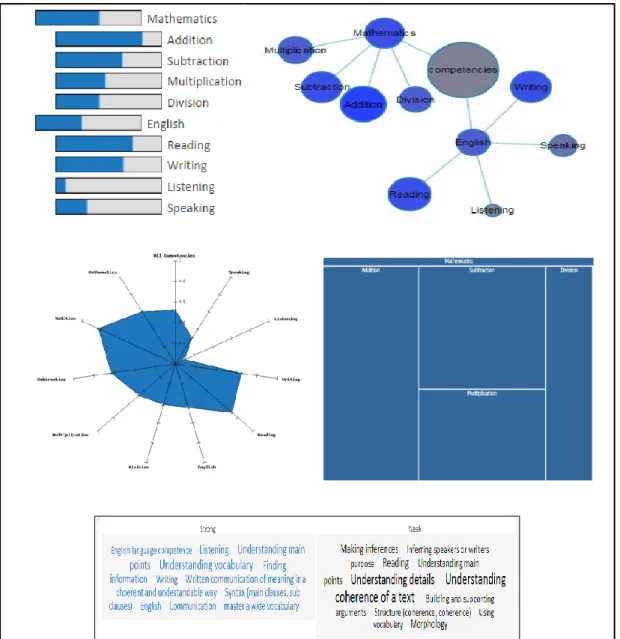
metacognition. ... 1 Figure 2-1. Different representations of learner models, such as a skill meter,
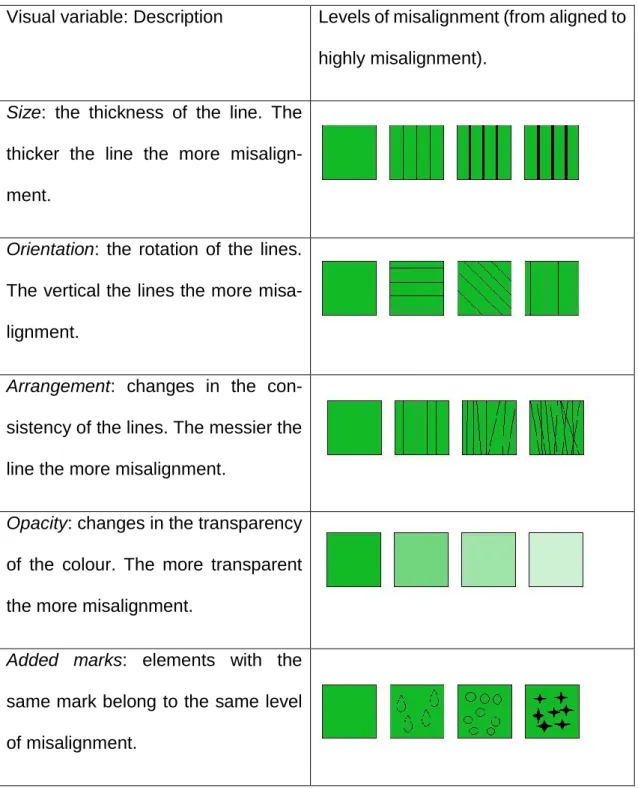
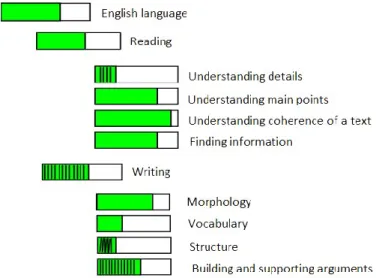
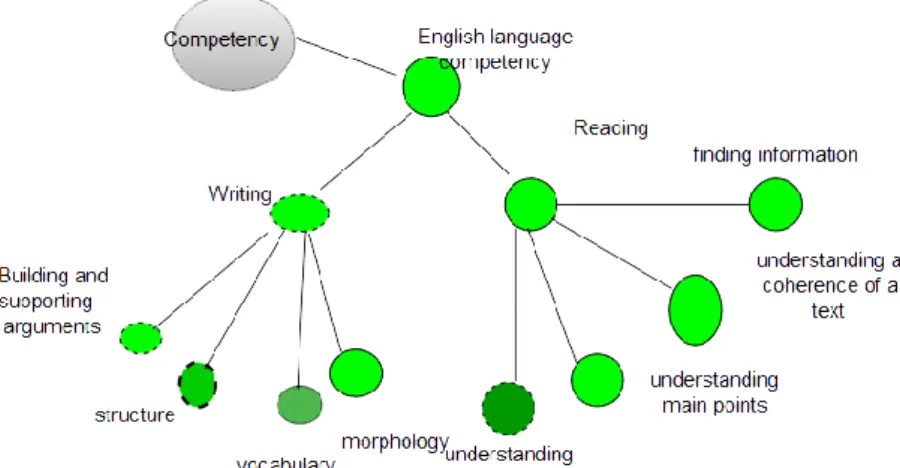
network, radar plot, tree map, and word cloud (Bull et al., 2016b). ... 27 Figure 3-1. Examples of visual variables. ... 42 Figure 3-2. Examples of Gestalt principles. ... 43 Figure 3-3. Arrangement is used in the skill meter to indicate topics that include inconsistent data (i.e. misalignment) in an OLM. ... 49 Figure 3-4. The size of dashed line is used in a network to indicate topics that include inconsistent data (i.e. misalignment) in OLM. ... 50 Figure 3-5. Opacity is used in a network to indicate topics that include inconsistent data (i.e. misalignment) in an OLM. ... 51 Figure 3-6. The size of dashed line is used in the tree map to indicate topics that include inconsistent data (i.e. misalignment) in an OLM. ... 52 Figure 3-7. Opacity is used in the tree map to indicate topics that include inconsistent data (i.e. misalignment) in an OLM. ... 52 Figure 3-8. Blur used in a word cloud to indicate topics that include inconsistent data (i.e. misalignment) in an OLM. ... 53 Figure 3-9. The size of the dashed lines is used in a radar plot to indicate
Figure 3-10. Screenshot of OLMlets interface: selecting the course (top), selecting the topic (bottom). ... 57 Figure 3-11. The standard skill meter within OLMlets showing details of a
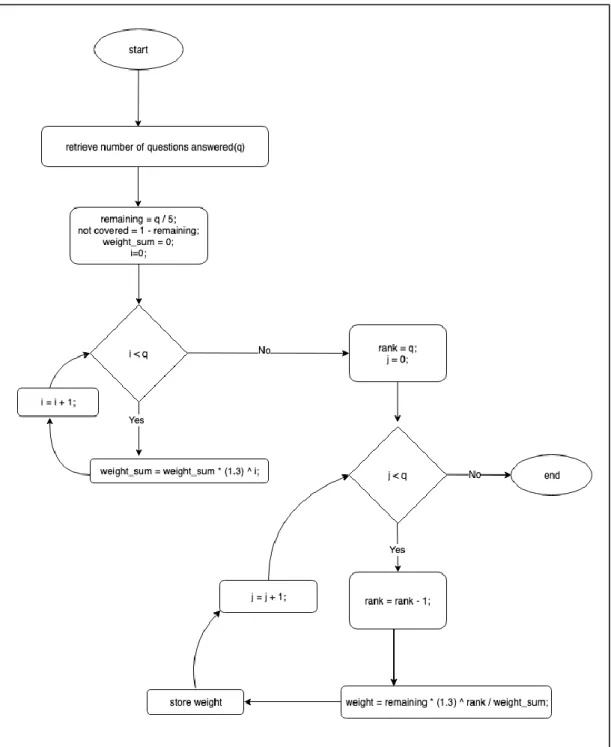
misconception in the course of Java Programming. ... 58 Figure 3-12. Flow chart of the calculation of the weighted mechanism for a single question. ... 60 Figure 3-13. The standard skill meter within OLMlets showing misconception details in the Java Programming course. ... 61 Figure 3-14. An example of a question and a self-assessment in the extended
OLMlets ... 63 Figure 3-15. Combined view... 66 Figure 3-16. visualising alignment using separated models. ... 67 Figure 3-17. Patterns of viewing the model based on the number of users in each group. ... 69 Figure 3-18. Expandable model, where the models are combined. ... 71 Figure 3-19. Expandable model where models are expanded. ... 71 Figure 3-20. Shows how the skill meter (expandable model) is affected while the student answered seven questions based on Table 3-3. ... 74 Figure 3-21. Text-based learner model within the OLMlets shows both (Computer’s Beliefs, My Beliefs) specified in Study (Chapter 7). ... 75 Figure 4-1. Visualising alignment using six different methods of visual variables applied to a skill meter learner model. ... 84 Figure 4-2. Scale of students’ preferred method from most to least preferred... 92
Figure 5-1. CALMsystem OLM (Kerly, Ellis and Bull, 2008) conversation fragment between the system and the learner to resolve a conflict occurred in a topic called Friction using chatbot. ... 101 Figure 5-2. Skill meter visualisation (Control condition). ... 104 Figure 5-3. The combined model skill meter uses the opacity of the colour to visualise alignment. ... 105 Figure 5-4. The expandable model when the model is combined. ... 106 Figure 5-5. The expandable model when the model is expanded. ... 106 Figure 5-6. Pre-questionnaire items where different views were found from the
learning section before OLMlets use. ... 114 Figure 5-7. Pre-questionnaire item for confidence section where different views among students was found before OLMlets use. ... 116 Figure 5-8. Post-questionnaire item of learning section where different views ... 118 Figure 5-9. Post-questionnaire items for confidence section where different views were found after OLMlets use. ... 120 Figure 5-10. Students’ views of the option to expand the models. ... 122 Figure 5-11. Box plots with error bars for students’ confidence gain for the three groups of OLMlets users. ... 127 Figure 5-12. Box plots with error bars for the three groups of OLMlets users for number of questions answered. ... 130 Figure 5-13. Box plots with error bars for the three groups of OLMlets users for number of times the model was viewed. ... 131
Figure 6-1. The control condition within OLMlets specified by a participant from this study. ... 141 Figure 6-2. The expandable model condition in the combined view. ... 142 Figure 6-3. The expandable model in both views (a) combined and (b) expanded specified by participant from this study. ... 142 Figure 6-4. Two-way ANOVA interaction graphs between the two independent
variables for bias 1 (a) and bias 2 (b). ... 152 Figure 6-5. Number of times the low-achieving control-group students visit the whole question set. ... 163 Figure 6-6. Number of times the low-achieving students from the expandable model condition visited each question set in its entirety. ... 164 Figure 6-7. Number of times the question sets were completed for the high-achieving students from the control condition. ... 165 Figure 6-8. Number of visits to question sets for high-achieving students from the expandable model condition. ... 166 Figure 7-1. The expandable model shown in the expanded view specified in this study by student S25. ... 176 Figure 7-2. A text-based learner model within OLMlets shows both (System’s Beliefs, My Beliefs) specified in this study by student S25. ... 176 Figure 7-3. Number of visits of questions for low-achieving students from the
expandable model condition. ... 188 Figure 7-4. Number of visits of whole questions for low-achieving students from the text-based model condition... 189
List of Tables
Table 3-1. Visual variables properties (Demmans Epp and Bull, 2015). ... 45 Table 3-2. Descriptions of the visual variables with examples of levels of
misalignment. ... 47 Table 3-3. The system calculation based on the weighted questions of seven
questions answered. ... 72 Table 4-1. Percentage of the use of different methods to represent only uncertainty according to the summary of 50 visualisations from different fields (Demmans Epp and Bull, 2015). ... 82 Table 4-2. Applying Thurstone’s paired comparison method for participants’ preferred method of visualising alignment. ... 90 Table 4-3. Total number of responses for each visual variable divided by total
responses. ... 91 Table 4-4. Normalising data using Z-transform for each visual variable. ... 92 Table 4-5. Descriptive statistics for the preference for each visual variable. ... 94 Table 4-6. A 6 × 6 matrix showing the z-value of Wilcoxon signed-rank assigned to the top row for the higher mean rank for the associated visual variable. ... 95 Table 5-1. Number of students participating in each condition ... 111 Table 5-2. Shows the mean rank for questionnaire items based on the difference between the three groups and the result of the Kruskal-Wallis test. The significant items are identified using bold text. ... 113
Table 5-3. The mean rank for each group on the pre-questionnaire items related to their confidence and the significant items is identified using the bold text. ... 115 Table 5-4. The mean rank for each group on the post-questionnaire items related to their learning. ... 117 Table 5-5. The mean rank for each group on the post-questionnaire items related to their confidence. ... 118 Table 5-6. Questionnaire items for both treatment groups about the interpretation of visualising alignment. ... 121 Table 5-7. Descriptive statistics for pre- and post-tests for both non-OLM-users and OLM-users including the sub-groups of OLM-users. ... 122 Table 5-8. Descriptive statistics for pre- and post-confidence for non-OLMlets users and OLMlets-users, including the three conditions of OLM-users. ... 124 Table 5-9. Post-hoc analysis using Bonferroni method for students’ confidence gain with significant p-value indicated in bold text. ... 128 Table 5-10. Descriptive statistics for students' system use for OLM-users. ... 129 Table 5-11. Post-hoc analysis using Bonferroni method for number of questions answered with significant p-value indicated in bold text. ... 130 Table 5-12. Post-hoc analysis using Bonferroni method for number of times the model was viewed with significant p-value indicated in bold text... 131 Table 6-1. Number of participants in each condition classified by students’ ability level. ... 140 Table 6-2. Number of questions, difficulty rating based on instructor’s perception for the course Java programming. ... 146
Table 6-3. Bonferroni-corrected paired sample t-test for low-achieving students for students' bias, significant difference indicated in bold. ... 158 Table 6-4. Bonferroni-corrected Wilcoxon signed rank test for low-achieving students for students' performance, significant difference indicated in Bold. ... 158 Table 6-5. Bonferroni-corrected paired sample t-test for high-achieving students for students' bias. ... 160 Table 6-6. Bonferroni-corrected paired sample t-test for high-achieving students for students' performance. ... 160 Table 6-7. Median and inter-quartile range of number of model views for both ability levels in both conditions. ... 161 Table 6-8. Median and inter-quartile range of number of questions answered for both low-and high-achieving students for both conditions. ... 162 Table 7-1. Number of participants in each condition classified by the median score of
students’ performances in Set 1. ... 174 Table 7-2. Percentage of questions, difficulty rating based on instructor’s opinion and the percentage of correct responses of student answers for each Bloom Taxonomy category... 178 Table 7-3. Students bias for low- and high- achieving students in Set 1 and Set 2 for both conditions (text-based learner model, expandable learner model). ... 182 Table 7-4. Bonferroni-corrected Wilcoxon Signed Ranks Test for students
performance from Set 1 to Set 2, Significant increase from Set 1 to Set 2 is indicated as bold and italic. ... 184
Table 7-5. Mean and standard deviation for low-and high-achieving students in both conditions. ... 186 Table 7-6. Mean and standard deviation for number of times the model was viewed for both low-and high-achieving students in both conditions. ... 186
Publications
1. Al-Shanfari, L., Demmans Epp, C., Baber, C., & Nazir, M. (2018). Visualising
Alignment to Support Students’ Judgement of Confidence in Open Learner Models. User Modelling and User-Adapted Interaction Journal. (Submitted) (Chapter 6).
Contribution of each author in the manuscript:
Al-Shanfari, L: Conceived and planned experiments, carried out the experiment, analysed the data and wrote the manuscript.
Demmans Epp, C: provided suggestions for the structure of the manuscript, pro-vided critical feedback and helped shape the research, analysis and the manu-script.
Baber, C: Verified the results of the analysis and provided critical feedback. Nazir, M: Calculated the level of difficulty of the assessment and experiments held in her class.
2. Al-Shanfari, L., Baber, C., & Demmans Epp, C. (2017). Student preferences for visualising uncertainty in open learner models. In E. André, R. Baker, X. Hu, M. M. T. Rodrigo, & B. du Boulay (Eds.), Artificial Intelligence in Education. Lec-ture Notes in Computer Science (Vol. 10331 LNAI, pp. 445--449). Wuhan, China: Springer. (Chapter 5)
Contribution of each author in the manuscript:
Al-Shanfari, L: Designed and distributed the questionnaires, analysed the data, wrote the whole paper and presented in the conference.
Baber, C: verified the design and results of the study and provided critical feed-back.
Demmans Epp, C: provided critical feedback.
3. Al-Shanfari, L., Demmans Epp, C., & Baber, C. (2017). Evaluating the effect of uncertainty visualisation in open learner models on students’ metacognitive skills. In E. André, R. Baker, X. Hu, M. M. T. Rodrigo, & B. du Boulay (Eds.), Artificial Intelligence in Education. Lecture Notes in Computer Science (Vol. 10331 LNAI, pp. 15–27). Wuhan, China: Springer. (Chapter 6)
Contribution of each author in the paper:
Al-Shanfari, L: Conceived and planned experiments, carried out the experiment, performed the calculation, wrote the paper and presented in the conference.
Demmans Epp, C: verified the design of the experiment, suggested some meth-ods to analyse the data, provided critical feedback and helped shape the re-search, analysis and the manuscript.
Baber, C: Verified the results of the analysis and provided critical feedback.
4. Al-Shanfari, L., Demmans Epp, C. & Bull, S. (2016). Uncertainty in Open Learner Models: Visualising Inconsistencies in the Underlying Data, in S. Bull, B. Ginon, M. Kickmeier-Rust, J. Kay & M.D. Johnson (Eds.), Workshop on Learning Analytics for Learners, LAK16, Edinburgh, Scotland, CEUR. (Chapter 3)
Contribution of each author in the paper:
Al-Shanfari, L: proposed the theoretical approaches, illustrated different design approaches, wrote the whole manuscript except section 5 and presented in the conference workshop.
Demmans Epp, C: provided critical feedback, helped in developing the theoret-ical framework of the paper and helped shape the research paper.
Bull, S: wrote section 5 in the paper, and provided a critical feedback
5. Bull, S, Al-Shanfari, L. (2015). Negotiating Individual Learner Models in Con-texts of Peer Assessment and Group Learning in Proceedings of Intelligent Sup-port for Learning in Groups (AIED 2015). CEUR, International Workshop on In-telligent Support for Learning in Groups (AIED 2015), Madrid, 23 June. (Chapter 2).
Contribution of each author in the paper: Bull, S: Wrote the whole paper.
Al-Shanfari, L: helped providing references to support the argument of the paper and presented in the conference workshop.
1
Chapter 1 : INTRODUCTION
Independent learning requires knowledge monitoring skills (Boud, 1989) that al-low students to reflect on their learning accurately. Metacognition enables stu-dents to understand and evaluate their own thinking (Flavell, 1979). Different met-acognitive activities can encourage learners to reflect on their learning processes, such as self-assessment, help seeking, self-explanation, and reflection. Metacog-nition can help students to select, evaluate, and plan for their own learning (Fla-vell, 1979). Further, researchers have shown that enhancing students’
aware-ness of their metacognitive skills can enhance students’ learning (Schraw and Dennison, 1994). Tobias and Everson (2002) consider knowledge monitoring the fundamental component for other metacognitive skills. Accordingly, they pro-posed a theoretical framework of metacognition, as shown in Figure 1-1.
Figure 1-1. Tobias and Everson (2002) Framework of componential model of metacognition.
2
Tobias and Everson (2002) define knowledge monitoring as the ability to distin-guish between what one does or does not know. The aim of the study in this thesis is to support students’ knowledge monitoring skills by enabling students to observe the alignment between their confidence in the correctness of answers, based on their own self-confidence rating without external influences, (referred to in this thesis as confidence judgement) with students’ actual performance, based on computer evaluation using an adaptive educational system. Misalignment arises when the computer evaluation and student confidence conflict. For exam-ple, a student could generate a correct answer while they were felling unconfi-dent. Further, a student could be confident that they give a correct answer, but then provide an incorrect response. Tobias and Everson explained that students who lack knowledge monitoring skills spend more time learning concepts that they have already mastered than on focusing their attention on other concepts yet to be mastered (Tobias and Everson, 2002).
Knowledge monitoring has gained attention from different researchers, interested in how to improve students’ knowledge monitoring skills. From these studies, a number of theories have been proposed. One such theory suggests that giving students the ability to practice their knowledge monitoring skills can improve their monitoring accuracy, by shifting confidence judgement from reliance on their own beliefs about their abilities to experience-based judgement (Koriat, 1997). Stu-dents providing answers to questions may perform correctly, but the correct an-swer may represent either solid knowledge or a random guess. Students with good knowledge monitoring skills can accurately align their own confidence in the
3
correctness of their answers to their actual performance. Another theory related to how student behaviour is affected when assessing their knowledge monitoring skills states the following:
High certitude correct responses should remain high because the learner is certain of the response, and it is the correct one. High cer-titude errors represent an interesting problem since they are the point of maximum discrepancy where the learner works hardest to correct them(Kulhavy and Stock, 1989, p.294).
This theory suggests that when misalignment is detected between students’ con-fidence and their performance, the student may seek to resolve the misalignment and this may affect their behaviour monitoring their knowledge. Researchers also argue that meta-cognitively skilled students have the capability to plan, monitor the success and the weakness of their own activities, and alter behaviour in ac-cordance with their monitoring. Low-achieving students are less proficient at monitoring their knowledge (Royer, Cisero and Carle, 1993). Experimental stud-ies showed that low-achieving students lack knowledge monitoring skills. Further, they tend to over-estimate their performance, which can lead them to discontinue their efforts in their learning (Koriat, 1997; Kelemen, 2000). Students’ lack of knowledge monitoring skills while learning is attributed to motivation (Zimmer-man, 1990). Therefore, it is important to motivate students to practice their knowledge monitoring skills, and to provide them with information that bonds their performance with their confidence.
4
Developing students’ metacognitive skills using Intelligent Tutoring Systems (ITSs) is fruitful. Recently, researchers have developed meta-cognitively intelli-gent tutoring systems, ‘systems that care’, to support students to regulate their learning more effectively (du Boulay et al., 2010). These ITSs include monitoring functionality to enable the adaptation of learning materials and experience to
stu-dents’ individual needs. The ITSs rely on a specific type of user model (often called a learner model) to drive this adaptation. For example, an intelligent tutor-ing system could keep records of past actions in the learner model to allow stu-dents to learn from their previous experience when repeated patterns of cognitive and metacognitive occur (Hull and du Boulay, 2009). The learner model is typi-cally hidden, which means that students cannot access their own learner model. Researchers have argued that the system should allow learners to access the learner model (Self, 1990), the main reasons being to promote metacognitive be-haviour, support students with self-regulated learning, and promote learner re-flection (Bull and Kay, 2013).
The aim of this thesis is to help students monitor their knowledge in terms of subject understanding and improve their knowledge monitoring skills by using Open Learner Models (OLMs). In this thesis, the research questions address the potential of incorporating students’ confidence in correctness of their answers and the system evaluation of students’ performance into an OLM. The approach used allows students to monitor their own learning by visualising the alignment in the context of OLMs. In this thesis, the effect of the alignment/misalignment in assessing confidence in the correctness of their answers on students’ behaviour
5
and the effect of practicing the confidence judgement are investigated within OLMs. Designing an OLM and presenting the information in a way that could influence the enhancement of students’ metacognitive skills is an essential as-pect that could contribute to the field of ITSs and OLMs.
1.1 Research Questions:
1. How does visualising alignment support students’ confidence judgement? 2. What is the preferred method to visualise alignment for OLM users? 3. How is the information’s presentation format important to the alignment
information in an OLM?
1.2 Metacognition
Metacognition is the ability to reflect on ones’ own knowledge in that it is ‘thinking about thinking’ (Flavell, 1979). Metacognition can be divided into three compo-nents: metacognitive knowledge, knowledge monitoring, and the control of these processes (Pintrich, Wolters and Baxter, 2000). Flavell describes metacognitive knowledge as the whole knowledge of the individual. He continues by stating that this knowledge can be influenced by factors such as the person, the tasks the person has taken, and the strategies that the person will decide to follow to ac-complish these tasks (Flavell, 1979).
Metacognitive monitoring includes metacognitive judgement, which is the ability to judge the correctness of the answers given. The third component is how the person can control activities to achieve a desired goal. Supporting students’
6
metacognitive judgement is the focus of this thesis. The next section provides methods to measure metacognitive judgement.
1.3 Measures of Metacognitive Judgement
Monitoring students’ knowledge allows them to reflect and become aware of their
own knowledge. There have been a variety of methods to measure metacognitive judgement, which include the following: the self-reporting of the person’s own judgement, thinking aloud (where students verbalise their thoughts while doing a task), and error detection (Pintrich, Wolters and Baxter, 2000). Error detection is the use of a text that contains some errors that the student should be able to identify, to show their ability to monitor their knowledge.
In this thesis, the method of self-reporting is used. There has been intensive
re-search to evaluate students’ knowledge monitoring ability using different
assess-ment techniques based on students’ self-reporting. Tobias and Everson (2009)
provided a technique that measures the students’ ability to differentiate between
what they do and do not know, called the knowledge monitoring assessment (KMA). In assessment, students were asked to evaluate their ability to solve a problem with a yes or no answer before actually solving it. A comparison between their judgement and their actual performance was evaluated, and provided the following outcomes (Tobias and Everson, 2009):
• Students who stated that they knew the answer and performed correctly: (a) [+ +].
7
• Students who stated that they did not know the answer but had given a correct answer: (b) [- +].
• Students who stated that they knew the answer but performed incorrectly: (c) [+ -].
• Students who stated that they did not know the answer and indeed per-formed incorrectly: (d) [- -].
The knowledge monitoring score is obtained by using the simple equation [1], (Tobias and Everson, 2009)
𝐾𝑀𝐴 = (𝑎 + 𝑑) − (𝑏 + 𝑐)
(𝑎 + 𝑏 + 𝑐 + 𝑑) [1]
The KMA score ranges between +1 and -1. The score -1 indicates that the student has poor knowledge monitoring skills and +1 shows accurate judgement.
In this thesis, the system has been extended to allow students to evaluate their confidence of the answer given, after responding to each question of the system-automated assessment. Thus, the KMA measure is not an appropriate measure to use in the context of this thesis because the confidence judgement is assessed after solving the question and there are more than two options, whereas KMA assesses students’ confidence before using the system and with two confidence options.
Schraw (2009) described five measures for assessing one’s own knowledge when the individual evaluates their confidence after the completion of a test item. The measurement applied in the confidence rating uses an ordinal scale from 0
8
(no confidence) to 100 (totally confident). The first method to measure students’ confidence judgement is absolute accuracy, which is the difference between a student’s confidence rating of their abilities to accomplish the task and their actual performance on that task. The higher the absolute accuracy the worse the stu-dent’s knowledge monitoring skills. The second measure is relative accuracy, which is the relationship between multiple confidence judgements and perfor-mance scores. This relationship focuses on the difference of a single confidence judgement and mean confidence and the difference between performance on a single item and mean performance. Relative accuracy is usually measured using a gamma coefficient (Maki et al., 2005), used for measuring the strength of asso-ciation between variables, which (in this instance) would indicate whether items that receive higher judgement are also the items that produce higher performance and whether items that receive lower judgement also produce lower performance. However, relative accuracy does not show whether the student is over- or under-confident. The other three measures that can be used are bias, scatter, and
dis-crimination. Bias of student’s confidence judgement shows the direction of the individual’s ability to estimate their performance accurately. Bias was calculated as a unitised difference of the confidence judgement and the performance, using Equation (2), (Schraw, 2009), as follows:
Bias = ∑ (𝑐𝑜𝑛𝑓𝑖𝑑𝑒𝑛𝑐𝑒−𝑝𝑒𝑟𝑓𝑜𝑟𝑚𝑎𝑛𝑐𝑒)𝑛1
𝑛 [2] The bias score is always between -1 and +1. The sign magnitude for the bias score is negative for under-confidence, positive for over-confidence, and a score
9
of 0 indicates that students’ performance was aligned with their confidence
judge-ment. Based on Equation 2, a bias score of +1 is obtained when the student fails to answer their knowledge assessment correctly but they are confident that the answer is correct. Conversely, a bias score of -1 is obtained when the student never fails in their knowledge assessment but they are unconfident that the an-swer is correct for the whole assessment. The score of 0 (null score) is obtained when the student aligns their confidence to their performance.
The fourth measure is the scatter, which shows the degree of individual variability in correct and incorrect responses. The fifth measure, which is discrimination, indicates the ability of the individual to differentiate between known and unknown items. A positive sign of discrimination indicates the individual is meta-cognitively aware that their answers are correct, whilst a negative sign represents lack of awareness (Schraw, 2009).
In the context of this thesis, the bias measure is used as a proxy to represent the accuracy (or alignment) of a student’s self-assessed confidence, which is called
confidence judgement, to the system’s evaluation of students’ performance.
Mis-alignment occurs when there is a disagreement between data sources. That is, when the system shows that the student understands the task but the student is not confident of having answered correctly, or when the system evaluation shows that the student lacks the necessary knowledge but the student is confident in his or her knowledge of the material. When a misalignment is detected, the system becomes uncertain about the state of the learner model. This uncertainty in
10
learner models can be represented through OLMs (Demmans Epp and Bull, 2015).
1.4 Can Students Accurately Assess their own Knowledge?
Metacognitive monitoring is a critical aspect of selecting a strategy and planning
for one’s learning. It provides the basis for deciding what and how long to study certain concepts. Researchers argue that metacognitive monitoring affects stu-dent self-regulation study, and thus it can affect overall learning (Thiede, Ander-son and Therriault, 2003). Based on the framework of Tobias and EverAnder-son (2009) shown in Figure 1-1, knowledge monitoring skills are a pre-requisite for
metacog-nition. Although students’ ability to monitor their knowledge varies from one
stu-dent to the other, several studies have confirmed that low-achieving stustu-dents tend to be over-confident in their abilities, whereas high-achieving students are more accurate in their confidence (DiFrancesca et al., 2016; Hacker et al., 2000; Niet-feld, Cao and Osborne, 2005). This suggests that high-achieving students are more consistent and that low-achieving students face many challenges and need more differentiated support. Some researchers suggest that low-achieving stu-dents are unaware of, and un-skilled in, metacognitive skills (Ehrlinger et al., 2008). However, other researchers suggest that while low-achieving students are unskilled, they may be aware that they lack metacognitive skills (Miller and Geraci, 2011).
To provide assistance for low-achieving students to improve their knowledge monitoring skills, it is necessary to know the factors that might influence knowledge monitoring skills. For example, test difficulty affects students’
11
confidence judgement, with students tending to be over-confident with more dif-ficult tests (Nietfeld, Cao and Osborne, 2005; Schraw and Dennison, 1994). Do-main knowledge is also an important factor. Students who are familiar with the domain become more confident and can assess their knowledge accurately (Niet-feld and Schraw, 2002).
Providing students with feedback is important to enable them to reflect on their awareness about their level of knowledge on an assigned task and their knowledge monitoring skills. For example, according to Callender, Franco-Wat-kins and Roberts (2016), providing feedback at the global level (i.e. for the whole test) about performance and judgement of confidence led to improved students’ performance and accuracy in their confidence judgement in a second test, in comparison to students who did not receive feedback after their first exam. Fur-ther, an improvement was identified in students’ performance and confidence judgement when feedback was provided at the local level, on a question-by-ques-tion basis (Renner and Renner, 2001). Training students to monitor their knowledge through feedback led to improvements in knowledge monitoring (Huff and Nietfeld, 2009). However, practising knowledge monitoring skills without re-ceiving feedback was not enough to result in improvement in monitoring their knowledge (Nietfeld, Cao and Osborne, 2005).
1.5 Study Objectives and Approach
Facilitating students’ knowledge monitoring skills in an OLM is fundamental for
supporting other metacognitive skills for more active learning. The main aim of
12
and what they do not know (unlearned) can be supported by visualising model alignment.
To fulfil the aim of this thesis, I have designed and built a model alignment and its representation in the base system (i.e. OLMlets OLM) to extend its features. OLMlets is programmed using PHP scripting language, which is connected to the MySQL database. OLMlets is hosted on the Apache web server and accessed through the link (http://olmlets.bham.ac.uk). Visualise alignment is represented between the computer’s evaluation of the students’ performance in the system’s
automated assessment and students’ confidence that the answers given are
cor-rect. The research objectives are as follows:
• To explore students’ preferred method of visual variable to visualise align-ment (Chapter 4).
• To investigate the impact of the alignment based on pre- and post-confi-dence, following an OLM use (Chapter 5).
• To investigate the impact of the alignment while students practice the con-fidence judgement within the OLM (Chapter 6).
• To investigate the importance of the information presentation of the align-ment in the OLM (Chapter 7).
• To explore students’ behaviour when viewing model alignment in an OLM (Chapters 5-7).
13
1.6 Chronology of the work
The thesis presents four studies to answer the research questions of this thesis. All studies were conducted after receiving the ethical approval from the Univer-sity of Birmingham Ethics Committee (reference ERN_15-0684P). The ethical approval involved submitting a full description of the studies together with the participation information sheets, to the university Ethics Board, who then issued a reference number to indicate that the proposal was ethically sound.
In this thesis, the evaluation studies were conducted using real class settings of undergraduate students from the School of Electronic, Electrical and Systems Engineering at the University of Birmingham (United Kingdom) and the Sultan Qaboos University (Oman). Courses related to computer programming and math-ematics were integrated in the OLMlets system. Students used the OLMlets sys-tem as an independent syssys-tem to help with their exam preparation.
The thesis was based on the research of Demmans Epp & Bull (2015), about uncertainty representation in visualisation in the context of OLMs. Different visual variables were used to indicate uncertainty in the data using different forms of OLM visualisation. The theory of the thesis was based on Kulhavy and Stock (1989), whereby the greater the discrepancy between student confidence about the correctness of the answer and their response, the more motivated the student is to reveal this discrepancy and more time is spent processing the feedback. Prior OLM research (Bull and Pain, 1995) investigated the impact of allowing stu-dents to align their confidence to their performance using a negotiated OLM, which uses a form of discussion between the student and the computer until
14
agreement is reached to maintain the accuracy of the model. From the research discussed above, I was interested to implement the proposed method of Dem-mans Epp and Bull, (2015), to visualise alignment in a simple OLM to investigate
the impact of the alignment on students’ confidence judgement and their
behav-iour when using the system.
I have conducted a pilot study to inform the design of the representation of visu-alising alignment in OLMs, which is discussed in Chapter 3, Section 3.3.5.
I decided to implement one form of visual variable (suggested by Demmans Epp and Bull, 2015)—which is the opacity of the colour to indicate the alignment in OLMs—using a control condition study. This was the first study presented in Chapter 5.
Demmans Epp and Bull (2015) used different visual variables, conducting an analysis of 50 visual variables to represent uncertainty in the data effectively. I was interested to explore the preferred method using six from those visual varia-bles, which were added marks, arrangement, opacity, numerosity, orientation, and size. This was done to help system designers to inform the design of the system when students preferred method is important. This was the second study presented in Chapter 4.
The third study was to investigate how visualising alignment impacts students’ bias of confidence judgement using students’ preferred method using a control condition study (Chapter 6). Surprisingly, students preferred the opacity of the
15
colour as their preferred method to visualise alignment in OLM, which was im-plemented in Study 1 (Chapter 5).
Although prior OLMs use text-based representation widely in their design to in-clude student’s self-assessment, there was an argument that presentation methods such as visual or textual may influence students’ metacognitive judge-ment (Burkett and Azevedo, 2012). Thus, Study 4 was conducted to investigate the impact of presentation format on the alignment information using two repre-sentations: graphical-based, using students’ preferred method explored in Study 2; and text-based, which was used in prior OLMs, such as in Mr.Collins (Bull and Pain, 1995).
1.7 Contributions
This thesis extends prior research that uses OLMs to promote learner reflection, by giving students the ability to compare the confidence judgement between two sets of beliefs (i.e. alignment). First, students’ judgement about the extent that
students’ met the teacher’s criteria for answering problems are aligned with the
teacher’s criteria defined for each task, for example Reflect OLM (Kay, Li and Fekete, 2007). Second, student self-assessment of their confidence that the an-swers are correct is aligned with the computer evaluation of students’ perfor-mance on the task for example, Mr. Collins, CALMsystem, and VisMod (Bull and Pain, 1995; Kerly and Bull, 2008; Zapata-Rivera and Greer, 2004).
As there is no prior research on the impact of visualising alignment on students’
16
context of OLMs, this thesis provides a practical implementation of real class studies that investigate the impact of providing students with information about themselves in their interaction with the system. More specifically, the research
seeks congruence between the computer’s view of the learner and the learner’s
perception of themselves. The findings contribute to the literature in the fields of Intelligent Adaptive Systems and OLMs, as they demonstrate the importance of visualising alignment in OLMs to support students’ knowledge monitoring skills, especially for low-achieving students who need more differentiated support (dis-cussed further in Chapters 6 and 7).
The second contribution of this thesis is to the fields of intelligent adaptive sys-tems and OLMs, in that it illustrates a variety of design approaches using different methods of visual variables to visualise alignment that can be applied to different representations of the learner model. This thesis explores students’ preferences for styles of visualising alignment applied to one simple representation (skill me-ter). To date, indicating students’ preference style to visualise alignment is a novel act in OLMs. These design approaches can develop guidelines that can inform designers of OLMs and ITSs when visualising alignment is important for
facilitat-ing students’ knowledge monitorfacilitat-ing skills (Discussed in Chapter 4).
The third contribution of this thesis is that information presentation of the under-lying learner model is an important aspect to consider when visualising alignment
17
Before explaining the approaches of the OLM to support students’ metacognitive
skills, the next section provides details of the theories related to metacognition
and, more specifically, to students’ knowledge monitoring from the field of
edu-cation and psychology.
1.8 Thesis Summary
This thesis addresses three research questions related to the presentation of alignment information in open learner models and the impact of adding this
infor-mation on students’ metacognitive skills. The following sections summarise the research questions and how these are approached in this thesis.
1. How does visualising alignment support students’ confidence judge-ment?
It is argued that OLMs promote students’ metacognitive skills (Bull and Kay, 2013). Some OLMs allow students to reflect on their own answers and facilitate metacognitive skills, such as help-seeking (Roll et al., 2011) and problem solving (Mitrovic and Martin, 2007). Researchers argue that supporting students’ confi-dence judgement may improve metacognitive skills to aid in selecting the appro-priate problem to solve (Mitrovic and Martin, 2007; Roll et al., 2011). This reflects the importance of knowledge monitoring skills in promoting metacognitive skills (Tobias and Everson, 2009).
Although some OLMs allow students to align their confidence judgement com-pared with the computer or the teacher’s viewpoint (Bull and Pain, 1995; Kay, Li and Fekete, 2007; Kerly and Bull, 2008; Zapata-Rivera and Greer, 2004), these
18
systems used either the negotiation method (i.e. both the computer and the stu-dent should agree to resolve the misalignment based on some form of discussion) (Bull and Pain, 1995; Kerly, Ellis and Bull, 2008), or the simple OLM Reflect-OLM (Kay, Li and Fekete, 2007). These systems do not use a control condition to in-vestigate the impact of the alignment on students’ knowledge monitoring skills. Moreover, researchers argue ‘simply presenting an inspectable OLM by itself may not be an effective way to support self-assessment and additional scaffold-ing may be necessary’ (Long and Aleven, 2013c).
Therefore, it is still an open question whether OLM can help students to be more accurate in assessing their own knowledge. Hence, this thesis provides an inves-tigation of this open research question and provides a form of visualisation of the alignment, demonstrating that the student can easily compare the two sets of beliefs of the computer evaluation of students’ answers and students’ confidence about the correctness in the answers given. This can help designers of OLMs and ITSs to consider visualising alignment when their goal is to support students’ confidence judgement.
2. What is the preferred method to visualise alignment for OLM users?
Exploring students’ preferred style to visualise alignment in OLMs is novel. Alt-hough some studies outside the educational context show that participants may prefer a method that is not necessarily the most effective (Boukhelifa et al., 2012), there are researchers who believe that providing users with their preferred
19
method can help them understand the information depicted by those visualisa-tions (Gerharz and Pebesma, 2009). Knowing students’ preferences in visualis-ing alignment could provide guidelines to designers about which approaches stu-dents may find beneficial.
3. How is information presentation format important in alignment infor-mation in OLMs?
Prior research argues that the presentation method (i.e., visual or textual) may
influence students’ metacognitive judgement (Burkett and Azevedo, 2012). Based on the first question about how visualising alignment can support students’ metacognitive skills, this thesis provides an investigation into whether the
repre-sentation of the alignment is important to facilitate students’ knowledge
monitor-ing skills when it is represented usmonitor-ing a textual or visual description. Representmonitor-ing alignment information using text-based description has been used in prior OLMs such as Mr.Collins and ReflectOLM (Bull and Pain, 1995; Kay, Li and Fekete, 2007). In Mr.Collins (Bull and Pain, 1995), students were willing to negotiate with the system to change the learner model when they did not agree with the content to provide a more accurate learner model. The Self-assessment Tutor (Roll et al., 2011) used text, allowing students to assess their confidence before and after solving the problem. The Self-assessment Tutor did not solve the problem of stu-dents’ over-confidence. (These studies used qualitative analyses only (Bull and Pain, 1995; Kay, Li and Fekete, 2007) or self-assessment combined with other metacognitive skills (Roll et al., 2011; Long and Aleven, 2013c)). Based on prior research, this thesis provides an investigation on the impact of visualising
20
alignment in OLMs and how students’ confidence judgement will differ according to the mode of the alignment representation (skill meters vs. text) explored in (Chapter 7). This can provide OLM designers and other interactive learning envi-ronments with the most appropriate representation to use for facilitating students’ knowledge monitoring skills.
1.9 Outline of Chapters
This section provides an overview of the structure of the rest of this thesis.
Chapter 2 — This chapter provides the background and related work for this the-sis through a review of the framework of the OLM approach and how OLMs
sup-ports students’ metacognitive skills. More precisely, it provides examples of
OLMs that have implemented knowledge monitoring skills in their systems to-gether with the type of OLM representation. The chapter also describes the
re-lated work of OLMs that used the alignment between the students’ confidence
and the computer’s view about the student performance, highlighting the current gap within the field.
Chapter 3 — This chapter focuses on information visualisation and how visual variables can play an important role in indicating the misalignment to provide the user with an overview of the inconsistency in the learner model without focusing their attention on the data. Examples of how indicating inconsistency (e.g. misa-lignment) in the learner model using different visual variables are applied to dif-ferent visualisation of the learner models. Finally, the system design and archi-tecture of the existing system is described (i.e. the OLMlets system). The learner
21
modelling process of the base system of OLMlets OLM is explained, together with how I modelled and built the model alignment and its representation of the learner model in the extended version of OLMlets.
Chapter 4 — This chapter presents a qualitative study that was performed to ex-plore the preferred method to visualise alignment in OLMs using students’ self -reports. In this study, students were asked to choose one of the visual variables among six other variables applied in simple learner model visualisation (e.g. skill
meter). By doing this, the students’ preferred method of indicating alignment
us-ing visual variables in a simple learner model visualisation (skill meter) was ex-plored.
Chapter 5 — In this chapter, an empirical study was performed to investigate the
impact of visualising alignment on students’ confidence gain as well as their
in-teraction with the system. In this study, students were asked to complete a pre-questionnaire and to solve a pre-test before they used the system. At the end of the study, students were asked to complete a post-questionnaire and to solve a post-test. By doing this, the impact of adding alignment in the visualisation of the learner model was explored.
Chapter 6 — In this chapter, another empirical study was conducted to investigate
the impact of visualising alignment on students’ confidence judgement using a
control condition. In this study, the impact of visualising alignment on students’ confidence judgement and action was explored.
22
Chapter 7— In this chapter, a follow-up study was conducted to investigate how the representation of alignment is important. Two versions of the alignment were developed: text-based and visual-based. This study used the same students from the study discussed in Chapter 6.
Chapter 8 — This chapter summarises the findings of this thesis and discusses its limitations, potential contributions, and future work.
23
Chapter 2 : Open Learner Models
This chapter presents an overview of Intelligent Tutoring Systems (ITSs) and Open Learner Models (OLMs). It provides examples of OLMs that use compo-nents of metacognition to support student learning. It also illustrates different OLMs that use the alignment between students’ confidence and the computer’s
or teacher’s own beliefs about the student’s performance using a text-based or visual learner model.
2.1 Intelligent Tutoring Systems
The monitoring of student knowledge can be performed by software, teachers, or students. Intelligent Tutoring Systems are a type of software that monitors student knowledge. They include monitoring functionality to enable the adaptation of
learning materials and experiences to students’ individual needs (Woolf, 2009). Intelligent Tutoring Systems rely on a specific type of user model, often called a learner model. The architecture of ITSs involves four main mechanisms: domain model, learner model, tutoring model, and the user interface (Nwana, 1990).
The source of knowledge that evaluates student performance and diagnoses er-rors is known as the domain model, or the expert model. As the student interacts with the system, all inference and system beliefs about the student are stored in the learner model (Woolf, 2009). The learner model contains specific information that the system has deduced about the learner. The learner model may comprise
24
information such as the level of knowledge of the learner, possible misconcep-tions, emomisconcep-tions, and competencies. Information in these models guides adaptivity in ITSs (Holt et al., 1994).
Most tutoring systems contain an outer loop that is responsible for selecting the next learning task and for executing each complex task as a whole (VanLehn, 2006). The minimal requirement for the tutoring system to be considered intelli-gent is the identification of an inner loop that provides adaptive support as the student is working on a task, and follows each step the student has taken in solv-ing the task. The inner loop is responsible for providsolv-ing feedback, assesssolv-ing the
students’ evolving knowledge, and updating the learner model each time the stu-dent interacts with the system (VanLehn, 2006). Accessing the learner model (making it inspectable) could promote students’ metacognitive skills, by allowing the learner to think about their own learning, thus promoting reflection (Bull and Kay, 2013). The next section provides an overview of the approach used in this thesis.
2.2 Open Learner Models
Open Learner Models are underlying learner models that are externalised to the learner through visualisation (Bull and Kay, 2016). In Open Learner Models, stu-dents gain responsibility for their learning by accessing the learner models. Open-ing the learner model to students can have benefits for students’ learning and their metacognitive skills, when compared with a closed learner model (Bull and Kay, 2013). For example, OLMs could promote learner reflection by externalising the learner model to students. By providing open access to students, this would
25
provide the capability of facilitating planning and monitoring of learner knowledge, facilitating collaboration among learners and improving its accuracy, by allowing the learner to contribute to his or her own learner model (Bull and Kay, 2016). Moreover, allowing the learner to access the learner model may increase trust in the content of their own learner model (Ahmad and Bull, 2008).
There are different types of OLM, each with their own unique features. Some allow the learner to only inspect the learner model (Bull and McKay, 2004; Bull, Jackson and Lancaster, 2010), whilst others give permission to edit the content of the learner model directly (Kay, 1997; Mabbott and Bull, 2006) or to negotiate the system to maintain learner model content, where both the system and the learner have control of the content of the learner model (Bull and Pain, 1995; Bull and Al-Shanfari, 2015; Dimitrova, 2003; Kerly, Ellis and Bull, 2008).
The learner model can be constructed using different learner modelling ap-proaches, such as the following: Bayesian networks—for example VisMod (Za-pata-Rivera & Greer, 2004); constraint-based modelling—for example SQL-Tutor (Mitrovic & Martin, 2007); and simpler weighted algorithms—for example OLMlets (Bull, Jackson & Lancaster, 2010).
Different OLM approaches use a wide variety of visualisation methods. These range from simple ones such as skill meters (Bull et al., 2016a, 2016b; Bull and Mabbott, 2006; Corbett and Bhatnagar, 1997; Duan, Mitrovic and Churcher, 2010; Mitrovic and Martin, 2007) to more complex methods, such as networks, radar plot, word cloud, (Bull et al., 2016a, 2016b), or hierarchal tree structures
26
(Duan, Mitrovic and Churcher, 2010; Kay, 1997; Mabbott and Bull, 2004). Figure 2-1 shows examples of these types of OLM. The most common and simple visu-alisation is a skill meter (top left of Figure 2-1). In skill meters, the student’s level of knowledge is indicated by the filling of the bar, and it can be useful with a minimal number of topics. However, one disadvantage of the skill meter is that when the domain includes a larger number of topics, the learner needs to scroll to view the topics. Network visualisation, top right of Figure 2-1, displays more topics; however, there might be difficulty in reading when nodes are near each other. The level of knowledge in the network is indicated with different variables (such as size and colour) to indicate the level of knowledge of the learner. When the node is bright and large, this indicates that the learner has achieved higher level of knowledge.
27
Figure 2-1. Different representations of learner models, such as a skill meter, network, radar plot, tree map, and word cloud (Bull et al., 2016b).
The radar plot, bottom left in Figure 2-1, can also visualise the learner level of knowledge and can include a greater number of topics in a smaller space than the skill meters. However, learners do not see the overall domain structure on one screen.
28
When the domain contains a large number of topics, the tree map could be con-sidered, as it allows the learner to view the topics and sub-topics. In the tree map, the learner could access the sub-topics by clicking on the parent topic. However, whilst the learner could take advantage of exploring a wide number of topics, they will not be able to compare topics from different parts of the tree map. The size of the rectangle of each topic indicates the level of understanding of the learner. The larger the size of the rectangle, the higher the level of knowledge. The word cloud at the bottom of Figure 2-1 separates the topics into two boxes: in the strong box, the larger the size of the word indicates stronger skills, whereas the larger size in the weaker box are weaker skills. However, topics that are at the border-line of both strong and weak topics could be difficult to read, because of their small size.
Allowing the learner to access the learner model through visualisation could lead them to reflect on different aspects of their learning and enhance their metacog-nitive skills.
2.3
Supporting Students’ Metacognitive S
kills in Open Learner
Models
Metacognition can support students in their learning (Schraw and Dennison, 1994). Researchers argue that the major challenges for learners lie in monitoring and regulating their cognitive and metacognitive processes during learning (Azevedo and Aleven, 2013). Based on Winne and Hadwin’s model of self-regu-lated learning (SRL), Greene and Azevedo (2007) suggest that learning occurs
29
in four basic phases: task definition, goal setting and planning, studying tactics, and adaptation to metacognition. Intelligent tutoring systems provide adaptive support for individual students and highlight the gaps to the learner, fostering their metacognitive and self-regulated behaviour (Azevedo and Aleven, 2013).
Different metacognitive skills are supported using ITSs, such as reflection (Kay, Li and Fekete, 2007), help seeking (Roll et al., 2011), self-awareness (Bull, Jack-son and Lancaster, 2010), and self-assessment (Mitrovic and Martin, 2007). Each of these metacognitive activities involves the processes of thinking, monitoring, and being aware about one’s own learning (Flavell, 1979). For example, in SQL-Tutor (Mitrovic and Martin, 2007), there is a constraint-based tutor that supports undergraduate students to learn the dominant database query language. As dis-cussed in Section 1.4, students’ metacognitive knowledge can be influenced by different factors, namely person, task, and strategy (Flavell, 1979). This will be explained here, based on the mechanism of the ITS and by applying the Winne
and Hadwin’s model of SRL (Greene and Azevedo 2007), where learning occurs in four phases. In SQL-Tutor (Mitrovic and Martin, 2007), phase one of task defi-nition in the SRL model was applied by allowing the student (person variable) to select and assess the difficulty of the task. Phase 2 was applied when the student set the goal and planned how to accomplish the task, by either completing the problem (task variable) or have the ability to abandon the problem. The student can select another problem (strategy variable), applying phase three of the SRL model. The last phase of the model SRL (adaptation to metacognition), was ap-plied where SQL-Tutor asks the student to clarify why they abandoned a problem.
30
This is achieved by selecting one of three possible options: ‘the problem is too easy’, ‘the problem is too difficult’, or ‘I need to work on different type of problem’. Students differ in the amount of knowledge that they acquire about tangible re-sources for accomplishing the task. Students with good knowledge monitoring skills would select the appropriate problems that may help them understand the subject. The SQL-Tutor uses a skill meter with a green fill-colour to represent the learned concept, red for still learning, and white for concepts that are not yet cov-ered. The learner model in SQL-Tutor does not show students information about the accuracy of their metacognitive judgement. In a comprehensive evaluation, it was evident that novice students benefited from using SQL-Tutor, which im-proved their learning and triggered a more positive attitude in high-achieving stu-dents (Hartley and Mitrovic, 2002). These benefits to the student could be be-cause the SQL-Tutor allows the student to assess the level of difficulty of the problem, promotes their reflection, and provides them with an awareness about their strengths and weaknesses.
Knowledge monitoring skills are a pre-requisite of metacognition (Tobias and Everson, 2009). Monitoring accuracy could affect students’ long-term retention in learning where over-confidence could lead to poor study choices that subse-quently affect learning (Dunlosky and Rawson, 2011). Thus, it is significant for ITSs to support the acquisition of metacognitive skills, such as knowledge moni-toring skills.
Different ITSs use different methods to measure student knowledge monitoring skills, as explained in Section 1.5. For example, the ‘think aloud’ method was
31
used in a Fraction Addition Tutor where students were required to think aloud to determine whether they correctly interpreted the learner model (Stampfer et al., 2011). The Intelligent Novice Tutor (Mathan and Koedinger, 2005) uses the error-detection method to identify errors from student answers. Subsequently, the sys-tem highlights the errors and provides an interface for error-correction. The stu-dent can then compare the two interfaces to istu-dentify discrepancies between the error and the error-correction outcome, which can enhance their metacognitive skills. Self-report is widely used to assess student confidence in their answers to
the system’s automated assessment (Bull and Pain, 1995; Kerly, Ellis and Bull, 2008; Long and Aleven, 2013b).
Next, some examples of tutoring systems that use self-assessment and other metacognitive elements to help students monitor their knowledge and reflect upon that on their learning are briefly described.
MetaTutor
MetaTutor (Azevedo et al., 2009) is hyper-media learning environment, designed
to scaffold students’ metacognitive, self-regulated learning process. MetaTutor uses an animated pedagogical agent to prompt and provide feedback to students’ use of different metacognitive skills, such as planning, metacognitive monitoring, and learning strategies, when learning complex science topics. Including different components of metacognition in MetaTutor has been shown to enhance students’ awareness and help students to monitor their progress to achieve their goals, enhancing their conceptual comprehension (Azevedo et al., 2011). It is also