ISSN(Online): 2319-8753 ISSN (Print): 2347-6710
I
nternational
J
ournal of
I
nnovative
R
esearch in
S
cience,
E
ngineering and
T
echnology
(A High Impact Factor, Monthly, Peer Reviewed Journal)
Visit: www.ijirset.com
Vol. 7, Issue 11, November 2018
Newly Designed Robust & Reliable AoDV
Protocol for Mobile Adhoc Network
Rahul Mukherjee1, Shilpi Biswas2
Asst Professor, Dept. of E&TC, RCET, Bhilai, India1
Research Scholar, Dept. of E&TC, GGITS, Jabalpur, India2
ABSTRACT - A Mobile Ad-hoc Network (MANET) is an assembly of wireless mobile nodes forming a temporary
network without using any centralized access point, infrastructure, or centralized administration. Data transmission between two nodes in MANET’s may requires multiple hops as the node's transmission range is limited. Mobility of the different nodes makes the situation even more complicated. Multiple routing protocols especially for these conditions have been developed during the last few years, to find optimized routes from a source to some destination.
KEYWORDS: MANET, AoDV, RR-AoDV
I. INTRODUCTION
1.1 What is Network
Network is a collection of autonomous computer [1-2] and other devices interconnected by communication channel to perform better results.
Fig. 1.1 Network
Mobile Ad-hoc network (MANET) is a network formed and functioning without any established infrastructure or centralized administration and consists of mobile nodes that use a wireless interface to communicate with each other. These mobile nodes serve as both hosts and routers so they can forward packets on behalf of each other. Hence the mobile nodes are able to communicate beyond their transmission range by supporting multihop communication. Mobile nodes can move freely, and organize themselves randomly i.e. each host can dynamically enter and leave the network. Thus, the network topology may change frequently and rapidly. This means that the network has to adapt itself to the current topology.
1
3
5
4
ISSN(Online): 2319-8753 ISSN (Print): 2347-6710
I
nternational
J
ournal of
I
nnovative
R
esearch in
S
cience,
E
ngineering and
T
echnology
(A High Impact Factor, Monthly, Peer Reviewed Journal)
Visit: www.ijirset.com
Vol. 7, Issue 11, November 2018
1.2 Wired & Wireless Network
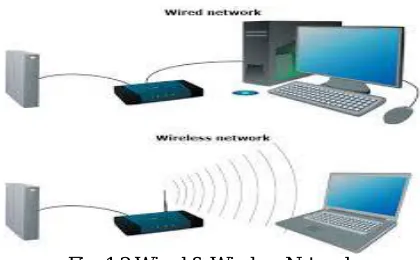
Fig. 1.2 Wired & Wireless Network
1.3 Ad-hoc Network
A Mobile Ad-hoc Network (MANET) is a collection of wireless mobile nodes forming a temporary network [3-4] without using any centralized access point, infrastructure, or centralized administration.
Fig. 1.3 Ad-hoc Network
1.4 Routing
In internetworking, the process of moving a packet [5-6] of data from source to destination. Routing is usually performed by a dedicated device called a router. Routing is a key feature of the Internet because it enables messages to pass from one computer to another and eventually reach the target machine. Each intermediary [7-8] computer performs routing by passing along the message to the next computer.
II. OPEN RESEARCH ISSUES
Ad-hoc network suffer from the lot of issues [9-10] in which congestion and security are the major issues of ongoing research.
ISSN(Online): 2319-8753 ISSN (Print): 2347-6710
I
nternational
J
ournal of
I
nnovative
R
esearch in
S
cience,
E
ngineering and
T
echnology
(A High Impact Factor, Monthly, Peer Reviewed Journal)
Visit: www.ijirset.com
Vol. 7, Issue 11, November 2018
and ad hoc on demand distance vector protocol. In mobile ad hoc networks, mobile nodes must collaborate with each other in order to interconnect, organize the dynamic topology as mobility cause route change and establish communication over wireless links. The simulation results showed the lead of proactive over reactive and hybrid protocols in routing traffic for dynamic changing topology. Proactive protocol, optimized link state routing, a protocol for building link tables for ad-hoc networks, can transmit traffic more rapidly though involve less processing speed in packet forwarding.
III. MOTIVATION
3.1 Concept of AODV
In AODV, the network is silent until a connection [11-12] is needed. At that point the network node that needs a connection broadcasts a request for connection. Other AODV nodes forward this message, and record the node that they heard it.
The Ad hoc On-Demand Distance Vector (AODV) algorithm enables dynamic, self-starting, multihop routing between participating mobile nodes wishing to establish and maintain an ad hoc network. AODV allows mobile nodes to obtain routes quickly for new destinations, and does not require nodes to maintain routes to destinations that are not in active communication. AODV allows mobile nodes to respond
to link breakages and changes in network topology in a timely manner. The operation of AODV is loop-free, and by avoiding the Bellman-Ford "counting to infinity" problem offers quick convergence when the ad hoc network topology changes (typically, when a node moves in the network). When links break, AODV causes the affected set of nodes to be notified so that they are able to invalidate the routes using the lost link.
One distinguishing feature of AODV is its use of a destination sequence number for each route entry. The destination sequence number is created by the destination to be included along with any route information it sends to requesting nodes. Using destination sequence numbers ensures loop freedom and is simple to program. Given the choice between two routes to a destination, a requesting node is required to select the one with the greatest sequence number.
3.2 Packet format Used in AODV
RREQ (Route Request)
RREP (Route Reply)
RERR(Route Error)
ISSN(Online): 2319-8753 ISSN (Print): 2347-6710
I
nternational
J
ournal of
I
nnovative
R
esearch in
S
cience,
E
ngineering and
T
echnology
(A High Impact Factor, Monthly, Peer Reviewed Journal)
Visit: www.ijirset.com
Vol. 7, Issue 11, November 2018
IV. LITERATURE SURVEY
S.No. Author’s Advantages Problems
1.
Sumit Gwalani et al. [1]
AoDV-PA incorporates path accumulation during the route discovery process in AoDV to
attain extra routing information.
Routing overhead increases.
2.
Suhua TANG et al.
[2]
This Modified AoDV mutes adapt to fast topology variations and reach local optimum
quickly.
Well test signal strength must be considered to make it more robust.
3. Chia-Ching Ooi [3]
This modified AoDV have feature of path accumulation. In this location information is utilized during route discovery to limit route
which make it a more powerful routing protocol.
Performance is not overall improved, only route finding is done.
4.
Andrea Gorrieri et.
al [16]
iAoDV used in it’s route discovery phase with the probabilistic forwarding mechanism denoted as IF. by the use of IF protocol the
number of control messages is effectively reduced
But this IF based route discovery process can also apply on DSR that can
be more use full.
5. Pei Tingrui [7]
Proposed a new routing model IH-AODV, which maintains nodes hierarchically based on
AODV for WMNs. That routing scheme is hybrid in nature as it uses both flat and hierarchical approach for finding the routes to the destination. Routing routes are thus found to
be hierarchical in nature. Thus yielding to be advantageous.
ISSN(Online): 2319-8753 ISSN (Print): 2347-6710
I
nternational
J
ournal of
I
nnovative
R
esearch in
S
cience,
E
ngineering and
T
echnology
(A High Impact Factor, Monthly, Peer Reviewed Journal)
Visit: www.ijirset.com
Vol. 7, Issue 11, November 2018
7.
Guo-ping XU et. al [9]
Proposed the AODV_Dprotocol which was more suited to the dynamic network environment. the improved AODV D algorithm can reduce the delay of the route discover, enhance the stability of the path so as to improve the overall performance of the
standard AODV protocol.
The proportion of the size of the static node in the wireless mesh network and how to control the quantity can also be
good work in this direction.
8.
Lawal Bello et. al
[10]
Increase performance of AODV and DSR routing protocols. This performance comparison was aimed to maximize throughput in a large capacity network while
minimizing end to-end delay in the presence of increased ambient noise level.
But it will be proper modeling of terrain effect prior to implementation to mitigate
the effect of noise on received signal strength of the packet
V. PROPOSED METHODOLOGY
1. In the proposed works, we will modified to AoDV for Reliable & QoS services because it cannot work well in the presence of attacker or multiple link failures.
2. In case multiple link failure, A0DV will goes to normal mechanism to establish the route for the communication, which may increases the end to end delay and routing overhead in the network.
A. Route Discovery in RR-AODV
When the route is needed, the source sends the RREQ packet to his entire neighbour after that node check if RREQ retry is less than Retry threshold (RET) then it select the route on the basis of True Value (TV) which is based on the previous history of the neighbour nodes (PDR & Throughput) of the each node & signal strength of the RREQ packet means it compare the TV value (more than 2 or not) & signal strength of RREQ packet of the sender’s node if it is greater than signal threshold value then intermediate node receive this packet otherwise it discard this packet with the help of this approach routing protocol search the Robust, Reliable & Stable path to the destination. If on the basis of TV value & signal strength if there is no route to the destination so node again send the RREQ packet to the neighbour node and RREQ retry is also increase by one, if it greater than Retry Threshold value then it switch to normal AODV and find the route on the basis of minimum hop count so we can always find the best path among available path even in the distant node.
ISSN(Online): 2319-8753 ISSN (Print): 2347-6710
I
nternational
J
ournal of
I
nnovative
R
esearch in
S
cience,
E
ngineering and
T
echnology
(A High Impact Factor, Monthly, Peer Reviewed Journal)
Visit: www.ijirset.com
Vol. 7, Issue 11, November 2018
B. IAODV (Base Paper Work)
C. Proposed Work: Robust & Reliable (RR) –AoDV
Step 1: Initialize True Value of each node, on the basis of PDR, Throughput (Say P & T)
Step 2: Broadcasted RREQ message to discover a route and decrees the True Value (TV) of each node by -1 or -2 (if it
is having PDR and Threshold) & increase by +2 or +4 during RREP process (if these two values have decreases) previously.
Step 3: If RREQ message is received by destination is having value of TV decrees by - in or -2 (in the routing table one
is for PDR & another is for Throughput ) and increase True Value of each node in shortest path by +2 or +4. (TV New =
TV+2 OR TVNew= TV+4), and Go to step 4.
Step 4: Source node will send Data Packet to the Destination node using shortest (Robust &Reliable path.
Step 5: If link is broken then apply local route repair mechanism to recover the route
Step 6: If route is available after local route repair then send data packet through repaired path and Go to step 8.
Step 7: Observed the True Value of each node in the shortest path at each observation period.
Step 8: If TV is less than 2 (TV
New =TV-2 ) than go to step 1.
Step 9: End
ISSN(Online): 2319-8753 ISSN (Print): 2347-6710
I
nternational
J
ournal of
I
nnovative
R
esearch in
S
cience,
E
ngineering and
T
echnology
(A High Impact Factor, Monthly, Peer Reviewed Journal)
Visit: www.ijirset.com
Vol. 7, Issue 11, November 2018
6.1 Packet Delivery v/s No. of Node Ratio Graph
Fig. 6.1 Packet Delivery Ratio
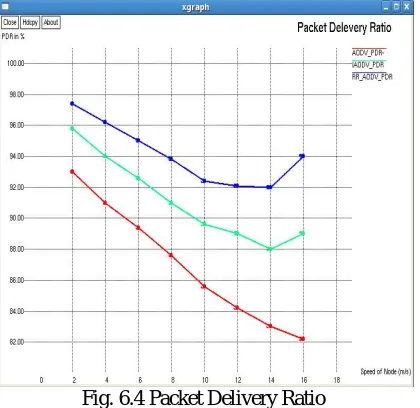
The graph shows a comparative analysis for AODV, IAODV, RRAODV for packet delivery ratio vs number of nodes
6.2 Routing Overheard v/s No. of Node Graph
Fig. 6.2 Routing Overhead
ISSN(Online): 2319-8753 ISSN (Print): 2347-6710
I
nternational
J
ournal of
I
nnovative
R
esearch in
S
cience,
E
ngineering and
T
echnology
(A High Impact Factor, Monthly, Peer Reviewed Journal)
Visit: www.ijirset.com
Vol. 7, Issue 11, November 2018
6.3 Throughput v/s Speed of Node Graph
Fig. 6.3 Throughput
The graph shows a comparative performance analysis for AODV, IAODV, RRAODV for throughput achieved versus speed of node
ISSN(Online): 2319-8753 ISSN (Print): 2347-6710
I
nternational
J
ournal of
I
nnovative
R
esearch in
S
cience,
E
ngineering and
T
echnology
(A High Impact Factor, Monthly, Peer Reviewed Journal)
Visit: www.ijirset.com
Vol. 7, Issue 11, November 2018
6.5 Routing Overheard v/s Speed of Node Graph
Fig. 6.5 Routing Overhead
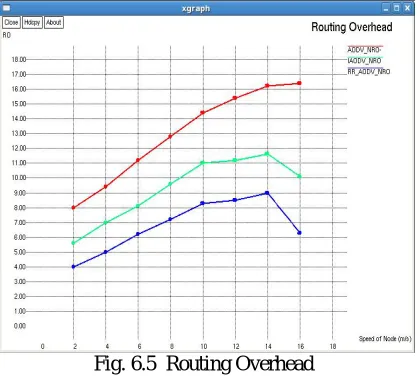
The graph shows a comparative performance analysis for AODV, IAODV, RRAODV for routing overhead versus speed of node
VII. CONCLUSION
In this research work we have done some modification in the normal working of the standard AODV protocol for enhancement of performance of routing process in Mobile ad-hoc Networks.
Throughput improves in RR-AODV.
PDR (Packet Delivery Ratio) increases whenever we use RR-AODV.
Network Overhead is decreased whenever we use RR-AODV.
Avg. End-to-End Delay increases whenever we use RR-AODV
A. Advantages of RRAODV Over IAODV
The RR-AoDV has been compared with the IAoDV protocol as well as the existing based on throughput, packet delivery ratio and overhead. It is observed that the protocol performs better than IAoDV protocol. The throughput& packet delivery ratio of our proposed protocol RR-AoDV is increased.
B. Advantages Over IAODV & AODV
The RR-AoDV has been compared with the IAoDV & AODV protocols as well as the based on Throughput, Packet Delivery Ratio and Routing Overhead. It is observed that the protocol performs better than IAoDV protocol. The Throughput & packet delivery ratio of our proposed protocol RR-AoDV is increased. The increment in Throughput is
17.64 % increased at 50 Nodes, and in PDR at 19.8% at 50 nodes as compare to IAoDV protocol, Routing
Overheard Decreases 18.88 % at 15 Nodes by when compare to IAoDV protocol. So in this work we got increment
on all three parameters as compared with IAODV as well as basic AODV.
VIII. FUTURE WORK
ISSN(Online): 2319-8753 ISSN (Print): 2347-6710
I
nternational
J
ournal of
I
nnovative
R
esearch in
S
cience,
E
ngineering and
T
echnology
(A High Impact Factor, Monthly, Peer Reviewed Journal)
Visit: www.ijirset.com
Vol. 7, Issue 11, November 2018
RR-AoDV is implemented for the ad-hoc network with very less mobility; it can be further enhanced to work on other kinds of networks like vehicular network, where the node mobility is very high and also sensor networks.
REFERENCES
[1] Sumit Gwalani, Elizabeth M. Belding-Royer, Charles E. Perkins, “AODV-PA: AODV with Path Accumulation” ,IEEE, 0-7803-7802-4/03 © 2003 IEEE
[2] Suhua TANG and Bing ZHANG , “A Robust AODV Protocol With Local Update” , ATR Adaptive Communications Research Laboratories, 2-2-2 Hikaridai, “Keihanna Science City”, 61942-2-288, Japan , 5th International Symposium an Multi-Dimensional Mobile Communications 0-7803-8601-9/04@ 2004 IEEE.
[3] Chia-Ching Ooi and N. Fisal ,“IMPLEMENTATION OF GEOCAST-ENHANCED AODV-bis ROUTING PROTOCOL IN MANET” ,0-7803-8560-8/04©2
[4] Baolin Sun, Hua Chen , Layuan Li ,”An Intrusion Detection System for AODV” , Proceedings of the 10th IEEE International Conference on Engineering of Complex Computer Systems (ICECCS’05) 0-7695-2284-X/05 © 2005 IEEE
[5] Rendong Bai and Mukesh Singhal, “DOA: DSR over AODV Routing for Mobile Ad Hoc Networks” IEEE TRANSACTIONS ON MOBILE COMPUTING, VOL. 5, NO. 10, OCTOBER 2006
[6]: Mallapur Veerayya, Vishal Sharma, Abhay Karandikar , “SQ-AODV: A NOVEL ENERGY-AWARE STABILITY-BASED ROUTING PROTOCOL FOR ENHANCED QOS IN WIRELESS AD-HOC NETWORKS” , 978-1-4244-2677-5/08c 2008 IEEE
[7]: Pei Tingrui, Zeng Wenli, Zhang Zhaoxiao, Peng Tao ,“An Improved Hierarchical AODV Routing Protocol for Hybrid Wireless Mesh Network” , 2009 International Conference on Networks Security, Wireless Communications and Trusted Computing.
[8]: Fei Tong1, Wan Tang, Li-Mei Peng1, Rong Xie, Won-Hyuk Yang, Young-Chon Kim , “A Node-Grade based AODV Routing Protocol for Wireless Sensor Network” , 2010 Second International Conference on Networks Security, Wireless Communications and Trusted Computing m,978-0-7695-4011-5/10 $26.00 © 2010 IEEE, DOI 10.1109/NSWCTC.2010.178 181.
[9]: Guo-ping XU, Jian-hui LID , “ Improvement of AODV Routing Protocol based on Wireless mesh networks” , 201O International Conference on Computer, Mechatronics, Control and Electronic Engineering (CMCE),978-1-4244-7956-611 0 ©20 1 0 IEEE.
[10]: Lawal Bello , Panos Bakalis , Samuel J. Manam , Titus I. Eneh and Kwashie A. Anang , “Power Control and Performance Comparison of
AODV and DSR Ad Hoc Routing Protocols” , 2011 UKSim 13th International Conference on Modelling and Simulation ,978-0-7695-4376-5/11
$26.00 © 2011 IEEE DOI 10.1109/UKSIM.2011.93 457.
[11]: Tao Yang, Tetsuya Oda, Leonard Barolli, Jiro Iwashige, Arjan Durresiand Fatos Xhafa, “ Investigation of Packet Loss in Mobile WSNs for AODV Protocol and Different Radio Models” , 2012 26th IEEE International Conference on Advanced Information Networking and Applications 1550-445X/12 © 2012 IEEE DOI 10.1109/AINA.2012.58 709.
[12]: Sridhar Subramanian and Baskaran Ramachandran, “Trust Based Scheme for QoS Assurance in Mobile Ad-Hoc Networks” ,International Journal of Network Security & Its Applications (IJNSA), Vol.4, No.1, January 2012 ,DOI : 10.5121/ijnsa.2012.4108 77.
[13] : D. Arivudainambi n, D.Rekha , ”Memetic algorithm for minimum energy broadcast problem in wireless adhoc networks “ , Science Direct journal ,22106502/2013ElsevierB.V..http://dx.doi.org/10.1016/j.swevo.2013.04.001.
[14]: Jeong-Hun Lee , Ilkyeong Moon , “Modeling and optimization of energy efficient routing in wireless sensor networks” , Science Direct , Applied Mathematical Modelling journal ,0307-904X/$ - see front matter _ 2013 Elsevier Inc. http://dx.doi.org/10.1016/j.apm.2013.10.044.
[15]: Ruo Jun Cai, Peter Han Joo Chong, Cherry Ye Aung , “Poster: Trust-based Routing with Neighborhood Connectivity to Prevent Single and Colluded Active Black Hole” ,2014 9th International Conference on Communications and Networking in China (CHINACOM).