Effect of Chelating Agent on the Efficiency of
Phosphate Solubilisers
Arushi Makkar1*, Anshu Sibbal Chatli2, Navdeep Kaur1 and Parneet Kaur2
P.G. Students, Department of Biotechnology, Guru Nanak Girls College, Model Town, Ludhiana (Punjab)-, India1 Assistant Professor, Department of Microbiology, Guru Nanak Girls College, Model Town, Ludhiana (Punjab), India2
ABSTRACT: Phosphate Solubilising Microbes (PSM) were isolated from Rhizosphere of Rosa and Hibiscus rosa sinensis from two different areas of Ludhiana (Urban Estate and Gorahoor). These microbes were tested to see their potentials to dissolute Tricalcium Phosphate (TCP) on Pikovskaya agar (PVK), MPVK agar and PVK broth supplemented with different EDTA concentrations (0.2 g, 0.5 g, 0.8 g, 1.0 g /250 ml). The decrease in pH and microbial biomass was also determined. Among microbial isolates Nonsporulating sterile was found to form maximum halo size followed by Micrococcus, Penicillium sp., Aspergillus niger and Aspergillus fumigatus on MPVK agar at 0.8 g/250 ml. The increase in P solubilisation and microbial biomass with decrease in pH of filterate was also observed.
KEYWORDS
:
Phosphte Solubilising Microbes, EDTA, PVKI. INTRODUCTION
Soil harbours various beneficiary microorganisms which are required to improve its fertility. These microbes work incognito by mutual interaction to maintain soil ecological balance by active participation in natural nutrient cycling (Talwar and Chatli, 2018). Phosphorus is the major essential nutrient present in the soil. Being a macronutrient, it is needed in abundance by plants. Phosphorus (P) increases the metabolic processes in plants including nitrogen fixation, respiration, photosynthesis, cell division and many more (Sharma et al, 2011). Although the amount of Phosphorus is abundant in soil but available in insoluble form which can not be taken up directly by the plants. The availability of soluble Phosphorus is approximately 20% (Chonker and Taraeder, 1984). So inoculation of various efficient P solubilisers in soil is mandatory to dissolute rest 80% of insoluble P. The deficiency of Phosphorus may cause various plant diseases such as browning of leaves, weak stem, poor development of plants and small leaves. So to meet up the required amount of Phosphorus by the plants, it should be present in available form. To increase the soil fertility and to make the environment eco-friendly, rather than using fertilizers as the source of Phosphate, plant growth promoters can be used. Solubilisation of insoluble sources of P is also affected by various abiotic stresses such as pH, temperature, salt concentration, moisture etc. In acidic soils certain chelating agents such as siderophores, organic acids etc also bind with Calcium of soil rock phosphate and hence render the availability of P in soluble form. Certain Amino acids are also used as chelating agents to provide numerous benefits to plants (Korat et al, 2001). EDTA (Ethylenediaminetetraacetic acid), a chemical chelating agent also forms a Calcium-EDTA complex and make Phosphorus free for plants (Johnston, 1956).
II. RELATED WORK
MPVK agar. Mardad et al (2014) demonstrated the effect of Carbon, Nitrogen sources and Abiotic stress on P solubilisation by Bacterial strains. It was observed that the addition on 1 mg/ ml of EDTA increased the levels of Phosphate released.
III. MATERIAL AND METHODS
Isolated Phosphate Solubilising Bacterium (PSB), Micrococcus and Phosphate Solubilisng Fungi (PSF), Aspergillus niger, Aspergillus fumigatus and Penicilium sp. from different areas of Ludhaiana (Urban Estate and Gorahoor) on Pikovskaya (PVK) and Modified Pikovskaya (MPVK) agar media were tested for their efficacy to solubilise P at different EDTA concentrations.
Determination of halo size:
Bacterial and Fungal isolates were cultured on PVK and MPVK agar media supplemented with Tricalcium Phosphate (TCP) as insoluble inorganic Phosphate source and different EDTA concentrations (0.2 g, 0.5 g, 0.8 g, 0.1 g / 250 ml). The plates were incubated at 28±1°C for 3 days for bacterial and 6 days for fungal cultures. The solubilisation of Phosphate by microbes was indicated by clear zone formed around the colony and its size was measured in mm. The halo size around the colony was calculated by subtracting the colony size from total size. The efficacy of microbes to solubilise Phosphate at different EDTA concentration was determined. The experiment was done in triplicates.
Quantitative estimation of P solubilisation in culture broth:
106 bacterial cells and 30×105 fungal spores per ml were inoculated with 100 ml PVK broth supplemented with TCP and 0.8 g EDTA for 3 days in bacteria and 6 days in fungi under shake at 250 rpm. Uninoculated broth served as control. The solubilised phosphate in clear filterate was determined using Ascorbic acid method (Watanobe and Olsen, 1965). Then the intensity of blue colour was measured on spectrophotometer at 730 nm and the quantity of solubilised P was expressed as µg/ml. The final pH of culture filtrate and microbial biomass was also determined.
IV. RESULTS AND DISCUSSION Effect of EDTA on phosphate solubilisation
The effect of chelation on solubilisation of inorganic phosphate by PSM was studied by adding 0.2, 0.5, 0.8, 1.0 g/250 ml of EDTA to PVK agar and broth.
P solubilsation activity on agar media
Addition of 0.8g/250 ml of EDTA formed large halo zone after dissoluting TCP in case of Non sporulating sterile (10.4 mm) (Fig.2) followed by Micrococcus (9.8 mm) (Fig. 3), Penicillium sp. (9.5 mm), Aspergillus niger (7 mm),
Aspergillus fumigatus (5 mm) in PVK agar (Table 1). This could be due to the formation of calcium EDTA complex, due to chelation of Ca2+ ions with EDTA. Increase in EDTA concentration beyond 0.8 g/250 ml caused decrease in halo size. It was observed that there was large halo zone on MPVK media than PVK, due to the interaction of bromophenol blue dye with that of genes of organism which resulted in increase in phosphatase activity. It was observed that when
Micrococcus was kept under refrigeration condition at 4-70 C, the zone size was increased, indicating more P solubilisation and its Psychrophilic nature (Fig. 4).
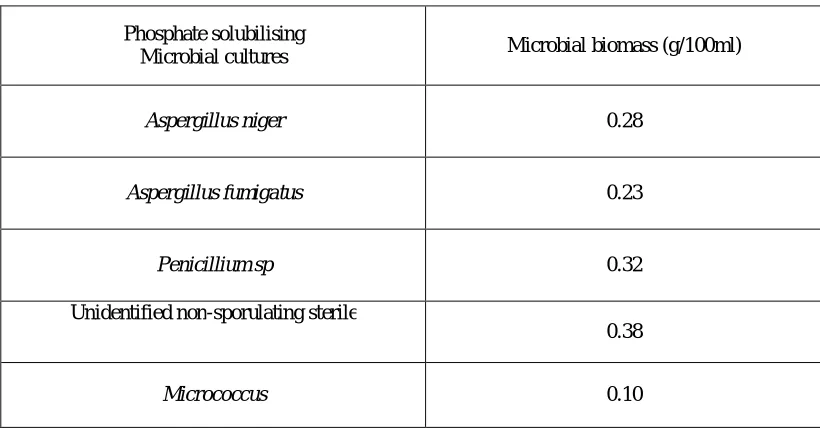
filterate and obtained maximum microbial biomass (Table 3) at 0.8 g/ 250ml EDTA concentration. The similar results were observed by (Chatli, 2005; Nautiyal et al, 2000)
TABLE 1: Effect of EDTA on halo zone formation (mm) after solubilisation of inorganic phosphate (TCP) by Phosphate solubilising microbes on Pikovskaya (PVK) and Modified Pikovskaya (MPVK) agar
Phosphate Solubilising Microbial cultures
Concentration of EDTA (g/250 ml)
0.2 0.5 0.8 1.0
Aspergillus niger
HALO ZONE (mm)
PVK MPVK PVK MPVK PVK MPVK PVK MPVK
2.5 3 4.5 5.2 6 7 3 3.2
Aspergillus
fumigatus 1.5 2.2 3 3.5 4.3 5 2 2.5
Penicillium sp.
2.6 3.4 5.5 6.3 8 9.5 3.5 3.7 Unidentified
non-sporulating sterile 4.2 5 6 7.5 9.8 10.4 4 4.5
Micrococcus
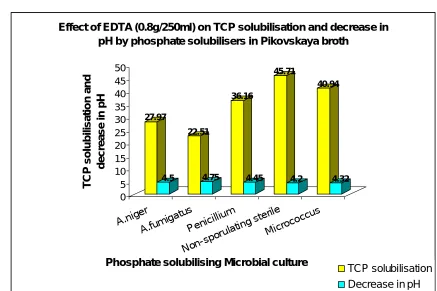
TABLE 2: Effect of EDTA (0.8 g/250 ml) on TCP solubilisation and Decrease in pH by Phosphate solubilising microbes in Pikovskaya broth (PVK)
Phosphate Solubilising Microbial cultures
TCP solubilise (μg/ml) Decrease in pH
Aspergillus niger
27.29 4.6
Aspergillus fumigatus
22.51 4.75
Penicillium sp
36.16 4.45 Unidentified non-sporulating
sterile 45.71 4.2
Micrococcus
40.94 4.32 Initial pH of broth = 6.8
TABLE 3:Microbial biomass (g/100 ml) in PVK broth after TCP solubilisation supplemented with EDTA (0.8 g)
Phosphate solubilising
Microbial cultures Microbial biomass (g/100ml)
Aspergillus niger 0.28
Aspergillus fumigatus 0.23
Penicillium sp 0.32
Unidentified non-sporulating sterile
0.38
27.97 4.5 22.51 4.75 36.16 4.45 45.71 4.2 40.94 4.32 0 5 10 15 20 25 30 35 40 45 50 TC P s ol u b il is a ti o n a n d de c re a s e i n pH A.nige r A.fum igatus
Penicilliu m
Non-s porula
ting ste rile
Microc occus
Phosphate solubilising Microbial culture
Effect of EDTA (0.8g/250ml) on TCP solubilisation and decrease in pH by phosphate solubilisers in Pikovskaya broth
TCP solubilisation Decrease in pH
Fig.1: Effect of EDTA (0.8 g/250ml) on TCP solubilisation and Decrease in pH by phosphate solubilisers in Pikovskaya broth
Fig. 3: Solubilisation of TCP by Micrococcus on PVK agar supplemented with different EDTA concentrations (0.2, 0.5, 0.8, 1.0 g/250 ml)
Fig. 4 : Increase in Halo Size by Phosphate solubilisers under refrigeration in the presence of EDTA REFERENCES
1. Chatli Anshu S. “Effect of Calcium and Chelating Agent on Inorganic Phosphate Biosolubilisation Under In vitro Conditions”. Journal Punjab Academy of Science, Vol. 2 (1 & 2), pp. 47-55, 2005.
2. Chonker P.K. and Taraeder J.C. “Accumulation of Phosphate in Soil”. J. Indian Soc. Soil Sci, Vol. 32, pp.266-272 , 1984.
3. Goswami Ekta, Makkar Arushi, Chatli Anshu S. and Sharma Akshita. “Testing Efficacy of Screened Phosphate Solubilisers Under In vitro Conditions ”. International journal of Current Research, Vol. 10 (10), pp. 74096-74099, 2018.
4. Johnston H.W. “Chelation between Calcium and Organic Anions”. N. Z. J. Sci. Technol, Vol. 37, pp. 522-537, 1956.
5. Koret K., Dane B.P. and Dube H.C. “Detection and Chemical Characterization of Siderophores Produced by Certain Fungi”. Indian J. Microbiol, Vol. 41, pp. 87-91, 2001.
6. Mardad llham, Serrano Aurelio, Soukri Abdelaziz. “Effect of Carbon, Nitrogen Sources and Abiotic Stress on Phosphate Solubilization by Bacterial Strains Isolated from a Moroccan Rock Phosphate Deposit”. J Adv Chem Eng , Vol. 1, pp. 102, 2014.
7. Nautiyal Shekhar. C, Bhadauria Shipra, Kumal Pradeep, Mondal Rajesh, Lal Hind, Verma Dinesh. “Stress Induced Phosphate Solubilization in Bacteria Isolated From Alkaline Soils”. FEMS Microbiology letters, Vol.182, pp. 291-296, 2000.
8. Parmar, N. and Dadarwal, K.R. “Rhizobacteria from the rhizosphere and rhizoplane of chickpea ( Cicer arietinum)”. Indian J. of Microbiol. Vol. 37, pp.205-210, 1997.
9. Sharma, S.S., V. Kumar and R.B. Tripathi “Isolation of Phosphate solubilising Microorganisms (PSMs) from Soil”. J. of Microbiol. and Biotechnol. Res. Vol. 1(2), pp.90-95, 2011.
10. Talwar Harleen K. and Chatli Anshu Sibbal. “Isolation and Enumeration of beneficiary microbes from soils of Punjab”. International Journal