ISSN(Online): 2320-9801
ISSN (Print): 2320-9798
International Journal of Innovative Research in Computer
and Communication Engineering
(An ISO 3297: 2007 Certified Organization)
Vol. 3, Issue 2, February 2015
Energy Efficient Path Determination in
WANET
K. Devi
1, S. Rinesh
2III M.E., Dept of CSE, Karpagam University, Coimbatore , India1
Assistant Professor, Dept of CSE, Karpagam University, Coimbatore , India2
ABSTRACT: Two algorithms were used in Energy-Efficient Reliable Routing in wireless Ad Hoc networks. Reliable minimum energy cost routing(RMECR) and Reliable minimum energy routing(RMER) . It reduces energy cost and data communication in wireless network . RMECR can increase the operational lifetime of the network using energy efficient reliable routes. RMECR have two types of networks : Hop by Hop and End by End. In the HBH system, a lost packet in each hop is retransmitted by the sender to ensure link level reliability. In EBE the ACKs are generated only at the destination and retransmissions happen only between the end nodes. RMER finds routes minimizing the energy consumed to route a packet from a source node to a destination node. It also extends the operational lifetime of the network . Disadvantages are End to end delay is maximum, Overusing of nodes may occur , Energy loss is high ,Retransmission of packets high. In this paper , we propose an algorithm called Enhanced RMECR (ERMECR) which is used to find out the high energy intermediators. Here the data is to be transmitted through the path which contains the high energy. Besides the energy constraints are considered for the path selection process. The path selection from source to destination is least hop count with high energy.
KEYWORDS: ERMECR , WANET , MDR , MAC
I. INTRODUCTION
A wireless ad hoc network (WANET) is a decentralized type of wireless network. The network is ad hoc because it does not rely on a pre existing infrastructure, such as routers in wired networks or access points in managed (infrastructure) wireless networks. Instead, each node participates in routing by forwarding data for other nodes, so the determination of which nodes forward data is made dynamically on the basis of network connectivity. In addition to the classic routing, ad hoc networks can use flooding for forwarding data.
Figure 1 : Wireless Ad-Hoc Network
ISSN(Online): 2320-9801
ISSN (Print): 2320-9798
International Journal of Innovative Research in Computer
and Communication Engineering
(An ISO 3297: 2007 Certified Organization)
Vol. 3, Issue 2, February 2015
II. RELATED WORK
In [1] author dealt with Multi-access protocol for Ad Hoc networks that conserves power by turning off radios under certain conditions. In this paper, power savings range from 10% to 70% in fully connected networks. It achieves the power savings without affecting the delay or throughput behavior of the basic protocol. In [2] author discussed the need to make routing protocols power aware. Using Traditional metrics such as hop count or delay for finding routes.This is more important to use cost/packet and maximum node cost. In this paper’s simulation work demonstrated that significant reductions in cost can be obtained by using shortest cost routing as opposed to shortest hop routing. In [3] author have shown, Why the effective total transmission energy, which includes the energy spent in potential retransmissions. The proper metric for reliable, energy efficient communications. The energy efficiency of a candidate route is thus critically dependent on the packet error rate of the underlying links, As part of future research, authors intend to extend our analyses (which assumed each link to be operating independently of other links) to scenarios, such as IEEE 802.11-based networks, where the logical links share the same physical channel and hence, interfere with one another. Indeed, since an energy-aware routing protocol defines the next-hop node (and hence, implicitly defines the associated transmission power), the choice of the routing algorithm is expected to affect both the overall network capacity and individual session throughputs in such scenarios. In [4] author propose a new metric, the drain rate, to forecast the lifetime of nodes according to current traffic conditions. This metric is combined with the value of the remaining battery capacity to determine which nodes can be part of an active route. It describe new route selection mechanisms for MANET routing protocols, which call the Minimum Drain Rate (MDR) and the Conditional Minimum Drain Rate (CMDR). MDR extends nodal battery life and the duration of paths, while CMDR also minimizes the total transmission energy consumed per packet. Using the ns-2 simulator and the dynamic source routing (DSR) protocol, to compare MDR and CMDR against prior proposals for energy-aware routing and show that using the drain rate for energy-aware route selection offers superior performance results. Methods keywords are system design and simulations.
The lifetime maximization problem is NP-hard. [5] authors are also have proposed a new online heuristic– OML–for lifetime maximization. Extensive simulations show that the new heuristic is superior to previously published heuristics for lifetime maximization both in terms of providing larger lifetime and in terms of sensitivity to algorithm parameters .Additionally, The proposed heuristic provides larger network capacity than provided by competing heuristics. The problem of minimum energy routing for reliable one-to-one communication in the presence of lossy links. [6] The author solved the problem in the hop-by-hop retransmission model, where each link is assumed to support link layer hop-by-hop retransmission and guarantee reliable delivery. In [7] , author have examined the energy cost metrics widely used in the existing energy efficient routing protocols, and developed more accurate energy consumption models for common MAC protocols CSMA, MACA, and 802.11. Unlike existing models that ignored energy consumption due to various control messages and thus underestimated the actual energy cost, in models take into account such energy consumption. The accuracy of models have been verified through simulations. More specifically, energy consumption models developed for both the EER and HHR modes have been shown to be much closer to the actual energy consumed than the existing models. In [8] author demonstrated the feasibility as well as potential benefits of data-driven routing by designing protocol LOF. LOF mainly used three techniques for link quality estimation and route selection: initial sampling, data-driven adaptation, and exploratory neighbor sampling. With its well-tested performance and implementation, LOF has been successfully used to support converge cast in the backbone network of Excels .
ISSN(Online): 2320-9801
ISSN (Print): 2320-9798
International Journal of Innovative Research in Computer
and Communication Engineering
(An ISO 3297: 2007 Certified Organization)
Vol. 3, Issue 2, February 2015
wireless links.MAC protocols such as CSMA and MACA may not support HBH retransmissions. Two sets of energy-aware reliable routing algorithms for HBH and E2E systems. In ERMER, energy cost of a path for EtoE packet traversal is the expected amount of energy consumed by all nodes to transfer the packet to the destination. In ERMECR, the energy cost of a path is the expected battery cost of nodes along the path to transfer packet from the source to the destination.
IV.PSEUDO CODE
Step 1 : Node Deployment(ni)
Step 2 : Set the Energy level to all the nodes. (Ei) Step 3 : Select the Source(S) and Destination(D) nodes
Step 4 : To select the Intermediater (I) based on minimum distance(d) and the high Energy(HE) Step 5 : Data Transmission from S to D.
Step 6 : To calculate the Energy Efficiency(Ef) Step 7 : To calculate the Energy Consumption(Ec) Step 8 : End.
V. SIMULATION RESULTS
The simulation analysis for ERMECR while the data transmission and certificate revocation based security is implemented using Network Simulator NS2
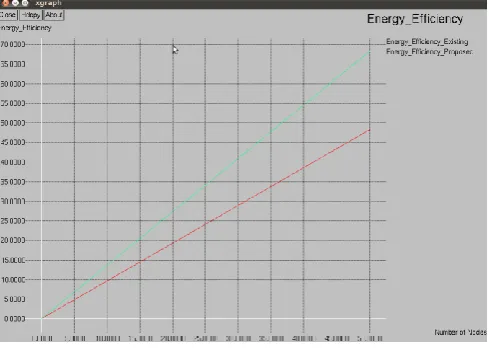
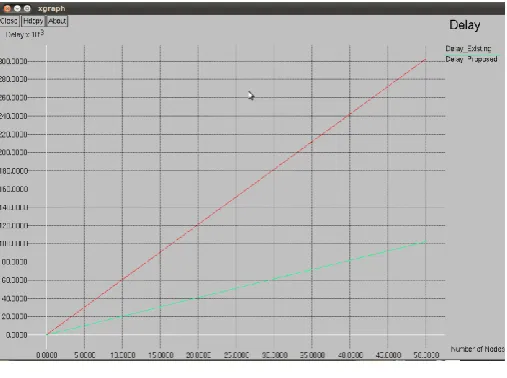
The simulation is done for Energy Efficiency , Energy consumption and Delay using ERMECR whose results are shown in Figure 1 , 2 & 3 respectively.
Figure 1 : Energy Efficiency
ISSN(Online): 2320-9801
ISSN (Print): 2320-9798
International Journal of Innovative Research in Computer
and Communication Engineering
(An ISO 3297: 2007 Certified Organization)
Vol. 3, Issue 2, February 2015
Figure 2 : Energy Consumption
The figure 2 shows that the Energy consumption of the proposed system is lesser than the existing system.
Figure 3 : Delay
The figure 3 shows that the Delay of the proposed system is lesser than the existing system.
VI.CONCLUSION AND FUTURE WORK
ISSN(Online): 2320-9801
ISSN (Print): 2320-9798
International Journal of Innovative Research in Computer
and Communication Engineering
(An ISO 3297: 2007 Certified Organization)
Vol. 3, Issue 2, February 2015
2. S. Singh, M. Woo, and C.S. Raghavendra, ―Power-Aware Routing in Mobile Ad Hoc Networks,‖ Proc. ACM Mobile Communication, pp 102-105, Oct. 1998.
3. S. Banerjee and A. Misra, ―Minimum Energy Paths for Reliable Communication in Multi-Hop Wireless Networks,‖ Proc. ACM Mobile Hoc, pp. 46-156, June 2002.
4. D. Kim, J.J.G. Luna Aceves, K. Obraczka, J. Carlos Cano, and P. Manzoni, ―Routing Mechanisms for Mobile Ad Hoc Networks Based on the Energy Drain Rate,‖ IEEE Transactions on Mobile Computing, vol. 2, issue no. 2, pp. 161-173, Apr.-June 2003. 5. J.-H. Chang and L. Tassiulas, ―Maximum Lifetime Routing in Wireless Sensor Networks,‖ IEEE/ACM Trans. Networking, vol. 12,
issue no. 4, pp. 609-619, Aug. 2004.
6. Q. Dong, S. Banerjee, M. Adler, and A. Misra, ―Minimum Energy Reliable Paths Using Unreliable Wireless Links,‖ Proc. ACM Mobile Hoc, pp. 449-459, May 2005.
7. J. Zhu, C. Qiao, and X. Wang, ―On Accurate Energy Consumption Models for Wireless Ad Hoc Networks,‖ IEEE Trans. Wireless Comm., vol. 5, issue no. 11, pp. 3077-3086, Nov. 2006.