University of South Carolina
Scholar Commons
Theses and Dissertations
2018
Bodies In Play: Female Athleticism In
Nineteenth-Century Literature
Jillian Weber
University of South Carolina
Follow this and additional works at:https://scholarcommons.sc.edu/etd
Part of theEnglish Language and Literature Commons
This Open Access Dissertation is brought to you by Scholar Commons. It has been accepted for inclusion in Theses and Dissertations by an authorized administrator of Scholar Commons. For more information, please [email protected].
Recommended Citation
Weber, J.(2018).Bodies In Play: Female Athleticism In Nineteenth-Century Literature.(Doctoral dissertation). Retrieved from
B
ODIES IN PLAY:
FEMALE ATHLETICISM IN NINETEENTH-
CENTURY LITERATUREby
Jillian Weber
Bachelor of Arts University of Illinois, 2009
Master of Arts
University of South Carolina, 2013
Submitted in Partial Fulfillment of the Requirements
For the Degree of Doctor of Philosophy in
English
College of Arts and Sciences
University of South Carolina
2018
Accepted by:
Leon Jackson, Major Professor
Catherine Keyser, Major Professor
Cynthia Davis, Committee Member
Katherine Adams, Committee Member
ACKNOWLEDGEMENTS
I am grateful to the University of South Carolina, the Institute for African
American Research, and the Bilinski Educational Foundation for generously funding me
through a Presidential Fellowship, a SPARC grant, an IAAR fellowship, and a Bilisnki
Fellowship. This funding made it possible to complete my research and finish my
dissertation.
Without the generosity, patience, advice, and guidance, of Cat Keyser, Leon
Jackson, Cynthia Davis, and Kate Adams, this dissertation would have never come to
fruition. Their insight and kindness were invaluable, and I am so appreciative to have had
them in my corner.
The love and support of my family, particularly my parents, propelled me to keep
working, even when I felt like I could not. They encouraged me every step of the way
and I am eternally grateful for them. My brothers made me laugh when I was taking
myself too seriously, and my grandparents, aunts, uncles, and cousins always cheered me
on.
My friends were my constant source of humor and support. They let me bounce
ideas off of them and they made me laugh when it was most needed. I am indebted to the
people, too many to name, who have positively affected my life over the past several
ABSTRACT
My dissertation explores depictions of athletic female characters in
nineteenth-century American literature. I argue that there is a rich literary tradition of athletic
women, whose origin I date to the 1840s, that has not been explored. To date, scholars
have considered athletic women in literature anomalies, a case of a gender-bending
female found in a single text, but not part of a longer genealogy of this character type. By
examining athletic women over a period of decades and across several genres of
American literature we see how this character type has been shaped by authors and
culture alike. I illustrate how authors fashioned a character type that reflected the racial,
political, and cultural moment in which he or she was writing. Simultaneously, athletic
female embodiment reveals how texts themselves change when physical performance
culture enters narratives.
Athletic women, historically and in fiction, are linked to the theater and
performance. Because athletic women were not taken seriously for their skills, they were
looked at as simply entertainment; their sports were often relegated to theatrical spaces,
such as stages during play intermissions. Authors recognized this connection between
athletics and performance and utilized it to draw attention to the performativity of gender
on the part of the female athlete. Athletic characters change their embodied performances
based on context and audience, showing how women appropriated cultural scripts
through sport. Ultimately, in nineteenth and early twentieth century literature, play-acting
TABLE OF CONTENTS
Acknowledgements ... iii
Abstract ... iv
List of Figures ... vi
Chapter 1: Introduction ...1
Chapter 2 “Off Went Bonnet and Skirt:” Boxing and Prostitution in the Flash Press ...26
Chapter 3 Bluestockings, Tomboys, and Literary Amazons in the Mid-Nineteenth Century ...75
Chapter 4 “The Steed that Never Tires:” Regionalism and Rupture in Cycling Narratives ...113
Chapter 5 “That Stirring Cry of Right Guard:” Athletics, Race, and Space in College Girl Novels ...149
LIST OF FIGURES
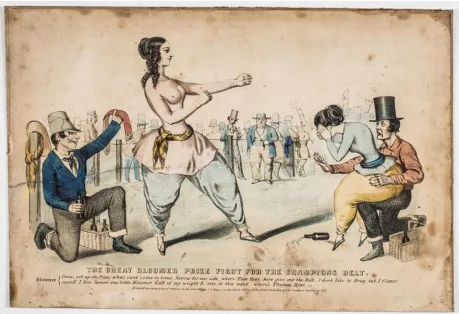
Figure 2.1 “The Great Bloomer Prize Fight” ...72
Figure 3.1 Kiralfy Bros “Black Crook” ...76
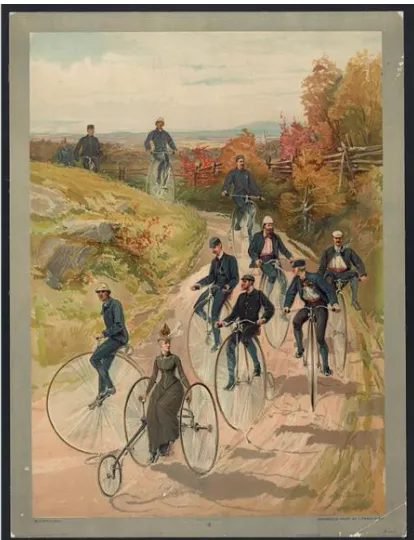
Figure 4.1 Bicycling ...120
CHAPTER1
INTRODUCTION
In 1883, the New York Times published “Miss Harris’s Base-Ball Nine,” about an
exhibition between two black female baseball teams in the Northeastern United States. It
reads:
A reporter of the Philadelphia Times to-day found a number of persons, white and
black, lounging under the maples in the Lamokin Woods, when suddenly a dusky
damsel, with a red and white jockey cap stuck upon her head, a short, tight-fitting
pink and white sheeny calico dress enveloping her form, and a pair of cricket
shoes on her feet, suddenly emerged upon the scene. (“Miss Harris”).
The woman described here, Ella Harris, is the captain of the Dolly Vardens No. 1
baseball team.1 Immediately, the reader’s attention is directed towards Ella’s feminine
body, as the reporter notes that she has a “ribbon suspended on [her] bosom.” She wears a
short, tight dress that further accentuates her female form. However, she also carries “a
base-ball bat over her right shoulder and she [strides] over the greensward with manly
strides.” She then “shoulder[s] her bat” and “stalk[s] down through the maple glade.”
While Ella’s movements are assertive and aligned with manliness, her clothing is “stuck
upon her head” and “envelops” her (“Miss Harris”). The language used to describe her
costume renders Ella submissive at the same time that her body is depicted as forceful.
1 Debra A. Shattuck gives a brief history of the Dolly Varden No. 1 and the Dolly Varden No. 2 teams in
With nearly every action that she takes, Ella seems to combine femininity and
masculinity in the way that she holds herself. As the article continues, it becomes clear
that Ella Harris takes command of the gaze directed towards her by both onlookers and
teammates. She also maintains steady control over the space of the field throughout the
article. When Ella “[emerges] on the scene” she becomes the object of everybody’s
attention, much like an actor walking onto a stage and captivating an audience. A “poorly
dressed young colored woman” shouts, “Foh de Lord’s sake, am dat you, Ella Harris?”
Ella ignores the question, refusing to either confirm or deny her identity, and monologues
in a “long, theatrical aside” about the tardiness of the Dolly Vardens No. 2 team (“Miss
Harris”). Then, to prepare for the game, Ella directs her players to stand in specific places
and she cordons off space, using rope and the players’ bodies to mark the field. She sets
the stage for the performance that is about to take place.
Ella’s form-fitting Dolly Vardens costume, which already juxtaposes her female
frame with her masculine comportment, also carries race and class implications. Not only
does her jockey cap recall the tradition of black men, often former slaves, serving as
jockeys in the nineteenth century, but the tight-fitting “pink and white sheeny…dress”2
mirrors a fashion trend from the 1870s—the Dolly Varden dress, so named for the white,
upper-class, flirtatious woman in Charles Dickens’s Barnaby Rudge (1841).3 In other
words, the way that Ella chooses to outfit herself puts the contradictions of her identity on
display. Her uniform, coupled with her theatrical asides, create a dynamic version of Ella
Harris that is difficult to pin down.
2 According to the Oxford English Dictionary, sheeny refers to something “having a bright, shiny surface”
and was first used in the seventeenth century (“sheeny, adj”).
3 For more information on the Dolly Varden dress see The Metropolitan Museum of Art: The United States
In fact, Ella is literally moving throughout the article, walking off the field and to
the train station. She moves between different geographic spaces—the woods, the train
station, and the baseball field. In each space, Ella interacts with different kinds of
people—white and black, onlookers and participants, and players from both Chester and
Philadelphia. As she negotiates those interactions, Ella repurposes the spaces that she
occupies. What begins as an open field quickly becomes a baseball diamond as Ella
marks the ground with ropes and “place[s] her men,” telling them where to stand on the
field. Then, while the team waits for their opponents to arrive, the players remake the
space for jumping rope. The “nine unbent themselves and hopped over the rope” with
vigor (“Miss Harris”). Ella claims dominance over the field, understanding that her
athleticism affords her more opportunities to traverse and repurpose these spaces than the
game’s onlookers have; instead, they sit in the shade, expressing hesitation to enter the
playing field space.
Ella’s commanding performance and the Dolly Vardens’ athleticism, perhaps
unsurprisingly, evoke negative responses, illustrating unease about the transgressive
nature of sportswomen in the nineteenth century, and in this case black sportswomen.
Most obviously, the reporter “employs racist slang to represent players’ speech patterns”
(Shattuck 117). The reporter also uses racist imagery, writing that the players “amused
themselves by pitching the ball at each other. One lady got hit in the upper lip, but it did
not seem to swell any bigger than it was before” (“Miss Harris”). Many onlookers at the
game responded disapprovingly to the players’ bodies. At the same time that the Dolly
Varden No. 1 players are sexualized by some male onlookers, who are “delighted” by the
responses. For instance, one woman notes that “‘If I was a man and had my girl gwine
foolin’ and monkeyin’ like dem I would hab nuffin to do wid her’” (“Miss Harris”). What
this article makes clear is that Americans were not entirely comfortable with the idea of
an athletic woman in the nineteenth century, and discourse on female embodiment is rife
with racist and sexist arguments that denigrate them.
I refer to “Miss Harris’s Nine” because it serves as a snapshot of the ways that
female athleticism functioned in the nineteenth-century United States, and what’s more, it
represents the ways that athleticism is closely linked to performance. As Debra Shattuck
notes, the Dolly Vardens were playing at a time when “spectators craved novelty”
(Shattuck 117). In fact, most early female baseball teams “were theatrical
productions…staged with costumes and circus-like spectacle” (Shattuck 72). The blurring
of women’s athletics and entertainment in the nineteenth century was not exclusive to
baseball, either. Rather, this unsettling of clear demarcations between athletes and
performers was common. In my dissertation I examine newspaper articles like “Miss
Harris’s Nine,” alongside stories and novels from the long nineteenth century, to make
sense of the intersection of performance culture, athleticism, gender subversion, and
racial categorization.
My dissertation, “Bodies in Play: Female Athleticism in Nineteenth-Century
Literature,” explores historical and fictional representations of nineteenth-century female
athletes that have been previously overlooked, much like “Miss Harris’s Nine.” Today,
when critics mention athletic women in fiction they tend to represent them as anomalies,
this character type.4 I instead follow the cultural trope of the athletic woman, whose
origin I date to the 1840s and which I trace through the 1920s. This character resists static
gender categorization as either masculine deviant or feminine mother, but also fends off
pejorative racialization, the imputation of excess embodiment assigned to women of
color. Given this aspiration to whiteness and anxiety about corporeality, it is little
surprise that this figure becomes entwined with nativist views by the end of the long
nineteenth century. Athletic women, marginalized in the mid-nineteenth century,
employed their athleticism and its associations with performance culture as cultural
capital, using their athletic bodies to navigate formerly inaccessible spaces. However, as
the nineteenth century progresses, literary genres like domestic fiction and the College
Girl novel illuminate the limits of athletic performance for characters who do not adhere
to heteronormative values or who are not part of the white middle-class.
The cultural figure of the athletic woman in the nineteenth century is one whose
athleticism is not simply about physical exertion. That is certainly a large part of her
athleticism, and I use the term “athletic” to refer to physical feats that involve some
combination of speed, endurance, strength, agility, and dexterity. But in addition to
physical exertion, in my project I consider the ways that publicness is often a
precondition for athletic performance. The athletic woman understood how to perform for
different audiences, costume herself, and contort her body in various ways depending on
the situation. The performative aspect of athleticism and its constantly shifting nature are
precisely what make it difficult to pin down one stable definition of the athletic woman in
4 For further reading on women athletes in literature see Michelle Abate’s Tomboys: A Cultural History;
the nineteenth century. That inability to ascribe a single fixed meaning to the athletic
woman opens up new ways to consider athletic female characters within the context of
nineteenth-century literature. It also means that no two examples of athleticism that I
discuss throughout this dissertation will exactly resemble one another. At times I discuss
the physicality of boxing in the 1840s, at other times I consider identity performance and
costumery of cyclists, and still at other times I think through the goals of community
building through sport. All are athletic performances, but all also encompass a public
performance of some sort.
My title, “Bodies in Play,” draws attention to the coextensivity of athletics and
performance culture in the nineteenth century, a relationship that allows the women
characters in my study, as Ella Harris does in the anecdote above, to highlight their own
theatricality and their traversal of public space and identity categories. Theater was a
purveyor of popular culture, including athletics, in the United States, and there was a
permeable line between athletic exertion and professional performance. Early women’s
baseball games featured interruptions for performances (Shattuck 72). Female boxers,
closely linked to vaudeville performances, held matches during intermissions at plays.
These matches took place on stage, with a set assembled and props placed around the
theatre (Pfister and Gems 1000).5 Additionally, actresses exercised and underwent
physical training before taking the stage and literary characters learned sports to put on
more “authentic” plays. Figures like Annie Oakley reenacted their athletic feats on stage
(Kasper 23-24). The list goes on.
5 Photographs of the Bennett Sisters, boxers and wrestlers who performed on stage in the middle of
Culturally, athletic women were considered performers, not athletes. As “Miss
Harris’s Nine” illustrates, “the myth undergirding their [female baseball players]
narrative was that blacks and women were baseball novices who could offer spectators
only comic relief, not serious athletic competition” (Shattuck 117). Women’s athletic
bodies were not often taken seriously as capable of skilled recreational activities outside
of a theatrical setting. Instead, outside the theater, women’s bodies were typically
assessed according to a binary: either dainty and feminine or hardened and masculinized
by labor, depending on their class status and race. While relegating athletic women to
theatrical spaces seems to make them freakish, their bodily presentations in these spaces
actually provide them a degree of agency. Performance spaces, heterotopias of sorts, let
audiences revel in the spectacularity of the body while also giving female athletes the
space to let their bodies be unruly and multivalent. These two seemingly incompatible
realities—the gaze on the athletic woman and the athletic woman’s expanding behavioral
options—coexist in one temporary space (Foucault 354). “Play with an unruly woman,”
Natalie Davis writes, “is partly a chance for temporary release from the tradition and
stable hierarchy; but it is also part of the conflict over efforts to change the basic
distribution of power within society” (qtd. in Russo 131). The performing female body, in
other words, is in flux and constantly working to upset (and at times to uphold)
hierarchical orders through her athletic displays, moving in and out of spaces typically
deemed masculine or exotic.
At a time when women were expected to hold and carry their bodies in particular
ways, athleticism offered them an alternative mode of being. The close links between
In theatrical spaces, athletic female identities were in flux because they were constantly
performed, reinterpreted, and rewritten. Perhaps because of this in-fluxness, athletic
women did not necessarily internalize cultural norms about their bodily comportment.
Instead, athletic women began to recognize that the control over their bodies their
athleticism afforded them, as well as their knowledge of physical culture worlds, allowed
women to perform certain identities. For example, Ella Harris’s fluctuating gender
identity—the way that she holds her body to evoke both masculinity and femininity—
allowed her to authoritatively command her teammates and fill some of the female
onlookers with the desire to “jine them girls and play wid ‘em” because they were “jes
lovely” (“Miss Harris”). Women appropriated cultural scripts and used that appropriation
as a form of cultural capital, a means to temporarily sidestep certain cultural barriers.
Sara Ahmed’s theory of orientation is useful here to think about how athletic
women navigated cultural scripts. She talks about orientation and the difficult experience
of walking into a strange room. However, “our intimacy with rooms, even dark ones, can
allow us to navigate our way. We might reach out and feel a wall. That we know how a
wall feels, or even what it does…makes the dark room already familiar” (Queerness 7).
Athletics provide women that sense of familiarity, enabling them to enter those rooms
more easily. Their abilities to converse about sport, partake in athletics, or reshape their
athletic bodies allows them to navigate those dark rooms that they would otherwise be
unable to enter. For instance, Jo March uses her knowledge of equestrianism to infiltrate
conversation at a ball with an upper-class crowd; Capitola Black renders her typically
kinetic body still to trick a sexual predator and then flies into motion and rides away on
cultural gap between her friends in the East and the West. Athletic performativity, then, is
an assumption or subversion of an athletic persona that women used as a form of agency.
They adapt a pre-existing script that they are already familiar with from men’s roles and
make it advantageous for themselves. This performing allowed women to cross racial
divides, class lines, social boundaries, and geographic borders in ways that would have
otherwise been unavailable to them. As they cross these boundaries, women shape the
new spaces they inhabit; their inhabitance makes it familiar. “The work of inhabiting
space involves a dynamic negotiation between what is familiar and unfamiliar,” and
athletic performativity allows for that negotiation to happen (Queerness 9).
However, the limits and restraints of athletic performativity become apparent in
nineteenth and twentieth century literature, as lower-class and non-white characters are
unable to achieve the same mobility and access as middle-and-upper-class white women.
Race and class inevitably play a role in the movement that female athletes are able to
attain in literature, and in each chapter, I consider how the intersections of race, class, and
gender shape the discourse about female athleticism. For example, lower-class, Irish
prostitutes are racially aligned with African American prostitutes in the flash weeklies
through both language and space. Several articles describe Irish women boxing in
African American churchyards and then later use the term “gingerbread” to refer to
Irishness—a word that also subtly links that Irishness to blackness. These women are
received differently, and more negatively, —by other women within the community of
prostitutes, by editors of the papers, and by readers—than well-to-do madams of white,
European ancestry. Similarly, Pauline Hopkins’s Ophelia Davis ends her cycling
kitchen space. Her attempts to present a middle-class identity in public through cycling
fail and she and her companion end up in a pile of white sand, evoking images of minstrel
shows in this scene. In other words, using intersectionality to examine literature about
athletic women makes clear the limits of the performing female body.
The limits to athletic performativity that women of color confront demonstrate the
ways that athletics were used as an instrument for enfranchisement in the long nineteenth
century. Athletics become a way to train—and exclude—women to be ideal citizens
within region and nation. As James Salazar notes, the muscular body signified the
“dehumanizing corporeality” of working classes and racial minorities for much of the
nineteenth century. However, towards the end of the century, “the muscular body
emerged as a powerful new signifier for the ‘fitness’ of a racialized national
character…[a body] empowered to withstand not only the enervating demands of
modernity but also the ‘race-diluting’ effects of massive immigration” (117). Athletics,
because they provide women with a space to perform and embody multiple identities,
give the impression of offering a number of productive possibilities for engagement with
national identity and citizenship in the mid-nineteenth century. However, upon closer
examination, it becomes clear that the woman-citizen ideal achieved if only contingently
or transiently through athleticism is quite exclusionary. For instance, in the College Girl
novel, basketball is premised as democratic, and the girls who engage in the sport discuss
how it trains them to be morally-upstanding members of a community. However, in these
stories it soon becomes clear that women of color cannot access athletic spaces, like the
gymnasium, in any role other than mascot, erasing any possibility of them achieving that
represent the limits of athleticism as citizen-making. Throughout the literature that I
examine in this dissertation, female athletes push boundaries and use their athleticism to
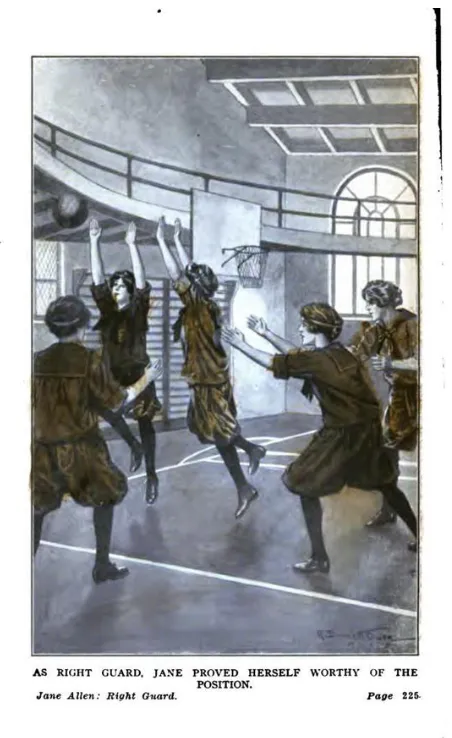
carve out spaces of belonging and American identity; Jane Allen and her friends, for
instance, play basketball so they might belong to a community that models virtuous and
respectable behaviors to the larger student body at Wellington College. Yet, the avenues
of movement available to them as white, middle-class women are not available to most
other marginalized characters in the same ways.
Scholarship
In the following chapters I am influenced by foundational texts from the 1980s
and 1990s that contextualize how athletic women were spoken about in
nineteenth-century America. For centuries, people have attempted to define, quantify, and direct
athletic female bodies through the lens of biology, health, and medicine. Groundbreaking
sports historians like Martha Verbugge, Jan Todd, Patricia Vertinksy, Jennifer
Hargreaves, Susan Cayleff, and Linda Borish, have published extensively about the shift
in attitudes towards women’s physical fitness throughout the 1800s. While current
scholarship on athletic women in literature remains scarce, a small number of scholars are
slowly beginning to explore the wide-reaching implications that athletic women in print
culture have on questions of politics, race, class, gender, and theater, to name a few
affected areas.6 The athletic body is scripted and influenced by, responds to, and is
molded in periodical and literary culture, as were contemporaneous viewers’
understandings of the athletic woman’s body. By analyzing written accounts of female
athleticism, I find both that the female athlete is an authorizing fiction, allowing writers
6 For more on athletic embodiment and literature, see Martha Patterson’s Beyond the Gibson Girl, James
like Louisa May Alcott and Fanny Bullock Workman to claim the body as a site of
feminine power rather than vulnerability, but also that many texts, like the flash papers
and even Alcott’s own sentimental sequels to Little Women, discipline and contain the
performing female body that seems unruly in non-textual spaces. However, as Sara
Ahmed notes, “the concept of ‘orientation’ allows us to rethink…how space is dependent
on bodily inhabitance” (Queerness 6). Discipline of the performing woman by authors
and other characters is not wholly successful because once the athletic woman is taken up
in print culture, she reorients space and her reception makes room for the
acknowledgment of her body in flux.
Frances B. Cogan and Alison Piepmeier address literature and physical culture
through a feminist lens, and they provide a blueprint on which I model my
interdisciplinary work. Cogan’s All American Girl:The Ideal of Real Womanhood in
Mid-Nineteenth-Century America introduces the Ideal of Real Womanhood, an
alternative to the fragile maiden so closely associated with the popular Cult of True
Womanhood in the nineteenth century.7 She proposes that “more than one popular ideal
for middle-class American women existed and was embraced between 1840 and 1880”
(9). Cogan focuses primarily on physical culture—diet, light exercise, living conditions—
not sport or athletics, but her recuperation of a counter-narrative to True Womanhood
supports my contention that the athletic woman was not a marginal or an aberrant figure
in the latter half of the nineteenth century but a hotly contested focus of cultural debate.
Cogan acknowledges that arguments for both Victorian ideals and a thriving physical
culture even became intertwined at times — some of the same arguments used to defend
7 For more on the Cult of True Womanhood see Barbara Welter’s 1966 article in American Quarterly, “The
the Cult of True Womanhood were adopted and used to make a case for why women
should maintain their health and physical activity (34). Like Cogan, I am interested in
illuminating the counternarrative to that of the nineteenth-century athletic woman as a
deviant and masculine freak. Within print culture, the athletic woman saw her body
marshalled into static categories in an attempt to subdue and regulate her. However, I
posit that this disciplinary action had an inadvertent effect: the embrace of athletic
women in print culture opened up new spaces for their performance and play.
Alison Piepmeier also uncovers the importance of physically fit women in the
public life of the nineteenth century. In Out in Public: Configurations of Women’s Bodies
in Nineteenth-Century America,Piepmeierfocuses on cultural attitudes in periodicals
towards women’s fitness. In her discussion of Sarah Josepha Hale, Piepmeier posits that
often periodicals and the materiality of publications come to stand in for women’s
moving bodies. Print stands in as a bodily surrogate and print culture becomes “a site
which offers not erasure of the body but a complicated public embodiment for the women
who exist there” (18). For her, print culture is a space that allows multivalent
embodiments and increased mobility for women. Piepmeier notes that “women can
utilize the material world of the printed page and the publishing marketplace to stand
for—and to travel for and speak for—their bodies” (18). Literature about the athletic
woman, her movement through that text, and that circulation of the text itself “help to
provide a vocabulary for all these women’s discursive constructions of their own bodies”
(Piepmeier 18).
I build on this insight in my project, which begins with the penny press and ends
in the performing, athletic woman. Though these texts often restricted or disciplined her
movements, her scandalous body also sold papers—and later, novels. Authors like Louisa
May Alcott were able to embody multiple personae and move across genres in their
writing. Alcott’s characters, through their athleticism, navigate various social settings by
adapting the way they carry and display their muscular and strong bodies. Then, the
publications themselves traversed multiple spaces and regions, as the print copies of
Alcott’s newspaper stories and novels circulated to homes by train and canal boat.
Piepmeier also points out the close connections between performance, writing,
and corporeality in her discussion of Anna Cora Mowatt, a nineteenth-century theater
performer and author. Piepmeier notes that Mowatt was fascinated by the physicality and
fitness of theater performers, and she herself lifted weights to prepare her body to go on
stage. Rather than striving for a daintiness in a space where she was the object of the
male gaze, Mowatt desired to enlarge her muscles, something which was often at odds
with femininity in the nineteenth century. Mowatt describes the work she does to ensure
that she has a powerful body because she is aware that “in distinction to the submissive
true womanly body, the sensational female body must be athletic in order to endure the
kinds of demands placed on it, from dangerous travel to violent attacks” (Piepmeier 37).
Piepmeier examines Mowatt’s polyvocal voice in her autobiography and parses out the
ways that Mowatt combines and navigates both the sentimental and the sensational (38).
Mowatt understood the oppositional categories that female embodiment often conjured—
public versus private, feminine versus masculine, spectacularized versus constrained—
and attempted to complicate those dichotomies in both her writing and her stage
was read on the stage as well as in her autobiography—is precisely what I see happening
more widely in the long nineteenth century when athletic women are featured in print
culture. Though the penny press was written by men and for men, it is striking to me how
often narratives about athletic women are also written by women. When Piepmeier
proposes that Mowatt was mediating her own body through autobiographical writings,
she provides an entrance-point for me to understand the close relationship between
women’s authorship and women’s athleticism.
Cogan and Piepmeier each use feminist theory and historiography to interrogate
the female body in the public eye. Michelle Abate’s research reminds us that this female
body often participates in a developmental narrative where girls move from boyishness to
appropriate womanliness, a transition that frequently involves abandoning athleticism. In
Tomboys: A Literary and Cultural History, Abate claims that while tomboys seem to
transgress gender roles through their athletic bodies, that is not necessarily the case.
Instead, Abate sees literary tomboys as often reifying traditional notions of middle-class,
white womanhood; tomboyism was regarded as simply a phase that developed the
strength and health for white, middle-class women to rear children. However, Abate
notes that most tomboys grow out of their athletic adventures and end up married with
children by the end of their stories (xii). Abate’s study informs much of my second
chapter, which considers how tomboys’ athleticism is affected in both E.D.E.N.
Southworth’s The Hidden Hand and Louisa May Alcott’s Little Women as they mature
out of adolescence. Athletic tomboys, as the begin to push the bounds of white
sensational stories, which are meant to be less instructive or didactic, tomboys are able to
remain active, challenging racial and gender norms through their athleticism.
To better understand the disciplinary function of athleticism as citizenship
training, I turn to Salazar’s Bodies of Reform: The Rhetoric of Character in Gilded Age
America, an examination of the ways in which character-building and corporeality go
hand-in-hand in numerous Progressive Era writings. The “rhetoric of character” is
intertwined with nationalist discourse and embodiment for Salazar, ideas upon which I
draw for my final chapter on nationalism and sport. I use his work as a model for
addressing the ways that athletics both reify and push against the reach of power, and
how those actions are made legible within the public sphere. Salazar deftly attends to “the
ways that the rhetoric of character provides a site for the extension and operation of
power but also for exceeding, undoing, or challenging the reach of power” (12). By the
end of the long nineteenth century, athletics were posed as egalitarian, character-building
activities, particularly for the college-age women who participated in them. However,
College Girl series like Jane Allen and Grace Harlowe reveal that despite being touted as
morally-instructive, women’s athletics were closely linked with nativism and only made
space in the gym for certain types of bodies.
Project Overview
My dissertation closely considers the interplay between female athleticism, genre,
performance, and space. Many of the authors that I examine in this dissertation are
women writers, not by intention but by default. During my research I found that far fewer
male authors wrote about athletic women in their texts, particularly in the genres within
literature, genres that feature a large number of women writers who describe
transgressive athletic female characters. If men wrote within these genres, they often did
so under pseudonyms, as these were considered more “feminine” fields. Writing in the
nineteenth century marked women authors’ bodies; critics commented on the ways that
writing built up women writers’ strong muscles and declared that writing turned them
into literary Amazons. As Ahmed says, “when women write, when they take up space as
writers, their bodies in turn acquire new shapes” (Queerness 61). If female athleticism
provided women the agency to traverse boundaries, I posit that women writers felt
marking their own bodies as athletic through authorship would also provide them an
athletic performativity, giving them new shape.
I have organized my dissertation into four chapters. Each chapter considers a
genre—racy newspapers, domestic fiction, sensational stories, regional literature, and
College Girl novels—and the setting that that genre is supposed to map—urban spaces,
the home space, the East and the West, universities, and athletic fields; I am interested in
how the female body moves through that setting, particularly in performing athleticism.
These chapters span roughly eighty years, beginning with newspapers from the 1840s and
ending with College Girl novels in the 1920s. I stop my discussion with the 1920s
because after this time the landscape of athletics begins to change. At this point, physical
education was becoming law; the United States, concerned by the high number of failed
army physicals, made physical education classes mandatory across the country (Cahn
57). Women’s teams professionalized in growing numbers, and, athletics became a
commercial venture in ways that they were not for women prior to the 1920s. The
I trace in my project; the liminality that women’s athletics had once occupied, which
provided athletic women the space to perform, shrunk when sport was formalized and
subject to oversight.
In each chapter of this dissertation, I deal with a different type of literature, and I
consider how athletic women are treated differently across genres. In some genres, like
sensation stories, athleticism is a source of pleasure and power. In others, like the College
Girl novel and domestic fiction, bodily performance is ultimately controlled and
restricted so that athletic women can assert their heteronormative whiteness. The intended
audience of the genre—whether it be a counterpublic, a mainstream reading public, a
lower-class audience, or an upper-class audience—largely determined how female
athleticism was handled in that fiction. Moralizing genres like domestic fiction cannot
allow women to remain athletic at story’s end because that athleticism is seen as a threat
to white, heteronormative marriage. Jo March’s character in Louisa May Alcott’s Little
Women suffers this fate and ends the novel stationary, holding a baby. By the twentieth
century, didactic fiction like the College Girl novel no longer ends with the loss of
women’s athleticism, but it does still highlight the ways that athletics reify white
Americanness. Jane Allen, for instance, asserts that athletics and egalitarianism are
closely linked, but when women of color enter athletic spaces with Jane, they only serve
to magnify Jane’s own white Americanness. On the other hand, genres such as
sensational newspapers and regional literature encourage female athleticism and provide
a greater space for women to use their athleticism as a tool for identity performance and a
way to accrue cultural capital. These genres put forth an image of the athletic woman as a
registers, costumes that disguise both her class and gender, and a knowledge of athletics
to navigate different situations and prevent violence from being enacted on her body.
Readers are meant to admire Capitola’s athletic abilities and the opportunities that they
afford her to code switch.
In the following chapters I address several kinds of spaces: The flash press depicts
city scenes, domestic fiction enters the home, regional literature shows women cycling
out of doors and across geographic regions, and the College Girl novel shows campus
gymnasiums and athletic fields. The physical spaces that female athletes traverse affect
how each of their bodies is read, and the women in turn repurpose the spaces as they
move across them. Ahmed notes that many spaces take the shape of the bodies that
occupy them, “naturalizing” them and aligning them with certain gender identities. If a
male author sits at a table and writes every day, for instance, then that table becomes
linked “to a specific kind of body”—the male body in this case (Queerness 58-59). I
argue that athletic women are able to penetrate typically masculine spaces and begin to
reorient them. For instance, flash weeklies describe prostitutes in New York City
improvising boxing rings, creating a space in which the social and bodily order is upset.
Within these rings, athletic women assert a female masculinity that is celebrated by their
broader prostitute community. Similarly, in regional literature athletic women become
code switchers, changing the ways that they carry their bodies, perform their athleticism,
and interact with people in different locations, sometimes to better fit in, sometimes to
assert their superiority. The bicycle, for example, provides women in regional literature a
mechanism for movement across geographic and cultural boundaries; characters like
West, in public and private. However, the limits to this spatial repurposing become clear
within each genre and the degree to which women are able to perform their athleticism
across boundaries depends largely on their race and class. As athletics are used more
often and more explicitly as a vehicle for white, feminine superiority and a mechanism
for enfranchisement, who can traverse boundaries through athletics—and importantly,
who cannot—becomes evident, either through athletic failures or barred entrance from
spaces like the gymnasium.
Chapter Outlines
My second chapter, “Off Went Bonnet and Skirt:” Boxing and Prostitution in the
Flash Press,” begins with a discussion of articles about boxers in the flash weekly papers
of the 1840s. These articles describe boxing matches between prostitutes and the crowds
that watch them. Historians locate the entrance of women into boxing in the late-1870s
with the match between Nell Saunders and Rose Harland; however, women—prostitutes
specifically—were boxing throughout the 1840s. Accounts in racy newspapers (The
Sporting Whip, The Flash, The Rake) complicate public discussions about gendered
embodiment and liminal spaces female boxers occupied due to their profession and
athletic displays. They both depict a space—the boxing ring—in which neither female
athleticism nor female sexuality are wholly condemned and illustrate the anxiety that
stems from that carnivalesque space. In this chapter I argue that this character type—the
athletic female—first appears with regularity in the flash weeklies and sporting papers of
the 1840s. Flash weeklies were published extensively for a short period of time and were
meant to entertain sporting men about the erotic entertainment that New York had to
trenchant, mocking humor and a titillating brew of gossip about prostitutes, theatrical
denizens, and sports contests” (Cohen et al. 1). These weeklies served as models for
young men “navigating the new world of unrestricted pleasure and commercialized
leisure in the city” (Cohen et al. 1).
One particularly common feature of the flash press is the article depicting
prostitutes boxing one another. In the flash weekly articles, fighting temporarily upsets
the social and bodily order in the flash weeklies. Articles appearing in the flash press
about prostitutes engaged in boxing matches introduce readers to a form of athletic
female masculinity that resists containment. In the ring, prostitutes are physically
assertive and their muscular bodies are revered in that space more than they are outside of
it. They sometimes fight the men with whom they are sexually engaged—and usually,
they win. The women engaged in these matches do not remain passive, and in fact,
domination in the ring is seen as a way to assert sexual prowess and to tote one’s sexual
endurance—qualities that the women benefit from financially. But, prostitute sex outside
of the ring reasserts social order. The editors of the flash press, though initially tolerant of
female boxing, at least when the prostitute is white, deride prostitutes in non-boxing
articles. They mock female pugilists’ bodies, remind readers of the bodily threats
prostitutes faced outside of the ring, sometimes even goading violence against certain
women, and ridicule women about the men with whom they engage. This disparagement
reveals an anxiety concerning the blurring of gender identifications that happened
between the ropes. Ultimately, pugilism articles reveal just as much about the fear of
unclear boundaries in the flash press—public and private, masculine and feminine—as
In my third chapter, “Bluestockings, Tomboys, and Literary Amazons in the
Mid-Nineteenth Century,” I focus on athletic tomboys in both domestic and sensational
fiction. Many texts were published in the mid-nineteenth century that champion young,
athletic women, such as Louisa May Alcott’s Little Women and E.D.E.N. Southworth’s
The Hidden Hand. These young women—tomboys—are constantly taking part in athletic
activities, but their athleticism is treated differently across genres. Southworth’s Capitola
Black, the heroine of the sensational Hidden Hand, is an athletic tomboy who is allowed
to go on adventures, marry, and retain her athleticism at the novel’s end. Southworth’s
influence on Alcott’s characterization of Jo March is apparent in the young girl’s
attempts at writing sensational stories, but Alcott’s character does not completely mirror
Capitola because of the class aspiration embedded in domestic fiction. In fact, Alcott
dramatizes this journey from sensational to domestic fiction in the plot of her novel.
When Jo writes sensational stories she is quite athletic, and the act of writing is one that
renders her body constantly in motion. As her literary focus turns to moralizing tales, her
connection to athletics changes and her self-display as a physically active woman must be
evacuated from the novel. By the end of Little Women, after her marriage to Professor
Bhaer, Jo stands still and holds a baby, while her husband and Laurie join their children
in sport. In a domestic novel that is meant to model middle-class, white, heteronormative
marriage to its readers, Jo March cannot remain athletic. Female athleticism is a threat to
white heteronormativity, as it is often associated with masculinity or lesbianism. In a
genre such as sensational literature, which is neither realistic nor didactic in the way that
During the last three decades of the nineteenth century, regional literature peaked
in popularity, and my fourth chapter examines this literature and the athletic female
cyclists that populate it. Regional literature typically took the form of short sketches that
focused on a specific locale. In Chapter Four, “‘The Steed that Never Tires’: Regionalism
and Rupture in Cycling Narratives,” I focus on the ways that female athletes recognized
and utilized porousness within regional literature to shape their identities. As physically
active women traverse various boundaries in regional sketches, they assume transregional
identities, which provide them a degree of agency that they are typically otherwise unable
to attain. They defy gender norms and cross different class and racial structures as they
pass through various neighborhoods. Cycling provides women with a means to escape a
sort of fixity of identity, and when female cyclists recognize this, they begin to use it to
their advantage. The first portion of the chapter centers on Willa Cather’s story
“Tommy,” and the ways in which Tommy performs her athletic identity differently when
she is in the East versus the West. I then move to a discussion of Fanny Bullock
Workman’s cycling narratives in an effort to show how athletic performativity and
cycling can be used as a vehicle to consolidate white, feminine superiority. Finally, I
close the chapter with an examination of Pauline Hopkins’s Contending Forces, which
illustrates the ways that women’s performative athleticism only extends so far. In this
case, Ophelia Davis’s race precludes her from fully traversing certain boundaries,
presenting limits of identity and performance
In Chapter Five, “That Stirring Cry of Right Guard: Athletics, Race, and Space in
College Girl Novels,” I focus onthe Jane Allen Series by Edith Bancroft, the Grace
women’s college life. My final chapter considers the rising popularity of College Girl
novels at the turn of the century and the athletic women that populate many of these
stories. Not only do sportswomen flourish in this genre, but they are starting to be taken
more seriously as athletes, reaching elite ranks in their physical pursuits. However,
stories that begin to normalize women’s participation in athletics do so through white,
middle class, educated female characters. Women of color were erased from the narrative
during a period when the inclusive potential of sport was heralded by women in the
United States and seen as an avenue for reaffirming one’s “Americanness” and
commitment to American values. In college novels, athletics model democratic
community and serve as an avenue to assimilate white women into an ideal citizenship,
conflating whiteness, athletics, and nationalism. More to the point, characters in these
stories delineate space as racialized and allow entry to non-white men and women only in
“supporting” roles, such as that of the mascot. They dramatize the possibility that an
ethnic outsider could infiltrate that space, so those outsiders must be thrown out. This
exclusion is particularly jarring when one realizes that athletic spaces in these works are
posed as egalitarian and democratic; however, they position non-participants as outsiders
to both the university and national community, and threats to that democracy.
Ultimately, athletics matter. As Title IX approaches its fiftieth anniversary and
conversations about women’s athleticism persist, it is imperative that work be done to
understand the history that contributes to attitudes about athletic women today. My
dissertation offers a way to view athletic women as agents and comprised of multiple
identities, rather than just masculine and static as they are often depicted. Through my
athleticism shaped the reception of the female body both on the field and on the page, and
print culture registers the ambivalence she occasioned. As Ahmed writes, “The work of
inhabitance involves orientation devices; ways of extending bodies into spaces that create
new folds, or new contours of what we could call livable or inhabitable
space…orientation is about making the strange familiar through the extension of bodies
into space” (Queerness 11). Athletic women in the nineteenth century began the work of
making those spaces familiar. They used their bodies to inhabit and shift them, and in the
process created a model for female athletes today to embody. Though some “spaces
extend certain bodies and simply do not leave room for others,” sportswomen today like
Serena Williams have taken up the work of carving out places for more women in that
space (Ahmed 11). Serena frequently encounters derision about her “masculine” body,
the grunts that she makes when she plays tennis, her arguments with referees about bad
calls, and her blackness in a white-dominated sport. However, as Claudia Rankine points
out, Serena “won’t be forced into stillness” (“Meaning”). She will not “keep to [the
script]” that “demands the humble absorption of racist assaults” by black athletes
(“Meaning”). Instead, echoing the public performances of nineteenth-century women, she
uses her athleticism to enter many rooms from which she would otherwise be barred. The
women of nineteenth-century literature did not completely level the playing field for
athletes today, but they have given today’s athletic women a blueprint to follow as they
CHAPTER 2
“OFF WENT BONNET AND SKIRT:” BOXING AND PROSTITUTION
IN THE FLASH PRESS
On July 31, 1842, readers of The Flash were greeted by a lengthy but common
description of a boxing match between two well-known prostitutes. This article, “A Ring
Fight at Mrs. Smith’s Between Nance Kemp and Kate Davis,” was neatly situated
between “Henry Shandfrod’s Exhibition” and “Fight Between Bill Jones and Tommy the
Greek.” The author of this article, likely the paper’s editor, writes about the match, for
which slander was the cause. As the paper notes, Nance Kemp, one of the pugilists, was
sexually involved with a “negro one night” and Kate, the second boxer, told her lover
about it, in addition to saying that “Nance had false teeth.” Bets were made, oyster stew
was touted as a prize, and the fight began:
Both being ‘owly’ as usual, they agreed to fight…. All being ready, they began to
peel—Nance appeared very large round the head and showed a fine pair of
kidneys; Kate on the reverse, stripped small, but well built for fighting. Nance
was seconded by English Liz, and had a strapping wench for bottleholder. Kate
was seconded by Mary Stothoff and had Lise Smith for bottleholder. Nance
walked round with great grace, threw a large quid of snuff out of her mouth, and
The match lasted five rounds and by round two, when time was called, Nance was
“somewhat swelled round the head.” Then, “Kate led off, tapping Nance in the mug, and
knocking out her false teeth—first blood for Kate—a good rally and both down.” By the
third round, Nance was “looking groggy” and “Both caught hold of hair with the left and
struck hard with the right—the seconds rushed in but it was no go, for Nance lost her
false hair. Kate down.” The last two rounds of the fight highlight the grotesque
descriptions of Nance and Kate. They look “very red around their pimples,” Kate laughs
at Nance’s head because it “shone like a glass bottle,” and audiences shout “‘well done,
Swellhead!” Towards the end of the fight, “Nance with a glass of gin and Kate with a
pitcher. Both let fly, with no effect. Another clinch, when the landlady appeared just
awakened from a sweet slumber, and swore she would have no fighting in her house.”
From this description, a number of things become evident: There is a clear anxiety about
miscegenation here, as the fight began over the purported intimacy between Nance
Kemp, an Irish woman, and a black man. We can also see that there is an emphasis
placed on artificiality, as Nance Kemp’s fake teeth and hair are mentioned throughout the
article. Additionally, there is a real interest in women’s bodies in this space—both their
grotesqueness and their celebration by the onlookers who cry, “‘Bravo, Kate you’re a
good ‘un,’ while Nance rushed in to the yard for a tub of water to soak her head” (“Ring
Fight”). Female athleticism is clearly wrapped up in questions of race, ethnicity, class,
gender, and sexuality in mid-nineteenth century periodicals. In the coming pages I
explore the intersections between many of these categories and what they can tell us
This chapter discusses the racy flash press of the 1840s and its relationship to the
prostitutes so often portrayed boxing one another in these papers. In source after source,
scholars have pointed to the New York-based boxing match between Nell Saunders and
Rose Harland in 1876 as the starting point for women’s participation in boxing in the
United States. Scholars do not dispute that women in England engaged in prize fighting
as early as the eighteenth century, but they also do not acknowledge a history in the
United States that begins during the antebellum period. Contrary to popular belief,
though, women were engaged in boxing matches as early as the 1840s. There are many
reasons that these matches are largely unfamiliar to us today, the fact that they took place
between prostitutes among them. The flash press, whose focus was the promotion of
prostitution, ran article after article that detailed prize fights and the pugilists involved in
mid-century New York.
These boxing matches ranged from spontaneous bouts to organized fights.
Sometimes the ring was assembled quickly, in response to a challenge from one woman
to another; other times a fight was planned in advance to take place inside a brothel,
meant to show off the physical prowess of a prostitute. The reportage afterwards,
however, served to conventionalize these matches, as they distinguished roles that the
supporting “team” played—bottleholders, seconds, referees. The flash articles also tended
to give round-by-round accounts of the fights, describe different punches and boxing
techniques, and detail the prize being offered to the winner. Whether the match was
spontaneous, like a pick-up game today might be, or planned, the participants assumed
bottleholders and seconds still assembled, a demarcation for the ring was made, and
onlookers still gathered.
In this chapter I examine articles about female boxers throughout the Northeast in
several bawdy periodicals8 in an effort to understand how their bodies were written about,
as well as how they themselves attempted to shape discussions regarding their bodies. In
the mid-nineteenth century there were certainly many athletic women living outside of
the Northeast and across the West; however, the circulation of the flash press papers was
limited primarily to the New York-Philadelphia-Boston area and thus that region will be
my primary focus in this chapter. What I discovered during my research is that fighting
temporarily upsets the social and bodily order in the flash weeklies, but then prostitute
sex outside of the ring reasserts that order. Participation by women in two ultra-embodied
acts—boxing and prostitution—worked to render their bodies kinetic and sometimes
difficult to read because of that movement. Articles appearing in the flash press about
prostitutes engaged in boxing matches introduce readers to a form of athletic female
masculinity that resists containment. The editors of the flash press initially tolerate that
movement, at least when the prostitute is white. However, subsequent mocking of female
pugilists’ bodies, as well as the bodily threats they faced outside of the ring, reveal an
anxiety concerning the blurring of gender identifications. In the face of that anxiety, the
editors of the papers reestablish the social and bodily order that was overturned between
the ropes. Outside of the female boxing ring, the flash papers tout masculine bravado and
8 I was able to visit the American Antiquarian Society in December 2016 thanks to a fellowship through the
a libertine republicanism premised on male heterosexual indulgence, ideas that seem
antithetical to the carnivalesque disorder that takes place in the ring. Ultimately pugilism
articles reveal just as much about the fear of unclear boundaries in the flash press—public
and private, masculine and feminine—as they do about the embodiment of athletic
women during the nineteenth century.
My discussion will begin with historical background about boxing in
nineteenth-century America. I first examine the ways that issues of race, gender, and class coincide
during the germinal stages of pugilism in the United States. I then shift to a brief
background about the flash press, the sexual underworld that it occupied, and its
relationship to prostitutes engaged in boxing matches. A more focused analysis on prize
fighting in the flash press follows, including a theorization of the boxers’ embodiment
and how their positions as both prostitutes and boxers affected the ways their bodies were
viewed. The prostitute’s female and muscular body moves through the spaces of the ring
(and boxing articles on the pages of papers) and performs athleticism in ways that upend
certain bodily orders. Rather than looking at these female boxers as simply women in
possession of dissenting bodies, we can use Judith Halberstam’s ideas about female
masculinity to more fully understand their corporeality and sexuality. However, outside
the space of the boxing ring, and outside of the boxing articles, the flash newspapers
ultimately reassert gendered social hierarchies. The anxiety about the “pollution” of
white, male bodies proves to be too much for boxing prostitutes to overcome outside the
Overview of Boxing in the Nineteenth Century
Boxing is not a new sport or even one that finds its roots in the nineteenth
century. Sometimes boxing is traced to Classical Greece, but there is research to suggest
that Egyptians partook in something resembling boxing earlier than that. In fact, “[t]he
first evidence of the sport can be found in Mesopotamian stone reliefs from the end of the
fourth millennium BC” (Boddy 7). Although I am tracing the origins of female boxing in
the United States on a consistent basis to the 1840s, there are accounts, often sexualized,
of women and “Amazons” engaging in boxing and athletics outside of the United States
that date back many centuries. I will not give an extensive history of boxing in the
ancient world, as that is not the aim of this project and that undertaking would certainly
require more space than I have. However, popular culture saw continuity between
classical boxing roles and contemporary practices.
Boxing existed in England before it made its way to the United States. It began to
take hold in the late-seventeenth century in the form of prize fighting and was widely
popular by the mid-eighteenth century. Initially, prize fighting was a sport for lower-class
citizens in England.9 It is considered the less refined arm of boxing and is closely
associated with bare-knuckle hitting, blood, gore, gambling, drinking, and spectacle
(Gorn 47). Boxing made its way to the United States around the 1820s when English
boxers began to trickle into the country, hoping to shape the direction of the sport here.
Prize fighting was the modus operandi for a vast majority of participants in early
American boxing. Its rise in popularity coincided with an influx of immigrants to the
9 As the eighteenth century progressed, more and more aristocrats and nobility began to participate in
United states and “pugilism thrived where ethnic communities were largest, in New York
and Philadelphia and, to a lesser degree, Boston, Baltimore, and New Orleans” (Gorn 46).
It wasn’t until the last few decades of the nineteenth century that sparring and other more
“respectable” forms of boxing began to take hold and entice middle-class men (and
women, though their membership in boxing history is often overlooked) to participate.
Another cause for boxing’s spread to the United States—Southern men traveling
to England for school and developing a fondness for pugilism there—rankled Thomas
Jefferson. It is said that those young men came back from England and introduced the
sport to friends in the States. Jefferson, though, saw little appeal in this prospect. He
noted that the young, educated man “learns drinking, horse racing and boxing…He is led
by the strongest of human passions, into a spirit of female intrigue…or a passion for
whores, destructive of his health, and in both cases learns to consider fidelity to the
marriage bed as an ungentlemanly practice” (qtd. in Gorn 59). Jefferson certainly
equates boxing with a lower-class status, but more importantly, he sees it as antithetical
to his vision of republicanism. What Jefferson misses, however, is that more and more
men took to the ring in efforts to reify their masculinity. An entire subculture of men
challenged the politics of respectable republicanism that Jefferson espoused. As many
scholars point out, urban spaces were becoming more crowded as the nineteenth century
churned on. Men felt that they needed a means of strengthening their muscles, and
relatedly, their masculinity; after all, with increased industrialization, demanding physical
labor was becoming scarcer and men were thought to be more effeminate. The fear of
dwindling masculinity also pervaded the flash press, whose readers were concentrated in
encouraged a libertine republicanism about which Jefferson expressed such horror. Their
libertine ideas, Patricia Cline Cohen et al. note, stood for “attacks on privilege, an
emphasis on erotic pleasure, [and] sexuality as intrinsic and natural” (73-74). Male
readers could finally feel as if they were part of a community, a subculture that
encouraged intermingled images of illicit sex and boxing. However, throughout the pages
of the flash press, articles appeared about women boxing one another, and sometimes
defeating and humiliating men in the ring, too. What do we make of a subculture that is
in defiance of respectable norms of republicanism and encourages virile displays of
masculinity, yet frequently reports on prostitutes engaging in grotesque battles and
defeating male opponents in matches?
The subculture that made up the flash press readers was a counterpublic, which, I
contend, is important to understanding the unsettling of distinctions between public and
private within the flash weeklies. Michael Warner defines a counterpublic as a group that
maintains a subordinate status and is defined by “[its] tension with a larger public”
(Warner 56-57). Additionally, a counterpublic “can mediate the most private and intimate
meanings of gender and sexuality. It can work to elaborate new worlds of culture and
social relations in which gender and sexuality can be lived” (57). In many ways, the main
purpose of the flash press is to mediate gender and sexuality and to make the private
public. Doing so normalizes certain behaviors and delivers the message to young,
heterosexual men that the illicit subculture to which they belong is thriving and
acceptable. The attempt here is to make known a new form of sexualized citizenship in
the mold of the heterosexual and sexually promiscuous male that would have previously
counterpublic that embraces and reifies their notions of libertine republicanism through
the dissemination of newspapers about prostitution. They are active participants “in
collective world making through publics of sex and gender” (Warner 57). One of the
effects of that counterpublic, though, is the publicizing of female masculinity that reveals
threats to the libertine republicanism the counterpublic stands for. In an effort to make
possible one new form of sexualized citizenship, the flash press also enables the creation
of another model of gendered citizenship—athletic women. The means for forming and
strengthening this counterpublic—the flash press and its focus on prostitutes—also
becomes the mechanism capable of revealing its anxieties and weaknesses.10
In the process of making a non-dominant social order public, the flash weeklies
use humor and the grotesque to present an alternative way of living. The editors of the
papers layered each issue with hyperbolic writing, falsehoods, personal vendettas,
blackmail, and bribery, making it difficult to separate historical events from mocking
satire. However, even in the moments when they may be exaggerating the events in the
ring or attempting to humiliate a foe, they do so by upending the normal social order.
Whether or not a description of a match between prostitutes is completely accurate, the
boxing narrative that is presented teaches us about the ways that athletic female bodies
10 To this point, I have only mentioned men and women of European descent involved in the sport. Black