The relationship between working memory and cognitive control: The
role of task complexity, organisational strategies and task-switching on
the task-span procedure.
Sami Yamin
BA BSocSci (Hons)
Submitted in partial fulfillment of the requirements of the degree of
Doctor of Psychology (Clinical Neuropsychology)
School of Psychology
Victoria University
Melbourne, Australia
Abstract
different symbol assigned to it (e.g. a parity judgement paired with a triangle,
DECLARATION
I, Sami Yamin , declare that the Doctor of Psychology (Clinical Neuropsychology) thesis entitled “The relationship between working memory and cognitive control: The role of task complexity, organisational strategies and task-switching on the task-span procedure.” is no more than 40,000 words in length including quotes and exclusive of tables, figures, appendices, bibliography, references and footnotes. This thesis contains no material that has been submitted previously, in whole or in part, for the award of any other academic degree or diploma. Except where otherwise indicated, this thesis is my own work.
DEDICATION
To my parents Dr Shahid and Mrs Shagufta Yamin, to whom I owe everything and
ACKNOWLEDGEMENTS
I would like to express my gratitude to the following people for contributing to the undertaking and completion of this thesis. To my participants, for volunteering their valuable time to complete my experiments and for all their patience during the never-ending computer tasks and occasional computer malfunctions. To my most patient supervisor, Izabela Walters for all the continued guidance, counsel and support, and most importantly keeping me on track!! To my friends, thank you for providing much needed distraction and well-timed respite from my thesis. I am forever indebted to you all for your understanding and forgiveness, particularly when plans were
TABLE OF CONTENTS
DECLARATION ... iv
DEDICATION ... v
ACKNOWLEDGEMENTS ... vi
LIST OF FIGURES ... xi
LIST OF APPENDICES ... xiv
1.1 Working Memory ... 18
1.2 A Theoretical Perspective: Models of Working Memory ... 21
1.3 The Nature of Working Memory Capacity Limitations and the Influence of Organisational Structures on Storage ... 27
1.4 The Influence of Additional Processing Requirements on Working Memory Capacity: The Trade-off Between Processing and Storage ... 34
1.4.1 Support for Single Capacity. ... 36
1.4.2 Theories that Support Multiple Components. ... 45
1.5 Task-Switching and Working Memory and its Relationship to Cognitive Control ... 49
1.6 Working Memory, Task-Switching and the Task-Span Procedure ... 59
1.7 Rationale for the Current Study ... 64
Preliminary Tasks ... 67
2.1 Pilot Study ... 67
2.1.1 Aim ... 67
2.1.2 Methods ... 67
2.1.3 Results and Discussion ... 70
2.2 Motor Control Task ... 71
2.2.2 Method ... 71
2.2.3 Results and Discussion ... 73
2.3 Single-Task ... 73
2.3.1 Aim ... 73
2.3.2 Method ... 73
2.3.3 Results and Discussion ... 75
Experiment 1 ... 76
3.1 Aims and Hypotheses ... 76
3.2 Method ... 78
3.2.1 Design ... 78
3.2.2 Stimuli and Apparatus ... 78
3.2.3 Procedure ... 79
3.3 Results ... 81
3.3.1 Accuracy ... 81
3.3.2 Reaction Time ... 84
3.3.3 Reaction Time Measure of Task-switching ... 85
3.4 Discussion ... 89
3.4.1 The Nature of Capacity Limits in Working Memory ... 89
3.4.2 Processing Task Complexity Influences Recall Performance ... 96
3.4.3 Task-Switching and Working Memory ... 100
3.4.4 Summary and Conclusion ... 104
Experiment 2 ... 105
4.1 Aims and Hypotheses ... 105
4.2 Method ... 107
4.2.2 Stimuli and Apparatus ... 107
4.2.3 Procedure ... 107
4.3 Results ... 109
4.3.1 Accuracy ... 109
4.3.2 Reaction Time ... 112
4.3.3 Reaction Time Measure of Task-switching ... 115
4.4 Discussion ... 120
4.4.1 The Processing Storage Trade-Off ... 120
4.4.2 Chunking is Mediated by Both Sequence Length and Number of Tasks to be Remembered. ... 121
4.4.3 The Role of Working Memory Load on Task-Switching ... 127
4.4.4 Conclusion ... 132
Experiment 3 ... 133
5.1 Aims and Hypotheses ... 133
5.2 Method ... 136
5.2.1 Design ... 136
5.2.2 Stimuli and Apparatus ... 136
5.2.3 Procedure ... 136
5.3 Results ... 139
5.3.1 Accuracy ... 139
5.3.1.1 Accuracy for 100 Percent Accurate Trials ... 141
5.3.1.2 Accuracy for Proportion of Correct Trials ... 144
5.3.2 Reaction Time ... 146
5.4 Discussion ... 153
5.4.2 Capacity Limitations and the Modified Task-Span Procedure ... 157
5.4.3 Task-Switching and the Modified Task-span Procedure... 161
5.4.4 Conclusion ... 167
General Discussion ... 168
6.1 Processing and Storage ... 168
6.2 The Influence of Organisational Factors on Working Memory Capacity ... 174
6.3 Working Memory and Task-Switching ... 177
6.4 Limitations ... 182
6.5 Conclusion ... 183
References ... 185
Appendix A: Participant Information and Consent Form ... 204
LIST OF FIGURES
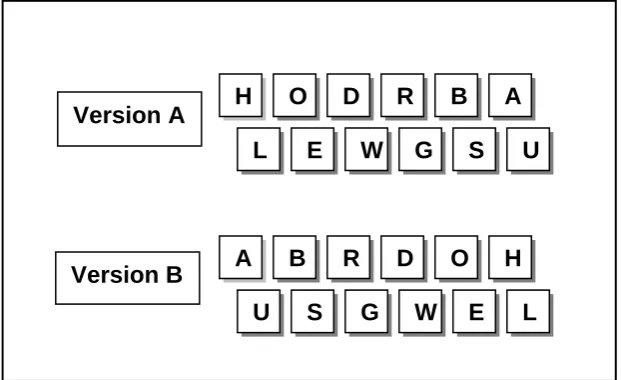
Figure 1. Keyboard layouts for both Version A and Version B in Experiments 1, 2 & 3...69
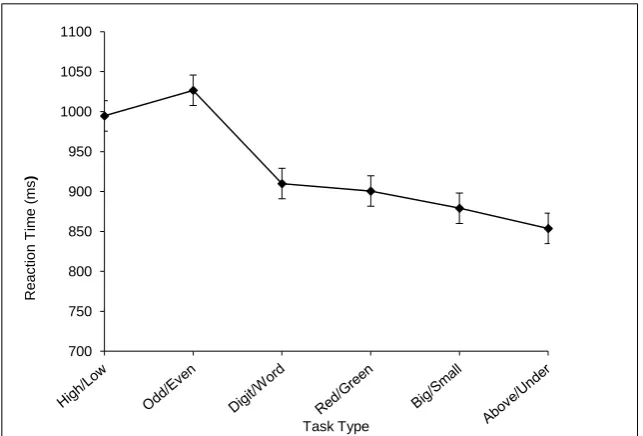
Figure 2. Mean reaction time (ms) and standard error for High/Low, Odd/Even, Digit/Word, Red/Green, Big/Small and Above/Under in the pilot study...70
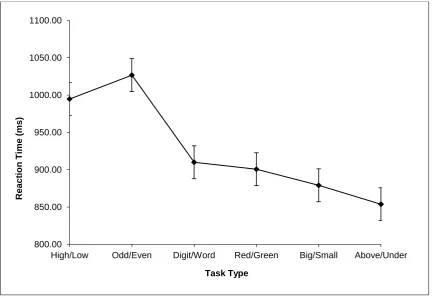
Figure 3. Mean reaction times (ms) and standard error for the single task condition...74
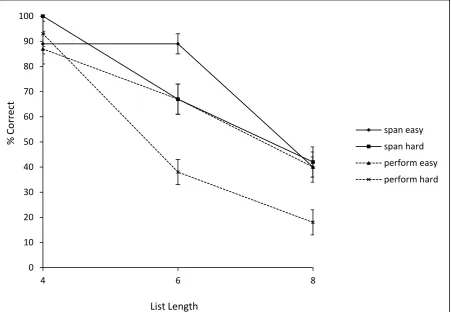
Figure 4. Proportion of 100 percent correct trials and standard error for memory span and perform conditions across List-Length and task difficulty...82
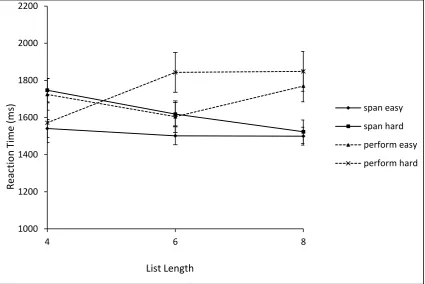
Figure 5. Mean reaction times (ms) and standard error for memory span and perform conditions across List-Length and task difficulty...85
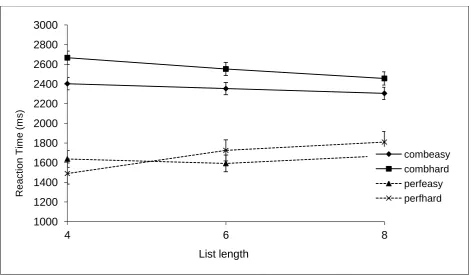
Figure 6. Mean reaction times (ms) and standard error for combined single task with memory span and perform conditions across List-Length and task difficulty...86
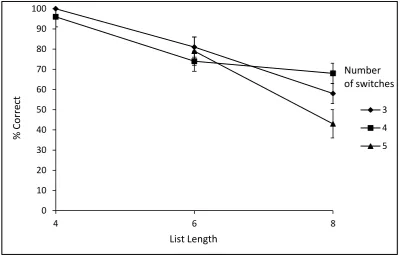
Figure 7. Proportion of 100 percent correct trials and standard error across the number of switches and List-Length for the memory span condition...109
Figure 9. Mean reaction times (ms) and standard error across the number of switches and List-Length for the memory span condition...112
Figure 10. Mean reaction times (ms) and standard error across the number of switches and List-Length for the perform condition...113
Figure 11. Mean reaction times (ms) and standard error across the number of switches and List-Length for the combined condition...116
Figure 12. Mean reaction times (ms) and standard error across the number of switches and List-Length for the perform condition...117
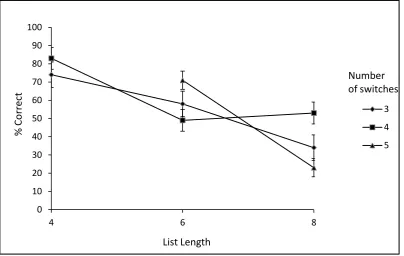
Figure 13. Proportion of 100 percent correct trials and standard error across the number of switches and List-Length for the memory span condition...140
Figure 14. Proportion of 100 percent correct trials and standard error across the number of switches and List-Length for the perform condition...141
Figure 15. Proportion of correct trials and standard error across the number of switches and List-Length for the span condition...143
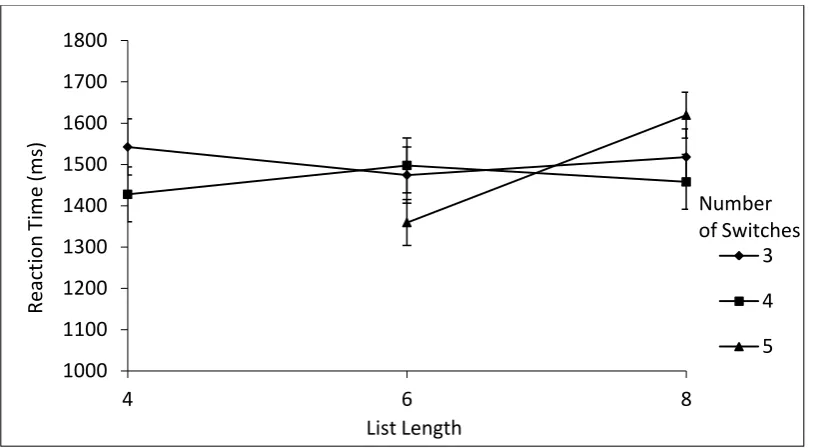
Figure 17. Mean reaction time (ms) and standard error for 100 percent correct trials across the number of switches and List-Length for the memory condition...147
Figure 18. Mean reaction time (ms) and standard error of 100 percent correct trials across the number of switches and List-Length for the perform condition...148
Figure 19. Mean reaction time (ms) and standard error for proportion of correct trials across the number of switches and List-Length for the combined memory and single task condition...150
LIST OF APPENDICES
We often need to remember information in an active, easily accessible form. These tasks are believed to involve working memory. The theoretical concept of working memory assumes that there is a limited capacity system, which temporarily maintains and stores information, and supports human thought processes by providing an interface between perception, long-term memory, and action (Baddeley, 2003; Jondies, Lacey & Nee, 2005; Logan, 2004). Thus, working memory is characterised as a highly interrelated ensemble of cognitive functions (Oberauer, Sub, Wihelm, & Wittman, 2003). The importance of working memory and its applicability to everyday tasks is well established, however, the more specific processes involved are less clear. Research suggests that there are three primary working memory functions: simultaneous storage and processing, supervision, and coordination of elements into structures (Buehner, Krumm, & Pick, 2005; Oberauer et al., 2003). In an
experimental setting, working memory is examined using a variety of span tasks in which participants are requiredto learn a list of tasks and recall or recall and use them after only a brief delay.
2004; Ericsson, Chase, & Faloon, 1980). In short-term memory tasks there are several ways to group items. These include temporal, rhythmic, and/or spatial structures which can be imposed either externally or by an individual’s internalized strategies.
More recently, research has examined the relationship between working
memory and task-switching. The ability to switch flexibly between tasks allows people to adapt to changing demands in the environment however task-switching comes at a cost. Switch costs reflect the control processes that are engaged when individuals switch between two competing tasks. Working memory tasks often require the flexible allocation of attentional resources and task-switching is a way of examining the role of attention on working memory (Bunting, 2006; Bunting & Cowan, 2005; Halford, Cowan & Andrews, 2007).The task-span procedure, developed by Logan (2004; 2007), was designed to specifically examine the relationship between working memory and task-switching. In this procedure, individuals are given a list of tasks to perform and then a series of stimuli to perform them on. The task-span procedure requires working memory to store the list of task names and keep track of progress through the list. It requires task-switching because successive tasks on the list are generally different. Although only an emerging field, examining the relationship between task-switching and working memory allows researchers to investigate the influence of cognitive control of attention on working memory.
This thesis aims to integrate and test theories of working memory, by
examining the role of attention on working memory and the current thesis aims to examine how these processes are linked. This thesis will review the most prevalent theories of working memory and the way in which working memory capacity is modulated by processing, organisational processes and task-switching.
1.1 Working Memory
Remembering a shopping list involves a series of steps and requires us to hold information in our mind and use it at the same time. We may group these items into various component categories, such as ingredients required for a dinner party, for the upcoming weekend, or items for a picnic. In addition, these items might involve several different perceptual subsets independent of conscious grouping or chunking i.e. fruits, vegetables, dairy, and meats. The items stored in memory need to remain activated and they may also require additional processing. For example, we might need to calculate the benefits of buying a product in a larger quantity. Thus, both storage and processing components are required to perform these tasks
simultaneously. Tasks such as these are believed to involve working memory.
The theoretical concept of working memory assumes that there is a limited capacity system, which temporarily maintains and stores information, and provides an interface between perception, long-term memory, and action (Baddeley, 2003; Jondies, Lacey & Nee, 2005; Logan, 2004). Thus, working memory is characterised as a highly interrelated ensemble of cognitive functions (Oberauer et al., 2003).
Carpenter, 1980; Just & Carpenter, 1992), mental arithmetic (Hitch, 1978), and problem solving (Engle, Tuholski, Laughlin, & Conway, 1999). Indeed, working memory has been closely linked to g, which reflects the component of variance that is common to all tests of cognitive ability (Colom, Rebollo, Palacios, Juan-Espinosa & Kyllonen, 2004). There is also a substantial body of evidence that proposes verbal working memory is vital to language acquisition whereby it acts to store unfamiliar sound patterns of words until more stable and long-term representations can be established (Duyck, Szmalec, Kemps & Vandierdonck, 2003). Collectively these findings underline the importance of working memory within the broader cognitive architecture.
memory as a system consisting of a store in the form of long-term memory traces active above threshold, processes for achieving and maintaining that activation, and controlled attention. These theoretical accounts suggest tasks that measure short-term memory should be distinguishable from, but related to, tasks that measure working memory. That is, because short-term memory is a subset of working memory, (i.e. working memory = short-term memory + attention), performance on short-term memory tasks should be related to performance on working memory tasks (Colom, Jung, & Haier, 2007). Working memory, as a whole, can be simply defined as the collective set of this activated information in memory (Cowan, 1995).
Activation is fragile and can be quickly lost through the operation of decay
(Barrouillet, Bernardin, Portrat, Vergauwe, & Camos, 2007; Cowan, 1995; Cowan, Wood, Nugent, & Treisman, 1997). Rehearsal allows these memory traces to remain active. When necessary, rehearsal can counteract decay, by refreshing activation (Cowan, Wood, Wood, Keller, Nugent, & Keller, 1998).
Working memory has been operationalised using a variety of techniques to examine the underlying processes involved. For example, early tasks required individuals to learn sequences of numbers (Miller, 1956; Ryan, 1968). In recent studies, attention has shifted towards more complex span tasks that involve not only short-term storage but also some processing component. Working memory span tasks, such as the counting span (Case et al., 1982; Conway, Kane, Bunting,
This section has briefly outlined the most basic aspects of working memory, the relationship between short-term memory and working memory, the
operationalisation of working memory and the relationship between working memory and other higher-order cognitive functioning. Working memory as a concept is far more complex than the simple definitions given here and the next section will
highlight how working memory is theoretically conceptualised by examining some of the most prevalent models of working memory.
1.2 A Theoretical Perspective: Models of Working Memory
complete system in itself with connections to other systems (e.g. Baddeley & Hitch, 1974) or 2) or those which conceptualise working memory as part of a larger
cognitive architecture that incorporates several aspects of higher order cognition (e.g. Lovett, Reder & Lebiere, 1997).
One of the first, and perhaps the most influential working memory model was devised by Baddeley and colleagues (Baddeley, 1986; 1992; Baddeley & Hitch, 1974). They proposed a three-component model of working memory that comprised an attentional control system, termed the ‘central executive’, and two subsidiary slave systems, the ‘phonological loop’ and the ‘visuospatial sketchpad’. The phonological loop is assumed to hold verbal information by using a temporary store and an articulatory rehearsal system. The sketchpad is assumed to hold visuospatial information and believed to be fractionated into separate visual, spatial and kinaesthetic components (Baddeley & Logie, 1999). The central executive is also assumed to have several components including focusing, dividing and switching attention (Baddeley, 1996; 2002; Baddeley, Emslie, Kolodny, & Duncan, 1998). More
recently, Baddeley (2000; 2002) introduced a new component to his original theory of working memory: an episodic buffer which is assumed to be a limited capacity
An alternative working memory model is the Embedded Process Model proposed by Cowan and colleagues (Cowan, 1999; 2001; Cowan, Elliot, Saults, Morey, Mattox, Hismjatullina, & Conway, 2005). Cowan (1999) suggested that three
components contributed to working memory. Working memory information comes from hierarchically arranged processes consisting of long-term memory, the subset of long-term memory that is currently activated, and the subset of the activated
component of memory that is currently in the focus of attention. He argued that attention is driven conjointly by voluntarily controlled processes and an involuntary attentional orienting system. The information in the current focus is the most readily accessible information in working memory. Information that is activated, although not to the extent of conscious awareness, can also be retrieved reliably, albeit with a slightly longer delay. Cowan (1999) argued that differing components of working memory, more specifically activation and storage, have different processing limitations. Essentially, attention is a limited capacity system such that only four chunks can be held in memory at any one time, whereas activation is time limited whereby activation of information within working memory will decay unless
reactivated through rehearsal (Cowan, 1999; Cowan, Day, Saults, & Keller, 1992).
Working memory can also be defined in terms of function, namely maintaining efficient selective access to information that is needed to complete a given task. Ericsson and Delaney (1999) suggested that working memory includes all the
complete a task. They argued that the amount of information that can be maintained in an accessible form for a specific task is not limited by a fixed capacity. Instead, they proposed that extended skill acquisition is necessary to achieve very high levels of performance, whereby ‘experts’ acquire knowledge and skills to rapidly encode information in long term memory. Ericsson and Delaney termed this phenomenon Long-Term Working Memory (LTWM) and argued that LTWM is mediated by
associative recall from long-term memory. It maintains access to memories based on temporal recency cues, an association to explicit retrieval structures, or on
associations to elaborate cognitive structures, generated during learning.
Furthermore, these structures may vary across individuals based on their available representations, knowledge, and preferred strategy. From this perspective,
individuals need to maintain selective access to relevant procedures in addition to information that is presented, retrieved and generated, by distinguishing it from a vast amount of other knowledge and procedures stored in long-term memory.
There are several models that view working memory as part of a larger cognitive architecture (Lovett et al., 1999; Kieras et al., 1999). Within these larger architectures, models are developed to explain more specific processes such as working memory. The Adaptive Character of Thought-Rationale (ACT-R) cognitive architecture proposes that information processing depends on the goal of the system (Anderson & Matessa, 1997; Anderson, Bothell, Lebiere, & Mattesa, 1998; Lovett et al., 1999). ACT-R theory suggests that there are two ways to define working memory in theoretical terms. Firstly, to equate working memory to content that is being
memory as a subset of declarative memory. Thus, working memory is not a specific system in itself, but instead declarative nodes are highly activated because they have been stimulated by the environment or are linked to current system goals (termed source activation). According to this definition, working memory consists of
mechanisms acting on declarative memory, learning decay, and attentional activation (Lovett et al., 1999).
Lovett et al. (1999) suggested that working memory can also be defined by the process that enables working memory elements to be maintained. This process-oriented definition of working memory suggests nodes in the highly activated subset of declarative memory receive an important part of their activation from the process that spreads the activation. Both definitions identify the basic mechanisms of working memory as a spread of source activation. This spread mostly affects nodes that are strongly linked to the goal and the general declarative mechanisms of learning and decay.
control store contains items that represent current task related goals, the steps and strategies required for goal completion, and the status of items which represent the current stages of completion of various processes. The tag stores, on the other hand, contain items that label other items in the modal (i.e. perceptual and motor) working memories. Such labelling assigns particular roles to modal working memory items referenced by the conditions and actions of production rules. Kerias et al. (1999) suggested that working memory encompasses the entire range of temporarily stored codes, knowledge representations and procedures where information is maintained, updated and applied for performing perceptual-motor and cognitive tasks. There are no limits on working memory per se; instead the limitation is caused by finite
processing speed and decay of symbolic codes in partitions of perceptual working memory.
The Soar model is another broader architecture which focuses on the functional capabilities needed for a memory system to support performance in a range of cognitive tasks (Newell, 1990; Young & Lewis, 1999). The functions of working memory are distributed across multiple components of the architecture, including long-term production memory (Young & Lewis, 1999). The Soar
architecture has no separate working memory mechanism as such (Young & Lewis, 1999) rather it is a production system architecture with two main memory
an impasse and sets up a substrate, processing of which is intended to produce information to allow processing of the original state to resume. New production rules are acquired whenever processing of a substrate generates information for the original state.
Despite the extensive and detailed theories of working memory, no single theory can explain all empirical evidence with adequate detail and without substantial modification. Many theories require the addition of a universal processor or ‘black box’ to explain complex results (i.e. Baddeley’s central executive or the Supervisory Attentional System). There are several key areas that remain contentious and require further empirical exploration. The most pertinent of these are the nature of capacity limitations and the influence of organisational structures on storage, the influence of processing on storage and the role of attention and cognitive control on working memory as examined through the relationship between task-switching and working memory.
1.3 The Nature of Working Memory Capacity Limitations and the Influence of
Organisational Structures on Storage
accounting for individual differences. More recent findings using a variety of stimuli have suggested that the capacity of this system, across stimuli, is more accurately represented as three to five items rather than Miller’s seven (Broadbent, 1975; Cowan, 2001; Mandler, 1975).
All theories of working memory assume that capacity is limited however they differ primarily in the assumptions they invoke to explain the limit. Some theories propose that a limited capacity for activation constrains the number of items that can be kept sufficiently active to be recalled (Anderson, Reder, & Lebiere, 1996;
Daneman & Carpenter, 1980; Just & Carpenter, 1992; Logan, 1978, 1979). Other theories assume that activation decays over time and only a limited number of items can be kept active enough to be recalled (Baddeley, 1986, 1996; Baddeley & Hitch, 1974; Cowan, 1995, 1999; Hitch, Towse, & Hutton, 2001). Still other theories assume that similar items interfere with each other, and this limits the number of items that can be kept sufficiently distinct from each other to be recalled accurately (Baddeley & Logie, 1999; see also, Cowan, 1999; Hasher & Zacks, 1988; Lustig Hasher & May, 2001; May, Hasher & Kane, 1999).
argued that the ability to store increasingly larger amounts of information in working memory was related to the sophisticated organisational strategies employed rather than a change in storage capacity. This process is known as chunking.
A chunk is a collection of concepts that have a strong association to one
another and much weaker associations with other chunks (Cowan, 2001). Chunking involves the reorganization of material into familiar or regular structures and can sometimes improve working memory performance (Bor, Cumming, Scott & Owen, 2004; Ericcson et al., 1980; Gobet, 2000). Gobet, Lane, Croker, Cheng, Jones, Oliver and Pine (2001) suggested that the literature can be divided into two broad areas based on how and when chunking is assumed to occur: the first assumes a
deliberate, conscious control of the chunking process (goal oriented chunking), and the second assumes a more automatic and continuous process of chunking during perception (perceptual chunking).
In serial recall tasks, Cowan (2001) proposed that people may be able to form multiword chunks rapidly when a list is presented. He suggested that there are
several ways in which this can occur, such as noticing that to-be-recalled information corresponds to elements in long-term memory (e.g. recoding the digit sequence 1-9-9-5 to 1995 as designating a particular year). Early work by Wickelgren (1964; 1967) found that rehearsing in groups of three items was optimal, irrespective of
Grouping through chunking can also occur using the temporal grouping
phenomena (Mclean & Gregg, 1967; Ryan, 1969). This effect arises when additional pauses are inserted in a presented list to form groups of items, for example, when a pause is placed between the 3rd and 4th, and 6th and 7th item in a nine digit list (Ng & Maybery, 2002). Early work by Ryan (1969) found that temporal grouping improved recall to a greater extent than non-temporal grouping. Further, regular patterns of temporal grouping (i.e. three clusters of four items in a list of 12 items) were significantly more accurate than irregular patterns of temporal grouping (i.e. three clusters of five, six and one item in a list of 12 items).This temporal grouping
phenomena has led some researchers to suggest that grouping is time dependent by assuming that positional information is retained by associating items with contextual information. In a series of experiments, Ng and Maybery (2002) varied the time between presentation of stimuli (stimulus onset asynchrony; SOA) to examine whether grouping is time-dependent. Lists of consonants were presented visually (with vocalization) in Experiment 1, auditorily in Experiment 2, and auditorily with articulatory suppression in Experiment 3. They found that forgetting was time-independent and that within-group temporal separation of items during presentation did not influence the pattern of error across all three experiments. Instead they argued that errors in performance and intrusion errors reflected within group/chunk serial position errors.
Similar results have been found by Hitch and colleagues (Hitch, Burgess, Towse & Culpin, 1996). In a series of experiments they examined the influence of
similarity on temporal grouping. Hitch and associates found that the temporal grouping effect on memory for visual sequences was removed by either articulatory suppression or reciting random digits; articulatory suppression however did not remove the temporal grouping effect for auditory lists. Hitch and colleagues concluded that the temporal grouping phenomenon is not critically dependent on rehearsal. Rather, temporal grouping has a role within the phonological loop
component of working memory. At a more general level, their findings suggested that the chunking of a sequence into familiar sub-sequences may consist of similar
underlying processes to temporal grouping. However, Hitch et al. suggested that chunking consists of more sophisticated processes than those involved in temporal grouping.
Previous research has found that associations between items can assist in immediate recall (Cumming, Paige & Norris, 2003; Hulme, Stuart, Brown & Morin, 2003; Stuart & Hulme, 2000). An alternative way to examine chunk length and
chunking is to impose associations on to-be-remembered material. A recent study, by Cowan, Chen and Rouder (2004) assessed the hypothesis that working memory capacity should include a constant number of separate mental units or chunks. They manipulated the influence of chunking by presenting novel pairs of words (A-B, C-D, E-F, etc.) and examined the effects of these paired associations on subsequent memory tests (serial and cued recall). In order to create chunks that varied in size between conditions, Cowan et al. used a training phase to manipulate the associative strength within word pairs. In serial recall, the previously studied pairs were
single-words or as pairs and varied in frequency of occurrence of the pairs (one, two or four paired presentations during a training period).
Cowan et al. (2004) found that although inducing associations between words increased the number of two-word chunks, the total chunk span (i.e. the number of singletons plus two word chunks) remained relatively constant. Further, they found that learned chunks are context specific such that they are bound in some way to correct serial positions. They concluded that the total number of chunks remained constant across association strengths and that working memory had a constant storage capacity. Thus, chunking capacity/chunk span and storage capacity may be relatively independent of one another. In other words, chunking capacity and storage capacity may rely on different underlying factors, or cognitive mechanisms and both may contribute to working memory capacity (Ottem, Liam & Karlsen, 2007).
neighbours, like cat and chair. Their findings demonstrated that forming episodic associations between words can implicitly mediate the association of other words from the same semantic categories and reveal a mechanism by which the semantic system contributes to the formation of new episodic associations (Silberman et al., 2005).
The question of whether immediate recall capacity is determined by either the number of chunks that can be recalled or by the length of the list of material to be recalled was examined by Chen and Cowan (2005). In their experiments, participants were required to learn new paired associations between words to create two word chunks. Each experiment had three phases: training phase, immediate recall, and free recall phase. Words during training were presented as either singletons or word pairs. Their results with free and serial recall of lists of different lengths indicated that chunk and length constraints occur under different circumstances. Performance in the free recall and serial recall conditions was similar for both the list of six learned pairs and six learned singletons as a chunk limit would suggest. In contrast, during serial recall, performance on a list of four learned pairs was very similar to
performance on a list of eight learned singletons. This is consistent with a List-Length limit and not the four singletons a chunk limit would suggest. They concluded that it is likely that these two limits can operate independently or together depending on task demands.
most theories of working memory agree that there is only a limited amount of information that can be held at any time, the nature of this capacity limitation is unclear. The question for capacity is whether capacity limits should be viewed simply from the perspective of a limited number of units of meaningful information that can be held in mind or as a combination of storage and organisational factors. This issue is further complicated by research that suggests that additional processing
requirements or the ability to effectively store information to perform a task influences working memory capacity. This ‘trade-off’ between processing and storage of
information will be examined in the next section.
1.4 The Influence of Additional Processing Requirements on Working Memory
Capacity: The Trade-Off Between Processing and Storage
Working memory and the temporary storage of information is often seen as an online process (Duff & Logie, 2001). As with all cognitive processing there is a
maximum capacity or limit. Some researchers have suggested that cognitive
Research examining the nature of the relationship between processing and storage has predominantly incorporated a dual-task methodology. A dual-task methodology usually involves an individual performing two tasks simultaneously and hinges on the idea that if two tasks can be performed simultaneously without
producing a substantial drop in performance or a trade-off, then the two competing tasks are believed to be independent (Duff & Logie, 2001). Vecchi and Cornoldi (1999) suggested that it is possible to distinguish between simple immediate memory tasks (storage tasks) and tasks involving both retention and manipulation of
information (processing tasks). Passive storage refers to retention of information that has not been modified after encoding, where encoding could be a response to
external stimuli, to long-term material, or result from mental manipulation by some other part of the cognitive system. Alternatively, active processing refers to the transformations and manipulations of stored information. The outcome of an active process may be retained in the passive store or determine an external output (Vecchi & Cornoldi, 1999).
There are several different techniques used to examine the relationship between storage and processing including comparing simple and complex span tasks (Daneman & Carpenter, 1980; Duff & Logie, 2001; Vecchi & Cornoldi, 1999), operation spans (McCabe, 2008; Turner & Engle, 1989; Unsworth & Engle, 2005), memory updating procedures (Morris & Jones, 1990) and more recently the task-span procedures (used in the current series of experiments; Logan, 2004; 2006). Despite substantial research conducted it is unclear whether performance on working memory span tasks are best described as a trade-off between processing and
separate processing and storage elements of a multicomponent model of working memory (Duff & Logie, 2001). This distinction between single capacity and multiple component models will be discussed at length in the next two subsections.
1.4.1 Support for a Single Capacity.
One of the most influential ideas about processing limitations is the hypothesis that the human cognitive system has a central limit that does not permit two
independent cognitive processes simultaneously (Byrne & Anderson, 2001; Oberauer & Gothe, 2006). Single capacity models suggest that working memory is a limited-capacity system in which resources are shared between processing and storage. Increasing cognitive load (the amount of resources needed to carry out a task) leads to a trade-off. Thus, performance decreases when the concurrent memory load increases, and any increase in difficulty of processing results in a loss of information from short-term storage memory (Anderson, Reder, & Lebiere, 1996; Case, Kurland, & Goldberg, 1982; Conway & Engle, 1994; Daneman & Carpenter, 1980; Just & Carpenter, 1992).
They found that whilst both simple and complex span tasks largely measured the same subcomponent processes i.e. rehearsal, maintenance, updating and controlled search, they differed in the extent to which these processes operated in a particular task. These findings suggest that a single capacity system is responsible for both processing and storage and that the decrease in performance in complex span tasks is due to additional requirements being placed on this processor.
Some theorists have proposed that the main difference between storage alone tasks and tasks that require both processing and storage is the benefit obtained from rehearsal during storage alone tasks (Colom, Rebollo, Abad, & Shih, 2006; Cowan, 2004). In complex tasks, the concurrent processing component of the task precludes rehearsal. Colom et al. (2006) argued that there was a general component for
maintaining information in an active and reliable state and that this was determined by the efficiency of working memory. Additional processing requirements lower the reliability of temporarily stored information given that these processing requirements take away a proportion of the capacity used for temporary maintenance. Colom and associates suggested that concurrent processing requirements leave less capacity for temporary storage of information. This diminishes the reliability of the stored information, which in turn leads to a greater number of errors.
colours. In their first experiment, the colour of the cue matched the cued items 75 percent of the time. They found that the rare mismatch (25 percent of the time) impaired recall of items on the list. Expanding on this in a second experiment, Bunting and Cowan (2005) changed the proportion of accurate cues to only 25 percent of trials. They found that when the cue-stimulus mismatch was more
frequent, the influence of the mismatch was removed. They argued that these results were difficult to reconcile with a passive storage mechanism alone; they proposed that attention serves as a form of memory storage and that processing difficulty (in terms of a colour mismatch) can impede working memory recall, due to drawing attention away from a storage function.
A series of studies have demonstrated that the attentional resources allocated to the maintenance of information is modulated by both duration of task and cognitive load (Barrouillet, Bernardin, & Camos, 2004; Barrouillett, Bernardin, Portrat,
Vergauwe & Camos 2007; Barrouillet & Camos, 2001; Gavens & Barrouillet, 2004). Barrouillett et al. (2007) found time is one of the main determinants of cognitive load and mental effort and the effect of concurrent activities on recall did not go beyond their duration when the processes were attention demanding. Further, spatial processing disrupted verbal maintenance suggesting that these findings were not modality specific. They proposed a sequential and time-based function of working memory in which processing and storage relied on a single and general purpose attentional resource to run executive processes devoted to constructing, maintaining, and modifying representations (Barrouillet et al., 2007).
and verbal information may be encoded in two different stores, there is a central capacity system that is responsible for processing. Some theorists have proposed that working memory capacity is limited by a central processing bottleneck (Oberaur & Kliegl, 2001; 2004). These theories suggest that there is a seriality constraint on processing that implies that domain specific subsystems of working memory cannot easily operate independently, even on very simple tasks (Baddeley, 1986). Oberaur & Kliegl (2004) examined this proposal by using working memory updating task (Oberaur & Kliegl, 2001; Salthouse, Babcock & Shaw, 1991) in which participants were asked to hold two items (one digit and the spatial position of a dot) in memory and to update them both numerous times according to simple rules. They found that without practice, individuals experienced significant dual-task costs when they executed two cognitive operations in working memory, even though the operations were highly different and were applied to representations from different domains. They suggested that there are constraints on processing in working memory that go beyond the limited capacity for maintenance. Although four independent chunks can typically be maintained in working memory at any time (Cowan, 2000; Halford, Wilson, & Phillips, 1998), manipulating even two of them at the same time is difficult and may be impossible without practice for most people. However when a dual-task combination of tasks was practiced, they found that two tasks could be combined with little associated cost. The same did not apply when the two tasks were practiced independently.
of a cognitive operation. Since the focus of attention is the gate for inputs to cognitive operations, its limitation to a single mental object implies a constraint on cognitive operations. Only one operation can be performed at any time, that is, only the object within the focus of attention can be manipulated. The dual-task costs seen at the beginning of practice trials (Oberauer & Kliegl, 2004) support this assumption. However, after practice, most participants are able to perform these cognitive operations in parallel with little or no dual-task costs. Theories assuming a central bottleneck (Byrne & Anderson, 2001; Oberauer, 2002; Pashler, 1994a) have difficulty explaining the influence of practice. Single resource models could add a functional bottleneck for cognitive operations in working memory (a strong constraint enforcing serial processing) but one that can be overcome by learning to combine the two tasks efficiently. The constraint lies not in a rigid cognitive architecture but in a flexible configuration of the cognitive system for scheduling central operations (Oberauer & Kliegl, 2004).
Most experiments examining the relationship between storage and processing focussed on either manipulating the amount of information held in working memory or the modality of the additional processing task (i.e. when a verbal storage task is combined with a verbal processing task as compared to a visual processing task). There are relatively few studies that have manipulated the load of the processing task. Those that have, found mixed results. For example, Conway and Engle (1996) suggested that processing task complexity was only important when it was
words recalled did not. Thus, processing difficulty had little influence on performance whereas the attention switching was a critical determinant of span.
In contrast, Bunting (2006) found that increasing attentional demand made the primary task more difficult to perform. He examined the role of processing difficulty in working memory span. He manipulated the ease of processing in order to have minimal processing load while still preventing overt rehearsal. The memory tasks were the Operation Span (OSPAN; a storage plus processing task) and Probed Recall (PR; a storage only task), and the criterion task was Raven’s Progressive Matrices (RAPM). OSPAN processing difficulty was minimized in a way that removed the demand of solving math equations while still preventing rehearsal. Task difficulty was manipulated in PR with the addition of easy and difficult distractor tasks. Bunting (2006) deduced that increasing attentional demand in the probed recall condition made the primary task more difficult to perform. This suggested that there was
increasingly less room for storage as processing demands increase. Thus processing difficulty is important in dual-component working memory tasks and determines individual differences in working memory.
Kemps (1999) found that visuospatial span was susceptible to both measures of complexity. Performance decreased as the number of blocks increased and recall was better when the blocks were positioned in a matrix rather than in a random fashion. She suggested that the effect of complexity was moderated by the
interaction between structure and amount of information presented. These results demonstrated that both the quantity and complexity of information influenced the amount of information recalled from visuospatial working memory.
Oberauer and Gothe (2006) investigated dual-task interference between processing and storage tasks by comparing short-term storage of numerical and spatial material and the execution of numerical and spatial operations. They conducted two experiments using a working memory updating task and asked participants to memorise a set of digits and a set of spatial positions, update
Historically, single capacity theories have considered processing and storage to be separate dimensions that load on a unitary processing resource. However, more recently a hybrid theory has been suggested that processing and storage was not merely determined by the amount of information and the addition of a processing task, but also by the complexity of both the processing and storage task and the relationship between the two. From this perspective, processing and storage are innately linked and that working memory capacity is determined by the complexity of relations that can be processed in parallel (Halford et al., 1998). The processing load imposed by interacting components of a task can be captured with the concept of relational complexity. Thus, the task becomes more complex as the number of
interacting factors increases. This complexity can be measured by the dimensionality of the relation or the number of related variables.
Halford et al. (1998) suggested that the processing complexity of a task is related to the number of interacting variables that must be represented in parallel to perform the most complex process involved in the task, using the least demanding strategy available to humans for that task. Processing complexity can also vary over time within one task, hence the critical value is the complexity of the most complex step. Tasks can vary in the number of steps they require, but this does not
“demand” or “load” and performance. More resources must be allocated to higher demand tasks to maintain performance (Halford et al., 1998).
More recently, Halford and colleagues (Halford et al., 2007) suggested that working memory and reasoning share the same related capacity limits. These limits are quantified in terms of the number of items that can be kept active in working memory, and the number of interrelationships between elements that can be kept active in reasoning. The latter defines the complexity of reasoning problems and the processing loads they impose.Working memory is limited to 3 and 4 chunks, and reasoning is limited to relations between four variables. One potential hypothesis is that both working memory and reasoning require items or concepts to be the focus of attention concurrently. This would enable them to be inter associated to form chunks or bound into coordinate systems, including relational representations that enable inferences to be made (Halford el al. 2007). From this perspective optimal learning of information requires the reduction of complexity of information to a level that does not exceed capacity (Elman, 1993).
Theories that support a single capacity suggest a general processing system is responsible for both processing and storage of information in working memory. They draw on findings from research that has found that when additional processing of information in working memory is required, storage capacity is reduced. More recently, theories have proposed that there is an attentional resource or buffer which is involved in the modification of information. Single capacity theories, however, only account for part of the findings in the literature. Numerous studies have found that there is indeed minimal or nil trade-off between storage and processing.
Consequently, alternative accounts have proposed that there are multiple components within working memory which will be discussed in the next section.
1.4.2 Theories that Support Multiple Components
The relative lack of dual-task disruption seen with particular task combinations has been linked to the operation of a multiple-component working memory system thought to offer online processing and temporary storage of information by means of a number of specialized cognitive functions (Baddeley, 1986; Baddeley & Logie, 1999). Within a multiple component model, each task is believed to draw specialized resources for visuospatial and verbal processing and storage (Baddeley et al., 1991). This perspective proposes that it is the types of tasks combined rather than the overall cognitive demand of the dual-task requirement that determines performance reduction in working memory (Cocchini et al., 2002).
& Cowan, 2007; Towse, Hitch, & Hutton, 2000). Cocchini et al. (2002) conducted two experiments, in which participants were required to perform pairwise combinations of a verbal memory task or a visual memory task with either a perceptuomotor tracking task (Experiment 1) or an articulatory suppression task (Experiment 2). They found minimal disruptions when two tasks were combined. Interestingly, there was a drop in accuracy when articulatory suppression was combined with a verbal memory task but not with the visual memory task. Based on these findings, Cocchini et al. concluded that a multiple component working memory model provided a better account of performance in concurrent immediate tasks than either models that assume a single capacity system for processing and storage or a limited capacity attentional system combined with active memory traces.
Duff and Logie (2001) conducted two experiments that examined the nature of working memory involved in span tasks using a version of the sentence span task (Daneman & Carpenter, 1980). In Experiment 1, participants verified sentences to determine whether the sentence was plausible and remember the final word of each sentence for later serial recall. Before the combined task, participants were required to perform each component of the task on its own. They found an overall decrement in both memory span and verification span when these tasks were performed
a small drop in performance in the combined task condition. They suggested that overall their results supported the multiple component models and argued that the central executive coordinates combined task performance as well as dealing with processing. The overall drop in performance on the two tasks can be attributed to an increase of load imposed on the executive by coordination. The alternative, from the single resource perspective, is that if both the processing and storage demands stretch working memory to its limits, then combining the task elements should result in a substantial drop in performance, greater than that observed in the experiments.
long-final list. Overall, both lists had the same processing requirements, thus the only difference between the two was the temporal structure.
More recent research has contradicted the findings of Towse et al. (2000) by distinguishing between mechanisms involved in forgetting and storage/maintenance. Maehara and Saito (2007) used the stimulus order effect in addition to the processing time effect to examine the specific predictions from the representation-based
interference account of working memory span. The representation-based account suggests that the nature of the material used in processing and storage episodes is critical in determining the magnitude of the stimulus order effect due to the
interference of similarly attributed representations. They found that when items were from the same domain, the representations generated during the processing tasks interfered with the memory representations. Further, they found that the processing time effect in verbal-verbal and spatial-spatial working memory span tasks was consistent with the prediction of the representation-based interference account. However, inconsistent with the representation-based interference account they also found a processing-time effect in the verbal-spatial and spatial-verbal working memory span task. These results suggested that forgetting mechanisms in the working memory span tasks were domain specific. They also argued that storage or maintenance activities require attentional control and seem to involve
single and multiple capacities. Thus, the ability to recall information is domain specific but there is a central processor that is influenced by processing time.
Despite extensive research into the relationship between processing and storage there is little consensus on whether both activities are performed by a single mechanism or multiple mechanisms. Although most studies acknowledge that there is at least a small dual-task decrement, the underlying reasons may be due to the difficulty in coordinating processing and storage requirements (multiple component theories) or due to additional processing demands on a single capacity system
(single component theories). What is clear regardless of theoretical orientation, is the importance of attention. Attention is central to both central resource and multiple capacity theories as is the concept of cognitive control. This will be discussed in detail in the upcoming section.
1.5 Task-Switching and Working Memory and its Relationship to Cognitive
Control
A student sits in his room writing his doctoral thesis; he is thinking about the next three papers he needs to include in his literature review. He finishes a sentence and realises that he has misplaced one of the papers he needs to reference. He starts searching through the mess that is on his desk. His phone rings; it is a friend discussing plans for later that evening. In this example, there are numerous
resources between tasks and reflects a load on cognitive control (also referred to as executive control; Logan, 2003); processes that control and coordinate skills, allows one to choose among tasks, monitor and adjust performance, and change tasks if required. These processes are also said to involve working memory.
Before examining the relationship between task-switching and working memory, it is important to understand the processes involved in switching between tasks. The ability to switch flexibly between tasks allows people to adapt to changing demands in the environment (Logan, 2003). However, task-switching comes at a cost. Switching set takes time and produces interference, as is evident in a variety of procedures that compare performance when tasks change, with performance when tasks remain constant (Allport, Styles, & Hsieh, 1994; Gopher, Armony, &
Greensphan, 2000; Logan & Bundesen, 2003; Rogers & Monsell, 1995). The measurement of ‘switch costs’ is of interest because it may reflect the control processes that are engaged when individuals switch between two competing tasks. In task-switching experiments, the reaction time (RT) switch cost is typically
measured as the difference in RT between switch and non-switch (repeat) trials (Wylie & Allport, 2000).
reconfiguration (TSR), a change in set that must occur before task-specific processes can proceed. This can include shifting attention between stimulus attributes or
between conceptual criteria and retrieving information regarding task demands (Monsell, 2003). Transient task-set inertia refers to the carry over effect (or residual cost) of task-set activation from trial to trial. Evidence for this is seen in slower
responses on the last trial of sequence A, B, A versus sequence C, B, A (Mayr, 2002; Mayr & Keel, 2000). Finally, associative retrieval refers to the fact that even when performing only one task, responses are slower if individuals have performed another task afforded by the same stimuli in the previous few minutes. This has been
attributed to associative retrieval of task-sets that are associated with the stimulus (Monsell, 2003).
once. In a second experiment, Rubin and Merian (2005) examined the influence of working memory demands on mixing costs by adding stimulus-response rules. They aimed to load working memory in a manner that did not result in an increase in ambiguity. They found that holding different task sets in working memory did not influence mixing costs. This suggested that the transient competition between task sets during set selection is a critical factor in controlling task sets and thus contribute to mixing costs, whereas working memory demand did not (see also, Kray &
Lindenberger, 2000; Los, 1996; Meiran, Chorev, & Sapir, 2000).
Working memory and task-switching are explicitly linked and require the flexible allocation of attentional resources. Several models of working memory have acknowledged the importance of attention (Baddeley, 2000; Cowan, 2005; Lavie, & De Fockert, 2005; Lavie, Hirst, De Fockert, & Viding, 2004). These include the episodic buffer introduced by Baddeley (2000) as an adjunct to his working memory model and Cowan’s (2005) postulation that an individual’s attention is flexible and can adjust from holding a single task goal to holding up to four objects or chunks of independent information. Several accounts assume that reconfiguration of
information only involves processes that operate on working memory: changing the content of working memory is sufficient to change performance (i.e. changing goals and changing stimulus-response mapping rules; Mayr & Kliegl, 2000; Rubinstein, Meyer, & Evans, 2001; Sohn & Anderson, 2001). Other researchers argue that reconfiguration involves both processes outside of and within working memory. Changing goals is not sufficient; the subordinate processes must also be
is, switch costs reflect interference from past task sets or past associations to the stimuli under different task sets (Allport et al., 1994; Allport & Wylie, 2000). Although only an emerging field, examining the relationship between task-switching and working memory allows researchers to investigate the influence of cognitive control of attention on working memory.
Several studies have found that advanced preparation for an upcoming task reduces the magnitude of switch costs (Altmann, 2004; Mayr & Kliegl, 2000; Yeung & Monsell, 2003). Mayr and Kliegl (2000) examined the processes used to prepare for an upcoming task set. The main goal of their study was to specify and test the hypothesis that long-term memory retrieval is associated with task-switching and specifically with the proactive reconfiguration component. To achieve this, they made inferences about switch-related processes through specific interactions between the switch manipulation and manipulations of primary task demands. Specifically, they predicted that switch costs would increase as a function of primary-task retrieval demands. Overall, the results from this series of experiments suggested that the retrieval-demand effect on switch costs was specifically associated with the
preparatory switch component. Mayr and Kliegl (2000) suggested that switch costs were larger when the switched-to task itself entailed high long-term memory retrieval demands (i.e. episodic retrieval) than when long-term memory retrieval demands were low (i.e. semantic retrieval). They concluded that the retrieval demand effect was selectively eliminated when people were allowed sufficient time for preparation. Thus, long term memory retrieval can be associated with the proactive or
Expanding on previous research, Mayr and Kliegl (2003) proposed that two distinct, serial processing stages are critical during changes of task configurations. The first stage is associated with cue-driven retrieval of rules for upcoming task demands from long-term memory into working memory (i.e. retrieval stage). The retrieval stage can be triggered through any internal or external signal and it can be anticipated before the response relevant stimulus appears. The second stage is linked directly to the actual stimulus rather than to the task cues. During this stage, task rules are applied in a relatively automatic manner once the stimulus is
presented.
To examine the distinction between these two stages, Mayer and Kliegl (2003) used the information reduction method. The key element of the information-reduction paradigm, as applied to the task-switching situation, is a 2:1 mapping between cues and tasks. When tasks can be accessed through more than one cue, three different types of trial-to-trial transitions are possible: (a) the task set and the cue stay the same (which is the usual no-switch condition); (b) a task switch is accompanied by a cue switch (which is the usual switch condition); or (c) a task set is repeated across successive trials, but the cue changes. They found that a large proportion of total switch costs was due to cue changes. Further, they found cue-switch costs but not task-switch costs were sensitive to effects of both practice and preparation. In
process that requires the application of active task rules to a stimulus and is indexed by the additional cost observed when both cues and tasks changed.
Central to the influence of task-switching on working memory is the role of sequencing. The coordination of multiple processes in a sequence plays an important function in understanding cognitive control (Schneider & Logan, 2006). Hierarchical control is present in the relationship between the sequence level (the representation of the task sequence and the processes that act on it) and the task level (the
representations of the individual tasks and their component processes). Neither need hierarchical control in themselves but the relationship between the two needs to be hierarchical whereby the sequence level determines what happens at the task level.
sequences, that is, the point at which sequence-level processes are likely active in the initiation and maintenance of a hierarchical control structure in working memory. They concluded that complex patterns of behaviour often unfold according to plans and that hierarchical control of cognitive processes is involved in experiments requiring the performance of explicit, memorized task sequences.
An important factor in separating the cost of performing a task-specific switching program from that of maintaining it is offered by the distinction between endogenous (where the person needed to remember to switch) and exogenous control (where there was an obvious cue to switch; Rogers & Monsell, 1995). When a switch is signaled by a well-learned external cue then there is presumably no need to hold a task-specific program. The difference between the endogenous and
exogenous conditions should be in the cost of maintaining and operating such a task-specific program (Baddeley, Chincota & Aldam, 2001). Diverting attention from one task to another is part of a larger system of cognitive control. The capacity to store and operate a complex program or set and the capacity to switch tasks are in theory, separable issues (Baddeley et al., 2001).
Baddeley et al. (2001) used a simple list based task-switching paradigm. The baseline condition used an exogenously cued version to study the process of
a central executive component. The second type of interference was most strongly associated with articulatory suppression, it had little impact on the blocked arithmetic condition but had a relatively clear effect in the switching condition. They suggested therefore that highly automatic verbal tasks such as simple articulatory suppression, or a well-learned response sequence such as counting, blocked the operation of the phonological loop while incurring minimal attentional demands. However, retrieval tasks that are attentionally demanding impacted on the capacity both to access simple number facts at speed and to retrieve the necessary operations involved in using an action control program.
suggested that task-switching interfered with the maintenance of items in working memory because during switch trials, attention was occupied for a certain amount of time without the opportunity for compensatory activities. Consistent with previous research (Barrouillelt et al., 2004; 2007) switching interfered with maintenance of tasks and decaying memory traces could not be refreshed. Liefooghe and colleagues (Liefooghe et al., 2008) concluded that the effect of task-switching on concurrent maintenance of information in working memory did not necessarily rely on specific task reconfiguration processes but instead from a combination of simple and more fundamental attention demanding processes.
Despite the significant amount of research in this area, the relationship between working memory and task-switching remains unclear. What does seem apparent is that working memory tasks often require the flexible allocation of attentional resources. Given the importance of attention it may be that drawing attention away from a task will compromise performance and may account for switch costs. The research outlined here is somewhat limited by the types of methodology employed. The task-switching studies that have examined the nature of capacity limitations, processing and storage, and the relationship between task-switching and working memory have generally used separate tasks that have been performed in parallel. The task-span procedure (Logan, 2004) offers an alternative integrative approach to examining the relationship between task-switching and working memory. This will be discussed in detail in the next section.
1.6 Working Memory, Task-Switching and the Task-Span Procedure
The task-span procedure, developed by Logan (2004; 2007), was designed to examine the interaction between working memory and task-switching. In this
procedure, individuals are given a list of tasks to perform and then a series of stimuli to perform them on. The task-span procedure requires working memory to store the list of task names and keep track of progress through the list. It requires
In Logan’s work, the task-span procedure involved three tasks that could be performed on numbers that were presented either as digits (e.g. 3) or words (e.g. nine). The three tasks were magnitude judgments (i.e. is the number greater than or less than 5), parity judgments (i.e. is the number odd or even), and form judgments (i.e. is the number a digit or a word). Task name reflected the alternative decisions within each judgment and each was mapped onto responses keys. Thus, Hi-Low was the name for the magnitude task, Odd-Even was the name for the parity task, and Digit-Word was the name for the form task. Participants were given lists of 1-10 task names. The lists were constrained so that each task was usually different from the one before it and the one after it. Consequently, individuals were required to switch tasks before performing each judgment. The names on the list were presented one at a time and followed by target stimuli that were presented one at a time. There was one target for each name on the list. The target stimuli were the digits 1, 2, 3, 4, 6, 7, 8, and 9 and the words one, two, three, four, six, seven, eight, and nine. As is typical in studies of task-switching, these stimuli were ambiguous, such that all three tasks could be performed on each of the stimuli. This stimuli was then used to contrast memory span condition where individuals were given lists of task names followed by cues to recall the names to the perform condition where participants were given lists of task names followed by lists of stimuli on which to perform the task.
condition, individuals were given lists of task names followed by cues to recall the names. The perform condition used the task-span procedure where participants were given lists of task names followed by lists of stimuli on which to perform the task. Logan (2004) found that recall accuracy was equivalent between the perform and memory span conditions suggesting that there was no trade-off between processing and storage. Further, reaction times were slower in the perform condition than in either the recall or the single-task conditions. Reaction times in the perform condition were slower than the sum of reaction times in the recall and single-task conditions. He attributed this to switch costs and suggested that the perform condition required an extra process beyond those required in the recall and single-task conditions. He concluded that these results were inconsistent with theories of task-switching which assume that changing goals in working memory is sufficient to enable a new task set and consistent with theories which assume that subordinate processes must be reconfigured.
time data could be explained by chunking. Individuals performed the task-span procedure with either consistent or varied lists. With consistent lists, they saw the same list of tasks for 10 consecutive study-test trials before proceeding to the next list. Under these conditions, they were expected to learn the sequence of tasks on each list in order to retrieve the next task directly from long-term memory, without having to retrieve chunks from working memory. With varied lists, individuals saw a different list on each study-test trial so they could not benefit from learning previous lists. Logan (2004) found that the scalloped pattern in function relating reaction times and list position appeared only in the varied-list condition and he argued that this supported the chunk retrieval hypothesis.