Executive Functions in Early Adulthood: Data for the
Controlled Animal Fluency Test
Jacqueline Evans-Barker
BSc. (Psychology) (Hons)
A thesis submitted to the School of Social Sciences and
Psychology as part of the requirements for the degree of
Doctor of Psychology (Clinical Neuropsychology)
Victoria University
DECLARATION
I, Jacqueline Evans-Barker, declare that the Doctor of Psychology (Clinical Neuropsychology) thesis entitled “Executive Functions in Early Adulthood: Data for the Controlled Animal Fluency Test” is no more than 40,000 words in length, exclusive of tables, figures, appendices, and references. This thesis contains no material that has been submitted previously, in whole or in part, for the award of any other academic degree or diploma. Except where otherwise indicated, this thesis is my own work.
Signature:……….
DEDICATION
ACKNOWLEDGEMENTS
I would like to acknowledge the following people, without whom this thesis would never have been completed:
My supervisor Dr Alan Tucker, I really can’t thank him enough. Alan’s support, guidance, and understanding kept me going through some very difficult times, whilst his knowledge and genuine love of neuropsychology has inspired me in my career. Alan has been my teacher, supervisor, and mentor and I look forward to continuing our association well into the future.
To all my wonderful participants who were so generous with their time, not to mention cups of coffee. I thank them and admire them for their openness and willingness to help a relative stranger.
I thank my husband Michael for his love and support and for just being him.
My beautiful daughter Bridgette who is my greatest source of motivation. I hope that me completing this thesis shows her that she can achieve anything.
Fellow members of the 2006 Victoria University Doctoral class, thank you for your friendship.
To Leonie Darch who has been so supportive and helpful throughout my time
at VU.
Thank you to my Psychologist colleagues at Ballarat Health Services for their positivity and encouragement and to my Clinical Manager Kylie McKenzie and to the “big boss” Wendy Hubbard for approving lots of study leave.
TABLE OF CONTENTS
DECLARATION i
DEDICATION ii
ACKNOWLEDGEMENTS iii
TABLE OF CONTENTS iv
LIST OF TABLES viii
LIST OF FIGURES ix
LIST OF APPENDICES x
ABSTRACT xi
CHAPTER 1. EARLY ADULTHOOD: DEVELOPMENTAL CONTEXT 1
1.1. Executive Functions 2
1.1.1. Brain regions / systems and executive functions 3 1.1.2. Individual differences in neural mechanisms 6
1.2. Theories of Executive Function 8
1.2.1. Lezak 8
1.2.2. Barkley 9
1.2.3. The unity / diversity framework of executive function 12 1.3. Relationship Between Executive Functions and Other Cognitive
Functions
13
1.3.1. Intelligence 15
1.3.2. Working memory 18
1.4. Relationship Between Executive Functions and Non-Cognitive Factors
21
1.4.1. Age 21
1.4.2. Education level 23
1.5. Executive Functions in Early Adulthood 26
1.5.1. Brain injury 26
1.5.2. Mental illness 28
1.6. Assessing Executive Functions 30
1.7. Verbal Fluency Tests of Executive Function in Clinical Practice 32
1.7.1. Phonemic verbal fluency 35
1.7.2. Semantic verbal fluency 36
1.8. The Controlled Animal Fluency Test 39
1.8.1. CAFT performance in late adulthood 40
1.8.2. CAFT performance in early adulthood 41
1.9. Rationale for the Current Study 43
1.10. Aims and Hypotheses 44
CHAPTER 2. METHOD 46
2.1. Participants 46
2.2. Assessment Instruments 46
2.2.1. Interview protocol 46
2.2.2. Executive function 47
Controlled Animal Fluency Test 47 Controlled Oral Word Association Test 48
Trail Making Test 48
2.2.3. Intellectual functioning 48
Wechsler Abbreviated Scale of Intelligence 48
2.2.4. Attention and working memory 49
Digit Span (WAIS-IV) 49
CHAPTER 3. RESULTS 51
3.1. Data Analysis 51
3.2. Demographic Data 51
3.2.1. Gender 52
3.2.2. Language background 53
3.3. Scores for All Dependent Variables 54
3.4. Tests of Hypotheses 55
3.4.1. Hypothesis one 55
3.4.2. Hypothesis two 55
3.4.3. Hypothesis three 56
3.4.4. Hypothesis four 56
3.4.5. Hypothesis five 56
3.4.6. Hypothesis six 57
3.5. Regression Analysis of Cognitive Variables on CAFT Conditions 57 3.5.1. Regression analysis of cognitive variables on CAFT Auto 58 3.5.2. Regression analysis of cognitive variables on CAFT Size 58 3.5.3. Regression analysis of cognitive variables on CAFT
Alphabet
58
3.6. Controlled Animal Fluency Test Normative Data 59
CHAPTER 4. DISCUSSION 60
4.1. Hypothesis One 60
4.2. Hypothesis Two 62
4.3. Hypothesis Three 64
4.4. Hypothesis Four 65
4.5. Hypothesis Five 66
4.6. Hypothesis Six 67
4.8. Strengths and Limitations 70
4.9. Future Directions 72
4.9.1. Demographic issues 72
4.9.2. Cross cultural issues 73
4.9.3. Modern theories of intelligence 73
4.9.4. Neural mechanisms underlying CAFT performance 74
4.10. Conclusion 74
LIST OF TABLES
Table 1.1
Regional Frontal Lobe Specialisation in Neuropsychological Processes
5
Table 1.2
Neural Mechanisms of Executive Function and Their Contribution to Cognitive and Affective Domains
7
Table 1.3
Executive Function Component and Associated Measures
31
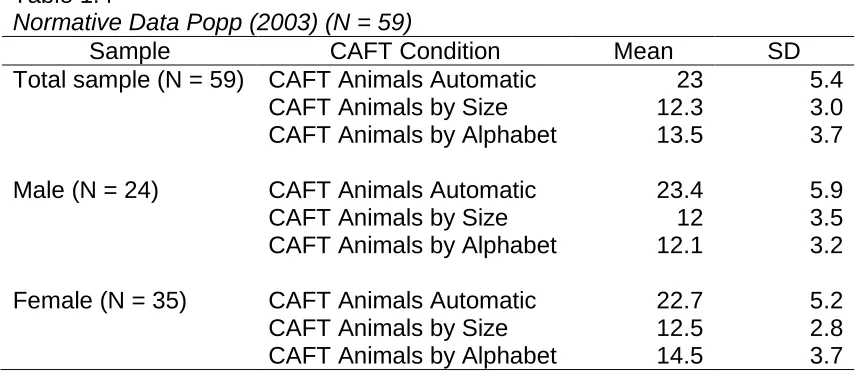
Table 1.4
Normative Data Popp (2003)
43
Table 3.1
Overall Sample Demographics
52
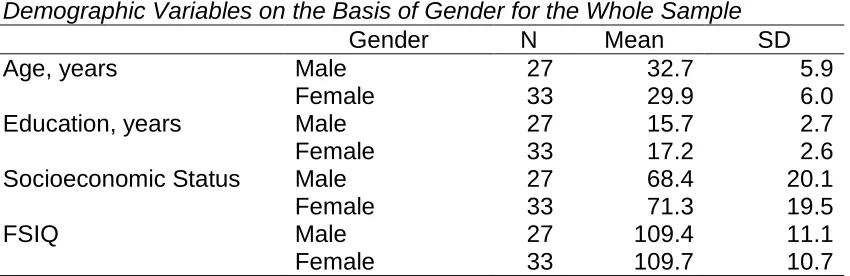
Table 3.2
Demographic Variables on the Basis of Gender for the Whole Sample
52
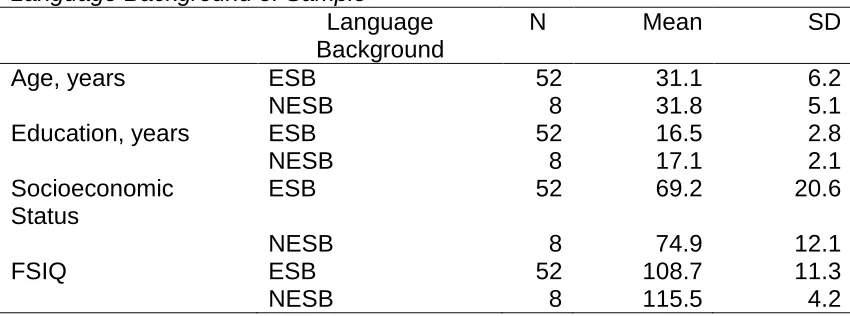
Table 3.3
Language Background of Sample
53
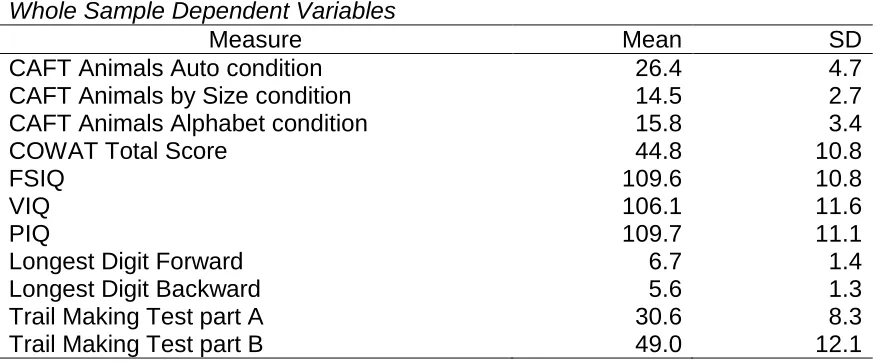
Table 3.4
Whole Sample Dependent Variables
54
Table 3.5
Correlations Between the CAFT and FSIQ
55
Table 3.6
Correlations Between the CAFT and Demographic Variables
56
Table 3.7
Controlled Animal Fluency Test Normative Data
LIST OF FIGURES
Figure 1.1.
Barkley’s theoretic model of executive
11
Figure 1.2.
The Unity / Diversity framework of executive function
13
Figure 1.3.
Baddeley’s model of working memory
LIST OF APPENDICES
APPENDIX A
Interview Protocol
87
APPENDIX B
Controlled Animal Fluency Test (CAFT) Instructions
89
APPENDIX C
Controlled Oral Word Association Test (COWAT) Instructions
91
APPENDIX D
Trail Making Test (TMT) part A and part B
93
APPENDIX E
Research Ethics Approval by Victoria University Human Research Ethics Committee
99
APPENDIX F
Information to Participants Form
101
APPENDIX G
Consent Form for Participants
ABSTRACT
Assessment tools that accurately assess executive functions in early
adulthood are important for clinical practice, particularly given factors that can affect the executive functions, such as brain injury and mental illness, are relatively common during this developmental period. The aim of the current study was to investigate a more recently refined measure of executive
function, the Controlled Animal Fluency Test (CAFT) in a non-clinical sample of young adults. Relationships between performance on the CAFT and other executive measures and cognitive measures were examined along with the relationship of CAFT measures to demographic factors. Further normative data for the CAFT for young adults were also obtained. Sixty individuals (27 male & 33 female) aged 19 to 40 years (M = 31.2 years, SD = 6.03)
participated. They were screened for brain injury, serious illness,
neurodevelopmental disorder, and psychotropic medication according to a structured interview protocol. Participants were tested with the CAFT, the Controlled Oral Word Association Test (COWAT), the Wechsler Abbreviated Scale of Intelligence (WASI), the Trail Making Test (TMT), and the Digit Span subtest from the Wechsler Adult Intelligence Scale – Fourth Edition (WAIS-IV). Results showed significant correlations between the three conditions of the CAFT and FSIQ; CAFT Size and part B of the Trail Making Test; CAFT Alphabet and the COWAT; and all three conditions of the CAFT and the demographic variables of SES and number of years of education. The current findings highlight the interconnectedness of executive functions and other cognitive constructs such as FSIQ and reinforce the importance of accounting for demographic variables when developing normative data sets. Most
CHAPTER 1. EARLY ADULTHOOD: DEVELOPMENTAL CONTEXT
For many individuals early adulthood, which is generally viewed by
developmental psychologists as the period from 20 years to 40 years is a time of change, uncertainty, and increasing competency in dealing with their world. For most people this is the period of peak physical fitness and health. Factors such as poor diet, sexually transmitted diseases, and substance use or
abuse, however, can negatively impact physical development during this stage of the lifespan. From a social and emotional perspective independence from parental figures is often sought, lifestyle choices are made, education and training are undertaken, and careers embarked upon. The changing nature of relationships with family, friends, and colleagues can be a source of pleasure or sadness as can the development of intimate relationships.
Early adulthood is not generally viewed as a period of life in which major age-related cognitive changes occur. Salthouse (2004) states “it is often assumed that age-related effects on cognitive functioning are small, are limited to aspects of memory, begin relatively late in adulthood, and possibly affect only some people” (p. 140). Salthouse, however, argues that these assumptions may be untrue. Data from several of his studies shows that improvements or increases in some skills are observed as a result of aging, such as in general knowledge and vocabulary. Subtle declines in other skills, however, were seen such as memory functions, cognitive speed, and reasoning. These changes, whether they were improvements or declines were clearly evident before the age of 50 years (Salthouse).
However, it is well recognised that cognitive changes during early adulthood can also occur due to brain disease such as tumours and the associated treatment, degenerative diseases such as Multiple Sclerosis or Huntington’s disease, psychological/psychiatric disorders such as depression and
such as diabetes, and more commonly, acquired brain injury. Cognitive skills that are commonly affected by these processes are the executive functions.
1.1. Executive Functions
‘Executive Functions’ are commonly referred to in neuropsychological research, literature, and clinical practice. The skills that comprise the executive functions, however, are quite often characterised differently by different authors. Alvarez and Emory (2006) describe executive functions as “‘higher-level’ cognitive functions involved in the control and regulation of ‘lower-level’ cognitive processes and goal-directed, future-oriented behaviour” (p.17). Banich (2009) lists specific functions or skills that comprise executive function, including sequencing, inhibitory control, task switching, freedom from distraction, appropriate utilisation of feedback, maintaining mental set, and responding appropriately to novel situations. Anderson (2002) suggests that “anticipation, goal selection, planning, initiation of activity, self-regulation, mental flexibility, deployment of attention, and utilisation of feedback” (p.71) are the primary components. One of the more commonly cited definitions of executive functions is that of Lezak (1982) who describes executive functions as “those mental capacities necessary for formulating goals, planning how to achieve them, and carrying out the plans effectively” (p. 281).
Despite a lack of consensus regarding the definition of executive functions there does appear to be some agreement regarding the complex nature of executive functions and their importance in all aspects of human life. It is the executive functions that allow us to plan and execute our day, responding appropriately to unexpected or novel situations. Executive functions enable us to see a complex task through from conception to completion (Jurado &
1.1.1. Brain regions / systems and executive functions
Executive functions are often referred to in the literature as ‘Frontal
Functions’, that is the group of skills that comprise the executive functions are thought to be mediated by the frontal lobes (Stuss & Alexander, 2000; Stuss & Levine, 2002). Stuss and Alexander, however, point out that there are many difficulties in understanding the relationship between the frontal lobes and executive functions. Furthermore, there is some disagreement in the literature about the relationship between the frontal lobes and the executive functions.
The frontal lobes are thought to be the mediators of executive functions as damage to this area often result in executive deficits (Banich, 2009; Grattan & Eslinger, 1991). Additionally, neuroimaging has demonstrated activation of the frontal lobes during tasks that are executive in nature (Jurado & Rosselli, 2006). However, it is important to note that the frontal lobes can be subdivided into three separate regions, each of which is thought to be functionally
different. These are, the primary motor cortex, the premotor cortex, and the prefrontal cortex (Nolte, 2002), with the prefrontal cortex being identified in many studies as the region primarily involved in mediating executive functions (Jurado & Rosselli, 2007).
The prefrontal cortex itself is further divided into three distinct regions based on neuroanatomy and cortical architecture; these are the dorsolateral, ventromedial, and orbitofrontal regions (Stuss & Levine, 2002). These three distinct regions and their corresponding subcortical circuits are suggested to be functionally different from one and other. The dorsolateral prefrontal cortex is largely involved in cognitive processes of memory, attention, (Stuss et al., 2000) spatial skills and reasoning abilities; the skills that comprise the
Stuss and Alexander (2000) present their conceptual review on the relationship between executive functions and the frontal lobes based on information they have gathered in several studies using patients with focal frontal lesions. Their collated data supports the position that there is not a singular executive function nor is there a “frontal homunculus” (p. 291). They contend that distinct areas within the frontal lobes are related to specific processes. They do, however, suggest that the use of complex tasks of executive function may activate several of the processes in multiple frontal areas thereby giving the impression that the frontal lobes are “functionally homogeneous” (p. 296). Stuss and Alexander also suggest that, due to their strong connection to the limbic system, the frontal lobes primary task may not be executive control. The development of personality, self-awareness,
consciousness, social and affective functioning may be the key task of the frontal lobes (Stuss & Alexander, 2000).
In order to investigate the concept of executive functions and its relationship to the frontal lobes, Alvarez and Emory (2006) conducted a meta-analysis of studies examining the effect of various brain lesions on neuropsychological test performance. Results indicated that neuropsychological tests that purport to assess executive functions, such as the Wisconsin Card Sorting test
(WCST), verbal fluency task, and the Stroop Test, were sensitive to frontal lobe damage but were not specific. The authors conclude that they found “inconsistent support for the historical association between executive
functions and the frontal lobes” (p. 33). Alvarez and Emory suggest that the high sensitivity but poor specificity of the neuropsychological measures to frontal lobe damage indicates that other brain regions in addition to the frontal lobes are required for appropriate executive functioning.
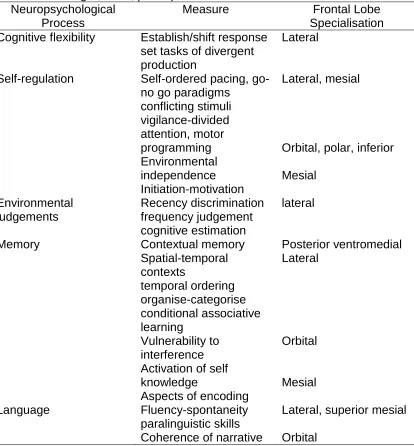
supporting cognitive, emotional, and social functions. The authors contend that there is evidence to support the division of the frontal lobes into superior mesial, orbital, and lateral sectors and that each of these divisions supports different, but interactive, neuropsychological processes, many of which can be identified as executive functions. The frontal lobe regions and their associated neuropsychological processes described by Grattan and Eslinger are shown in Table 1.1.
Table 1.1
Regional Frontal Lobe Specialisation in Neuropsychological Processes (Grattan & Eslinger, 1991, p. 304).
Neuropsychological Process
Measure Frontal Lobe
Specialisation Cognitive flexibility Establish/shift response
set tasks of divergent production
Lateral
Self-regulation Self-ordered pacing, go-no go paradigms conflicting stimuli vigilance-divided attention, motor programming Environmental independence Initiation-motivation Lateral, mesial
Orbital, polar, inferior Mesial Environmental judgements Recency discrimination frequency judgement cognitive estimation lateral
Memory Contextual memory
Spatial-temporal contexts temporal ordering organise-categorise conditional associative learning Vulnerability to interference Activation of self knowledge
Aspects of encoding
Posterior ventromedial Lateral
Orbital
Mesial
Language Fluency-spontaneity
paralinguistic skills Coherence of narrative
1.1.2. Individual differences in neural mechanisms
An increasing trend over the past 10 years in cognitive neuroscience research is to investigate individual differences in neural mechanisms that mediate the cognitive functions. Braver, Cole, and Yarkoni (2010) conducted a review of a number of studies that have employed variety of techniques, such as
Table 1.2
Neural Mechanisms of Executive Function and Their Contribution to Cognitive and Affective Domains (adapted from Braver et al., 2010).
Cognitive / Affective Domain
Neural mechanism Contribution Working Memory (WM) Lateral Inferior Parietal
Sulcus (IPS)
Lateral Prefrontal Cortex (PFC)
Basal Ganglia & PFC
Core storage system Maintains integrity of WM representations Attentional filtering Excitatory drive that can increase IPS capacity Increased WM capacity due to dopaminergic modulation
Trait Anxiety Dorsolateral Prefrontal Cortex (DLPFC)
PFC
Anxiety associated with reduction in DLPFC activation
Poor cognitive control of anxiety due to reduced sustained but increased transient activation Emotion Regulation Lateral PFC
PFC-Amygdala relationship
1.2. Theories of Executive Function
1.2.1. Lezak
Lezak (1982) argues that executive functions are at the core of all human activities that are socially oriented, useful, and creative, that it is the executive functions that allow an individual to set a goal and achieve that goal. With this in mind Lezak conceptualises executive functions as having four major
components (1) goal formulation; (2) planning; (3) carrying out activities; and (4) effective performance.
Lezak’s (1982) first category of executive functions, goal formulation, is the ability of an individual to set a goal or act with intent. Goal formulation, which was subsequently renamed volition (Lezak, Howieson & Loring, 2004),
encompasses an awareness of self, including physical, social, and situational awareness. Lezak makes a clear distinction here between purposive, goal-directed motivation that she views as an executive function, and the instinctive impulses and reflexes of infants and “subhuman animals” (p. 286). The
second component identified by Lezak (1982) is planning. Lezak views planning as being comprised of multiple skills including sustained attention, the ability to view the environment and oneself objectively, the capacity for abstract thinking, the ability to generate ideas and think of alternatives, and to make choices in order to carry out a goal.
Carrying out activities, which has been renamed purposive action (Lezak et al., 2004), follows on from planning in that, it is viewed by Lezak (1982) as the “translation of an intention or a plan into self-serving, productive, activity” (p. 290). The capacities involved in this component include the ability to initiate and maintain, switch and stop a complex behavioural pattern in an
ability to monitor their behaviour, making corrections where necessary, and to adjust the intensity and pace of the delivery where appropriate.
1.2.2. Barkley
Barkley (2001) proposes an evolutionary view of the development and conceptualisation of executive functions, believing that it’s important to
understand how executive functions have developed over time from the skills seen in the early primates that evolved into humans. In adopting an
evolutionary perspective Barkley attempted to define the executive functions and to answer the question “why is there executive functioning” (p. 2).
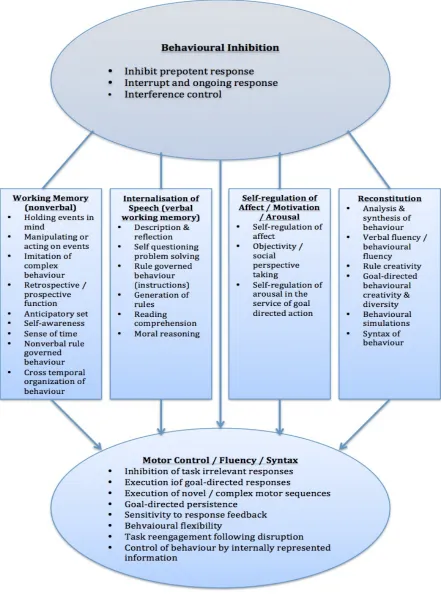
The theoretical model of executive function proposed by Barkley (1997; 2001) encompasses many of the abilities noted as executive functions by other researchers previously discussed. Barkley’s model, however, is comprised of five major executive functions and their associated component processes, (1) response inhibition; (2) non-verbal working memory; (3) verbal working
memory; (4) self-regulation of emotion and motivation; and (5) reconstitution. Barkley (2001) believes that these major executive functions develop
throughout an individual’s life from being overt forms of behaviour in infancy and childhood to being covert forms of behaviour in adulthood. Moreover, Barkley contends that this overt to covert transition has occurred throughout human evolution as an adaptive mechanism, after all, executive functions are the capacities required for self-directed, goal oriented behaviour.
Response inhibition is the first of the major executive functions outlined by Barkley (2001). It has a role in inhibiting prepotent responses, interrupting ongoing responses, and in providing a form of interference control. Response inhibition enables skills of impulse control, delay of gratification, and
Non-verbal working memory is the second major executive function described by Barkley (2001) and is involved in retrospective and prospective functions. This enables an individual to have some sense of the continuity of time. It also enables a person to be able to hold information, such as events, in mind. Verbal working memory, the third executive function, is involved in covert receptive and expressive language and enables self-talk such as self refection and instruction, reading comprehension, and assists with rule-governed
behaviour (Barkley, 2000; Barkley, 2001).
Barkley (2001) proposes that self-regulation of affect/motivation is, as the name suggests, involved in goal directed behaviour and motivation as well as affective regulation and arousal. These processes contribute to an individual’s level of motivation, their ability to persist with a task, and their ability to control their emotions. The fifth major executive function outlined by Barkley is
1.2.3. The unity / diversity framework of executive function
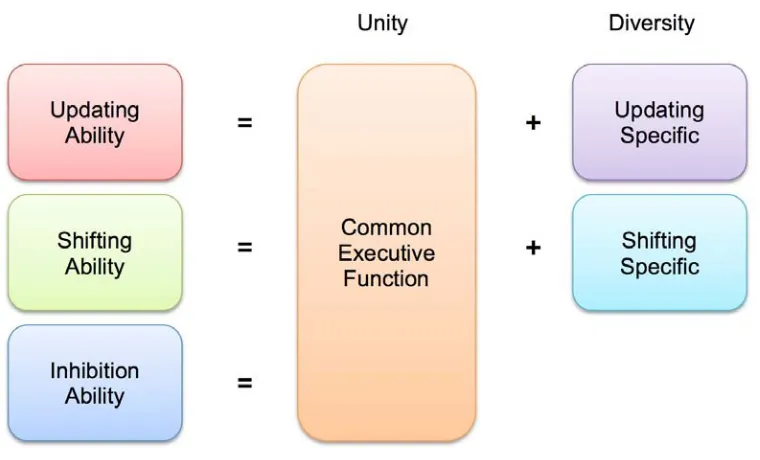
Miyake et al. (2000) recognised the need to provide evidence for a theory of executive function that explains how executive functions are organised and what contribution is made by specific skills, the executive subcomponents, to the whole. With a focus on three specific executive functions, these being shifting, defined as the ability to switch between tasks, updating is defined as the ability to add or delete information in working memory, and inhibiting, defined as the ability to suppress a dominant or automatic response Miyake et al. employed an individual differences approach to “examine the extent of unity or diversity of these three executive functions” (p. 54).
Miyake et al. (2000) tested 137 participants on a variety of commonly used executive function tasks and on tasks that were thought to specifically measure the three target executive functions. The results revealed that the three target executive functions of shifting, updating, and inhibiting are separable functions but are correlated. Miyake et al. suggest that this finding supports the view that executive functions have both unity and diversity.
Since the original Miyake et al. (2000) study, Friedman et al. (2006), Friedman et al. (2008), and Friedman, Miyake, Robinson and Hewitt (2011) have further explored individual differences in executive functions, using a range of
framework of executive function, the Unity / Diversity framework which is depicted in Figure 1.2.
The second conclusion drawn by Miyake and Friedman (2012) in their review is that genetics is a significant contributor to individual differences seen in executive function. Thirdly, they conclude that the “unity” component of executive function may be a good predictor of differences seen in socially oriented behaviours. Finally, Miyake and Friedman found that individual differences seen in executive functions have some constancy throughout development.
Figure 1.2. The Unity / Diversity framework of executive function. (Miyake &
Friedman, 2012, p. 11).
1.3. Relationship Between Executive Functions and Other Cognitive
Functions
for example, believe that executive functions differ somewhat from other cognitive functions as they represent a group of mental functions rather than a single construct. They suggest that executive functions can be viewed as being more ‘active’ than other cognitive functions as executive functions are involved in carrying out a goal directed task. Put simply, executive functions are employed when we are actively doing something. Conversely, other cognitive functions tend to be more passive and involved with general knowledge and retaining facts.
Lezak et al. (2004) subscribes to a similar view to Reynolds and Horton (2008) in their conceptualisation of executive functions and how they are related to other cognitive functions. Lezak et al. suggest that executive functions are involved in the “how or whether a person goes about doing something” (p. 35) whilst other cognitive functions are generally concerned with “what or how much” (p. 35). Lezak et al. explain their position further by describing the functional impairments that are likely seen in individuals with a specific cognitive deficit in comparison to executive dysfunction. Lezak et al. contend that cognitive deficits usually result in a specific impairment and that as long as the executive functions are still intact the individual can continue to function relatively well. On the other hand, executive deficits generally present globally, given their role in coordinating or directing the specific cognitive functions. Impaired executive functions may result in clinically significant impairments in adaptive behaviour despite intact cognitive functions.
Alvarez and Emory (2006), however, refer to executive functions as high-level cognitive functions. These high-level cognitive functions or “supervisory
cognitive processes” (p. 17) are involved in directing and organising lower-order cognitive functions in the implementation of a goal-directed task.
1.3.1. Intelligence
Executive functions are conceptualised as a group of interrelated functions that are involved in the performance of goal-directed, problem solving tasks and have been identified as being imperative for independent, adaptive
functioning in all aspects of life (Lezak et al., 2004). Given their relationship to other aspects of cognition some authors (Obonsawin et al., 2002; Piguet et al., 2002; Salthouse, 2005; Unsworth et al., 2009) have investigated the relationship between executive functions and another important cognitive concept, general intellectual functioning or intelligence.
A contemporary theory of intelligence is the Cattell-Horn-Carroll theory of cognitive abilities (CHC theory). The CHC theory is an amalgamation of the Cattell-Horn, Gf,Gc model of intelligence, which proposed that fluid
intelligence included skills such as novel reasoning and problem solving and that crystallised intelligence constituted acquired knowledge, with the more recent three-stratum theory by Carroll (1993).
The CHC theory has undergone a number of modifications in the years since its inception with the current CHC model consisting of nine broad abilities, these being: crystallised intelligence (Gc); fluid intelligence (Gf); quantitative reasoning (Gq); reading and writing ability (Grw); short-term memory (Gsm); long-term storage and retrieval (Glr); visual processing (Gv); auditory
processing (Ga) and processing speed (Gs). The CHC theory assumes that the exact nature of intelligence can be derived through analysing scores obtained on variety of cognitive tests, therefore, this theory is considered a psychometric theory of intelligence (McGrew, 2004).
and crystallised intelligence (Gc) as originally described in the dichotomous Cattell-Horn model of intelligence and more recently by the CHC theory. Specifically, Friedman et al. investigated three distinct executive functions, of inhibiting, updating, and shifting. Friedman et al. found that inhibiting,
updating, and shifting were related to the three different measures of intelligence with updating being the most closely related. However, when correlations between the three executive measures were considered, only updating was still found to be significantly related to intelligence. The authors also found no difference in association between Gf, Gc and WAIS-III FSIQ with the three executive measures. These findings highlight the importance of working memory (updating) with regard to intelligence and also suggest that Gf is not more closely related to executive functions than overall intelligence or Gc. The findings of Friedman et al. with regard to the relationship between Gf and executive functions are in contrast to those of Decker, Hill, and Dean (2007).
In order to investigate the association between executive functions and Gf, or fluid reasoning abilities, Decker et al. (2007) administered three executive tasks, the Category Task (CT), the Trail Making Test part B (TMT-B), and the Wisconsin Card Sorting Test (WCST), and three subtests of the Woodcock Johnson – Revised Fluid Reasoning Cluster, to individuals aged from 19 to 45 years. Their findings strongly support an association between executive
functions and fluid reasoning and indicate that executive function tests and tests of fluid reasoning may be measuring the same skills (Decker et al.,). These findings have significant implications from a theoretical perspective. If these measures are in fact tapping into the same processes it suggests that executive functions and what we view as intelligence may be better
In a recent study Davis, Pierson, and Finch (2011) contend that the there is still some uncertainty within the literature regarding the relationship between executive functions and intelligence. In order to help clarify this they
administered the Delis Kaplan Executive Function System (D-KEFS) and the Wechsler Adult Intelligence Scale – Third Edition (WAIS-III) to 63 participants aged between 18 and 38 years. Their findings revealed a strong association between performance on the D-KEFS and WAIS-III suggesting an overlap in those skills thought to be executive in nature and those that are thought to represent intelligence. Despite this strong association, however, the D-KEFS was found to measure skills not accounted for by the intelligence measure. The authors conclude that in clinical settings executive functions should be independently assessed “although it may be possible to extrapolate an idea of broad executive functioning from the WAIS-III” (Davis et al., p. 67).
In considering many of the individual subtests that makeup the WAIS-III and the skills that are required to undertake these tasks one could argue that as item difficulty increases in many subtests performance relies more heavily on the executive functions. For example, although the Block Design subtest is views as a measure of visuospatial and construction skills, executive skills are necessary for successful performance as an individual has to plan, arrange, and organise the blocks according to a particular pattern. Good performances on the processing speed tasks are dependent on the ability to sequence and order visual information and are also reliant on good planning and monitoring skills. Persistence and motivation are also required to undertake the
processing speed tasks. The Similarities and Matrix Reasoning subtests, on the other hand, require cognitive flexibility, which is also viewed as an
1.3.2. Working memory
In 1974 Baddeley and Hitch set out to investigate memory, which at the time was viewed as a dichotomous system comprised of short-term memory (STM) and long-term memory (LTM). More specifically, Baddeley and Hitch’s initial question was “what is short-term memory for?” (Baddeley & Hitch, 1974, p. 86). From this study Baddeley and Hitch proposed a three-component model of working memory that replaced the existing STM model. This resulted in a working memory-LTM view of human information processing rather than the existing STM-LTM model.
Baddeley (1992) defines working memory as “a brain system that provides temporary storage and manipulation of information necessary for such complex cognitive tasks as language comprehension, learning, and
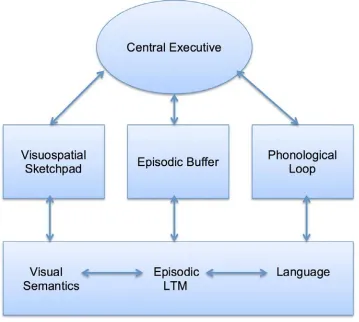
reasoning…..Working memory has been found to require the simultaneous storage and processing of information” (p. 556). The original model of working memory as proposed by Baddeley and Hitch (1974) included an attentional control system that they termed the ‘central executive’. Two subsystems, the phonological loop, which held speech-based information, and the visuospatial sketchpad, which held visual information, aided this central executive. Since Baddeley and Hitch originally proposed this three-component model of
working memory there have been a number of modifications, the most recent by Baddeley in 2000.
viewed as slave systems, and episodic long-term memory (LTM). See Figure 1.3 for Baddeley’s (2000) model of working memory.
Figure 1.3. Baddeley’s model of working memory (Baddeley, 2000).
The relationship between executive functions and working memory was investigated by Rende, Ramsberger, and Miyake (2002). The aim of their study was to examine the contribution of different working memory
components, based on the Baddeley and Hitch (1974) model, on the
performance of phonemic and semantic verbal fluency tasks. The results of this study suggest that it is not only the central executive component of the Baddeley & Hitch model of working memory that plays a key role in the
successful performance of verbal fluency tasks but that the subcomponents of visuospatial sketchpad and phonological loop also play an important
Specifically, Rende et al. (2002) found that the visuospatial sketchpad was particularly associated with performance of semantic fluency tasks. Rende et al. suggest that this is due to individuals commonly using visualisation
strategies to complete this task. Therefore, the ability to temporarily store and manipulate visual information is important for successful completion of
semantic verbal fluency tasks. Conversely, the working memory component of phonological loop was found to be particularly associated with performance on phonemic fluency tasks. Again the authors propose that this is due to the search-by-initial-letter strategy commonly employed by individuals
undertaking phonemic verbal fluency tasks and the need for individuals to be able to temporarily store and manipulate verbal information for successful completion.
In clinical practice and in research, span tasks, such as operation span, counting span, and reading span are commonly used as measures of working memory (Conway et al., 2005; Engle, 2002; Hill et al., 2010; Kane et al., 2004). Conway et al. (2005) suggest that span tasks of working memory have been designed with Baddeley and Hitch’s (1974) model of working memory in mind. They have been designed to assess immediate memory capacity, or short-term memory, whilst actively engaging in ongoing mental activity
(Conway et al.,). One of the most frequently used span tasks is the Digit Span test which is purported to be a measure of auditory-verbal attentional capacity and working memory (Ostrosky-Solís & Lozano, 2006).
immediate memory capacity, would be subserved by the phonological loop whilst the Digits Backward condition, the measure of working memory, would utilise the central executive in addition to the phonological loop (Ostrosky-Solís and Lozano, 2006).
1.4. Relationship Between Executive Functions and Non-Cognitive
Factors
Understanding the impact that demographic variables can have on cognitive functions and neuropsychological test performance is vitally important to ensure accurate and appropriate collation of normative data (Lezak, 2004; Mitrushina, Boone, Razani & D’Elia, 2005). Some of the demographic variables that are reported to affect executive functions in particular include age, education level, and socioeconomic status (Coman et al., 1999; Gladsjo et al., 1999; Saykin et al., 1995; Sherrill-Pattison, Donders & Thompson, 2000; Unverzagt et al., 1996; Welsh-Bohmer et al., 2009; Wiederholt et al., 1993).
1.4.1. Age
In ‘normal’ aging, the structural and functional efficiency of the brain changes. There is grey and white matter volume loss, neuronal numbers decrease, as do the number of neuronal connections, whilst ventricular volume and
literature investigating executive functions in ‘normal’ or nonpathological aging is somewhat lacking in comparison. Therefore, the nature and course of executive changes in normal aging is less clear (Treitz et al.,).
Collie, Shafiq-Antonacci, Maruff, Tyler, and Currie (1999) investigated the relationship between age and neuropsychological test performance using the battery developed by the Consortium to Establish a Registry for Alzheimer’s Disease (CERAD), which includes the domain of executive function, on a healthy Australian sample aged 44 years and above with a mean age of 63.1 years (SD = 9.02). Age was found to have a significant effect on
neuropsychological test performance with individuals in the older age group performing more poorly on executive measures than individuals in the younger age group.
Hester, Kinsella, Ong, and McGregor (2005) also investigated the impact of demographic variables, including age, on performance on the Trail Making Test, which is said to assess the executive component of cognitive
flexibility/set shifting (Kortte, Horner & Windham, 2002). As with Collie et al. (1999), age had a significant influence on test performance, specifically, older participants performed more poorly than their younger counterparts (Hester et al.,).
The authors contend “the results of the present study are generally consistent with the idea of age-associated executive dysfunction” (Treitz et al., p. 384).
1.4.2. Education level
Education level is another factor that has been shown to have an impact on cognitive and executive abilities throughout the lifespan. Hester et al. (2005) found, as with age, that education level influenced performance on the Trail Making Test part B in their study involving 363 community dwelling individuals aged between 60 and 89 years. The results of this study revealed a small but significant relationship between age and performance on the Trail Making test part B with individuals that have 12 or more years of education performing significantly better on this test than individuals with 11, or fewer than 11 years of education (Hester et al.,).
Ganguli et al. (2010) conducted a study involving 1413 individuals grouped according to education level (i.e., less than high school; high school graduate; more than high school). These results also revealed an association between education level and cognitive and executive functioning. Ganguli et al.
demonstrated that lesser education was associated with poorer performance in all cognitive domain assessed, these being attention, executive, language, memory, and visuospatial skills.
In a fairly recent study Meijer, van Boxal, Van Gerven, van Hooren and Jolles (2009) investigated the interactions between education and health status (i.e., physical, social and psychological functioning) with regard to cognitive
functioning and change over a six-year period in two groups of individuals aged 24 to 47 years and 49 to 77 years. The results reveal that level of
education does have a significant impact on cognitive test performance for the younger group only and that the specific cognitive domain affected differs with respect to health status component. A significant positive association
initial performance on tasks of working memory, speed, and executive functioning. At the six-year follow-up, however, education level and physical functioning were positively related to performance on tasks that assess cognitive speed whilst education and psychological functioning were
associated with performance on executive functioning tasks. In addressing the question as to why significant findings were revealed only for the younger group of participants the author suggest that as one ages the “protective effects” of education lessen. They go on to state “Educational experience may therefore only serve as a counter-weight to health-related cognitive deterioration in younger persons, who still benefit from direct effects of education on brain structure and function” (Meijer et al., 2009, p. 527).
1.4.3. Socioeconomic status
The relationship between executive function performance and socioeconomic status is a little unclear. In their study of 340 individuals that ranged in age from seven to 21 years Krikorian and Bartok (1998) found no significant
relationship between socioeconomic status, as determined by parental level of education and occupation, and performance on a non-verbal measure of executive functioning, the Porteus Maze Test. Coelho (2002) categorised participants into one of three SES groups, professional, skilled worker, and unskilled worker. This was based on a modified version of the Hollingshead Four Factor Index of Social Status (1972), which uses number of years of education and occupation to determine social status. Unlike Krikorian and Bartok (1998) Coelho’s results did show a significant, positive relationship between socioeconomic status and discourse performance, which has found to be a correlate of executive functioning.
and Bartok, as a measure of executive function as it requires good planning skills and inhibitory control for successful performance. The Porteus Maze Test, however, is not primarily used as a measure of executive function and some authoritative sources, such as Strauss, Sherman and Spreen (2006) do not list it as a test of executive function. In contrast, the Coelho study
examined the relationship between socioeconomic status and discourse performance, which arguably involves a broader range of executive skills including initiation, verbal fluency, monitoring, and organisation. Coelho’s finding of a significant relationship between a verbal executive function task and socioeconomic status in comparison to Krikorian and Bartok’s
nonsignificant finding using a visual task may reflect the cognitive modality.
Kaplan et al. (2001) investigated the association between performance on tests of executive function, including the Trail Making Test and a test of verbal fluency, and childhood socioeconomic status in a study involving 496 Finnish men. In this study childhood socioeconomic status was determined on the basis of parental (father and mother) education and occupation. The results were fairly consistent revealing poorer executive function performance in those individuals with lower childhood socioeconomic status. When the participants own level of education was accounted for (e.g., did not complete elementary school; completed elementary or elementary plus some junior high school; completed elementary plus some vocational training; completed junior high school and more) poorer executive function performance was still observed in those participants with lower childhood socioeconomic status (Kaplan et al.,).
skills training generally occurred on the job. Today, however, there are a wide variety of education pathways and further training past secondary school including Tafe and online courses. Additionally, it is not unusual for individuals to change jobs on a more regular basis and to work across a variety of
industries. These factors are important to consider if a uniform operationalisation of SES is to be determined.
1.5. Executive Functions in Early Adulthood
Despite some debate as to whether there is age-related cognitive change during the early adulthood stage of life there are some factors that do affect cognitive skills, in particular the executive functions, which are relatively common during this stage of life.
1.5.1. Brain Injury
There are many causes of brain injury including, but not limited to stroke, tumour, poisoning, suffocation, and various diseases such as Parkinson’s disease, Alzheimer’s disease, and Multiple Sclerosis. Brain injuries also occur due to physical trauma to the head. A report on hospitalisations due to
Functional and neuropsychological outcomes following a brain injury vary greatly and are dependent on several factors including injury severity, the location of damage within the brain, the individuals age at the time of injury, the circumstances of the injury, and even the possibility of bias due to
compensation, litigation, and secondary gain (Fleminger, 2009). Nevertheless, despite there being a wide variety of neuropsychological outcomes following brain injury, given the nature of executive functions and that they are
mediated by the frontal lobes, and their interconnectedness with other cognitive functions, deficits in the functions that are commonly viewed as being executive in nature, such as planning, organising, idea generation, and inhibition, are a common consequence of brain injury.
Although it is accepted that attention, memory, processing speed, and
executive function deficits are common sequelae of brain injury, Serino et al. (2006) were interested in understanding whether these deficits were primarily the result of a unique impairment in the Central Executive System (CES) as described in Baddeley’s (2002) model of working memory or the result of deficits in information processing speed. Using a cohort of 37 TBI patients with an age range of 14 to 69 years Serino et al. results support the
involvement of the CES in cognitive outcome following TBI, rather than a general slowing of information processing speed. This is because working memory was primarily affected as were other functions such as divided attention and long term memory which are said to be dependent on the CES.
impairments. The results revealed significantly poor performance by the TBI group in comparison to controls across the domains of processing speed, memory, and executive function. Two less commonly used tests of executive function, namely the Sustained Attention to Response Task (SART), a
computerised task that is said to measure response inhibition over a
sustained period, and the Hayling Sentence Completion Test, also a task of response inhibition, were found to be the most sensitive executive measures.
A recent study by Senathi-Raja, Ponsford and Schönberger (2010) examined the impact that age at time of injury, injury severity, and time post injury has on long-term cognitive function, including executive function, five to 22 years post TBI. One hundred and twelve participants, aged 16-81 years at the time of their injury were matched with 112 healthy controls. Injury severity in the TBI participants, as determined by length of post traumatic amnesia (PTA) duration, ranged from mild to very severe. On average, TBI participants were seen 11.22 years post injury and were assessed using a range of cognitive and executive tasks including a measure of verbal fluency.
Results of the aforementioned study clearly demonstrate persistent basic cognitive and executive deficits in long-tern TBI survivors (Senathi-Raja et al., 2010). The level of long-term impairment was found to be significantly
associated with TBI severity and age at time of TBI, with older age at time of injury associated with poorer long term outcomes. TBI in adolescence or early adulthood was found to be associated with less severe long-term cognitive and executive deficits than in older age groups, however, increased time post injury was not found to have a positive impact on cognitive and executive functioning, even in the younger age groups (Senathi-Raja et al.,).
1.5.2. Mental Illness
alcohol use disorders & drug use disorders) is one of the leading causes of disability and reduced productivity across the lifespan. More importantly, however, mental illness was found to significantly reduce individuals overall quality of life. This report by the ABS (2006) also demonstrated that the prevalence of mental illness within the Australian population generally
increased with age until approximately 44 years of age and then declined with the highest proportion of mental illness seen within the early adulthood age range. Given the prevalence of mental illness, particularly amongst individuals within the early adulthood age range, the impact that mental illness has on an individuals everyday functioning, and the wider societal consequences, it is important to examine the effect that mental illness has on cognitive
functioning.
Chepenik, Cornew and Farah (2007) suggest that we intuitively know that mental illness, such as a mood disorder, affects the way in which we think and how effectively we are able process information. Torres, Boudreau and
Yatham (2007) conducted a meta-analysis investigating the
neuropsychological functioning of euthymic bipolar disorder patients with the aim of determining whether these patients display cognitive deficits as seen in their symptomatic counterparts. The results of the meta-analysis revealed a pattern of impairment of moderate to large effect size across the cognitive domains of attention/processing speed, episodic memory, and executive functions. This is similar to what has been observed in symptomatic bipolar disorder patients. Therefore, the authors suggest that their meta-analysis provides evidence that the neuropsychological deficits in the domains of attention/processing speed, memory, and executive function are trait-related, that is, these deficits are independent of symptomatology.
Porter, Bourke and Gallagher (2007) state that “neuropsychological impairment is well established as a feature of major depressive disorder (MDD)” (p.115). In their review they sought to clarify the pattern of
melancholia, psychotic depression, unipolar, and bipolar depression) with a particular focus on the neuropsychological domains of attention, verbal and non-verbal learning and memory, and executive function. The authors also examined the affect of other factors such as age, gender, and comorbid diagnoses on neuropsychological impairment. Although their findings were largely inconclusive, that is a distinct pattern of neuropsychological deficit in MDD was not seen, Porter at al. suggest that impairments in executive functions are more commonly seen in elderly patients with MDD, those with severe melancholia, those with psychotic depression, and those with bipolar disorder.
1.6. Assessing Executive Functions
Given the term executive function describes range of cognitive skills rather than a singular construct it is not surprising that there is a broad range of neuropsychological tests that reportedly assess these different facets of executive functions. These varied tests of executive functions have been developed for, and used in both clinical and research studies for people of all ages. In clinical practice measures of executive function are used for a variety of reasons including assisting with diagnostic clarification, to obtain a better understanding of an individual’s behavioural difficulties, and for rehabilitation and intervention purposes. In an aged population tests of executive function are used for diagnostic clarification, particularly with regard to dementia and to discriminate between normal, mildly, and severely cognitively impaired
individuals (Bryan & Luszcz, 2000; Whelihan, Thompson, Piatt, Caron & Chung, 1997).
As with other cognitive measures it is important to determine whether tests of executive function assess what they purport to assess. Furthermore, it is important to determine whether there is an association between performances on tasks that assess different facets of executive function. The issue of
describe the phenomena of cognitive congruence as the widely acknowledged finding that performance on virtually any cognitive task is positively correlated with performance on any other cognitive task. Bryan and Luszcz do, however, suggest that the relationships between different measures of executive
function are generally greater than what would be accounted for by the phenomena of cognitive congruence alone.
Some of the more commonly used tests of executive function and the component of executive function they purport to assess as described by Strauss et al. (2006) and Pennington and Ozonoff (1996) are shown in Table 1.3. This ‘compendium’ of executive function tests focuses on measures that are used clinically; it does not include those developed for laboratory research and not widely available to practising psychologists.
Table 1.3
Executive Function Component and Associated Measures (adapted from Strauss et al., 2006 & Pennington and Ozonoff, 1996)
Executive Function Component Test
Set shifting Wisconsin Card Sorting Test
Trail Making Test, part B Contingency Naming Test Planning and organisation Tower of London
Porteus Mazes
Rey-Osterrieth Complex Figure Test
Working Memory Sentence Span
Counting Span Digit Span
Inhibition Stroop Test
Hayling Test Go-No Go
Fluency Controlled Oral Word Association
Test
Category Fluency
1.7. Verbal Fluency Tests of Executive Functionin Clinical Practice
Verbal fluency, like all executive functions, is said to be mediated by the frontal lobes but more specifically is related to left hemisphere function
(Goldstein, Obrzut, Cameron, Hunter & Armstrong, 2004). Verbal fluency tests of executive function are designed to measure the speed and ease at which an individual can produce words according to certain rules. Successful completion of verbal fluency tasks is reliant on many cognitive processes including initiation, being able to respond to a novel request (Monsch et al., 1994), retrieval of information from long-term memory, immediate memory and working memory capacity to generate category cues and monitor words already retrieved (Unsworth, Spillers & Brewer, 2011), inhibitory control to be able to inhibit a response that does not comply with the stated rule (McDowd et al., 2011), and vocabulary (Unsworth et al., 2011). Typically, two rules sets or conditions can be used with tasks of verbal fluency, these being phonemic fluency or semantic fluency (Jurado & Rosselli, 2007; Lezak, 2004).
Troyer, Moscovitch and Winocur (1997) propose a theoretically based, two component model of fluency performance in an effort to understand more about underlying cognitive processes involved in undertaking both semantic and phonemic verbal fluency tasks. The first component they propose is clustering, which Troyer et al. view as the generation of words within either phonemic or semantic categories. In their study Troyer et al. defined
phonemic clusters as groups of words, given in succession, that start with the same two letters (e.g., art, arm), that have the same structure with the
exception of a different vowel sound (e.g., fit, fat), that are homonyms (e.g., some, sum), or that are rhyming words (e.g., sand, stand). Troyer et al. used animals as their semantic category and defined clusters as animals generated in succession that belong to the same semantic subgroup, for example
African animals, farm animals, Australian animals, and pets. Given this
reliant on verbal memory and word storage and is thereby subserved by temporal lobe processes.
The second component proposed by Troyer et al. (1997) is switching which is the ability to shift or change response from one cluster to another. To be able to successfully switch from one response set to another an individual must be able to initiate a strategic search, they must be cognitively flexible, and
possess the ability to shift, therefore, switching is view by Troyer et al. to be mediated by frontal lobe processes. Overall, the results of the Troyer at al. study support the view that clustering and switching are separate and important components of both phonemic and semantic verbal fluency performance. Switching was found to be the more important of the two for performance on phonemic fluency tasks with clustering found to be equally important for both phonemic and semantic fluency tasks.
In a recent study involving a group of young adults, aged 18 to 35 years, Unsworth et al. (2011) examined the processes involved in word generation that allow for successful performance on both phonemic and semantic verbal fluency tasks using the two-component, clustering and switching, model proposed by Troyer et al. (1997). Additionally, these authors sought to
examine verbal fluency performance in relation to other cognitive processes of working memory capacity, inhibition, vocabulary size, and processing speed.
Unsworth et al. (2011) demonstrate that switching, or the ability to generate category cues, and clustering, the production of words within phonemic or semantic subcategories, were found to be related successful performance on both phonemic and semantic verbal fluency tasks with switching found to be the more important of the two. With regard to the relationship between switching and clustering and other cognitive processes, working memory capacity was found to be an important contributor to both switching and clustering and was found to be more strongly related to successful
other cognitive processes examined. Vocabulary was found to be related to clustering and the number of words generated, however, no significant
relationship was found between vocabulary and switching. Processing speed, however, was found to be significantly related to switching rather than
clustering, and was also found to be related to successful performance for both semantic and phonemic verbal fluency tasks. Finally, inhibition was not found to be related to either switching or clustering, although, it was found to be related to number of words produced. On further examination, however, this relationship was found to be the result of variations in working memory capacity, with the authors concluding that inhibition was not related to successful performance on tasks of verbal fluency (Unsworth et al.,)
Although the study by Unsworth et al. (2011) suggests that phonemic and semantic verbal fluency tasks are mediated by the same processes, other studies, such as that undertaken by Monsch et al. (1994) have found
difference in performance between phonemic and semantic verbal fluency in various patient groups. Specifically, Monsch et al. compared phonemic and semantic verbal fluency performance in patients with dementia of the
Alzheimer type and patients with Huntington’s disease. The Huntington’s patients were found to perform poorly on both fluency tasks whereas the Alzheimer’s group showed far greater impairment on the semantic fluency task. Melinder, Barch, Heydebrand & Csernansky, (2005) suggest that one of the reasons why differences are observed in phonemic and semantic verbal fluency performance between patient groups is that whilst successful
performance on both fluency tasks rely on the same underlying cognitive processes, semantic fluency performance is reliant on an intact semantic system whereas phonological fluency tasks are not.
Gladsjo et al. (1999) assessed 768 ‘normal’ adults ranging in age from 20 to 101 years on the COWAT and an animal fluency tasks with an aim of
investigating the influence of demographic variables including age,
fluency performance and developing further norms for these tests. Educational level and ethnicity were found predict phonemic fluency
performance whilst age, educational level, and ethnicity explained the largest variance in semantic fluency performance (Gladsjo et al.,).
1.7.1. Phonemic verbal fluency
Phonemic verbal fluency tests require participants to produce as many words as they can during a specific time frame (usually one minute) beginning with a specific letter, most commonly F, A, and S. The Controlled Oral Word
Association test (COWAT) (Benton, Hamsher & Rey, 1994) is one commonly used example of a phonemic verbal fluency test.
Despite the wide use of phonemic verbal fluency tasks across a range of neuropsychological settings the utility of phonemic verbal fluency tasks in diagnosis and/or detection of frontal lobe deficits is contentious. Cerhan et al. (2002) conducted a study of the utility of phonemic fluency tasks in predicting Alzheimer’s disease. The results of the study demonstrated that phonemic fluency tasks were useful in predicting Alzheimer’s disease but not as good as semantic fluency tasks.
In their study of low-grade brain tumour patients Goldstein et al. (2004) hypothesised that patients with left hemisphere tumours would perform more poorly on verbal fluency tasks (phonemic and semantic) than right
hemisphere patients as verbal fluency is more particularly associated with the left hemisphere. Results of this study showed significant findings with regard to semantic verbal fluency but no significant findings in relation to phonemic verbal fluency. These findings suggest that phonemic verbal fluency is not a particularly sensitive indicator of left hemispheric lesions.
frontal lobe dysfunction in a traumatic brain injury (TBI) population. In contrast to the results of Goldstein et al. (2004), Jurado et al. found greater impairment on phonemic verbal fluency, but not semantic verbal fluency, in patients with frontal lobes lesions in comparison to matched controls. The authors conclude that their results are “consistent with the idea that phonemic and semantic fluency tasks have different brain-based substrates, and that phonemic fluency is more sensitive to frontal lesions than semantic fluency” (p.792).
1.7.2. Semantic verbal fluency
Semantic fluency tasks involve asking the participant to produce as many items/objects as possible, within a certain time frame (usually one minute), according to a specific category. Common categories include fruit and vegetables, clothing, things in the supermarket, or the most common
category, animals (Strauss et al., 2006). Successful performance on tasks of semantic verbal fluency relies on intact semantic knowledge rather than letter-sound knowledge which means that temporal brain regions are involved in addition to frontal structures (Kavé, Heled, Vakil & Agranov, 2011).
Although Kavé et al. (2011) predicted, based on previous research, that TBI patients would perform more poorly on phonemic fluency tasks the opposite was found to be true. The TBI patients performed more poorly on the
semantic fluency tasks. In analysing their results they found that this was a result of deficits in switching, an executive function, and not due to poor clustering, a temporal lobe function.
One of the benefits of using semantic verbal fluency tasks rather than
phonemic verbal fluency tasks is that they don’t rely as heavily on letter-sound knowledge, therefore, they may be more appropriate to use in illiterate
individuals. A study conducted by Manly et al. (1999) investigated the effect of literacy on neuropsychological test performance in a group of education-matched literate and illiterate individuals. Verbal fluency tasks included in the study were the COWAT and category fluency (animals, food and clothing). The results show that many of the illiterate individuals were unable to complete the phonemic fluency task, the COWAT, as they were unable to generate any words for specific letters and those that were able to generate words were found to perform more poorly than their literate counterparts. Conversely, no significant difference was found between the literate and illiterate group on semantic verbal fluency performance.
da Silva, Petersson, Faisca, Ingvar & Reis (2004) explored the usefulness of semantic verbal fluency tests for the assessment of illiterate individuals using two criteria, animals and supermarket items. The results revealed no
seen between the two groups may be due to the positive impact that reading has on acquiring knowledge (da Silva et al., 2004).
Ardila, Ostrosky-Solís and Bernal (2006) contend that semantic verbal fluency using animals as the designated category has some significant benefits in comparison to other categories that are commonly used. Firstly, it is a category that is easily defined across cultures and languages. Ardila et al. use the example of “vegetable” to highlight the ambiguity that can exist in defining a semantic field between culture and languages. They suggest that “vegetable” in Spanish, for example, is not as clear and defined a category as it is in English. “Vegetable” in Spanish may include trees and grass where this is clearly not the case in English.
Another benefit that Ardila et al. (2006) see in using animals as category is its relative consistency and stability across countries, educational attainment, and time. They suggest that there are only small differences seen between individuals living in different countries using the category of animals in
comparison to other categories and in comparison to phonemic cues. Time, or generational differences may be seen in individuals from the same culture for example the category of “tool” may produces vastly different responses in a 80 year old in comparison to a 30 year old (Ardila et al.,).
produced farm animals, pets, and then zoo animals. The authors suggest this finding may be due to the different socio-cultural backgrounds of these two groups. In summary, Pekkala et al. suggest that semantic verbal fluency tasks are a useful assessment tool that may be “relatively culture-free” (p. 442).
1.8. The Controlled Animal Fluency Test
The Controlled Animal Fluency Test (CAFT) was originally devised by Jan Monti (Ewing) (1984) and further developed by Tucker (Tucker, Ewing, and Ross, 1996; Tucker, personal communication, 2008). The CAFT was
developed as a verbal fluency type measure of executive functions, similar to the Controlled Oral Word Association Test (COWAT) but utilising semantic criteria and phonemic criteria in separate conditions (trials).
The CAFT consists of three conditions and involves asking participants to name as many animals (defined broadly) as possible within 60 seconds according to three distinct conditions. Condition 1 is Animals Automatic in which participants are asked to name as many animals as they can. A point is awarded for every correct response. This procedure is the most commonly used semantic verbal fluency task and is commonly referred to as Animal Fluency (Strauss et al., 2006). The benefit of this task in comparison to the COWAT is that successful performance does not rely on phonological knowledge and, as mentioned above, cultural effects appear to be minimal.
The second condition of the CAFT is Animals by Size. In this condition participants are asked to name as many animals as they can in order from smallest to largest. Points are awarded for every animal named that is larger than the previous one. Points are not awarded, however, for animals named that are clearly out of size order.