1952
INNOVATIONS IN ACADEMIC PERFORMANCE AUDIT (APA) TO EMPOWER
TEACHING & LEARNING: THE UNITEN EXPERIENCE
Zainal Ariffin Ahmad
Graduate Business School, College of Graduate Studies, UNITEN, Kajang Malaysia
Norsalwati Binti Mohd Razalli
Quality Management Centre,UNITEN, Kajang Malaysia
ABSTRACT
Institutional audit is an integral part of the quality assurance process in the Malaysian higher education to determine whether the institution is achieving its mission and goals, to identify strengths and areas of concern, and to enhance quality. One form of institutional audit is the periodic academic performance audit to determine the continuation or maintenance of programme accreditation status. In 2011, UNITEN conducted an institutional audit (Academic Performance Audit) exercise to prepare for SETARA 2012 or the Rating System for Higher Education Institutions in Malaysia. UNITEN was conferred SETARA Tier 5 - Excellent in 2012 compared to Tier 4 in 2009. Based on action science approach, this paper discusses the lessons learned during the Academic Performance Audit (APA) conducted in 2011 and how they empowered the teaching-learning environment at UNITEN. It will also highlight the three innovations introduced in the APA process.
Keywords:
Academic Performance Audit (APA), Rating system (SETARA), Action science, teaching-learning, Innovation.1.
INTRODUCTION
Institutional audit is an integral part of the quality assurance process in the Malaysian higher education. As mandated by the Malaysian Qualifications Agency, institutional audit is an external evaluation of an institution to determine whether it is achieving its mission and goals, to identify strengths and areas of concern, and to enhance quality (MQA, 2009). According to the Code of Practice for Institutional Audit (COPIA), there are several forms of institutional audits, either comprehensive or thematic, or by faculty and across faculties. Another form of institutional audit is the periodic academic performance audit (APA) to determine the continuation or maintenance of programme accreditation status. In preparation for the institutional audit, an internal quality audit is conducted which is a self-review exercise by the higher education provider to determine whether it is achieving its mission and goals to identify strengths and areas of concern, and to enhance quality. The outcome of the internal quality audit is a Self-Review Report for Institutional Audit (MQA, 2009).
Recently, UNITEN conducted an institutional audit exercise to prepare for SETARA 2012 or the Rating System for Higher Education Institutions in Malaysia. Established by the Ministry of Higher Education in 2009, SETARA is Malaysia's first rating system to measure the performance of undergraduate teaching and learning in universities and university colleges in Malaysia. The SETARA results were measured on three generic dimensions: Input (20%) comprising Governance (12%), Physical & Financial Resource (3%), Talent (5%); Process (40%) – Curriculum, and Output
International Journal of Asian Social Science
Special Issue: International Conference on Teaching and Learning in Education, 2013
1953 (40%) measured by the Quality of Graduates. Based on a six-tier category (Tier 6 Outstanding to
Tier 1 Weak), UNITEN was conferred SETARA Tier 5 - Excellent in 2012 compared to Tier 4 in 2009. Whereas there were many reasons that could have contributed to the improvement in UNITEN’s rating for SETARA, it may partly be attributed to the lessons learned from APA in 2009 which became the basis for innovation and learning in the APA process. Therefore, based on action science approach, this paper discusses the learning during the Academic Performance Audit (APA) conducted at UNITEN in 2011 and how it impacted or empowered the university’s teaching-learning environment. It will also highlight three innovations that were introduced in the APA process.
2.
ABOUT UNITEN
UniversitiTenagaNasional (UNITEN) was established on 19 August 1996 wholly-owned by the public-listed TenagaNasionalBerhad (TNB) (www.uniten.edu.my). Recently, UNITEN ratified its new Vision to be “A leading global energy university that shapes a sustainable future” and Mission “we strive to advance knowledge and learning experience through research and innovation that will best serve human society” (UNITEN Annual Report, 2011). UNITEN offers foundation, bachelor, masters, and PhD programmes focused on engineering, information technology, business management and related areas through five colleges at its two campuses in Putrajaya and Muadzam Shah, Pahang. With more than 40 academic programmes, UNITEN had undergone many institutional audits as part of the accreditation process of all academic programmes as mandated by the Malaysian Qualifications Agency. There were 464 local and 25 international faculty members with a total of 9,705 local and international students at the time of the APA audit (UNITEN Annual Report, 2011).
3.
LITERATURE REVIEW
In this study, the learning that took place during the Academic Performance Audit was analyzed using the learning framework based on action science espoused by Argyris (1995). Developed by Chris Argyris and Donald Schön (1978), action science is a field of inquiry "aimed at exploring the reasoning and attitudes which underlie human action, and producing more effective learning" in individuals, organizations, and other social systems (Senge, 1994, p.237). The framework encompasses learning at the individual, group and organizational levels.
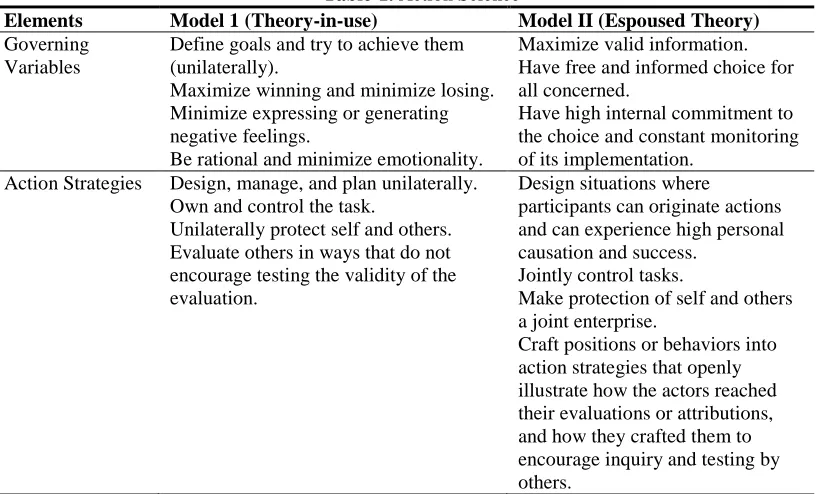
According to Argyris (1995), learning occurs whenever errors are detected and corrected, or when a match between intention and consequences is produced for the first time. Argyris and Schön (1974) make a distinction between two theories of action, namely theory-in-use and espoused theory. Theories of action are the master programs, patterns, designs, sets of rules, or propositions that people use to design and carry out their actions. These are the governing variables, values, theories, beliefs, concepts, rules, attitudes, routines, policies, practices, norms, or skills that underlie actions (Action Science Network, 2007). Argyris and Schön (1974) further suggest that individuals have mental maps or models on how to act in situations and the way they plan, implement and review their actions. These maps or models guide their actions rather than the theories they explicitly espouse. However, there is a split between theory and action, and Argyris and Schön (1974) argue that two theories of action are involved. Wide gaps exist between espoused theories and theories-in-use and action science helps to minimize these gaps. In action science, theory-in-use or Model I is implicit in what we do as practitioners and managers, and espoused theory or Model II is what we use to convey or to speak of our actions to others. This distinction raises questions the congruence between theory-in-use or action and espoused theory. Effectiveness results from achieving congruence between theory-in-use and espoused theory and this is accomplished via reflection (Argyris, 1980). To reduce ineffectiveness, the parties concerned must shift from using Model I to using Model II in resolving difficult problems. Below is the description of Model I and Model II provided by the Action Science Network (2007).
anti-1954 learning behavior. Model I actors do not encourage testing or validating claims, overprotect
participants, and inhibit learning in detecting and correcting non-routine errors. Single-loop learning and defensive reasoning processes produce mixed messages. Whereas they protect out of thoughtfulness, caring, diplomacy, or concern, the very act of caring for and respecting others inhibits criticism. Thus, by avoiding conflict, participants consistently fail to deal with difficult issues. Since Model I processes do not activate theories-in-use, these processes reduce the possibility of learning (Action Science Network, 2007).
The main characteristic of Model II is double-loop learning, a productive reasoning process that involves minimal interpersonal defensiveness. Model II is the domain of usable knowledge. It has high standards for questioning goals and testing the validity of claims. Productive reasoning relies on the idea of probabilistic causality, the claim that "A will probably cause B." Probabilistic causality allows for the richness and uniqueness of concrete situations. It recognizes the inherent gap that exists between stored knowledge and the knowledge required to act effectively, the continual need to change the status quo (Action Science Network, 2007).
Argyris (1995) further argues that there are two ways to correct the errors. Firstly, change the behavior which requires single-loop learning. Secondly, to correct errors to change the underlying programme, or master programme which is double-loop learning. If actions are changed without changing the master programme individuals use to produce the actions, then the correction will either fail or will not persevere. Argyris and Schön’s (1974) theory of action are based on three elements:
Governing variables: those dimensions that people are trying to keep within acceptable limits whereby any action can impact a number of such variables and can trigger a trade-off among governing variables.
Action strategies: the moves and plans used by people to keep their governing values within the acceptable range.
Consequences: the results of an action. These can be both intended – those actor believe will result, or unintended. These consequences can be for the self, and/or for others (Anderson, 1997).
Table 1 summarizes the key concepts and ideas of action science used in this analysis.
Table-1. Action Science
Elements Model 1 (Theory-in-use) Model II (Espoused Theory) Governing
Variables
Define goals and try to achieve them (unilaterally).
Maximize winning and minimize losing. Minimize expressing or generating negative feelings.
Be rational and minimize emotionality.
Maximize valid information. Have free and informed choice for all concerned.
Have high internal commitment to the choice and constant monitoring of its implementation.
Action Strategies Design, manage, and plan unilaterally. Own and control the task.
Unilaterally protect self and others. Evaluate others in ways that do not encourage testing the validity of the evaluation.
Design situations where
participants can originate actions and can experience high personal causation and success.
Jointly control tasks.
Make protection of self and others a joint enterprise.
1955 Consequences Defensiveness
Mistrust COMPETITION Interpersonal manipulation Self-service Over-protective Conformity Use of power
Low freedom of choice Low internal commitment Low risk taking.
"Self-sealing, single-loop" learning Anti-learning
Little public testing of notions about why others behave as they do, what they need, etc.
Decreased effectiveness
Minimally defensive interpersonal relations
COLLABORATION Cooperation
Trust
High individuality
Open confrontation on difficult issues
High freedom of choice.
"Double-loop" learning (includes questioning of goals)
Processes can be disconfirmed Public testing of theories and attributions.
Increased quality of life Effective problem solving and decision making, especially for difficult issues
Increased long-run effectiveness. Source: Action Science Network (2007).
4.
METHODOLOGY
The first author served as the Chief Auditor whereas the second author was the Document Control Officer with a team of 20 academics from UNITEN’s five colleges appointed as auditors. In preparation for SETARA 2011 exercise, the 20 internal auditors were divided into five teams to conduct the Academic Performance Audit (APA) on the 9 areas under COPIA (Code of Practice for Institutional Audit) with 181 benchmarked and enhanced standards as shown in Table 2.
Table-2. Summary of COPIA Areas and Benchmarked and Enhanced Standards Benchmarked
Standard
Enhanced Standard
Total
1. Vision, Mission, Educational Goals & Learning Outcomes
1.1 Statement of Vision, Mission and Educational Goals
1.2 Participation in the formulation of Vision, Mission and Educational Goals
1.3 Academic Autonomy 1.4 Learning Outcomes
9 4 1 2 2 5 2 1 1 1 14
2. Curriculum Design and Delivery
2.1 Curriculum Design and Teaching-Learning Methods
2.2 Curriculum Content and Structure 2.3 Management of Programmes 2.4 Linkages with External Stakeholders
17 7 2 7 1 8 3 1 2 2 25
3. Assessment of Students
3.1 Relationship between Assessment and Learning
3.2 Assessment Methods
3.3 Management of Student Assessment
1956 4. Student Selection & Support Services
4.1 Admission and Selection
4.2 Articulation Regulations, Credit Transfer and Credit Exemption
4.3 Transfer Students
4.4 Student Support Services and Co-Curricular Activities
4.5 Student Representation and Participation 4.6 Alumni
24 10 1 2 6 4 1 16 4 1 1 4 4 2 40
5. Academic Staff
5.1 Recruitment and Management 5.2 Service and Development
12 7 5 4 2 2 16
6. Educational Resources 6.1 Physical Facilities
6.2 Research and Development 6.3 Educational Expertise 6.4 Educational Exchanges 6.5 Financial Allocation
14 6 3 1 1 3 10 3 3 1 2 1 24
7. Programme Monitoring and Review 7.1 Mechanism for Programme Monitoring and
Review
7.2 Involvement of Stakeholders
6 5 1 3 1 2 9
8. Leadership, Governance and Administration 8.1 Governance
8.2 Institutional and Academic Leadership 8.3 Administrative and Management Staff 8.4 Academic Records
8.5 Interaction with External Sectors
17 6 4 3 2 1 11 6 2 1 1 1 28
9. Continual Quality Improvement 9.1 Quality Improvement
4 4
3 3
7
Total (32 Sections) 115 66 181
Source: MQA (2009)
The first innovation introduced in the APA process was the creation of coding for each of the 181 standards (e.g. 1.1 B.1 for benchmarked and 1.1 E.1 for enhanced standard) of the APA instrument used by the Malaysian Qualifications Agency as shown in Table 3 below.
Table-3. Sample Coding for the APA Standards
Tier No Code Standard
Area 1 : Vision, Mission, Educational, Goals &Learning Outcomes 1.1 Statement of Vision, Mission and Educational Goals
5 1 B.1 The HEP has formulated educational goals highly consistent with its vision and mission.
5 2 1.1 B.2 The mission statement and educational goals very well reflect the crucial elements of the processes and outcomes of higher education that is in line with national and global contemporary developments.
5 3 1.1 B.3 The vision, mission, and educational goals are approved by a governing board or other appropriate body whose membership is made up of those highly competent to discharge such duties and responsibilities.
1957 5 5 1.1 E.1 The mission and educational goals highly encompass leadership qualities
in the areas of social responsibility, research and scholarly attainment, community engagement, ethical values, professionalism, and knowledge creation.
5 6 1.1 E.2 The HEP's planning and evaluation processes, educational programmes, educational support services, financial and physical resources, and administrative processes are more than adequate and highly appropriate to fulfil its stated goals.
1.2 Participation in the Formulation of Vision, Mission and Educational Goals 5 7 1.2 B.5 The vision, mission and goals are developed in extensive consultation
with principal stakeholders which include departments, research centres, governing boards, academic and administrative staff, and student organisations.
5 8 1.2 E.3 The vision, mission and goals are periodically reviewed in extensive consultation with a wider range of stakeholders that may include the community, civil society, international peers, alumni, industry, professional bodies, funding agencies, and the government.
Source: UNITEN (2012).
The second innovation was that the auditors evaluated the evidences from the audit meetings for each standard using a tier system developed by UNITEN based on the grading scale for the MQA Evaluation Instrument for Institutional Audit as follows (UNITEN, 2012):
UNITEN APA Audit MQA Evaluation Instrument
Tier 5 – Commendation Level 5 – Excellent (9.0 -10.00) Tier 4 – Observation/Recommendation Level 4 – Very Good (7.0 - 8.9) Tier 3 – Minor Non-Conformance Level 3 – Good (5.0 - 6.9) Tier 2 – Major Non-Conformance Level 2 – Satisfactory (4.0 - 4.9) Tier 1 – Major Non-Conformance Level 1 – Unsatisfactory (0 - 3.9)
Upon approval of the SETARA/D-SETARA Committee on 16 August 2011, the teams were briefed in a workshop on 7 September 2011 by a veteran external auditor on the expectations, roles and tasks of auditors as well as how to conduct the audit and collect data. Using Argyris’ (1995) learning framework discussed in literature review, the APA audit was conducted using the following steps based on the Audit Plan:
Data collection
13-15 September 2011 - Audit teams conducted internal audit with auditees and representatives from
relevant colleges and departments – opening meeting, interviews, site visits, and document check. Control
21 September 2011 - Present progress to SETARA Committee Formulating and Implementing Strategy
28 September 2011 - Audit Meeting – present rough data and immediate action Implementation
7 October 2011 - Present progress to Special Senate (ratify new policies) Continued Learning
10 October 2011 Phase 1 - Corrective Action 14 November 2011 Phase 2 – Harmonization Implementation
13-15 December 2011 - revisit audit
1958 - Areas of concern that need to be addressed
- Strategies for maintaining and enhancing the strengths - Steps that have been taken to address the problem areas - Conclusions and recommendation for change
Follow-up
21 December 2011 Final APA Report presented to the SETARA/D-SETARA Committee.
In action science, the critical question is whether data, knowledge, or information is actionable. Actionable and non-actionable data can be in the form of directly observable conversations, or descriptions of actual or proposed problems. The problems involve issues of personal responsibility: where the auditees evaluate an event or attribute qualities to themselves or others. Observations include statements by the auditors that outline their undiscussed thoughts and feelings, or internal monologues related to the descriptions (Action Science Network, 2007). The audit team members as action researchers were asked to record these descriptions or conversations as minutes as they engage in audit meetings with the auditees and representatives from relevant colleges and departments. To standardize record keeping, the auditors were asked to use a form adopted from the ISO 9001 Corrective Action Request (CAR) Form as shown in Fig. 1. This form was filled out by the auditors and based on the Objective Evidence and Plan of Action, and each of the 181 standards was registered as either Tier 1 or 2 Major Conformance, Tier 3 Minor Non-Conformance, Tier 4 Observation/Recommendation, and Tier 5 Commendation. Also, all meetings with the auditees were documented as minutes. The third innovation in the APA process was the CAR Form used the auditors to request corrective action to be undertaken by the respective colleges and departments after the audit and verified during the revisit audit in order to close out the Non-Conformance Report (NCR) (UNITEN, 2012).
Figure-1.Corrective Action Request Form.
5.FINDINGS
1959 committee and student performance and progression analysis for non-engineering programmes
(MQA, 2012).
Model I which involve single-loop learning processes was evidenced during the data collection phase of the internal audits conducted during 13-15 September 2011. In interviewing and talking with the auditees and representatives from relevant colleges and departments. During the opening meeting, interviews, site visits, and document check, the auditees were forthcoming with evidences required for the standards to be documented in the CAR Form. However, it was observed that both the auditees were rather inhibited and refrained from saying things that can cause them to experience embarrassment or threat and prevent them from identifying, reducing, and correcting the causes of the embarrassment or threat. For example, when posed with questions and asked to produce objective evidence for certain standards (e.g. 2.2.E.4, 6.1.B.6 Policy on ICT usage in Teaching and Learning), many auditees referred to the existing Policy on Teaching and Learning and said that it was available but not sure whether it covered ICT. Most of the time, the auditees said they just follow procedures and avoid conflict, thus they fail to deal with difficult issues and deferred it to higher authorities or top management to decide. Since Model I processes do not activate theories-in-use, these processes reduce the possibility of learning (Action Science Network, 2007).
We also saw evidence of Model II double-loop learning, a productive reasoning process that involves minimal interpersonal defensiveness during the Control and Formulating and Implementing Strategy phases. Immediately after the APA internal audit, the Chief Auditor presented progress to the SETARA Committee on 21 September 2011 and raised several observations that required actions at the university level and top management level required further verification of the data. After the internal audits, all auditors met in a workshop on 28 September 2011 to calibrate their findings on the standards, objective evidences, and action plans. Many auditors were quite vocal in questioning goals and testing the validity of claims of the auditees vis-à-vis the standards. The initial review of the 181 standards saw many of the standards falling within Tier 3 and 4 due to lack of evidences as well as relevant policies were not in place. Hence, during the implementation phase, when the data was presented to the Special Senate on 7 October 2011, it was significant to note that due to the initial results of the audit, ten issues were raised to top management of which six involved the establishment or revision of policies. The other four issues addressed were (UNITEN, 2012):
1.1.E.1 Review of Educational Goals to be in line with UNITEN’s vision and mission 2.4.E.7 Tracer Study and the establishment of a One Stop Center at Alumni Office 3.1.E.2 Establishment of One Stop OBE at Teaching and Learning Centre
6.2.B.9 Utilization of research in teaching and learning – monitored by the Research Management Centre.
1960 was done at the individual (academics) and group levels (college and departments). Secondly,
correcting errors by changing the master programme, or double-loop learning. Besides the existing policy on student and staff with disabilities (OKU) approved by JPU in November 2011, six new policies were promulgated and approved by the Jemaah PengurusanUniversiti (JPU) on 5th December 2011 which reflected the seriousness of top management in conforming to the standards and changing the underlying programme to reinforce the required changes in improving the teaching-learning environment at UNITEN. The new policies addressed various standards are listed in Table 4. As correctly pointed out by Argyris, if actions are changed without changing the master programme individuals use to produce the actions, then the correction will either fail or will not persevere.
Table-4. List of New Policies to Address APA Issues Policies
Code Policies (approved by JPU on 5
th December 2011) Department/
Business Unit 2.2.E.4
6.1.B.6
Teaching & Learning Policy – amendments (to include ICT)
Teaching Learning Centre
8.2.B.7 8.2.B.8
Policy on the Selection Criteria and Process for
Appointment of Academic Leadership Human Resources
8.2.E.8 Policy on Training for Top Management and Academic
Leadership Human Resources
6.4.B.11
6.4.E.8 Policy on Industry Attachment of Academic Staff Human Resources 6.4.B.11
Policy on Exchanges of Academic Staff Human Resources
6.2.B.8 Intellectual Property and Commercialisation Policy University Training & Consultancy
4.1.E.3 Policy on Students and Staff with Disabilities (OKU) (approved by JPU on November 2011)
DVC/Human Resources/ Student Affairs
Source: UNITEN (2012)
6.
CONCLUSION
The 2011 Academic Performance Audit (APA) exercise addressed several key issues that were highlighted in the APA 2009 and uncovered other issues that challenges the congruence between theory-in-use and espoused theory of the academics and administrators in UNITEN. Three innovations were introduced in the APA process to facilitate learning, namely coding, tier system, and corrective action request form. Based on the initial audit conducted on 13-15 September 2011, a total of 181 benchmarked and enhanced standards were evaluated and the corrective actions were taken within the 3 months period. As a result, UNITEN achieved Tier 5 Commendation on 175 standards (111 benchmarked and 65 enhanced standards) and Tier 4 Recommendation on 4 standards (3 benchmarked and 1 enhanced standard) and one standard 4.1 B.4 was not applicable in UNITEN as it does not selection interview (UNITEN, 2012). Using the learning framework, the results shows that to reduce ineffectiveness in academic performance, the parties concerned must shift from using Model I (single-loop learning) to Model II (double-loop learning) in resolving difficult problems which was evidenced throughout the APA process. Therefore, based on action science approach, this paper presents the lessons learned during the 2011 Academic Performance Audit (APA) and how they empowered the university’s teaching-learning environment at UNITEN.
7.
ACKNOWLEDGEMENT
1961