Smart railway gate system
Kudapa Lokesh
1, Dhanesh G
2, Arpitha P
3, Prajna K
41 Kudapa Lokesh,Dept.of computer science and Engineering, SDIT,Kenjar,Mangaluru,Karnataka,India 2 Dhanesh G,Dept.of computer science and Engineering, SDIT,Kenjar,Mangaluru,Karnataka,India
3 Arpitha P,Dept.of computer science and Engineering, SDIT,Kenjar,Mangaluru,Karnataka,India 4 Prajna K,Dept.of computer science and Engineering, SDIT,Kenjar,Mangaluru,Karnataka,India
Abstract
The present work attempts to automate the opening and closing of gates at a railway level crossing. In general, level crossing
gates are operated manually by a gate keeper. When the train starts to leave the station, the station in-charge delivers this
information to the closest gatekeeper to get ready. This human intervention can be avoided by automating the process. In
situations where the train is late due to some reason, the gates remain closed for long durations causing dense traffic jam near the
gates. This too can be prevented by automation. The proposed system uses two pressure sensors and one infrared sensors to detect
the arrival and departure of train respectively .Pressure sensor, IR sensor, Servo motor and Arduinouno is used to control the
open and close status of the railway crossing gate. we propose a model where pressure sensor is placed under the railway tracks.
When the pressure sensor detects the train then the signal turns red and the motor operates to close the gate. The gate remains
closed until the train completely moves away from the level cross. When the departure of the train is detected by the IR sensor, the
traffic signal turns green and the motor operates to open the gate. Thus automation of the gate operations at the railway level
cross is achieved using sensors.
.
Key Words: Sensor, Arduinouno, Obstacle detection, Railway gate and Automation etc…
---***---1. INTRODUCTION
This is the project implemented as smart railway gate system which contains two sensors namely pressure sensor and IR sensor. The primary function of this system is to automate unmanned railway gates using these sensors. Using simple electronic components we have tried to automate the control of railway gates.
Railroad is one of transient mode which has an important role in moving passengers and freights. Therefore more efforts are necessary for improving its safety. Now a day’s India is the country which having world’s largest railway network. Over hundreds of railways running on track every day. As we know that it is surely impossible to stop, the running train at instant in some critical situation or emer-gency arises. Train accidents having serious repercussion in terms of loss of human life, injury, damage to railway
property.Our country is a progressive country. It has already enough economic problems which are ever been unsolved. To avoid all these things some sort of automatic and independent systems has to be develop. There are mainly two types if level crossings they are manned level crossing and unmanned level crossing. Mannes level crossing is classified into classes like A Class, B Class. Unmanned level crossing is classified into C Class D Class Railways being the cheapest mode of transportation are preferred over all the other means. When we go through the daily newspapers we come across many Railroad related accidents. This is mainly due to the carelessness in manual operations or lack of workers. Therefore we are proposing this Smart Railway Gate system. The main objective of the system is to automate unmanned railway gates using sensors. Using simple electronic components we have tried to automate the control of railway gates.
The purpose of the project is to automate the railway gate control at unmanned level crossings replacing the gate keepers and also the semi automatically operated gates. It deals with two things. Firstly, to provide safety to road users by reducing the accidents that usually occur due to carelessness of road users and at times errors made by the gatekeepers. And secondly, it deals with reducing the time for which the gate is being kept closed.
2. RELATED WORK
Existing models to control the gates of the railway crossing are:
1) IR Based Automatic Railway Gate Control System When the gates are controlled manually, the time for which the gate is open are less, so IR based system are proposed. This system includes microcontroller, DC motor, IR sensor. The sensors are installed near the crossing. When the train reaches the crossing from either side, the sensor detects the train and sends the signal that train has arrived. When the train arrives, the IR transmitter senses and generates a signal; at the same time IR receiver receives the signal and generates an interrupt signal [1]. The motor which is connected with the controller moves in the clockwise direction when the interrupt signal is generated and moves in the anticlockwise direction when the interrupt ends.
This system has the advantage of being cheap and simple with the disadvantage that it is slow and IR sensor gets affected by weather conditions
2) Ultra-Wideband Radar System for Detection at Railway Crossings.
Due to limitations of IR system the radar system is proposed at the crossing. In this system, beam interruption is used for detecting objects using radar. With beam interruption, a beam is directed towards the reflector and if the beam is interrupted the received power is reduced .This indicates that there is any object [2]. Two radars are required to cover the crossing, each having 50 degree beam width. If one radar is used, then the gain is reduced. When the radar detects the object it activates the alarming system. In this system we detect the vehicles at the crossing, but not the train. This system has the advantage that the optical wavelengths are operated in all weather conditions.
The disadvantages of this system include the fact that (a) Radio frequency has harmful effect on human in a longer run and it is less reliable.
(b) It is designed to detect the vehicles at the crossing not the train.
Sensor based railway gate automation system is developed to automate the process of opening and closing of gate at the railway level crosses. The system detects the arrival and the departure of the train for the gate operation using different types of sensors. The proposed system uses two pressure sensors and one infrared sensors to detect the arrival and departure of train respectively. Sensors and servo motors are programmed using Arduino micro-controller.
IR sensor: IR sensors detect the train using infra-red receiver and transmitter. Infra-red sensors are capable of detecting the presence of an object by sensing the heat being emitted by the object. It emits or detects the radiations to detect the motion of an object surrounding it. The most commonly used sensors for the automatic railway gate system is vibration sensors and IR sensors [5].
PRESSURE SENSOR:
The main purpose of pressure sensor in this project is to detect the arrival of the train. The pressure sensor acts as a force sensing resistor in an electrical circuit. When the force sensor is unloaded, its resistance is very high. When a force is applied to the sensor, this resistance decreases. The resistance can be measured by a multimeter, then applying a force to the sensing area.
4. SYSTEM ARCHITECTURE
Fig-1: system architecture
Fig-2 shows the flow chart of the arrival and departure of the train. when the train arrival is detected the pressure sensor is activated,followed by LED blinks to red,buzzer gives a beep sound and gate will be closed.when the train depature is detected the IR sensor is activated followed by LED blinks to green,buzzer gives a beep sound and gate will be opened.
No
Yes
Fig-2: Flow chart of arrival and departure of the train
5. HARDWARE REQUIREMENTS
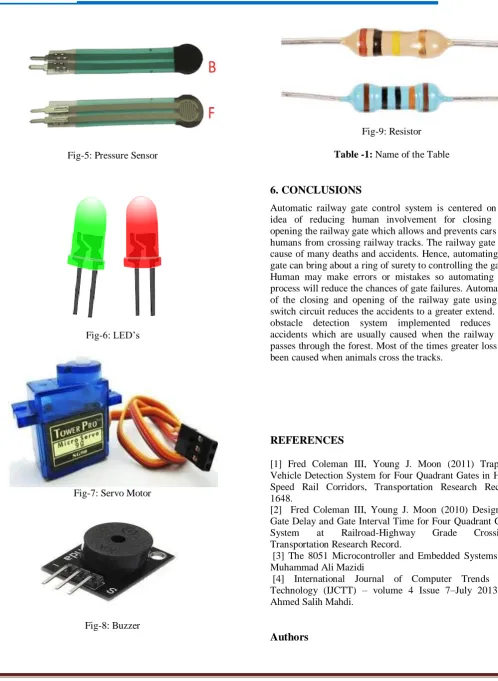
The hardware components in Fig. 3, 4, 5, 6, 7, 8 and 9 are used in the railway gate automation system:
a) Arduino UNO micro-controller b) IR Sensor
c) Pressure sensor d) LED
e) Servo Motor f) Buzzer g) Resistors
Fig-3: Arduino UNO micro-controller
Fig-4: IR Sensor start
Train arrival
Pressure sensor activated
LED (green) Buzzer(sound) motor (gate close)
Train departure
LED (red) Buzzer(sound) motor (gate open)
Fig-5: Pressure Sensor
Fig-6: LED’s
Fig-7: Servo Motor
Fig-8: Buzzer
Fig-9: Resistor
Table -1: Name of the Table
6. CONCLUSIONS
Automatic railway gate control system is centered on the idea of reducing human involvement for closing and opening the railway gate which allows and prevents cars and humans from crossing railway tracks. The railway gate is a cause of many deaths and accidents. Hence, automating the gate can bring about a ring of surety to controlling the gates. Human may make errors or mistakes so automating this process will reduce the chances of gate failures. Automation of the closing and opening of the railway gate using the switch circuit reduces the accidents to a greater extend. The obstacle detection system implemented reduces the accidents which are usually caused when the railway line passes through the forest. Most of the times greater loss has been caused when animals cross the tracks.
REFERENCES
[1] Fred Coleman III, Young J. Moon (2011) Trapped Vehicle Detection System for Four Quadrant Gates in High Speed Rail Corridors, Transportation Research Record 1648.
[2] Fred Coleman III, Young J. Moon (2010) Design of Gate Delay and Gate Interval Time for Four Quadrant Gate
System at Railroad-Highway Grade Crossings
Transportation Research Record.
[3] The 8051 Microcontroller and Embedded Systems By Muhammad Ali Mazidi
[4] International Journal of Computer Trends and Technology (IJCTT) – volume 4 Issue 7–July 2013 by Ahmed Salih Mahdi.
Kudapa Lokesh
Complete his B.E in Computer science & Engineering in 2018 from Shree Devi Institute of Technology, Mangaluru.
Dhanesh G
Complete his B.E in Computer science & Engineering in 2018 from Shree Devi Institute of Technology, Mangaluru.
Arpitha P
Complete her B.E in Computer science & Engineering in 2018 from Shree Devi Institute of Technology, Mangaluru.
Prajna K