The Essence of Complementary Pain Relief Methods in Modern
Nursing in Ghana: The Concerns of Patients and Nurses
Wombeogo Michael & Dominic Abugre
(PhD, DLit ET Phil, PGIPN, SRN, FWACN,FGCNM)(PhD Candidate, MHE, B.Ed,SRN) Introduction
Pain is an experience that everyone attest to as has been experienced from time to time and is relatively subjective in nature. It is a complex, multidimensional and subjective phenomenon that is perceived directly by the sufferer and can be described, as Seers (1999:615) puts it, by pain location, intensity, temporal aspects, quality, impact and meaning. It may be psychosocial, economic and cultural in context and is elicited in both verbal and non-verbal expression. According to Melzack & Wall (in Seers, 1999), pain goes beyond a sensory phenomenon, but involves emotional, cognitive and behavioural components and is shaped by the complex interaction of psychological, physiological and sociocultural factors.
Background/literature review
As far back as in 1972, McCaffery defined pain as “whatever the experiencing person says it is, whenever he says it does”. This definition clearly
points out the level of subjectivity of pain. It is the sufferer who knows what and where the pain is and how to describe it. According to Wall (in Seers, 1999) pain is a need, just like thirst and hunger, rather than a sensation or a feeling of discomfort. The reason is that pain signals the need for recovery and recuperation and indicates that “activity should be disrupted and substituted by activity related to the prevention of further damage for cure and recovery” (Seers, 1999). Several factors influence the way one views pain and include past experience of pain, the age of the individual experiencing the pain, the personality build-up of the individual (introverts complain less pain than extroverts), the cultural background, social conditioning/peer pressure and organisational factors, among others.
reaction, chronic pain is persistent even after healing has taken place and has no clear warning system.
For the sake of this article, attention is on pain relief and more particularly on complementary methods of pain relief and its essence as a practice in modern nursing in Ghana. Currently, the health practice for pain relief in Ghana employs various methods including the use of medications (narcotic analgesics such as morphine and non-narcotic analgesics such as aspirin and adjuvant medications such as anticonvulsants, neuroleptics, anxiolytics, antidepressants and corticosteroids (WHO, 2015)) and complementary methods of pain reliefwhich include distraction, relaxation imagery, transcutaneous electrical nerve stimulation (TENS), massage, application of heat or cold, hypnosis, biofeedback and acupuncture.
It is highly imperative that any complementary pain relief method employed is uniquely appropriate for each and every patient. The nurse should know what the patient is capable of doing and wants to do to relief pain and then take advantage of previous experiences to help him relief pain. For instance, the
technique) is a promising intervention for procedural pain management.Patients may simply think by using complementary techniques, their pain is considered as psychological and may create negative perceptions about service qualityprovided by the nurses.
Parasuraman et al., (1988) opine that because it may be difficult for the patient to assess technical quality, they tend to rely on the "how" of pain relief delivery, and in addition “focus on the service dimensions like empathy, reliability, responsiveness associated with the service encounter”. Ware and Snyder (1975) in time past intimated that a lot of patients find it difficult to distinguish between the "caring" (functional) performance and the "curing" (technical) performance of healthcare providers. This situation forces most patients to assess their care on the functional aspects of the technical performance. This signifies that non-technical interventions in pain relief influence patients' ratings of the overall method of pain relief and these aspects of the medical encounter would be, perhaps more important than the technical aspects. Parasuraman et al., (1985) argued that service quality can be defined as the difference between predicted or expected service (patient
expectations) and perceived service (patient perceptions). If patients‟ expectations exceed performance, then perceived quality is considered less than satisfactory and a service quality gap materialises. This in effect does not necessarily represent the fact that the service is of low quality but rather patient expectations have not been met hence client dissatisfaction occurs and opportunities arise for better meeting of patient expectations. Asubonteng et al., (1996) defined service quality as the difference between patient expectations of service performance before the service encounter and their perceptions of the actual service received.
As indicated earlier on the types of
complementary pain relief methods, distraction is
one of such and is often used by nurses in pain
relieving process. Distraction involves diverting
attention towards stimuli other than the pain. For
instance, switching on television or tuning on
music during pain management. In this vein,
Seers (1999) cautions that distraction does not
remove the pain, “but can help to make it more
attention”. In a study results, Landier (2010)
suggests that mind–body interventions, including hypnosis, distraction, and imagery, may be effective, alone or as adjuncts to pharmacological interventions, in managing procedure-related pain, anxiety, and distress particularly in paediatric oncology. Thus, distraction as an intervention tool for pain relief has a cultural manifestation. The way individuals react and contain pain tend to have a bearing on their cultural
toning.
Bukola (2017) suggests that the effective
use of distraction as an intervention in varied
populations, could show evidence of cultural
influenceson pain expression, measurement and
management approaches.
Relaxation is another method employed to relief pain. According to McCaffery & Beebe (1989), relaxation is a „state of relative freedom from both anxiety and skeletal muscle tension‟. A randomised controlled trials study, Seers and Carroll (1998:468) revealed that those who receivedrelaxation technique manipulationsexperienced significantly less pain sensation and/or distress after surgery or a procedure as compared to those who did not.
Aim
The aim of this study is to situate the essence of complementary methods for pain relief in modern nursing in Ghana
Objectives
1. To assess various pain relieving methods used other than complementary methods in Ghana 2. To describe the effect of complementary method
of pain relief and its essence in modern nursing on patients suffering from various types of pain 3. To find out the relation of complementary pain
relief method as a core nursing skillin patient pain relief in Ghana
Research problem
give some relief; they do so only for a limited time. Some patients often times explore alternative methods just as caregivers do for patients, but rarely consider these methods as essential even though pain is relieved significantly and has an enduring effect. This study seeks to address why so and how complementary methods of relieving pain can be explored and promoted as core care for patient pain relief.
Hypothesis
1. There is a difference in the utilisation of medical and non-medical methods for pain relief
2. There is a difference in the effect on patient pain relief between complementary pain relief method and other methods
3. There is a positive relation in the use of complementary pain relief method and actual patient pain relief
Methods
The methodological approach took into consideration the setting, the design, data collection techniques (quantitative and qualitative), sampling (random and
systematic), data analysis strategy and inclusion and exclusion criteria.
The setting was the Tamale Teaching Hospital, the biggest referral hospital for the three northern regions of Ghana, comprising Northern, Upper East and Upper West, situated in Tamale, the regional Capital of Northern Region.
The research design
The term „patient‟ refers to clients on admission
in the hospital ward and receiving nursing,
medical or surgical attention from health
workers.A hospital ward based cross-sectional study
was conducted among surgical, medical, orthopaedic and neurological wards targeting patients with pain and who had used at least one or twotypes of pain relieving method at the time of the study including complementary pain relieving method.
wards not included in the units selected for the study irrespective of whether or not they were in pain.
Sample and sampling technique
The study employed the consecutive sampling technique (CST) to gather data. According to (Bowers,House& Owens, 2011), consecutive
sampling is a sampling technique in which every subject meeting the criteria of inclusion is selected until the required sample size is achieved. In consecutive sampling technique all individuals who agree to participate are selected, provided they meet pre-established criteria, until the number of subjects desired has been recruited. Consecutive sampling can be highly useful when the available subject pool is limited or when using selection criteria as stringent as to reduce the number of subjects to a point that threatens the generality of findings.
Patients were purposively selected based on those who met the inclusion criteria of having pain and having used at least one complementary method of relieving pain. The selection of the wards was conveniently done as researcher‟s knowledge of which wards have patients in the inclusion criteria was brought to bear.
To determine the sample size, the Krejcie & Morgan sample size determination table was adopted based on the total number of respondents by using the CST approach. The population of patients who had pain and employed one or two pain relieving methods within the inclusion criteria in each of the wards are as follows; surgical ward (9), medical ward (5), orthopaedic ward (11) and neurological ward (10), a total of 35 patients. According by the table of Krejcie & Morgan (2012), the sample size is 32 as seen on table 1 below.
Data collection technique and analysis
A self-administered questionnaire was created by the researcher that asked for closed-ended responses from patients for quantitative analysis and an in-depth interview guide which asked for open-ended responses from three questions, thus; 1. How would you describe the pain? 2. What methods are you using
to relief the pain? 3. Why do you use those methods? Patients‟ responses were anonymous.
The data was analysed quantitatively using descriptive and inferential numeric approach and qualitatively using description and thematic text approach.
The study protocol was reviewed and approved by Health Research Ethics Review Committee of the University for Development Studies School of Allied Health Sciences. Verbal permission to undertake the
study was obtained from the Director of Research of the Teaching Hospital and the nurses of selected wards and the study participants and data collection was done confidentially.
Results/findings
Table 1 Aim for pain relief
Aim Nurses Patients Totals
Number percentage Number percentage No. %
Complete relief of pain - 3 9.37 3 9.37
As much pain relief as possible 2 6.26 8 24.99 10 31.24
Just enough relief for patients to function
1 3.12 13 40.63 14 43.76
Relief up to a level patient can tolerate
1 3.12 4 12.50 5 15.63
4 12.50 28 87.50 32 100.00
Table 2 Expectation for pain relief
Expectations Nurses Patients Totals
Number Percentage Number Percentage No. %
Complete relief 1 3.12 10 31.25 11 34.38
Enough relief to relax and socialise 2 6.26 11 34.37 13 40.62
exacerbation
4 12.50 28 87.50 32 100.00
Table 3 Types of pain relief method preferred
Types Nurses Patients Totals
Number Percentage Number Percentage No. %
Medication 3 9.38 18 56.25 21 65.63
Surgical - 0.00 3 9.37 3 9.37
Complementary techniques 1 3.12 6 18.75 7 21.87
Other - 0.00 1 3.13 1 3.13
4 12.50 28 87.50 32 100.00
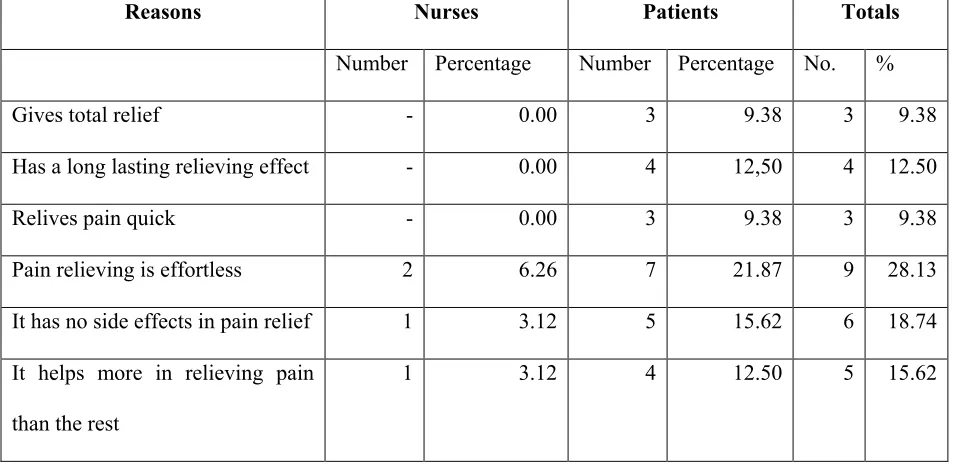
Table 4 Reasons for preferred method
Reasons Nurses Patients Totals
Number Percentage Number Percentage No. %
Gives total relief - 0.00 3 9.38 3 9.38
Has a long lasting relieving effect - 0.00 4 12,50 4 12.50
Relives pain quick - 0.00 3 9.38 3 9.38
Pain relieving is effortless 2 6.26 7 21.87 9 28.13
It has no side effects in pain relief 1 3.12 5 15.62 6 18.74
It helps more in relieving pain than the rest
It is priceless - 0.00 2 6.25 2 6.25
4 12.50 28 87.50 32 100.00
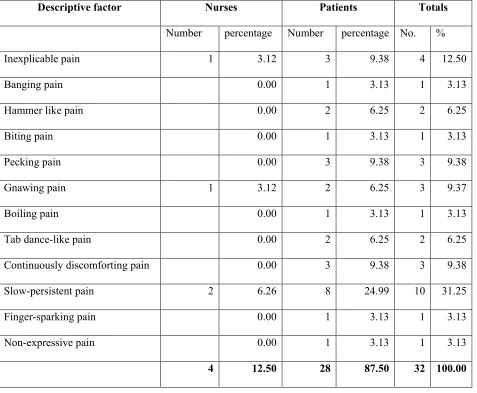
Table 5 Pain descriptively quantified as expressed by respondents
Descriptive factor Nurses Patients Totals
Number percentage Number percentage No. %
Inexplicable pain 1 3.12 3 9.38 4 12.50
Banging pain 0.00 1 3.13 1 3.13
Hammer like pain 0.00 2 6.25 2 6.25
Biting pain 0.00 1 3.13 1 3.13
Pecking pain 0.00 3 9.38 3 9.38
Gnawing pain 1 3.12 2 6.25 3 9.37
Boiling pain 0.00 1 3.13 1 3.13
Tab dance-like pain 0.00 2 6.25 2 6.25
Continuously discomforting pain 0.00 3 9.38 3 9.38
Slow-persistent pain 2 6.26 8 24.99 10 31.25
Finger-sparking pain 0.00 1 3.13 1 3.13
Non-expressive pain 0.00 1 3.13 1 3.13
4 12.50 28 87.50 32 100.00
Table 6 Essence of complementary methods for pain relief in modern nursing practice
Number percentage Number percentage No. %
Extremely essential 2 6.26 10 31.25 12 37.51
Very essential 0.00 11 34.37 11 34.37
Essential 1 3.12 2 6.25 3 9.37
May be incorporated 1 3.12 5 15.63 6 18.75
Not essential 0.00 0 0.00 0.00
Do not know 0.00 0 0.00 0.00
4 12.50 28 87.50 32 100.00
In-depth interview guide
1. How would you describe the pain?
Respondent 1The pain is unbearable. I am unable to point exactly where it is at the moment. I do not think
I can ever overcome this. What is this that I am going
through? (A patient in the Neurology ward, TTH,
2017)
Respondent 2I cannot describe this pain. It is like a hammer or should I say a heavy object that is being
used perpetually on me. Please, help me with some
medicine to at least reduce it a little bit (A patient at
Male Surgical Ward, TTH, 2017)
2. What methods are you using to relief the pain?
Respondent 1They give me some medicines to take by mouth and others they inject me with. Sometimes
the nurses ask me to take deep breaths and
concentrate on something else, like my job without
thinking too much about the pain. They often engage
me in a conversation. Even though the pain will be
there when they are around and we are chatting, I
feel less of the pain than when they are not around
me. Yesterday, I just had to call the nurse in the
afternoon to sit by me for us to chat. I realize that the
chatting method and the advice I receive from the
nurses have been very helpful (A patient from the
Respondent 2Mostly I was giving a body massage and asked to sit in a tilting position on the bed. This
was extremely helpful in relieving the pain.
Occasionally, the nurses give me some pills to take
when the intensity of the pain increases so much (A patient from the Orthopaedic Ward of TTH, 2017)
3. Why do you use those methods?
Respondent 1 Because the body massages, the positioning and all these methods relief my pain
gradually and makes me able to relax a little longer.
Even though they do not completely eradicate the
pain, I get relief for a longer period. I am really
grateful for the support I receive from the nurses (A
patient from the Medical Ward of TTH, 2017)
Respondent 2My brother, the massage is a wonderful treatment. I tell you, I have never
conceived that anything else other than medication
could give me any relief of pain. I am impressed! It
works like magic. I shall continue to do same at home
if I am advised to do so by the nurses (A patient from
the Orthopaedic Ward of TTH, 2017).
Discussion
Essence of pain relief method according to aim variable
than an abrupt stoppage of pain in modern nursing practice.
Expectation for pain relief
In employing a pain relief method, 40.42% of respondents expected that their pain should subside enough such that they could relax and socialise without much difficulty. However, 34.38% of them expected a complete relief of their pain, while 25% of respondents expected that the method employed would reduce their pain significantly to allay their fears of the pain increasing. Pain is unwanted and socially disabling phenomenon. It therefore comes along with fears and anxiety as whether the pain would enable the sufferer to eat well, exercise routine activities and even socialise with others, for instance. These thoughts naturally provoke a need for pain occurrence reduction in intensity.Literature has it (Wall, in Seers, 1999), that though pain signals a need for recovery, it equally indicates the need for something to be done to achieve recovery, thus the demand for a relieving method that will minimise or eradicate it.
Types of pain relief method preferred
Pain experience comes along with desperation and several attempts are employed by both clients and caregivers to relief it. A total of 65.63% of the respondents preferred medication as the fastest mode for pain relief as against 21.87%. Though medicine intake (morphine, heroin, etc.) for pain relief, tends to have a low sustained action and the patient has to continuously use same to feel short term pain relief they preferred more to others.
Respondent 1They give me some medicines to take by mouth and others they inject me with. Sometimes
the nurses ask me to take deep breaths and
concentrate on something else, like my job without
thinking too much about the pain. They often engage
me in a conversation. Even though the pain will be
there when they are around and we are chatting, I
feel less of the pain than when they are not around
me. Yesterday, I just had to call the nurse in the
afternoon to sit by me for us to chat. I realize that the
chatting method and the advice I receive from the
nurses have been very helpful (A patient from the
Medical Ward of TTH, 2017)
demonstrated in the verbal expressions above by the respondent from the medical ward of TTH. The relief of pain has no definite way. It is the way that best relieves pain and allows the patient to endure and socialize with little difficulty. For instance, the patient in the above findings strongly stated that “Even though the pain will be there when they are around and we are chatting, I feel less of the pain
than when they are not around me.” This statement
strongly confirms the power of complementary methods available to the nurse without prescription from anyone else to bring relief to patients in pain. Besides, it points to the fact that patients are much aware of which methods are useful for their pain relief as compared to what are routinely available like medication and strict compliance of uptake of mirage of instructions and care aimed at pain relief. Indeed, nurses have a role in this and a function that they have control over as instinctive care givers in the healthcare fraternity.
Reasons for preferred method
On why some of the patients preferred the complementary pain relief method more, these are
Respondent 1Because the body massages, the positioning and all these methods relief my pain
gradually and makes me able to relax a little longer.
Even though they do not completely eradicate the
pain, I get relief for a longer period. I am really
grateful for the support I receive from the nurses (A
patient from the Medical Ward of TTH, 2017)
Respondent 2My brother, the massage is a wonderful treatment. I tell you, I have never
conceived that anything else other than medication
could give me any relief of pain. I am impressed! It
works like magic. I shall continue to do same at home
if I am advised to do so by the nurses (A patient from
the Orthopaedic Ward of TTH, 2017).
Patients have build-up experience on how, where and what the pain they go through is and can be relieved. Accordingly, respecting the patients‟ preferences in pain relief must be an un-debatable option by nurses in their care of patients suffering from pain.
Pain descriptive quantification variable as expressed by respondents
they had already mentioned. In analyzing the responses from qualitative perspectives, the study picked two most prominent overarching themes identified as unbearable and indescribable among patients. Among patients, the four most prevalent descriptive themes identified from the analysis as causing intense, indescribable or unbearable pain are slow-persistent pain (31.25%), inexplicable pain (12.50%), pecking and continuously discomforting pain (9.38% each) and hammer-like pain (6.25%). These descriptive themes signify the level of pain experienced by patients and how they perceive the pain signals. This calls to mind McCaffery‟s (1975)
definition of pain as “whatever the experiencing
person says it is, whenever he says it does”. It is
only the patient who can best describe how
he/she feels about pain better than anyone else
can say.
Essence of complementary methods for pain relief in modern nursing practice
Complementary pain relief methods are extremely essential in modern nursing. Majority of respondents
(37.51%) with 31.25% of them being the patients or the beneficiaries intimated that complementary methods of various kinds are of extreme essence in modern nursing practice. While a good percentage (18.75%) are of the opinion that both complementary and other orthodox approaches (namely medical and surgical) could be incorporated in pain management, it is worth noting that majority of patients (81.25%) see complementary approaches in patient pain relief to be essential components in nursing practice in contemporary times. One thing is clear from the findings; that no one saw complementary methods for pain relief not to be an essential approach in modern nursing practice. The use of simple and effortless complementary methods such as chatting with patients in pain have been overlooked by many a nurse as they become overwhelmed by their routine nursing duties. This is a point that nursing educators and supervisors ought to pay attention to and encourage nurses to make good use of in their daily activities at work for patients in pain, in particular.
Recommendations
means of making use of both medical and non-medical methods for pain relief as a key functional activity
Pain relief methods have differences in both technique and effect and must be employed differently by nurses and other caregivers in relieving patients‟ pain. For instance, the use of medication and simple methods like bedside chatting with patient can relief patient pain, but the approach and effect in use are not the same. Nurses must take note and enlist the cumulative experiences of patients‟ preferences in reliving their pain.
Nurses and other healthcare givers may be educated on the relation of complementary pain relief and other methods in modern nursing advance practice as an essential approach in pain relief other than the use of medication or surgery as the case may be.
Conclusion
Pain relief methods are both medical and non-medical in approach. Nurses and health professionals have employed both methods in relieving pain of patients in Ghana. However, there is a difference in the
utilisation of medical and non-medical methods for pain relief for patients having pain.
There is a difference in the effect on patient pain relief between complementary pain relief method and other methods. The study has concluded from its findings that pain relief methods differ in both technique and effect on patients having pain. In order to support patients relieve their pain, there is need for nurses and other healthcare givers to use different approaches as may be tolerable by the patients to achieve the desired effect.
In sum, complementary pain relief methods are very essential in the supportive care of patients in pain and should be a core learning and practice model in nursing in Ghana.
Acknowledge of Source of Funding if any for
the Research work
The authors wish to state that they have not
received any funding of any sort from any
organisation or person (s) in so far as this
manuscript is concerned.
References
[1] Asubonteng, P., McCleary, K.J. & Swan, J.E. (1996). "SERVQUAL revisited: a critical review of service quality", The Journal of Services Marketing, Vol. 10 No.6, pp. 62-81.
[2]
Bowers, D., House, A. & Owens, D.H.
(2011).
Getting Started in Health Research. ISBN:978-1-4051-9148-7.BMJ Books
[3]
Bukola, I.M. (2017).The Effectiveness ofDistraction as Procedural Pain Management
Technique in Paediatric Oncology Patients: A
Meta-analysis and Systematic Review.
Journalof Pain and Symptom Management,Volume 54,
Issue 4, Pages 589-600.e1
[4] Landier, W. (2010).Use of Complementary and Alternative Medical Interventions for the Management of Procedure-Related Pain, Anxiety, and Distress in Pediatric Oncology: An Integrative Review.
https://doi.org/10.1016/j.pedn.2010.01.009Get rights
and content
[6] McSweeney, M. (2009). Complementary and Alternative Therapies for Pain. SLE workshop presentaqtion at Surgery Hospital.
https://www.hss.edu/conditions_complementary-alternative-therapies-for-pain.asp
[7] Parasuraman, A., Zeithaml, V.A. & Berry, L.L. (1988). “A conceptual model of service quality and its implications for future study”, Journal of Marketing, Vol. 49 No. 10, pp. 41-50.
[8] Seers, K. (1999). “Pain” in Nursing Practice: Hospital and Home – THE ADULT, edited by M.F.
Alexander, J.N. Fawcett & P.J. Runciman. London. Churchill Livingstone, Harcourt Brace and Company limited, Pgs 615-632
[9] S e e r s K . & C a r r o l l D . ( 1 9 9 8 ) . Relaxation techniques for acute pain management: a systematic review, Journal of Advanced Nursing 27, 466–475
[10] Ware, E. & Snyder, M.K. (1975)."Dimensions of patient's attitudes regarding doctors and medical services", Medical Care, Vol. 26, pp. 669-73.
[11] Youssef, F. N., Nel, D. & Bavaird, T. (1996). “Health care quality in NHS Hospitals”, International Journal of Health Care Quality